📄 Exam Questions & Readable Text Transcript
Full OCR-extracted text of questions, syllabus codes, and exam instructions.
Extracted Content: 2011_Physics_Alevel_mj_paper3
Page 1
Extracted Text
©)Copyright: Zimbabwe Schoo! Examinations Council, J2011.
©ZIMSEC 52011 : {Turn over
Far Petfurmaiice seat
ZIMBABWE SCHOOL EXAMINATIONS COUNCIL
General Certificate of Education Advanced Level
PHYSICS 9188/3
PAPER 3
JUNE 2011 SESSION 50 minutes
Additional materials:
Answer paper
Electronic Calculator and / or Mathematical tables
Ruler (mm)
TIME 50 minutes
INSTRUCTIONS TO CANDIDATES
Write your name, Centre number and candidate number in the spaces provided on the
answer paper/answer booklet.
Answer three questions.
Question 1 is compulsory.
Answer any other two from the remaining questions.
Write your answers on the separate answer paper provided.
If you use more than one sheet of paper, fasten the sheets together.
All working for numerical answers must be shown.
INFORMATION FOR CANDIDATES
The number of marks is given in brackets [] at the end of each question or part question.
You are reminded of the need for good English and clear presentation in your answers.
Candidates are advised to spend 25 minutes on question 1.
This question paper consists of 10 printed pages and 2 blank pages.
---
Page 2
Extracted Text
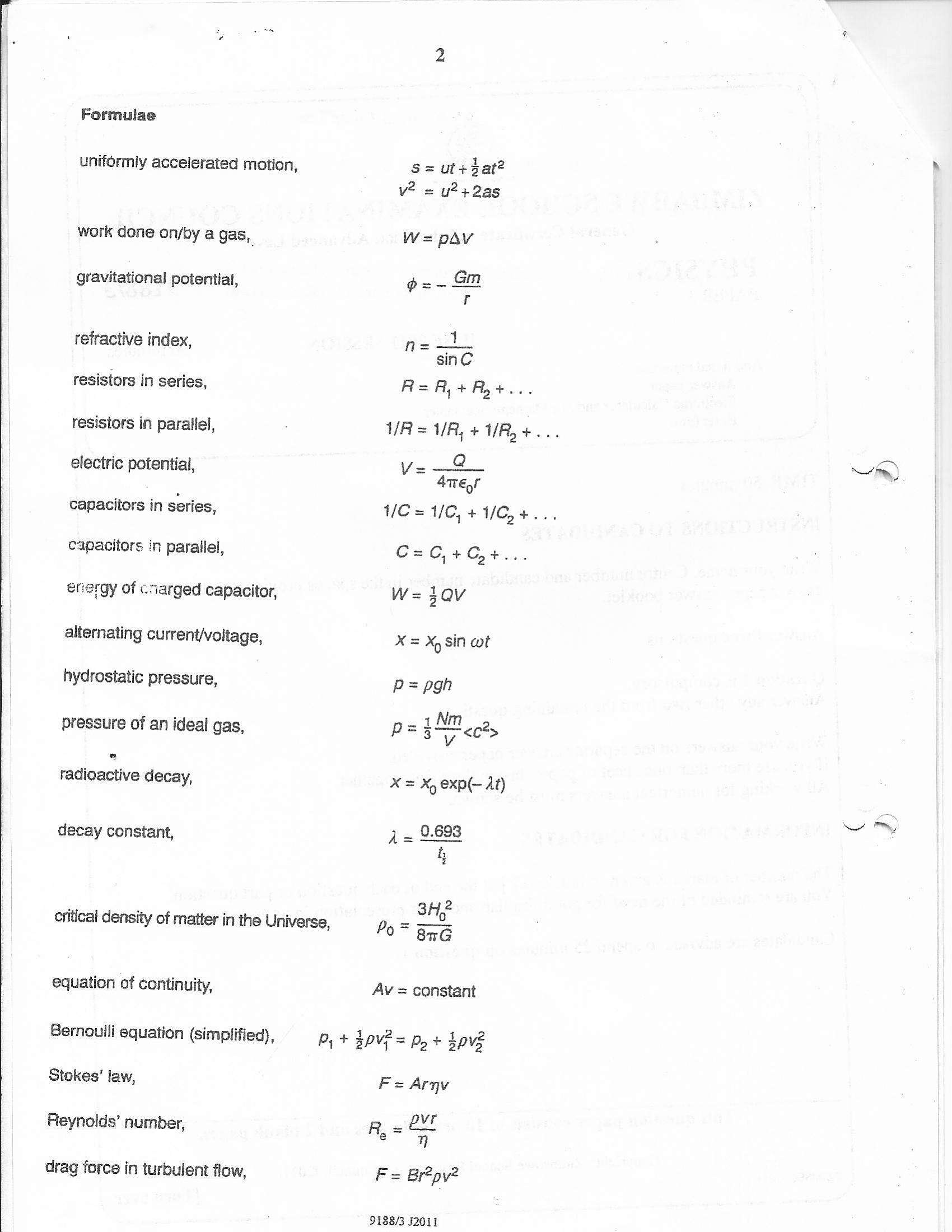
Formulaeuniformly accelerated motion,
work done on/by a gas,
gravitational potential,
refractive index,
resistors in series,
resistors in parallel,
electric potential,
capacitors in series,
capacitors in parallel,
energy of cnarged capacitor,
alternating current/voltage,
hydrostatic pressure,
pressure of an ideal gas,
*
radioactive decay,
decay constant,
critical density of maiter in the Universe,
equation of continuity,
Bernoulli equation (simplified),
Stokes’ law,
Reynolds’ number,
drag force in turbulent flow,
2
$= ut+dat?
v? = y?+2as
W = pav
o=- Gn
r
j
n=—
sinc
R= A, +FAyt. =
WR = 1R, + 1/Ry +...
Q
ater
WC = 1/0, + 0,4...
C=C, # Cy Ficus
W= 3av
X= X)sin wt
P= pgh
p= i Am oes
X= X, exp(- At)
Q = 2.693
= a
3H,2
’0* BG
Av = constant
Py + BOY = Pp + $pvg
F=Arnv
pyr
R, = 7
F = Brpy?
9188/3 J2011
---
Page 3
Extracted Text
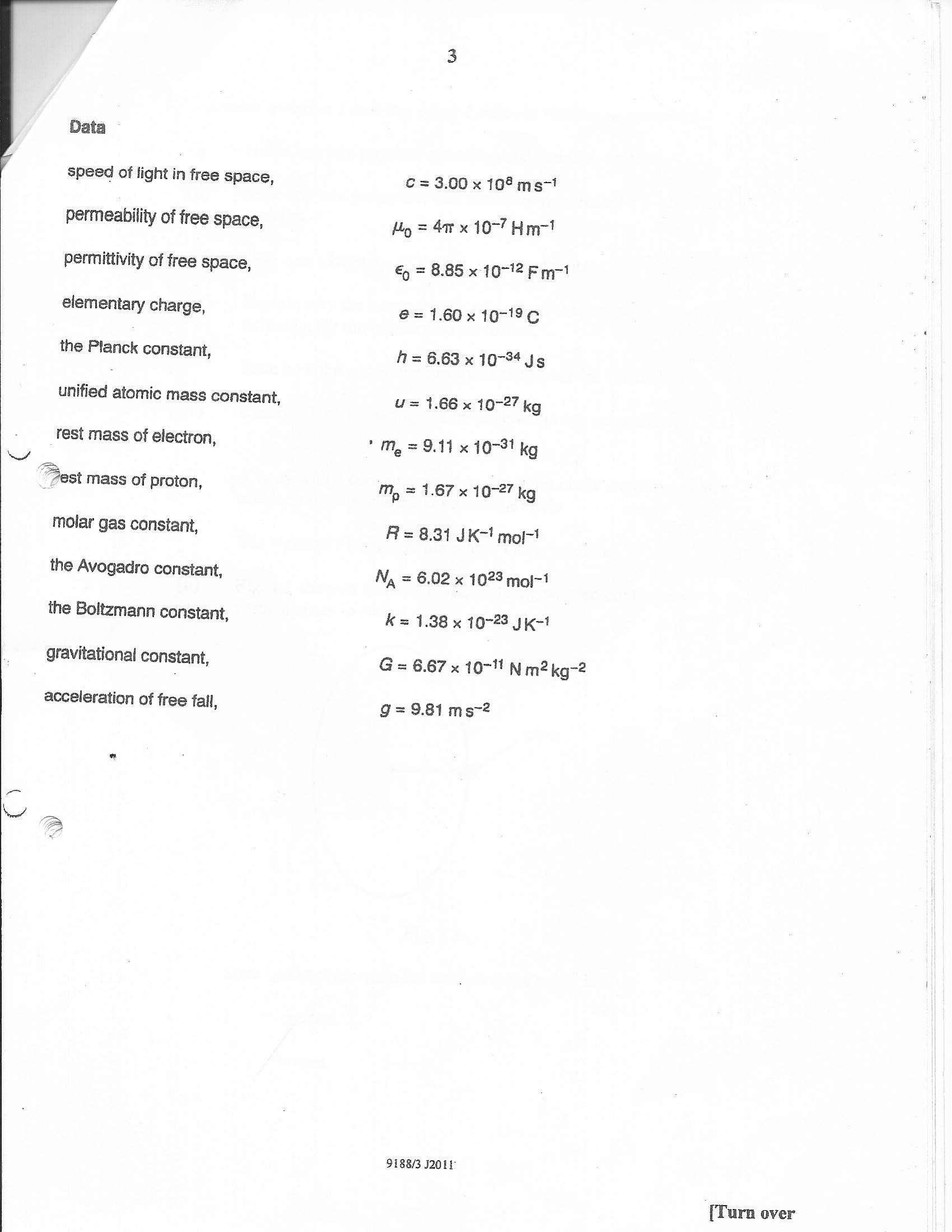
Data speed of light in free Space, permeability of free space, permittivity of free space, elementary charge, the Planck constant, unified atomic mass constant, rest mass of electron,est mass of proton,
molar gas constant,
the Avogadro constant,
the Boltzmann constant,
gravitational constant,
acceleration of free fall,
Cc)
»)
c=3.00x 10⁸ ms-t
My = 4 x 10⁷? Ht
€ = 8.85 x 10712 Fy
@= 1.60x10⁻¹⁹¢
N= 6.63 x 10-94 Js
u= 1.66 x 10⁻²⁷ kg
* M, = 9.11 x 10⁻³¹ kg
M, = 1.67 x 10⁻²⁷ kg
R= 8.31 JK- mol
Ny = 6.02 x 10²³ mol~1
k = 1.38 x 10⁻²³ yK-1
G = 6.67 x 10⁻¹! Nm2kg-2
9 = 9.81 ms-2
9188/3 J201b
[Turn over
---
Page 4
Extracted Text
(a){b)
4
Answer question I and any other 2 from the remaining questions.
@
(ii)
(iif)
(iv)
(¥)
(ii)
Name any two physical quaitities and their S.I. units.
State any two properties that can be used to describe a physical
quantity.
Give one advantage of the S.I. system of units.
Explain why the homogeneity of a physical equation is not
sufficient for the equation to be cotrect.
State how the correctness of the equation can be verified,
Describe how a reading can be precise but not accurate,
[7]
A body with a constant speed in a uniform circle experiences an
acceleration towards the centre of the circle,
Use Newton’s laws to explain how this is possible.
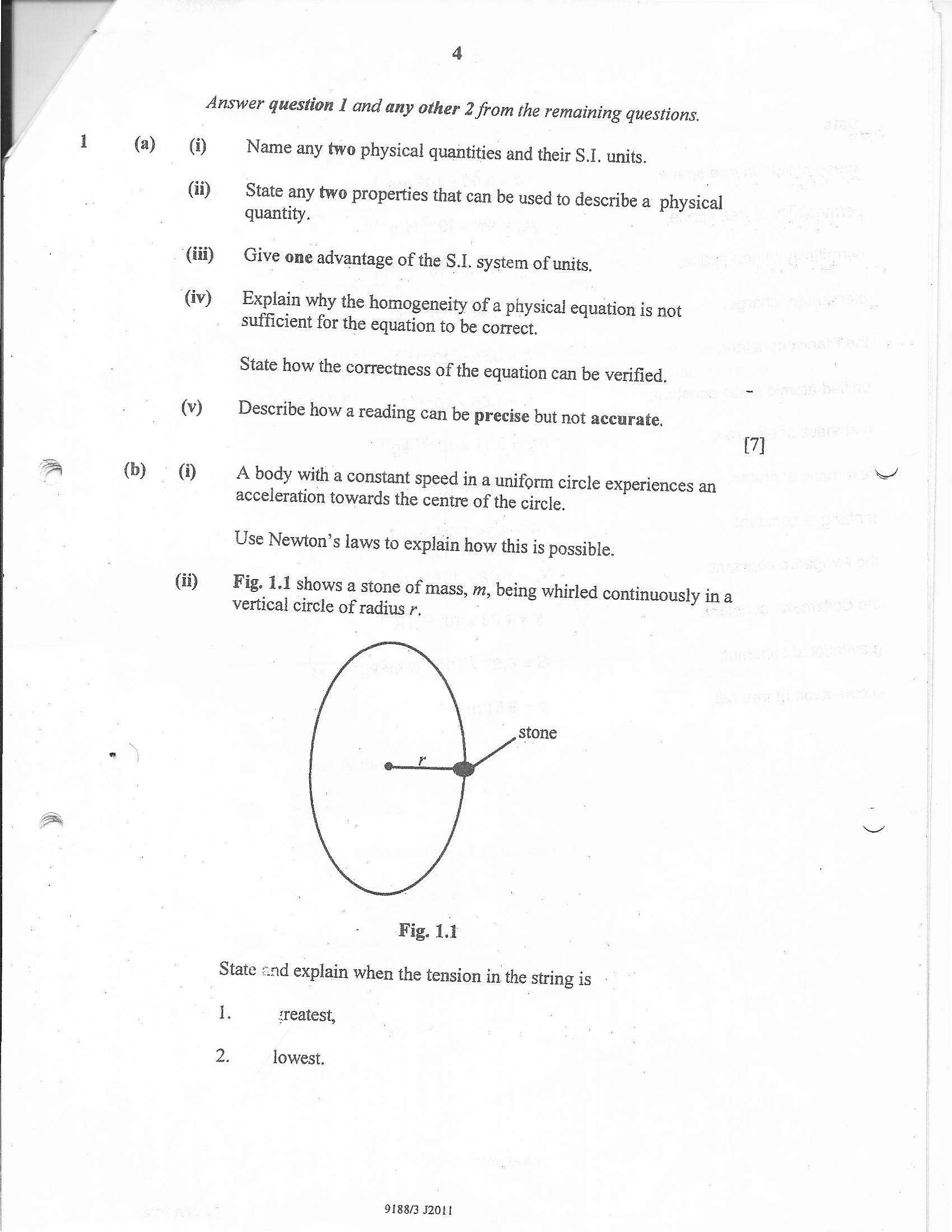
Fig. 1.1 shows a stone of mass, m, being whirled continuously in a
vertical circle of radius r,
stone
Fig. 1.1
State snd explain when the tension in the string is -
Ts sreatest,
2; lowest.
9488/3 J2011
C
---
Page 5
Extracted Text
ci5
A brick falls from the top of a building of height, , above the
ground. Ifthe brick has a mass, m, show that the gain in kinetic
energy AE,, by the time it hits the ground, is given by
_ GMmh
ke R 2
where G is the universal gravitation constant, // is the mass of
the earth and 2 is the radius of the earth.
[7]
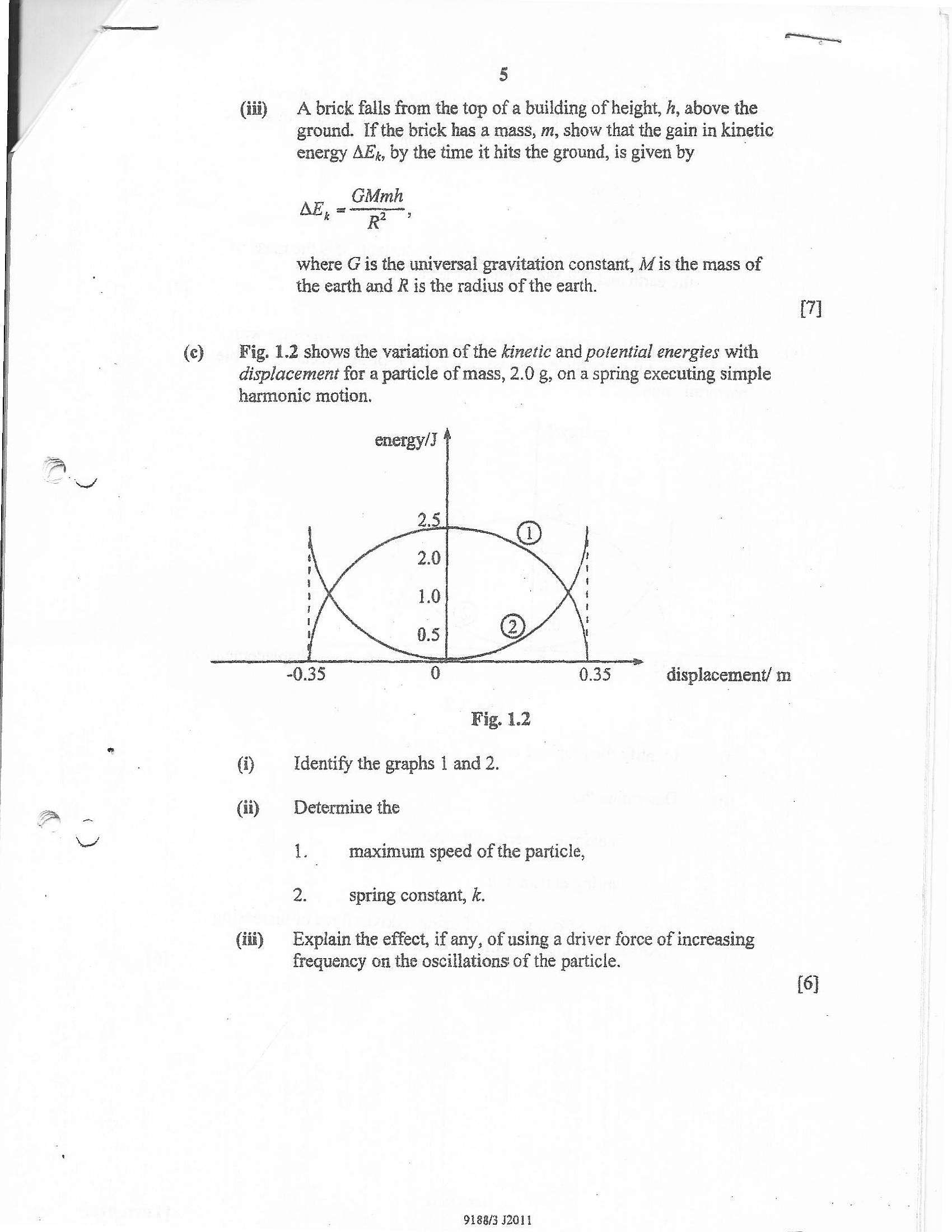
(c} ‘Fig. 1.2 shows the variation of the dinetic and potential energies with
displacement for a particle of mass, 2.0 g, on a spring executing simple
harmonic motion.
energy/J
-0.35 o 0.35 displacement/ m
Fig. 1.2
(i) Identify the graphs 1 and 2.
(ii) Determine the
1. maximum speed of the particle,
2) spring constant, k.
(iii) Explain the effect, if any, of using a driver force of increasing
frequency on the oscillations of the particle. 6
9168/3 J2011
---
Page 6
Extracted Text
6 2 (a) @ Distinguish between damped and forced oscillations.(ii) ——- Describe the effect of damping on resonance.
[4]
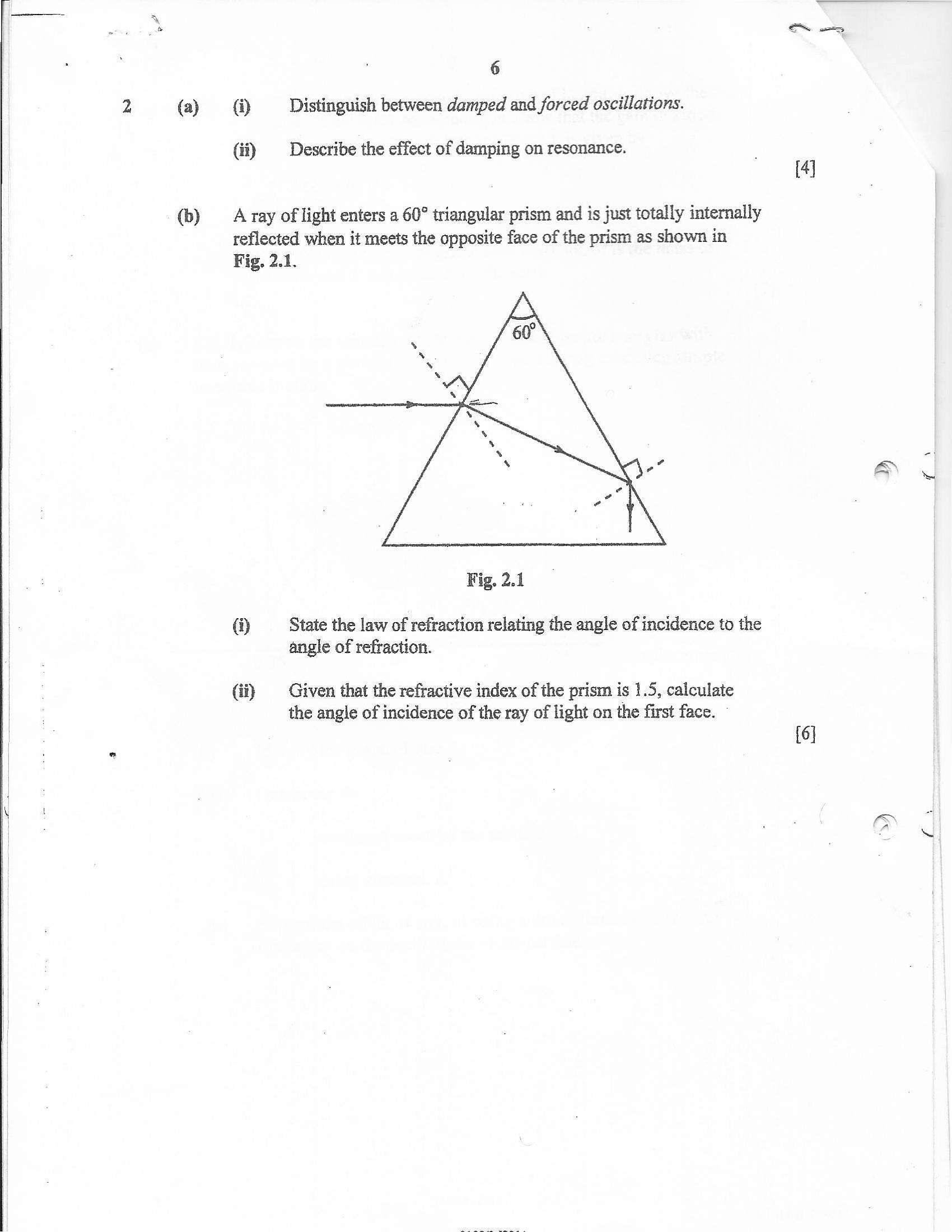
(b) A ray of light enters a 60° triangular prism and is just totally internally
reflected when it meets the opposite face of the prism as shown in
Fig. 2.1.
Fig, 2.1
@ State the law of refraction relating the angle of incidence to the
angle of refraction.
(ii) Given that the refractive index of the prism is 1.5, calculate
the angle of incidence of the ray of light on the first face.
[6]
»
---
Page 7
Extracted Text
all,a
3 (a)
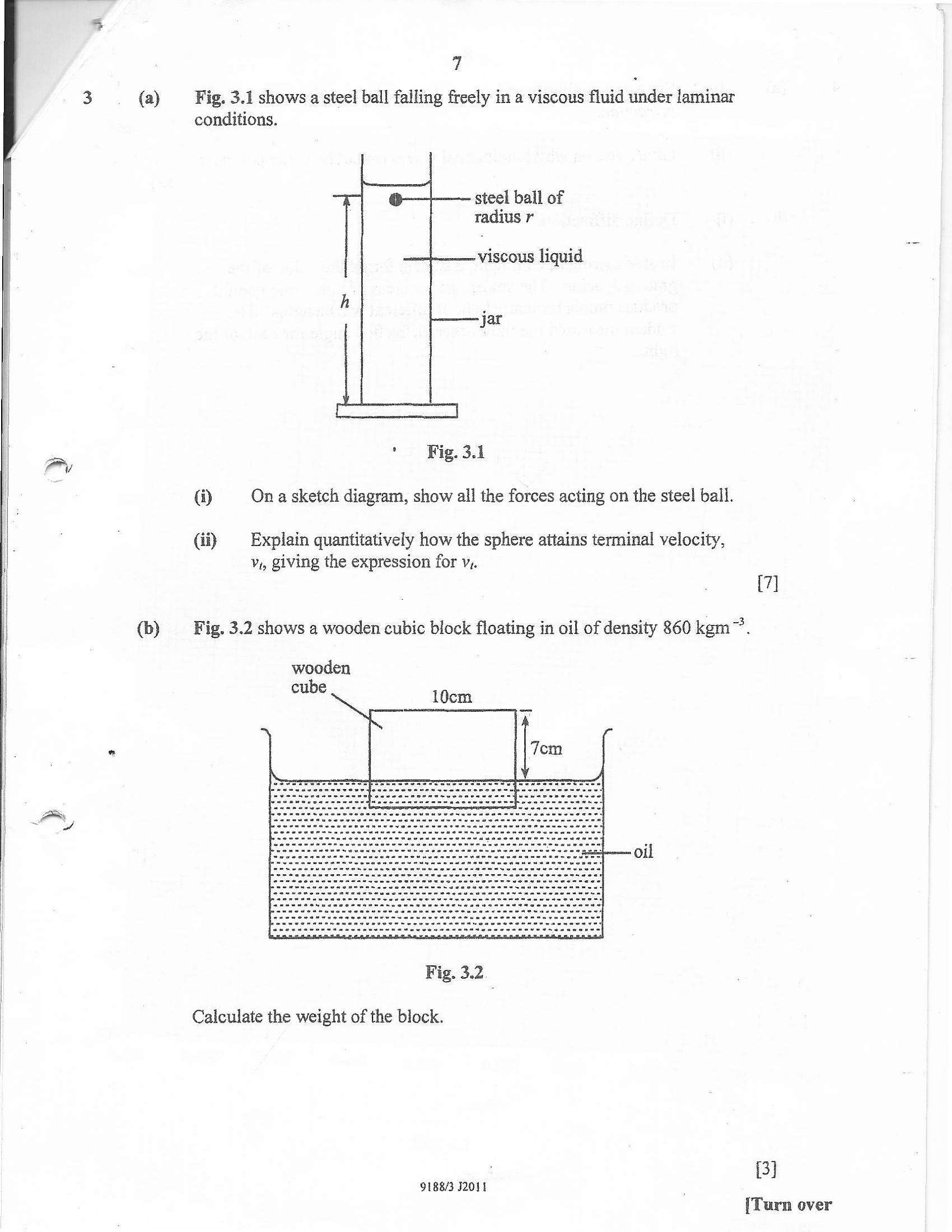
Fig. 3.1 shows a steel ball falling freely in a viscous fluid under laminar
conditions.
steel ball of
radius r
viscous liquid
jar
a, ' Fig. 3.1
@ On a sketch diagram, show all the forces acting on the steel ball.
(ii) —_ Explain quantitatively how the sphere attains terminal velocity,
v, giving the expression for v,.
{7]
(b) Fig. 3.2 shows a wooden cubic block floating in oil of density 860 kgm ~.
wooden
cube 10cm
om
= a
oil
Fig. 3.2
Calculate the weight of the block.
: (3)
9188/3 J2011
{Turn over
---
Page 8
Extracted Text
(a)(b)
8
State one similarity and one difference between reflection and
refraction.
Give a reason why longitudinal waves cannot be plane polarised.
[3]
Define diffraction.
In an experiment with light, a student forgot the value of the
grating spacing. The student had sources of light which could
produce monochromatic light of different wavelengths. The
student measured the third order diffraction angle for each of the
light.
a
9188/3 J2011
---
Page 9
Extracted Text
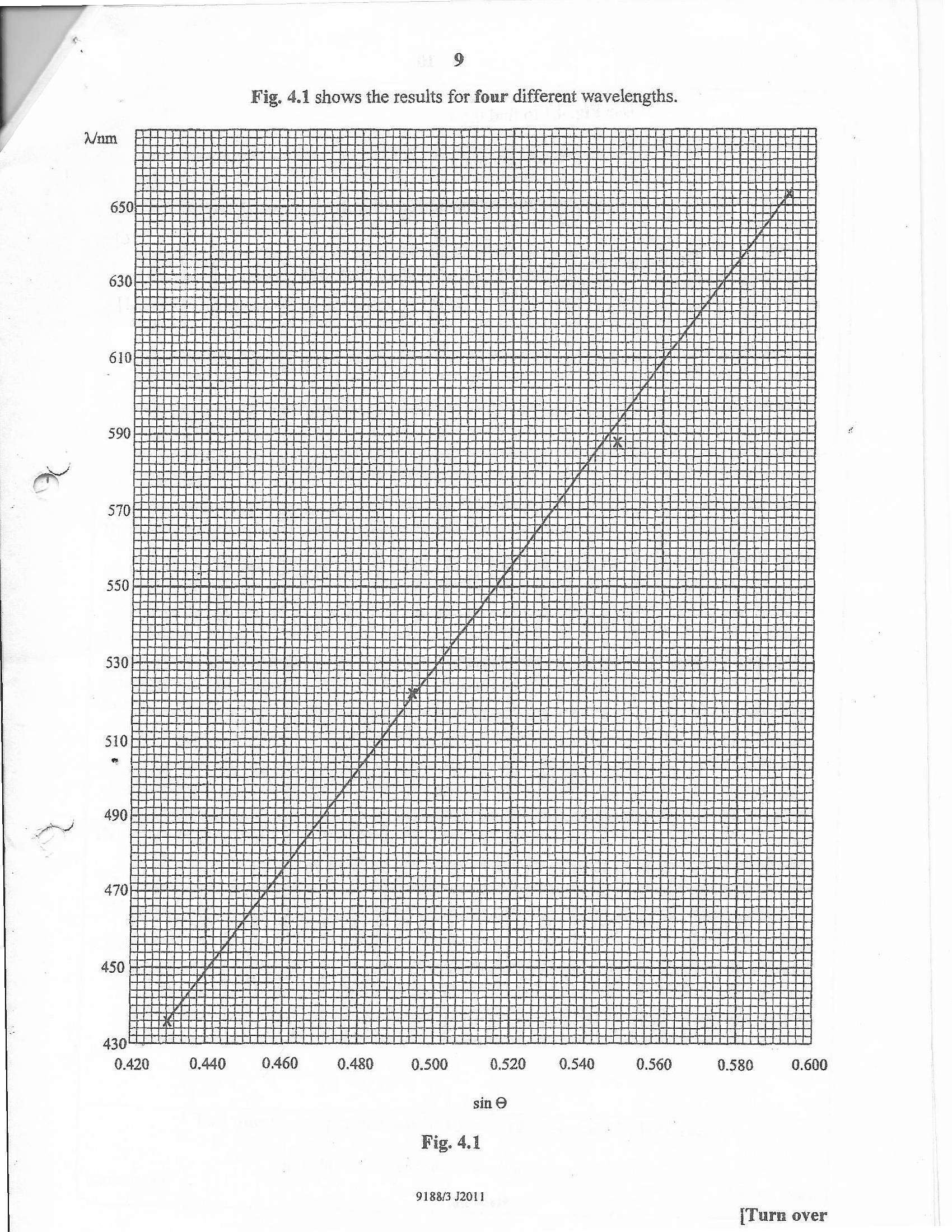
9Fig, 4.1 shows the results for four different wavelengths.
A/om i i f a | r Hl H
iE is HY ia HH i ee) AB i
EP 4 H EEEEEECEEEEEEEH HEE
: H rH SeanErssseerseeuctarerza!
6504 c H rc co ttt t
Soo a
EE Heer FH
630 EEF | |
: : Sree eontentatectantastattcs HH
EH SSHSHETeneTEeeeTenRTEeRTnRITTTRTTTTTE tt |
sloRH 7 precise
EH 4 Cer Ht CI Corr apis oa
CI fo tr rte : + t fee
590 | cet i. Leer
jenn f peor a i
aa im i
sf ro naneae t at Ho
“rs Coe ch
: : He H HH
5704 Tt t tee co t t
Hoe = Ss = fH He
E = Lopes ie
550 im + t i ae rt + t
EEEEE HEY FEECH :
ae +t aig EEE F
FEY H ae HH
530 ! : ret
7 t | TH PEE f
ort | 4 mI crt
E acane must : 4 u rH T } t { EEE
510 Hi | EArt
% it + H HH t Tt H H ae reo H <a cert
HH s { a “HH t Cory
= Basducnsstetetetets +
: ne i HA : + He Ht HEE
r] Coe {
470 EH T rt Lorre PH i i ae een a
c
aa { tr reer ia
CI t ce ro = EE F t
oe pee a
450 + H
4 it i
ites Ssaaetocatteoceaitsstetecsiitoae srerieseessiitte
E on H i ag t ~
4304 HEEH EEE san EHH
0.420 0.440 0.460 0.480 0.500 0.520 0.540 0.560 0.580 0.600
sin ©
Fig. 4.1
9188/3 J2011
[Turn over
---
Page 10
Extracted Text
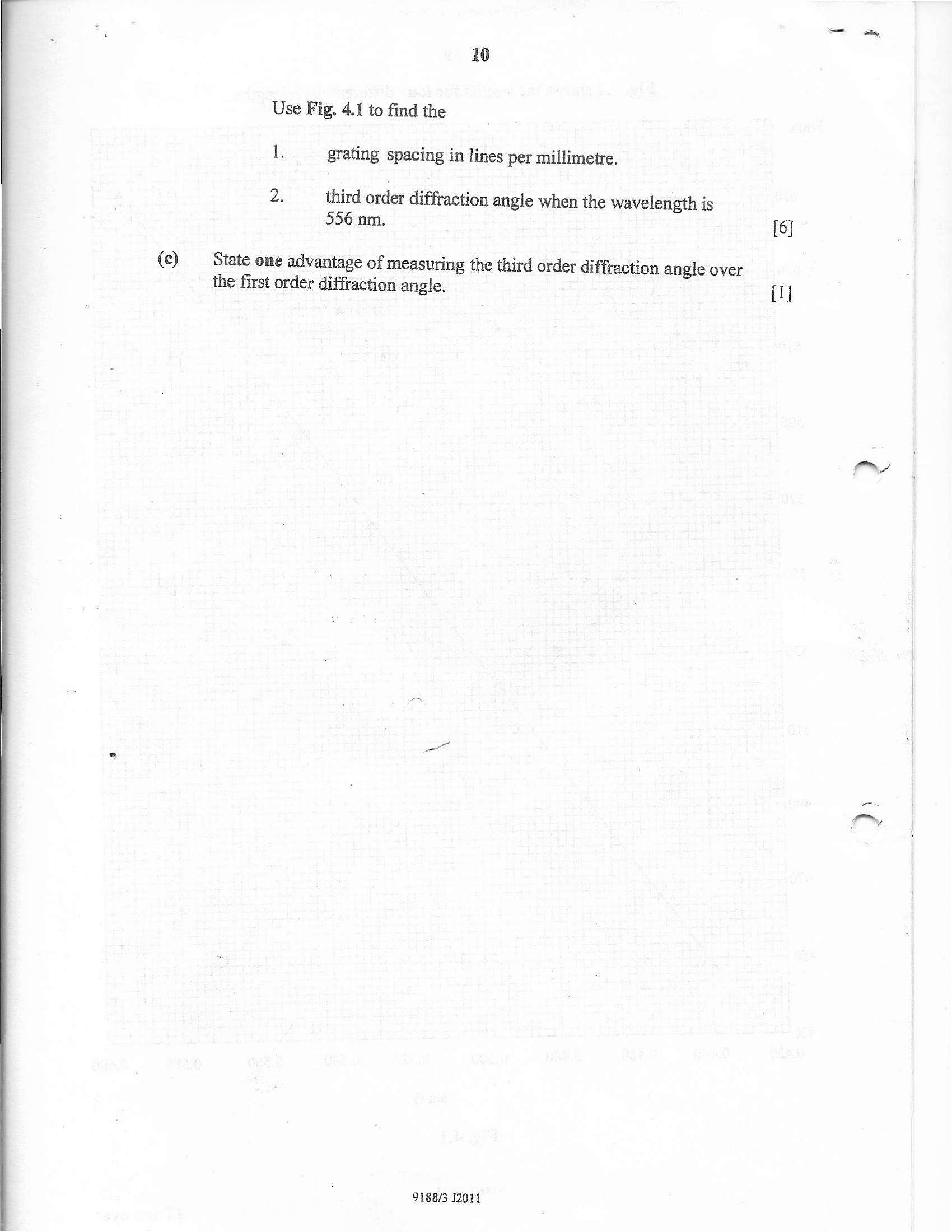
10 Use Fig. 4.1 to find the le grating spacing in lines per millimetre, 2; third order diffraction angle when the wavelength is 556 nm. [6](c) State one advantage of measuring the third order diffraction angle over
the first order diffraction angle. [1]
9188/3 J2011
>
---
Struggling with the concepts in this paper?
Revise syllabus notes, key exam points, and interactive practice questions for Physics: