2024_Combined science_olevel_mj_paper3
Year: 2024 • Views: 1 • Downloads: 2
📄 Exam Questions & Readable Text Transcript
Full OCR-extracted text of questions, syllabus codes, and exam instructions.
Extracted Content: 2024_Combined science_olevel_mj_paper3
Page 1
Extracted Text
Candidate Name Centre Number Candidate NumberMATHS GUARDIOLA +447852954215| ss)
For Performance Measurement
ZIMBABWE SCHOOL EXAMINATIONS COUNCIL
General Certificate of Education Ordinary Level
COMBINED SCIENCE 4003/3
PAPER 3 Practical Test 1 hour 30 minutes
JUNE 2024 SESSION
Candidates answer on the question paper.
Additional materials:
As listed in instructions to Supervisors
Calculator (optional)
INSTRUCTIONS TO CANDIDATES FOR EXAMINER’S USE
Write your name, centre number and candidate number in
the spaces at the top of this page.
Answer both questions.
Write your answers in the spaces provided on the question paper.
Record all experimental results in the spaces provided in the
question paper.
INFORMATION FOR CANDIDATES
The number of marks is given in brackets [ ]
at the end of each question or part question.
This question paper consists of 6 printed pages and 2 blank pages.
Copyright: Zimbabwe School Examinations Council, J2024.
©ZIMSEC J2024 Turn over
LAMAN
---
Page 2
Extracted Text
You are required to determine the amount of the soluble solid in a mixture. You are provided with a mixture of a soluble solid and an insoluble solid. The mixture is labelled S.You are also provided with a beaker labelled B1, a stirring rod, water, measuring
cylinder, filter paper, a filter funnel, access to a balance.
(a) — Measure 20.0 cm’ of water using a measuring cylinder.
Add the water to the beaker, B1.
Measure the mass of B1 plus the water.
Record the mass of B1 plus the water in Table 1.1.
Add the mixture S to the beaker B1.
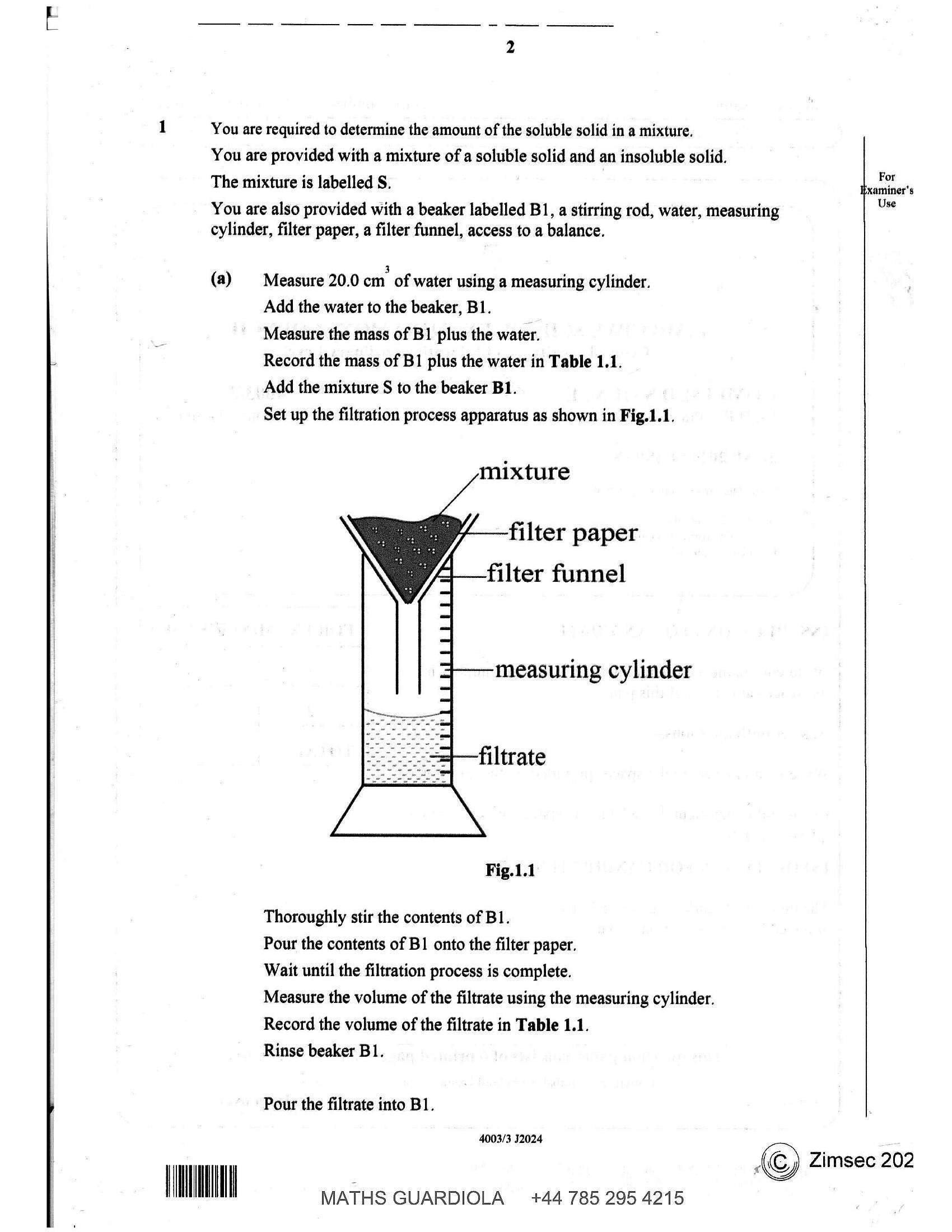
Set up the filtration process apparatus as shown in Fig.1.1.
measuring cylinder
filtrate
Fig.1.1
Thoroughly stir the contents of B1.
Pour the contents of B1 onto the filter paper.
Wait until the filtration process is complete.
Measure the volume of the filtrate using the measuring cylinder.
Record the volume of the filtrate in Table 1.1.
Rinse beaker B1.
Pour the filtrate into B1.
4003/3 J2024
For
Examiner's
Use
< Zimsec 202
MU
MATHS GUARDIOLA _ +44 785 295 4215
---
Page 3
Extracted Text
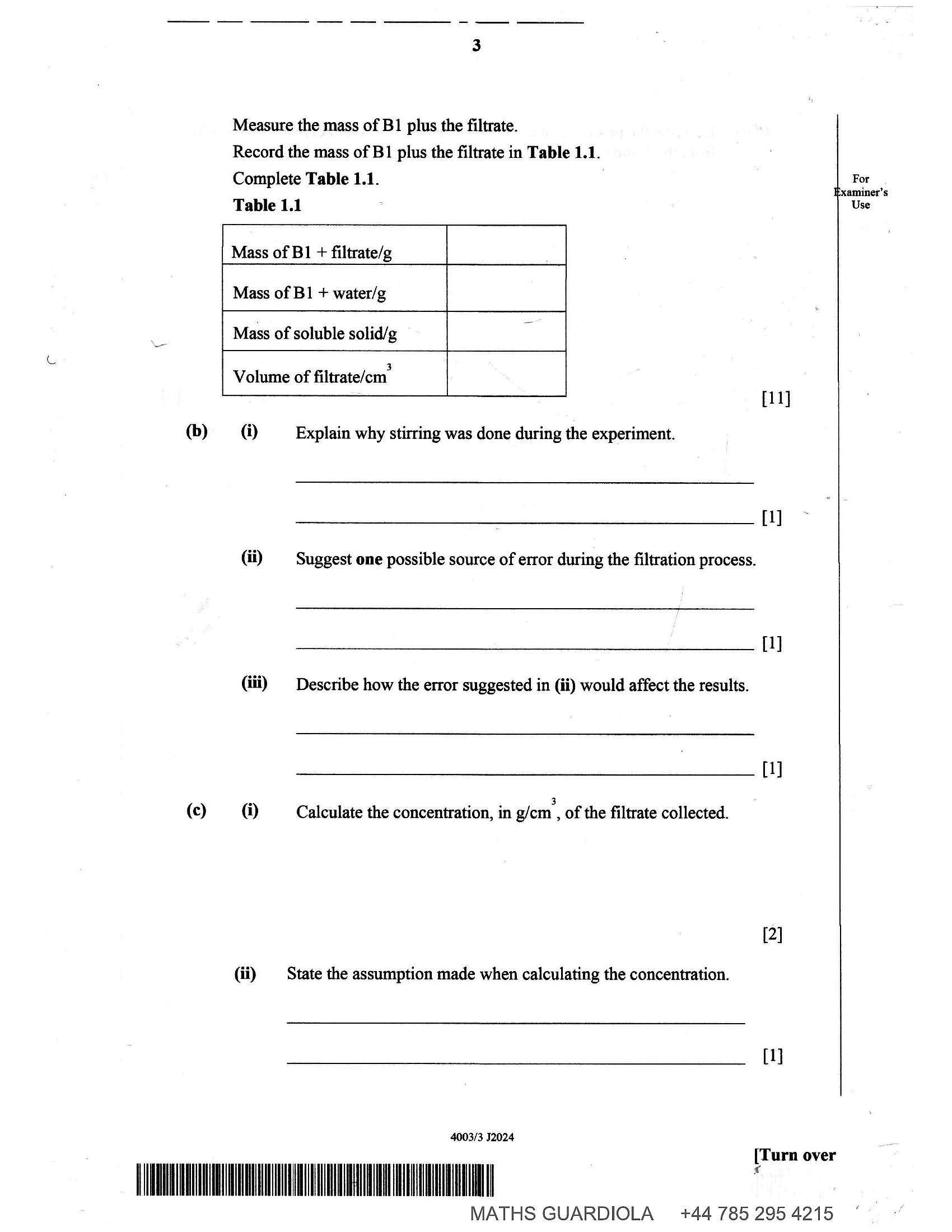
Measure the mass of B1 plus the filtrate.Record the mass of B1 plus the filtrate in Table 1.1.
Complete Table 1.1. For
Table 1.1 Use
Mass of B1 + filtrate/g
Mass of B1 + water/g
Mass of soluble solid/g
Volume of filtrate/om™
(11]
o®) @ Explain why stirring was done during the experiment.
1] ~
(ii) Suggest one possible source of error during the filtration process.
OQ]
(iii) Describe how the error suggested in (ii) would affect the results.
[1]
© Calculate the concentration, in g/cm , of the filtrate collected.
[2]
(ii) —_— State the assumption made when calculating the concentration.
{1}
4003/3 J2024
‘ccc
[Turn over
£
GUARDIOLA +44 785 295 4215 *
---
Page 4
Extracted Text
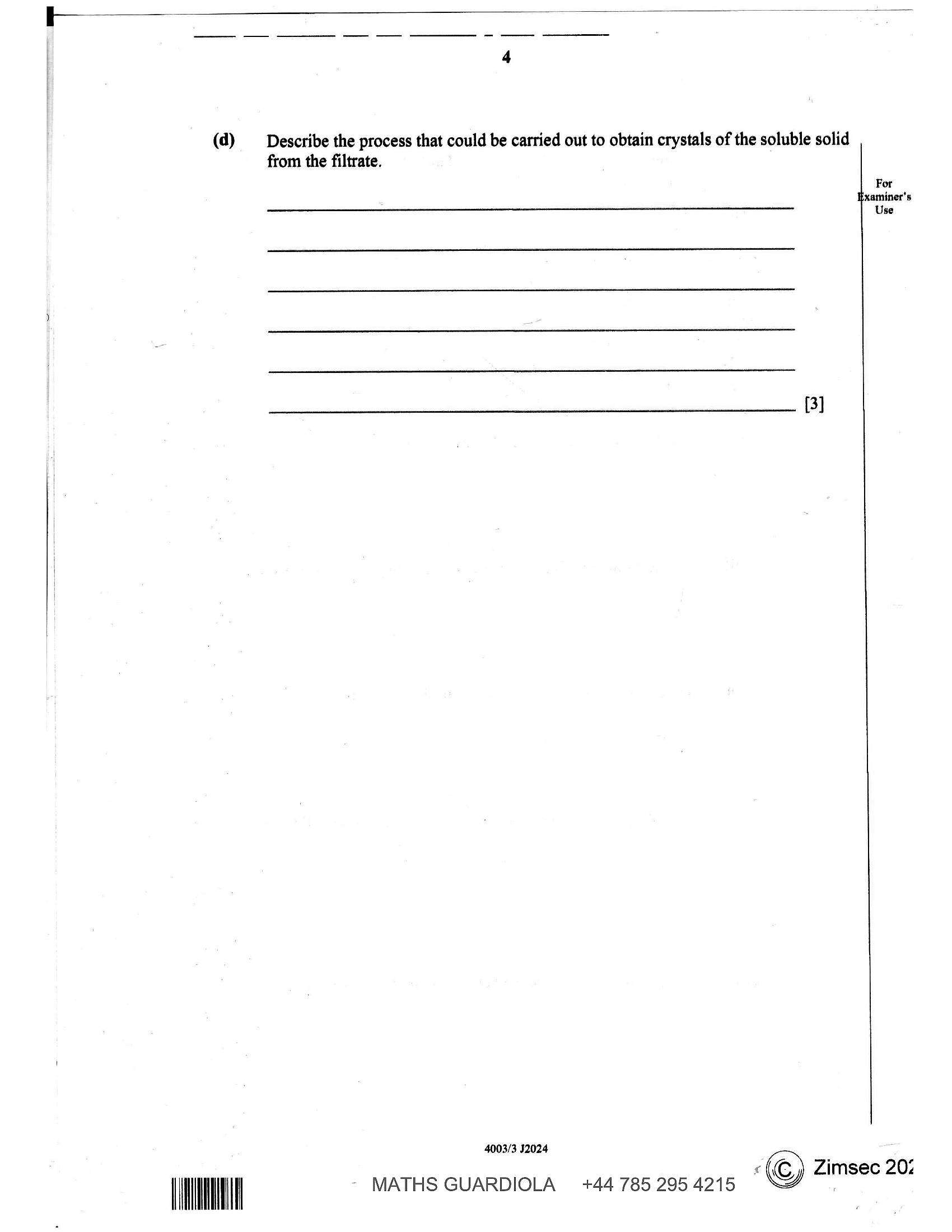
(d) Describe the process that could be carried out to obtain crystals of the soluble solid from the filtrate.For
yaeminer's
Use
[3]
4003/3 32024
(AIAN ~ MATHS GUARDIOLA +44 785 295 4215 ‘ © Zimsec 202
---
Page 5
Extracted Text
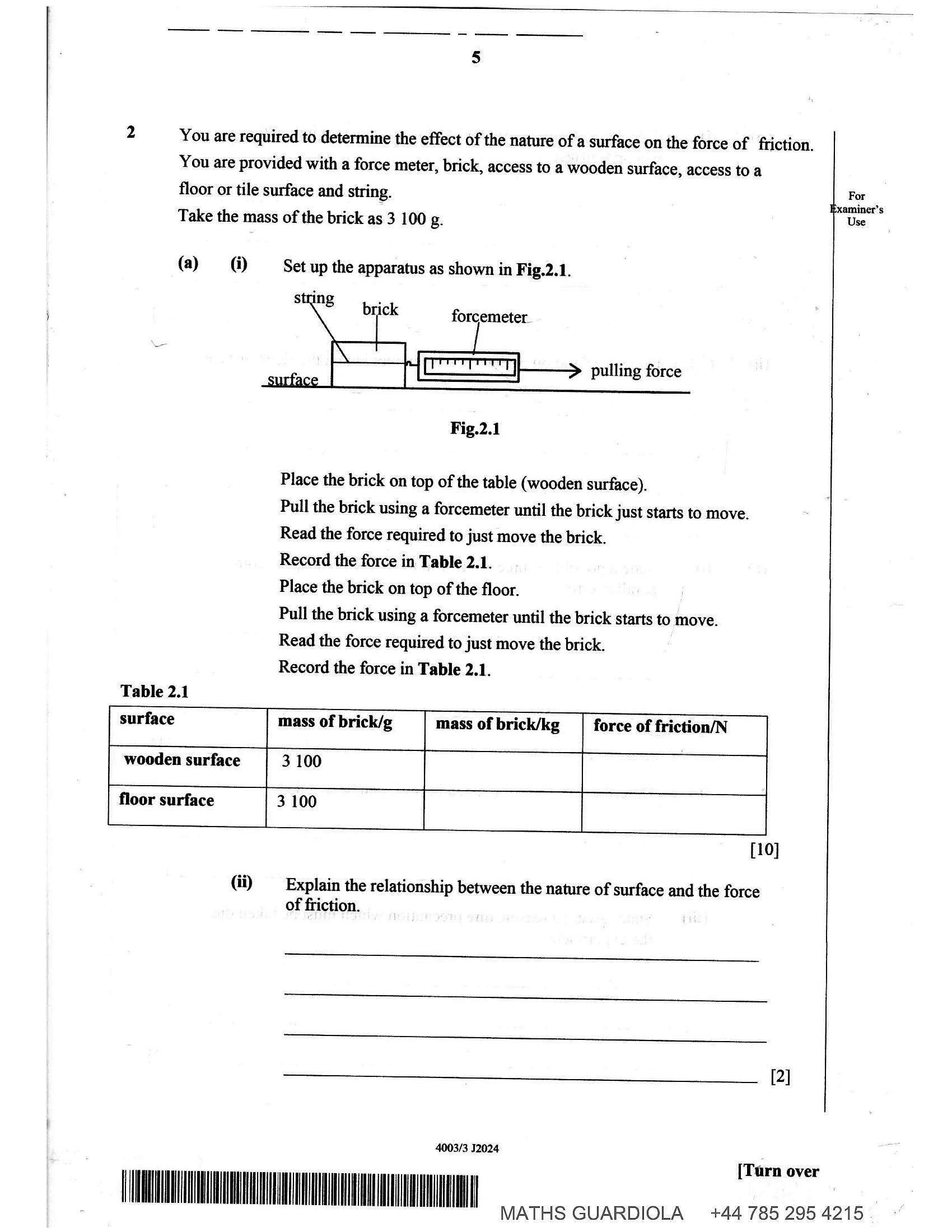
2 You are required to determine the effect of the nature of a surface on the force of friction. You are provided with a force meter, brick, access to a wooden surface, access to afloor or tile surface and string.
Take the mass of the brick as 3 100 g.
(a) @ Set up the apparatus as shown in Fig.2.1.
string F
brick forcemeter
Xo esa
ulling force
tice | PREZ] pulling
Fig.2.1
Place the brick on top of the table (wooden surface).
Pull the brick using a forcemeter until the brick just starts to move.
Read the force required to just move the brick.
Record the force in Table 2.1.
Place the brick on top of the floor.
Pull the brick using a forcemeter until the brick starts to move.
Read the force required to just move the brick.
Record the force in Table 2.1.
Table 2.1
surface mass of brick/g mass of brick/kg force of friction/N
wooden surface 3 100
floor surface | 3 100
[10]
(ii) —_ Explain the relationship between the nature of surface and the force
of friction.
[2]
4003/3 32024
[Turn over
TT
MATHS GUARDIOLA +44 785 295
4215
---
Page 6
Extracted Text
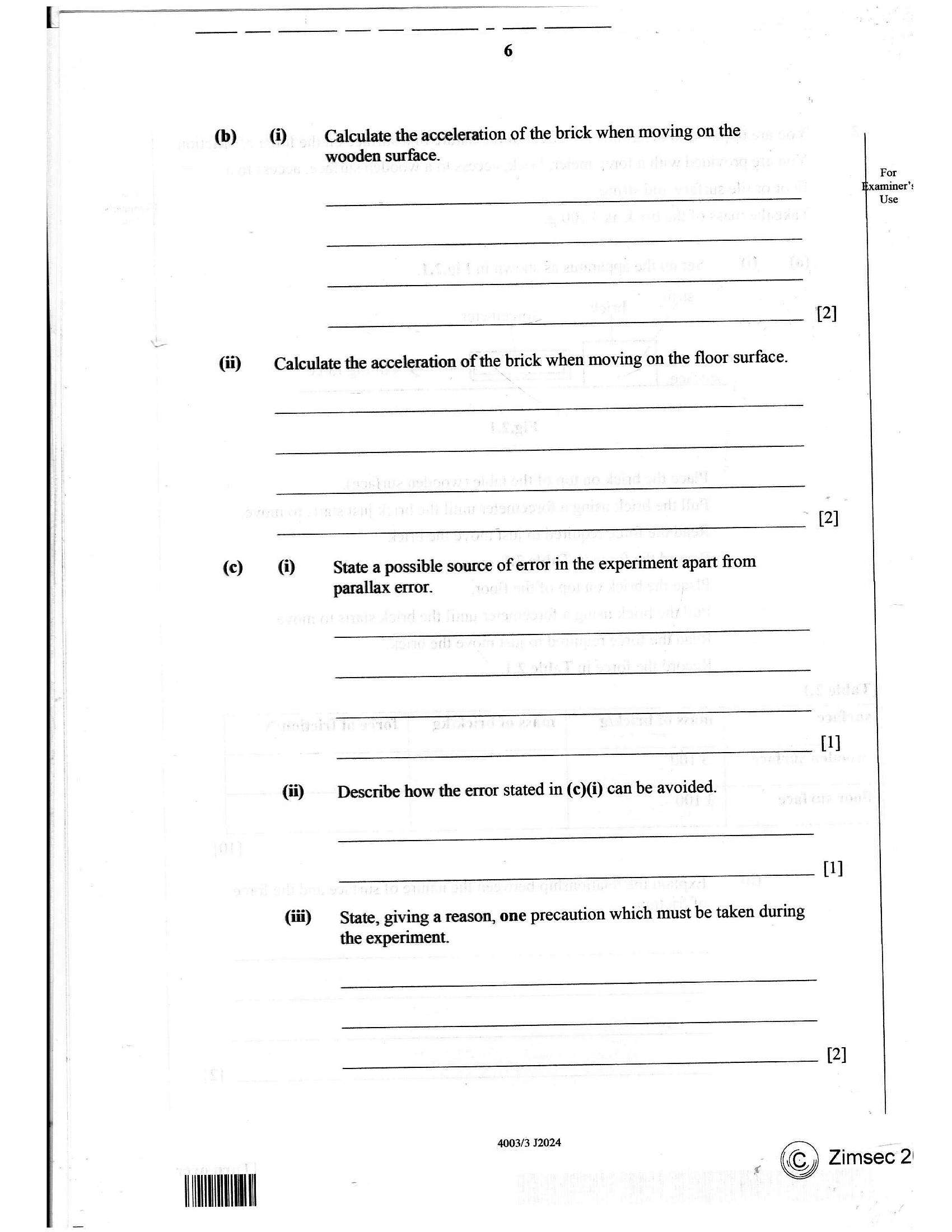
(b) @ Calculate the acceleration of the brick when moving on the wooden surface.[2]
(ii) Calculate the acceleration of the brick when moving on the floor surface.
[2]
(©) @ __ State a possible source of error in the experiment apart from
parallax error.
0]
(ii) _ Describe how the error stated in (c)(i) can be avoided.
(1]
(iii) State, giving a reason, one precaution which must be taken during
the experiment.
[2]
4003/3 J2024
For
Hxaminer’s
Use
WU - © Zimsec2
---
Struggling with the concepts in this paper?
Revise syllabus notes, key exam points, and interactive practice questions for Science Combined: