📄 Exam Questions & Readable Text Transcript
Full OCR-extracted text of questions, syllabus codes, and exam instructions.
Extracted Content: The_Periodic_Table_QP
Page 1
Extracted Text
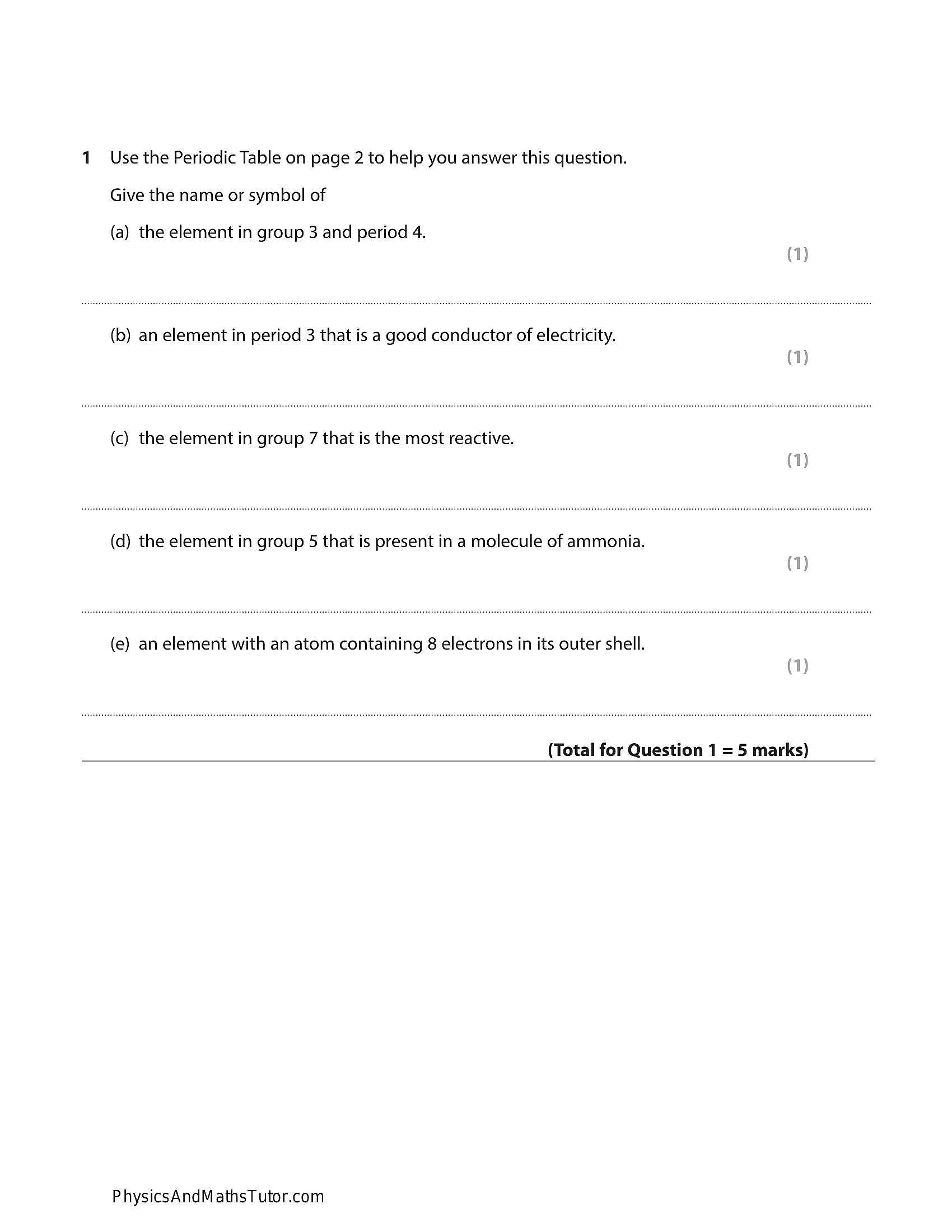
1 Use the Periodic Table on page 2 to help you answer this question. Give the name or symbol of(a) the element in group 3 and period 4.
4)
(b) an element in period 3 that is a good conductor of electricity.
4)
(c) the element in group 7 that is the most reactive.
4)
(d) the element in group 5 that is present in a molecule of ammonia.
4)
(e) an element with an atom containing 8 electrons in its outer shell.
(Total for Question 1 = 5 marks)
PhysicsAndM athsTutor.com
---
Page 2
Extracted Text
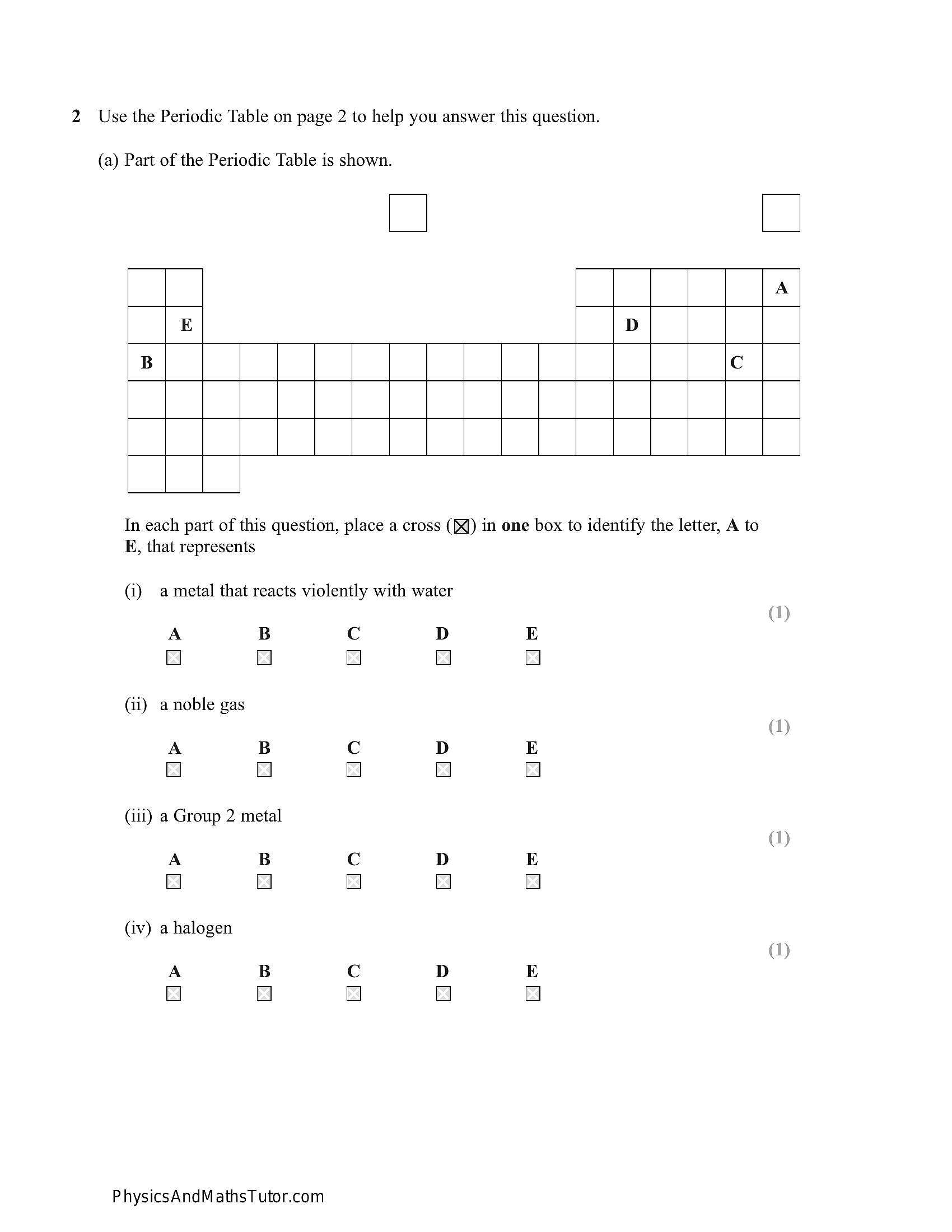
2 Use the Periodic Table on page 2 to help you answer this question.(a) Part of the Periodic Table is shown.
In each part of this question, place a cross () in one box to identify the letter, A to
E, that represents
(i) a metal that reacts violently with water
A B Cc D E
(ii) a noble gas
A B Cc D E
(ii) a Group 2 metal
A B Cc D E
(iv) a halogen
A B Cc D E
PhysicsAndM athsTutor.com
---
Page 3
Extracted Text
(b) Complete these sentences by placing a cross (X) in one box next to the correct answer.(i) The elements in the Periodic Table are arranged in order of increasing
number of neutrons
atomic number
relative atomic mass
mass number
(ii) Elements in the same group in the Periodic Table have the same number of
electrons in the outer shell
protons in the nucleus
neutrons in the nucleus
atoms
(Total for Question 2 6 marks)
PhysicsAndM athsTutor.com
---
Page 4
Extracted Text
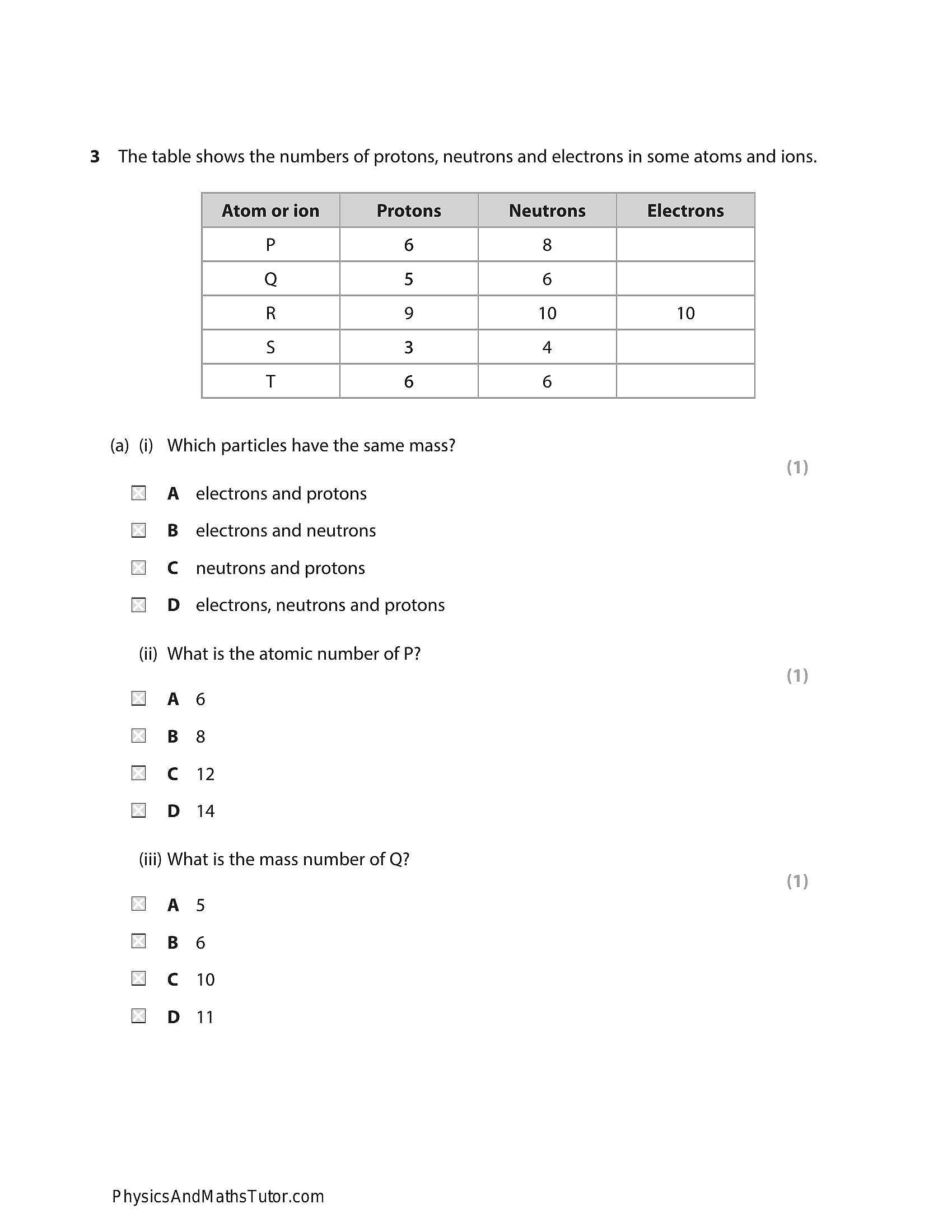
3 The table shows the numbers of protons, neutrons and electrons in some atoms and ions.Atom or ion Protons Neutrons Electrons
P 6 8
Q 5 6
R 9 10 10
) 3 4
T 6 6
(a) (i) Which particles have the same mass?
electrons and protons
electrons and neutrons
neutrons and protons
590 Nn BB >
electrons, neutrons and protons
(ii) What is the atomic number of P?
6
8
12
59 AN BB PF
14
(iii) What is the mass number of Q?
5
6
10
59 AO BB PF
11
PhysicsAndM athsTutor.com
—_
---
Page 5
Extracted Text
(b) Which group of the Periodic Table contains element T?4)
(c) (i) Which two letters represent isotopes of the same element?
4)
cennennnutnnettniieninnasnnasnninneieniinniinniinniiesiieaienntnnitniit BINT oe ecesnnnnnnttnintteetnnentnnsnnitennnninnainnntnaiieniesienisennse
(ii) Which letter represents a positive ion?
4)
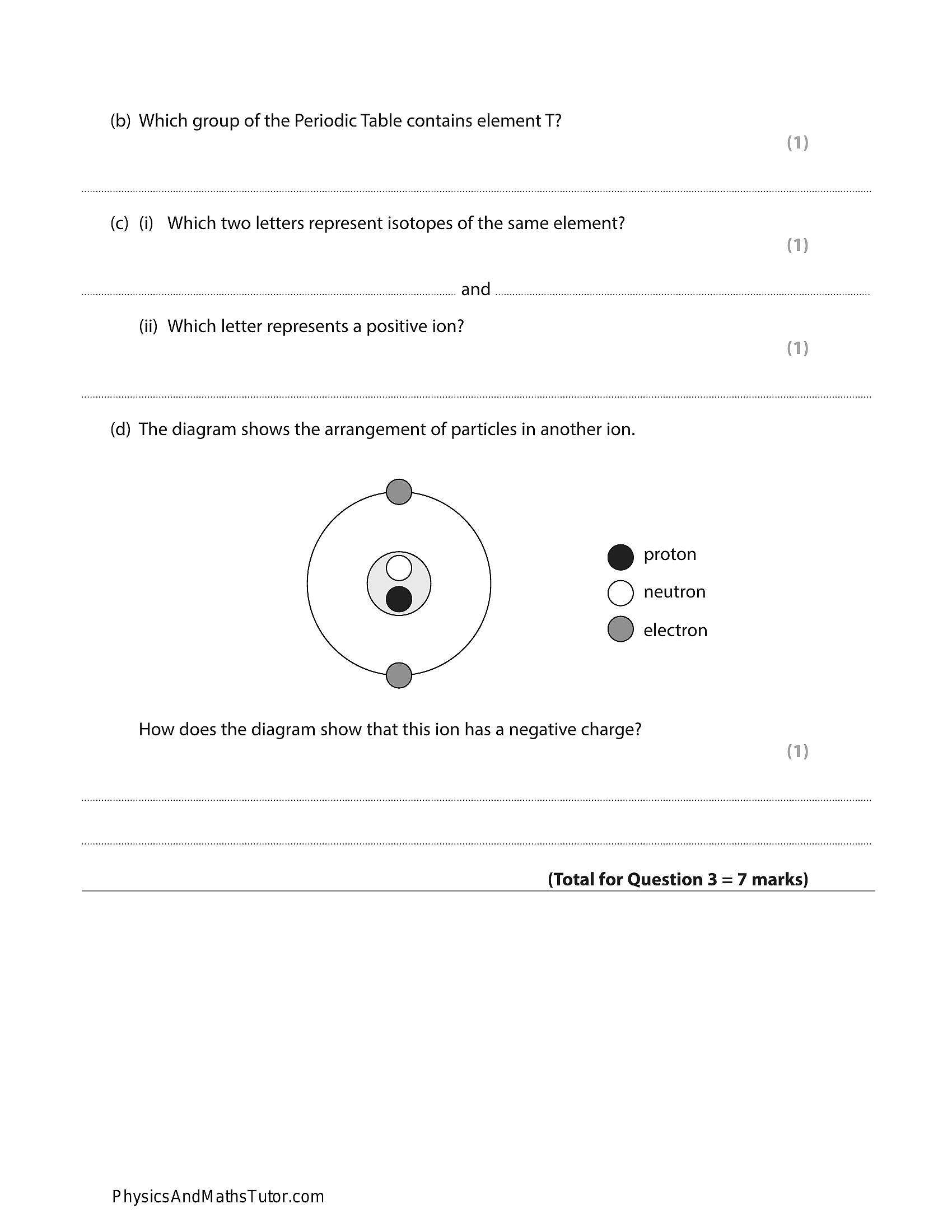
(d) The diagram shows the arrangement of particles in another ion.
e@ proton
@ O neutron
@ electron
How does the diagram show that this ion has a negative charge?
4)
(Total for Question 3 = 7 marks)
PhysicsAndM athsTutor.com
---
Page 6
Extracted Text
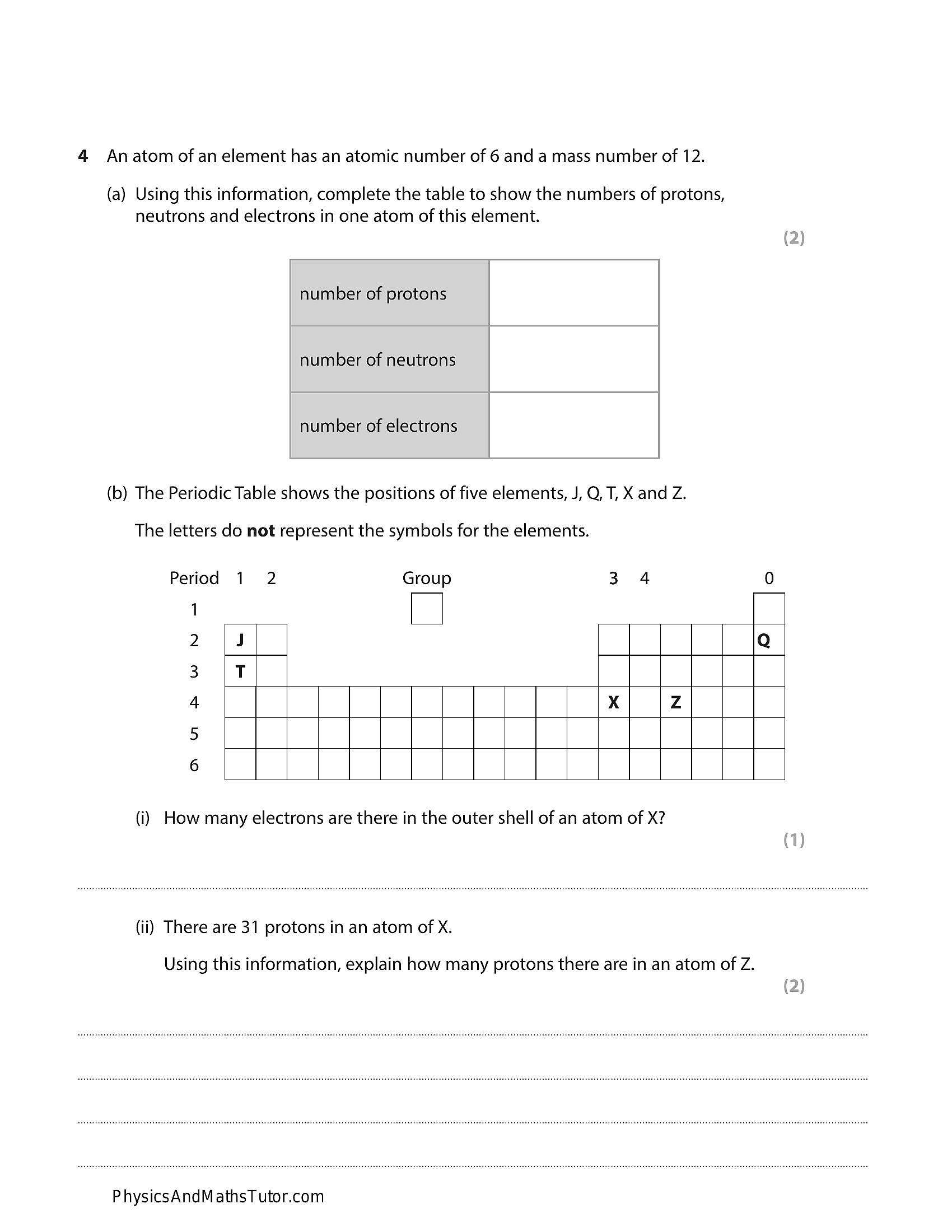
4 Anatom of an element has an atomic number of 6 and a mass number of 12.(a) Using this information, complete the table to show the numbers of protons,
neutrons and electrons in one atom of this element.
number of protons
number of neutrons
number of electrons
(b) The Periodic Table shows the positions of five elements, J, Q, T, X and Z.
The letters do not represent the symbols for the elements.
Period 1 2 Group 3.4 0
1
Anu BwWhN
~<
N
(i) How many electrons are there in the outer shell of an atom of X?
(ii) There are 31 protons in an atom of X.
Using this information, explain how many protons there are in an atom of Z.
PhysicsAndM athsTutor.com
---
Page 7
Extracted Text
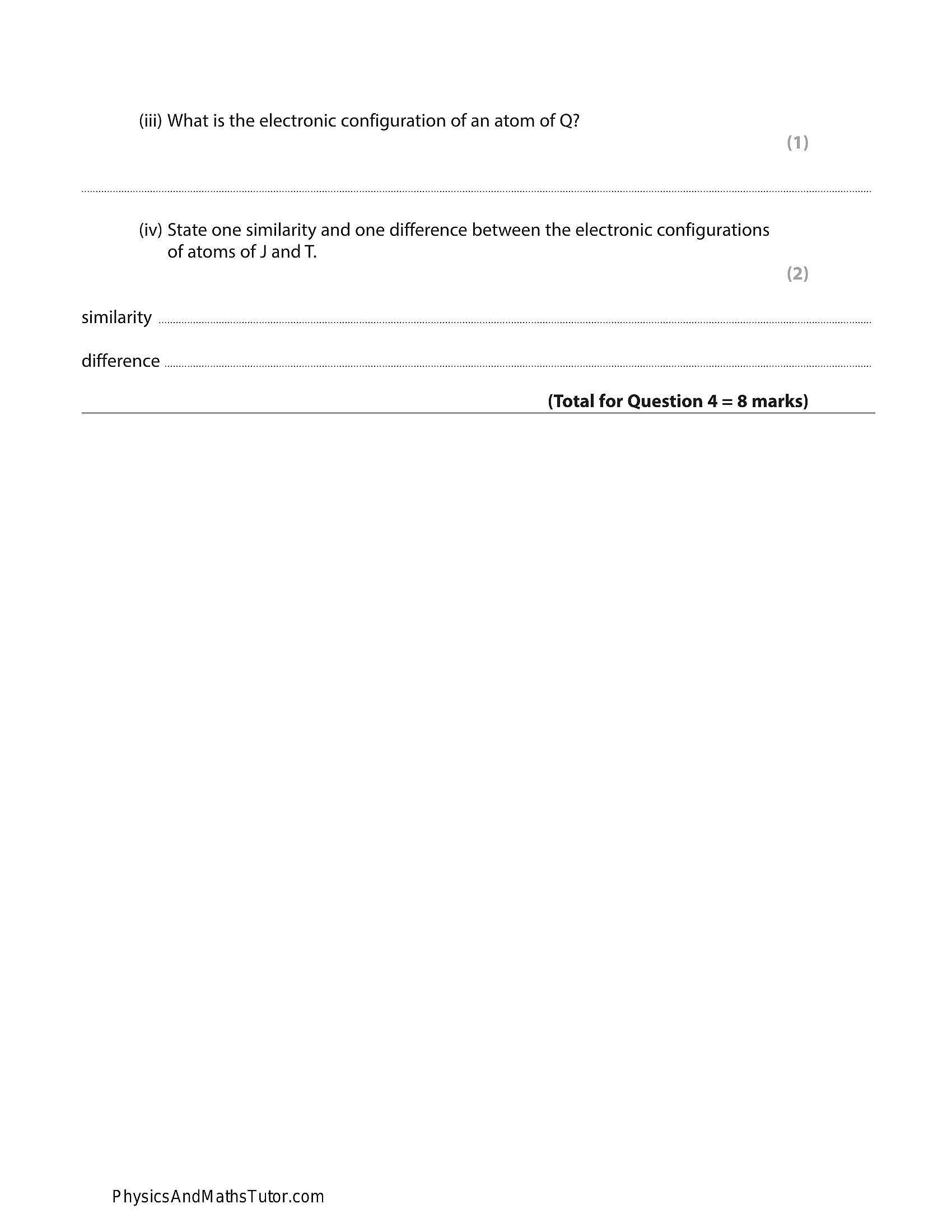
(iii) What is the electronic configuration of an atom of Q?(1)
(iv) State one similarity and one difference between the electronic configurations
of atoms of J and T.
similarity
DiPFEP ENCE oo coececessesnntnsnnnnntnintnsnnnninnnnnnnnnnstnnnsnninenninnsnsnnsnunienninenninsnainenninsninninniiinniesnusstninsninnsnusnaenstes
(Total for Question 4 = 8 marks)
PhysicsAndM athsTutor.com
---
Page 8
Extracted Text
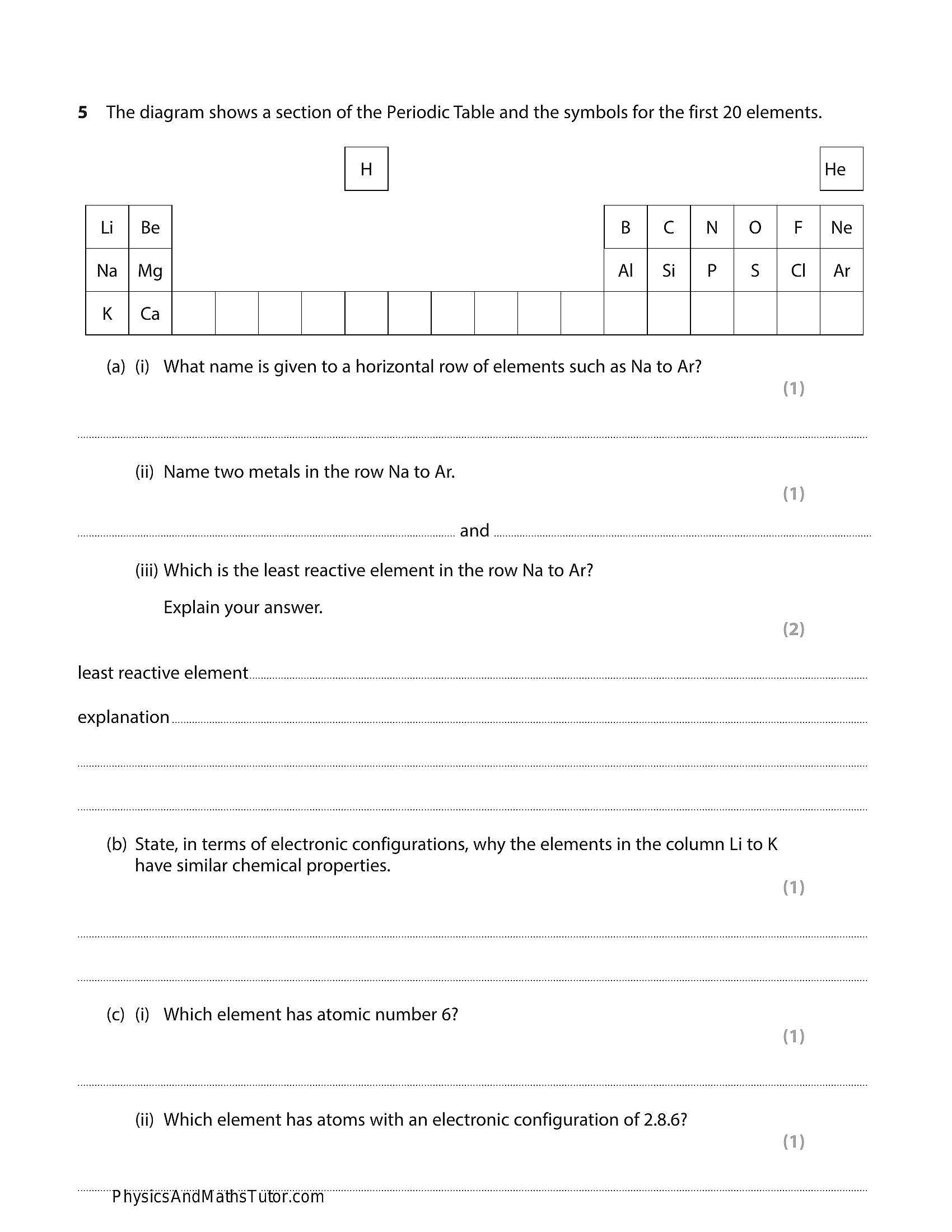
5 The diagram shows a section of the Periodic Table and the symbols for the first 20 elements.H He
Li | Be B Cc N | O F | Ne
Na | Mg Al | Si P S | Cl | Ar
K | Ca
(a) (i) What name is given to a horizontal row of elements such as Na to Ar?
(iii) Which is the least reactive element in the row Na to Ar?
Explain your answer.
least reactive ClEMENt ccna ssnaninnnsinnnannisiussnusinnnsnnitannstusinnnsnennainsiennitnstnnninnsansasesnes
OXPLAN ATION cess nnneninnesnnninnanniieeiinninnainniieniiesinniinniiiniiesiiniinniinntiniiiniieininnaiinniiiniietninniinnatintt
(b) State, in terms of electronic configurations, why the elements in the column Li to K
have similar chemical properties.
(c) (i) Which element has atomic number 6?
---
Page 9
Extracted Text
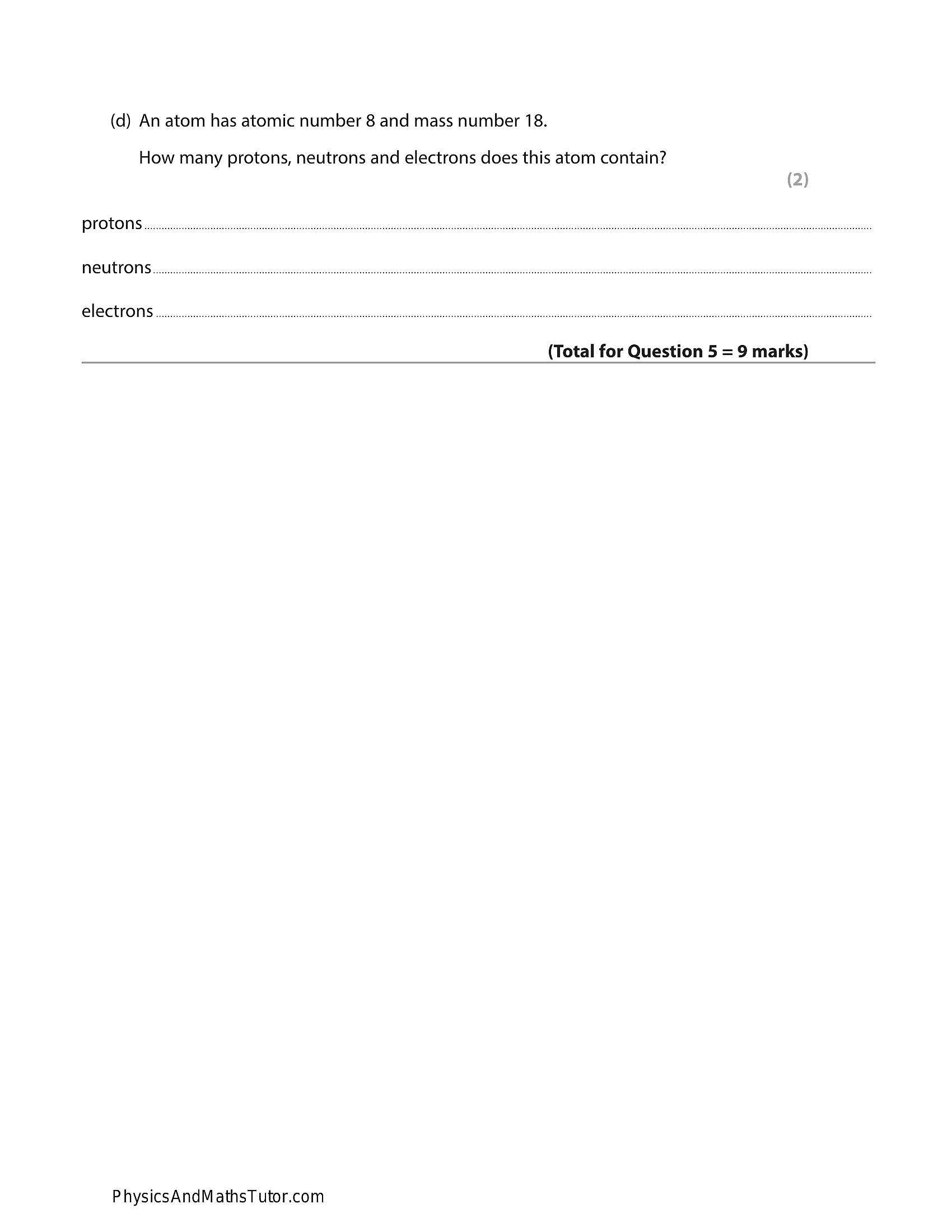
(d) An atom has atomic number 8 and mass number 18.How many protons, neutrons and electrons does this atom contain?
PFOTONS ccs ceessstetnsistnssotetnsistssrstsisiststssisisiisistrsisissisistrsistsissistrsistsiisistrsistsissistrsistsissistsiiststisistssistsisieissistesieensssiete
MOUTON occ ecsesssssssssstsessstneessnnensoneatsetnnistsanunnintuanintasinetaeisenseesonseesenansetintiesneiasineastntasisetnsssetseesonsensenianneiatiesintiasineinstneesetneenesenets
MVSCEONS oe cosnnnnnnntnnnnnntnnnnnnininennisnnnnenninanannsnunintnsnnhneinsnusinnnenninannsiuintnsnniniinsteinnnsnnnnenstansnnsnininssnees
(Total for Question 5 = 9 marks)
PhysicsAndM athsTutor.com
---
Page 10
Extracted Text
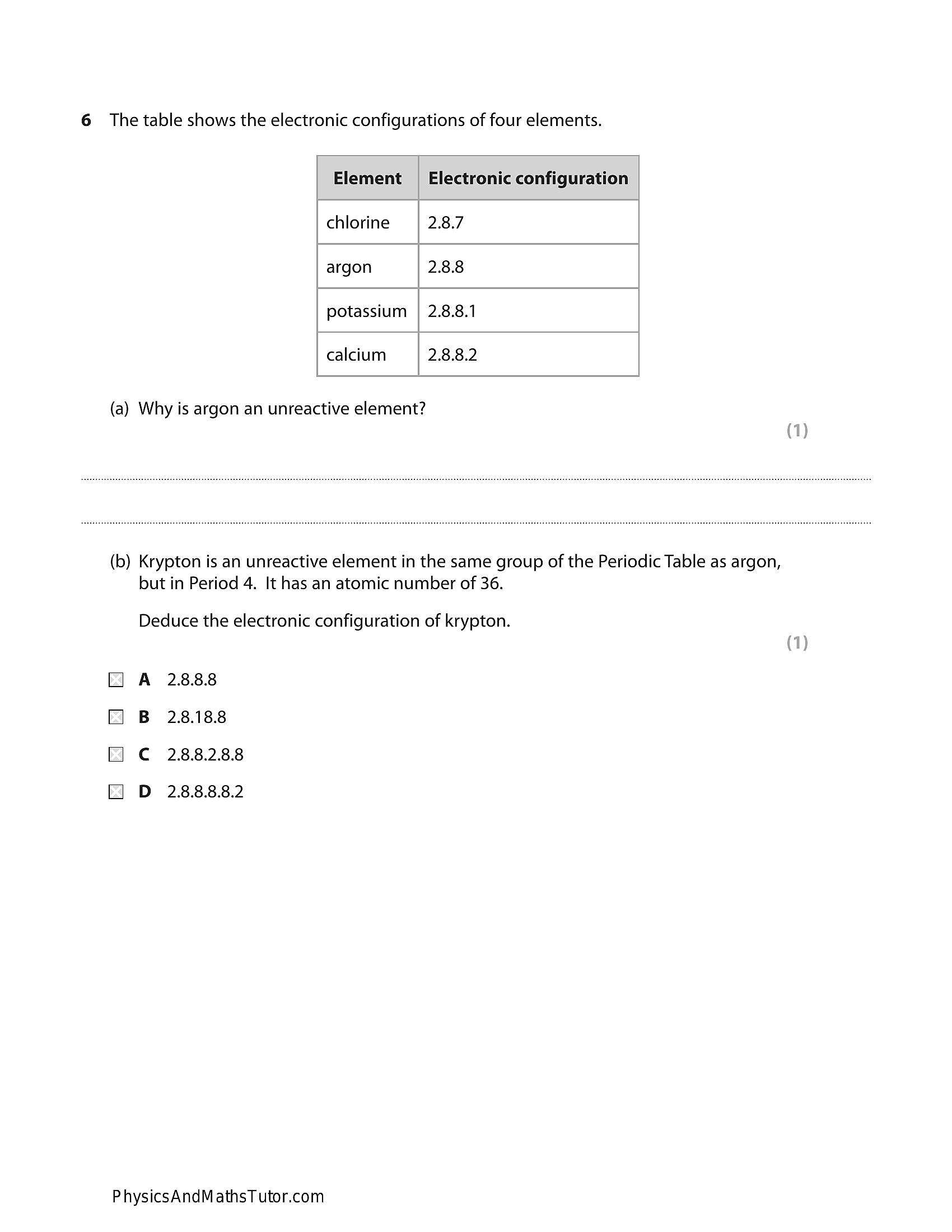
6 The table shows the electronic configurations of four elements.Element | Electronic configuration
chlorine 2.8.7
argon 2.8.8
potassium | 2.8.8.1
calcium 2.8.8.2
(a) Why is argon an unreactive element?
(b) Krypton is an unreactive element in the same group of the Periodic Table as argon,
but in Period 4. It has an atomic number of 36.
Deduce the electronic configuration of krypton.
2.8.8.8
2.8.18.8
A
B
C 2.8.8.2.8.8
D
2.8.8.8.8.2
PhysicsAndM athsTutor.com
---
Page 11
Extracted Text
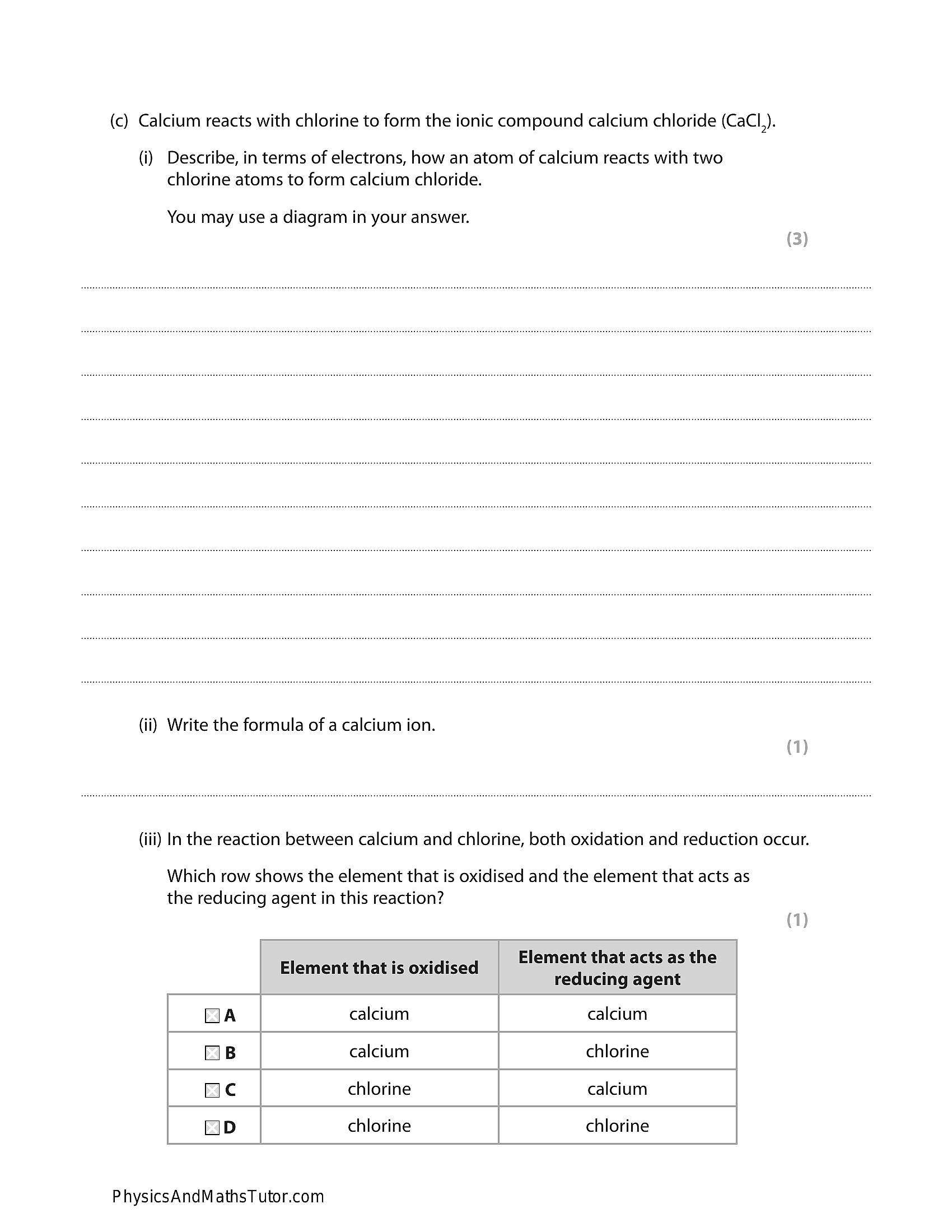
(c) Calcium reacts with chlorine to form the ionic compound calcium chloride (CaCl).(i) Describe, in terms of electrons, how an atom of calcium reacts with two
chlorine atoms to form calcium chloride.
You may use a diagram in your answer.
(iii) In the reaction between calcium and chlorine, both oxidation and reduction occur.
Which row shows the element that is oxidised and the element that acts as
the reducing agent in this reaction?
Element that is oxidised Blomenie that acts.as the
reducing agent
| A calcium | calcium
| B calcium | chlorine
| Cc chlorine | calcium
| D chlorine | chlorine
PhysicsAndM athsTutor.com
---
Page 12
Extracted Text
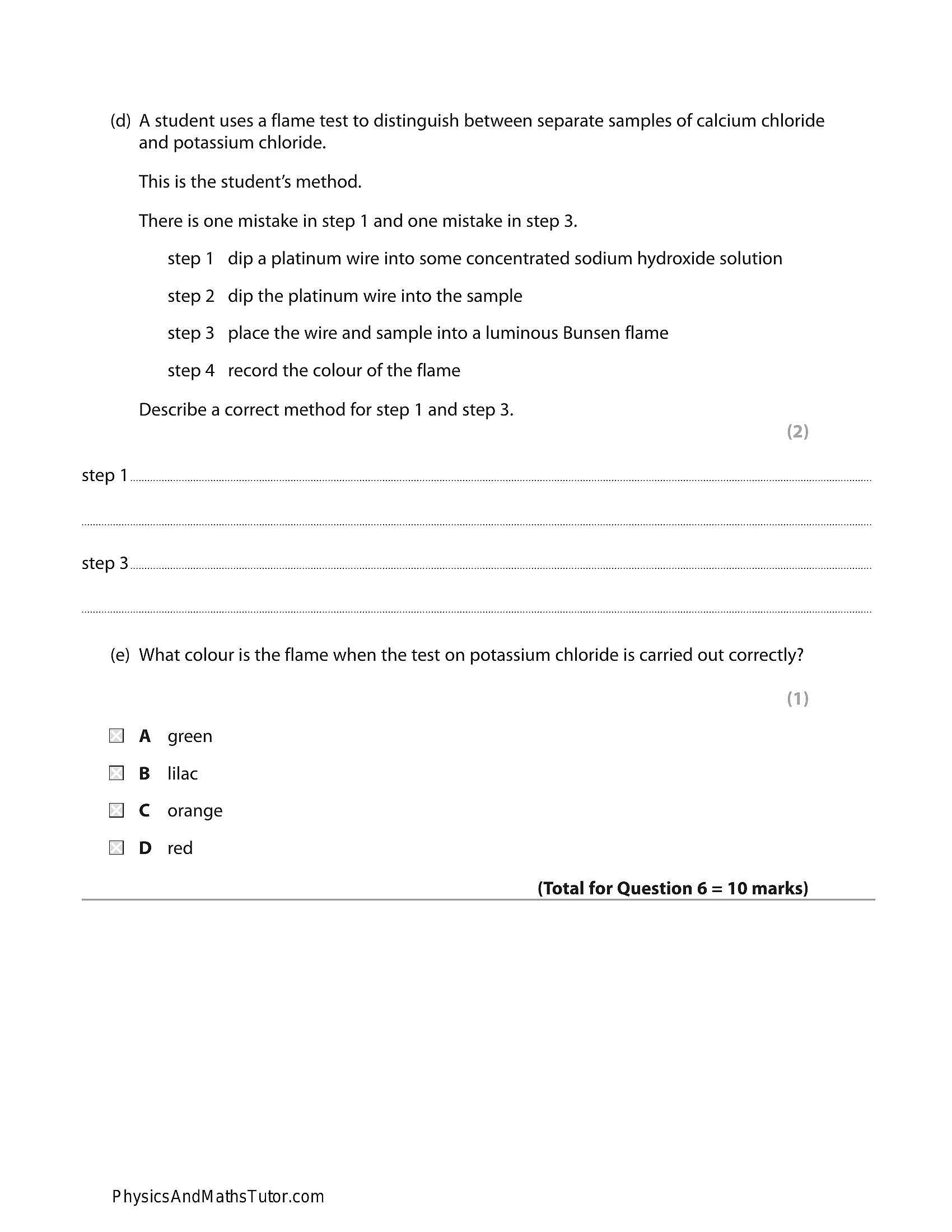
(d) A student uses a flame test to distinguish between separate samples of calcium chloride and potassium chloride.This is the student's method.
There is one mistake in step 1 and one mistake in step 3.
step 1 dip a platinum wire into some concentrated sodium hydroxide solution
step 2 dip the platinum wire into the sample
step 3 place the wire and sample into a luminous Bunsen flame
step 4 record the colour of the flame
Describe a correct method for step 1 and step 3.
(e) What colour is the flame when the test on potassium chloride is carried out correctly?
green
lilac
orange
50 A BB PF
red
(Total for Question 6 = 10 marks)
PhysicsAndM athsTutor.com
---