📄 Exam Questions & Readable Text Transcript
Full OCR-extracted text of questions, syllabus codes, and exam instructions.
Extracted Content: 6021q1Specimen paper
Page 1
Extracted Text
r ara bor Pemsance MesarenentZIMBABWE SCHOOL EXAMINATIONS COUNCIL
General Certificate of Education Advanced Level
MECHANICAL MATHEMATICS 6021/1
PAPER 1
SPECIMEN PAPER 3 hours
Additional materials:
Answer paper
Graph paper
List of Formulae
Electronic calculator
TIME 3 hours
INSTRUCTIONS TO CANDIDATES
Write your name, Centre number and candidate number in the spaces provided on the answer
paper/answer booklet.
Answer all questions
If a numerical answer cannot be given exactly, and the accuracy required is not specified in
the question, then in the case of an angle it should be given to the nearest degree, and in other
cases it should be given correct to 2 significant figures.
If a numerical value for gis necessary, take g = 9.81 ms.
INFORMATION FOR CANDIDATES
[he number of marks is given in brackets [ ] at the end of each question or part question.
[he total number of marks for this paper is 120.
[he use of an electronic calculator is expected, where appropriate.
Y ou are reminded of the need for clear presentation in your answers.
This question paper consists of 8 printed pages.
Copyright: Zimbabwe School Examinations Council, Specimen paper.
@ZIMSEC Specimen paper
---
Page 2
Extracted Text
Answer all questionsThe trajectory of a projectile’s motion is described by the equation
y = 2x— 0.01x where xis the horizontal displacement and yis the vertical
displacement from the point of projection.
Find the
@ angle of projection, [1]
Gi) _ initial velocity of projection. [2]
Model trolleys P and Q of masses 0.5 kg and 0.8 kg respectively are held in
contact on a smooth horizontal surface. A compressed spring inside one of the
trolleys is released and they then move apart. The speed of P is 4.5 ms‘!.
Calculate the speed of Q. [3]
A tractor of mass 5.5 tonnes moves with a constant speed of 4 ms! up a slope
inclined 30° to the horizontal.
Given that the engine of the tractor is working at a constant rate of 160 kW, find
the resistance to the motion. [4]
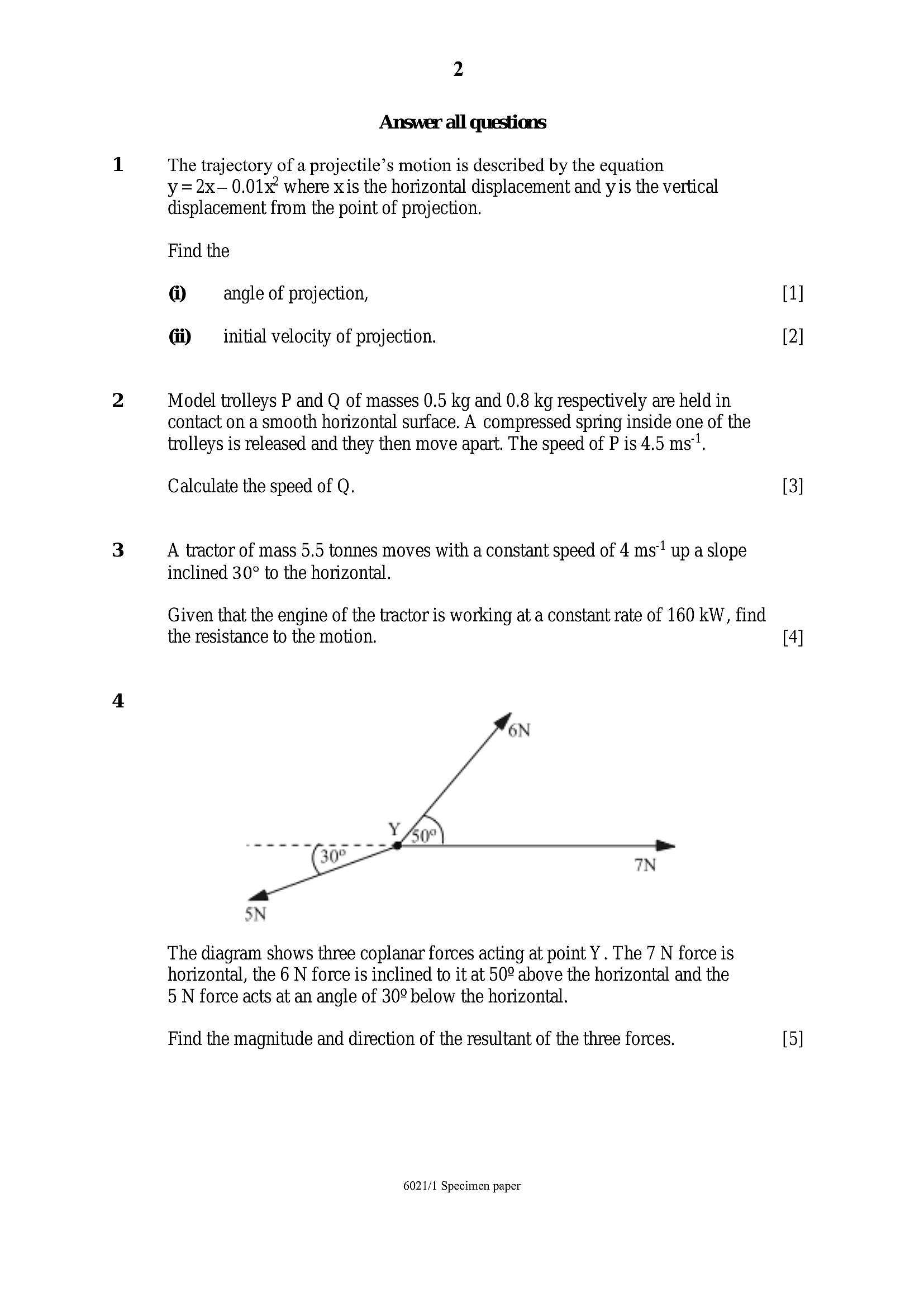
7N
The diagram shows three coplanar forces acting at point Y. The 7 N force is
horizontal, the 6 N force is inclined to it at 50° above the horizontal and the
5 N force acts at an angle of 302 below the horizontal.
Find the magnitude and direction of the resultant of the three forces. [5]
6021/1 Specimen paper
---
Page 3
Extracted Text
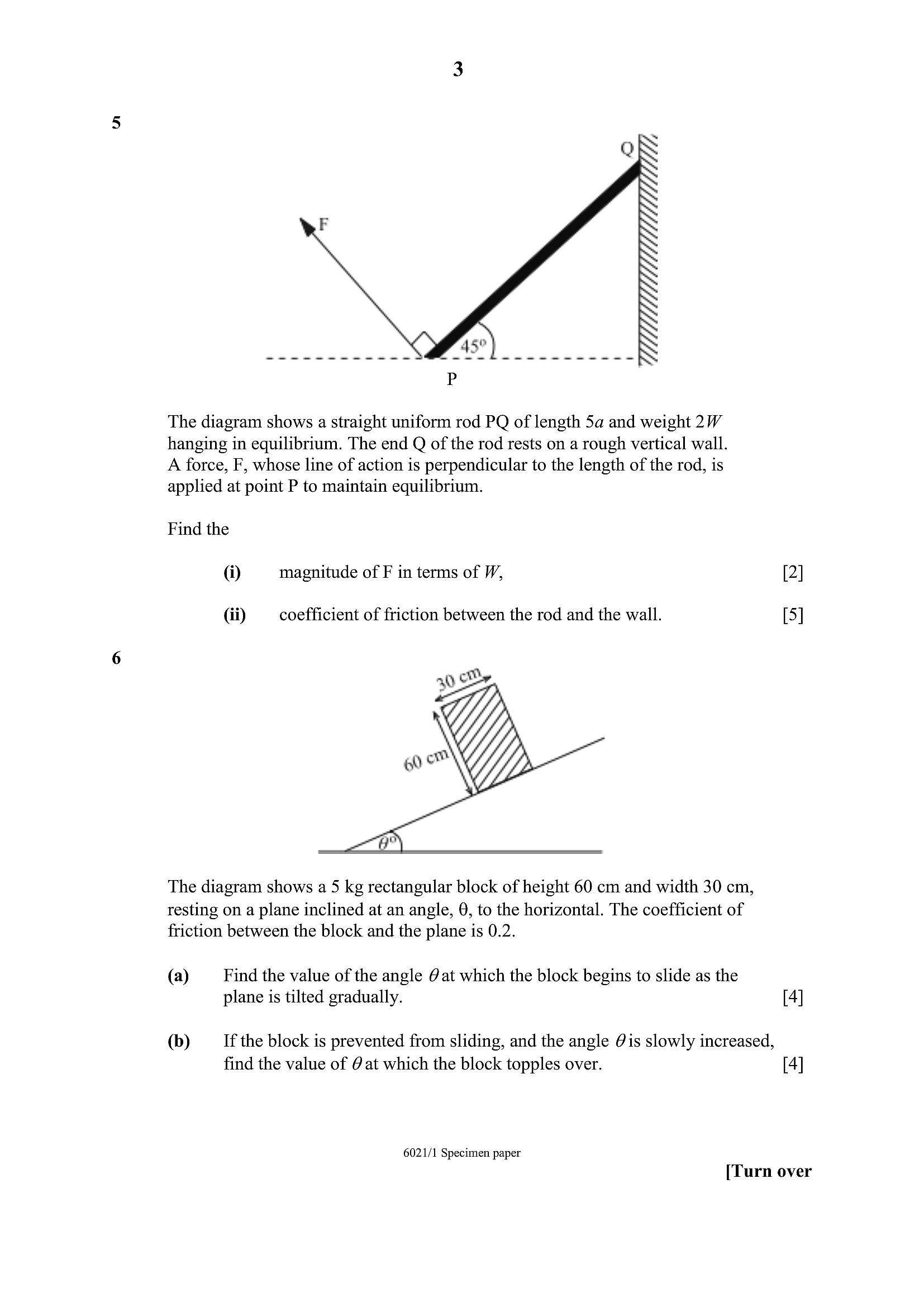
The diagram shows a straight uniform rod PQ of length 5a and weight 2W hanging in equilibrium. The end Q of the rod rests on a rough vertical wall. A force, F, whose line of action is perpendicular to the length of the rod, is applied at point P to maintain equilibrium.Find the
@ magnitude of F in terms of W, [2]
(¢1)) coefficient of friction between the rod and the wall. [5]
om
The diagram shows a 5 kg rectangular block of height 60 cm and width 30 cm,
resting on a plane inclined at an angle, 8, to the horizontal. The coefficient of
friction between the block and the plane is 0.2.
(a) Find the value of the angle @ at which the block begins to slide as the
plane is tilted gradually. [4]
(b) If the block is prevented from sliding, and the angle @is slowly increased,
find the value of @ at which the block topples over. [4]
6021/1 Specimen paper
[Turn over
---
Page 4
Extracted Text
4A particle starts from rest and accelerates at 2 ms~? for 3 seconds. It then
maintains the attained velocity for 4 seconds and then decelerates at 5 ms~?
for 2 seconds.
@) Sketch a velocity-time graph for the motion of the particle for the
9 seconds.
&) Calculate the
@ total distance travelled by the particle in the 9 seconds,
Gi) _—_ displacement of the particle at the end of the 9 seconds.
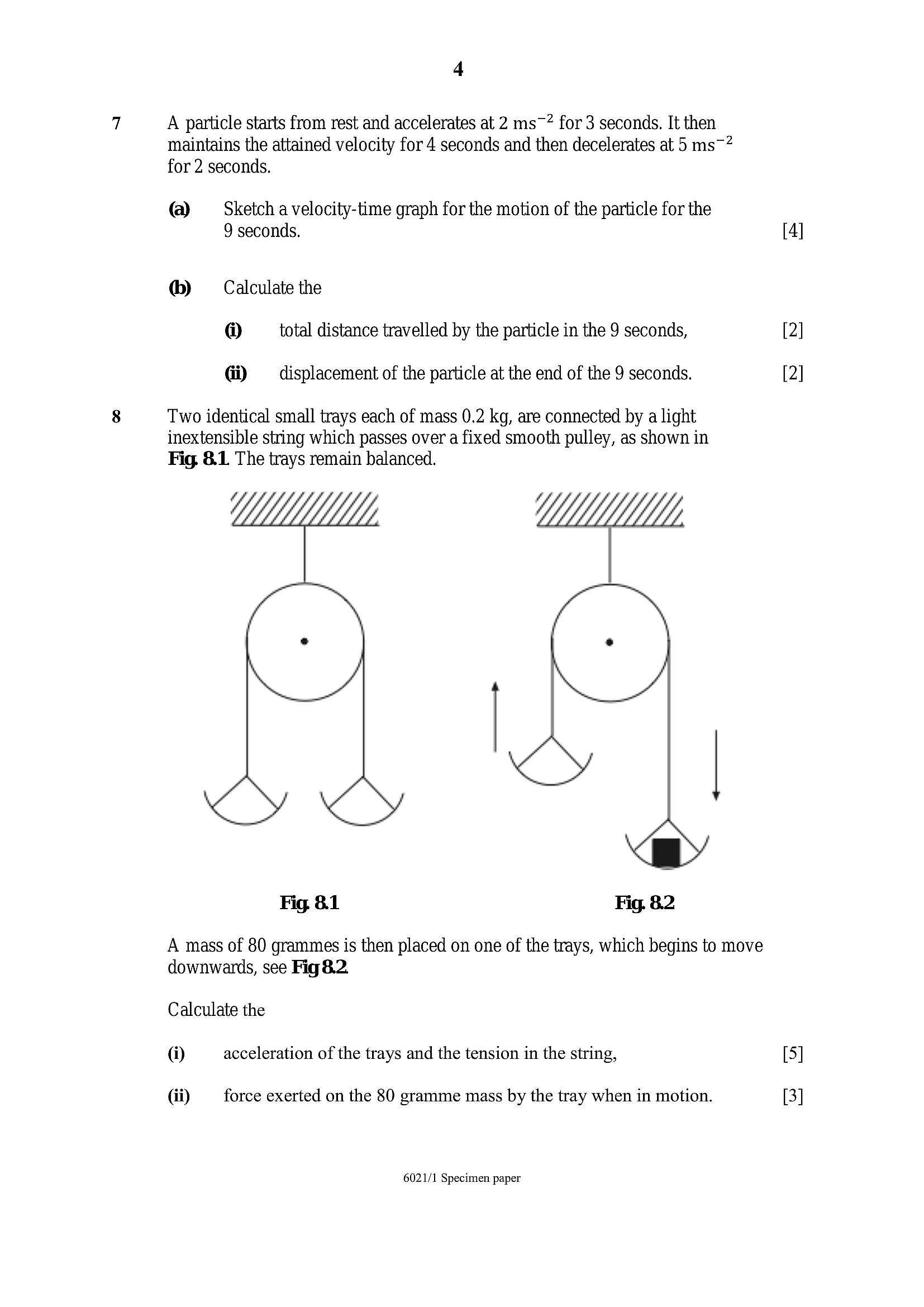
Two identical small trays each of mass 0.2 kg, are connected by a light
inextensible string which passes over a fixed smooth pulley, as shown in
Fig. 8.1 The trays remain balanced.
Fig. 81 Fig. 82
A mass of 80 grammes is then placed on one of the trays, which begins to move
downwards, see Fig &2.
Calculate the
@ acceleration of the trays and the tension in the string,
(¢1)) force exerted on the 80 gramme mass by the tray when in motion.
6021/1 Specimen paper
[2]
---
Page 5
Extracted Text
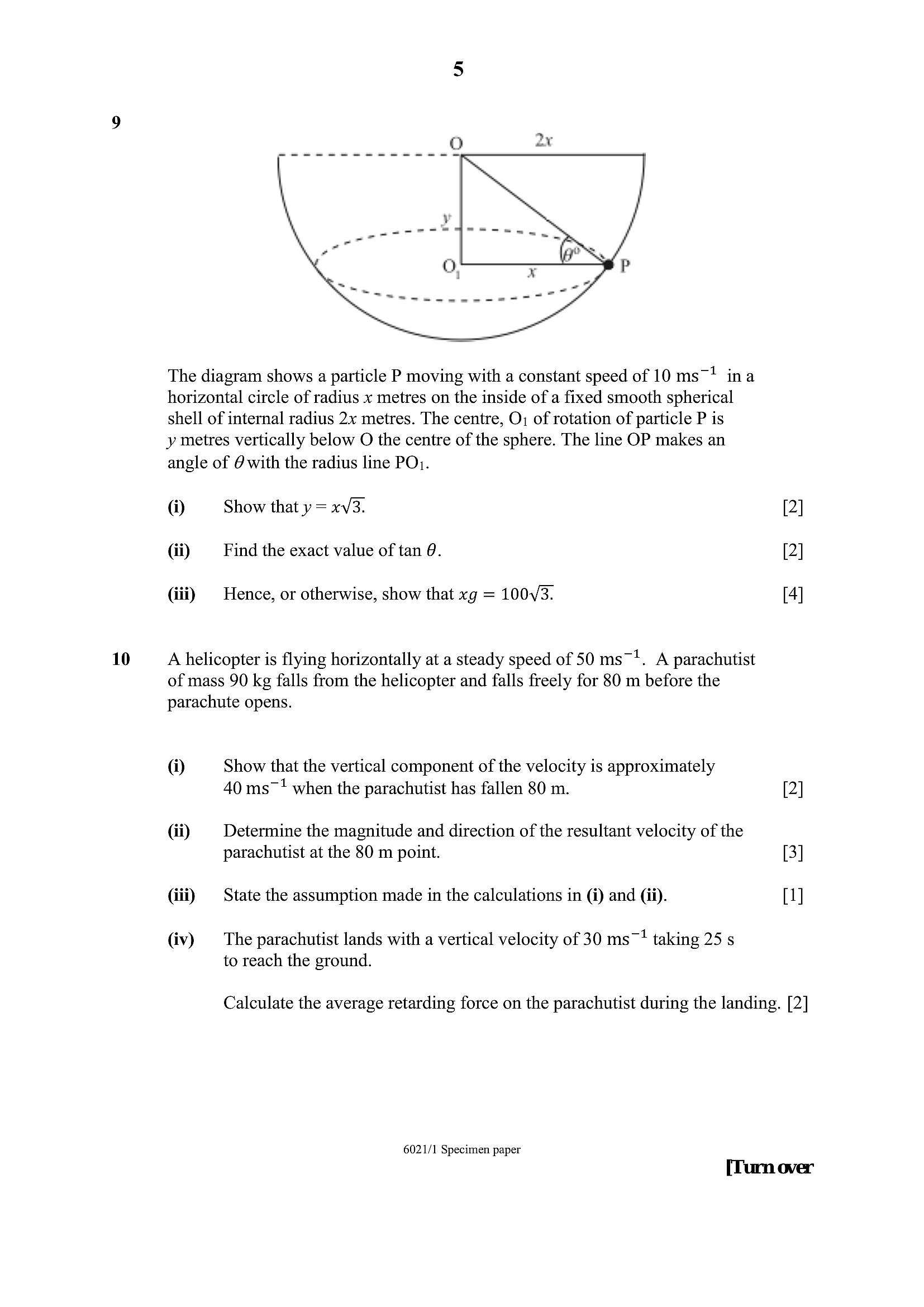
10The diagram shows a particle P moving with a constant speed of 10 ms~
lina
horizontal circle of radius x metres on the inside of a fixed smooth spherical
shell of internal radius 2x metres. The centre, O; of rotation of particle P is
y metres vertically below O the centre of the sphere. The line OP makes an
angle of @ with the radius line PO;.
@
(ii)
(iii)
Show that y = xv3. [2]
Find the exact value of tan @. [2]
Hence, or otherwise, show that xg = 100V3. [4]
A helicopter is flying horizontally at a steady speed of 50 ms~?. A parachutist
of mass 90 kg falls from the helicopter and falls freely for 80 m before the
parachute opens.
@
(ii)
(iii)
(iv)
Show that the vertical component of the velocity is approximately
40 ms~1 when the parachutist has fallen 80 m. [2]
Determine the magnitude and direction of the resultant velocity of the
parachutist at the 80 m point. [3]
State the assumption made in the calculations in (i) and (ii). [1]
The parachutist lands with a vertical velocity of 30 ms~* taking 25 s
to reach the ground.
Calculate the average retarding force on the parachutist during the landing. [2]
6021/1 Specimen paper
---
Page 6
Extracted Text
116
A train is moving along a straight track with uniform acceleration. The
train passes through a level crossing P with a speed of 22 ms~+ and another
level crossing R, 1 500 m from P, at 28 ms“.
(a) Calculate the
@ time taken by the train to move from Pto R,
GD _acceleration of the train.
® = Qisasign post between Pand Rsuch that PQ : QR=2: 3.
Calculate the
@ distance PQ,
Gi) __ the speed of the train as it passes sign post Q.
A train starts from rest at station P and accelerates uniformly until it reaches
a speed of 30 ms~*. It maintains this speed for 120 seconds until brakes are
applied and brought to rest with uniform retardation at station Q. The
magnitude of the retardation is three times that of the acceleration. The total
time taken for the whole journey is 480 seconds.
@) Sketch the (v,t) graph for the train’s journey.
&) Find the
@ time taken when accelerating,
Gi) __total distance travelled by the train,
Git) —_ acceleration.
6021/1 Specimen paper
3]
---
Page 7
Extracted Text
134
——<strong></strong><strong>_| _3 7 </strong><strong></strong>__—»:
P
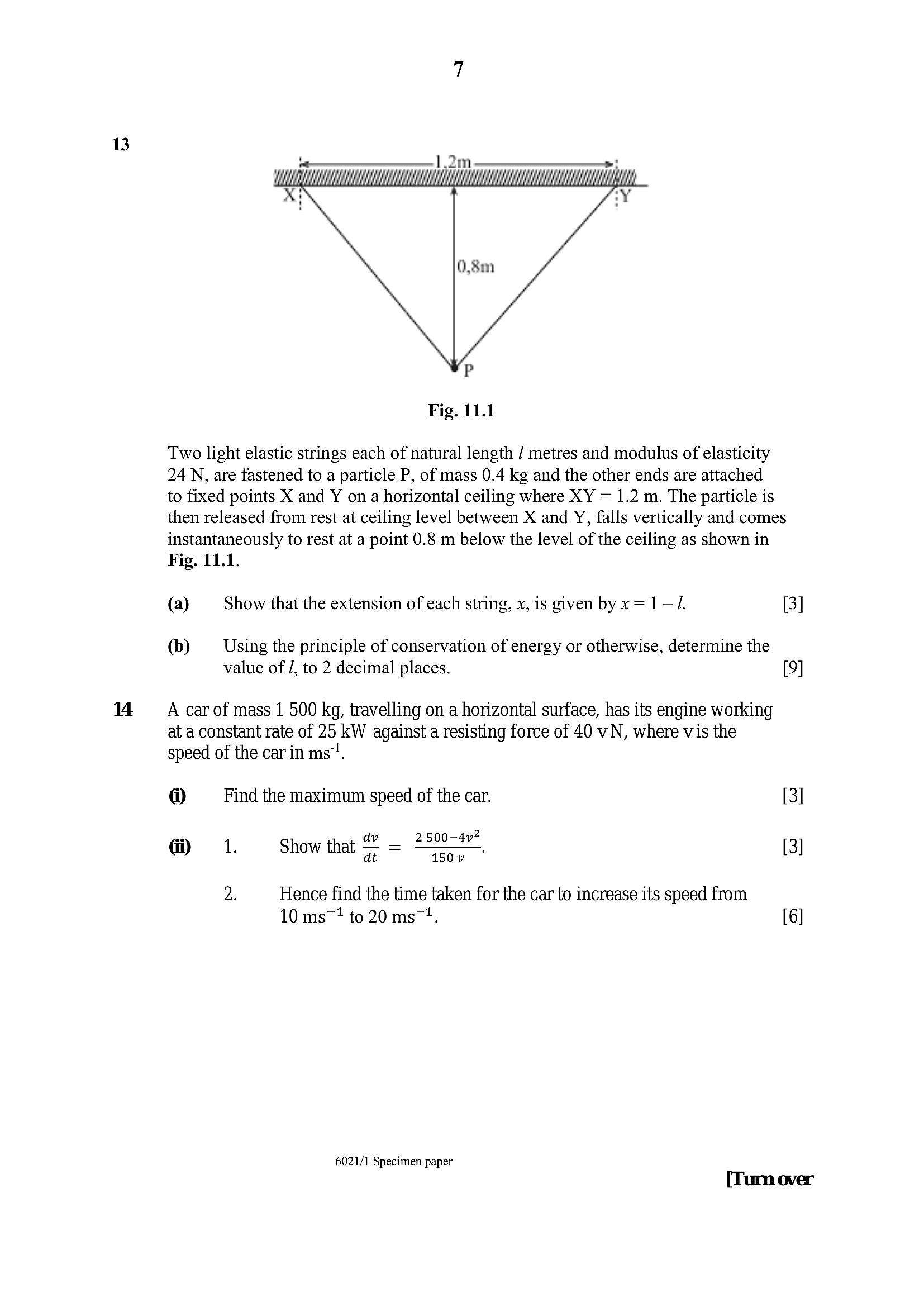
Fig. 11.1
Two light elastic strings each of natural length / metres and modulus of elasticity
24 N, are fastened to a particle P, of mass 0.4 kg and the other ends are attached
to fixed points X and Y on a horizontal ceiling where XY = 1.2 m. The particle is
then released from rest at ceiling level between X and Y, falls vertically and comes
instantaneously to rest at a point 0.8 m below the level of the ceiling as shown in
Fig. 11.1.
(a) Show that the extension of each string, x, is given by x = 1-/. 13]
(b) Using the principle of conservation of energy or otherwise, determine the
value of /, to 2 decimal places. [9]
A car of mass 1 500 kg, travelling on a horizontal surface, has its engine working
at a constant rate of 25 kW against a resisting force of 40 vN, where vis the
speed of the car in ms"!.
@ Find the maximum speed of the car. [3]
. dv 2 500—4v?
@ 1. Show that — = —- [3]
2. Hence find the time taken for the car to increase its speed from
10 ms“! to 20 ms“. [6]
6021/1 Specimen paper
---
Page 8
Extracted Text
OS~O5
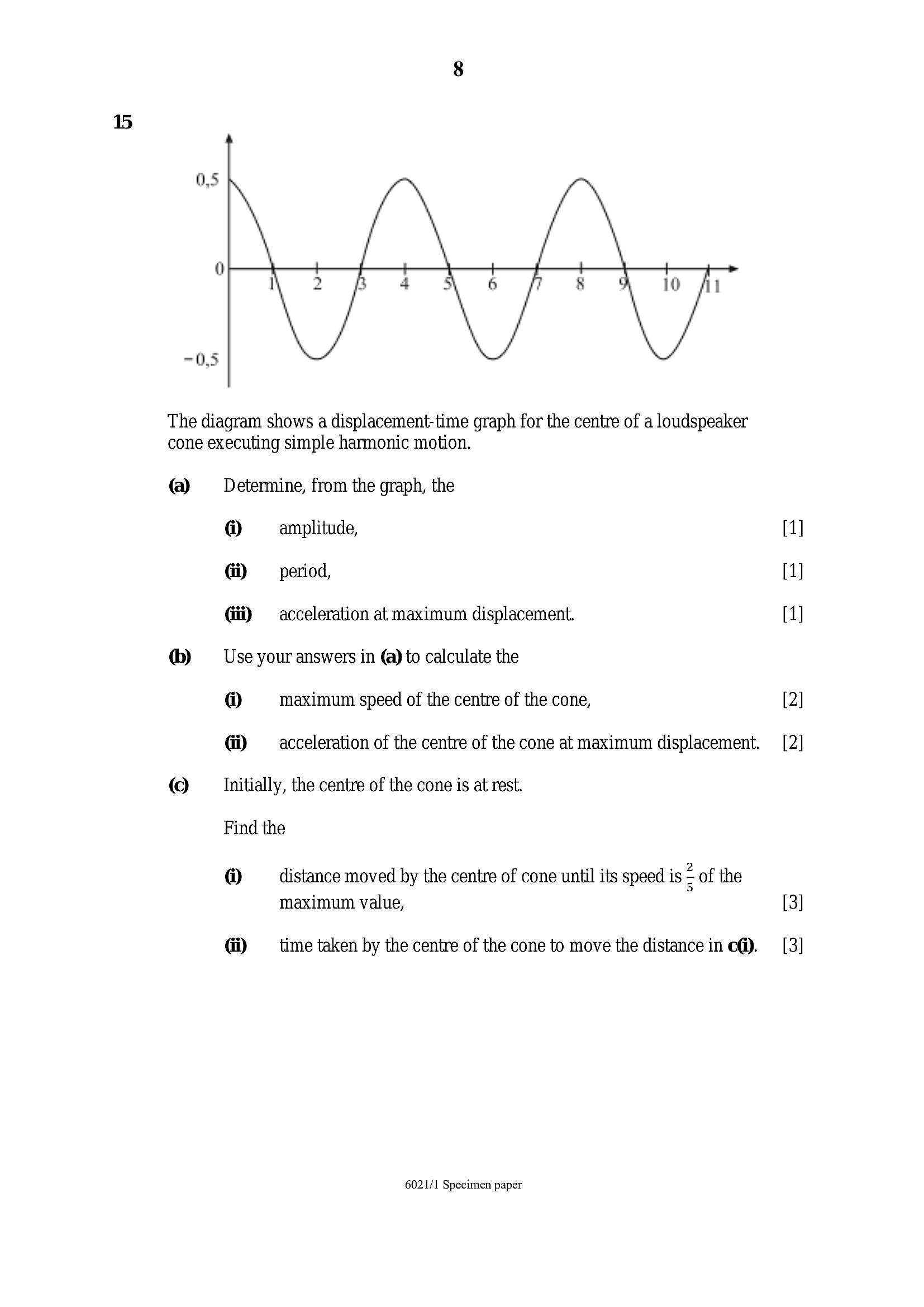
The diagram shows a displacement-time graph for the centre of a loudspeaker
cone executing simple harmonic motion.
@
)
©
Determine, from the graph, the
@ amplitude,
@) ___soperiod,
Gi) ~—_ acceleration at maximum displacement.
Use your answers in (a) to calculate the
@ maximum speed of the centre of the cone,
@) acceleration of the centre of the cone at maximum displacement.
Initially, the centre of the cone is at rest.
Find the
@ distance moved by the centre of cone until its speed is = of the
maximum value,
Gi) __ time taken by the centre of the cone to move the distance in ci).
6021/1 Specimen paper
1]
---