📄 Exam Questions & Readable Text Transcript
Full OCR-extracted text of questions, syllabus codes, and exam instructions.
Extracted Content: 6031q3specimen
Page 1
Extracted Text
ZIMBABWE SCHOOL EXAMINATIONS COUNCILGeneral Certificate of Education Advanced Level
CHEMISTRY 6081/3
PAPER 3
2 hours 30 minutes
Additional materials:
Answer paper
Data Booklet
Mathematical tables and/or electronic calculator
TIME: 2 hours 30 minutes
INSTRUCTIONS TO CANDIDATES
Write your name, Centre number and candidate number in the spaces provided on the answer
paper/answer booklet.
Answer six questions.
Answer two questions from Section A, ane question from Section B, two questions from Section C
and one question from section D.
Write your answers on the separate answer paper provided.
If you use more than one sheet of paper, fasten the sheets together.
INFORMATION FOR CANDIDATES
The number of marks is given in brackets [ ] at the end of each question or part question.
Y ou are reminded of the need for good English and clear presentation in your answers.
This question paper consists of 13 printed pages and 3 blank pages.
Copyright: Zimbabwe School Examination Council, Specimen
©ZIMSEC
---
Page 2
Extracted Text
Section AAnswer any twoquestions from this section.
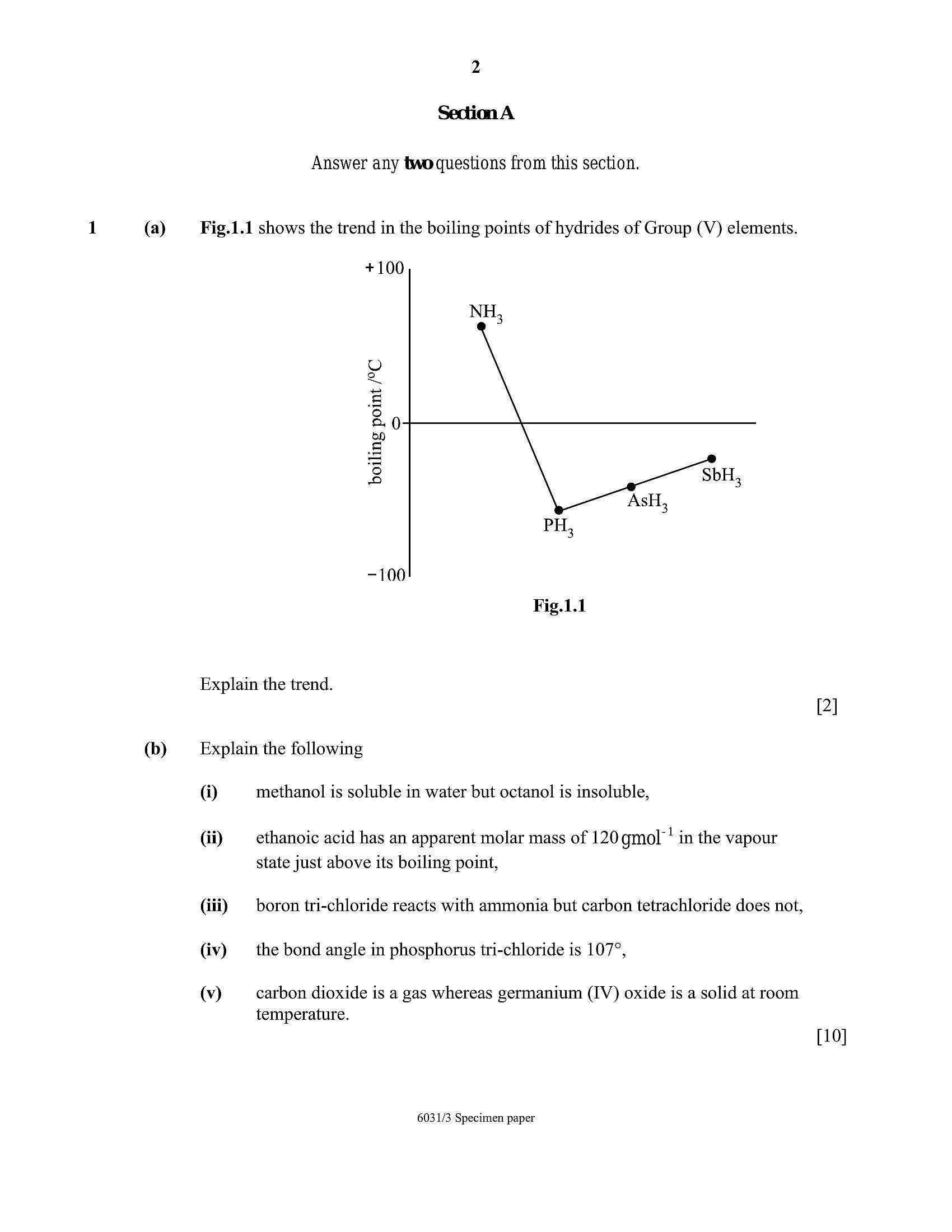
(a) Fig.1.1 shows the trend in the boiling points of hydrides of Group (V) elements.
+100
NH,
?
=|
ze)
a.
oh
&
2 SbH,
AsH,
PH,
-100
Fig.1.1
Explain the trend.
[2]
(b) Explain the following
@ methanol is soluble in water but octanol is insoluble,
(ii) —_—sethanoic acid has an apparent molar mass of 120 gmol' in the vapour
state just above its boiling point,
(iii) boron tri-chloride reacts with ammonia but carbon tetrachloride does not,
(iv) | the bond angle in phosphorus tri-chloride is 107°,
(v) carbon dioxide is a gas whereas germanium (IV) oxide is a solid at room
temperature.
[10]
6031/3 Specimen paper
---
Page 3
Extracted Text
(a)(b)
(©)
A titration was carried out using acidified potassium dichromate (VJ in a
conical flask and a solution of iron (II) sulphate in a burette.
@ Write a balanced chemical equation for the reaction.
+e /
(ii) Calculate F’,.
(iii) | Sketch a graph to show the e.m.f. change during the nitration. B]
[Total:15]
0) Define the terms
1. activation energy,
2. catalyst.
(ii) Explain why the activation energy for the synthesis of ammonia in the
Haber process is high.
[3]
The equation for the Haber process is
N,4+3Hy 22NHy, DH? =-92 kjmol”
2g)
and the activation energy, for the uncatalysed decomposition of
ammonia is 4335 kJmol''.
@ Sketch, on the same axes, a labelled reaction pathway diagrams of the
catalysed and uncatalysed reaction.
(ii) Determine the activation energy of the uncatalysed formation of ammonia.
[5]
In an experiment, 120 mole of Hy, were mixed with 40.0 mole of N,,.,and
2(9)
pressurised in a 2.0 dm? vessel until equilibrium was reached when there was
40 % conversion of the reactants to ammonia.
@ Write the K, expression for the formation of ammonia.
(ii) Calculate the K; and state its units.
[4]
6031/3 Specimen paper
[Turn over
---
Page 4
Extracted Text
(d)(b)
()
(d)
Hydrogen carbonate ions provide a buffering action in biological systems.
0) Define the term buffer solution.
(ii) Explain by means of equations the buffering action of hydrogen
carbonate ions. [3]
[Total:15]
[Use of the Data Booklet is recommended in this question.]
The standard zinc - copper cell is as shown:
2 2
Zn/ 20) J Cur! Cu,
0) Define the term standard cell potential.
(ii) Calculate the standard cell potential for this cell,
(iii) | Write the overall equation for the cell reaction.
(iv) Explain the effect of adding zinc granules on the value of F “cell.
[4]
Outline how zinc impurities are removed during the electro-purification of
copper. [2]
A sample of impure zinc dust of mass 0.350 g was added to an excess of
aqueous iron (III) sulphate. The iron (II) produced required 100 cm? of
0.0200 moldm? potassium manganate (VII) for titration.
@ Write the equation for the reactions which take place.
(ii) Calculate the percentage purity of the zinc dust.
[6]
Explain why the solubility of MgO is low in water. [3]
[Total:15]
6031/3 Specimen paper
---
Page 5
Extracted Text
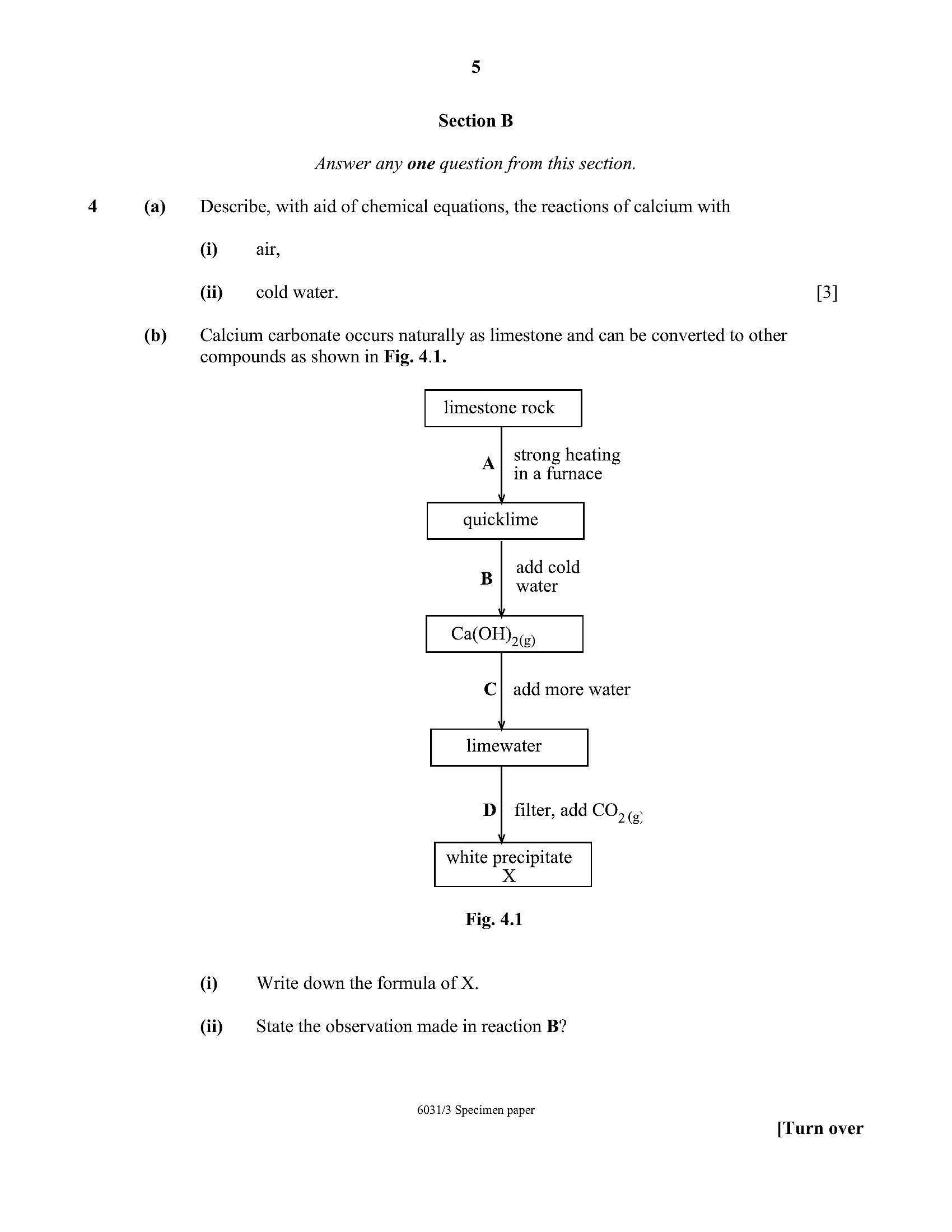
Section B Answer any one question from this section. (a) Describe, with aid of chemical equations, the reactions of calcium with 0) air, (ii) cold water. [3](b) Calcium carbonate occurs naturally as limestone and can be converted to other
compounds as shown in Fig. 4.1.
limestone rock
strong heating
in a furnace
add cold
water
Ca(OH),()
add more water
limewater
D| filter, add CO.
2(g)
white precipitate
Xx
Fig. 4.1
@ Write down the formula of X.
(ii) State the observation made in reaction B?
6031/3 Specimen paper
[Turn over
---
Page 6
Extracted Text
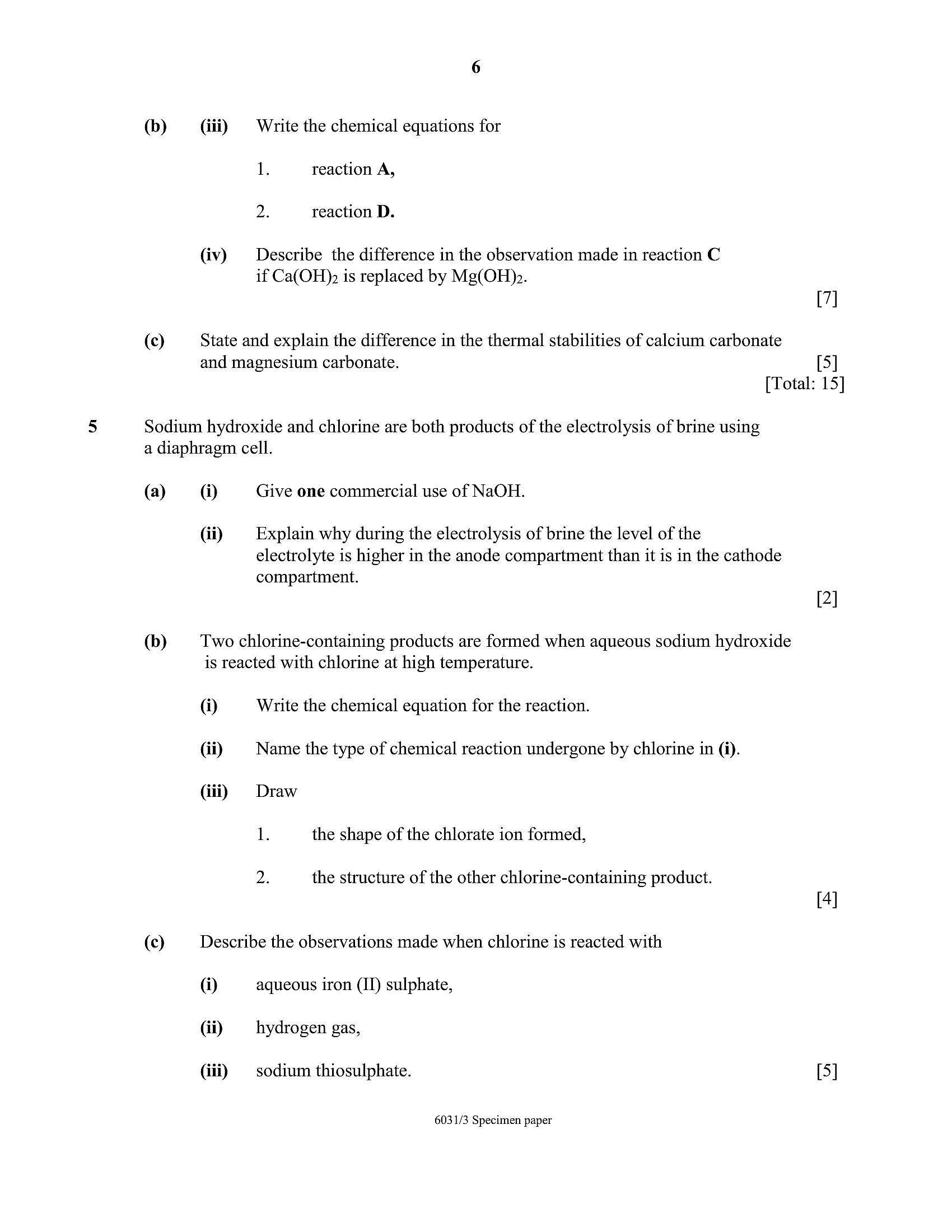
(b) (iii) | Write the chemical equations for 1. reaction A, 2. reaction D.(iv) Describe the difference in the observation made in reaction C
if Ca(OH), is replaced by Mg(OH):.
[7]
(c) State and explain the difference in the thermal stabilities of calcium carbonate
and magnesium carbonate. [5]
[Total: 15]
Sodium hydroxide and chlorine are both products of the electrolysis of brine using
a diaphragm cell.
(a) @ Give one commercial use of NaOH.
(ii) Explain why during the electrolysis of brine the level of the
electrolyte is higher in the anode compartment than it is in the cathode
compartment.
[2]
(b) Two chlorine-containing products are formed when aqueous sodium hydroxide
is reacted with chlorine at high temperature.
@ Write the chemical equation for the reaction.
(ii) | Name the type of chemical reaction undergone by chlorine in (i).
(iii) + Draw
1. the shape of the chlorate ion formed,
2. the structure of the other chlorine-containing product.
[4]
(c) Describe the observations made when chlorine is reacted with
@ aqueous iron (II) sulphate,
(ii) hydrogen gas,
(iii) — sodium thiosulphate. [5]
6031/3 Specimen paper
---
Page 7
Extracted Text
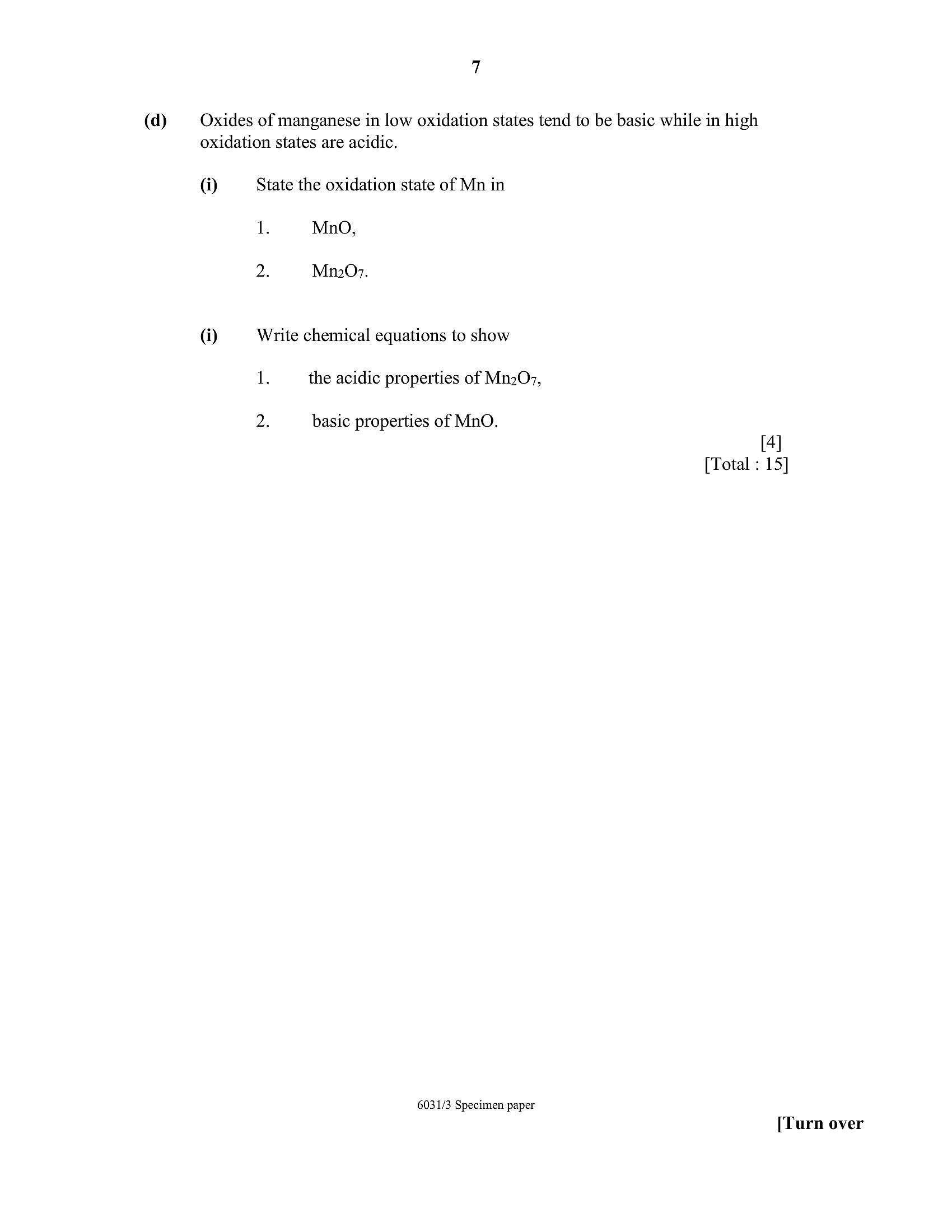
(d)Oxides of manganese in low oxidation states tend to be basic while in high
oxidation states are acidic.
@ State the oxidation state of Mn in
1. MnO,
2. Mn207.
0) Write chemical equations to show
1. the acidic properties of Mn2O7,
2. basic properties of MnO.
[4]
[Total : 15]
6031/3 Specimen paper
[Turn over
---
Page 8
Extracted Text
8 Section CAnswer any two questions from this section
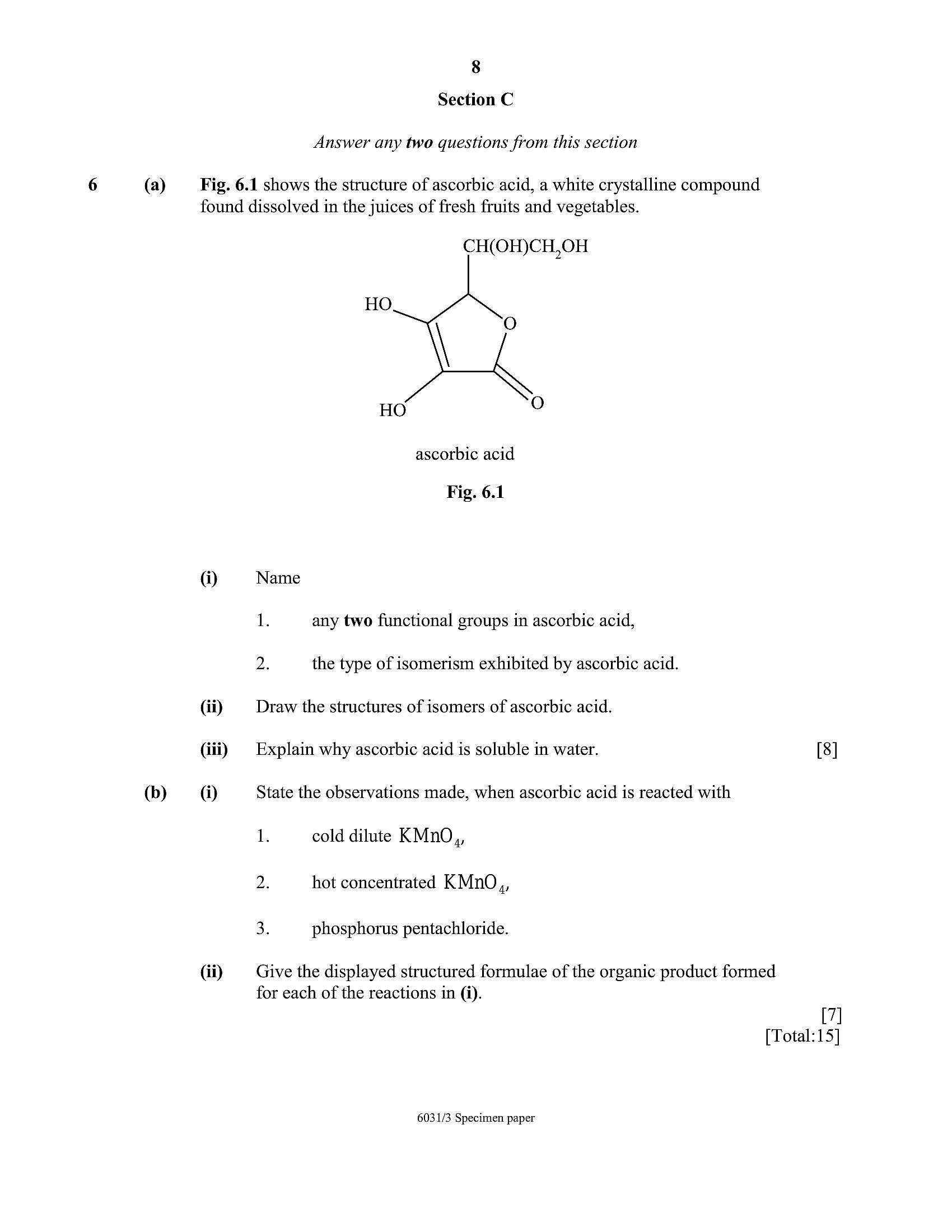
(a) Fig. 6.1 shows the structure of ascorbic acid, a white crystalline compound
found dissolved in the juices of fresh fruits and vegetables.
CH(OH)CH,OH
HO
\ O
HO 0
ascorbic acid
Fig. 6.1
0) Name
1. any two functional groups in ascorbic acid,
2. the type of isomerism exhibited by ascorbic acid.
(ii) Draw the structures of isomers of ascorbic acid.
(iii) | Explain why ascorbic acid is soluble in water. [8]
(b) 0) State the observations made, when ascorbic acid is reacted with
1. cold dilute KMn0,,
2. hot concentrated KMn0,,
3. phosphorus pentachloride.
(ii) Give the displayed structured formulae of the organic product formed
for each of the reactions in (i).
[7]
[Total:15]
6031/3 Specimen paper
---
Page 9
Extracted Text
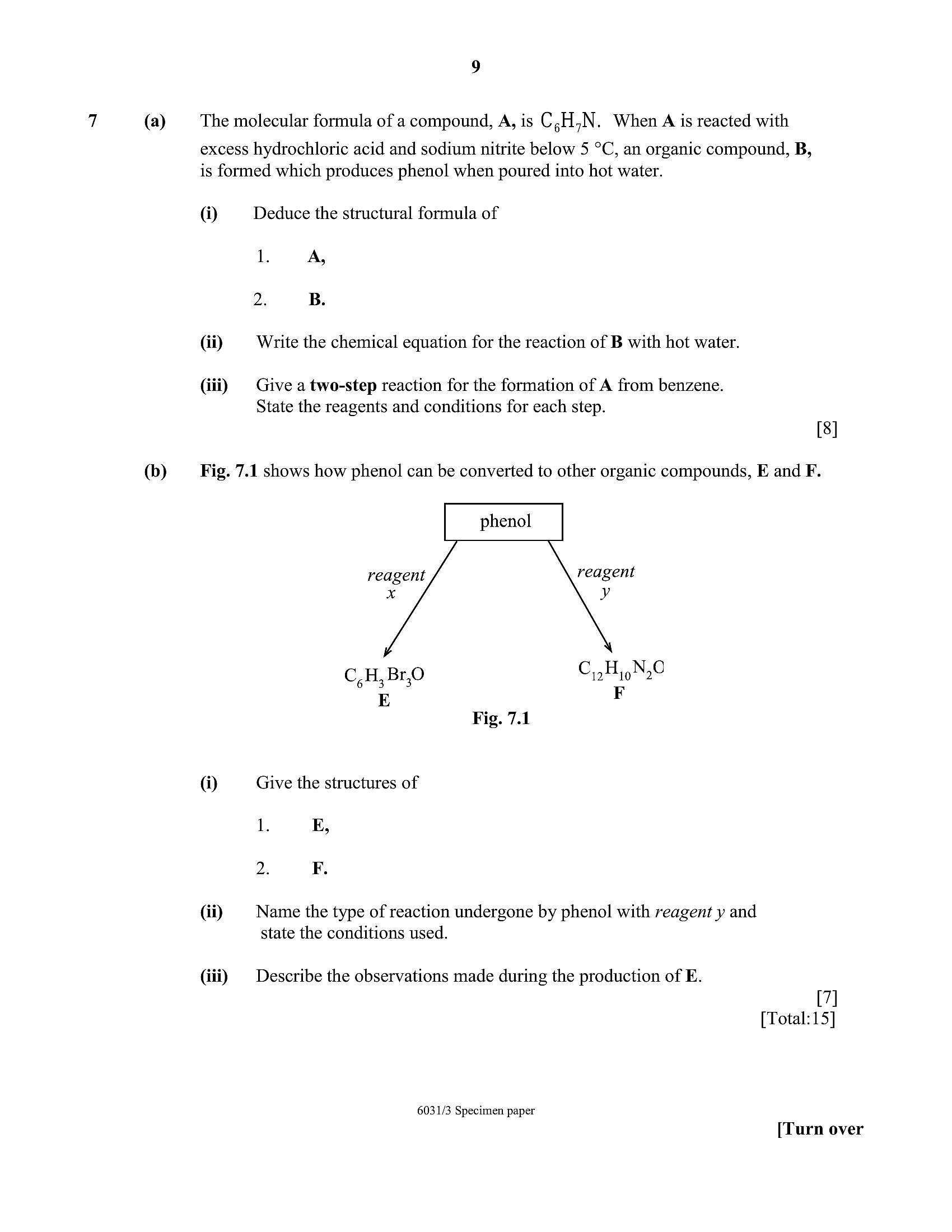
(a) The molecular formula of a compound, A, is C;H,N. When A is reacted withexcess hydrochloric acid and sodium nitrite below 5 °C, an organic compound, B,
is formed which produces phenol when poured into hot water.
@ Deduce the structural formula of
1. A,
2. B.
(ii) Write the chemical equation for the reaction of B with hot water.
(iii) | Give a two-step reaction for the formation of A from benzene.
State the reagents and conditions for each step.
[8]
(b) Fig. 7.1 shows how phenol can be converted to other organic compounds, E and F.
reagent reagent
x y
C,H, Br,O C,,H,yN,0
E F
Fig. 7.1
(@) Give the structures of
1. E,
2. F.
(ii) | Name the type of reaction undergone by phenol with reagent y and
state the conditions used.
(iii) | Describe the observations made during the production of E.
[7]
[Total:15]
6031/3 Specimen paper
[Turn over
---
Page 10
Extracted Text
(a) (b)()
10
State any two differences between addition and condensation polymerisation. [2]
@ Draw two repeat units of
1. nylon 6,
2. nylon 66.
(ii) Deduce from the units in (i) one difference between the two polymers.
[6]
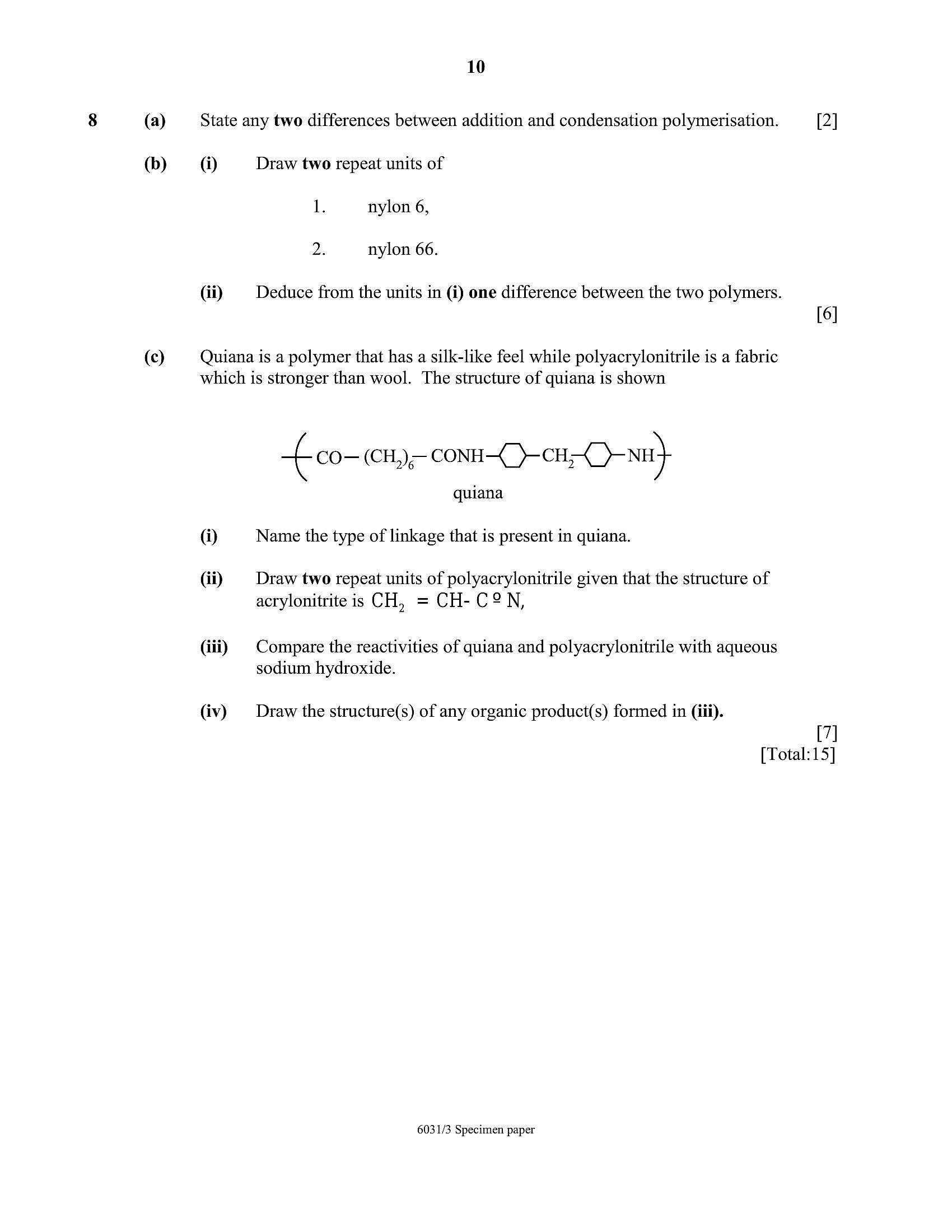
Quiana is a polymer that has a silk-like feel while polyacrylonitrile is a fabric
which is stronger than wool. The structure of quiana is shown
~ CO— (CH,)— CONH-_)—CH;_)— wit}
quiana
0) Name the type of linkage that is present in quiana.
(ii) Draw two repeat units of polyacrylonitrile given that the structure of
acrylonitrite is CH, = CH- C2N,
(iii) | Compare the reactivities of quiana and polyacrylonitrile with aqueous
sodium hydroxide.
(iv) Draw the structure(s) of any organic product(s) formed in (iii).
[Total: im /
6031/3 Specimen paper
---
Page 11
Extracted Text
11 Section DAnswer any one question from this section
Hwange thermal power station contributes a great deal of sulphur dioxide into
the atmosphere.
(a) @ Give the source of SO2 at Hwange.
(ij) | Write an equation to show how SOz is formed.
(iii) | Using equations state and explain two methods that could be
employed in controlling SO2 emission.
(iv) Describe the effects of SO2 emission into the atmosphere.
[7]
ib) @& Define the term incineration.
(ii) State any two advantages and any two disadvantages
of incineration.
(iii) | Describe the effects of ozone depletion.
[8]
[Total : 15]
(a) Define the term
0) partition,
(i) ~—s partition coefficient.
[2]
(b) Butanoic acid of mass 1.20 g was shaken with a mixture of 100 cm?
of water and 100 cm? of ether. After equilibration, the ether layer
had 0.024 moles of butanoic acid whilst the water layer had 0.16 moles.
@ Calculate the partition coefficient for butanoic acid between
ether and water.
(ii) State and explain any two factors which affect the magnitude
of the partition coefficient in b(i).
(iii) State, with a reason, whether a mixture of ethanoic acid dissolved
in water obeys the partition law when added to benzene.
[8]
6031/3 Specimen paper
[Turn over
---
Page 12
Extracted Text
(©)(d)
12
At | atm pressure, HC/ and H2O form an azeotropic mixture containing
20.22% HCI, that boils at 109 °C.
Draw
@ the vapour pressure composition curve for HC/ and H20,
(ii) the boiling composition curve for HC/ and H20.
In each case show the liquid curve, the vapour curve and the
azeotropic composition.
[4]
Describe how a constant boiling point HC/(aq solution can be prepared
in a laboratory. {1]
[Total : 15]
---