📄 Exam Questions & Readable Text Transcript
Full OCR-extracted text of questions, syllabus codes, and exam instructions.
Extracted Content: 6031q2specimen
Page 1
Extracted Text
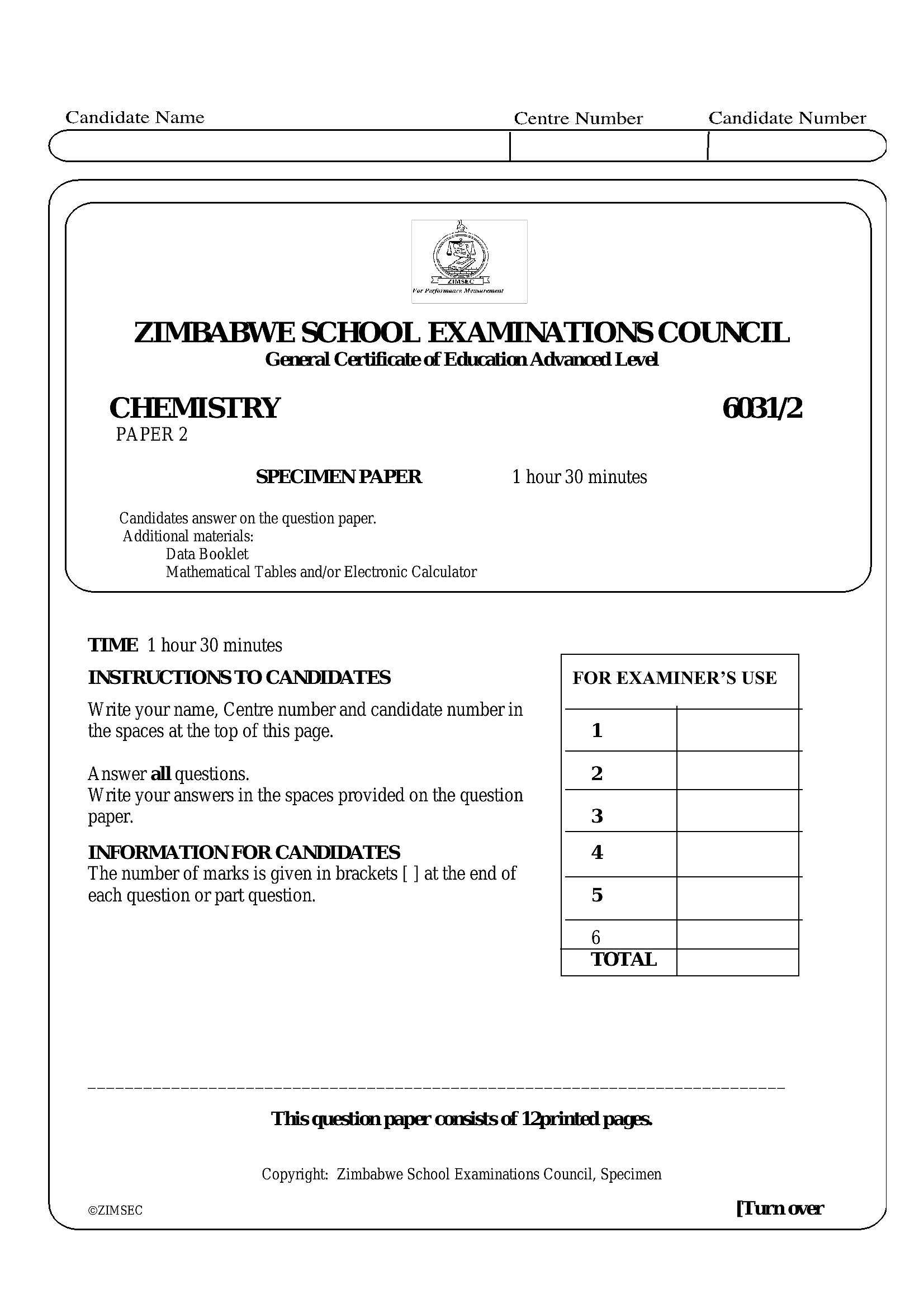
Candidate Name Centre Number Candidate NumberZIMBABWE SCHOOL EXAMINATIONS COUNCIL
General Certificate of Education Advanced Level
CHEMISTRY 6081/2
PAPER 2
SPECIMEN PAPER 1 hour 30 minutes
Candidates answer on the question paper.
Additional materials:
Data Booklet
Mathematical Tables and/or Electronic Calculator
TIME 1 hour 30 minutes
INSTRUCTIONS TO CANDIDATES FOR EXAMINER’S USE
Write your name, Centre number and candidate number in
the spaces at the top of this page. 1
Answer all questions.
Write your answers in the spaces provided on the question
paper.
INFORMATION FOR CANDIDATES
The number of marks is given in brackets [ ] at the end of
each question or part question.
mil w | N
ol
TOTAL
This question paper consists of 2printed pages.
Copyright: Zimbabwe School Examinations Council, Specimen
©ZIMSEC [Turn over
---
Page 2
Extracted Text
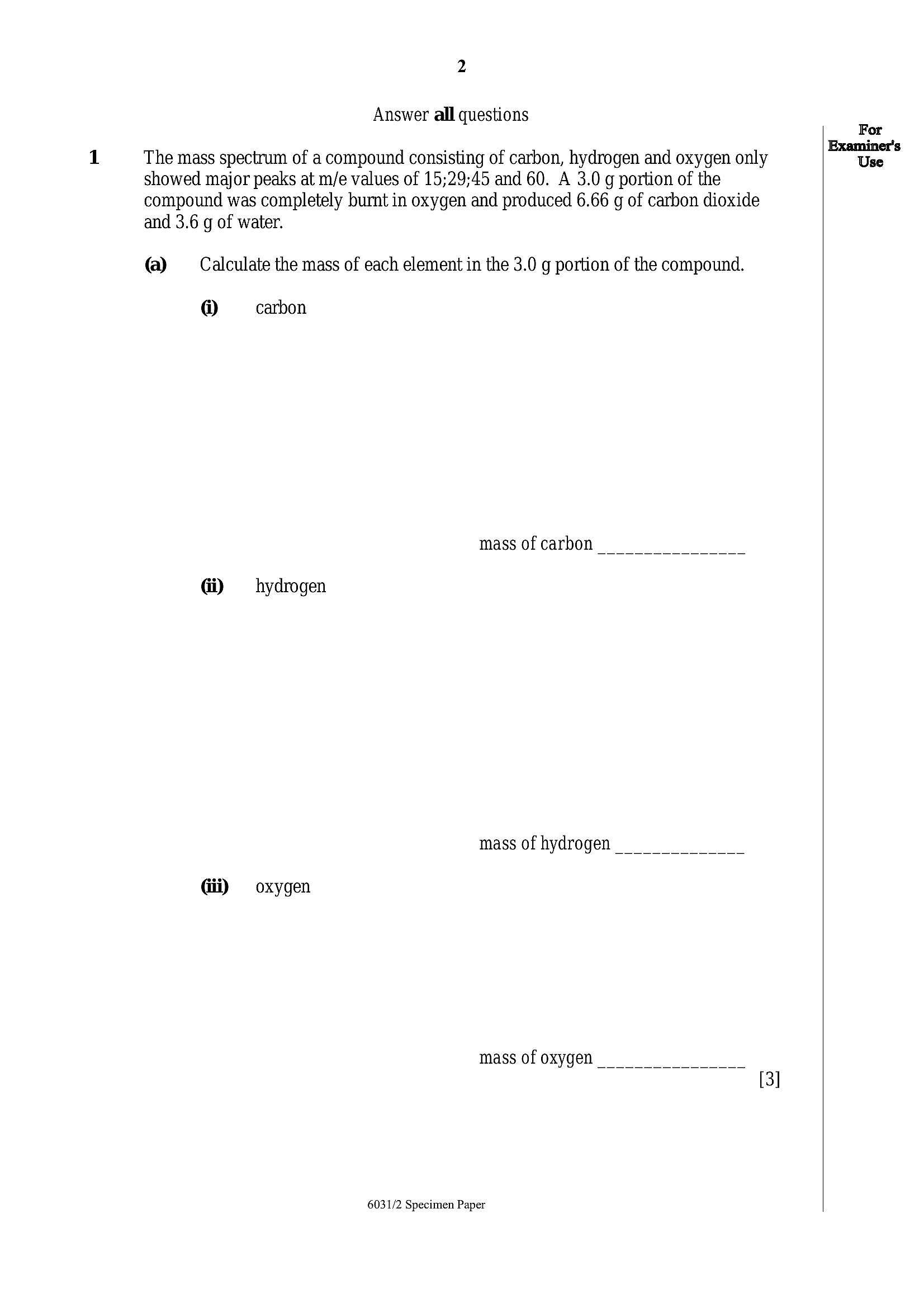
2Answer all questions
The mass spectrum of a compound consisting of carbon, hydrogen and oxygen only
showed major peaks at m/e values of 15;29;45 and 60. A 3.0 g portion of the
compound was completely burnt in oxygen and produced 6.66 g of carbon dioxide
and 3.6 g of water.
(@@) —_ Calculate the mass of each element in the 3.0 g portion of the compound.
@ carbon
mass of carbon
Gi) hydrogen
mass of hydrogen
Gi) oxygen
mass of oxygen
6031/2 Specimen Paper
For
Examiner's
Use
---
Page 3
Extracted Text
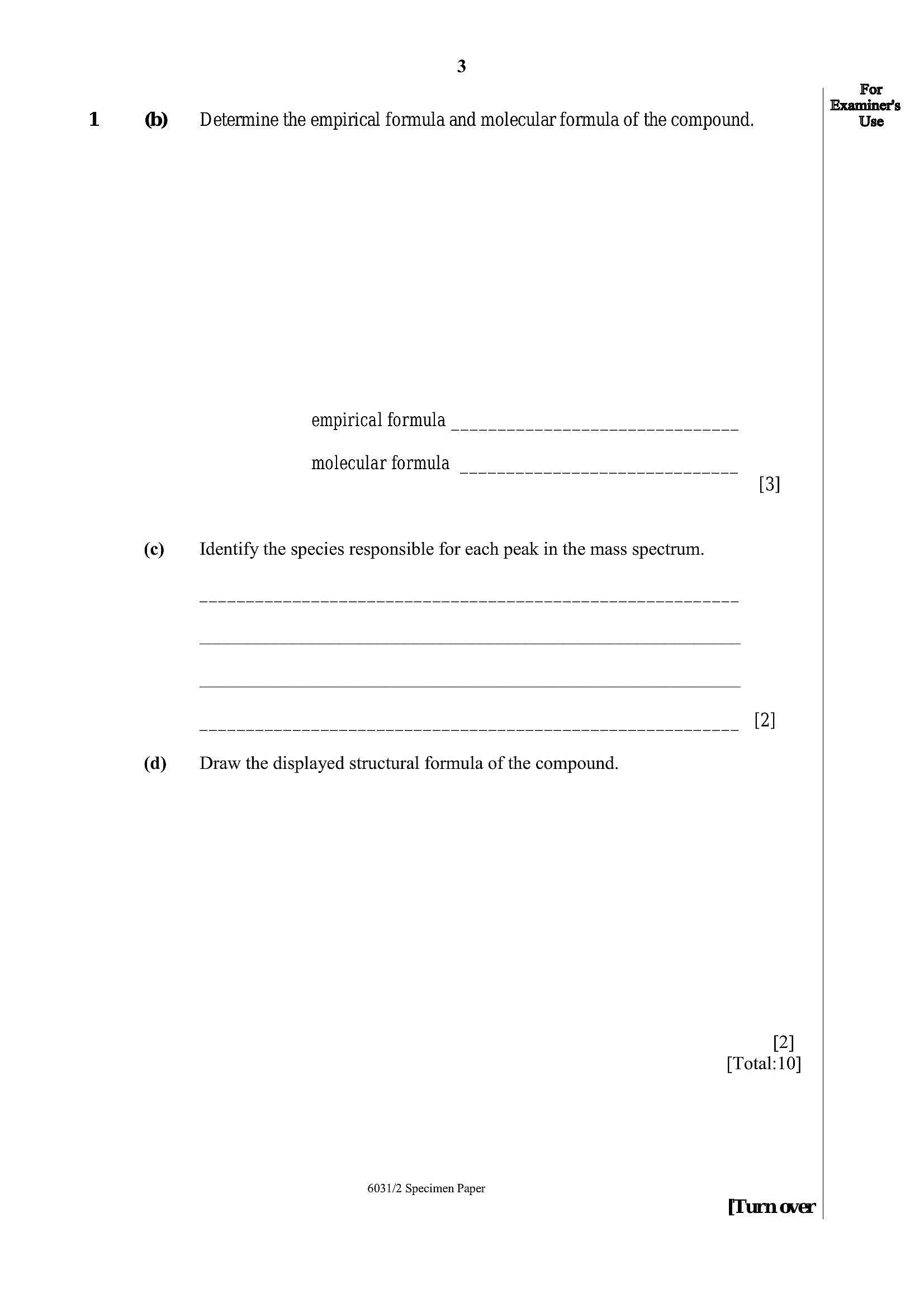
&) _ Determine the empirical formula and molecular formula of the compound.empirical formula
molecular formula
(c) Identify the species responsible for each peak in the mass spectrum.
(d) Draw the displayed structural formula of the compound.
[2]
[Total:10]
6031/2 Specimen Paper
For
Use
---
Page 4
Extracted Text
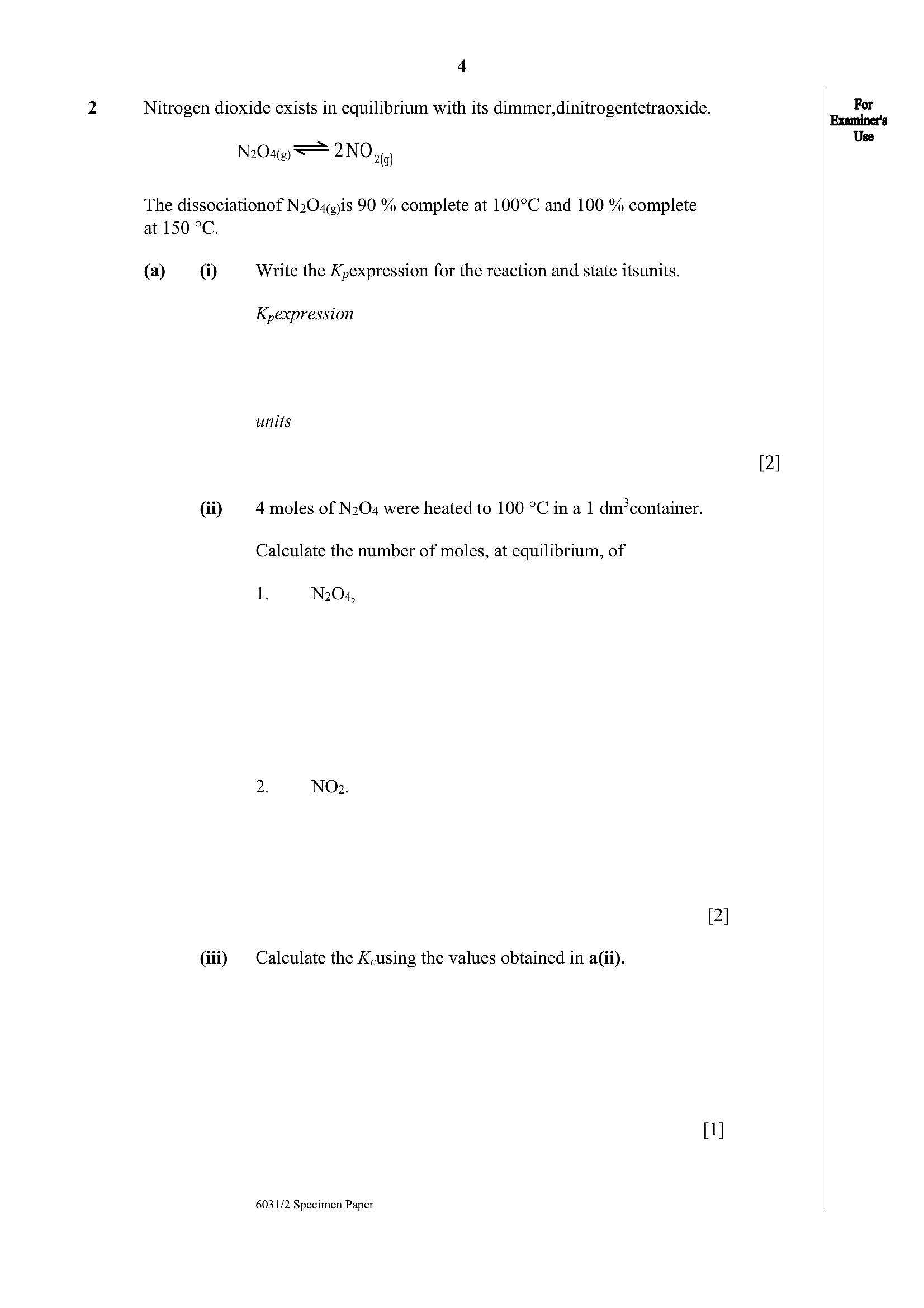
4 Nitrogen dioxide exists in equilibrium with its dimmer,dinitrogentetraoxide.N2Oaq — 2 NO 44)
The dissociationof N2O4q@is 90 % complete at 100°C and 100 % complete
at 150 °C.
(a) @ Write the K,expression for the reaction and state itsunits.
Kpexpression
units
(ii) 4 moles of N2Ou were heated to 100 °C in a 1 dm*container.
Calculate the number of moles, at equilibrium, of
1. N20a,
2. NO2.
[2]
(iii) Calculate the K-using the values obtained in a(ii).
[1]
6031/2 Specimen Paper
[2]
For
Use
---
Page 5
Extracted Text
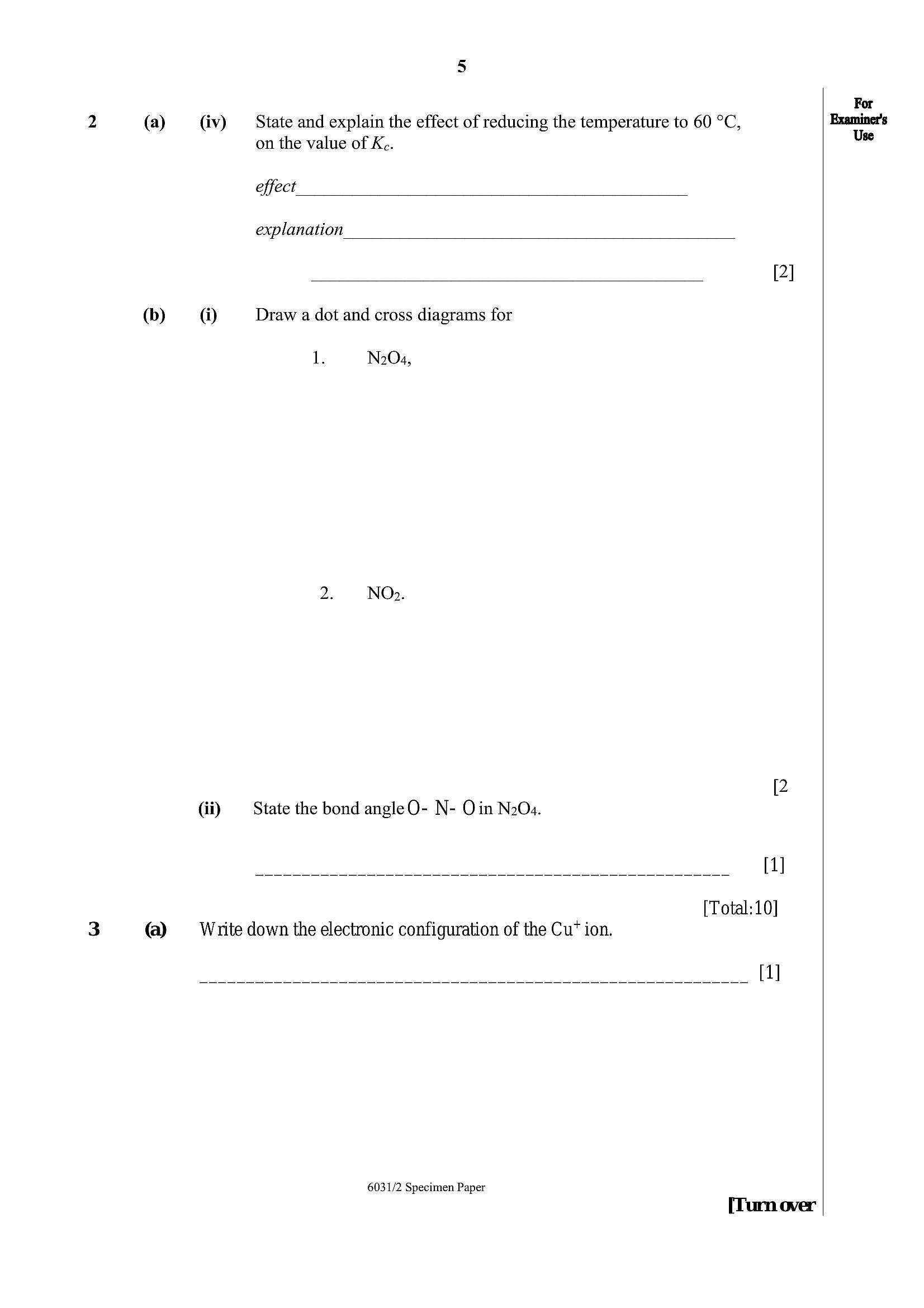
(a) (iv) | State and explain the effect of reducing the temperature to 60 °C,on the value of Ke.
effect
explanation
(b) @ Draw a dot and cross diagrams for
1. N20a,
2. NO».
(ii) State the bond angleO- N- Oin N2Oa.
6031/2 Specimen Paper
[2]
[2
For
Use
---
Page 6
Extracted Text
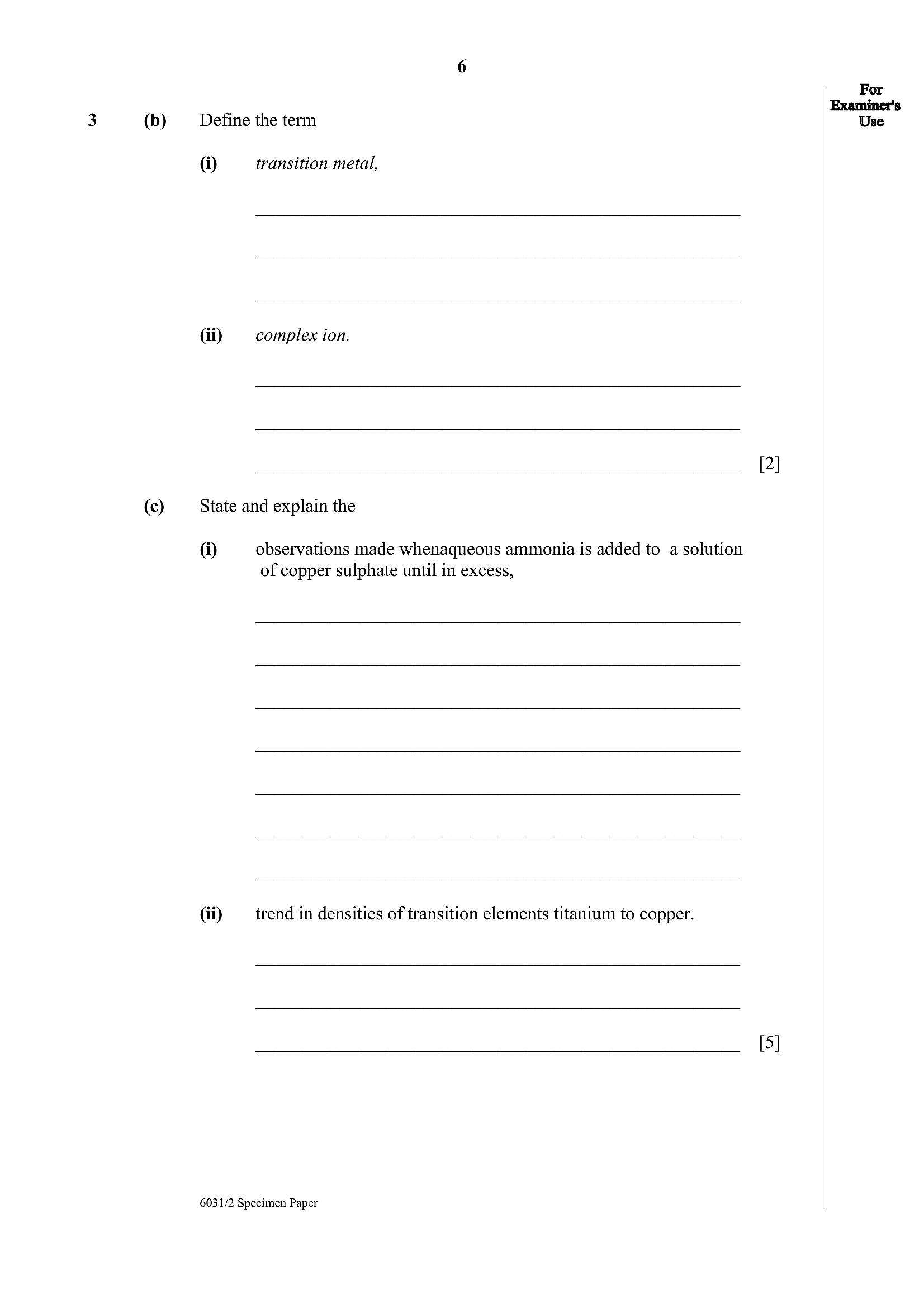
(b) Define the term0) transition metal,
(ii) complex ion.
[2]
(c) State and explain the
@ observations made whenaqueous ammonia is added to a solution
of copper sulphate until in excess,
(ii) trend in densities of transition elements titanium to copper.
[5]
6031/2 Specimen Paper
For
Use
---
Page 7
Extracted Text
7(d) Explain why the melting point of calcium is less than that of manganese.
[2]
[Total:10]
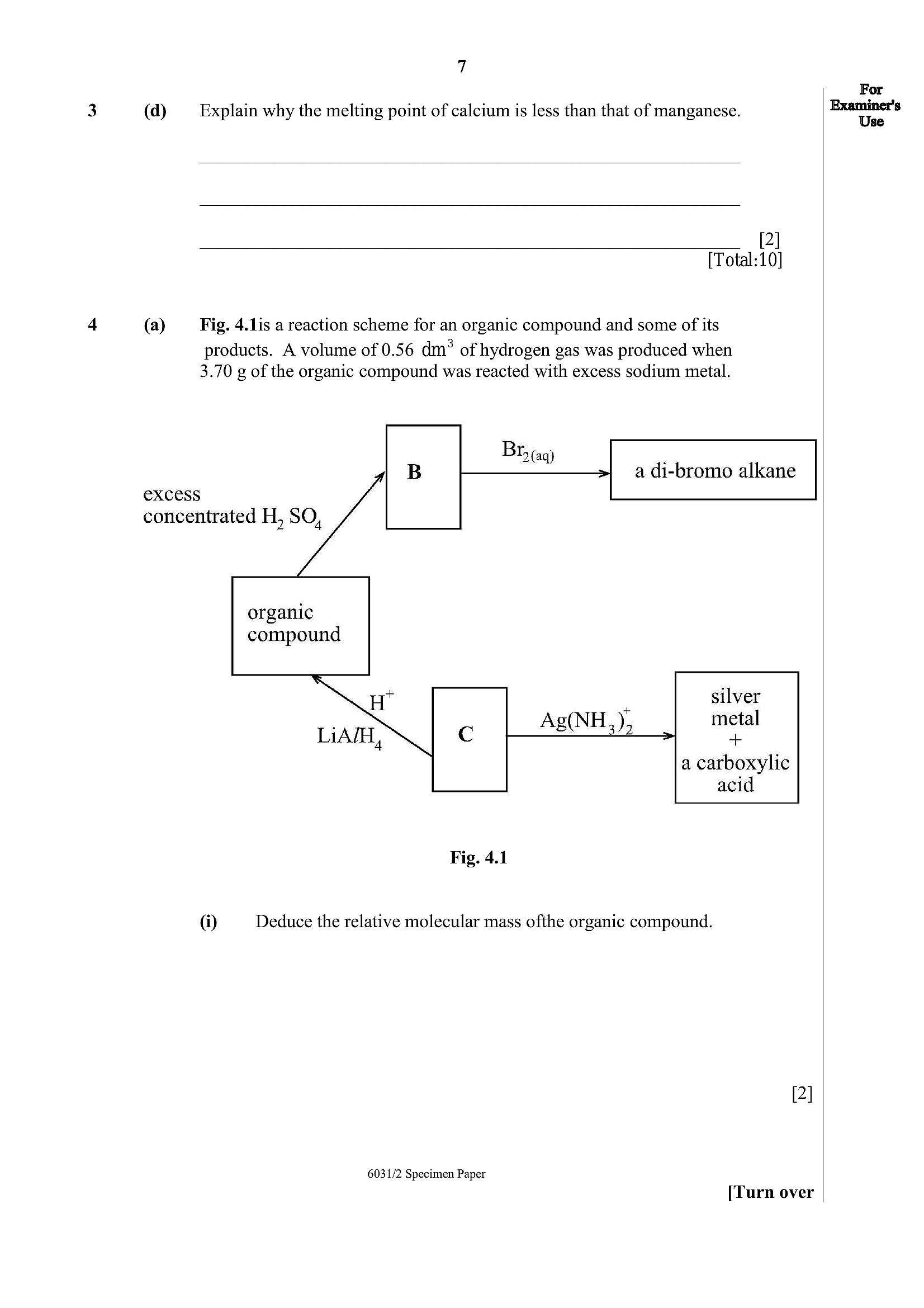
(a) Fig. 4.1is a reaction scheme for an organic compound and some of its
products. A volume of 0.56 dm? of hydrogen gas was produced when
3.70 g of the organic compound was reacted with excess sodium metal.
a di-bromo alkane
eXcess
concentrated H, SO,
organic
compound
silver
metal
+
a carboxylic
acid
Fig. 4.1
@ Deduce the relative molecular mass ofthe organic compound.
[2]
6031/2 Specimen Paper
[Turn over
For
Use
---
Page 8
Extracted Text
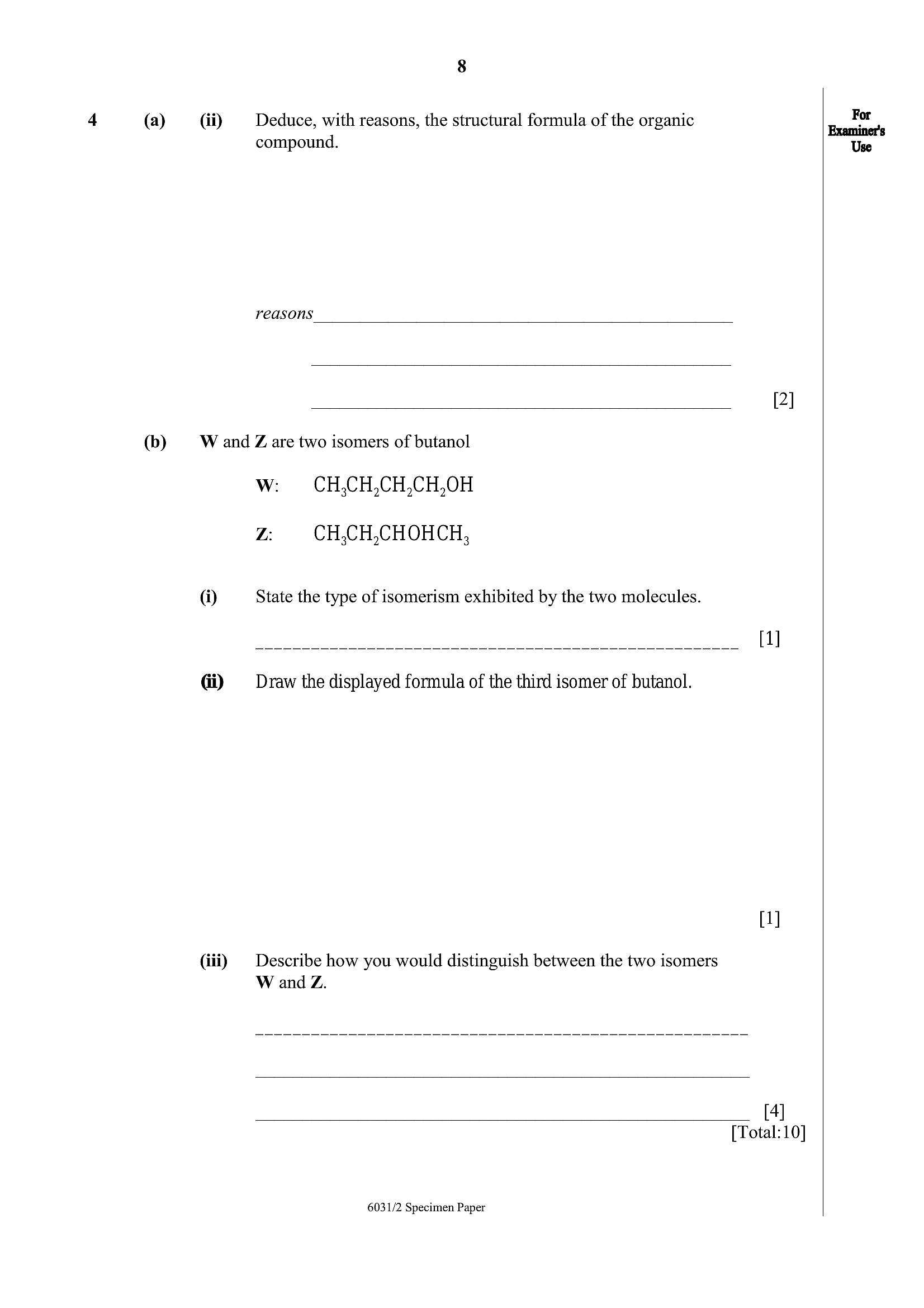
(a) (ii) Deduce, with reasons, the structural formula of the organic compound.reasons
(b) W and Z are two isomers of butanol
Ww: CH,CH,CH,CH,OH
z: CH,CH,CHOHCH,
@ State the type of isomerism exhibited by the two molecules.
Gi) _— Draw the displayed formula of the third isomer of butanol.
(iii) | Describe how you would distinguish between the two isomers
W and Z.
6031/2 Specimen Paper
[2]
[1]
[4]
[Total:10]
For
Use
---
Page 9
Extracted Text
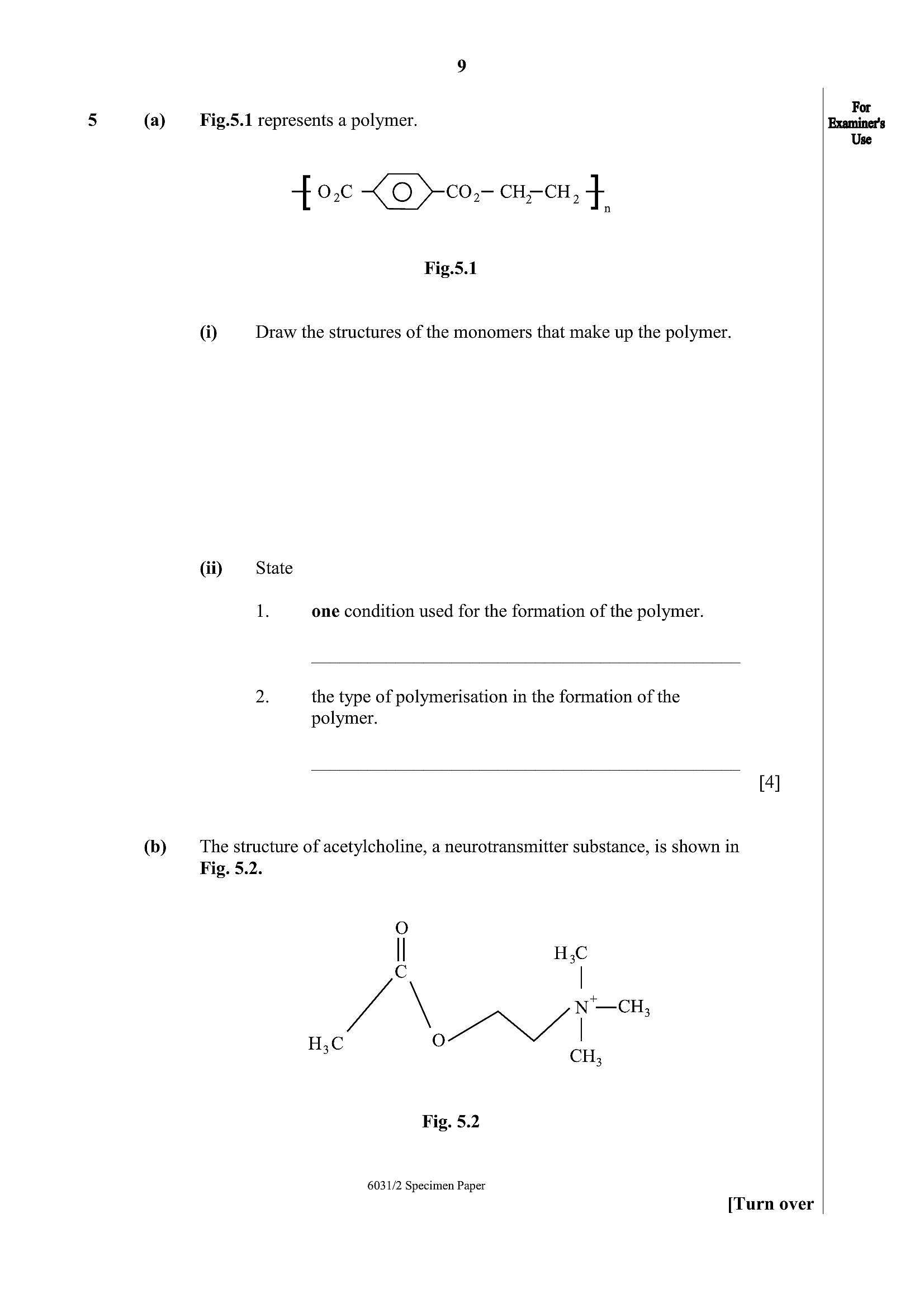
(a) Fig.5.1 represents a polymer.+f 0.¢ <O-CO;- CH-CH, t.
Fig.5.1
@ Draw the structures of the monomers that make up the polymer.
(ii) State
1. one condition used for the formation of the polymer.
2. the type of polymerisation in the formation of the
polymer.
[4]
(b) The structure of acetylcholine, a neurotransmitter substance, is shown in
Fig. 5.2.
0)
| H.C
|
/ \ ware
0 |
H,C cH,
Fig. 5.2
6031/2 Specimen Paper
[Turn over
For
Use
---
Page 10
Extracted Text
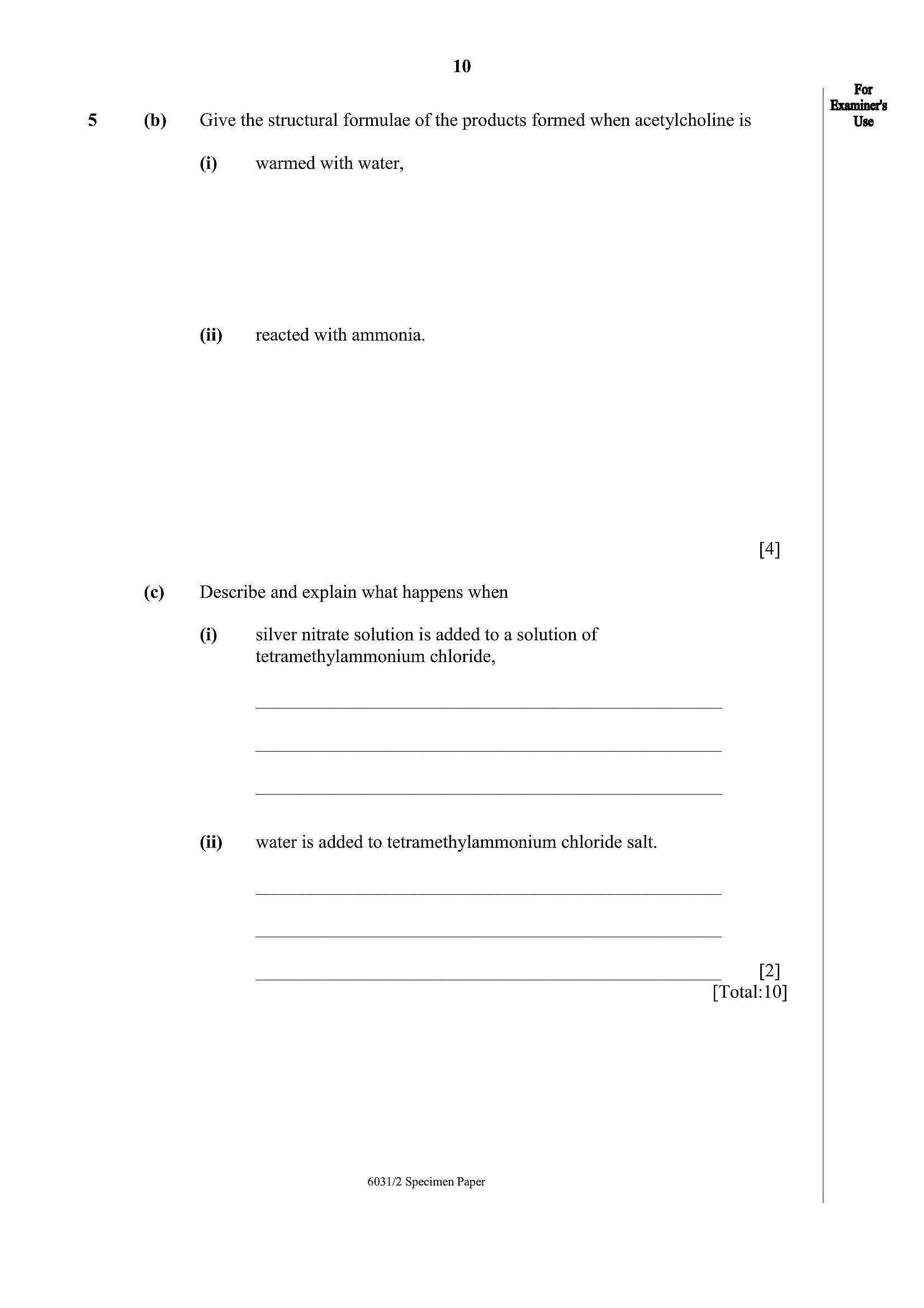
10(b) Give the structural formulae of the products formed when acetylcholine is
@ warmed with water,
(ij) ~~ reacted with ammonia.
[4]
(c) Describe and explain what happens when
@ silver nitrate solution is added to a solution of
tetramethylammonium chloride,
(ii) —_— water is added to tetramethylammonium chloride salt.
[2]
[Total:10]
6031/2 Specimen Paper
For
Use
---
Page 11
Extracted Text
(a)(b)
11
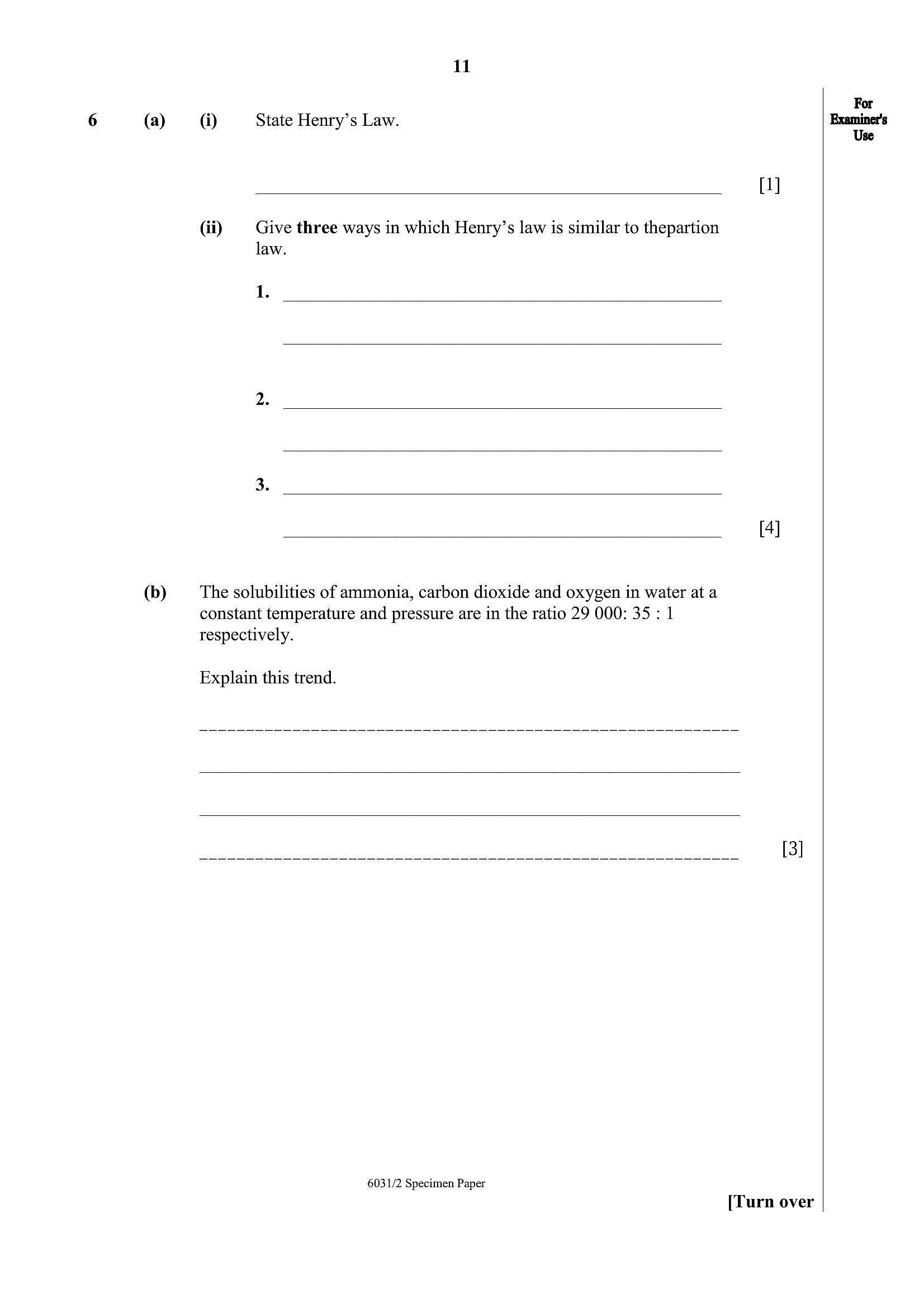
@ State Henry’s Law.
[1]
(ii) Give three ways in which Henry’s law is similar to thepartion
law.
1.
[4]
The solubilities of ammonia, carbon dioxide and oxygen in water at a
constant temperature and pressure are in the ratio 29 000: 35 : 1
respectively.
Explain this trend.
6031/2 Specimen Paper
[Turn over
For
Use
---
Page 12
Extracted Text
()12
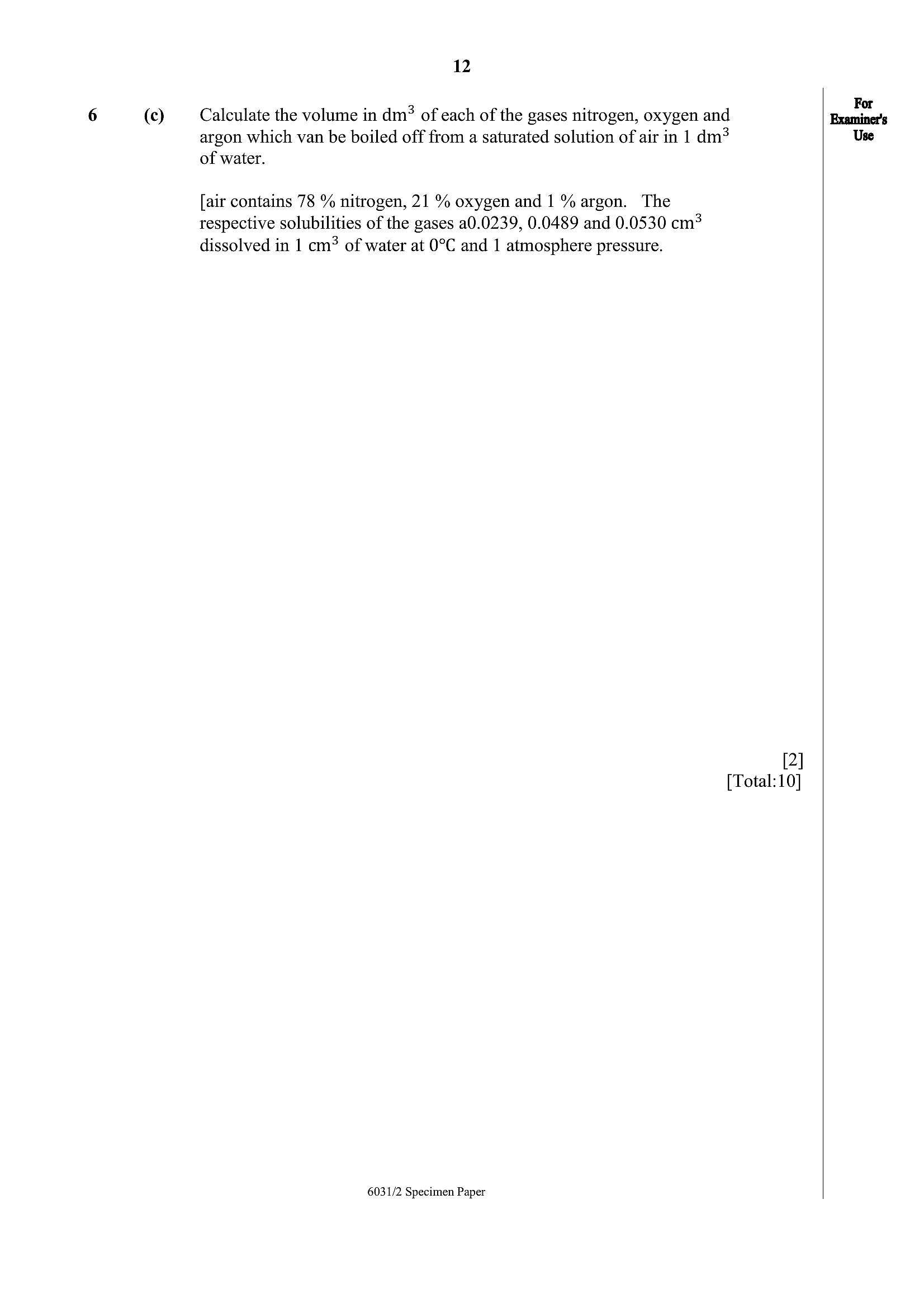
Calculate the volume in dm? of each of the gases nitrogen, oxygen and
argon which van be boiled off from a saturated solution of air in 1 dm?
of water.
[air contains 78 % nitrogen, 21 % oxygen and 1 % argon. The
respective solubilities of the gases a0.0239, 0.0489 and 0.0530 cm?
dissolved in 1 cm? of water at 0°C and 1 atmosphere pressure.
[2]
[Total:10]
6031/2 Specimen Paper
For
Use
---