📄 Exam Questions & Readable Text Transcript
Full OCR-extracted text of questions, syllabus codes, and exam instructions.
Extracted Content: 6030q4 specimen
Page 1
Extracted Text
Candidate Name Centre Number Candidate NumberZIMBABWE SCHOOL EXAMINATIONS COUNCIL
General Certificate of Education Advanced Level
BIOLOGY 6080/4.
PAPER 4 Practical Test
SPECIMEN PAPER 2 hours 30 minutes
Candidates answer on the question paper.
Additional materials:
As listed in Instructions to Supervisors
Electronic calculator
TIME 2 hours 30 minutes
INSTRUCTIONS TO CANDIDATES
Write your name, Centre number and candidate number in the spaces at the top of this page.
Answer all questions.
Write your answers in the spaces provided on the question paper.
INFORMATION FOR CANDIDATES
The intended number of marks is given in brackets [ ] at the end of each question or part question.
Y ou are advised to spend the first 15 minutes carefully reading through the whole paper before
starting to answer any question. These 15 minutes are included in the time allocated for the
whole paper.
FOR EXAMINER’S USE
Y ou are reminded of the need for good English and
clear presentation in your answers. 1
2
3
TOTAL
This question paper consists of 8 printed pages.
Copyright: Zimbabwe School Examinations Council, Specimen Paper.
©ZIMSEC SPECIMEN PAPER [Turn over
---
Page 2
Extracted Text
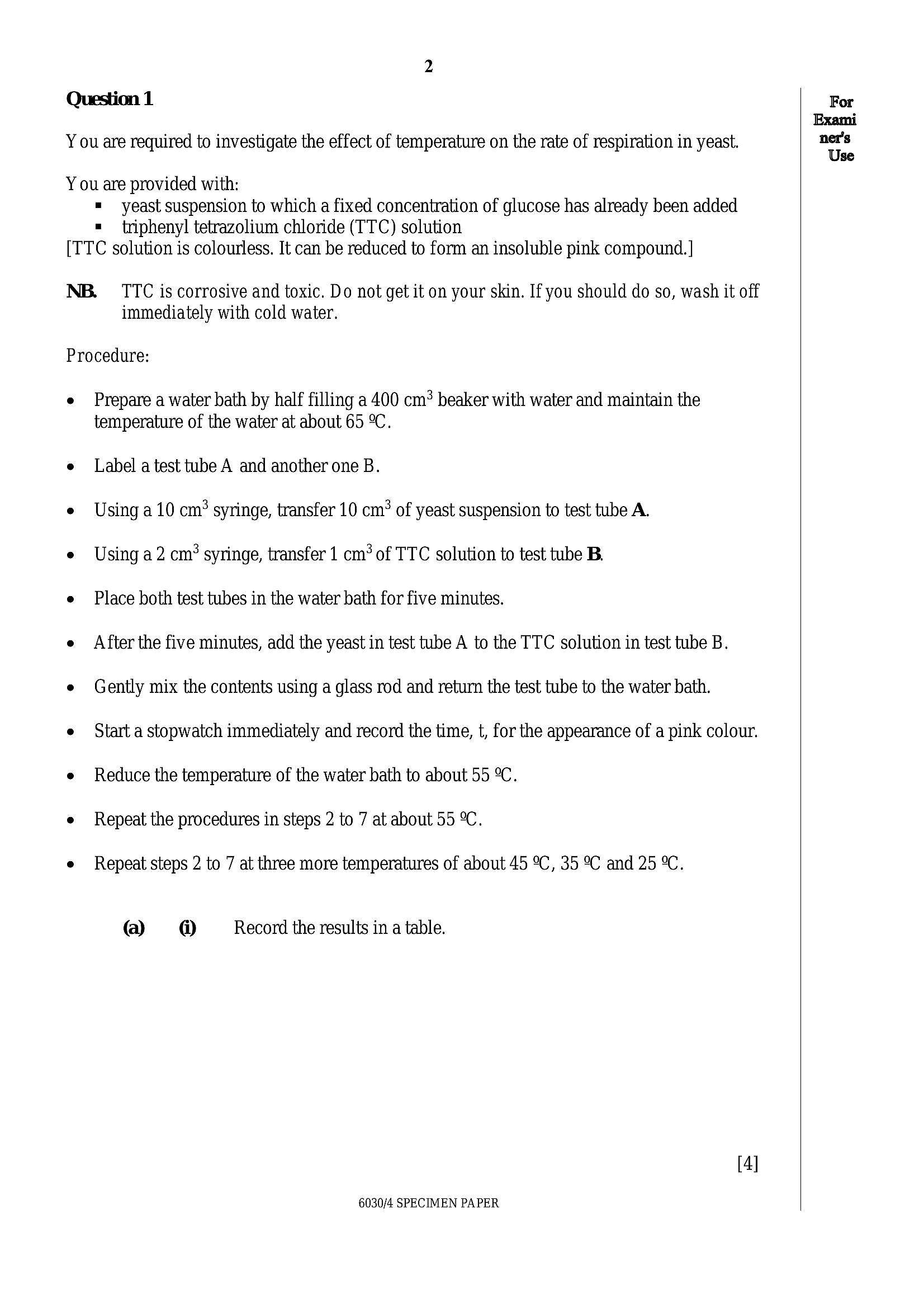
Question 1 Y ou are required to investigate the effect of temperature on the rate of respiration in yeast. Y ou are provided with: = yeast suspension to which a fixed concentration of glucose has already been added = tripheny! tetrazolium chloride (TTC) solution [TTC solution is colourless. It can be reduced to form an insoluble pink compound. ]NB. TTC is corrosive and toxic. Do not get it on your skin. If you should do so, wash it off
immediately with cold water.
Procedure:
e Prepare a water bath by half filling a 400 cm? beaker with water and maintain the
temperature of the water at about 65 °C.
e Label atest tube A and another one B.
e Using a 10 cm? syringe, transfer 10 cm? of yeast suspension to test tube A.
e Using a2 cm! syringe, transfer 1 cm? of TTC solution to test tube B.
e Place both test tubes in the water bath for five minutes.
e After the five minutes, add the yeast in test tube A to the TTC solution in test tube B.
e Gently mix the contents using a glass rod and return the test tube to the water bath.
e Start a stopwatch immediately and record the time, t, for the appearance of a pink colour.
e Reduce the temperature of the water bath to about 55 °C.
e Repeat the procedures in steps 2 to 7 at about 55 °C.
e Repeat steps 2 to 7 at three more temperatures of about 45 °C, 35 °C and 25 °C.
(a) @ Record the results in a table.
[4]
6030/4 SPECIMEN PAPER
For
ner's
Use
---
Page 3
Extracted Text
Forner's
Use
[3]
over
=
: meestontesstacttastectesrtasttastastanita
pp py
hot Scene
; SS EES Eee 0 eee eee ee eee ce
H SEE
6030/4 SPECIMEN PAPER
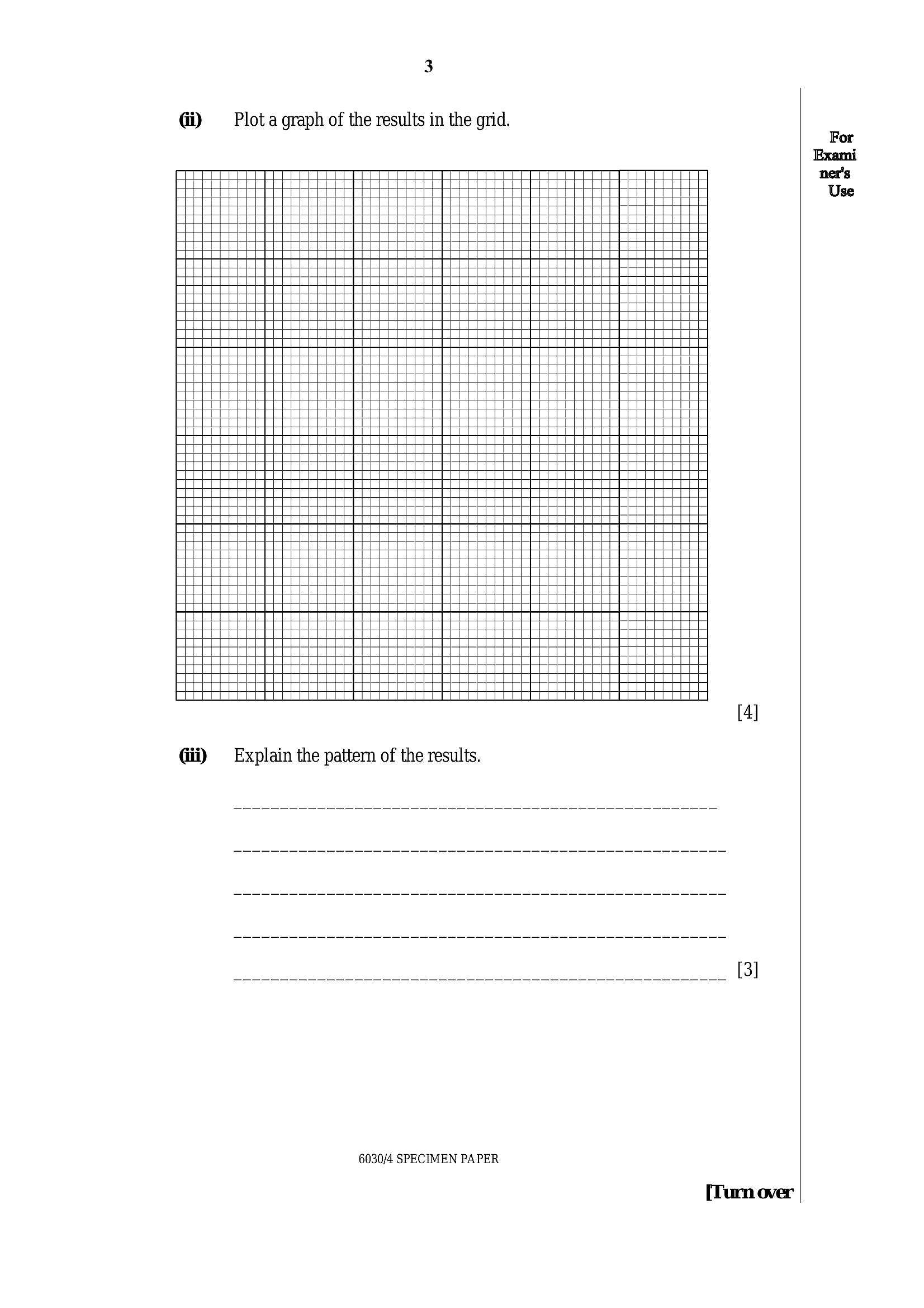
Plot a graph of the results in the grid.
Explain the pattern of the results.
@i)
Sco eas ee
SEES EEEEEEETOUEEEEEE
PEEEEEEEEEEEEEE EEE
Gii)
---
Page 4
Extracted Text
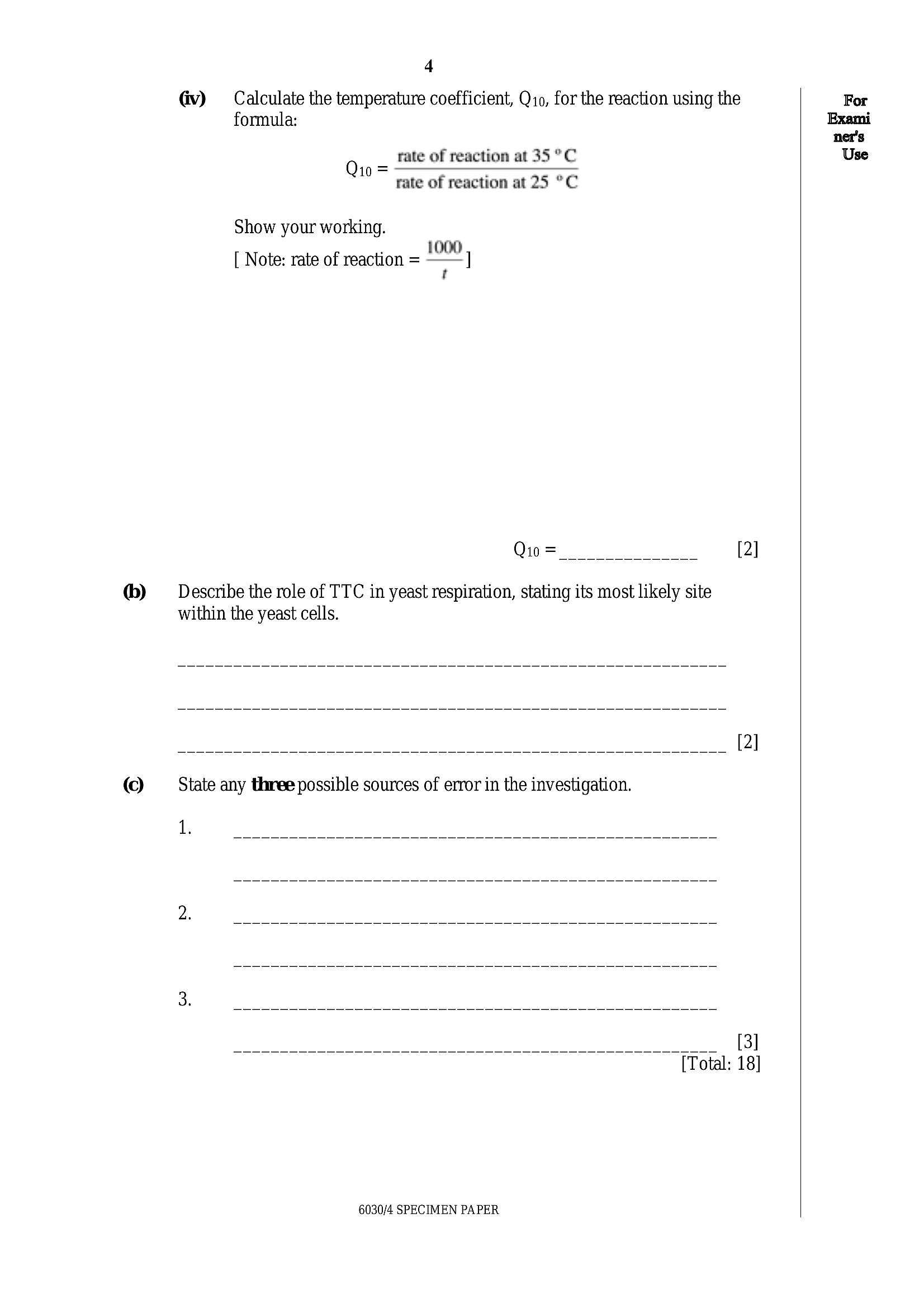
4@) Calculate the temperature coefficient, Qo, for the reaction using the
formula:
rate of reaction at 35°C
Qo =
rate of reaction at 25 °C
Show your working.
. 000
[ Note: rate of reaction = a
Qto = [2]
&) Describe the role of TTC in yeast respiration, stating its most likely site
within the yeast cells.
© State any three possible sources of error in the investigation.
6030/4 SPECIMEN PAPER
For
ner's
Use
---
Page 5
Extracted Text
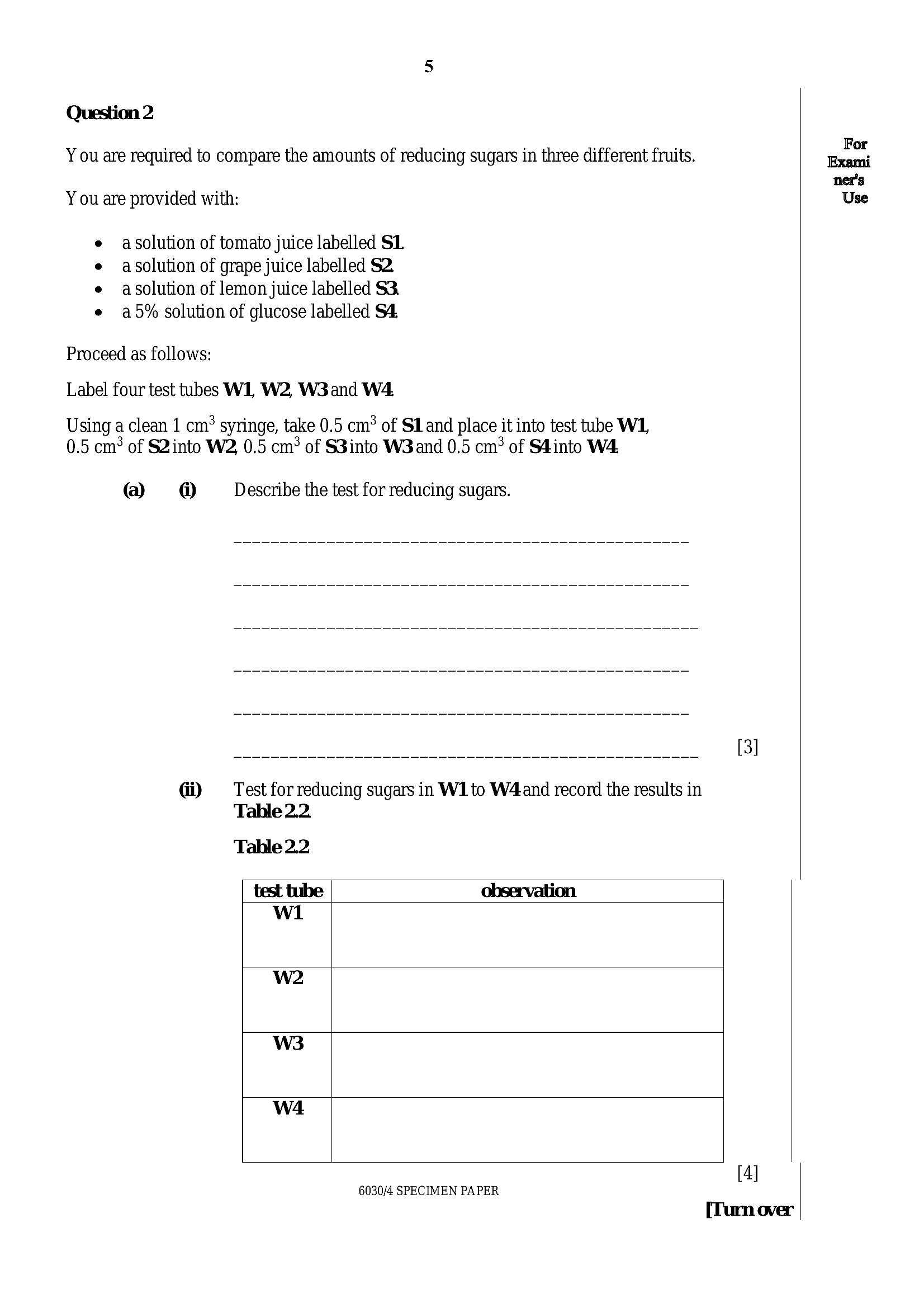
Question 2 Y ou are required to compare the amounts of reducing sugars in three different fruits. Y ou are provided with:a solution of tomato juice labelled SL
a solution of grape juice labelled S2.
a solution of lemon juice labelled S3.
a 5% solution of glucose labelled S4
Proceed as follows:
Label four test tubes W1, W2, W3 and W4
Using a clean 1 cm! syringe, take 0.5 cm? of S1and place it into test tube W1,
0.5 cm? of S2into W2, 0.5 cm? of S3into W3and 0.5 cm? of SAinto W4.
(a) @ Describe the test for reducing sugars.
Gi) ‘Test for reducing sugars in W1 to W4and record the results in
Tahle 2.2.
Tahle2.2
test tube observation.
wil
Ww4
6030/4 SPECIMEN PAPER
[4]
[Turn over
For
ner's
Use
---
Page 6
Extracted Text
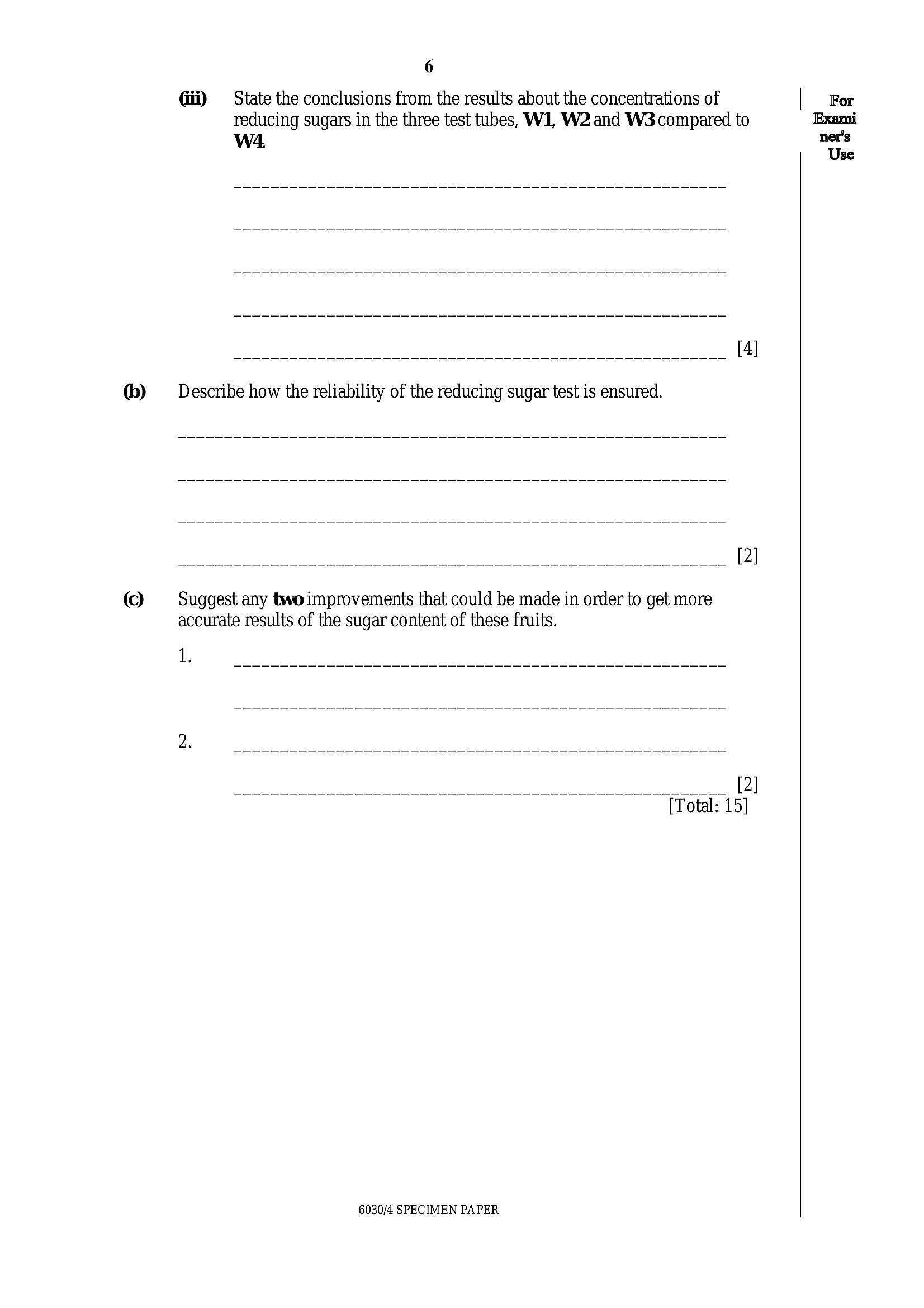
6Gii) State the conclusions from the results about the concentrations of
reducing sugars in the three test tubes, W1, W2 and W3 compared to
W4.
&) Describe how the reliability of the reducing sugar test is ensured.
© — Suggest any twoimprovements that could be made in order to get more
accurate results of the sugar content of these fruits.
wo [2]
[Total: 15]
6030/4 SPECIMEN PAPER
For
ner's
Use
---
Page 7
Extracted Text
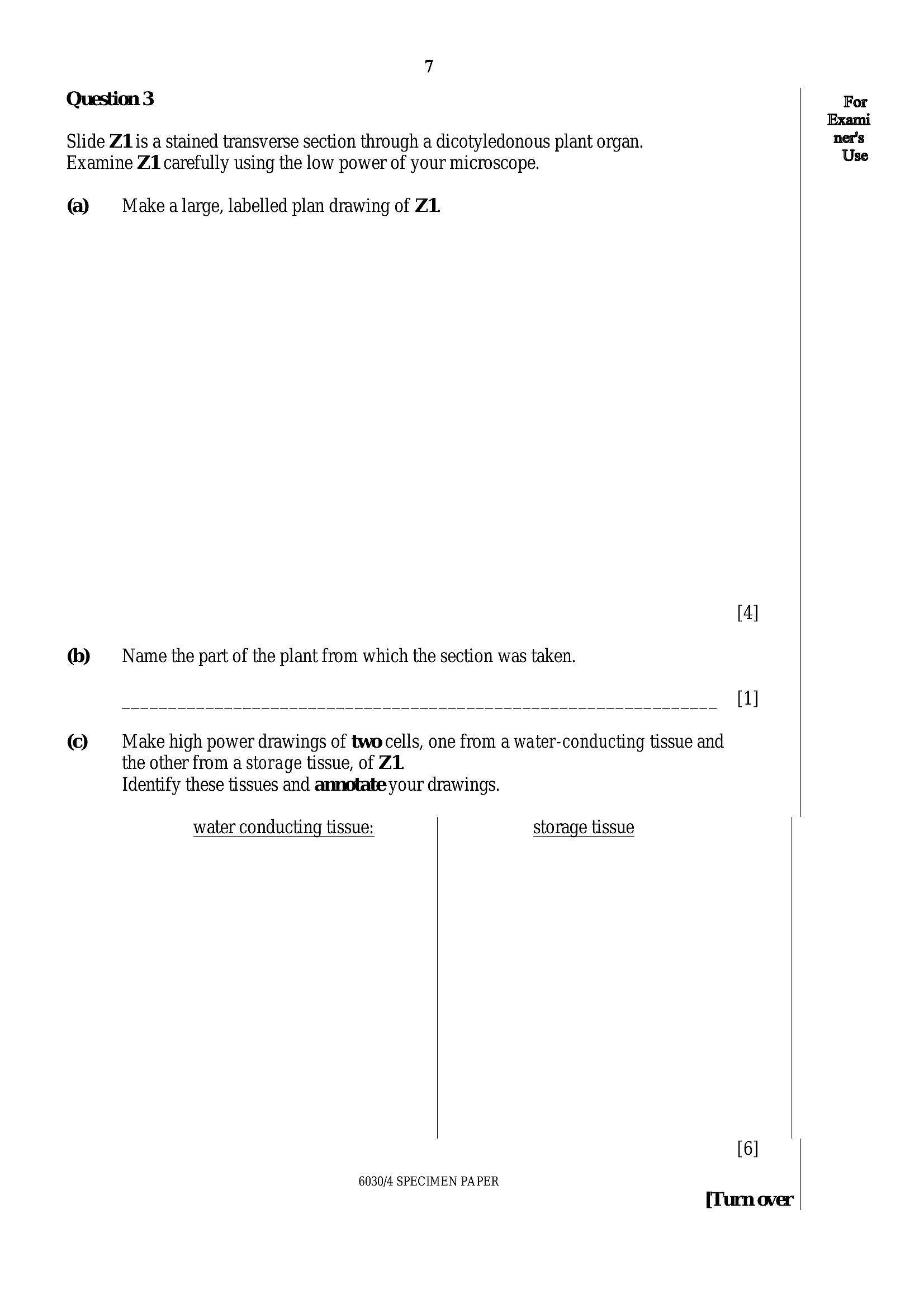
Question 3Slide Z1 is a stained transverse section through a dicotyledonous plant organ.
Examine Z1 carefully using the low power of your microscope.
@) = Makea large, labelled plan drawing of Z1.
&) Name the part of the plant from which the section was taken.
© Make high power drawings of two cells, one from a water-conducting tissue and
the other from a storage tissue, of Z1.
Identify these tissues and annotate your drawings.
water conducting tissue:
6030/4 SPECIMEN PAPER
storage tissue
[6]
[Turn over
For
ner's
Use
---
Page 8
Extracted Text
qd)8
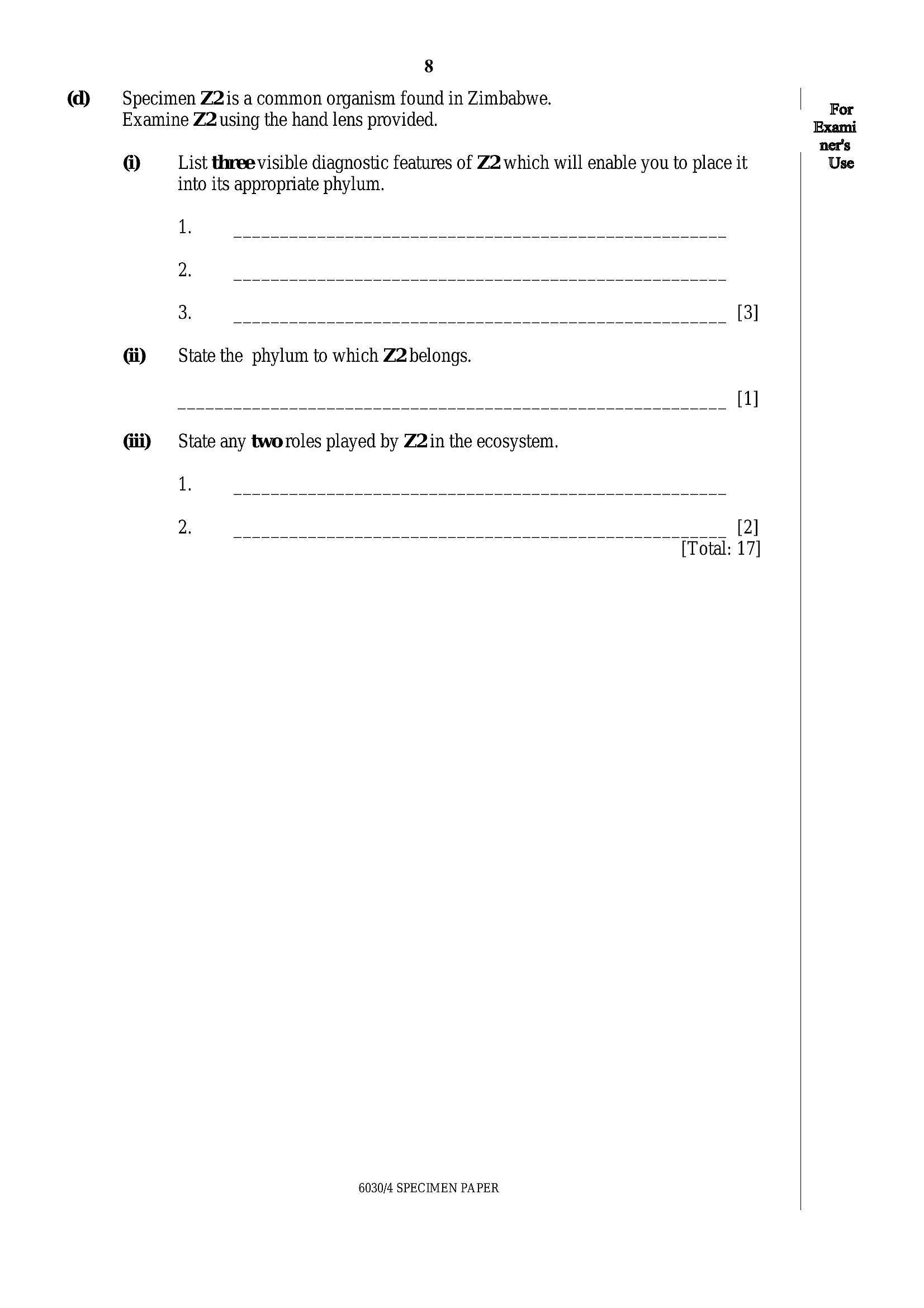
Specimen Z2 is a common organism found in Zimbabwe.
Examine Z2 using the hand lens provided.
@ List three visible diagnostic features of Z2 which will enable you to place it
into its appropriate phylum.
Gi) State the phylum to which Z2 belongs.
Gi) State any tworovles played by Z2 in the ecosystem.
2. [2]
[Total: 17]
6030/4 SPECIMEN PAPER
For
net's
Use
---