


📄 Exam Questions & Readable Text Transcript
Full OCR-extracted text of questions, syllabus codes, and exam instructions.
Extracted Content: 4003q3 specimen paper.
Page 1
Extracted Text
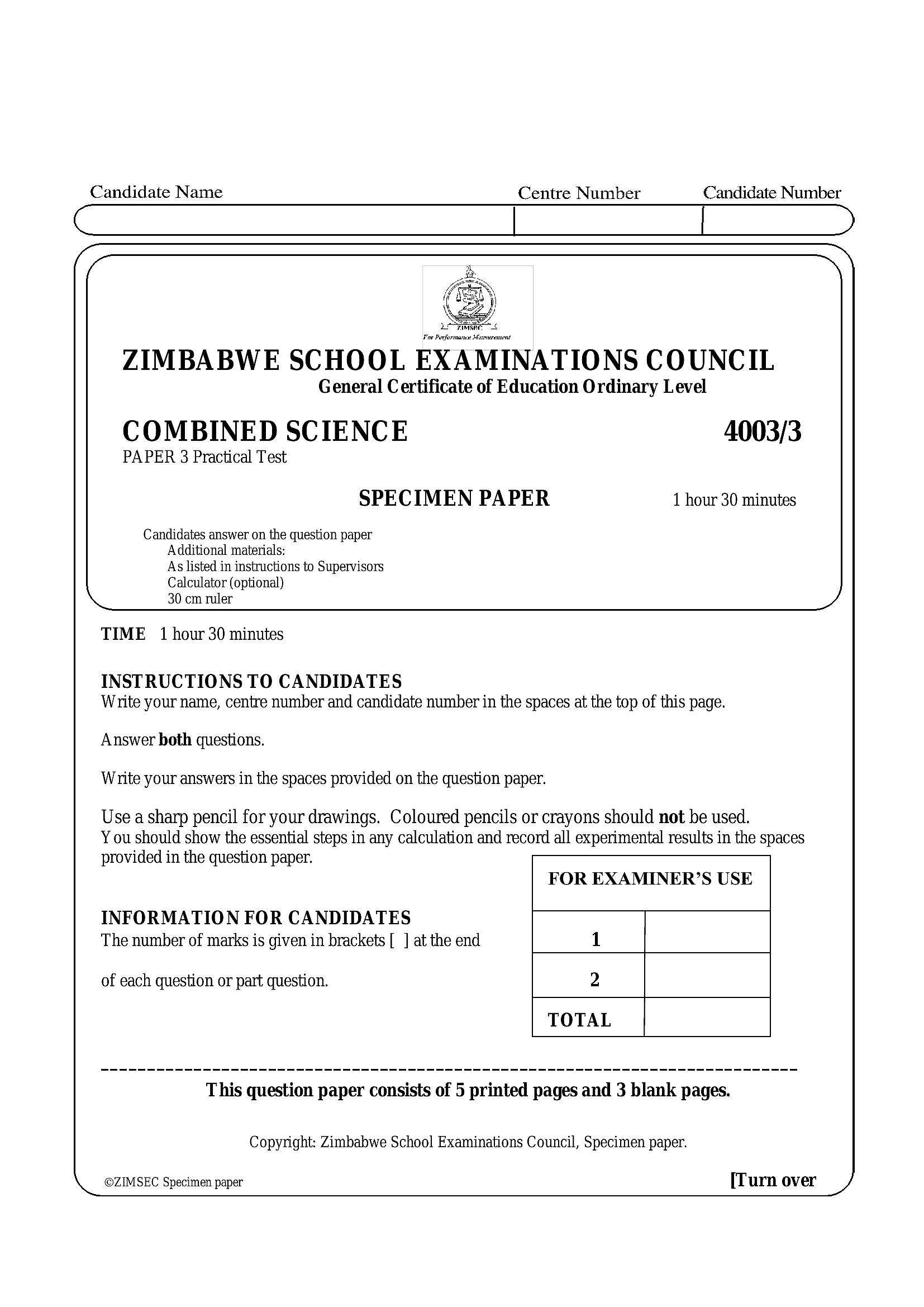
Candidate Name Centre Number Candidate NumberTor Perfart crement
ZIMBABWE SCHOOL EXAMINATIONS COUNCIL
General Certificate of Education Ordinary Level
COMBINED SCIENCE 4003/3
PAPER 3 Practical Test
SPECIMEN PAPER 1 hour 30 minutes
Candidates answer on the question paper
Additional materials:
As listed in instructions to Supervisors
Calculator (optional)
30 cm ruler
TIME 1 hour 30 minutes
INSTRUCTIONS TO CANDIDATES
Write your name, centre number and candidate number in the spaces at the top of this page.
Answer both questions.
Write your answers in the spaces provided on the question paper.
Use a sharp pencil for your drawings. Coloured pencils or crayons should not be used.
Y ou should show the essential steps in any calculation and record all experimental results in the s
provided in the question paper.
FOR EXAMINER’S USE
INFORMATION FOR CANDIDATES
The number of marks is given in brackets [ ] at the end
of each question or part question.
This question paper consists of 5 printed pages and 3 blank pages.
Copyright: Zimbabwe School Examinations Council, Specimen paper.
©ZIMSEC Specimen paper [Turn over
---
Page 2
Extracted Text
(a)2
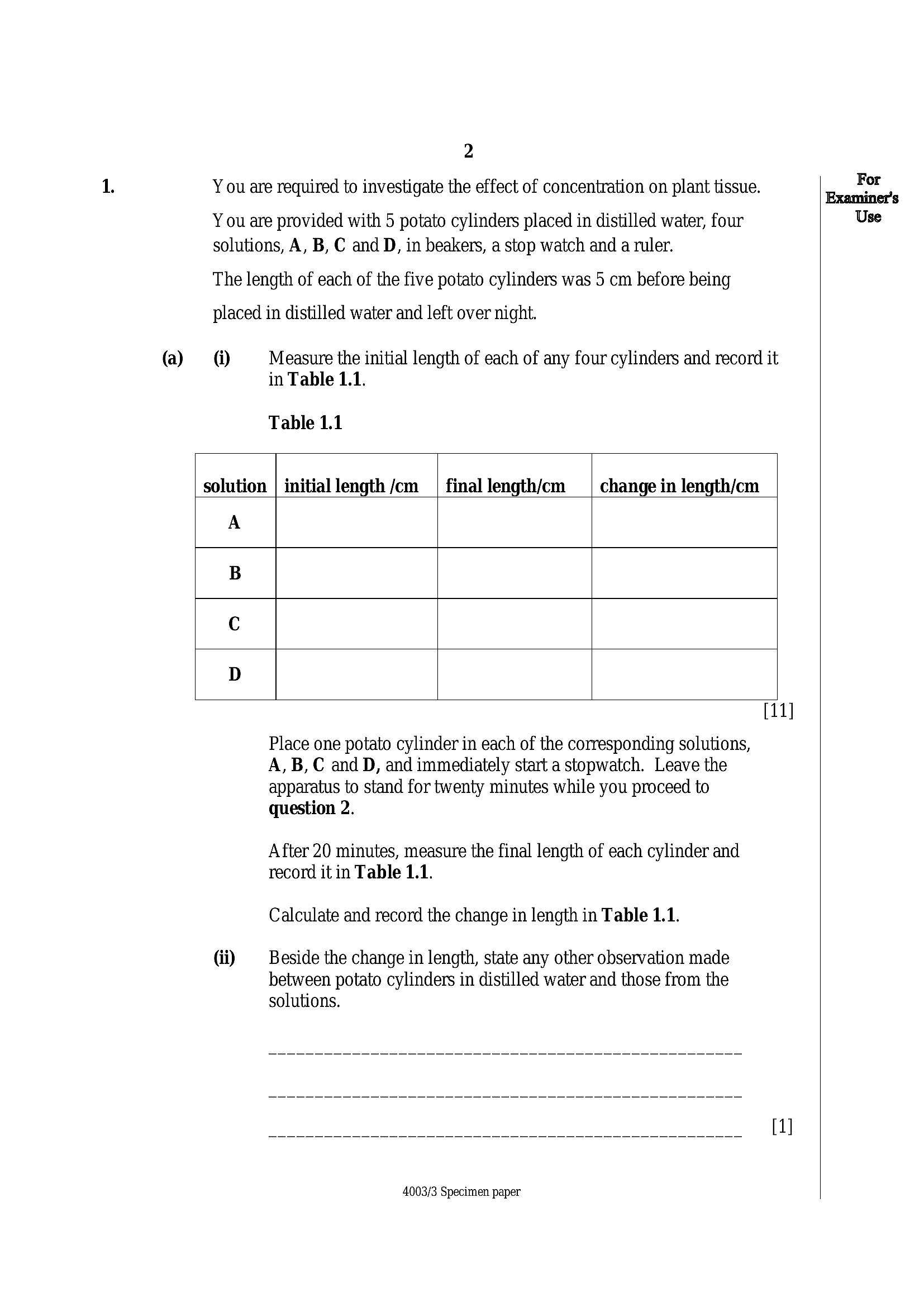
Y ou are required to investigate the effect of concentration on plant tissue.
Y ou are provided with 5 potato cylinders placed in distilled water, four
solutions, A, B, C and D, in beakers, a stop watch and a ruler.
The length of each of the five potato cylinders was 5 cm before being
placed in distilled water and left over night.
[11]
(1) Measure the initial length of each of any four cylinders and record it
in Table 1.1.
Table 1.1
solution | initial length /cm | final length/cm _| change in length/cm
A
B
C
D
Place one potato cylinder in each of the corresponding solutions,
A,B,C and D, and immediately start a stopwatch. Leave the
apparatus to stand for twenty minutes while you proceed to
question 2.
After 20 minutes, measure the final length of each cylinder and
record it in Table 1.1.
Calculate and record the change in length in Table 1.1.
(ii) Beside the change in length, state any other observation made
between potato cylinders in distilled water and those from the
solutions.
4003/3 Specimen paper
For
Examiner's
Use
---
Page 3
Extracted Text
©3
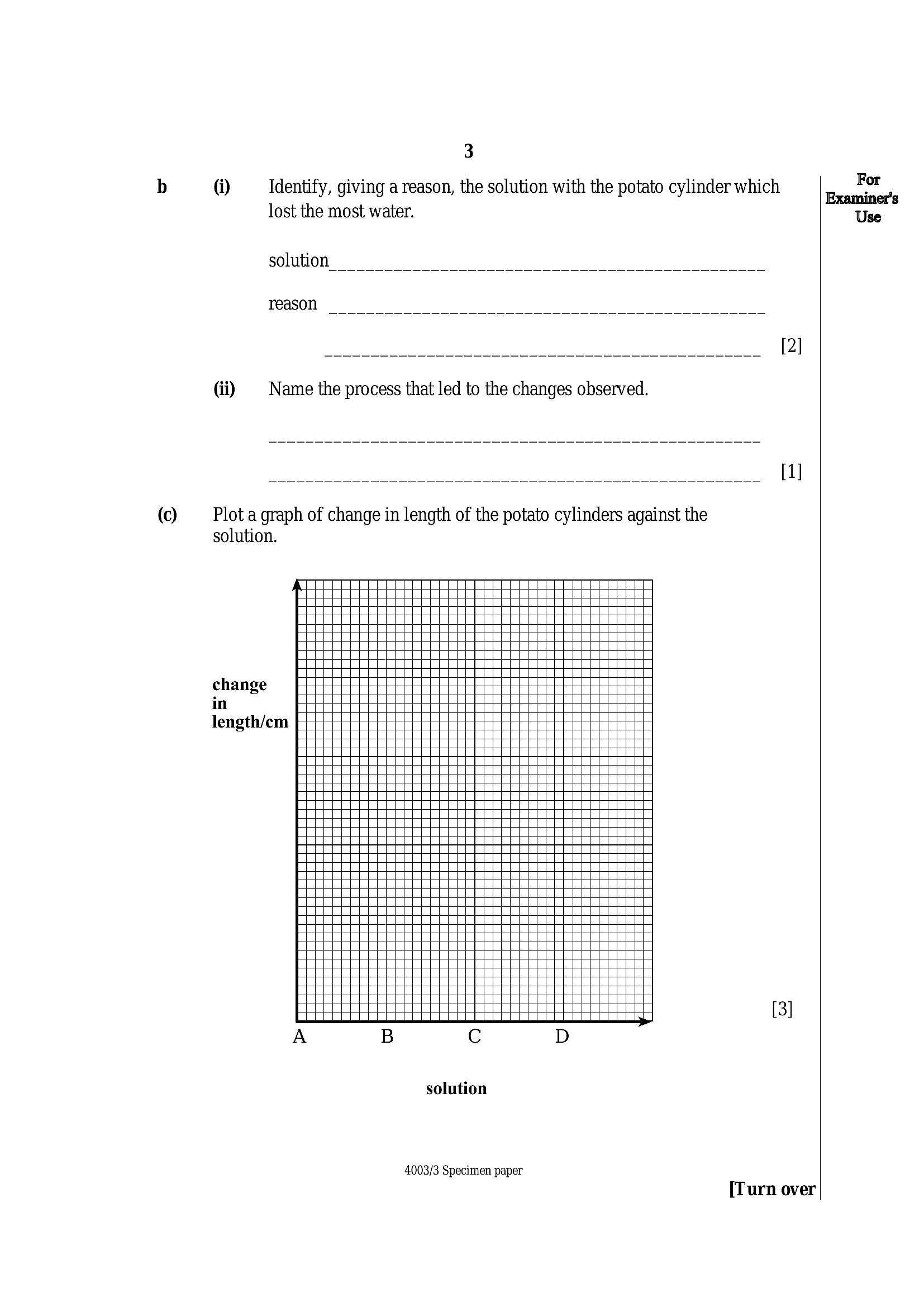
(1) Identify, giving a reason, the solution with the potato cylinder which
lost the most water.
solution
(ii) Name the process that led to the changes observed.
Plot a graph of change in length of the potato cylinders against the
solution.
in
length/em
solution
4003/3 Specimen paper
[Turn over
For
Examiner's
Use
---
Page 4
Extracted Text
(d)(a)
4
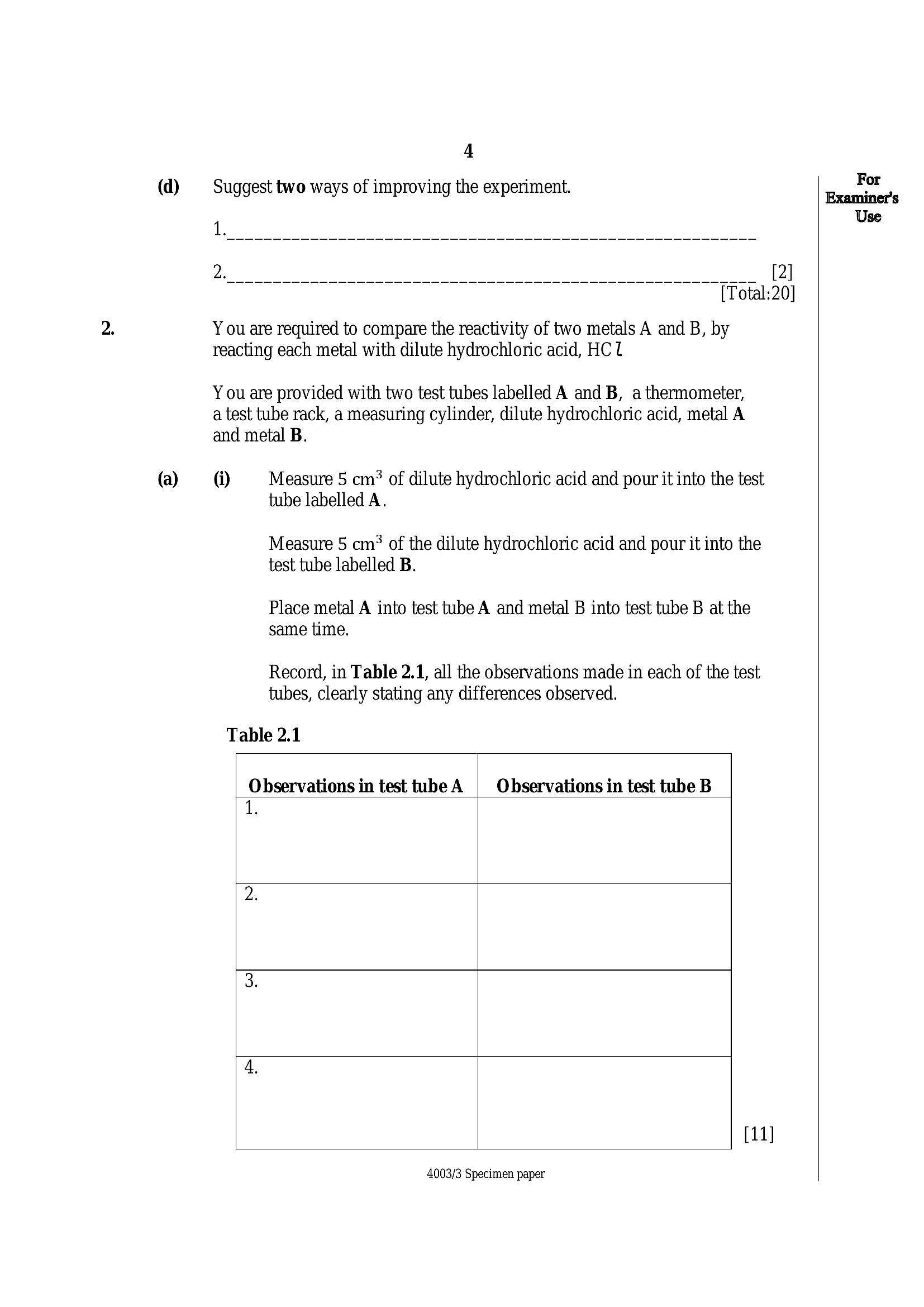
Suggest two ways of improving the experiment.
2. [2]
[Total:20]
Y ou are required to compare the reactivity of two metals A and B, by
reacting each metal with dilute hydrochloric acid, HC l
Y ou are provided with two test tubes labelled A and B, a thermometer,
a test tube rack, a measuring cylinder, dilute hydrochloric acid, metal A
and metal B.
@ Measure 5 cm? of dilute hydrochloric acid and pour it into the test
tube labelled A.
Measure 5 cm? of the dilute hydrochloric acid and pour it into the
test tube labelled B.
Place metal A into test tube A and metal B into test tube B at the
same time.
Record, in Table 2.1, all the observations made in each of the test
tubes, clearly stating any differences observed.
Table 2.1
Observations in test tube A Observations in test tube B
1.
4003/3 Specimen paper
For
Examiner's
Use
---
Page 5
Extracted Text
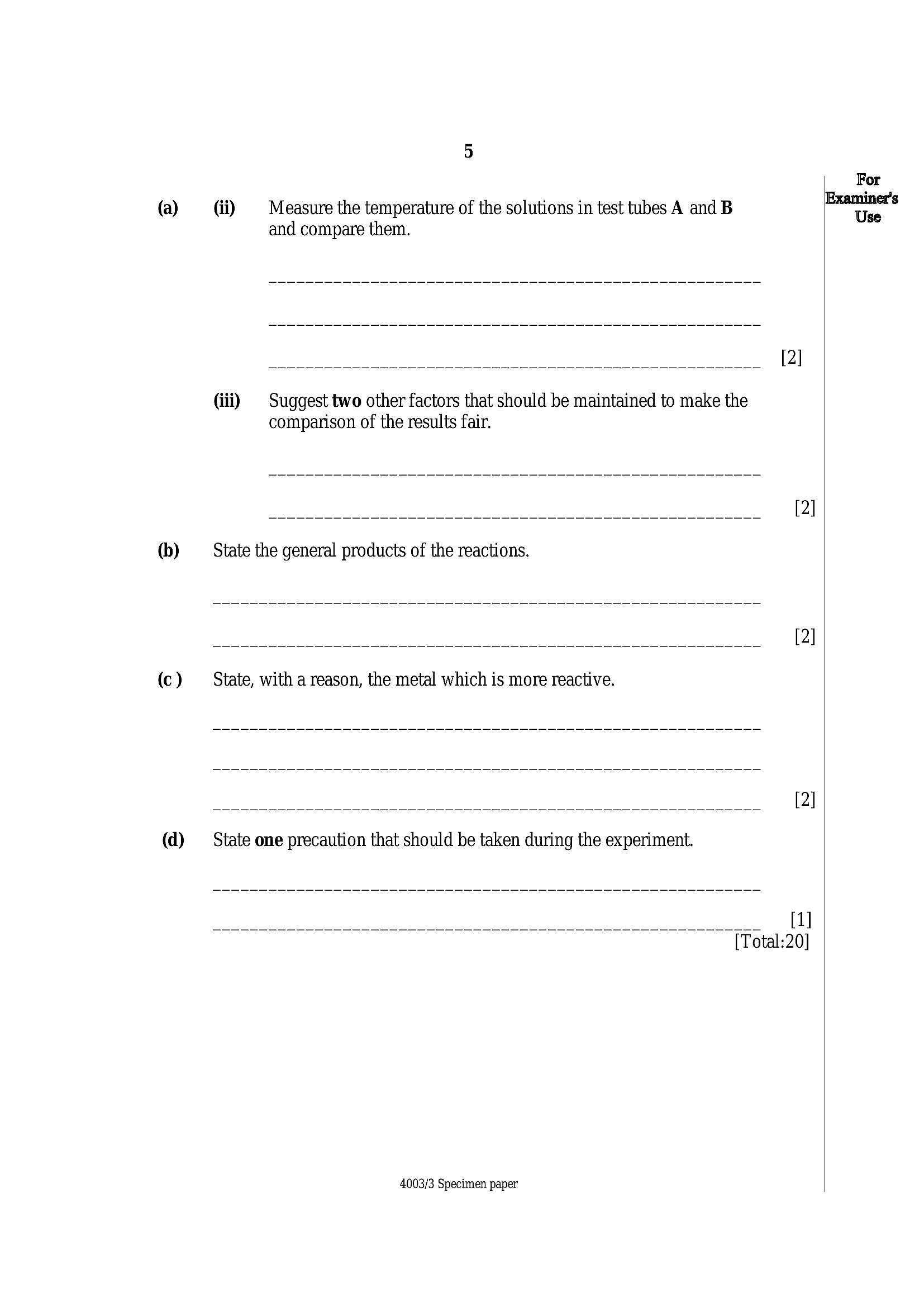
For [Examiner's(a) di Measure the temperature of the solutions in test tubes A and B Use
and compare them.
(iii) Suggest two other factors that should be maintained to make the
comparison of the results fair.
(b) State the general products of the reactions.
(c) — State, with a reason, the metal which is more reactive.
(d) — State one precaution that should be taken during the experiment.
woe [1]
[Total:20]
4003/3 Specimen paper
---
Page 6
Extracted Text
6 BLANK PAGE4003/3 Specimen paper
---
Page 7
Extracted Text
7 BLANK PAGE4003/3 Specimen paper
---
Page 8
Extracted Text
8 BLANK PAGE4003/3 Specimen paper
---