📄 Exam Questions & Readable Text Transcript
Full OCR-extracted text of questions, syllabus codes, and exam instructions.
Extracted Content: 4024q2Specimen paper
Page 1
Extracted Text
Candidate Name Centre Number Candidate Number)
Dyin
For Performance Mecsurement
ZIMBABWE SCHOOL EXAMINATIONS COUNCIL
General Certificate of Education Ordinary Level
CHEMISTRY4024/2
PAPER 2 Theory
SPECIMEN PAPER 1 hour 45 minutes
Candidates answer on the question paper.
Additional materials:Electronic calculator
Allow candidates 5 minutes to count pages before the examination
This booklet should not be punched or stapled and pages should not be removed.
TIME 1 hour 45 minutes
INSTRUCTIONS TO CANDIDATES
Write your name, Centre number and candidate number in the spaces at the top of this page
and centre number and candidate number on top of the right corner of every page of this
paper. Check if the booklet has all the pages and ask the invigilator for a replacement if there
are duplicate or missing pages.
Section A
Answer all questions.
Write your answers in the spaces provided on the question paper.
Section B
Answer any four questions.
Write your answers on the spaces provided on the question paper
Do not fasten the booklet
INFORMATION FOR CANDIDATES
The number of marks is given in brackets [ ] at the end of each question or part question paper.
A copy of the periodic table is on page 20.
This question paper consists of 20 printed pages.
Copyright: Zimbabwe School Examinations Council, Specimen paper.
OZIMSEC [Turn over
---
Page 2
Extracted Text
2Section A
Answer all the questions in the spaces provided.
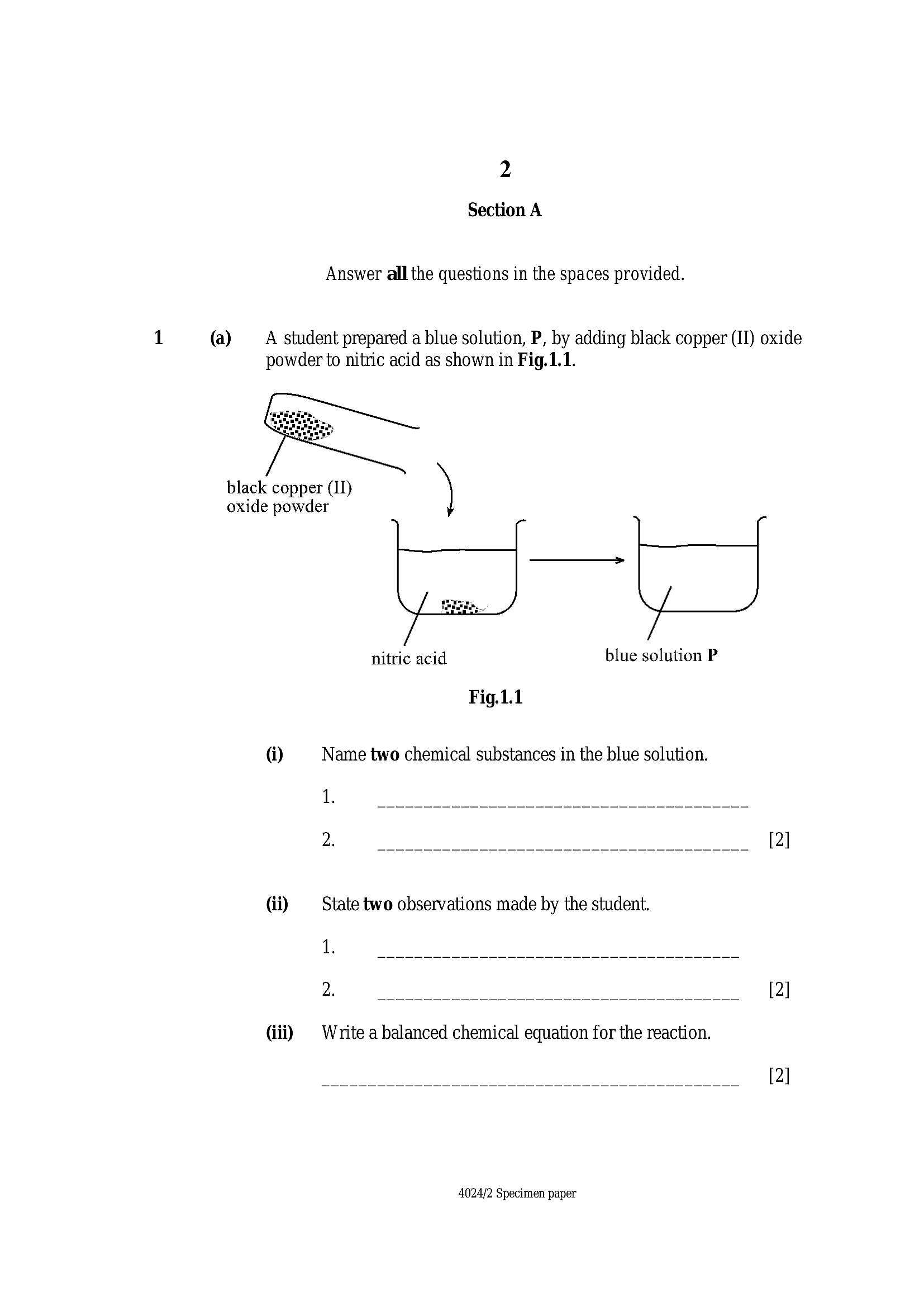
(a) _ A student prepared a blue solution, P, by adding black copper (II) oxide
powder to nitric acid as shown in Fig.1.1.
black copper (11)
oxide powder
nitric acid blue solution P
Fig.1.1
@ Name two chemical substances in the blue solution.
ii) State two observations made by the student.
(iii) © Write a balanced chemical equation for the reaction.
4024/2 Specimen paper
---
Page 3
Extracted Text
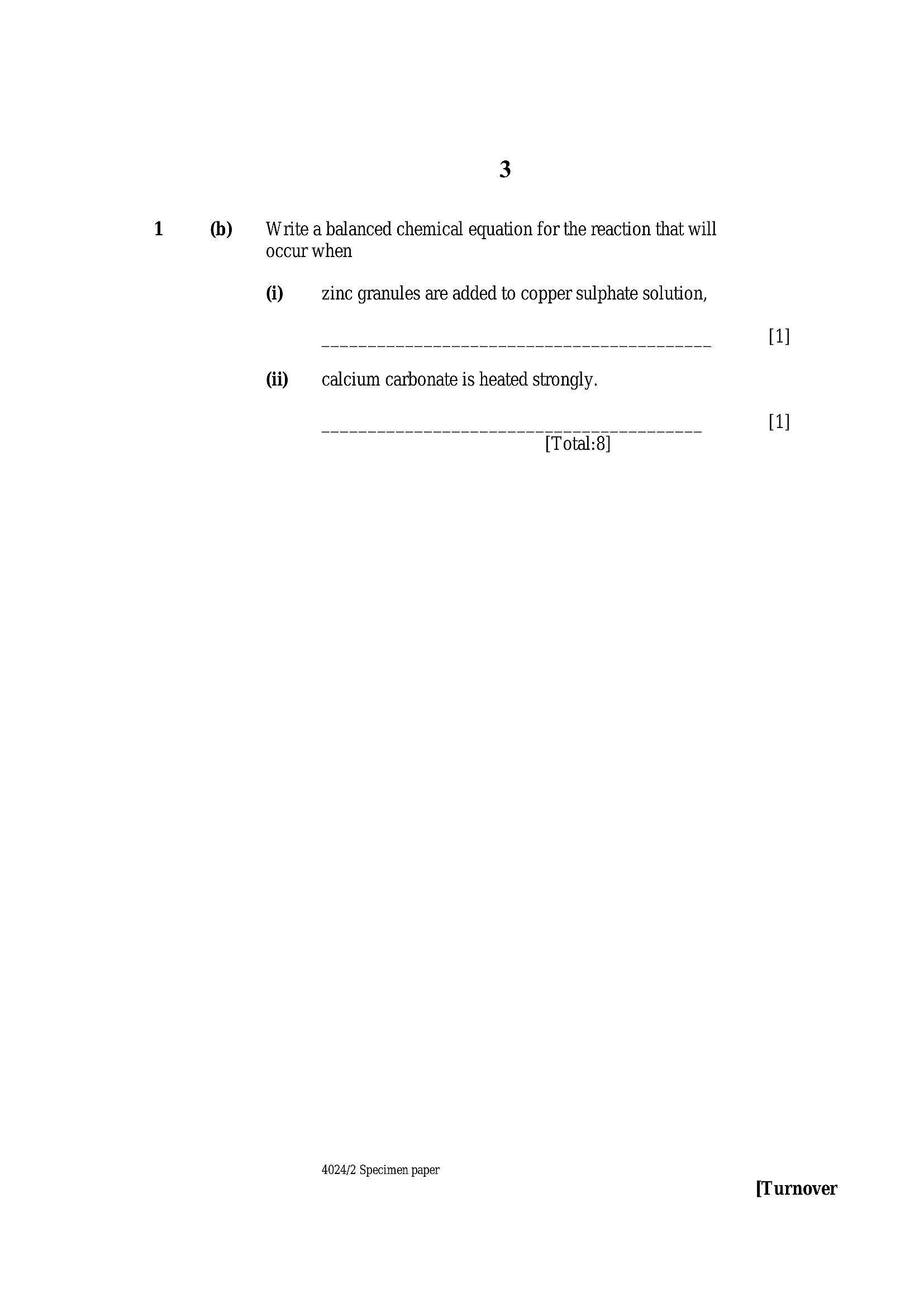
(b)Write a balanced chemical equation for the reaction that will
occur when
@ zinc granules are added to copper sulphate solution,
ii) calcium carbonate is heated strongly.
4024/2 Specimen paper
[Turnover
---
Page 4
Extracted Text
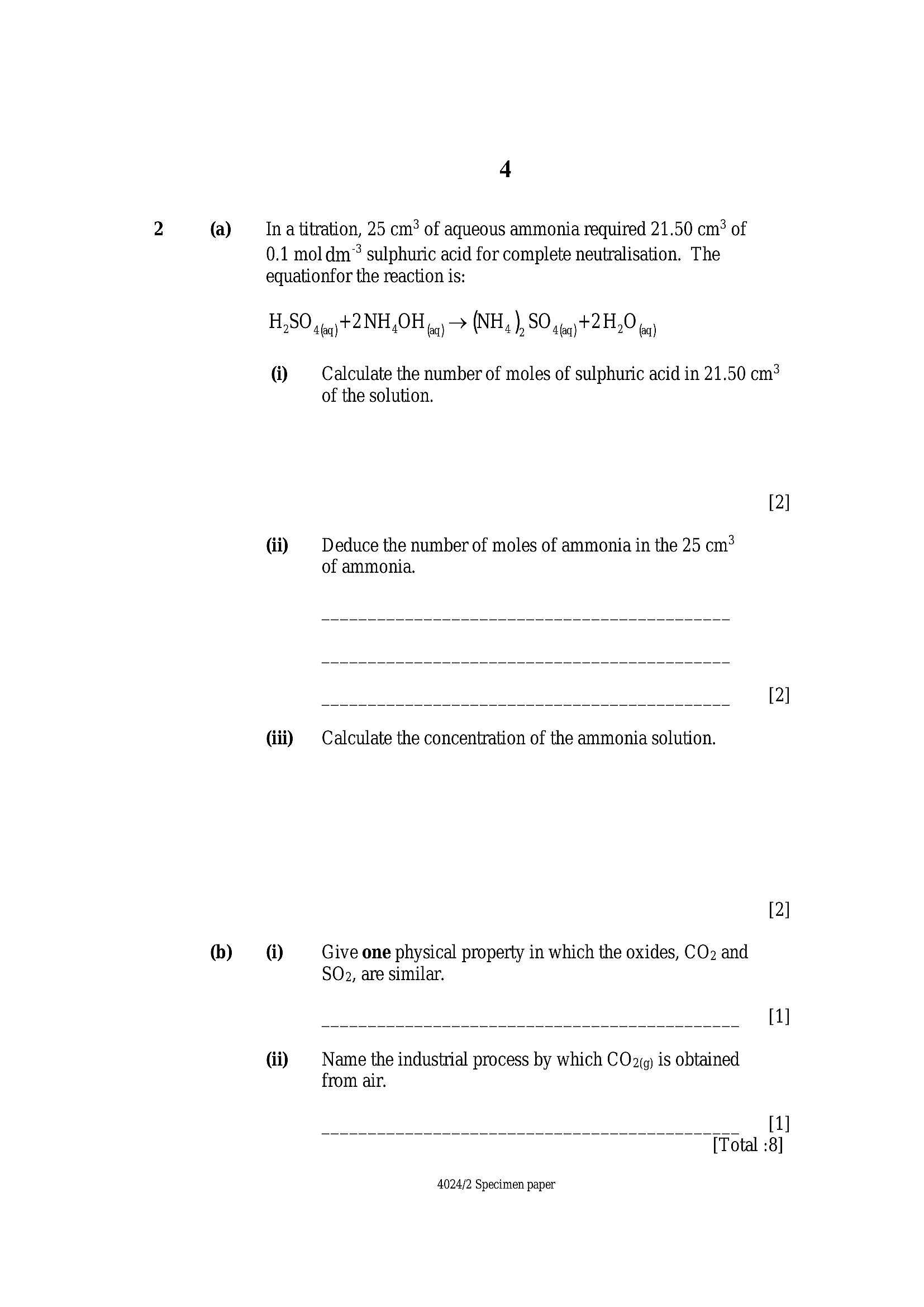
4(a) _ Ina titration, 25 cm? of aqueous ammonia required 21.50 cm? of
0.1 mol dm® sulphuric acid for complete neutralisation. The
equationfor the reaction is:
HSO jyq)+2NH,OH ,.) > (NH, ), SO gyq) +2110 fa)
4laq
@ Calculate the number of moles of sulphuric acid in 21.50 cm?
of the solution.
[2]
ii) Deduce the number of moles of ammonia in the 25 cm?
of ammonia.
(iii) Calculate the concentration of the ammonia solution.
ob) @& Give one physical property in which the oxides, CO2 and
S02, are similar.
(ii) Name the industrial process by which CO2q) is obtained
from air.
_oo ee [1]
[Total :8]
4024/2 Specimen paper
---
Page 5
Extracted Text
(a)(b)
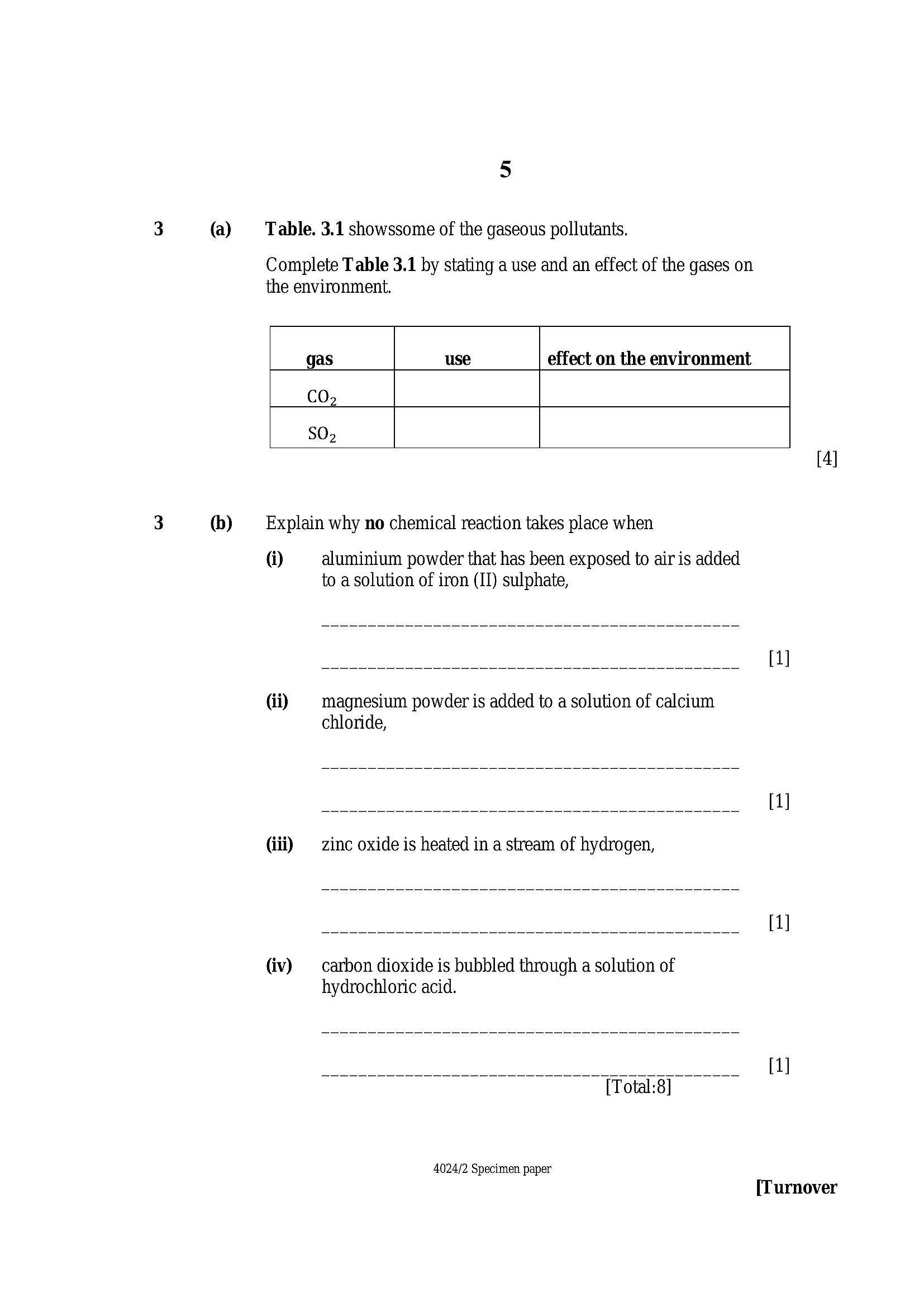
Table. 3.1 showssome of the gaseous pollutants.
Complete Table 3.1 by stating a use and an effect of the gases on
the environment.
gas
use
effect on the environment
CO,
S02
Explain why no chemical reaction takes place when
09) aluminium powder that has been exposed to air is added
to a solution of iron (II) sulphate,
ii) magnesium powder is added to a solution of calcium
chloride,
(iii) zinc oxide is heated in a stream of hydrogen,
(iv) carbon dioxide is bubbled through a solution of
hydrochloric acid.
4024/2 Specimen paper
[1]
[Turnover
---
Page 6
Extracted Text
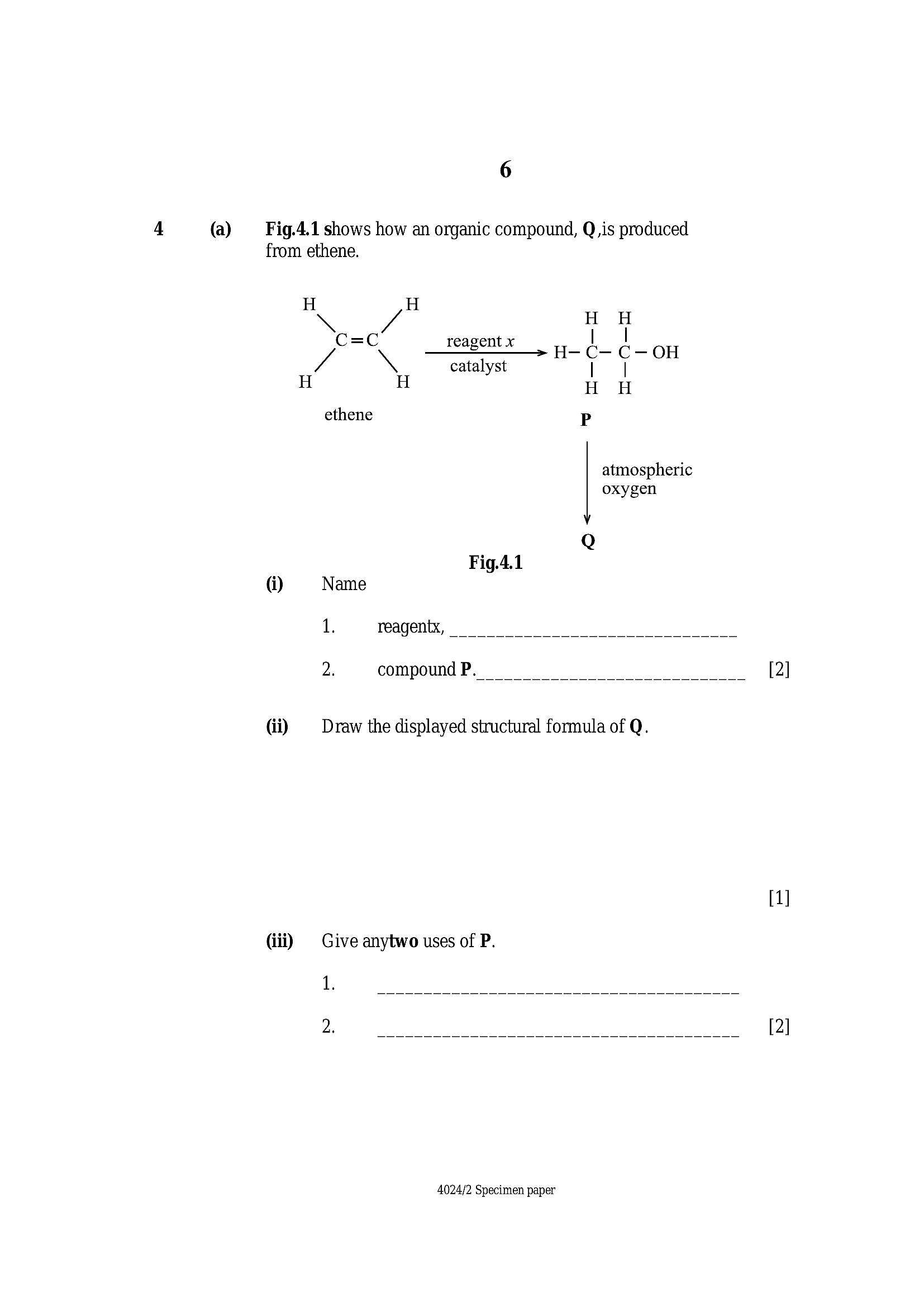
(a)Fig.4.1 shows how an organic compound, Q,is produced
from ethene.
H H
\ 7% qt
C=C |
/ \ reagent x ~C—C-—OoH
catalyst ||
H H HH
ethene P
atmospheric
oxygen
Q
Fig.4.1
@ Name
1. reagentxX,
2. compoundP, [2]
ii) Draw the displayed structural formula of Q.
(iii) Give anytwo uses of P.
4024/2 Specimen paper
---
Page 7
Extracted Text
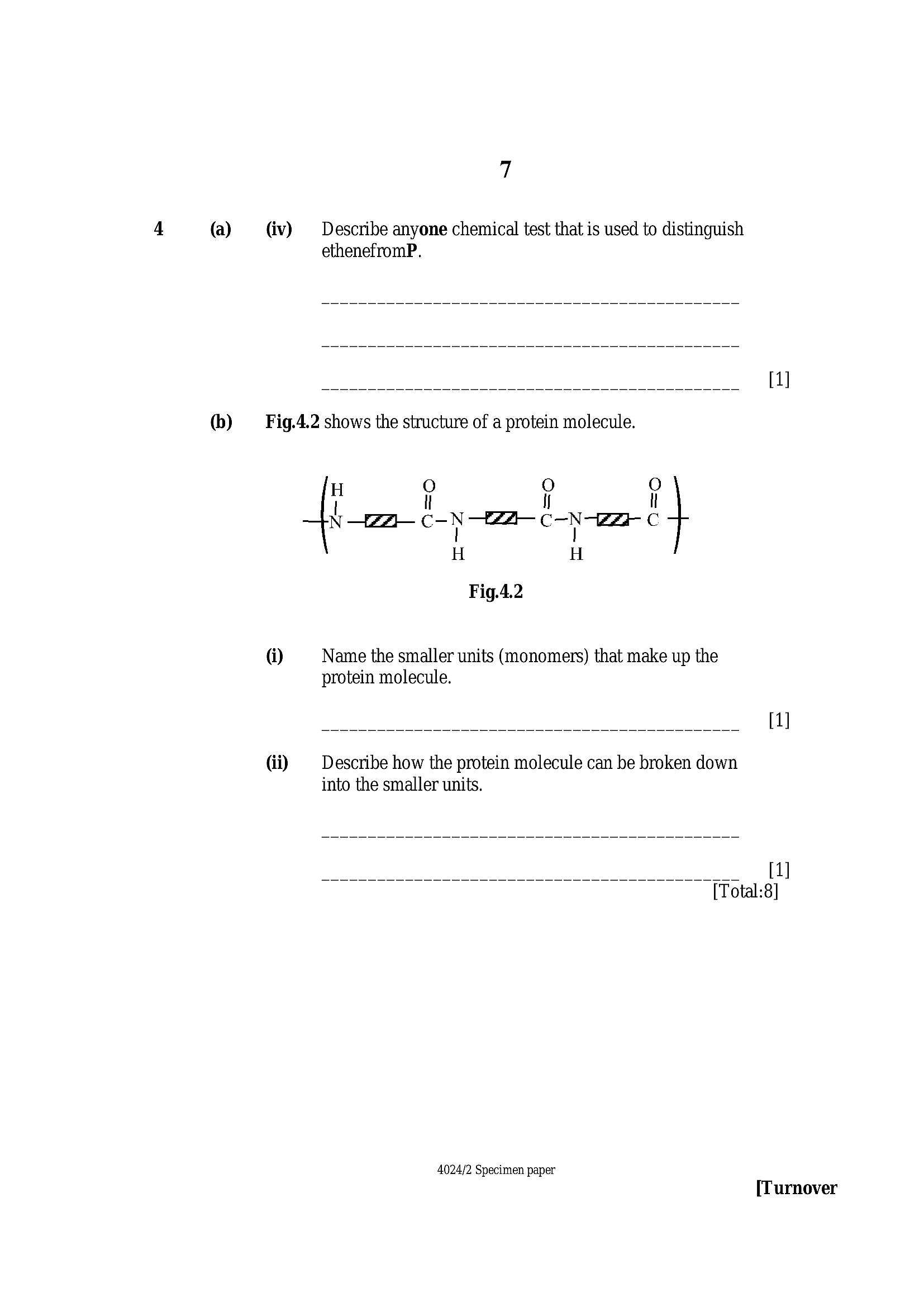
(a) (iv) Describe anyone chemical test that is used to distinguish ethenefromP.(b) Fig.4.2 shows the structure of a protein molecule.
" 7 i i
N FF CoN —Ez7t— CON aaa Cc
H H
Fig.4.2
@ Name the smaller units (monomers) that make up the
protein molecule.
ii) Describe how the protein molecule can be broken down
into the smaller units.
4024/2 Specimen paper
[Turnover
---
Page 8
Extracted Text
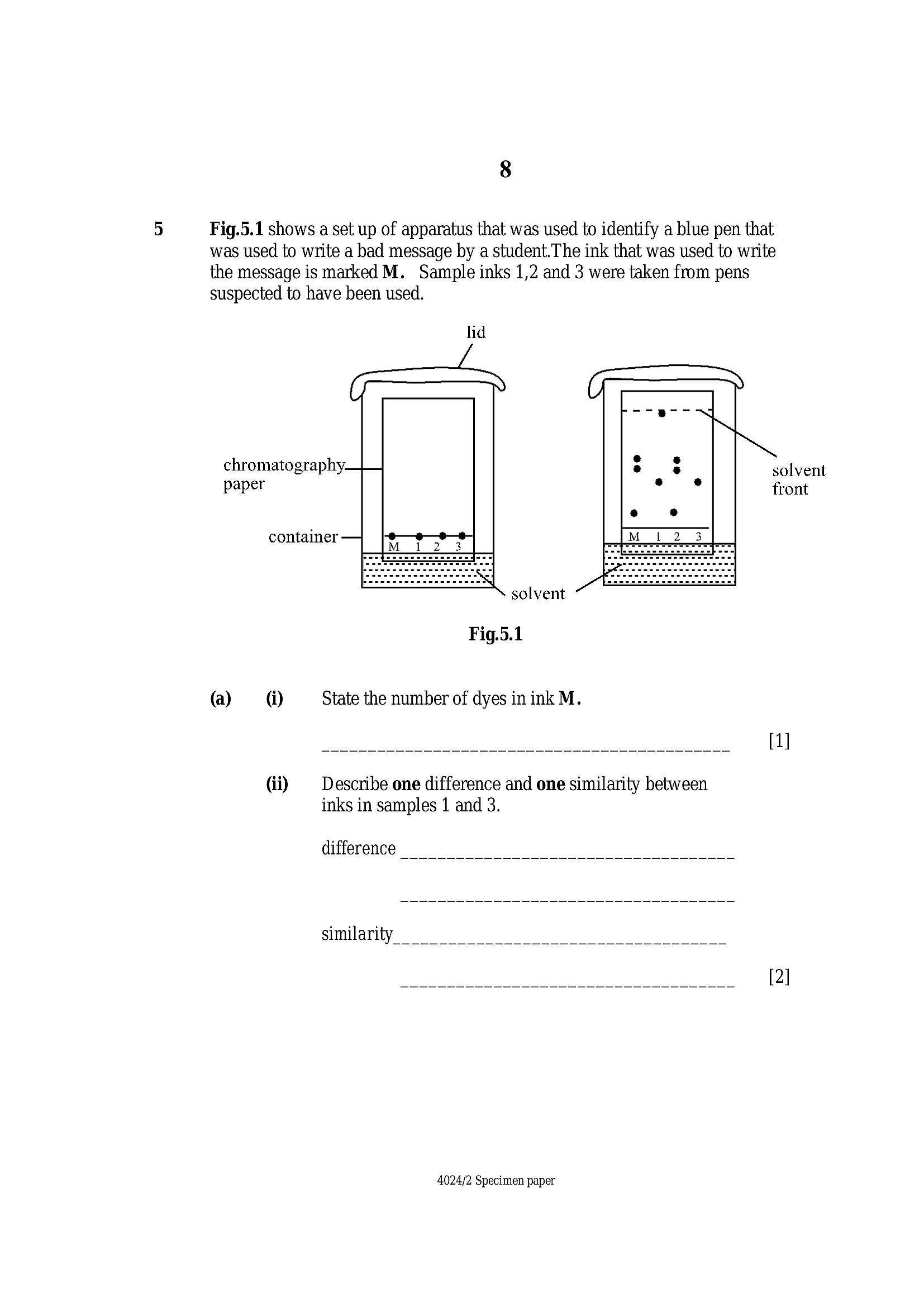
Fig.5.1 shows a set up of apparatus that was used to identify a blue pen that was used to write a bad message by a student.The ink that was used to write the message is marked M. Sample inks 1,2 and 3 were taken from pens suspected to have been used.lid
chromatography.
paper
solvent
front
container
solvent
Fig.5.1
(a) 09) State the number of dyes in ink M.
ii) Describe one difference and one similarity between
inks in samples 1 and 3.
difference
similarity
4024/2 Specimen paper
---
Page 9
Extracted Text
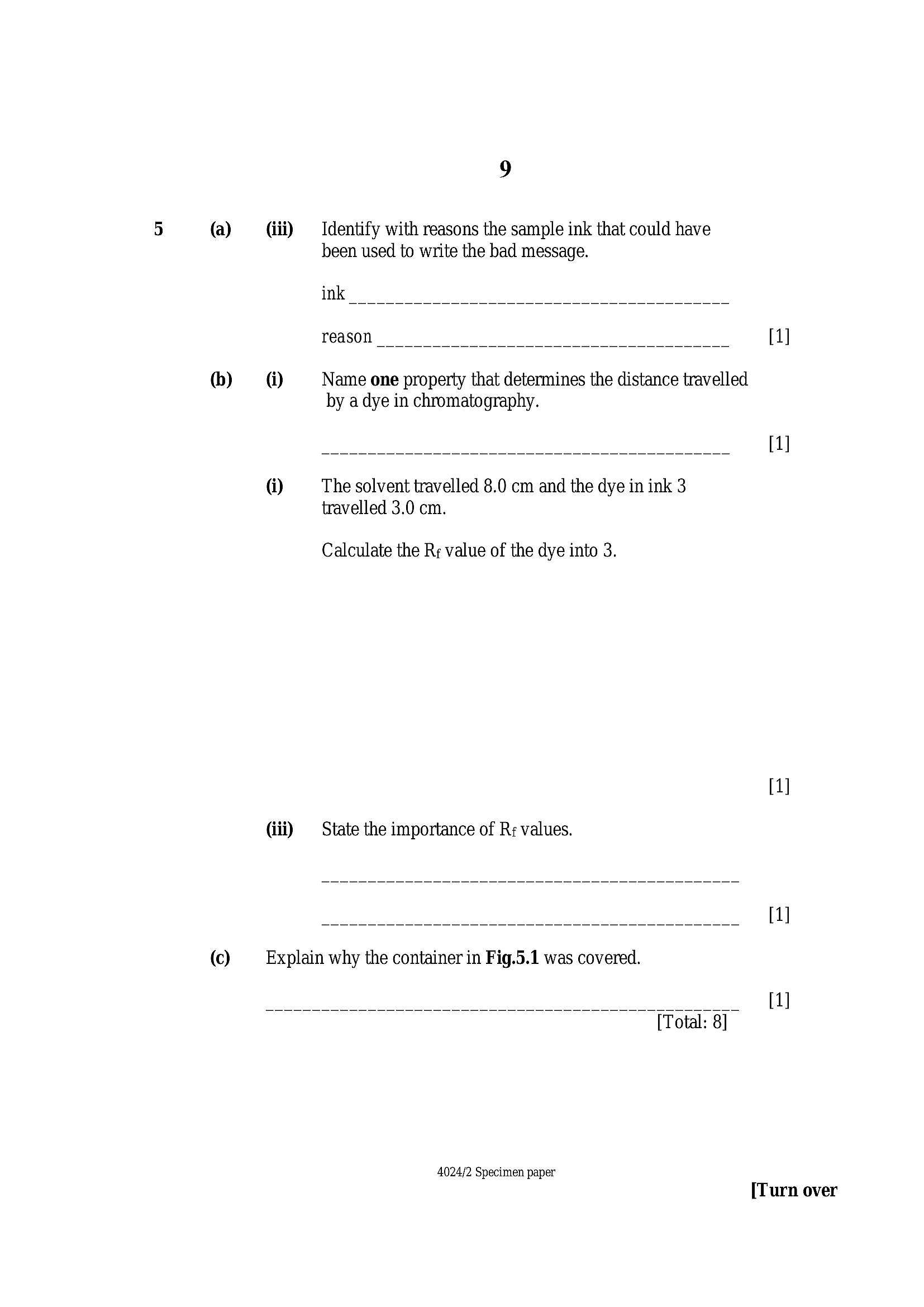
9(a) (iii) Identify with reasons the sample ink that could have
been used to write the bad message.
(b) @ Name one property that determines the distance travelled
by a dye in chromatography.
09) The solvent travelled 8.0 cm and the dye in ink 3
travelled 3.0 cm.
Calculate the R¢ value of the dye into 3.
(iii) State the importance of R¢ values.
(c) Explain why the container in Fig.5.1 was covered.
[Total: 8]
4024/2 Specimen paper
[Turn over
---
Page 10
Extracted Text
10Section: B
Answer any four questions from this section.
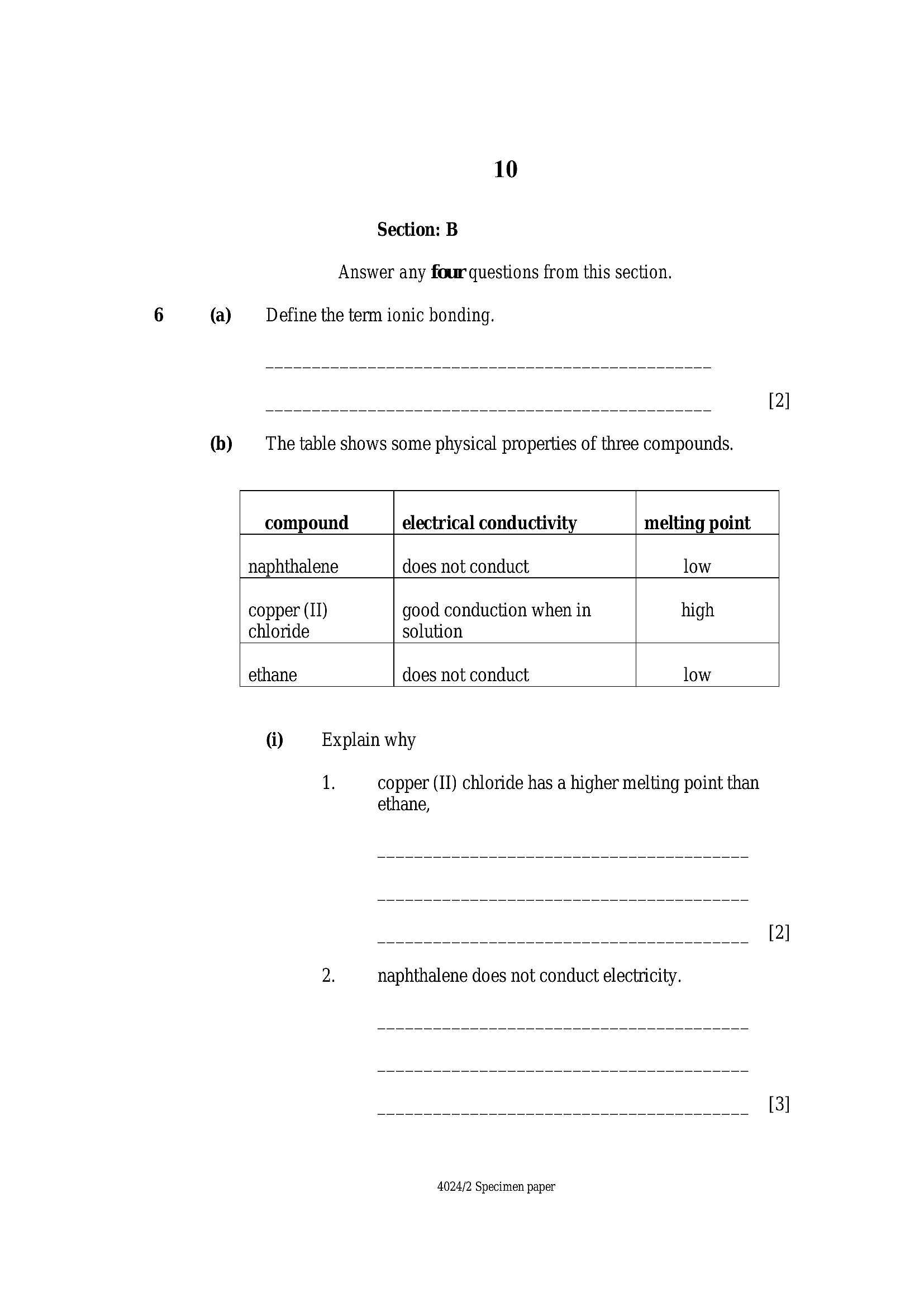
(a) Define the term ionic bonding.
(b) The table shows some physical properties of three compounds.
compound electrical conductivity melting point
naphthalene does not conduct low
copper (I]) good conduction when in high
chloride solution
ethane does not conduct low
09) Explain why
1. copper (II) chloride has a higher melting point than
ethane,
4024/2 Specimen paper
---
Page 11
Extracted Text
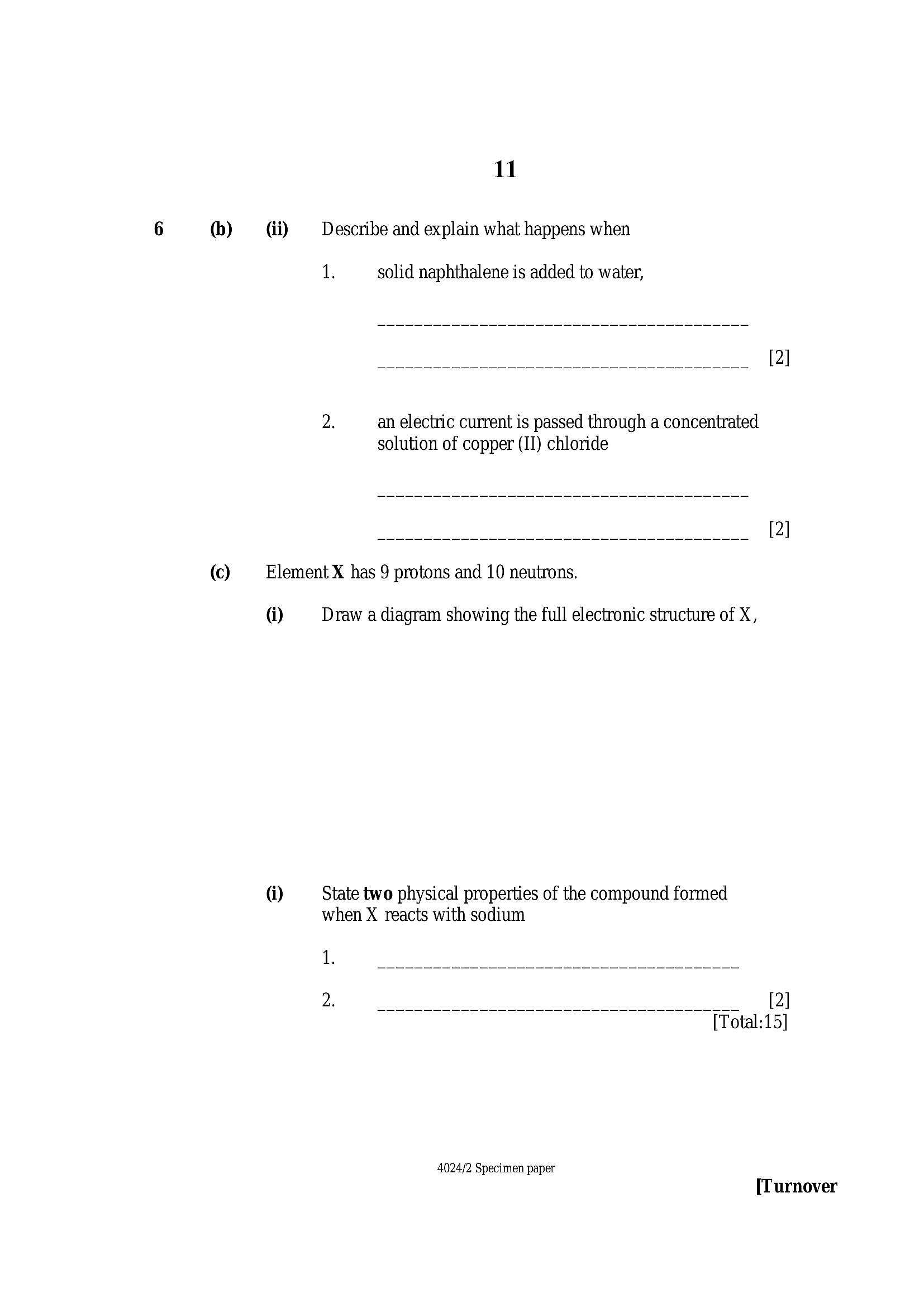
11(b) ii) Describe and explain what happens when
1. solid naphthalene is added to water,
2. an electric current is passed through a concentrated
solution of copper (II) chloride
oe [2]
( Element X has 9 protons and 10 neutrons.
09) Draw a diagram showing the full electronic structure of X,
@ State two physical properties of the compound formed
when X reacts with sodium
5
0 [2]
[Total:15]
4024/2 Specimen paper
[Turnover
---
Page 12
Extracted Text
12(a) Cast iron from the blast furnace contains 4 to 5 % carbon and
other impurities.
@ Name one other impurity in cast iron.
(ii) Describe how the impurities are removed in the oxygen
lance furnace.
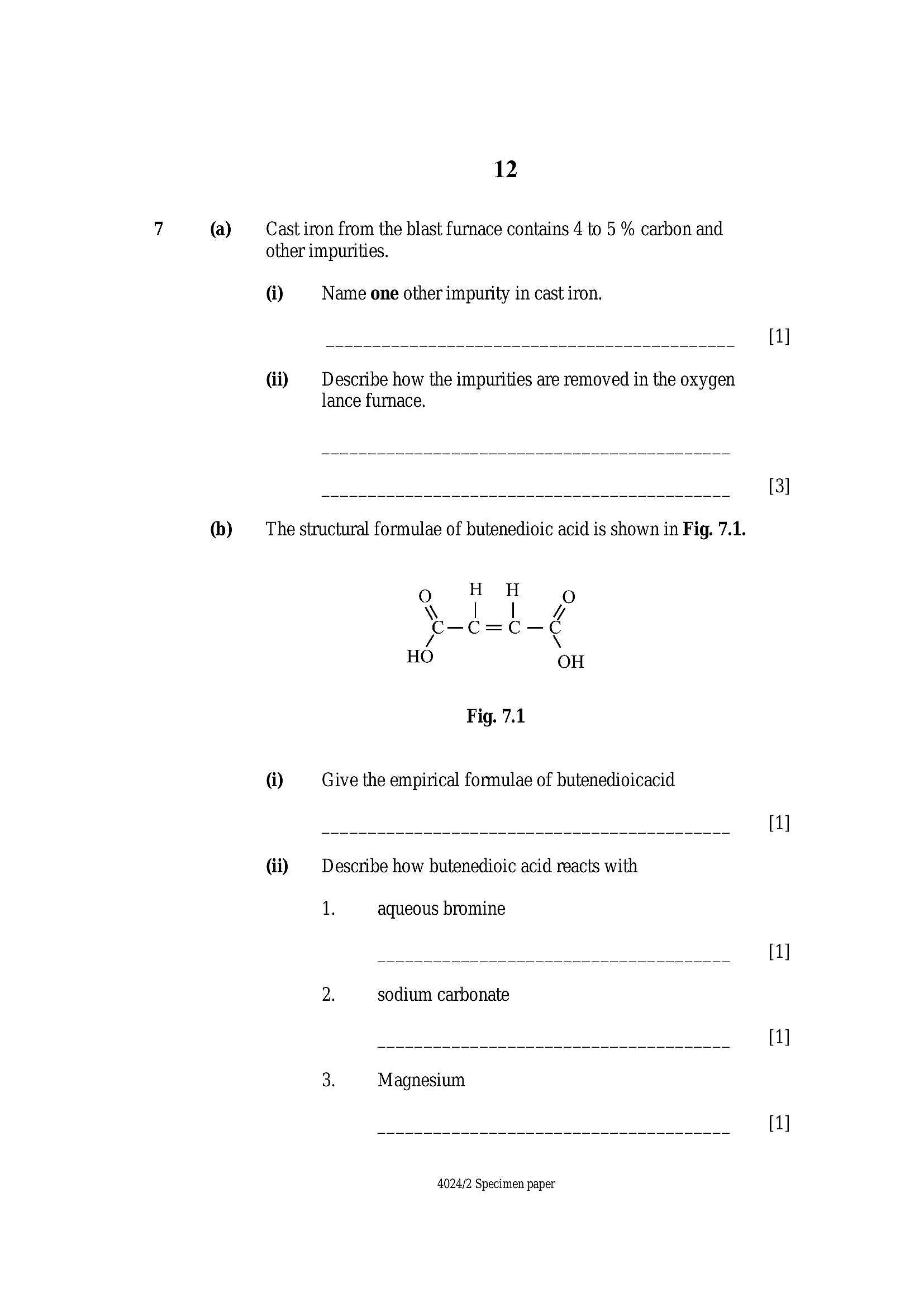
(b) The structural formulae of butenedioic acid is shown in Fig. 7.1.
o HH 9g
\ | y/,
—c=c-€
HO OH
Fig. 7.1
09) Give the empirical formulae of butenedioicacid
ii) Describe how butenedioic acid reacts with
1. aqueous bromine
oe [1
2. sodium carbonate
oe [1
3. Magnesium
[1
4024/2 Specimen paper
---
Page 13
Extracted Text
7 (b)(©)
13
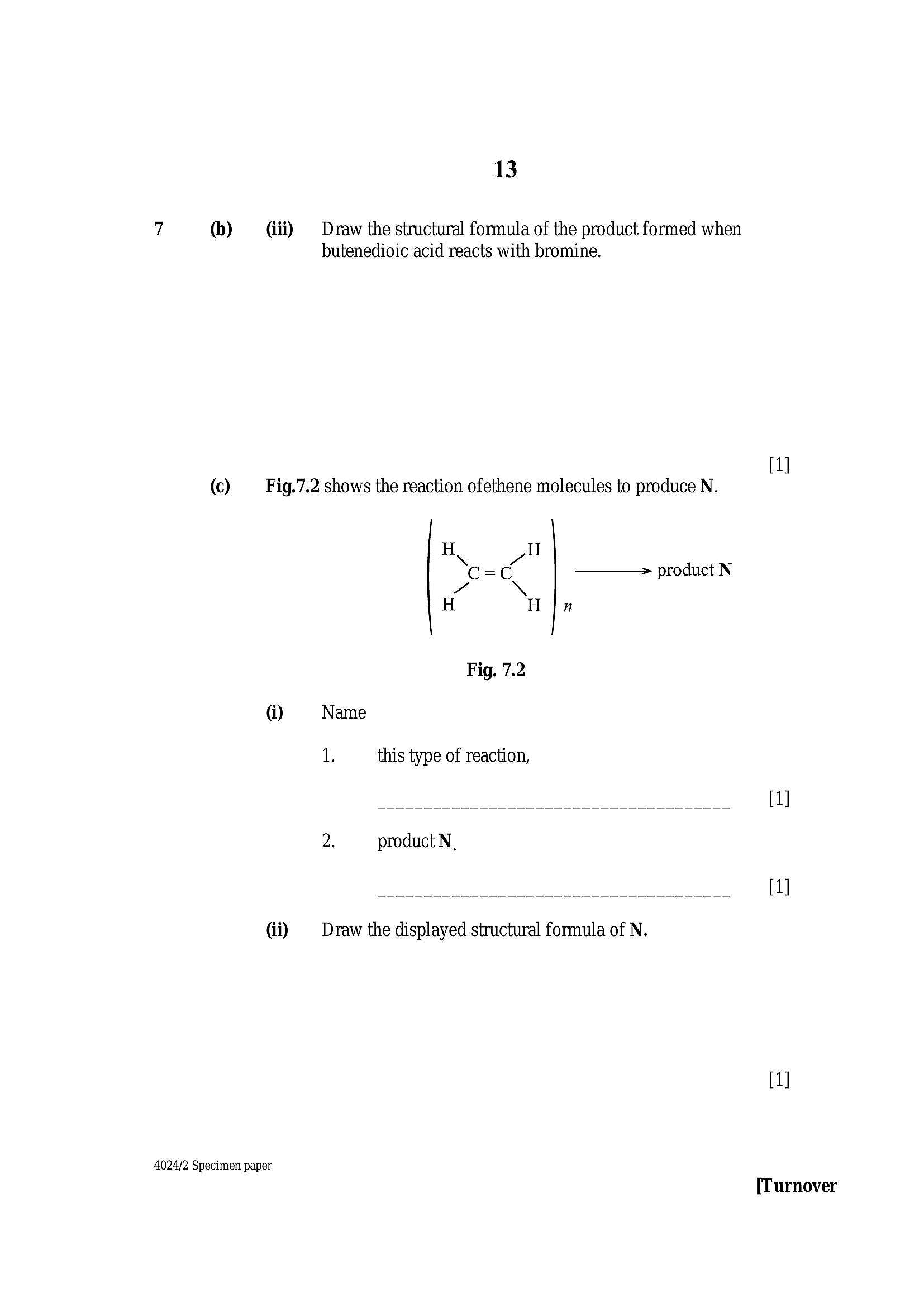
(iii) Draw the structural formula of the product formed when
butenedioic acid reacts with bromine.
[1]
Fig.7.2 shows the reaction ofethene molecules to produce N.
H H
Nc = ne —> product N
a \
H H fa
Fig. 7.2
@ Name
1. this type of reaction,
2. product N,
ii) Draw the displayed structural formula of N.
4024/2 Specimen paper
[Turnover
---
Page 14
Extracted Text
(©)(a)
14
(iii) State any two uses of the product N.
(iv) Describe how productN can be safely disposed from
the environment.
oe [3]
[Total:15]
Describe how a pure sample of sodium chloride can be prepared
fromsolutions of hydrochloric acid and sodium hydroxide of
known concentrations.
[4]
4024/2 Specimen paper
---
Page 15
Extracted Text
(b)15
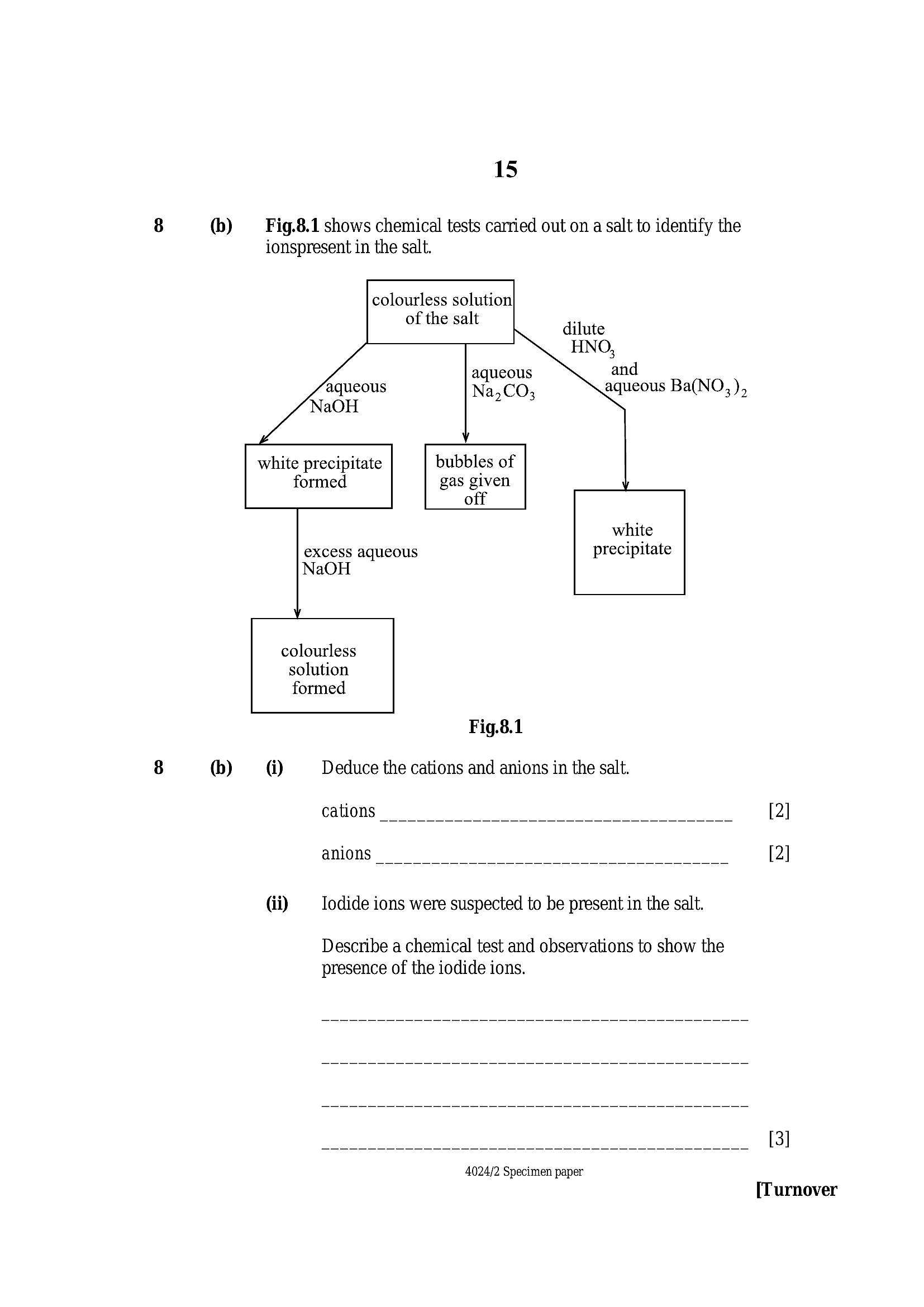
Fig.8.1 shows chemical tests carried out on a salt to identify the
ionspresent in the salt.
colourless solution|
of the salt dilute
HNO,
and
aqueous Ba(NO, ),
bubbles of
gas given
off
white precipitate
formed
white
excess aqueous precipitate
NaOH
colourless
solution
formed
Fig.8.1
09) Deduce the cations and anions in the salt.
cations
anions
ii) Iodide ions were suspected to be present in the salt.
Describe a chemical test and observations to show the
presence of the iodide ions.
4024/2 Specimen paper
[Turnover
---
Page 16
Extracted Text
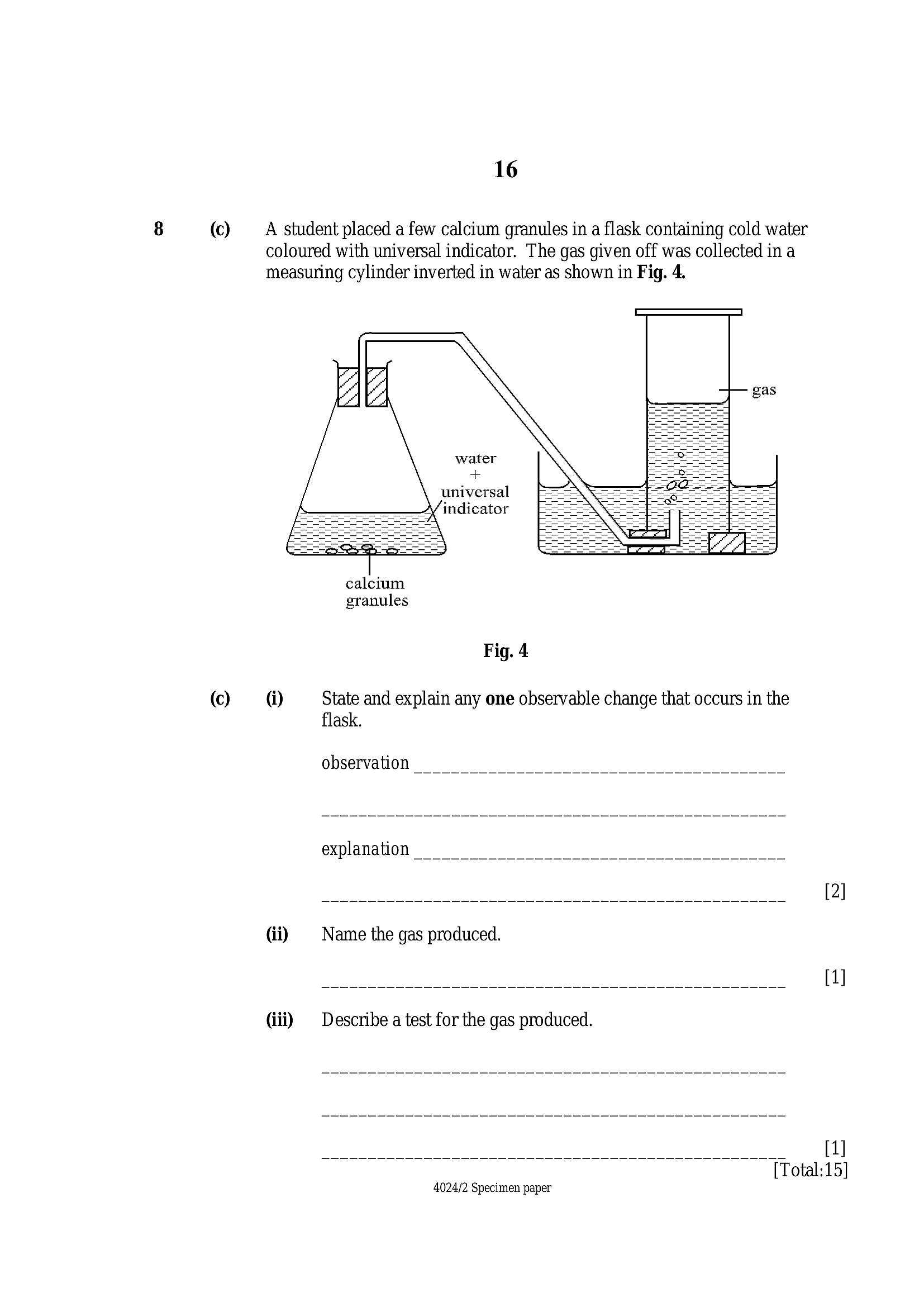
16(c) _ A student placed a few calcium granules in a flask containing cold water
coloured with universal indicator. The gas given off was collected in a
measuring cylinder inverted in water as shown in Fig. 4.
water
+
universal
indicator
calcium
granules
Fig. 4
( 09) State and explain any one observable change that occurs in the
flask.
observation
explanation,
oe [2]
(ii) Name the gas produced.
oe [1]
(iii) | Describe a test for the gas produced.
oe [1]
[Total:15]
4024/2 Specimen paper
---
Page 17
Extracted Text
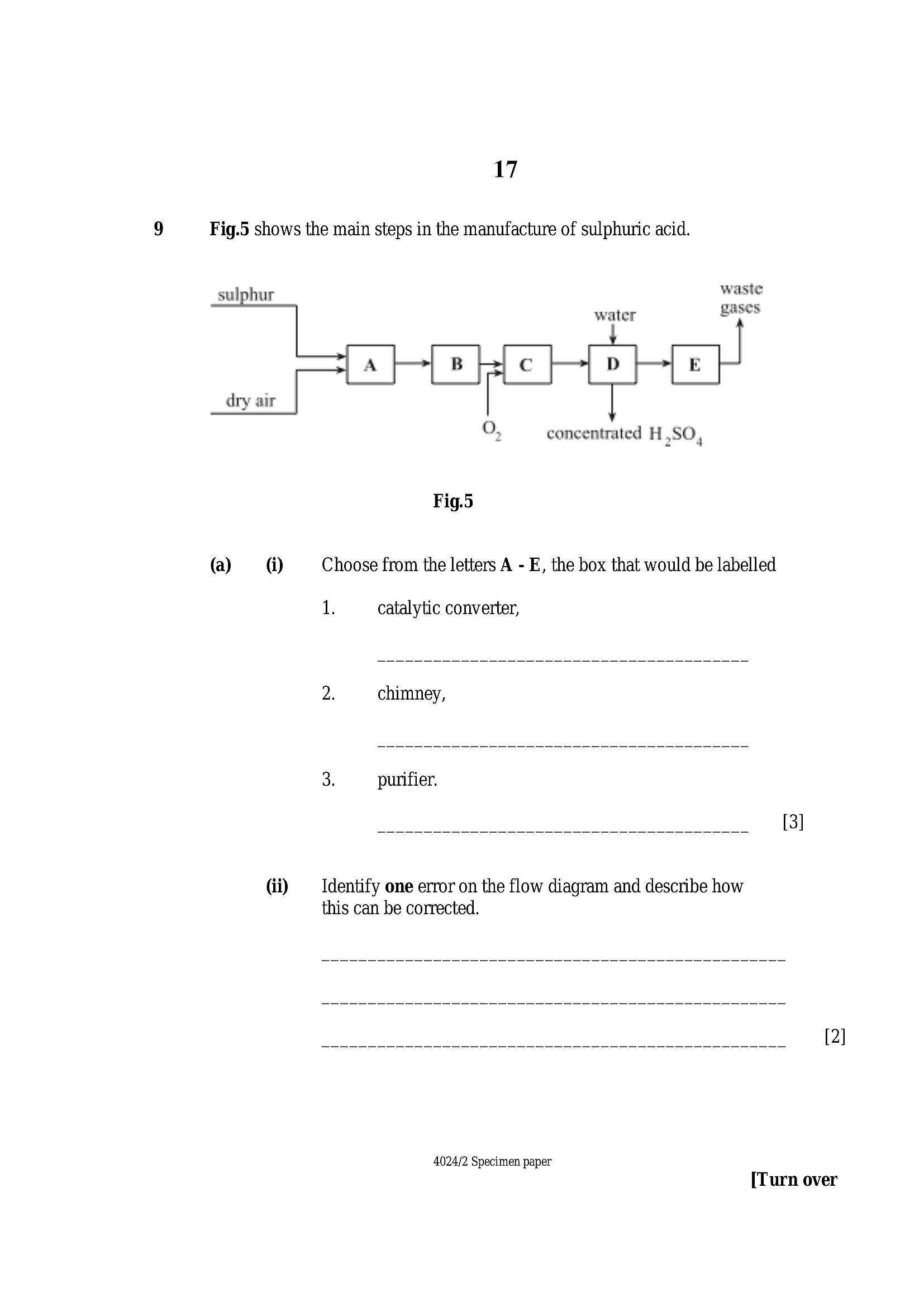
17Fig.5 shows the main steps in the manufacture of sulphuric acid.
sulphur waste
water BASCS
LB [> |
dry air
0, coneentrated H SO,
Fig.5
(a) @ Choose from the letters A - E, the box that would be labelled
1. catalytic converter,
2. chimney,
3. purifier.
(ii) Identify one error on the flow diagram and describe how
this can be corrected.
4024/2 Specimen paper
[Turn over
---
Page 18
Extracted Text
10(a)
(b)
(a)
18
(iii) State any one condition used in C and write the overall
equation for the reaction which takes place.
condition
Describe how sulphuric acid is converted into ammonium
sulphate fertilizer.
oo [3]
[Total:15]
@ two different physical properties of bromine and iodine.
ii) two similar chemical chemical properties of bromine
and iodine.
(iii) any two uses of chlorine.
4024/2 Specimen paper
---
Page 19
Extracted Text
10(b)
19
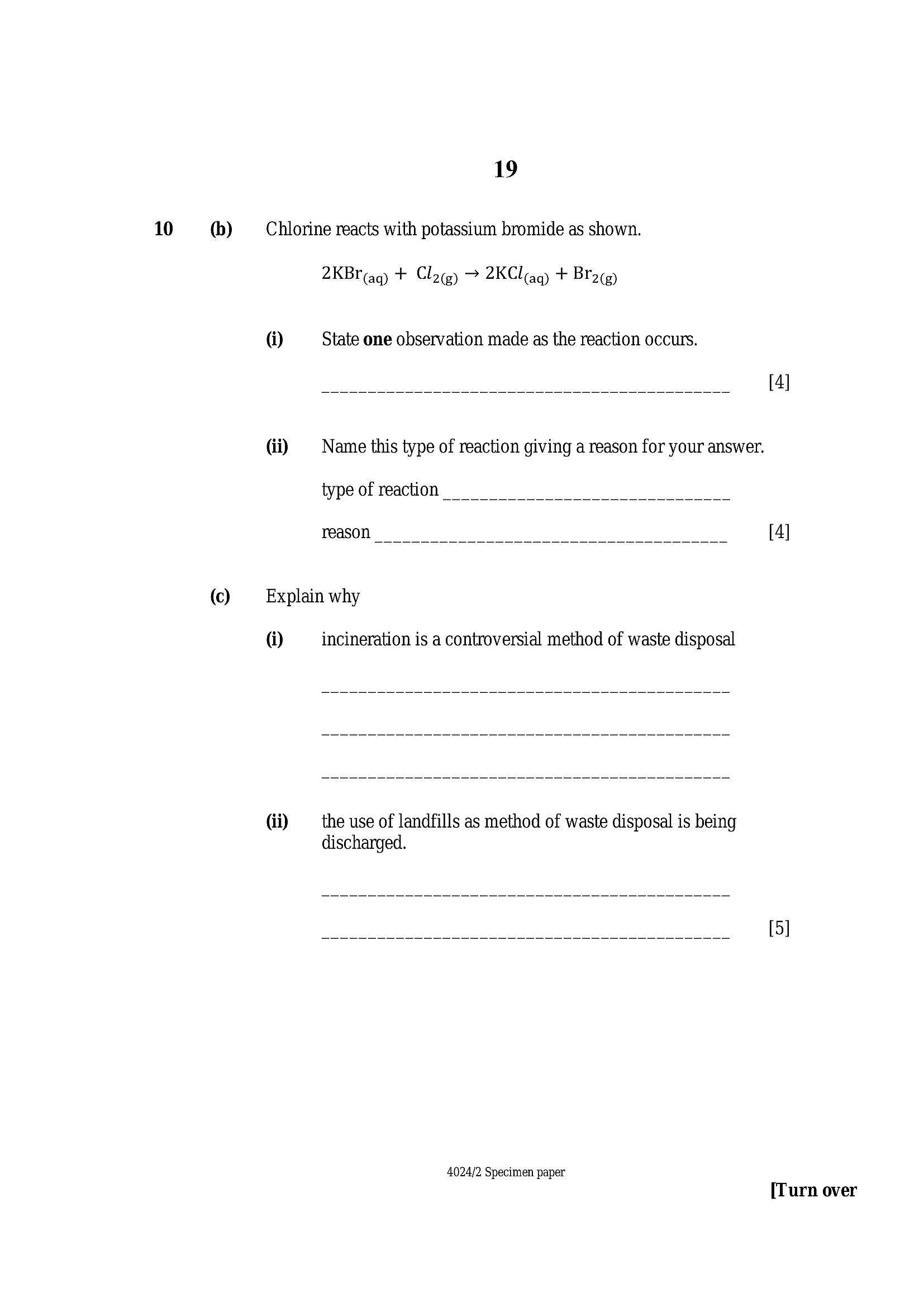
Chlorine reacts with potassium bromide as shown.
2KBr(aq) + Cly(g) > 2KCl aq) + Brag)
09) State one observation made as the reaction occurs.
(ii) | Name this type of reaction giving a reason for your answer.
type of reaction
Explain why
09) incineration is a controversial method of waste disposal
ii) the use of landfills as method of waste disposal is being
discharged.
4024/2 Specimen paper
[Turn over
---
Page 20
Extracted Text
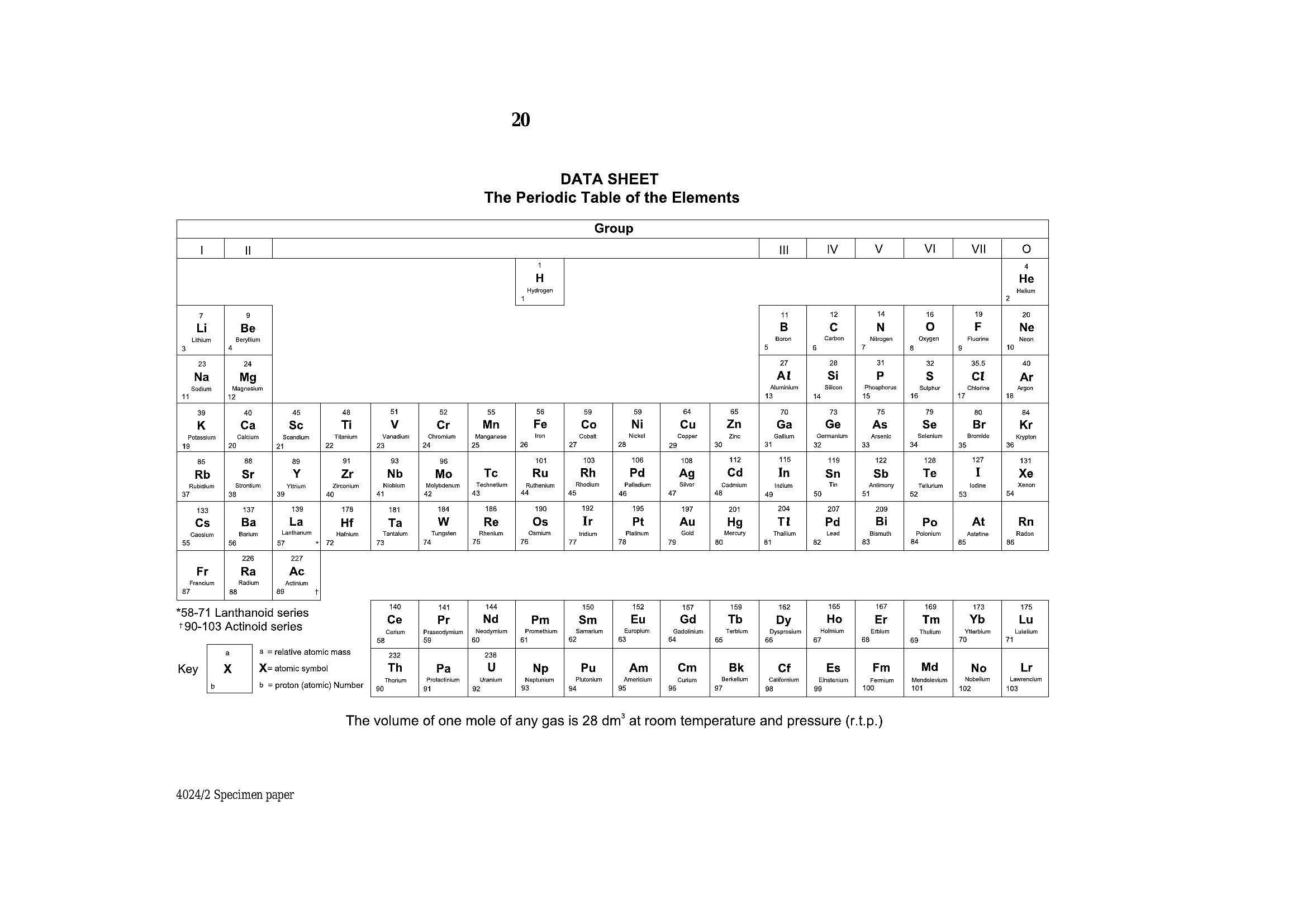
20DATA SHEET
The Periodic Table of the Elements
Group
I Ul Ill IV v vi Vil e}
1 4
H He
Hydrogen Helium
1
7 9 an 12 14 16 19 20
Li Be B c N oO F Ne
him Beryum Boron Carbon trogen Onygen Fuorine Neon
4 6 8 9 10
23 24 27 28 PT 32 355 40
Na Mg Al Si P s cl Ar
Sodium — | Magnesium ‘Aluminium sicon | Phosphorus | Sulphur hioina ‘Argon
2 13 14 16 16 18
39 40 45 48 51 52 55 56 59 59 64 65 70 73 75 79 80 a4
K Ca Sc Ti Vv Cr Mn Fe Co Ni Cu Zn Ga Ge As Se Br Kr
Potassium Calcium ‘Scandium Titeniurn Vanadium | Chromium | Manganese tron Cobatt Nickol Copper Zine Gallium, Germanium Arsenic Selenium Bromide Krypton
19 20 24 2 23 24 28 26 27 28 29 30 31 32 3 35 36
85 88 89 ot 93 96 101 103 106 108 112 115 119 122 128 127 131
Rb sr Y 2r Nb Mo Te Ru Rh Pd Ag Cd In Sn Sb Te I Xe
Rubidium | Stronium rum Zirconium | Niobium — | Molybdenum | Technetiom | Ruthenium | Rhodium Pallsium siver Cadmium indium Tin santimery | Tetum todine Xenon
37 38 39 40 44 42 43 4 45 46 47 49 50 62 53 54
133 137 139 178 181 184 186 190 192 195 197 201 204 207 209
Cs Ba La Hf Ta Ww Re Os Ir Pt Au Hg Tl Pd Bi Po At Rn
Caesium Barium Lanthanum Hafnium ‘Tantalum Tungsten Rhenium ‘Osmium: rigium Platinum Gold ‘Mercury Thallium Lead Bismuth Polonium stating Radon
55 56 57 *| 72 73 74 75 76 7 78 79 80 81 82 83 85 86
226 227
Fr Ra Ac
Frencium | Radium Atrium
87 88 89
+ . 140 141 144 150 152 187 159 162 165 167 169 173 175
*58-71 Lanthanoid series
190-103 Actinoid seri Ce Pr Nd Pm Sm Eu Gd Tb Dy Ho Er Tm Yb Lu
- ctinold series Cerium — | Praseodymium | Neodymium | Promethium | Samarium Europlum Gadolinium Terbium Dysprosium | Holmium Erbium Thutium Ytterbium Lutetium
58 59 61 62 63 65 66 ov 68 69 70 cal
a a = relative atomic mass 232 238
Key x XE atomic symbol Th Pa U Np Pu Am Cm Bk Cf Es Fm Md No Lr
- . Thorium | Protactiium | uranium | Neptuniom | Plutonium | Ameriium curum | Berketum | caiforsum | cinstenium | —ermium | Mendelevium | Nobefum | Lawrencium
b » = proton (atomic) Number 90 ot 92 93 94 96 a7 98 99 101 102 103
4024/2 Specimen paper
The volume of one mole of any gas is 28 dm’ at room temperature and pressure (r.t.p.)
---