

📄 Exam Questions & Readable Text Transcript
Full OCR-extracted text of questions, syllabus codes, and exam instructions.
Extracted Content: 4024q3Specimen
Page 1
Extracted Text
Candidate Name Centre Number Candidate NumberZIMBABWE SCHOOL EXAMINATIONS COUNCIL
General Certificate of Education Ordinary Level
CHEMISTRY 4024/3
PAPER 3 Practical Test
SPECIMEN PAPER 1 hour 30 minutes
Candidates answer on the question paper.
Additional materials:
As listed in Instructions to Supervisors
Mathematical tables and/or Electronic calculator
TIME 1 hour 30 minutes
INSTRUCTIONS TO CANDIDATES
Write your name, Centre number and candidate number in the spaces at the top of this page.
Answer both questions.
Write your answers in the spaces provided on the question paper.
Y ou should show the essential steps in any calculation and record all experimental results in the
spaces provided on the question paper.
INFORMATION FOR CANDIDATES
The number of marks is given in brackets [ ] at the end of each | FOR EXAMINER’S USE
question or part question.
Qualitative analysis notes for this paper are printed on page 6. 1
2
3
TOTAL
This question paper consists of 6 printed pages and 2 blank pages.
Copyright: Zimbabwe School Examinations Council, Specimen paper.
©ZIMSEC [Turn over
---
Page 2
Extracted Text
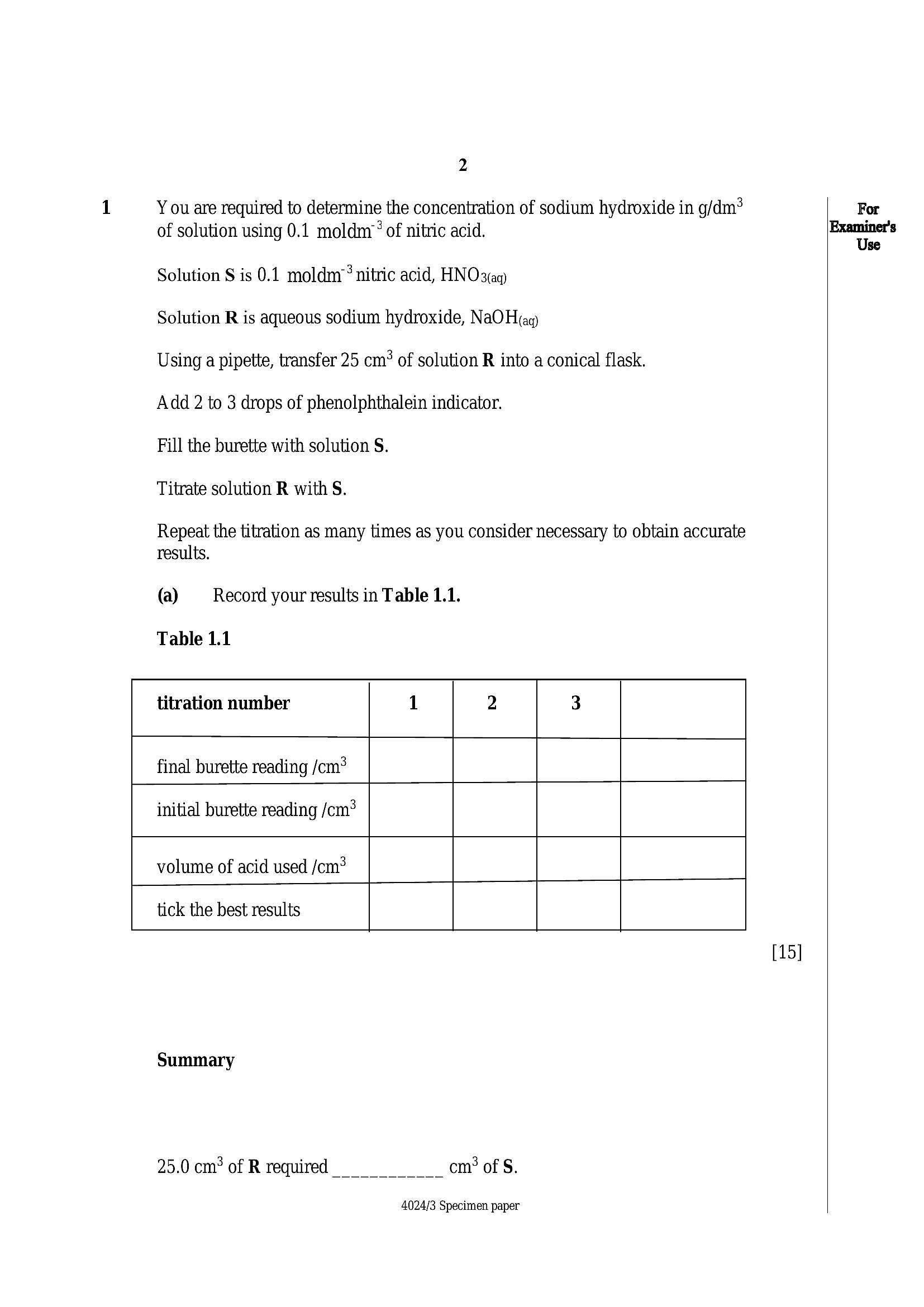
2Y ou are required to determine the concentration of sodium hydroxide in g/dm?
of solution using 0.1 moldm‘® of nitric acid.
Solution $ is 0.1 moldny® nitric acid, HNO3(aq)
Solution R is aqueous sodium hydroxide, NaO Haq)
Using a pipette, transfer 25 cm? of solution R into a conical flask.
Add 2 to 3 drops of phenolphthalein indicator.
Fill the burette with solution S.
Titrate solution R with S.
Repeat the titration as many times as you consider necessary to obtain accurate
results.
(a) Record your results in Table 1.1.
Table 1.1
titration number 1 2 3
final burette reading /cm?
initial burette reading /cm?
volume of acid used /cm?
tick the best results
Summary
25.0 cm? of R required cm} of S.
4024/3 Specimen paper
For
Examiner's
Use
---
Page 3
Extracted Text
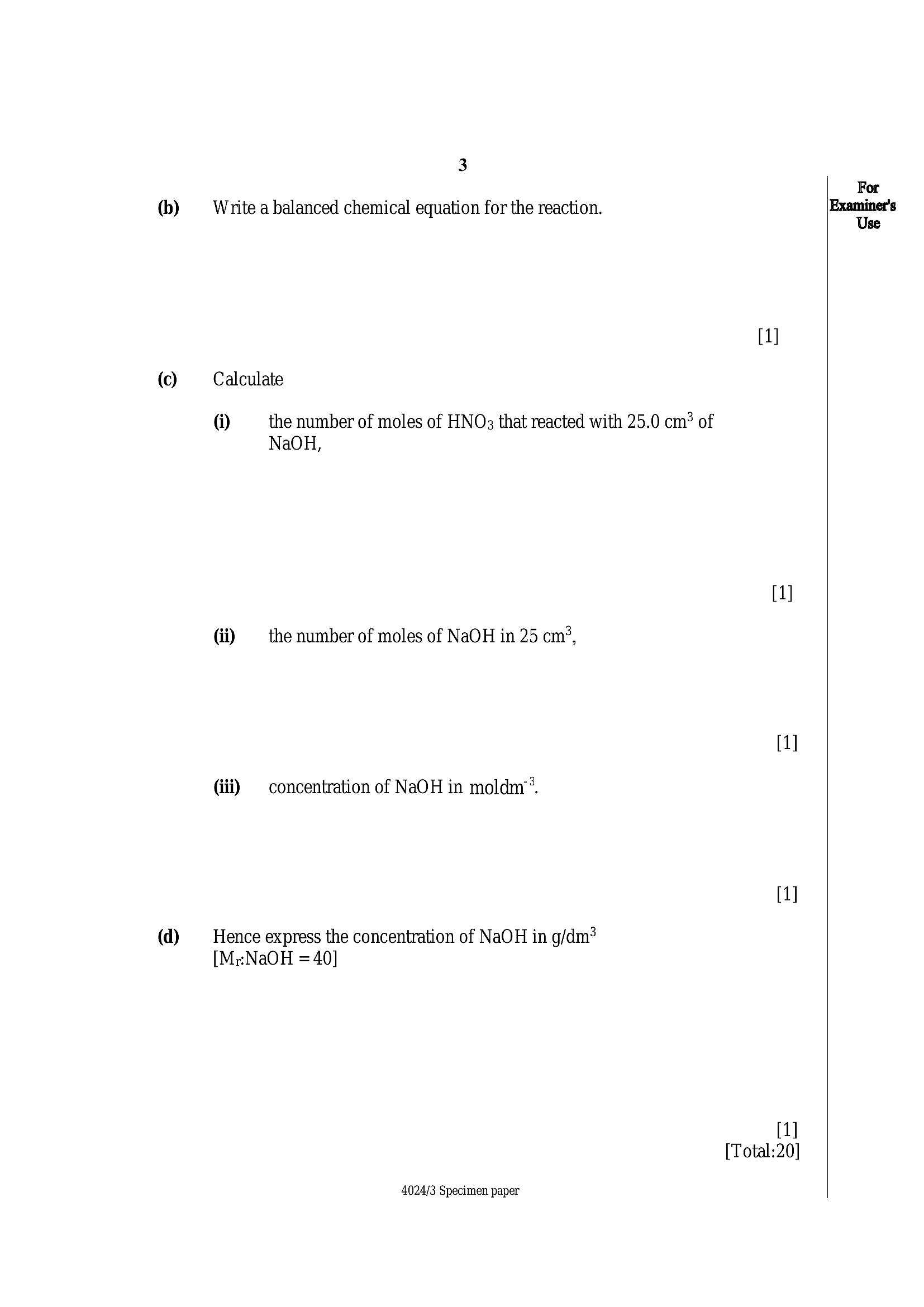
3(b) Write a balanced chemical equation for the reaction.
() Calculate
@ the number of moles of HNO; that reacted with 25.0 cm? of
NaOH,
di the number of moles of NaOH in 25 cm?,
(iii) concentration of NaOH in moldm’’.
[1]
@ Hence express the concentration of NaOH in g/dm3
[MrNaOH =40]
[1]
[Total:20]
4024/3 Specimen paper
For
Use
---
Page 4
Extracted Text
(a)4
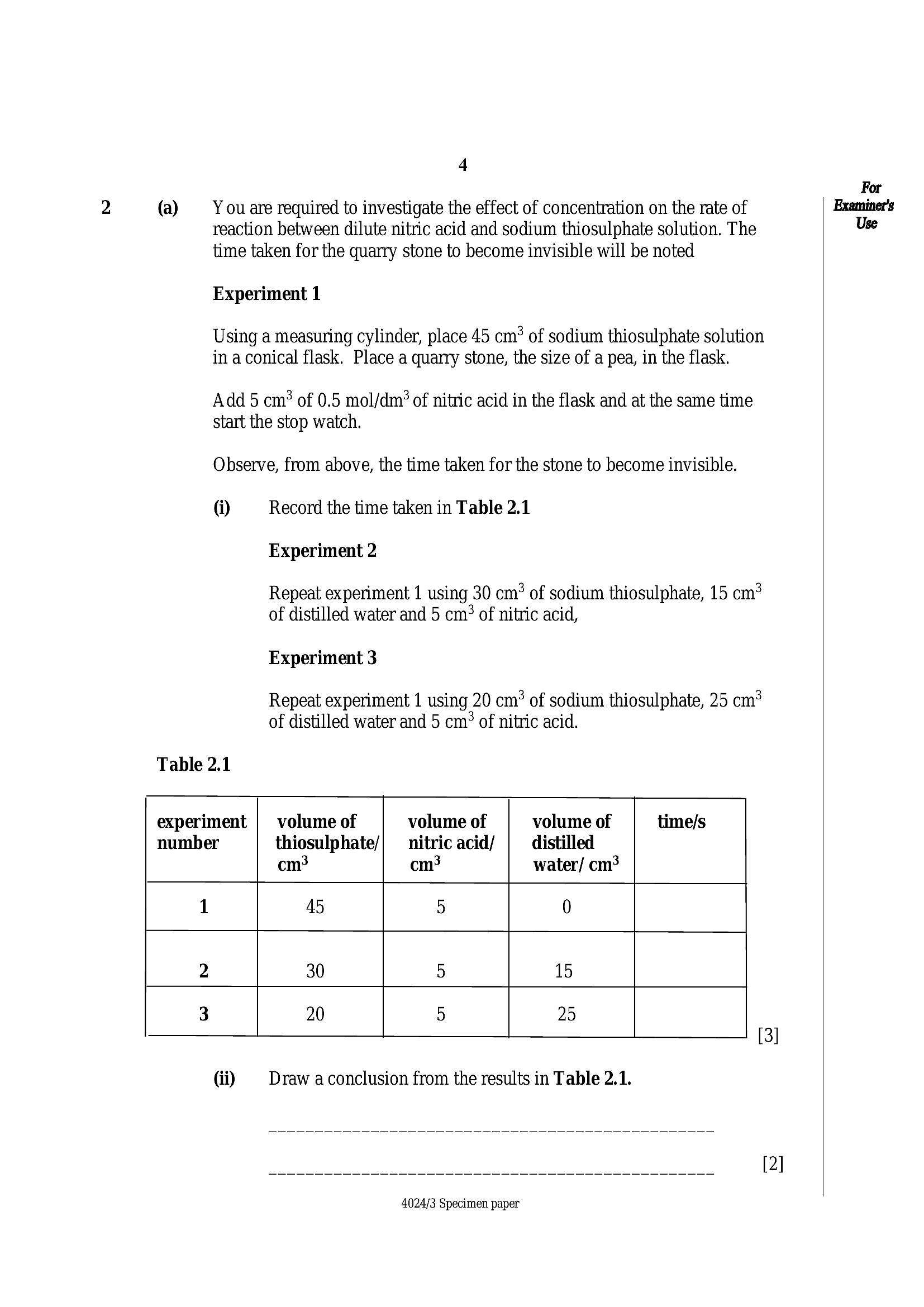
Y ou are required to investigate the effect of concentration on the rate of
reaction between dilute nitric acid and sodium thiosulphate solution. The
time taken for the quarry stone to become invisible will be noted
Experiment 1
Using a measuring cylinder, place 45 cm? of sodium thiosulphate solution
in aconical flask. Place a quarry stone, the size of a pea, in the flask.
Add 5 cm? of 0.5 mol/dm’ of nitric acid in the flask and at the same time
start the stop watch.
Observe, from above, the time taken for the stone to become invisible.
@ Record the time taken in Table 2.1
Experiment 2
Repeat experiment 1 using 30 cm? of sodium thiosulphate, 15 cm?
of distilled water and 5 cm? of nitric acid,
Experiment 3
Repeat experiment 1 using 20 cm? of sodium thiosulphate, 25 cm?
of distilled water and 5 cm? of nitric acid.
Table 2.1
experiment
number
volume of
thiosulphate/
volume of
nitric acid/
volume of
distilled
time/s
cm3 cm3 water/ cm?
45 5 0
30 5 15
20 5 25
di Draw aconclusion from the results in Table 2.1.
4024/3 Specimen paper
For
Use
---
Page 5
Extracted Text
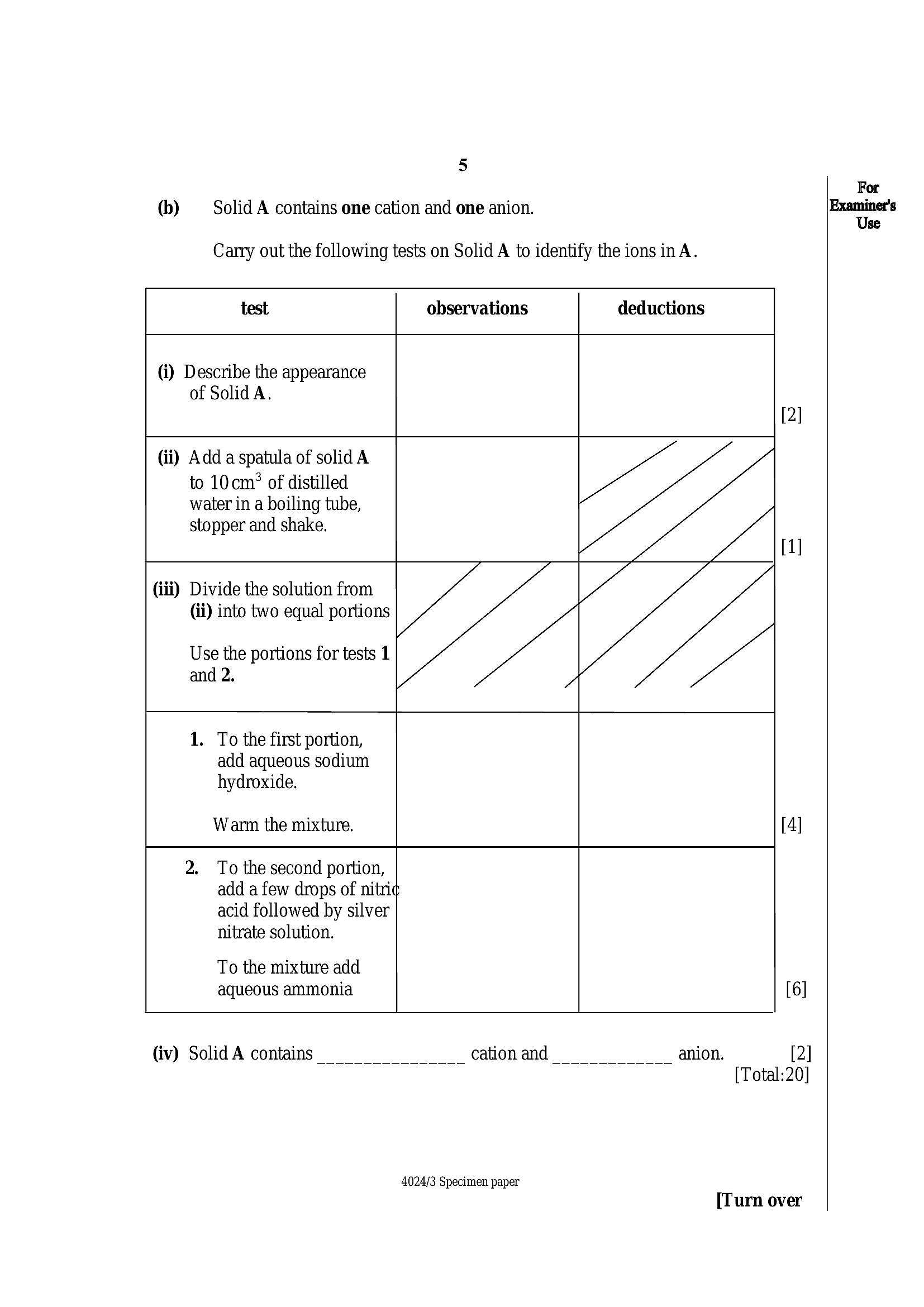
5(b) Solid A contains one cation and one anion.
Carry out the following
ests on Solid A to identify the ions inA.
test
observations deductions
(i) Describe the appearance
of Solid A.
(ii) Add a spatula of solid A
to 10cm? of distilled
water in a boiling tube,
stopper and shake.
(iii) Divide the solution from
(ii) into two equal portions
Use the portions for tests 1
and 2.
1. To the first portion,
add aqueous sodium
hydroxide.
Warm the mixture.
2. To the second portion,
add a few drops of nitri
acid followed by silver
nitrate solution.
To the mixture add
aqueous ammonia
[6]
(iv) Solid A contains
cation and anion. [2]
4024/3 Specimen paper
[Total:20]
[Turn over
For
Use
---
Page 6
Extracted Text
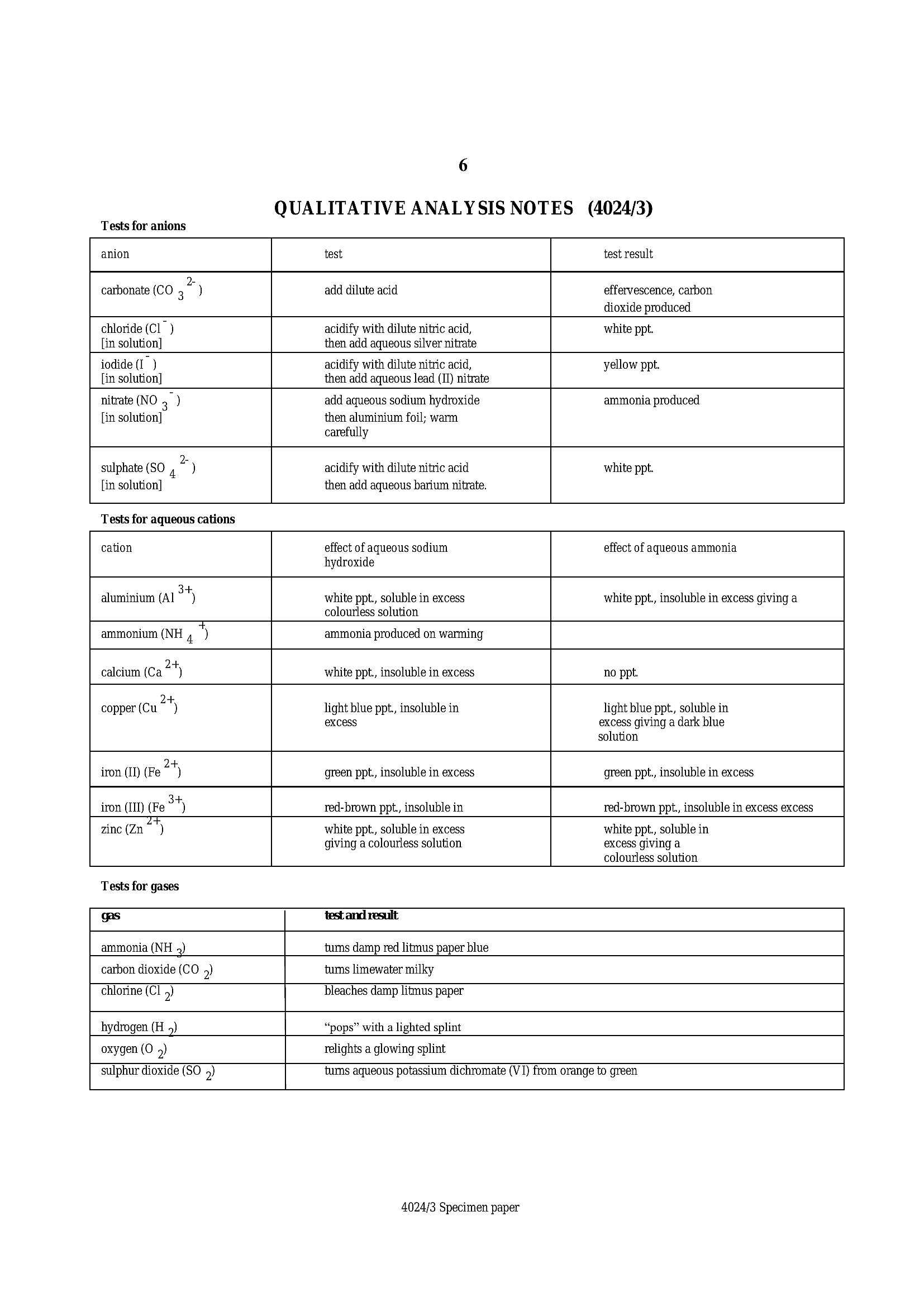
6QUALITATIVE ANALYSIS NOTES (4024/3)
Tests for anions
anion test test result
carbonate (CO 3 = ) add dilute acid effervescence, carbon
dioxide produced
chloride (Cl ) acidify with dilute nitric acid, white ppt.
[in solution] then add aqueous silver nitrate
iodide (I ) acidify with dilute nitric acid, yellow ppt.
[in solution] then add aqueous lead (II) nitrate
nitrate (NO 3 =) add aqueous sodium hydroxide ammonia produced
[in solution] then aluminium foil; warm
carefully
sulphate (SO 4 = ) acidify with dilute nitric acid white ppt.
[in solution] then add aqueous barium nitrate.
Tests for aqueous cations
cation effect of aqueous sodium effect of aqueous ammonia
hydroxide
aluminium (Al 3h white ppt., soluble in excess white ppt., insoluble in excess giving a
colourless solution
ammonium (NH 4 4 ammonia produced on warming
. 2+, . . .
calcium (Ca™ ) white ppt., insoluble in excess no ppt.
copper (Cu as) light blue ppt., insoluble in light blue ppt., soluble in
excess excess giving a dark blue
solution
iron (II) (Fe ca green ppt., insoluble in excess green ppt., insoluble in excess
iron (III) (Fe 34) red-brown ppt., insoluble in red-brown ppt., insoluble in excess excess
zine (Zn. a white ppt., soluble in excess white ppt., soluble in
giving a colourless solution excess giving a
colourless solution
Tests for gases
gas
test and result
ammonia (NH 4)
tums damp red litmus paper blue
carbon dioxide (CO 2)
tums limewater milky
chlorine (C1 P)
bleaches damp litmus paper
hydrogen (H 2)
“pops” with a lighted splint
oxygen (O 2)
relights a glowing splint
sulphur dioxide (SO 2)
tums aqueous potassium dichromate (V1) from orange to green
4024/3 Specimen paper
---
Page 7
Extracted Text
7 BLANK PAGE4024/3 Specimen paper
---
Page 8
Extracted Text
8 BLANK PAGE4024/3 Specimen paper
---