📄 Exam Questions & Readable Text Transcript
Full OCR-extracted text of questions, syllabus codes, and exam instructions.
Extracted Content: 6032q3Specimen
Page 1
Extracted Text
ZIMBABWE SCHOOL EXAMINATIONS COUNCILGeneral C ertificate of Education Advanced Level
PHYSICS 6032/3
PAPER 3 THEORY
SPECIMEN PAPER 2 hour 30 minutes
Additional materials:
Answer paper
Electronic calculator and/or Mathematical tables
Ruler (mm)
TIME =. 2: hour 30 minutes
INSTRUCTIONS TO CANDIDATES
Write your name, Centre number and candidate number in the spaces provided on the
answer paper/answer booklet.
Answer four questions.
Question1 is compulsory.
Answer any other three from the remaining questions.
Write your answers on the separate answer paper provided.
If you use more than one sheet of paper, fasten the sheets together.
All working for numerical answers must be shown.
INFORMATION FOR CANDIDATES
The number of marks is given in brackets [ ] at the end of each question or part question.
Y ou are reminded of the need for good English and clear presentation in your answers.
This question paper consists of 12 printed pages.
Copyright: Zimbabwe School Examinations Council, Specimen Paper.
@ZIMSEC SPECIMEN [Turn over
---
Page 2
Extracted Text
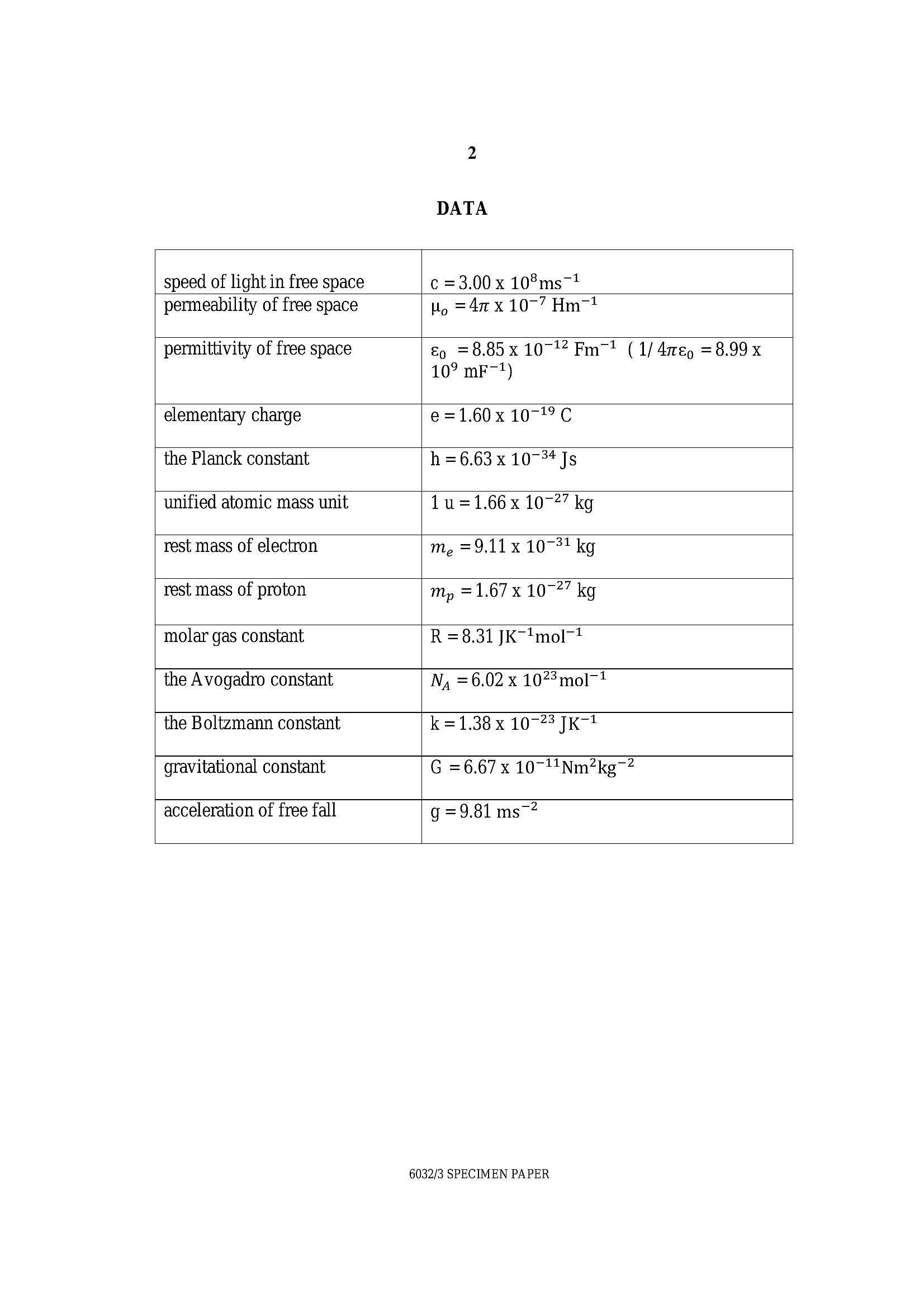
DATAspeed of light in free space
c =3.00 x 10®ms~?
permeability of free space
up =4nx 107-7 Hm
permittivity of free space
€) =8.85x 10712 Fm (1/ 4e, =8.99 x
10° mF-*)
elementary charge
e=1.60x10°1°C
the Planck constant
h =6.63 x 10-* Js
unified atomic mass unit
1u=1.66x 10⁻²” kg
rest mass of electron
m, =9.11 x 10-37 kg
rest mass of proton
Mp = 1.67 x 10°27 kg
molar gas constant
R =8.31 JK-tmol
the Avogadro constant
N, =6.02 x 10²%mol-?
the Boltzmann constant k =1.38 x 10⁻²³ Jk?
gravitational constant G =6.67 x 10⁻¹¹Nm2kg~2
acceleration of free fall g =9.81 ms“?
6032/3 SPECIMEN PAPER
---
Page 3
Extracted Text
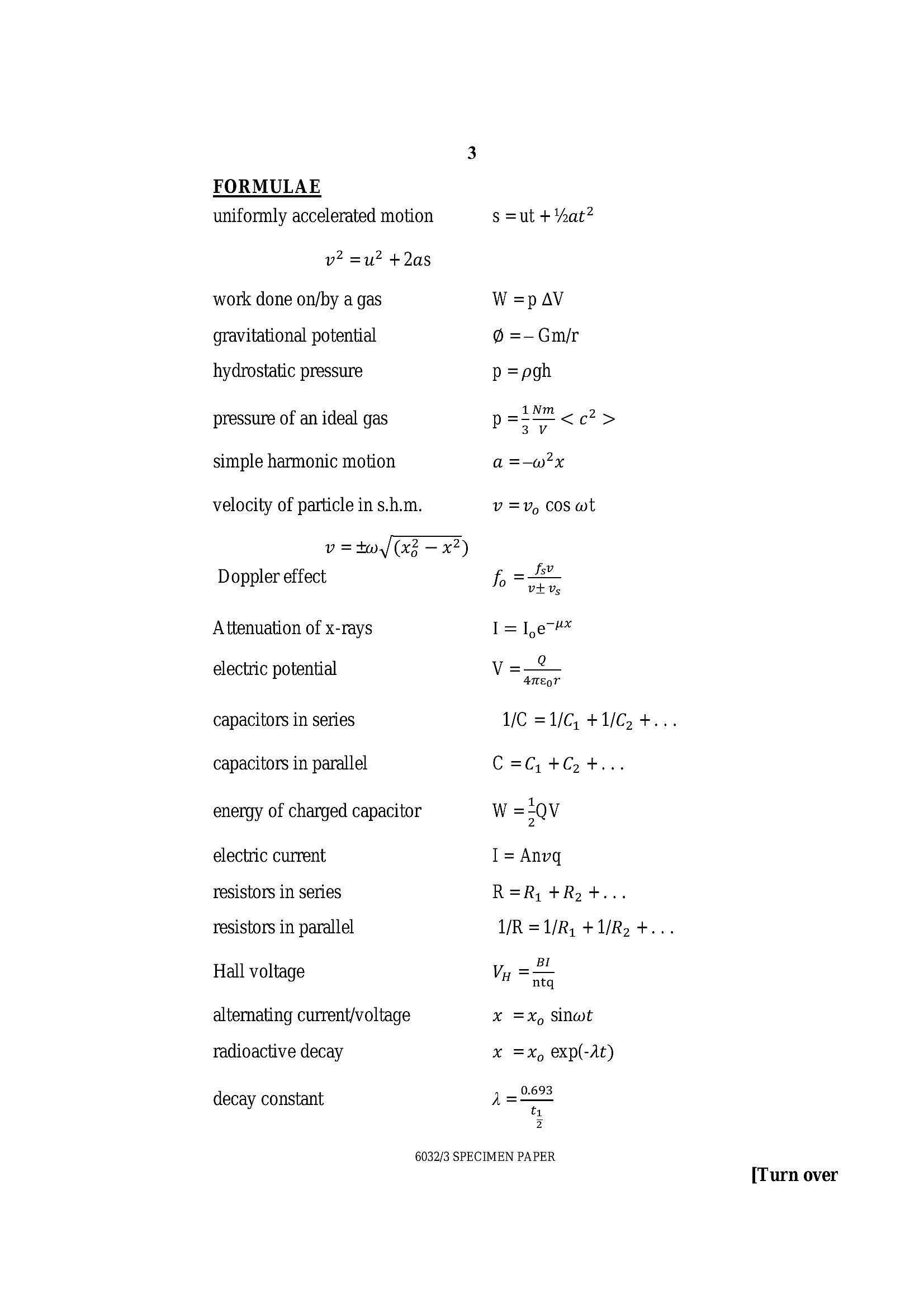
FORMULAE uniformly accelerated motionv? =u? +2as
work done on/by a gas
gravitational potential
hydrostatic pressure
pressure of an ideal gas
simple harmonic motion
velocity of particle in s.h.m.
v = 0/3 — 2?)
Doppler effect
Attenuation of x-rays
electric potential
capacitors in series
capacitors in parallel
energy of charged capacitor
electric current
resistors in series
resistors in parallel
Hall voltage
alternating current/voltage
radioactive decay
decay constant
s =ut + Yat?
W =p AV
=-Gm/r
p =pgh
=i <>
a=-w?*x
Vv =Vp COS wt
f = fsv
0 vt,
I=I,e4%%
- 2
AmEgr
WC =1C, +1/C, +...
C=C, +Q +...
1
W =sQV
I= Anvg
R=R, +R, +...
WR =1/R, + 1/Ro +...
_ BI
HOt
xX =X, sinwt
xX =X, exp(-At)
_ 0.693
t1
2
A
6032/3 SPECIMEN PAPER
[Turn over
---
Page 4
Extracted Text
(a)true value
(b)
4
Answer question 1 and any other 3 from the remaining questions.
@ Define systematic error.
di List any two possible causes of random error.
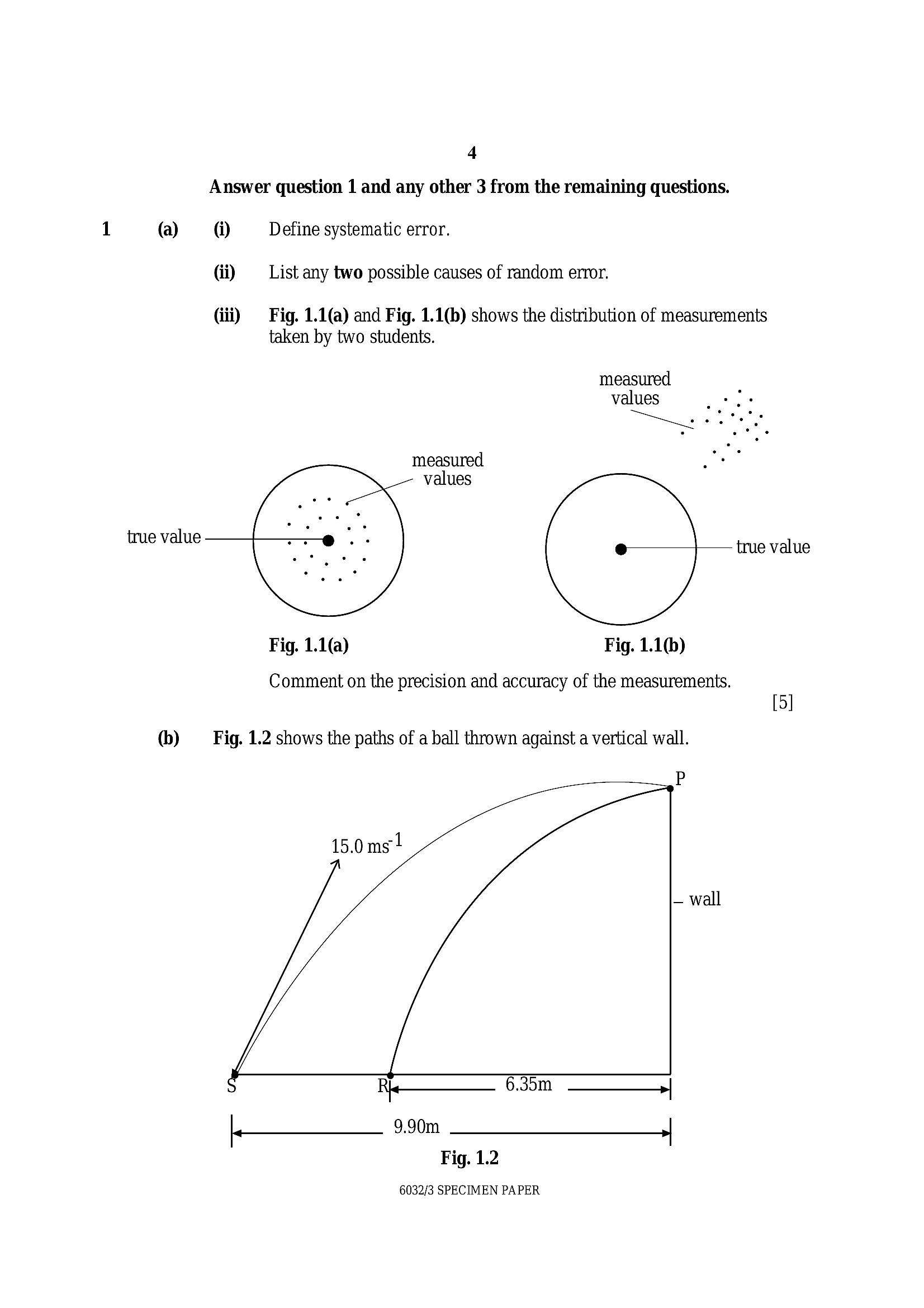
(ii) Fig. 1.1(a) and Fig. 1.1(b) shows the distribution of measurements
taken by two students.
measured
values
measured
values
true value
Fig. 1.1(a) Fig. 1.1(b)
Comment on the precision and accuracy of the measurements.
[5]
Fig. 1.2 shows the paths of a ball thrown against a vertical wall.
P
Rls 6.35m ———_+|
|<strong></strong>_ 9.90m —___J
Fig. 1.2
6032/3 SPECIMEN PAPER
---
Page 5
Extracted Text
©5
The ball is thrown from S with an initial velocity of 15.0 ms~* at 60° to the
horizontal. The horizontal distance from S to the wall is 9.90 m. The ball hits the
wall at P with a velocity at right angles to the wall and rebounds to point R.
Assume no air resistance.
(1) Determine the vertical height gained by the ball as it travels from S
to P.
di Calculate the time taken by the ball to travel from S to P.
(iii) Show that the velocity of the ball immediately after rebounding
from the wall is about 4.80 ms~?.
(iv) | The mass of the ball is 60 x10~?kg. Calculate the change in
momentum as it rebounds from the wall.
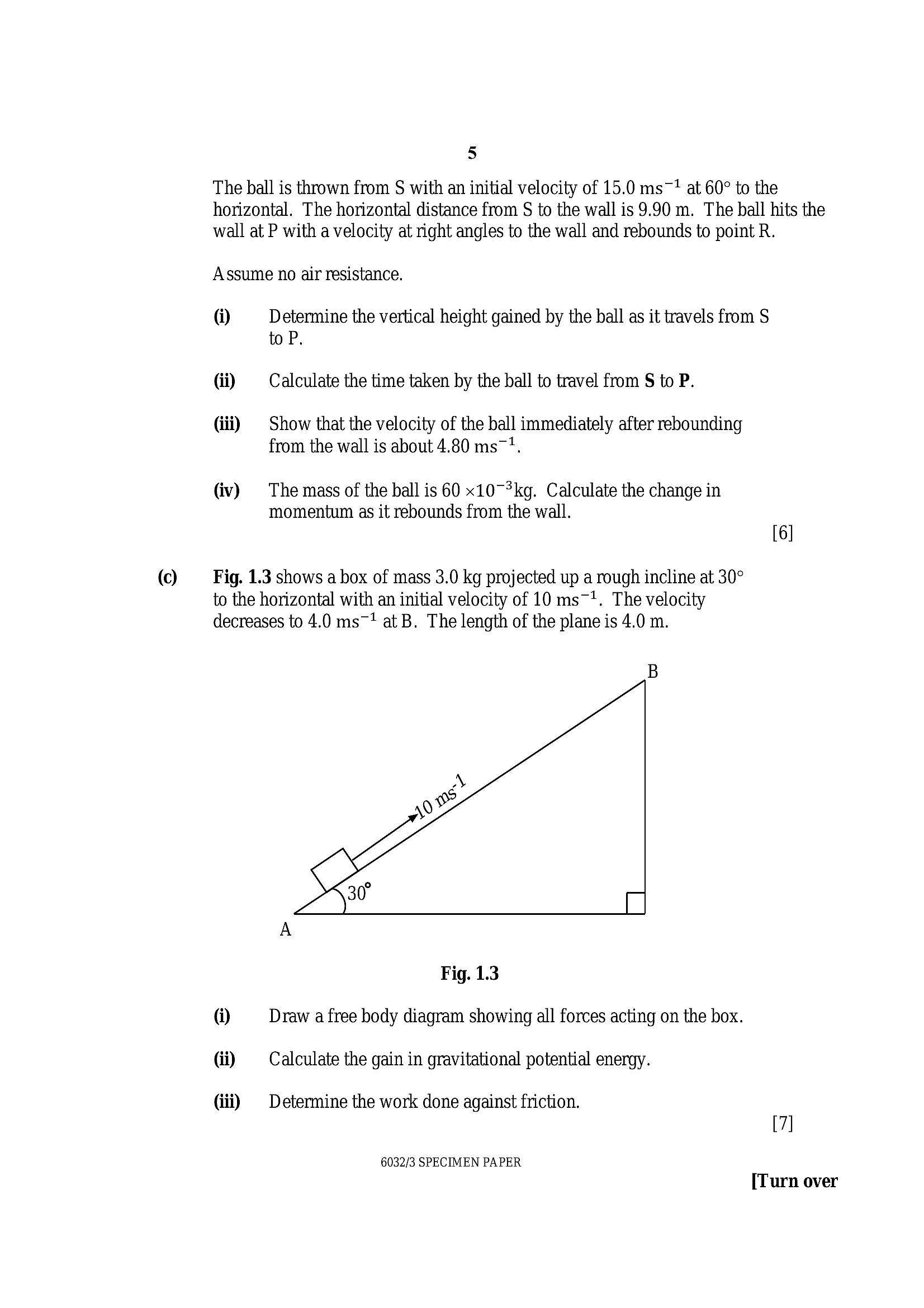
Fig. 1.3 shows a box of mass 3.0 kg projected up a rough incline at 30°
to the horizontal with an initial velocity of 10 ms~?. The velocity
decreases to 4.0 ms~* at B. The length of the plane is 4.0 m.
B
Fig. 1.3
(1) Draw a free body diagram showing all forces acting on the box.
(ii) Calculate the gain in gravitational potential energy.
(iii) | Determine the work done against friction.
6032/3 SPECIMEN PAPER
[7]
[Turn over
---
Page 6
Extracted Text
(d)(a)
(b)
©
6
A satellite of mass m, travels at an angular speed o, in a circular orbit
at a height h, above the surface of planet of mass M and radius R.
@
Gi)
(iii)
Gi)
Gi)
(iii)
State in words Newton’s law of universal gravitation.
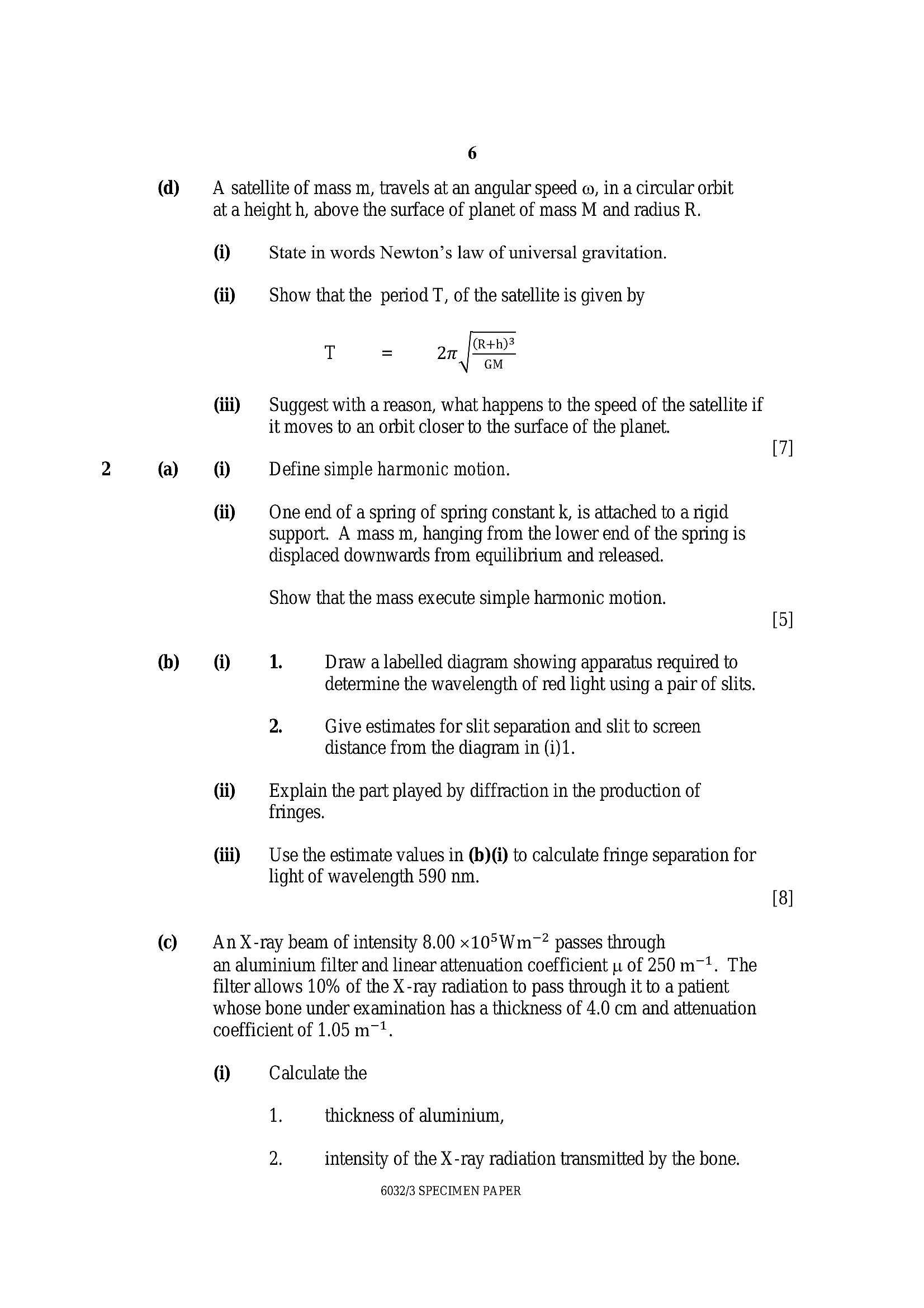
Show that the period T, of the satellite is given by
(R+h)3
GM
T = 2n
Suggest with a reason, what happens to the speed of the satellite if
it moves to an orbit closer to the surface of the planet.
Define simple harmonic motion.
One end of a spring of spring constant k, is attached to a rigid
support. A mass m, hanging from the lower end of the spring is
displaced downwards from equilibrium and released.
Show that the mass execute simple harmonic motion.
1. Draw a labelled diagram showing apparatus required to
determine the wavelength of red light using a pair of slits.
2. Give estimates for slit separation and slit to screen
distance from the diagram in (i)1.
Explain the part played by diffraction in the production of
fringes.
Use the estimate values in (b)(i) to calculate fringe separation for
light of wavelength 590 nm.
An X-ray beam of intensity 8.00 x10°Wm~? passes through
an aluminium filter and linear attenuation coefficient » of 250 m~t. The
filter allows 10% of the X-ray radiation to pass through it to a patient
whose bone under examination has a thickness of 4.0 cm and attenuation
coefficient of 1.05 m~t.
@
Calculate the
1. thickness of aluminium,
2. intensity of the X-ray radiation transmitted by the bone.
6032/3 SPECIMEN PAPER
[7]
---
Page 7
Extracted Text
(d)(a)
Gi)
(iii)
Suggest the advantages of passing the X-rays through the filter
7
before passing it through the patient.
Explain how an anti-scatter grid improves the X-ray image
produced.
Outline how X-rays are used to build up the images produced in
aCT scan.
Explain why CT scanning requires a powerful computer.
Explain what is meant by magnetic field.
Sketch four lines to show the magnetic field around a
long straight current carrying conductor.
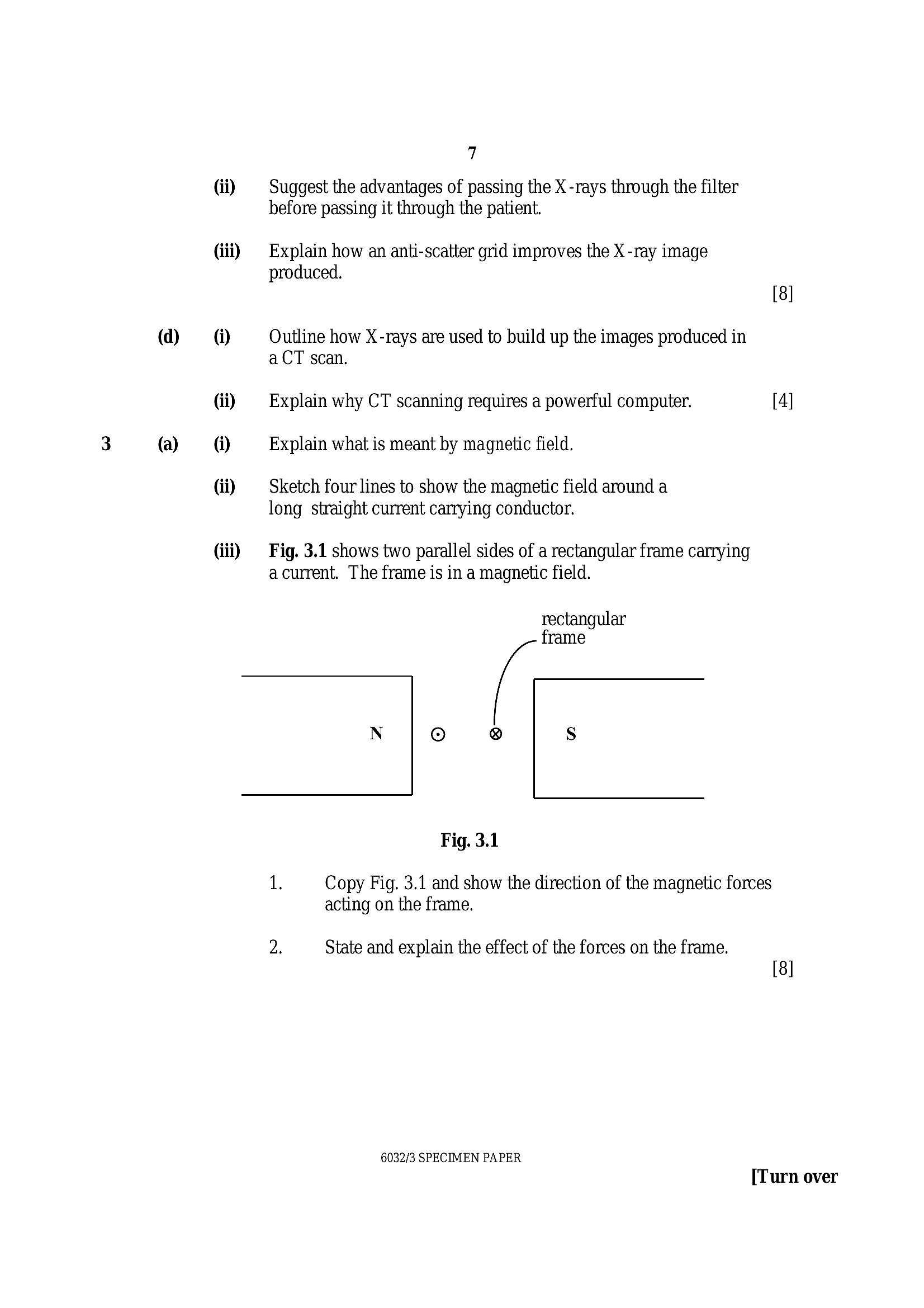
Fig. 3.1 shows two parallel sides of a rectangular frame carrying
acurrent. The frame is in a magnetic field.
rectangular
frame
1.
2.
cn
Fig. 3.1
Copy Fig. 3.1 and show the direction of the magnetic forces
acting on the frame.
State and explain the effect of the forces on the frame.
6032/3 SPECIMEN PAPER
[8]
[Turn over
---
Page 8
Extracted Text
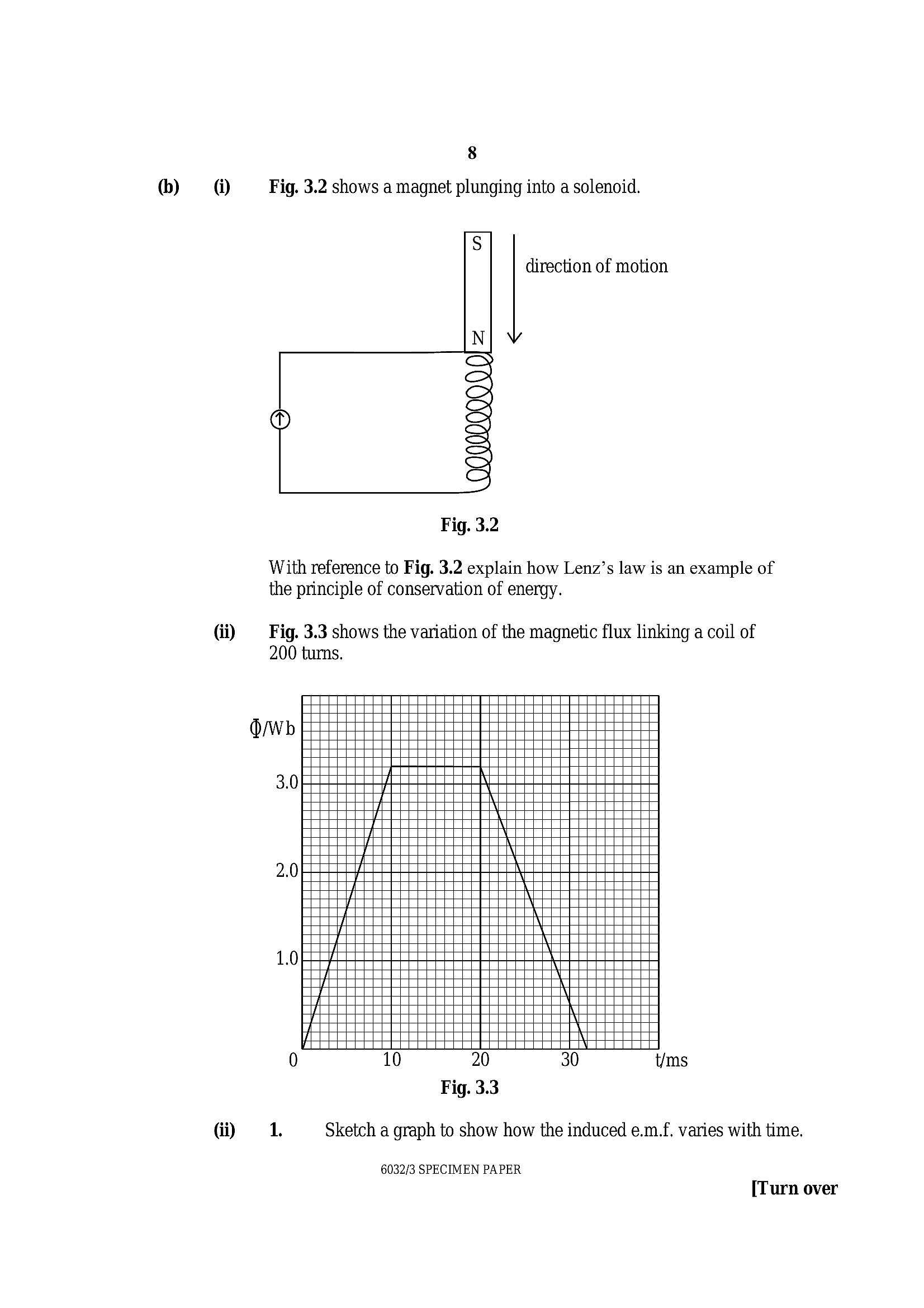
8 ob) @ Fig. 3.2 shows a magnet plunging into a solenoid.direction of motion
Fig. 3.2
With reference to Fig. 3.2 explain how Lenz’s law is an example of
the principle of conservation of energy.
(ii) ‘Fig. 3.3 shows the variation of the magnetic flux linking a coil of
200 tums.
OWb
3.0
2.0
1.0
AY
NY
0 10 20 30 t/ms
Fig. 3.3
di 1. Sketch a graph to show how the induced e.m_.f. varies with time.
6032/3 SPECIMEN PAPER
[Turn over
---
Page 9
Extracted Text
©(a)
(b)
9
2. Suggest two ways by which the magnitude of the induced
e.m.f. can be increased.
[8]
@ State the function of a transformer.
di A transformer has 600 turns in its primary coil and a sinusoidal
input voltage of r.m.s. value 230 V. The output has a peak to
peak voltage of 120 V.
1. Calculate the number of turns in the secondary coil.
2. Explain why r.m.s. values are considered and not mean values
in ac. circuits.
(iii) In a transformer, there is thermal energy produced. Describe and
explain the sources of the thermal energy.
[9]
Define
@ laminar flow,
di incompressible flow.
[2]
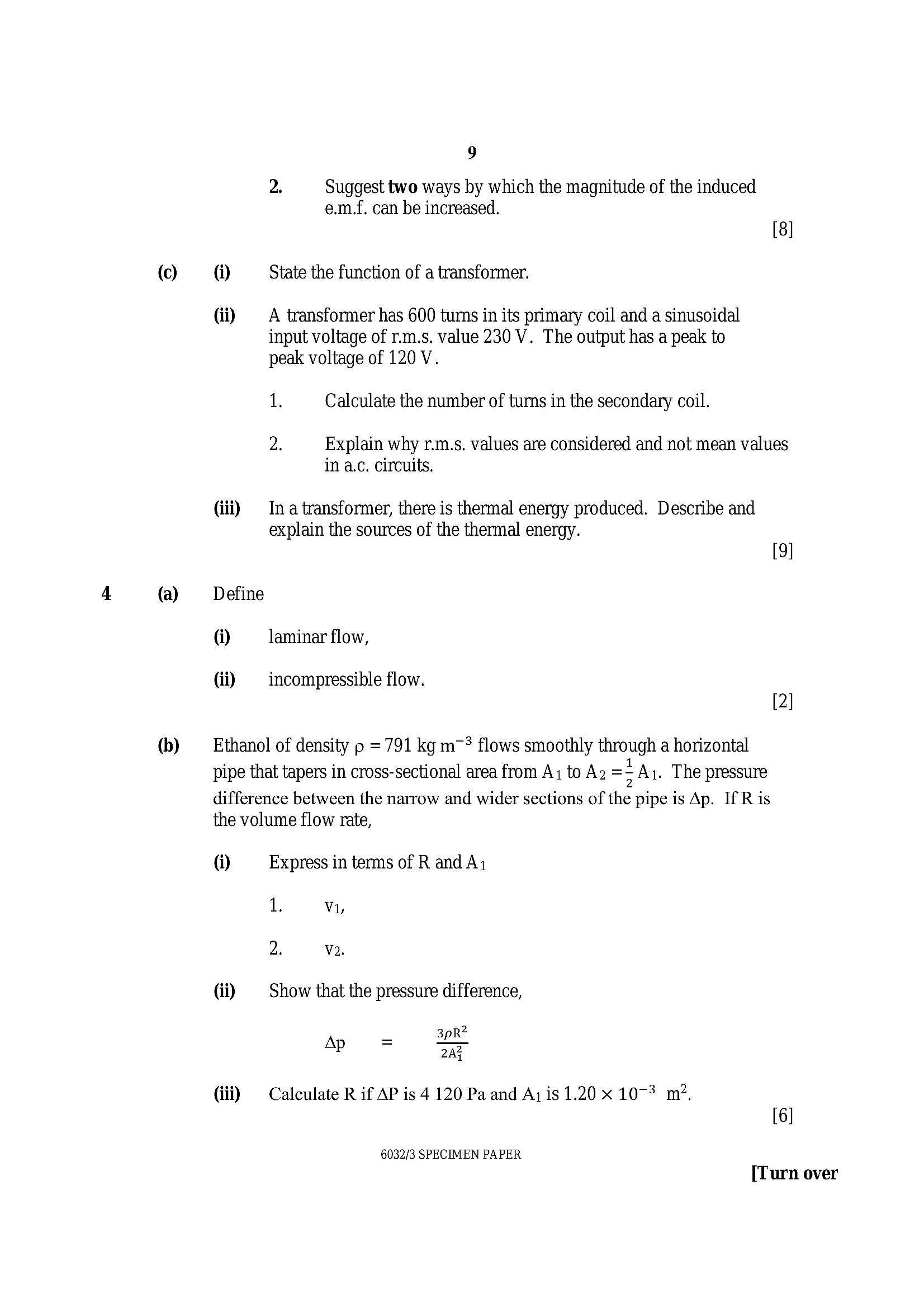
Ethanol of density p = 791 kg m~? flows smoothly through a horizontal
pipe that tapers in cross-sectional area from Ai to A2 = : Ay. The pressure
difference between the narrow and wider sections of the pipe is Ap. If R is
the volume flow rate,
@ Express in terms of R and Ai
1. Vi
2. V2.
di Show that the pressure difference,
3pR?
2A2
Ap =
(iii) Calculate R if AP is 4 120 Pa and Aj is 1.20 x 1073 m2,
[6]
6032/3 SPECIMEN PAPER
[Turn over
---
Page 10
Extracted Text
©(d)
10
@ Outline how molecular movement causes pressure exerted by a
gas.
(ii) A car’s tyre contains a gas at a pressure of 3.00 x 10° Pa. After
along drive the tyre becomes hot and expand. The volume of the
gas increases by 1% while its temperature increases by 5%.
Calculate the final pressure, assuming the gas behaves ideally.
[4]
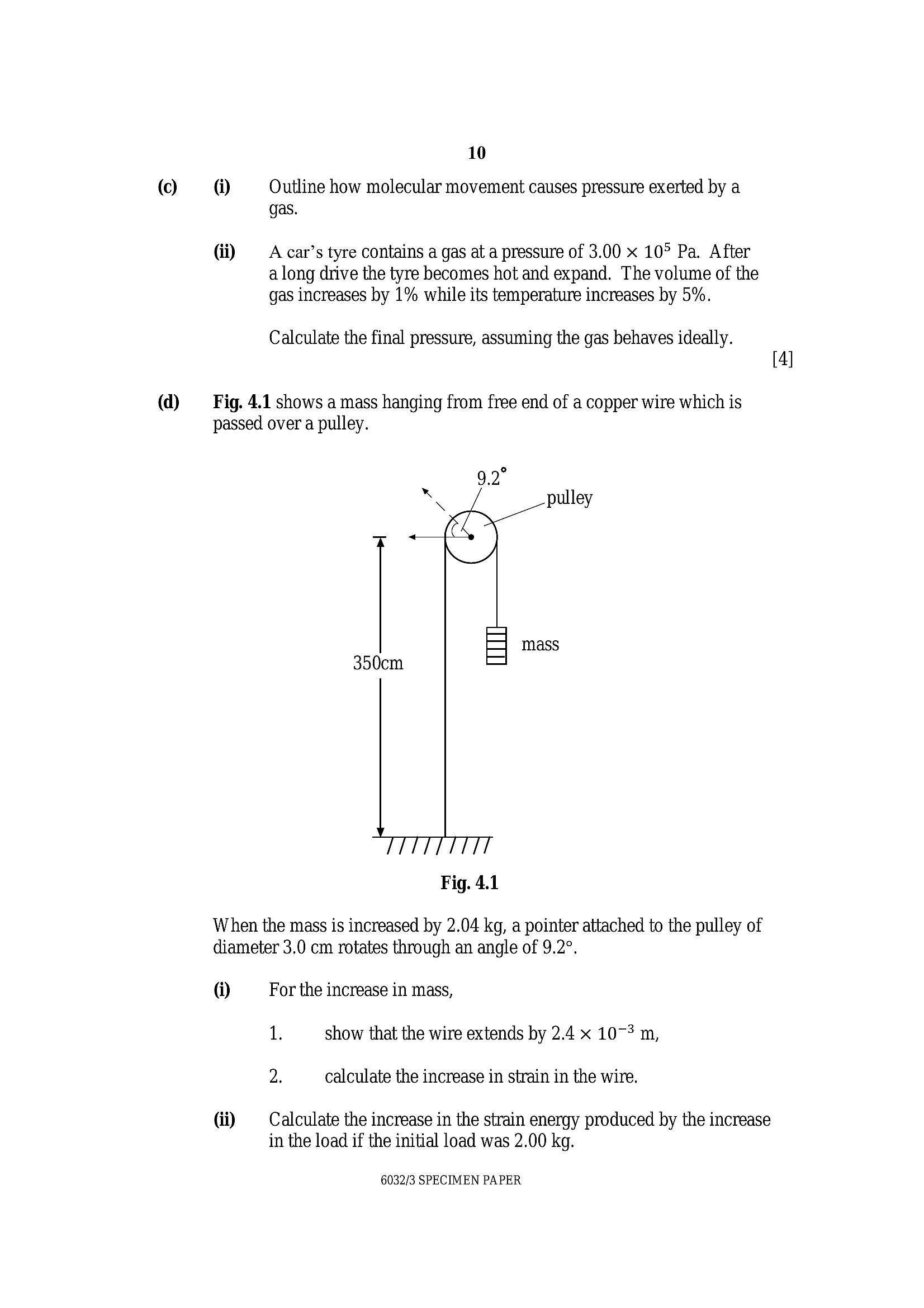
Fig. 4.1 shows a mass hanging from free end of a copper wire which is
passed over a pulley.
mass
350cm
Fig. 4.1
When the mass is increased by 2.04 kg, a pointer attached to the pulley of
diameter 3.0 cm rotates through an angle of 9.2°.
@ For the increase in mass,
1. show that the wire extends by 2.4 x 1073 m,
2. calculate the increase in strain in the wire.
(ii) Calculate the increase in the strain energy produced by the increase
in the load if the initial load was 2.00 kg.
6032/3 SPECIMEN PAPER
---
Page 11
Extracted Text
©(a)
(b)
(iii)
@
Gi)
11
The specific heat capacity of copper is 420 J/kg/k and the mass of the
wire is 6.2 g.
1. Calculate the change in temperature of the wire as it extends.
2. State the assumption you have made in your calculation.
[8]
Explain what is meant by thermometric property.
Suggest with a reason, the suitable type of thermometer for measuring
temperature of
1. boiling liquid oxygen,
2. molten iron in a blast furnace.
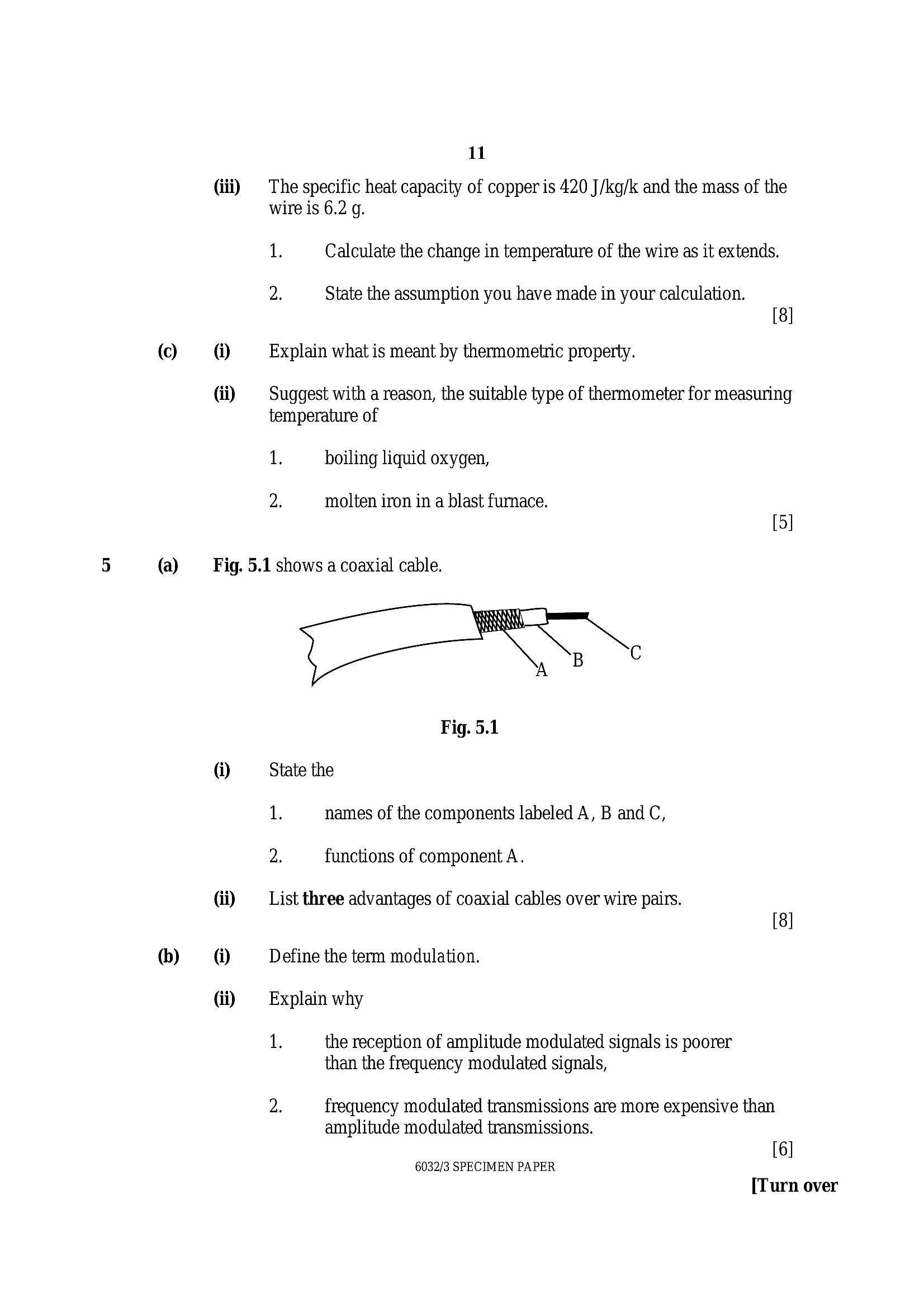
Fig. 5.1 shows a coaxial cable.
@
Gi)
Gi)
Fig. 5.1
State the
1. names of the components labeled A, B and C,
2. functions of component A.
List three advantages of coaxial cables over wire pairs.
[8]
Define the term modulation.
Explain why
1. the reception of amplitude modulated signals is poorer
than the frequency modulated signals,
2. frequency modulated transmissions are more expensive than
amplitude modulated transmissions.
[6]
6032/3 SPECIMEN PAPER
[Turn over
---
Page 12
Extracted Text
12©
TE PET rt rt H (|
a =k -
& aa EEL EEL EHH
BER :
= os PEE | aaae aaae rte
E os PEE a Pry ry Pry ry rtry
g os PEE | aaae aaae rte
2 Cho 1 : coo coo C4
oO CI | oon oon Cee
a CI | Ce Ce Cee
oa | | aaae aaae rte
& Hi L EAH EEEEEEEE EH
a Coo im
2 Se H
& GE Sy BUUEEEEEESSEEEEEEEE
3S Coo Cec Cee Cer]
cc) HH H
a Coo im
a SoA or }
ad {| {tt | {| [Pty [Pty [Tt
a CPt i imi
B HH H HI
‘a Coo u mt
° os | CI Cee Cee an
| as PE | Pere Pere rt
n Cee CECE Ce Ce Cee
= aon oan Lt aaae aaae rte
oS on aan CeCe CeCe CET
Gq {| aooe | aaae aaae rte
a a LEPEEE Er CAC CAC Cee
N im a i t ian i
3S Gets ii i
= HH BanDS eee HELA EEEEESEEEECH
al im im Cot CC
1 1 oo HEH
Signal
Voltage/V HH
8.0H4
20 30 40 50 60 70 80 t/ms
Fig. 5.2
10
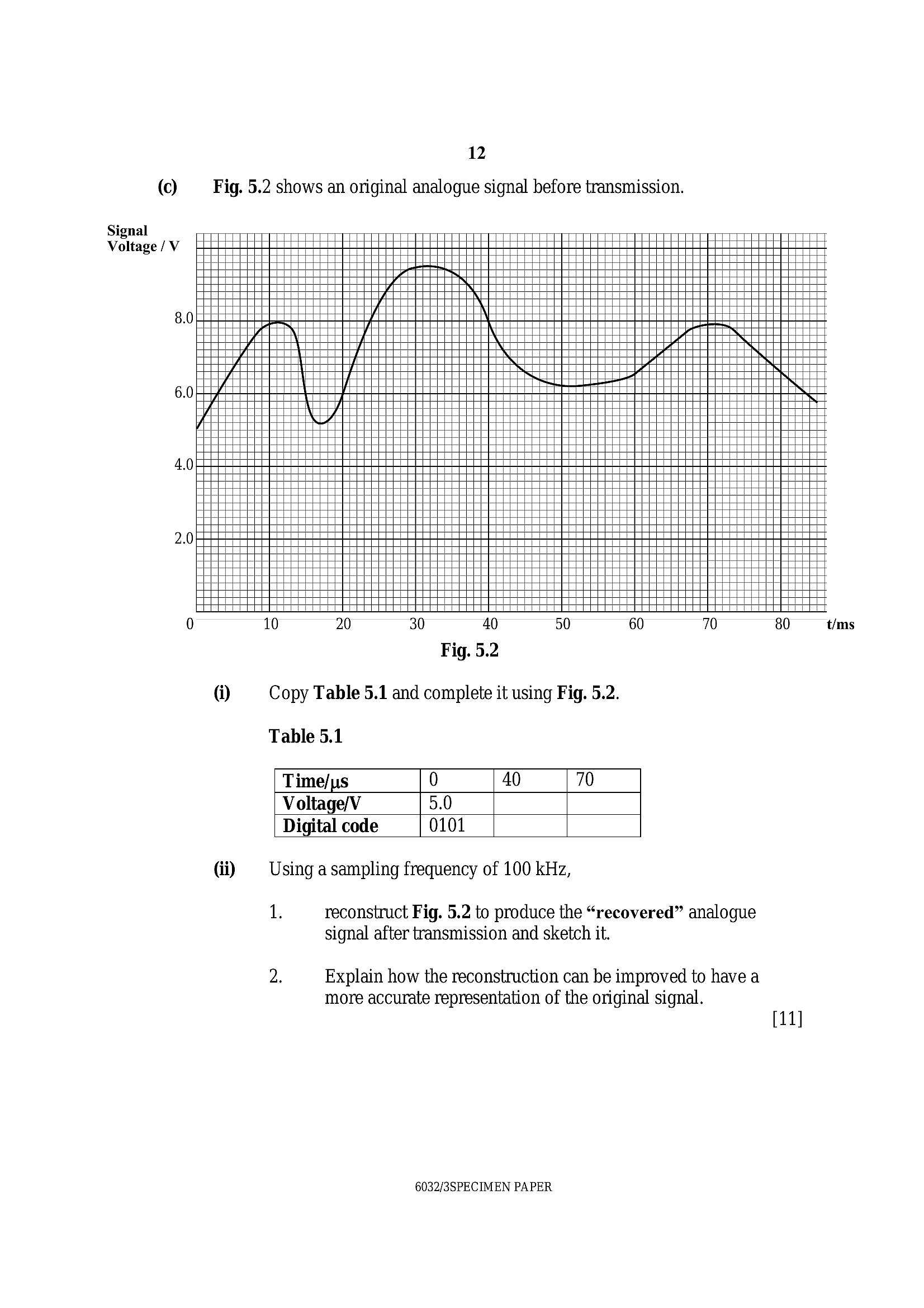
Copy Table 5.1 and complete it using Fig. 5.2.
@
70
[11]
40
5.0
0101
Table 5.1
Time/us
Voltage/V
Digital code
Using a sampling frequency of 100 kHz,
Gi)
Explain how the reconstruction can be improved to have a
reconstruct Fig. 5.2 to produce the “recovered” analogue
more accurate representation of the original signal.
signal after transmission and sketch it.
1.
6032/3SPECIMEN PAPER
---