📄 Exam Questions & Readable Text Transcript
Full OCR-extracted text of questions, syllabus codes, and exam instructions.
Extracted Content: argumentative essay
Page 1
Extracted Text
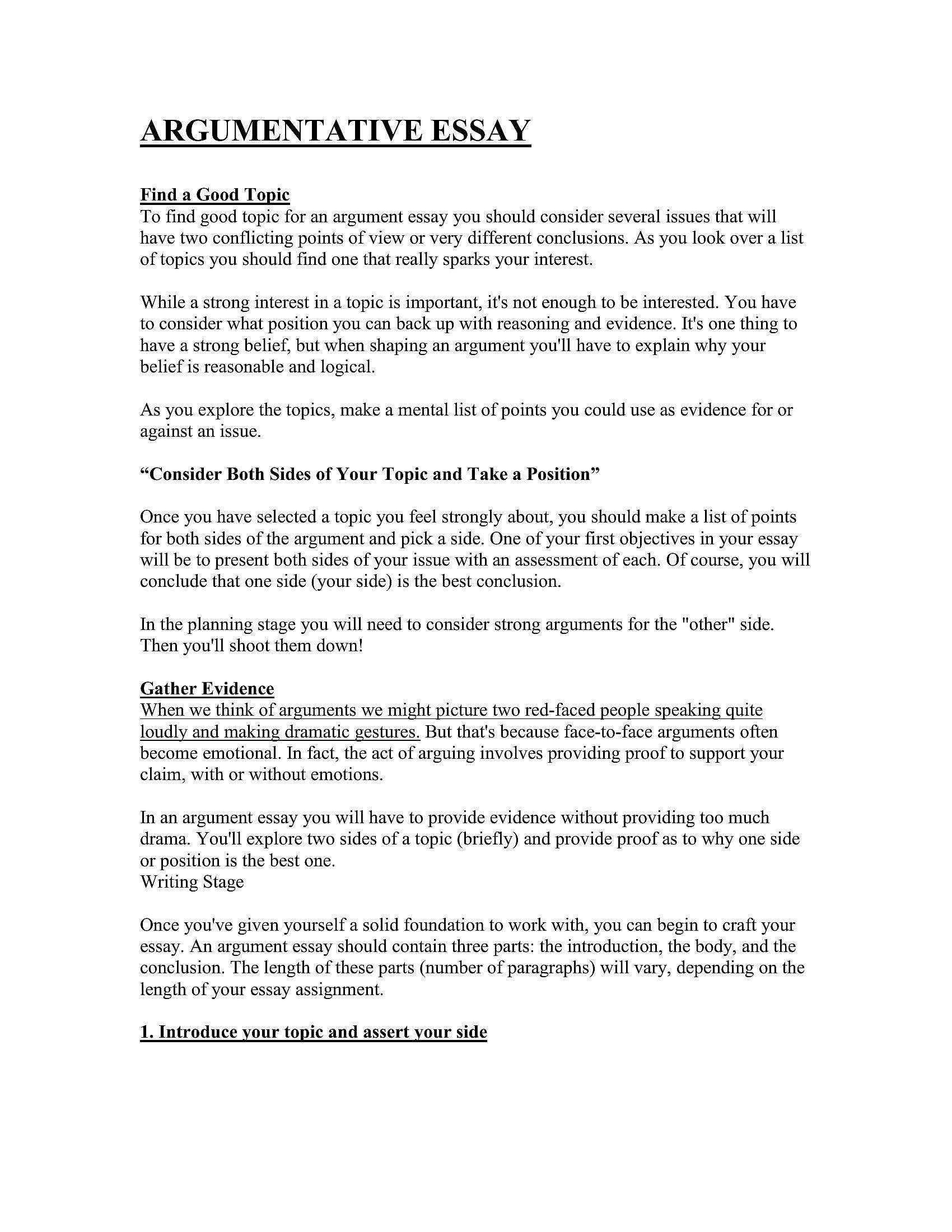
ARGUMENTATIVE ESSAYFind a Good Topic
To find good topic for an argument essay you should consider several issues that will
have two conflicting points of view or very different conclusions. As you look over a list
of topics you should find one that really sparks your interest.
While a strong interest in a topic is important, it's not enough to be interested. You have
to consider what position you can back up with reasoning and evidence. It's one thing to
have a strong belief, but when shaping an argument you'll have to explain why your
belief is reasonable and logical.
As you explore the topics, make a mental list of points you could use as evidence for or
against an issue.
“Consider Both Sides of Your Topic and Take a Position”
Once you have selected a topic you feel strongly about, you should make a list of points
for both sides of the argument and pick a side. One of your first objectives in your essay
will be to present both sides of your issue with an assessment of each. Of course, you will
conclude that one side (your side) is the best conclusion.
In the planning stage you will need to consider strong arguments for the "other" side.
Then you'll shoot them down!
Gather Evidence
When we think of arguments we might picture two red-faced people speaking quite
loudly and making dramatic gestures. But that's because face-to-face arguments often
become emotional. In fact, the act of arguing involves providing proof to support your
claim, with or without emotions.
In an argument essay you will have to provide evidence without providing too much
drama. You'll explore two sides of a topic (briefly) and provide proof as to why one side
or position is the best one.
Writing Stage
Once you've given yourself a solid foundation to work with, you can begin to craft your
essay. An argument essay should contain three parts: the introduction, the body, and the
conclusion. The length of these parts (number of paragraphs) will vary, depending on the
length of your essay assignment.
1. Introduce your topic and assert your side
---
Page 2
Extracted Text
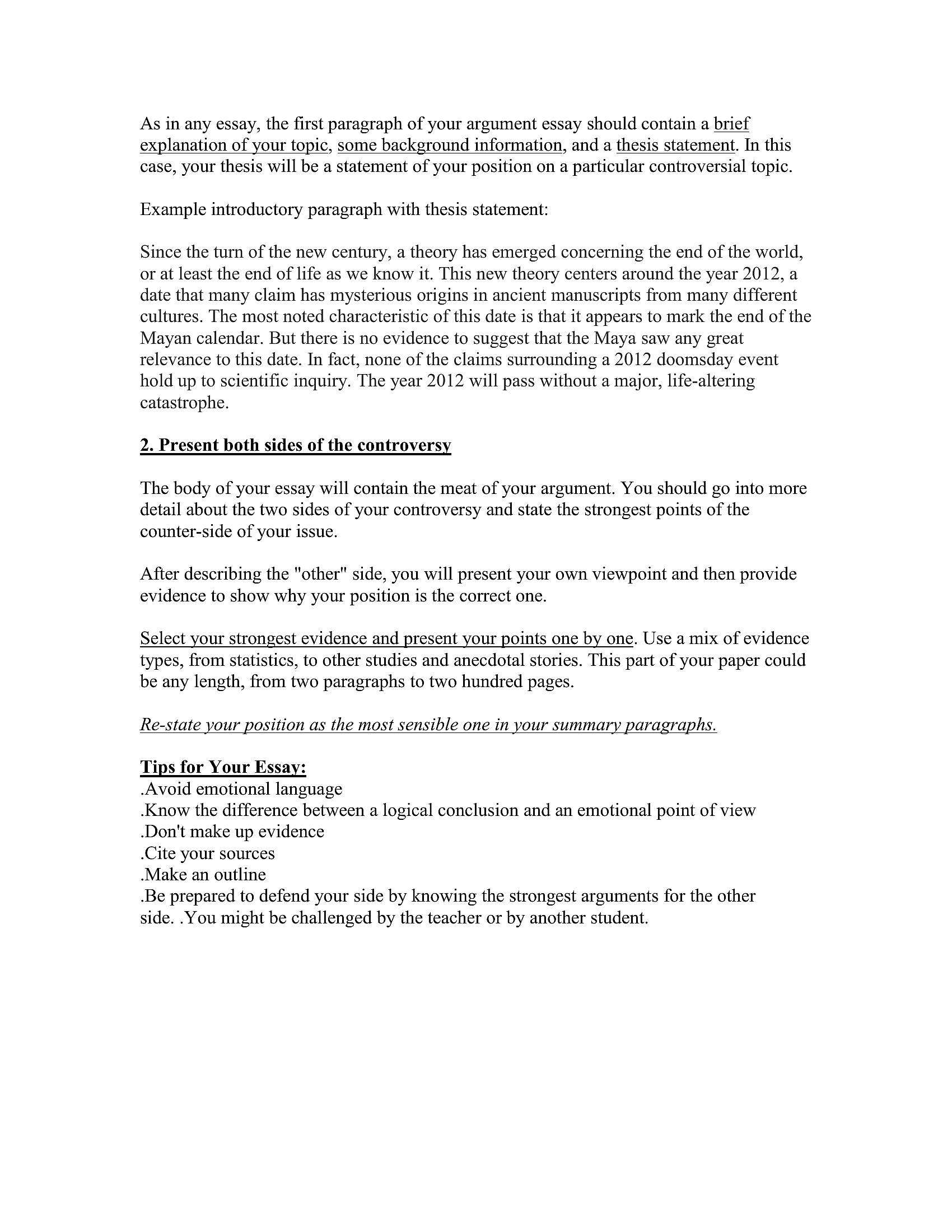
As in any essay, the first paragraph of your argument essay should contain a brief explanation of your topic, some background information, and a thesis statement. In this case, your thesis will be a statement of your position on a particular controversial topic.Example introductory paragraph with thesis statement:
Since the turn of the new century, a theory has emerged concerning the end of the world,
or at least the end of life as we know it. This new theory centers around the year 2012, a
date that many claim has mysterious origins in ancient manuscripts from many different
cultures. The most noted characteristic of this date is that it appears to mark the end of the
Mayan calendar. But there is no evidence to suggest that the Maya saw any great
relevance to this date. In fact, none of the claims surrounding a 2012 doomsday event
hold up to scientific inquiry. The year 2012 will pass without a major, life-altering
catastrophe.
2. Present both sides of the controversy
The body of your essay will contain the meat of your argument. You should go into more
detail about the two sides of your controversy and state the strongest points of the
counter-side of your issue.
After describing the "other" side, you will present your own viewpoint and then provide
evidence to show why your position is the correct one.
Select your strongest evidence and present your points one by one. Use a mix of evidence
types, from statistics, to other studies and anecdotal stories. This part of your paper could
be any length, from two paragraphs to two hundred pages.
Re-state your position as the most sensible one in your summary paragraphs.
Tips for Your Essay:
-Avoid emotional language
-Know the difference between a logical conclusion and an emotional point of view
-Don't make up evidence
.Cite your sources
-Make an outline
.Be prepared to defend your side by knowing the strongest arguments for the other
side. .You might be challenged by the teacher or by another student.
---