


📄 Exam Questions & Readable Text Transcript
Full OCR-extracted text of questions, syllabus codes, and exam instructions.
Extracted Content: 4023q02
Page 1
Extracted Text
Surname Forename(s) Centre Number Candidate NumberFor Performance Measurement
ZIMBABWE SCHOOL EXAMINATIONS COUNCIL
General Certificate of Education Ordinary L evel
PHYSICS 4023/2
PAPER 2: Theory
SPECIMEN PAPER 2 hours
Additional materials: Electronic calculator and/or Mathematical table
Graph paper
Allow candidates 5 minutes to count pages before the examination
This booklet should not be punched or stapled and pages should not be removed.
TIME: 2 hours
INSTRUCTIONS TO CANDIDATES
Write your name, centre number and candidate number in the spaces at the top of this page and
Centre number and candidate number on top of the right corner of every page of this paper.
Check if the booklet has all the pages and ask the invigilator for a replacement if there are
duplicate or missing pages.
Section A
Answer all questions.
Write your answers in the spaces provided on the question paper.
Section B
Answer any three questions.
Write your answers on the spaces provided on the question paper
Do not fasten the booklet
INFORMATION FOR CANDIDATES
The number of marks is given in brackets [ ] at the end of each question or part question paper.
Candidates are reminded that all quantitative answers should include appropriate units.
Candidates are advised to show all their working in a clear and orderly manner, as more marks are
awarded for sound use of Physics than for correct answers.
This question paper consists of 21 printed pages and 3 blank pages.
Copyright: Zimbabwe School Examinations Council, Specimen paper.
©@ZIMSEC Specimen paper [Turn over
---
Page 2
Extracted Text
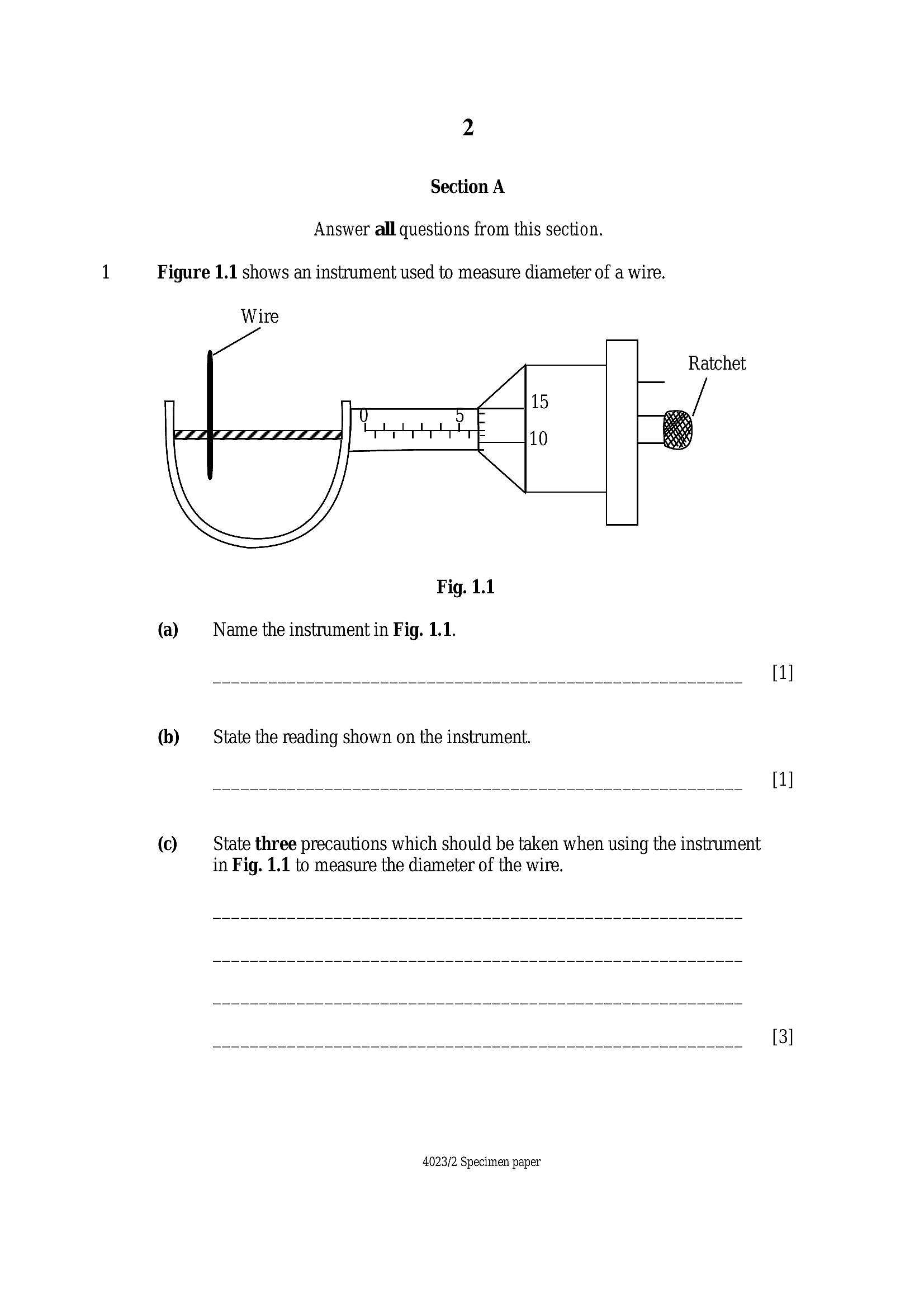
Section A Answer all questions from this section. Figure 1.1 shows an instrument used to measure diameter of a wire.Wire
a
Ratchet
Fig. 1.1
(a) Name the instrument in Fig. 1.1.
(b) State the reading shown on the instrument.
() State three precautions which should be taken when using the instrument
in Fig. 1.1 to measure the diameter of the wire.
4023/2 Specimen paper
---
Page 3
Extracted Text
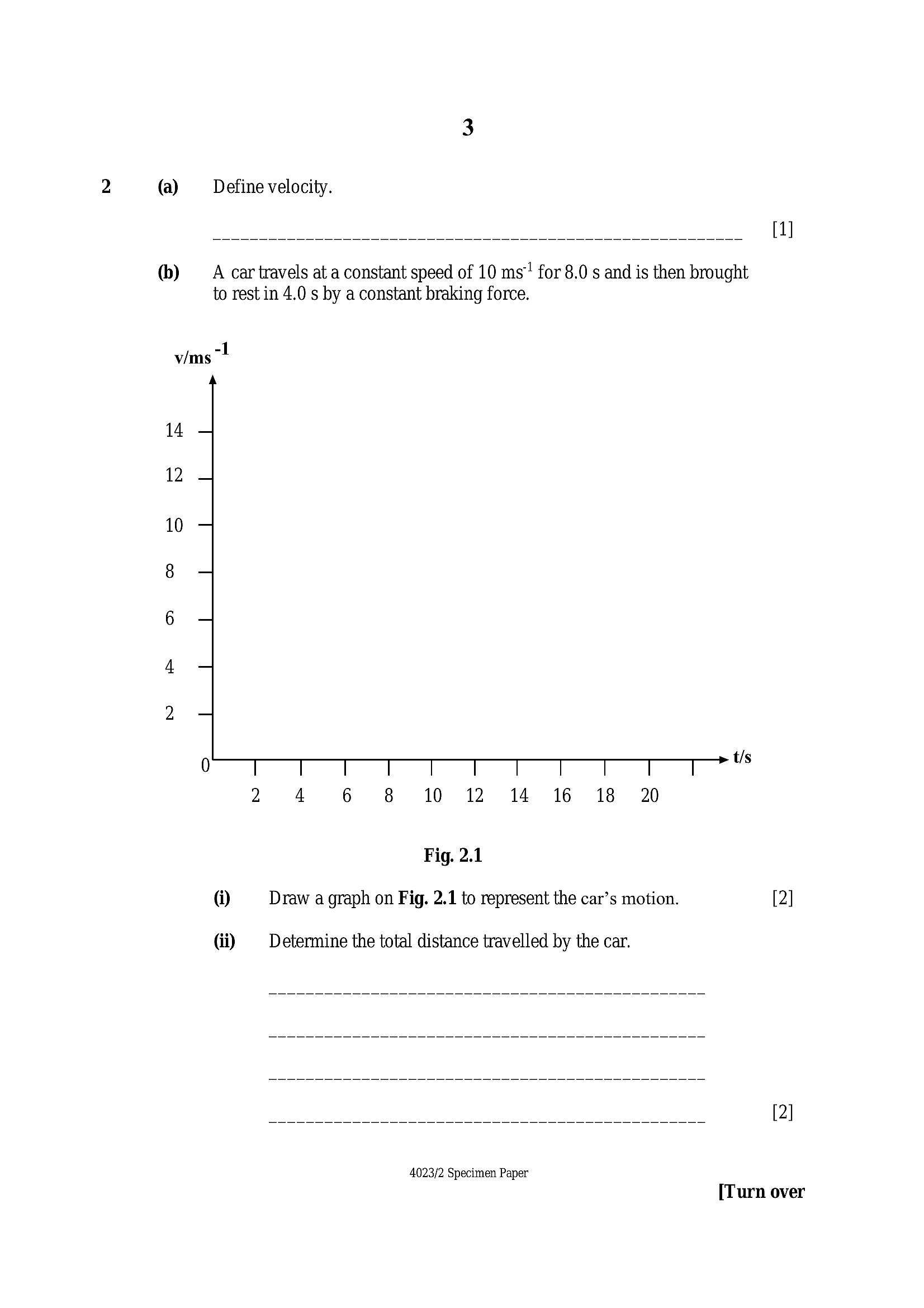
(a) Define velocity.(b) A car travels at a constant speed of 10 ms for 8.0 s and is then brought
to rest in 4.0 s by a constant braking force.
v/ms “i
14
12
10
0 tis
2 4 6 8 10 12 14 16 18 20
Fig. 2.1
(1) Draw a graph on Fig. 2.1 to represent the car’s motion. [2]
di Determine the total distance travelled by the car.
4023/2 Specimen Paper
[Turn over
---
Page 4
Extracted Text
(a) @ State one non-renewable source of energy.(ii) Explain why charcoal is a renewable source of energy.
(iii) Describe the main energy conversions which occur at
Hwange Thermal Power Station.
@ State any two renewable resources.
(ii) State the advantage of using multiple cylinders in an engine.
(iii) | Explain the effect of worn out fuel jets on the efficiency of an engine.
4023/2 Specimen Paper
---
Page 5
Extracted Text
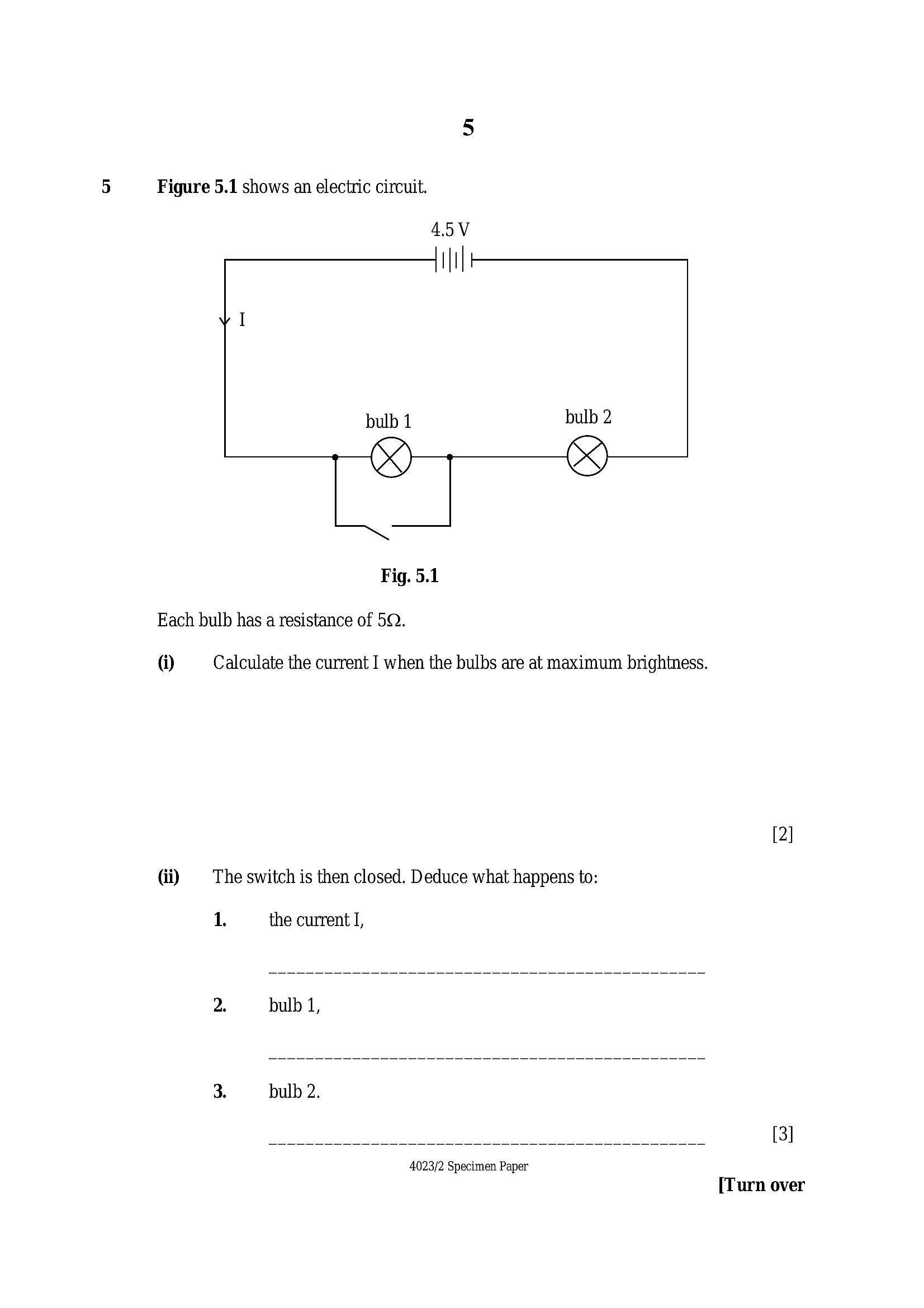
5Figure 5.1 shows an electric circuit.
4.5V
I||| R-—————_,
I
bulb 1 bulb 2
Fig. 5.1
Each bulb has a resistance of 5Q.
@ Calculate the current I when the bulbs are at maximum brightness.
di The switch is then closed. Deduce what happens to:
1. the current I,
2. bulb 1,
3. bulb 2.
4023/2 Specimen Paper
[3]
[Turn over
---
Page 6
Extracted Text
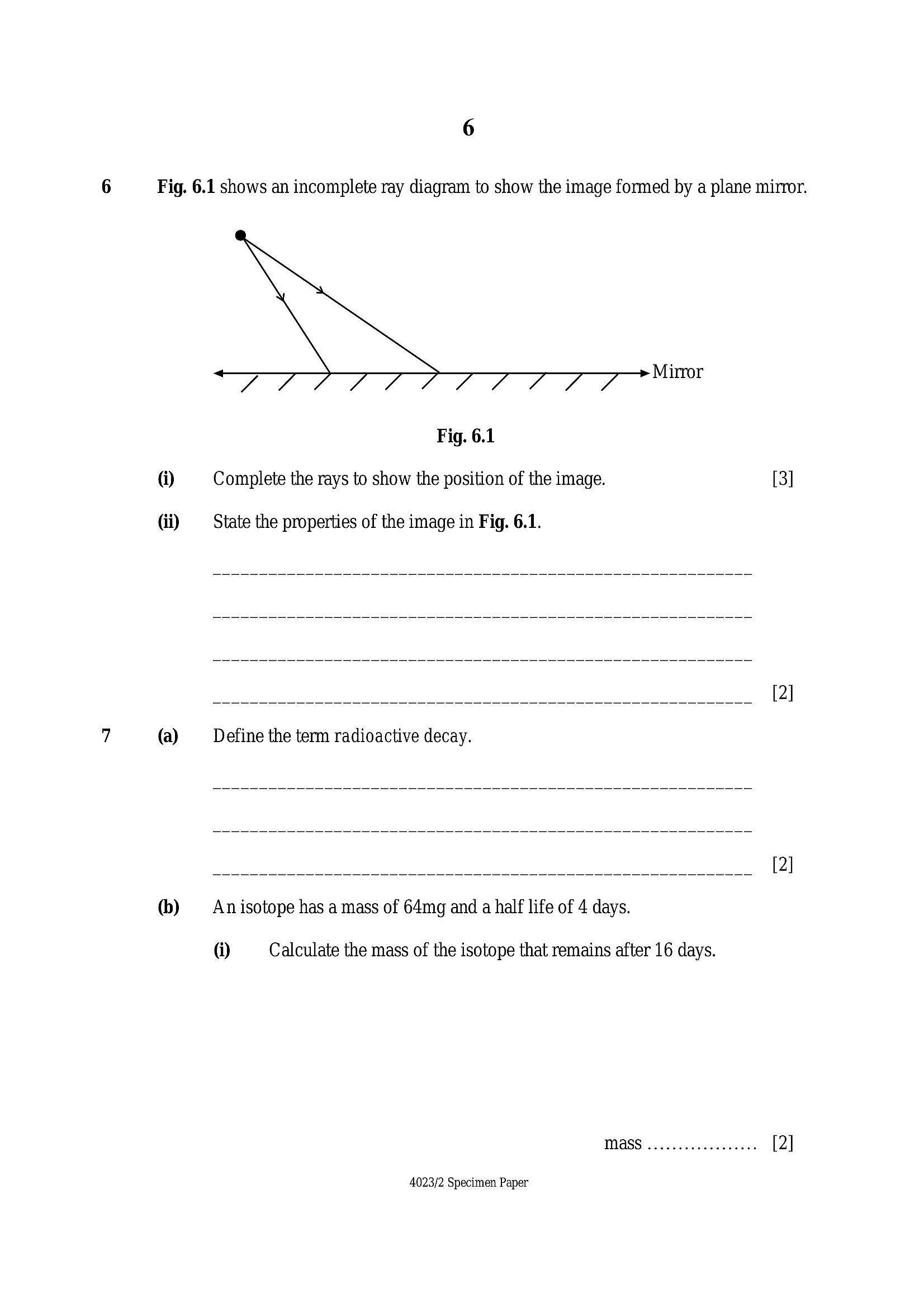
6 Fig. 6.1 shows an incomplete ray diagram to show the image formed by a plane mirror. Mirror 7 Fig. 6.1 (1) Complete the rays to show the position of the image. [3](ii) State the properties of the image in Fig. 6.1.
(b) —Anisotope has a mass of 64mg and a half life of 4 days.
@ Calculate the mass of the isotope that remains after 16 days.
4023/2 Specimen Paper
---
Page 7
Extracted Text
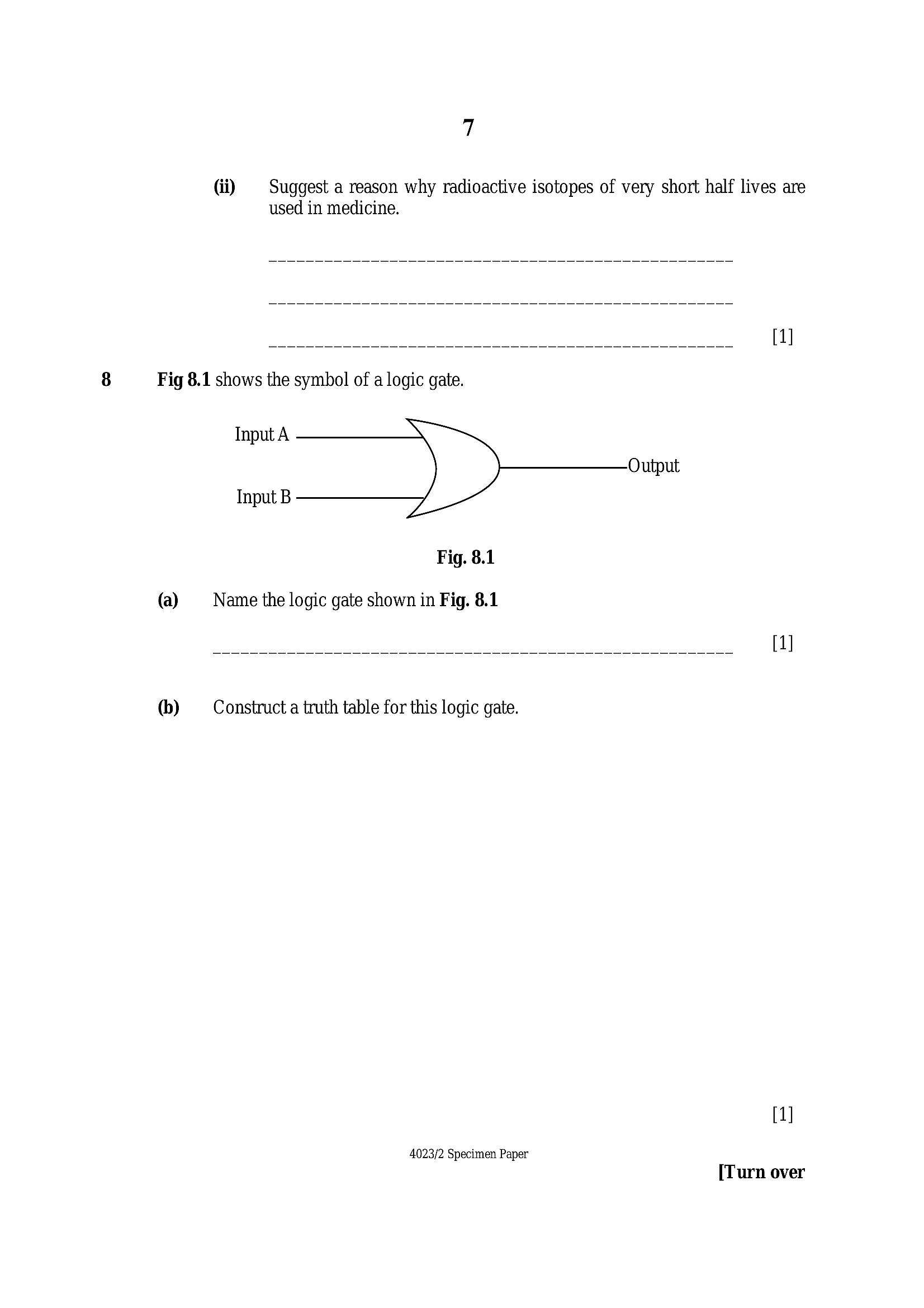
(ii) | Suggest a reason why radioactive isotopes of very short half lives are used in medicine.Fig 8.1 shows the symbol of a logic gate.
Input A
Output
Input B
Fig. 8.1
(a) Name the logic gate shown in Fig. 8.1
(b) Construct a truth table for this logic gate.
[1]
4023/2 Specimen Paper
[Turn over
---
Page 8
Extracted Text
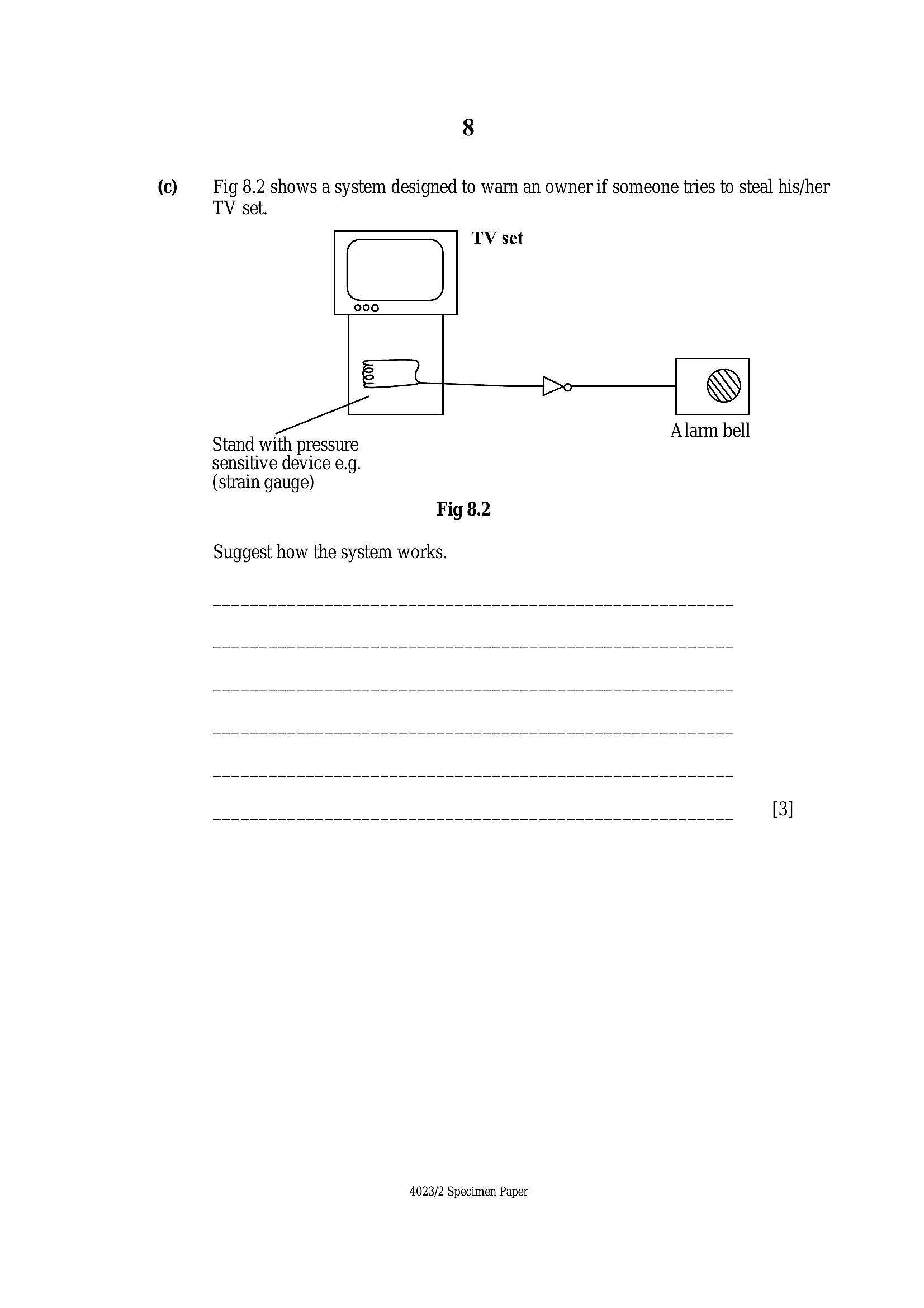
(©) Fig 8.2 shows a system designed to warn an owner if someone tries to steal his/herTV set.
Alarm bell
Stand with pressure ame
sensitive device e.g.
(strain gauge)
Fig 8.2
Suggest how the system works.
4023/2 Specimen Paper
---
Page 9
Extracted Text
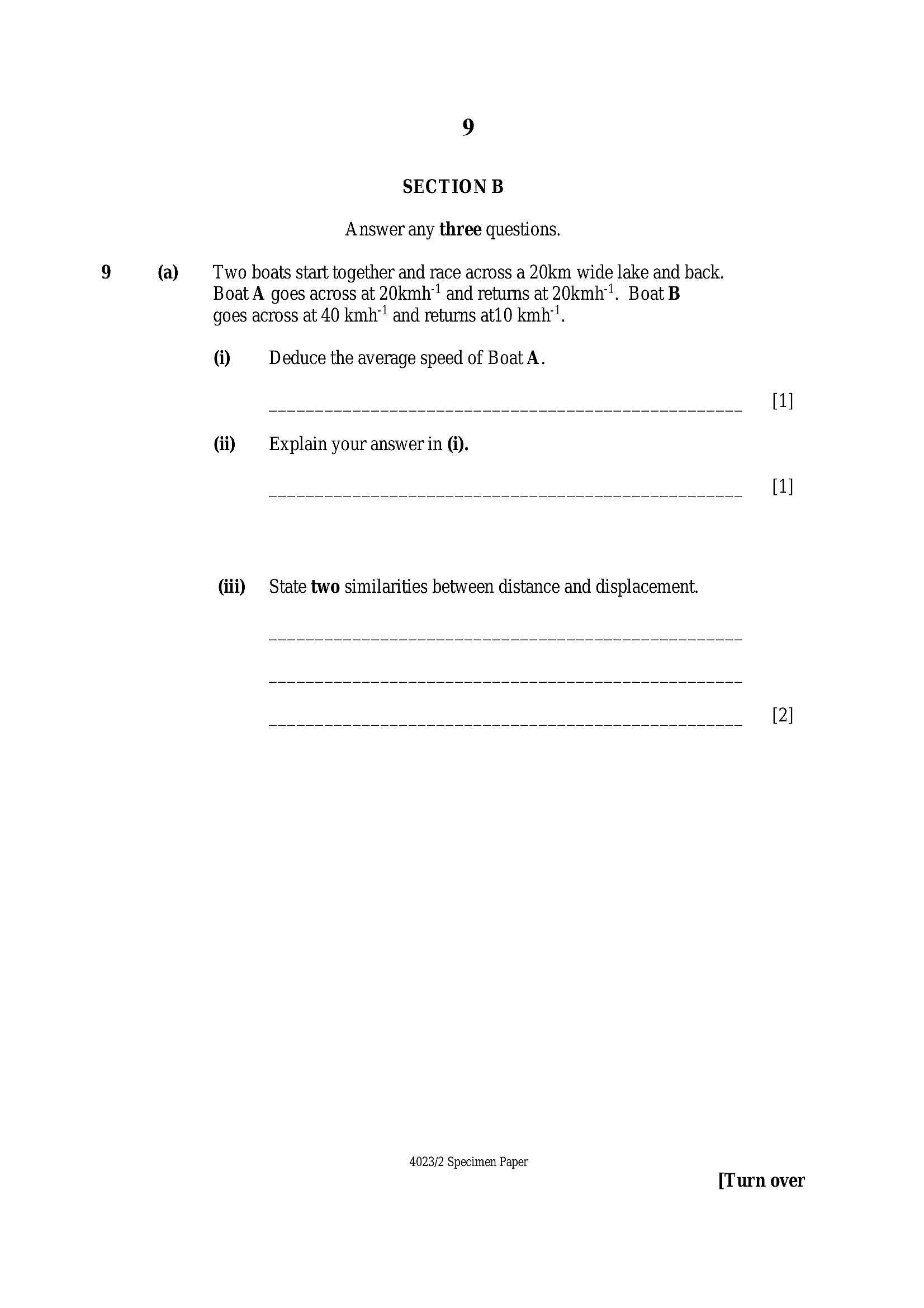
(a)9
SECTION B
Answer any three questions.
Two boats start together and race across a 20km wide lake and back.
Boat A goes across at 20kmh'! and returns at 20kmh!. Boat B
goes across at 40 kmh”! and returns at10 kmh".
@ Deduce the average speed of Boat A.
di Explain your answer in (i).
(iii) State two similarities between distance and displacement.
4023/2 Specimen Paper
[Turn over
---
Page 10
Extracted Text
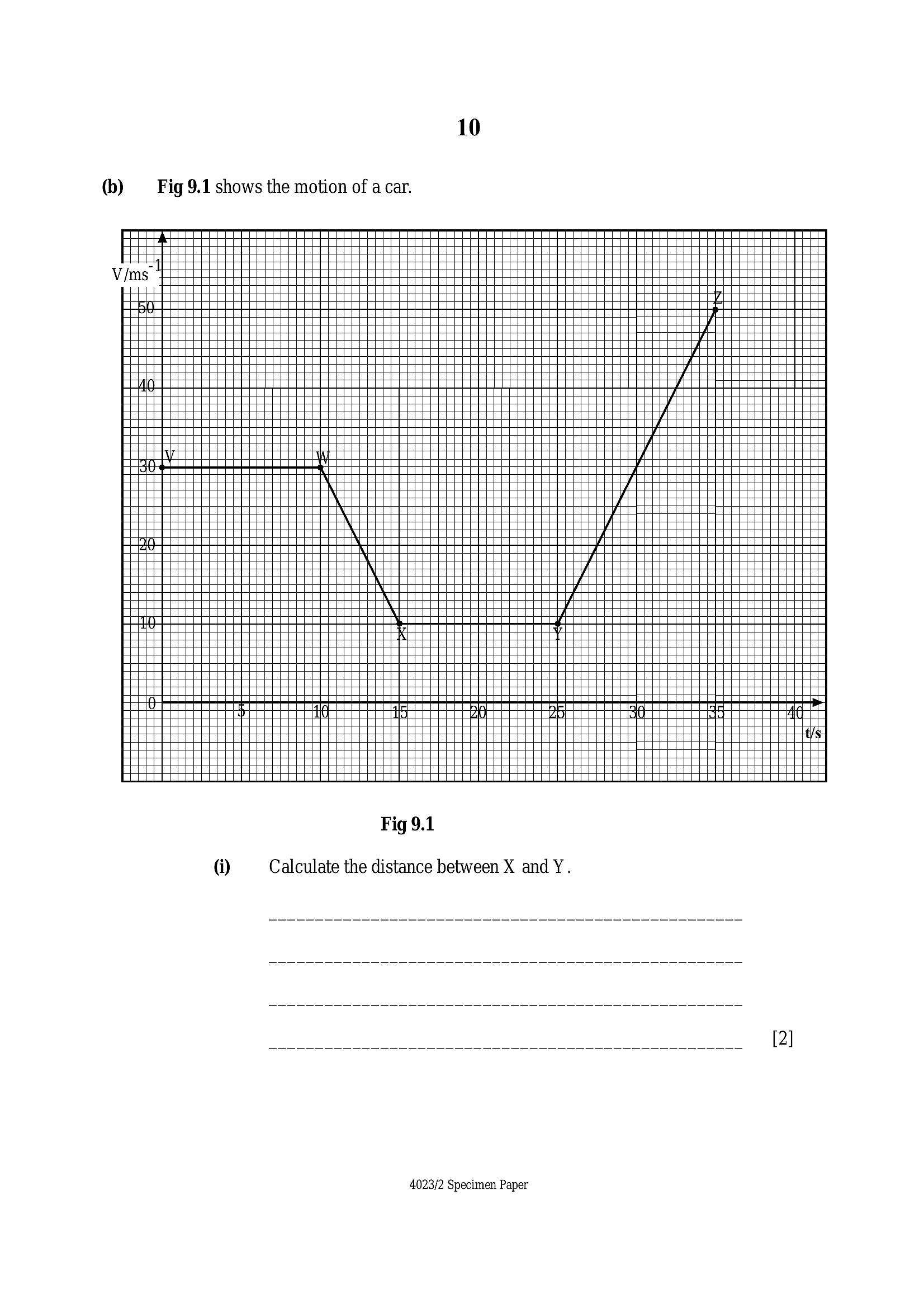
10(b) Fig 9.1 shows the motion of a car.
Vims"
my
ry
Fig 9.1
@ Calculate the distance between X and Y.
4023/2 Specimen Paper
---
Page 11
Extracted Text
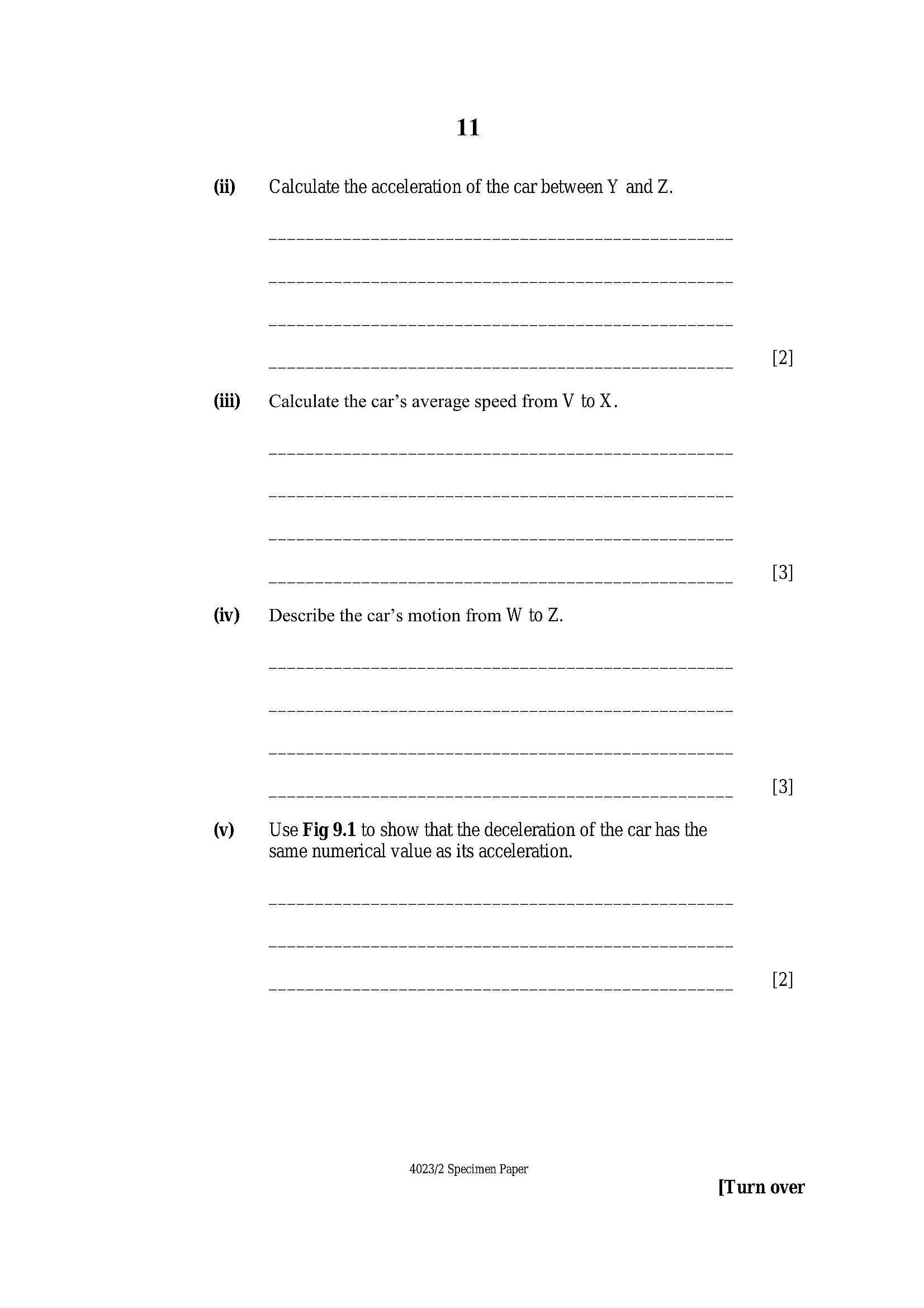
Gi)(iii)
(iv)
v)
11
Calculate the acceleration of the car between Y and Z.
Use Fig 9.1 to show that the deceleration of the car has the
same numerical value as its acceleration.
4023/2 Specimen Paper
[Turn over
---
Page 12
Extracted Text
©(d)
12
Explain why an object going round a circle cannot have constant
velocity even though the speed is constant.
A parachutist falls from an aircraft which is flying. The parachute opens
sometime after the start of the fall and attains terminal velocity. Explain how
terminal velocity is attained.
4023/2 Specimen Paper
---
Page 13
Extracted Text
10(a)
(b)
13
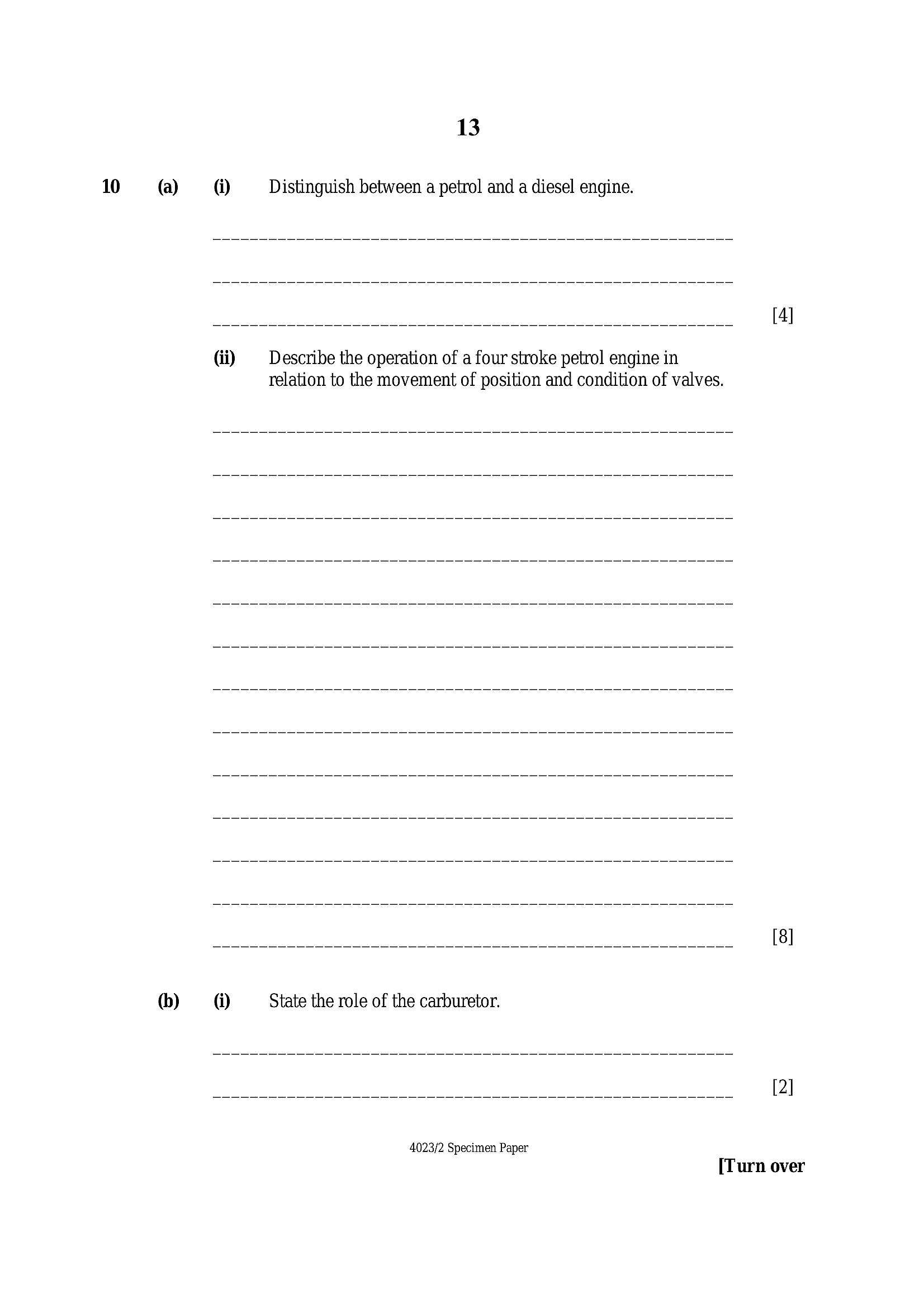
@ Distinguish between a petrol and a diesel engine.
(ii) Describe the operation of a four stroke petrol engine in
relation to the movement of position and condition of valves.
(1) State the role of the carburetor.
4023/2 Specimen Paper
[Turn over
---
Page 14
Extracted Text
©14
Gi) Explain what you understand by the efficiency of an engine.
(iii) | Suggest two ways in which the efficiency of a petrol
engine may be reduced.
4023/2 Specimen Paper
---
Page 15
Extracted Text
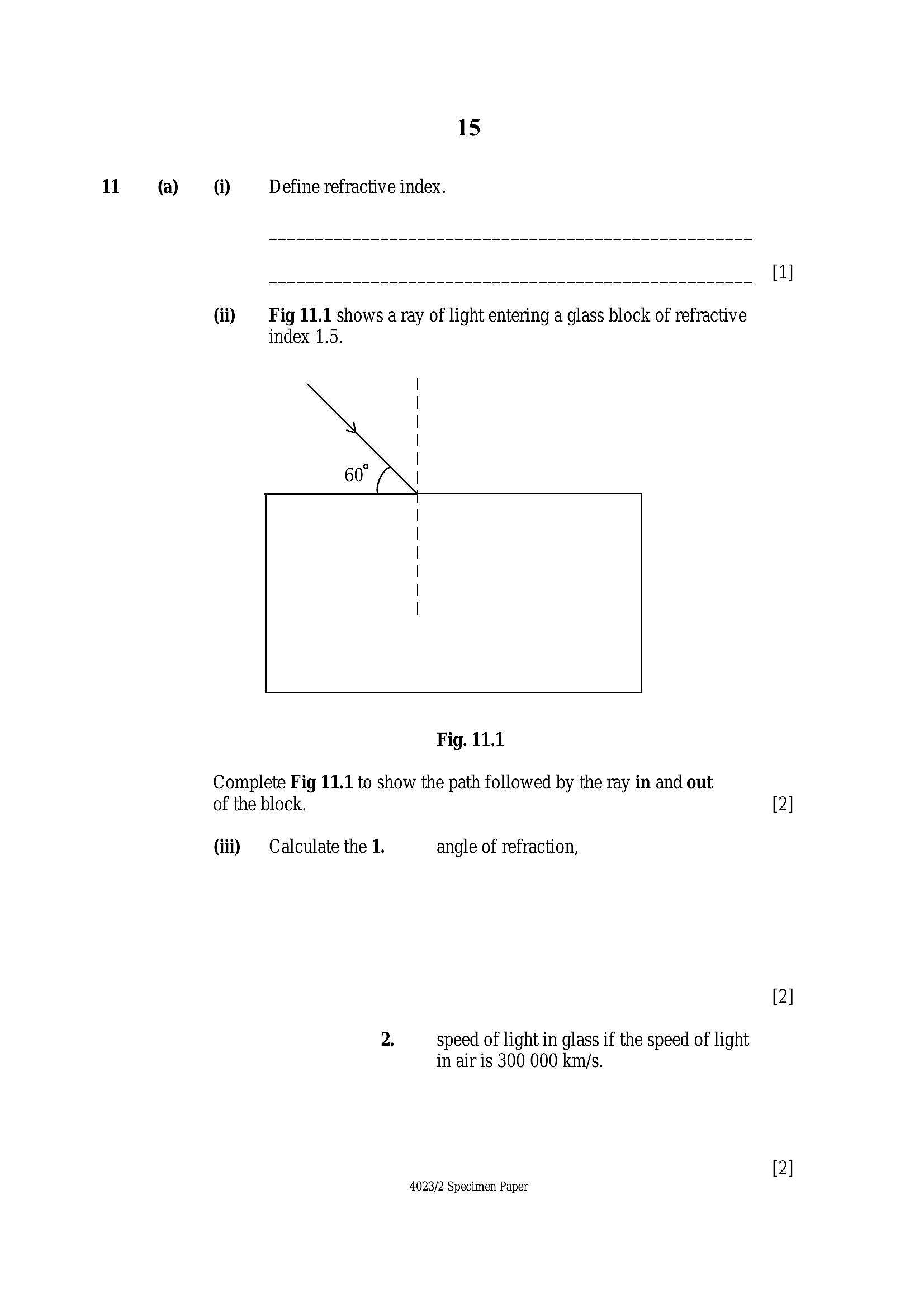
1511 (a) @ Define refractive index.
(i) ‘Fig 11.1 shows a ray of light entering a glass block of refractive
index 1.5.
Fig. 11.1
Complete Fig 11.1 to show the path followed by the ray in and out
of the block. [2]
(iii) Calculate the 1. angle of refraction,
[2]
2. speed of light in glass if the speed of light
in air is 300 000 km/s.
4023/2 Specimen Paper
---
Page 16
Extracted Text
16(iv) — Explain what causes refraction of light.
(b) @ Define the term critical angle.
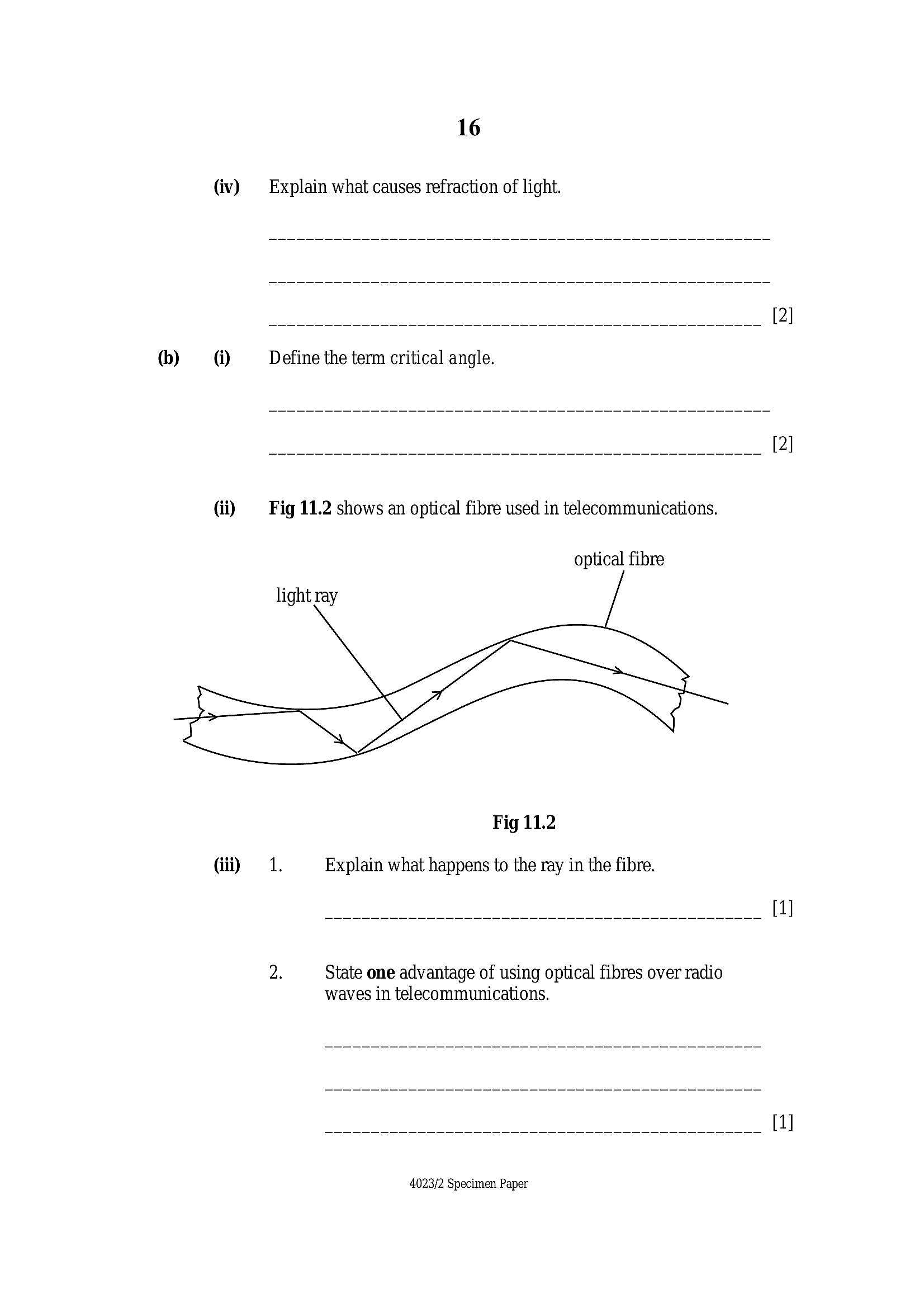
di Fig 11.2 shows an optical fibre used in telecommunications.
optical fibre
light ray
Fig 11.2
Gi). Explain what happens to the ray in the fibre.
2. State one advantage of using optical fibres over radio
waves in telecommunications.
4023/2 Specimen Paper
---
Page 17
Extracted Text
17() @ Distinguish between a real and virtual image formed by a lense.
(1) en Illustrate with the aid of a diagram the term long sight.
2. Explain how long sight can be corrected.
4023/2 Specimen Paper
[Turn over
---
Page 18
Extracted Text
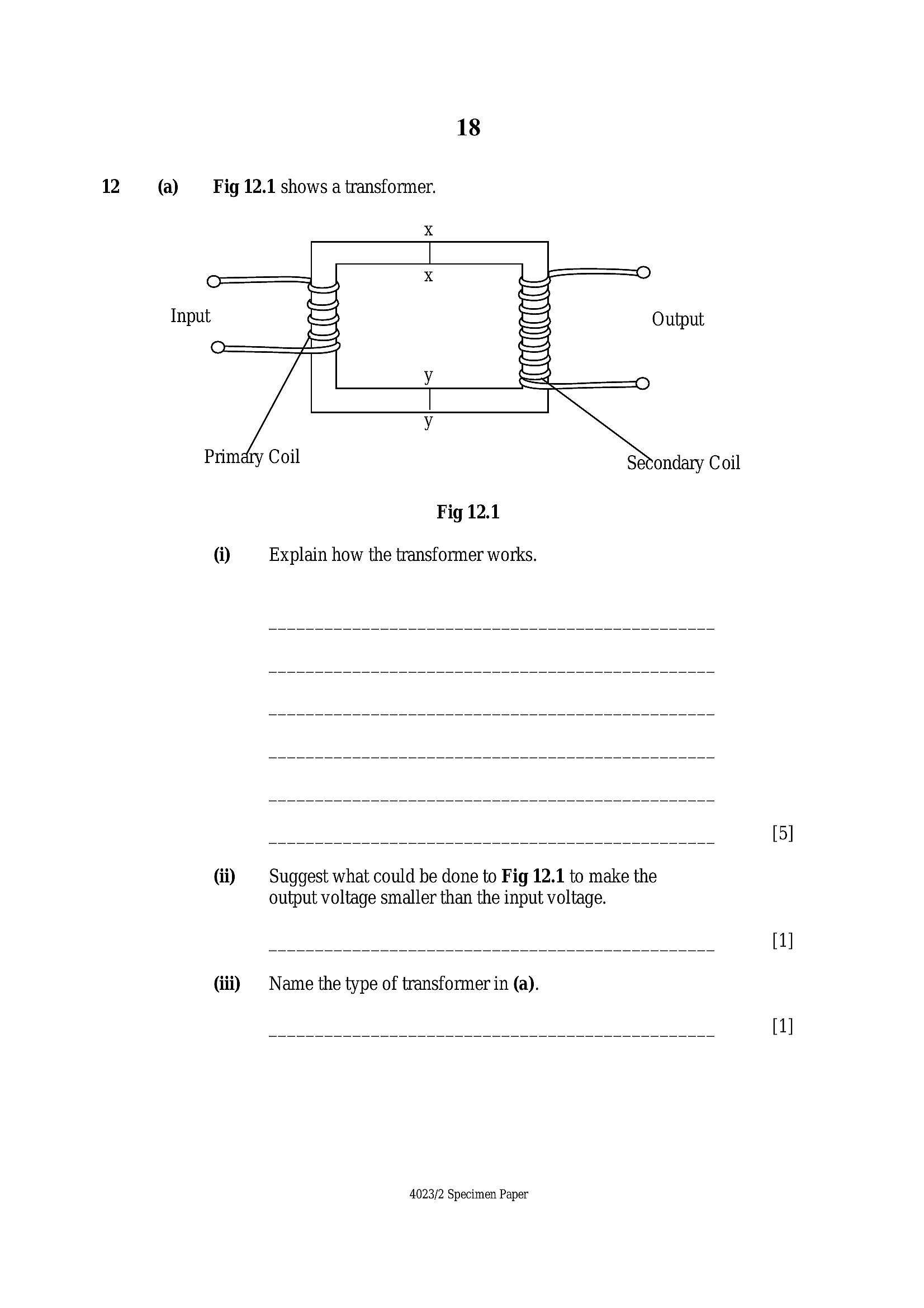
1812 (a) Fig 12.1 shows a transformer.
Primary Coil Setondary Coil
Fig 12.1
@ Explain how the transformer works.
(ii) | Suggest what could be done to Fig 12.1 to make the
output voltage smaller than the input voltage.
(iii) © Name the type of transformer in (a).
4023/2 Specimen Paper
---
Page 19
Extracted Text
(b)19
(iv) Suggest with reasons, what will happen to the working
of the transformer if the core is split at xx and yy then
separated by 35cm.
(vy) Suggest why the core is made of soft iron.
An ideal transformer is used to step up the voltage supply from 200 V
to 400 V. A resistor is connected to the output. The current in the
primary coil is 3A.
Calculate the current in the secondary coil.
4023/2 Specimen Paper
[Turn over
---
Page 20
Extracted Text
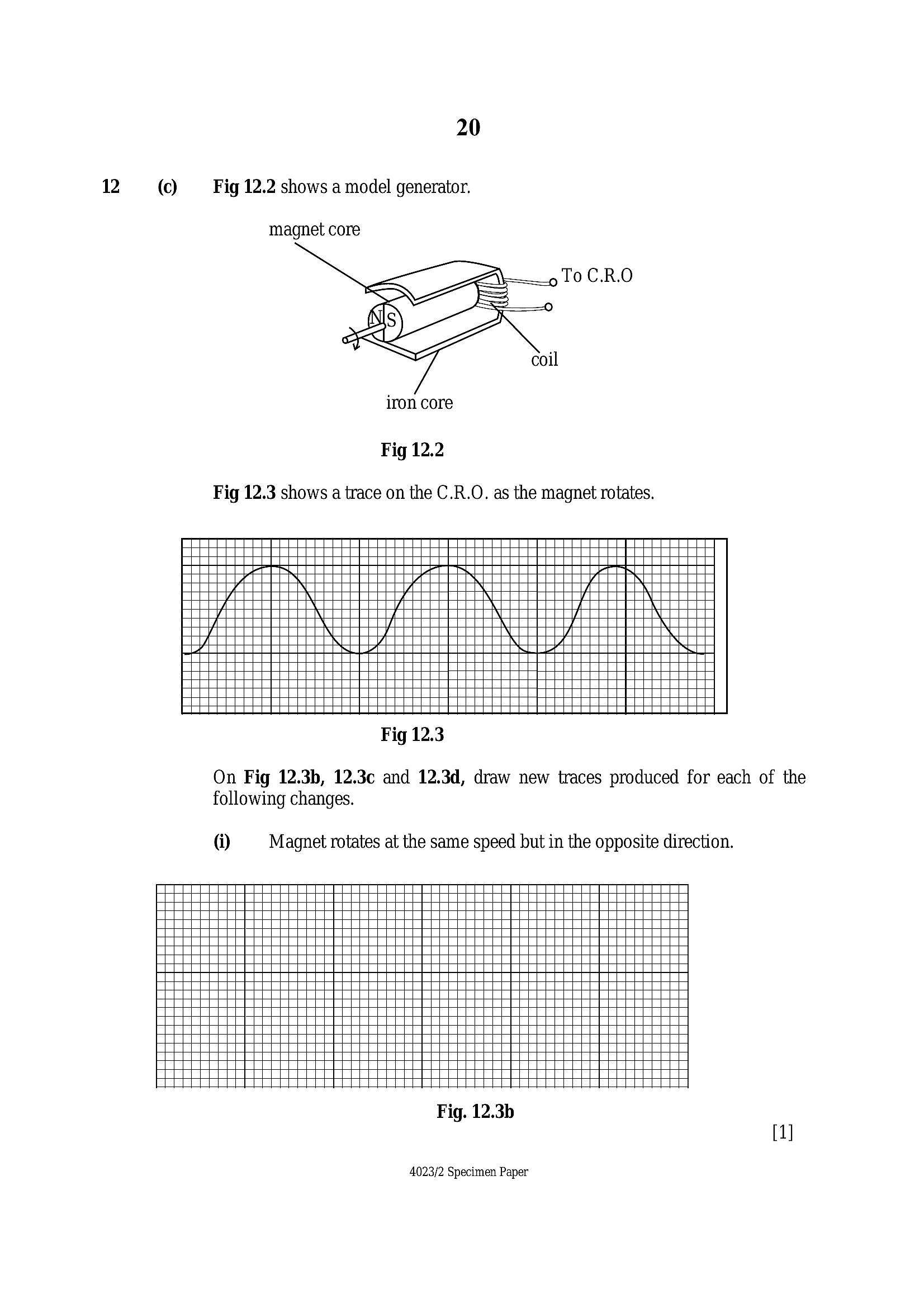
2012 () Fig 12.2 shows a model generator.
magnet core
To C.R.O
coil
iron core
Fig 12.2
Fig 12.3 shows a trace on the C.R.O. as the magnet rotates.
Fig 12.3
On Fig 12.3b, 12.3c and 12.3d, draw new traces produced for each of the
following changes.
@ Magnet rotates at the same speed but in the opposite direction.
Fig. 12.3b
4023/2 Specimen Paper
---
Page 21
Extracted Text
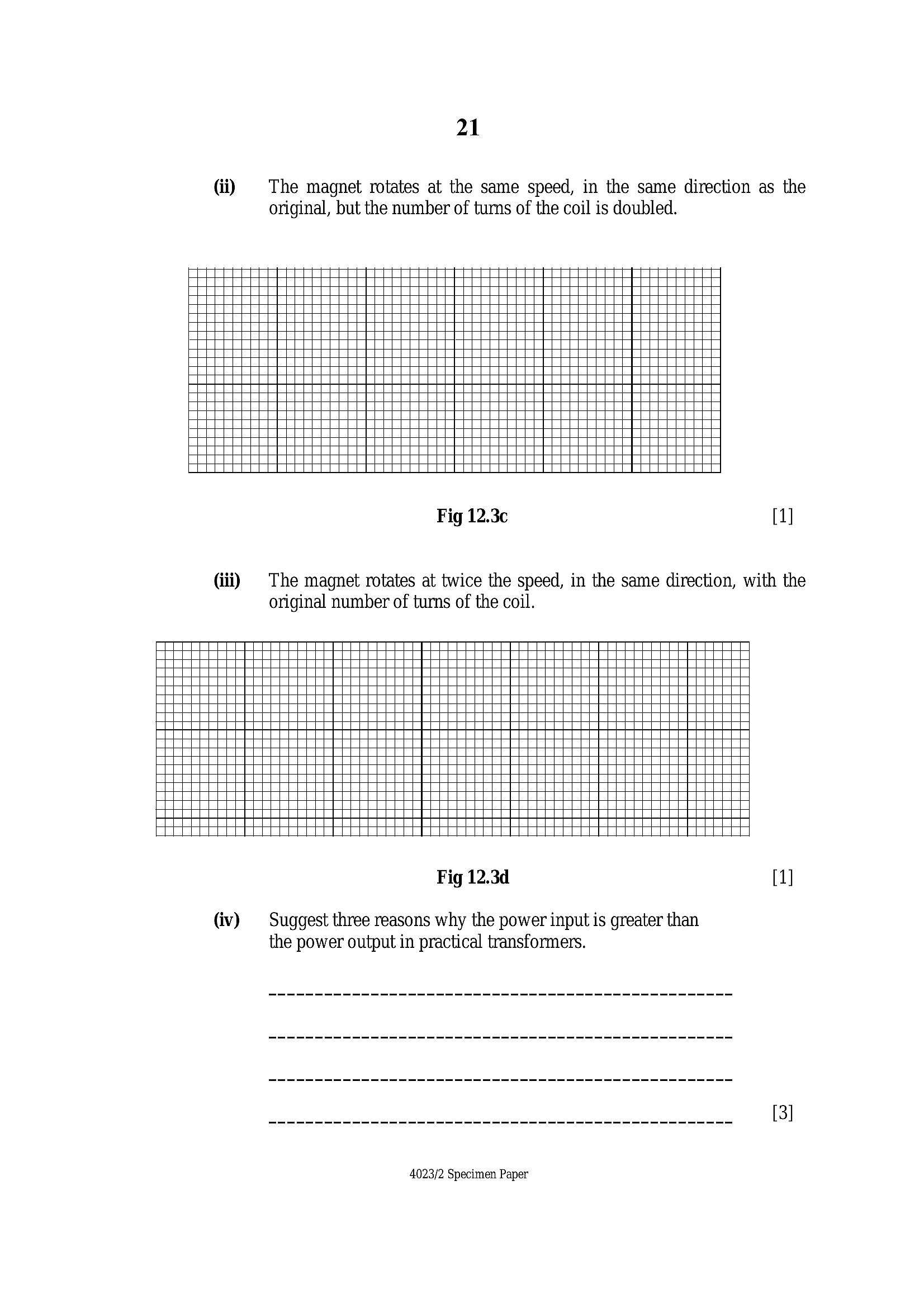
21di The magnet rotates at the same speed, in the same direction as the
original, but the number of turns of the coil is doubled.
Fig 12.3c [1]
(iii) The magnet rotates at twice the speed, in the same direction, with the
original number of turns of the coil.
Fig 12.3d [1]
(iv) Suggest three reasons why the power input is greater than
the power output in practical transformers.
4023/2 Specimen Paper
---
Page 22
Extracted Text
22BLANK PAGE
4023/2 Specimen Paper
---
Page 23
Extracted Text
23BLANK PAGE
4023/2 Specimen Paper
---
Page 24
Extracted Text
24BLANK PAGE
4023/2 Specimen Paper
---