
📄 Exam Questions & Readable Text Transcript
Full OCR-extracted text of questions, syllabus codes, and exam instructions.
Extracted Content: 4021q4 EXAM CIRCULAR NO 10 OF 2018
Page 1
Extracted Text
Zmbabwe School Examinations C ouncil Examinations Centre, Upper East Road, Mount Pleasant P.O. Box CY 1464, Causeway, Harare, ZimbabweD[TIMSEC
For Performance Measurement
03 March 2018
EXAMINATIONS POLICY CIRCULAR
NUMBER 10 OF 2018
DISTRIBUTION:
All communications should be addressed
to: The Director, Zimbabwe School
Examinations Council,
Telephone: 302623-4, 302642,
307815, 306242
Telegraphic address: “ZIMSEC”
Facsimile: 302288; 339080; 333889
Your Ref:
Our Ref:
e Permanent Secretary-Ministry of Primary and Secondary Education
e All ZIMSEC Regional Managers
e All Provincial Education Directors-Ministry of Primary and Secondary Education
e All District Education Officers-Ministry of Primary and Secondary Education
e Heads of Ordinary Level Examination Centres
ASSESSMENT OF CANDIDATES IN COMPUTER SCIENCE SYLLABUS (4021)
This circular brings to your attention procedures for the assessment of Ordinary Level Computer
Science (4021) candidates.
1. The Practical Coursework
Candidates will be expected to present a project. The expectations of the project were sent
out in 2017 (see Appendix 1) and copies will be kept at Regional Offices for centres to
photocopy if they find that to be more convenient.
A contents page should be prepared to indicate the location of sections of the project. The
candidate’s project should contain the individual assessment mark sheet (See Appendix 2)
with all the teacher’s marks indicated.
The project document should contain the project assessment form (See A ppendix 3) with all
candidates’ marks recorded. In addition, the teacher should submit a soft copy of the
candidates’ work in the form of a CD. Each candidate should have a folder on the CD, where
his/her project has been saved. The folder should have the candidate’s name and number.
The project should be completed by 05 October 2018 and the projects should be
submitted to ZIMSEC Regional Offices or ZIMSEC Cluster Collection Centres by 26
October 2018.
2. The Practical Examination
Each registered candidate will sit for a practical examination as indicated in the syllabus. The
duration of the Practical Examination is 3 hours. Please note that the 3 hours does not include
Directors; Prof E. (Eddie) Mwenje (Chairperson), Mrs M.F Masiye — Moyo (Vice-Chairperson), Mr W.C Chanakira, Prof M. Furusa,
DrC.A.T Katsvanga, Ms F. Mokwena, Mr W.T Mufuka, MrA.M Mukuvisi, Mr F. Mhlanga, Mr N. Nhapi, Prof L.M Nyagura, Mrs L. Ross,
Ms B. Sigauke, Prof D.J Simbi, Prof K. Wekwete, Mr E.S Nhandara (Executive)
---
Page 2
Extracted Text
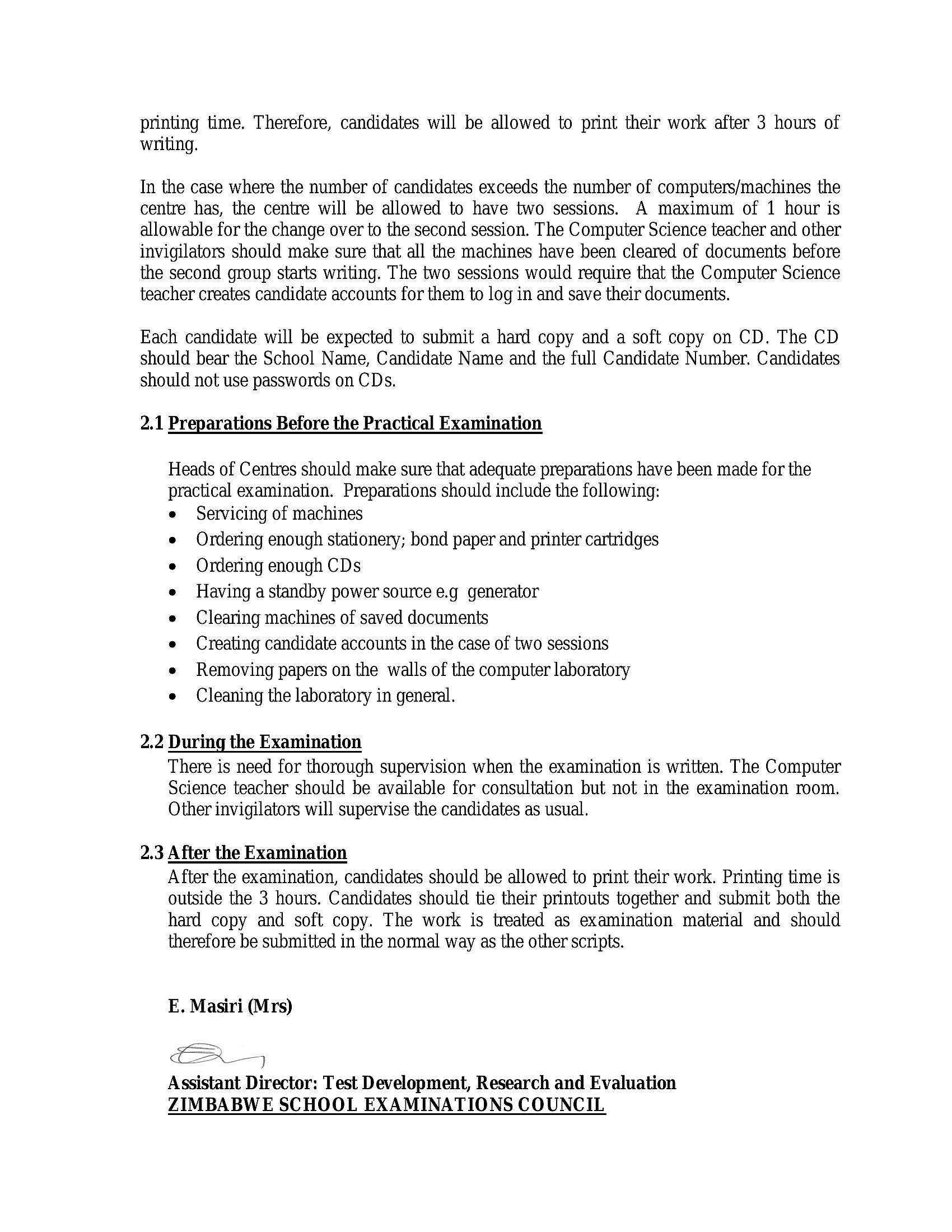
printing time. Therefore, candidates will be allowed to print their work after 3 hours of writing.In the case where the number of candidates exceeds the number of computers/machines the
centre has, the centre will be allowed to have two sessions. A maximum of 1 hour is
allowable for the change over to the second session. The Computer Science teacher and other
invigilators should make sure that all the machines have been cleared of documents before
the second group starts writing. The two sessions would require that the Computer Science
teacher creates candidate accounts for them to log in and save their documents.
Each candidate will be expected to submit a hard copy and a soft copy on CD. The CD
should bear the School Name, Candidate Name and the full Candidate Number. Candidates
should not use passwords on CDs.
2.1 Preparations Before the Practical Examination
Heads of Centres should make sure that adequate preparations have been made for the
practical examination. Preparations should include the following:
e Servicing of machines
e Ordering enough stationery; bond paper and printer cartridges
e Ordering enough CDs
e Having a standby power source e.g generator
e Clearing machines of saved documents
e Creating candidate accounts in the case of two sessions
e Removing papers on the walls of the computer laboratory
e Cleaning the laboratory in general.
2.2 During the Examination
There is need for thorough supervision when the examination is written. The Computer
Science teacher should be available for consultation but not in the examination room.
Other invigilators will supervise the candidates as usual.
2.3 After the Examination
After the examination, candidates should be allowed to print their work. Printing time is
outside the 3 hours. Candidates should tie their printouts together and submit both the
hard copy and soft copy. The work is treated as examination material and should
therefore be submitted in the normal way as the other scripts.
E. Masiri (Mrs)
———o )
Assistant Director: Test Development, Research and Evaluation
ZIMBABWE SCHOOL EXAMINATIONS COUNCIL
---
Page 3
Extracted Text
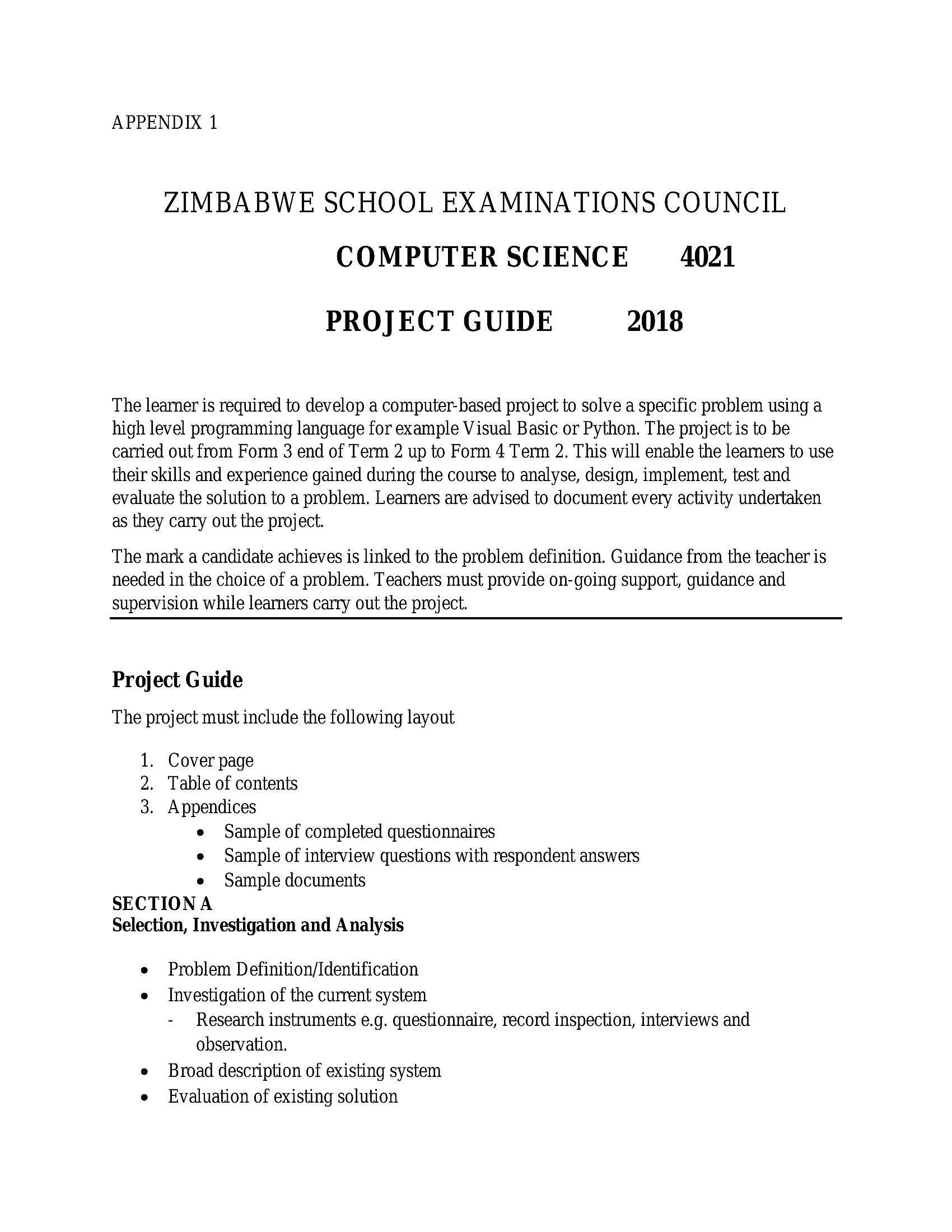
APPENDIX 1ZIMBABWE SCHOOL EXAMINATIONS COUNCIL
COMPUTER SCIENCE 4021
PROJECT GUIDE 2018
The learner is required to develop a computer-based project to solve a specific problem using a
high level programming language for example Visual Basic or Python. The project is to be
carried out from Form 3 end of Term 2 up to Form 4 Term 2. This will enable the learners to use
their skills and experience gained during the course to analyse, design, implement, test and
evaluate the solution to a problem. Learners are advised to document every activity undertaken
as they carry out the project.
The mark a candidate achieves is linked to the problem definition. Guidance from the teacher is
needed in the choice of a problem. Teachers must provide on-going support, guidance and
supervision while learners carry out the project.
Project Guide
The project must include the following layout
1. Cover page
2. Table of contents
3. Appendices
e Sample of completed questionnaires
e Sample of interview questions with respondent answers
e Sample documents
SECTIONA
Selection, Investigation and Analysis
e Problem Definition/Identification
e Investigation of the current system
Research instruments e.g. questionnaire, record inspection, interviews and
observation.
e Broad description of existing system
e Evaluation of existing solution
---
Page 4
Extracted Text
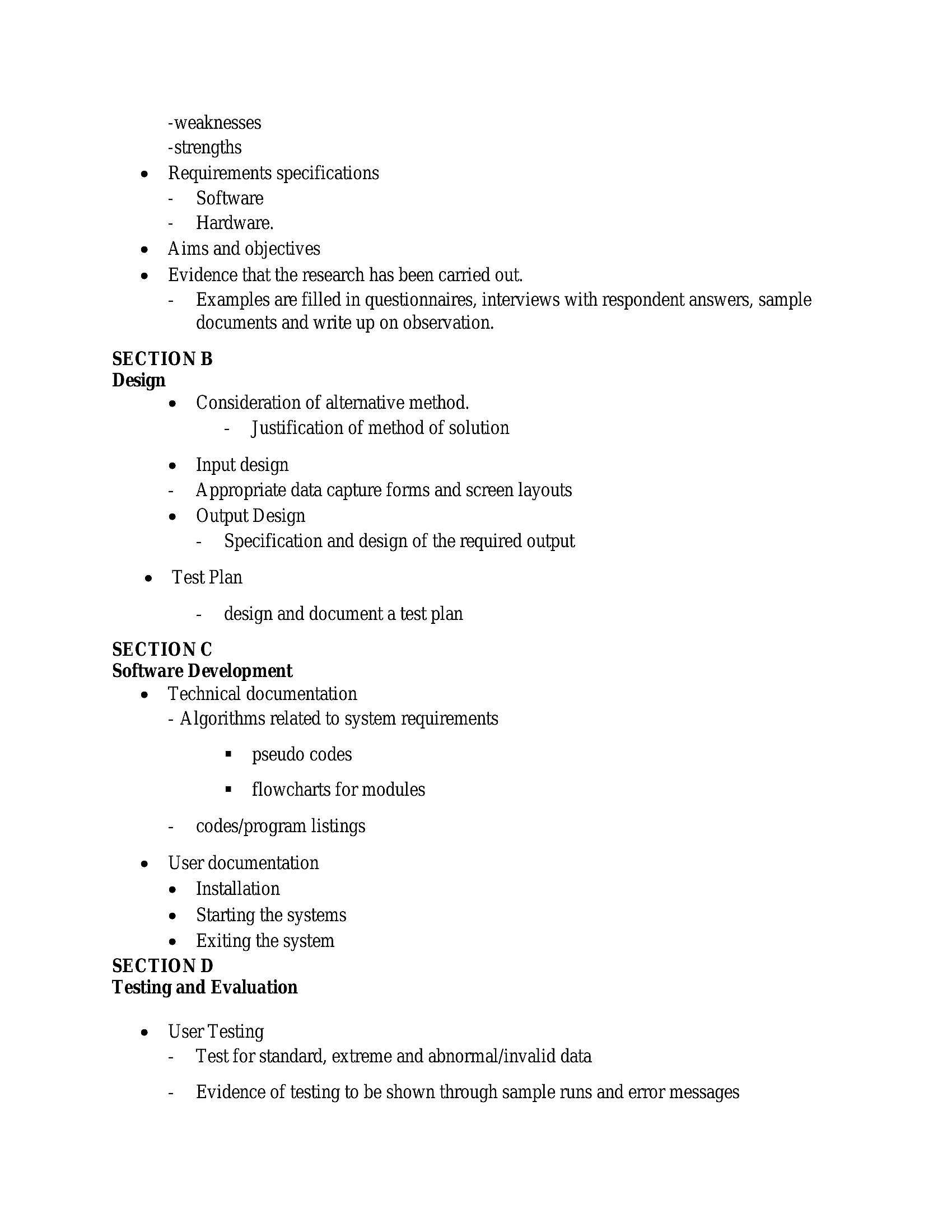
-weaknesses -strengths e Requirements specifications Software Hardware. e Aims and objectives e Evidence that the research has been carried out. - Examples are filled in questionnaires, interviews with respondent answers, sample documents and write up on observation.SECTION B
Design
e Consideration of alternative method.
- Justification of method of solution
e Input design
- Appropriate data capture forms and screen layouts
e Output Design
- Specification and design of the required output
e Test Plan
- design and document a test plan
SECTION C
Software Development
e Technical documentation
- Algorithms related to system requirements
= pseudo codes
«flowcharts for modules
- codes/program listings
e User documentation
e Installation
e Starting the systems
e Exiting the system
SECTION D
Testing and Evaluation
e User Testing
- Test for standard, extreme and abnormal/invalid data
- Evidence of testing to be shown through sample runs and error messages
---
Page 5
Extracted Text
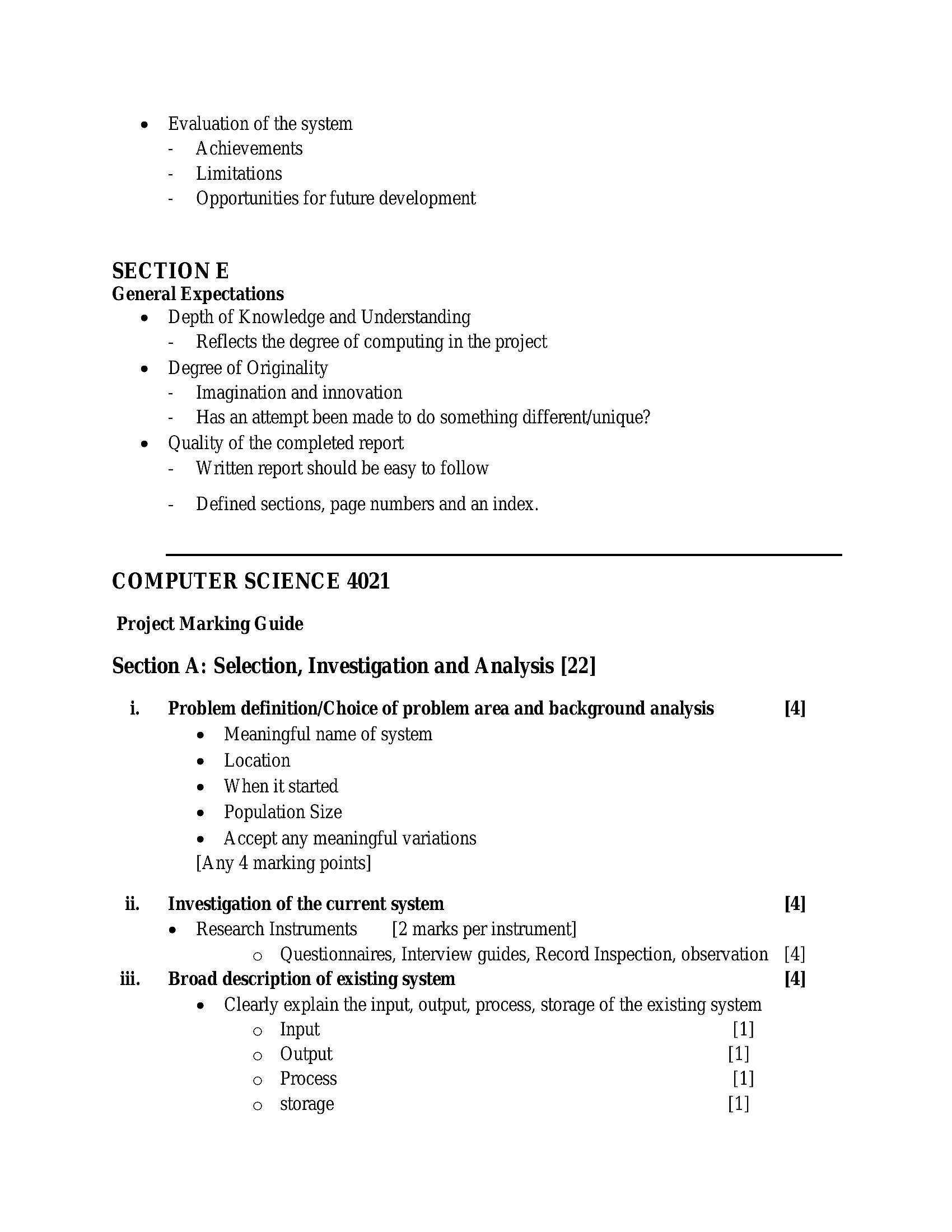
e Evaluation of the system Achievements Limitations Opportunities for future developmentSECTION E
General Expectations
e Depth of Knowledge and Understanding
- Reflects the degree of computing in the project
e Degree of Originality
Imagination and innovation
Has an attempt been made to do something different/unique?
e Quality of the completed report
- Written report should be easy to follow
- Defined sections, page numbers and an index.
COMPUTER SCIENCE 4021
Project Marking Guide
Section A: Selection, Investigation and Analysis [22]
i, Problem definition/C hoice of problem area and background analysis [4]
e Meaningful name of system
e Location
e When it started
e Population Size
e Accept any meaningful variations
[Any 4 marking points]
ii. Investigation of the current system [4]
e Research Instruments [2 marks per instrument]
© Questionnaires, Interview guides, Record Inspection, observation [4]
iii. Broad description of existing system [4]
e Clearly explain the input, output, process, storage of the existing system
o Input [1]
o Output [1]
o Process [1]
o storage [1]
---
Page 6
Extracted Text
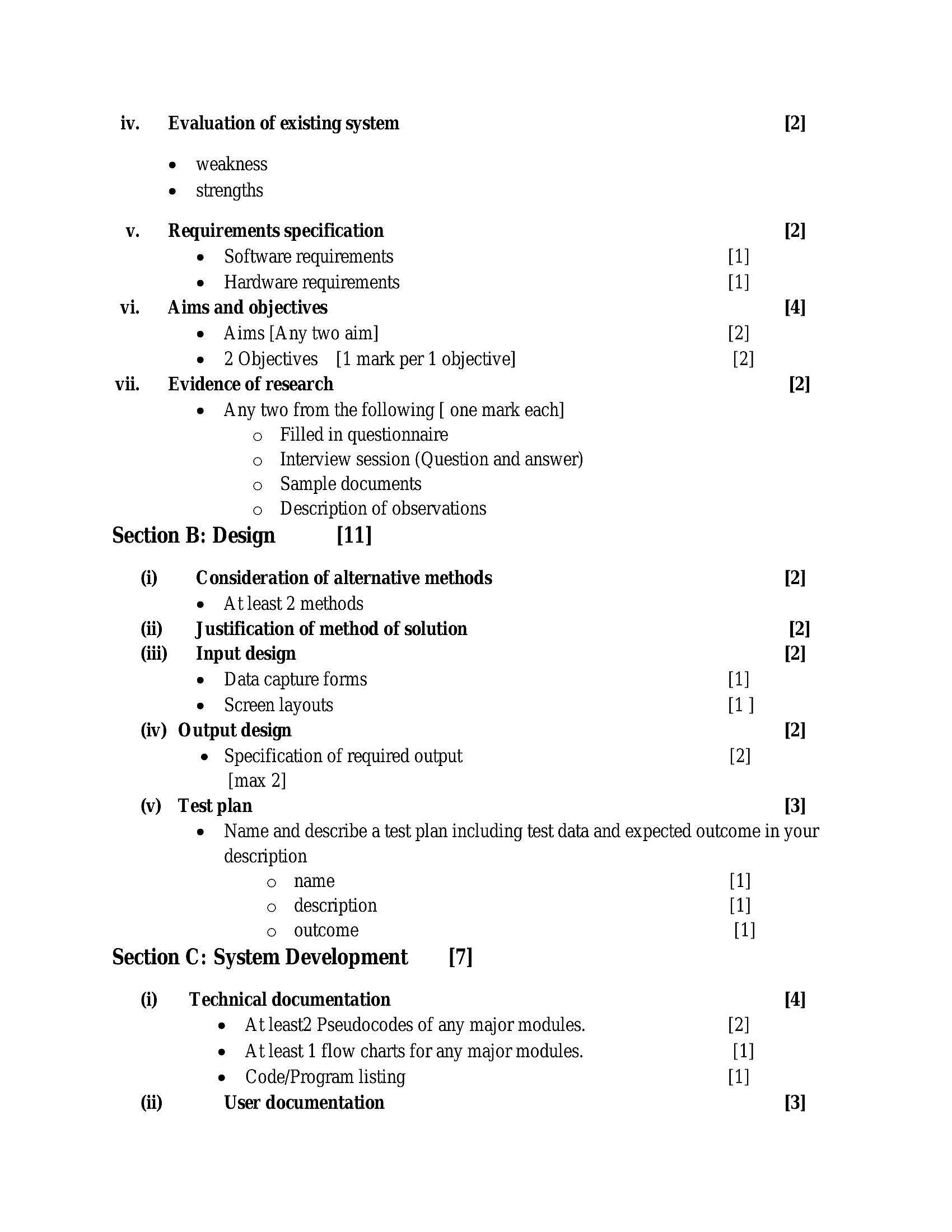
iv. Evaluation of existing system [2]e weakness
e strengths
v. Requirements specification [2]
e Software requirements [1]
e Hardware requirements [1]
vi. Aims and objectives [4]
e Aims [Any two aim] [2]
e 2Objectives [1 mark per 1 objective] [2]
vii. | Evidence of research [2]
e Any two from the following [ one mark each]
o Filled in questionnaire
o Interview session (Question and answer)
o Sample documents
o Description of observations
Section B: Design [11]
@ Consideration of alternative methods [2]
e Atleast 2 methods
(ii) Justification of method of solution [2]
(ii) Input design [2]
e Data capture forms [1]
e Screen layouts [1]
(iv) Output design [2]
e Specification of required output [2]
[max 2]
(v) Test plan B]
e Name and describe a test plan including test data and expected outcome in your
description
o name [1]
o description [1]
o outcome [1]
Section C: System Development [7]
@ Technical documentation [4]
e Atleast2 Pseudocodes of any major modules. [2]
e Atleast 1 flow charts for any major modules. [1]
e Code/Program listing [1]
di User documentation B]
---
Page 7
Extracted Text
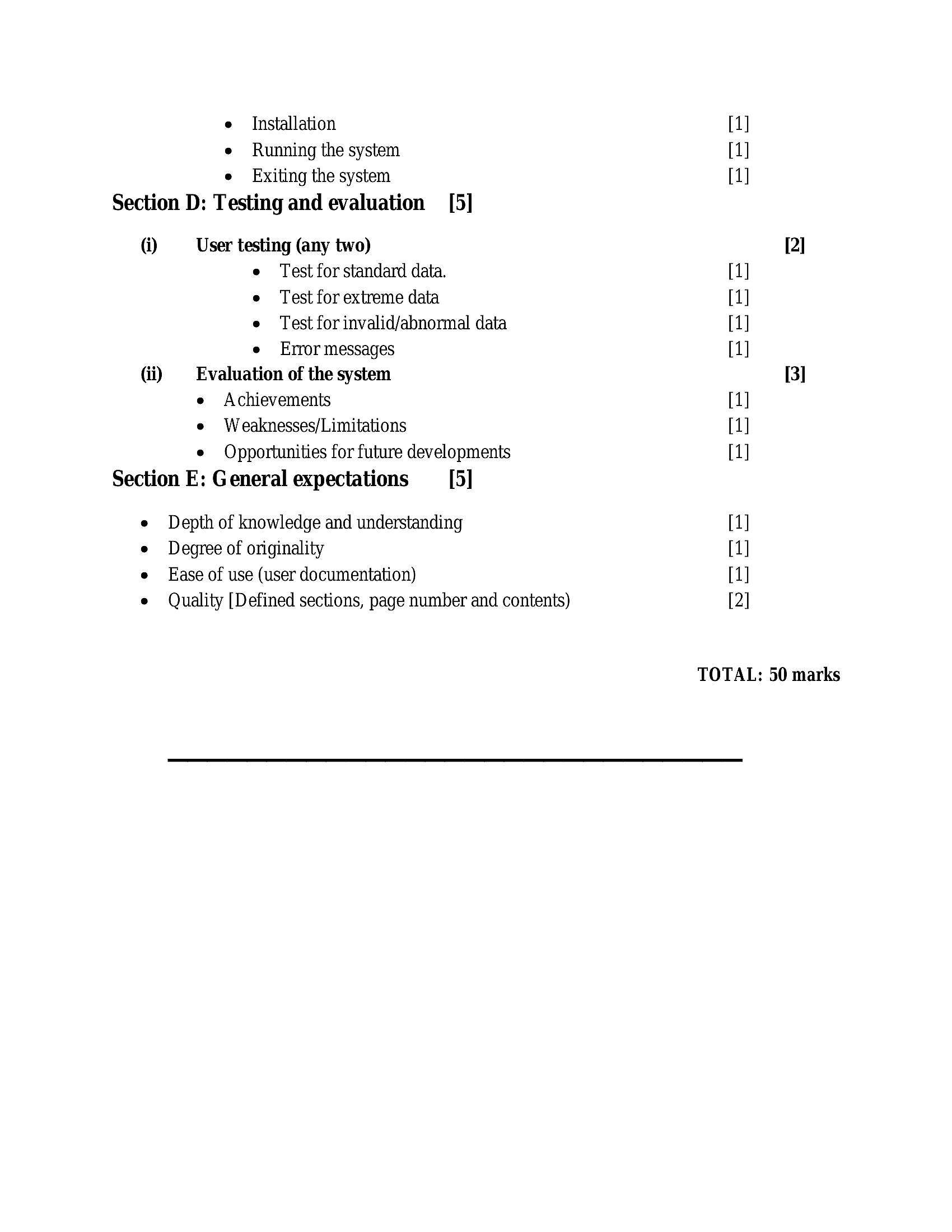
e Installation [1]e Running the system [1]
e Exiting the system [1]
Section D: Testing and evaluation [5]
@ User testing (any two) [2]
e Test for standard data.
e Test for extreme data
e Test for invalid/abnormal data
e Error messages
lilies timed
di Evaluation of the system B]
e Achievements [
e Weaknesses/Limitations [
e Opportunities for future developments [
Section E: General expectations _—[5]
e Depth of knowledge and understanding
e Degree of originality
e Ease of use (user documentation)
e Quality [Defined sections, page number and contents)
lili imed
TOTAL: 50 marks
---
Page 8
Extracted Text
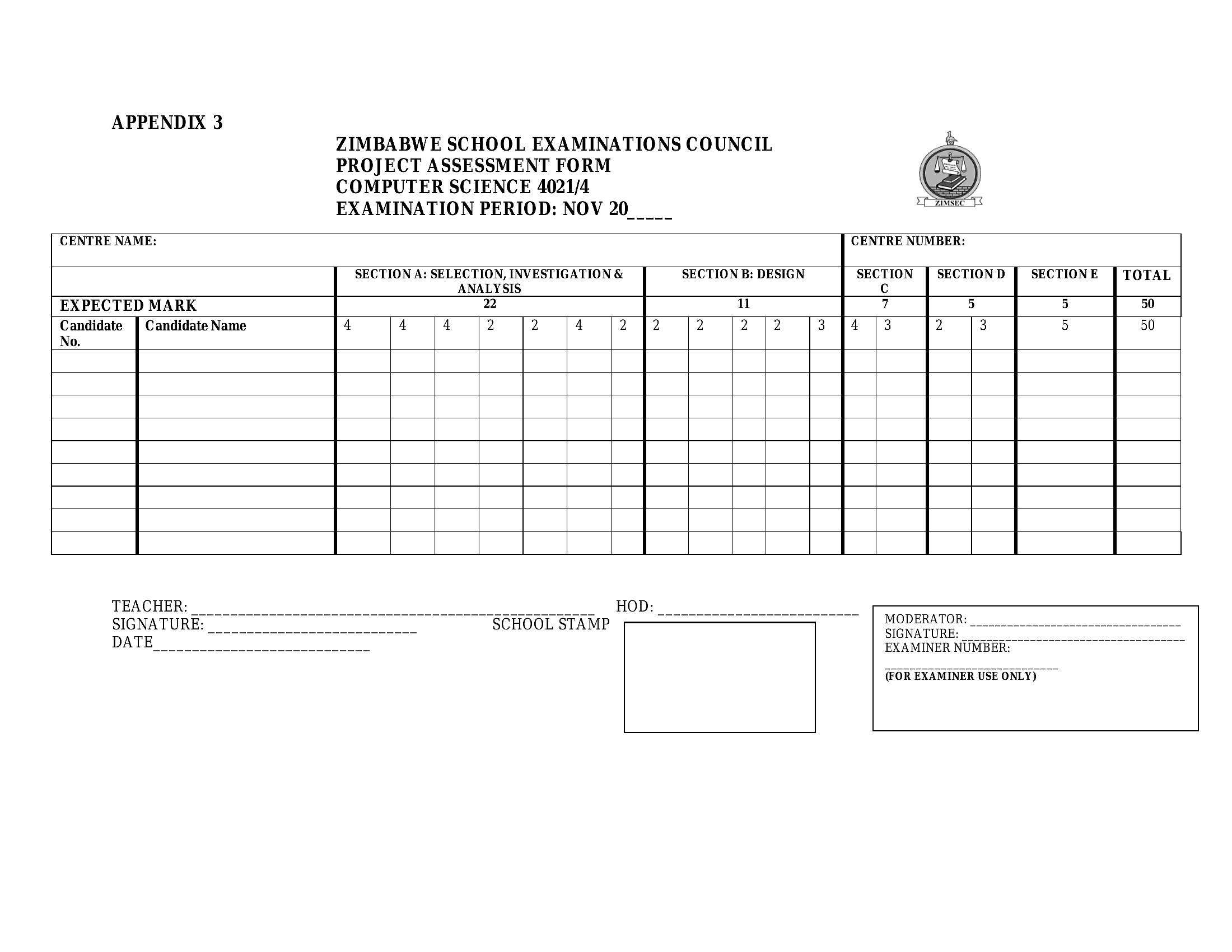
APPENDIX 3ZIMBABWE SCHOOL EXAMINATIONS COUNCIL
PROJECT ASSESSMENT FORM
COMPUTER SCIENCE 4021/4
EXAMINATION PERIOD: NOV 20
CENTRE NAME: CENTRE NUMBER:
SECTION A: SELECTION, INVESTIGATION & SECTION B: DESIGN SECTION SECTION D SECTIONE TOTAL
ANALYSIS Cc
EXPECTED MARK 22 il 7 5 5 50
Candidate | Candidate Name 4 4 4 2 2 4 2 2 2 2 2 3 4 3 2 3 5 50
No.
TEACHER: HOD: MODERATOR
SIGNATURE: SCHOOL STAMP SIGNATURE:
DATE EXAMINER NUMBER:
(FOR EXAMINER USE ONLY)
---
Page 9
Extracted Text
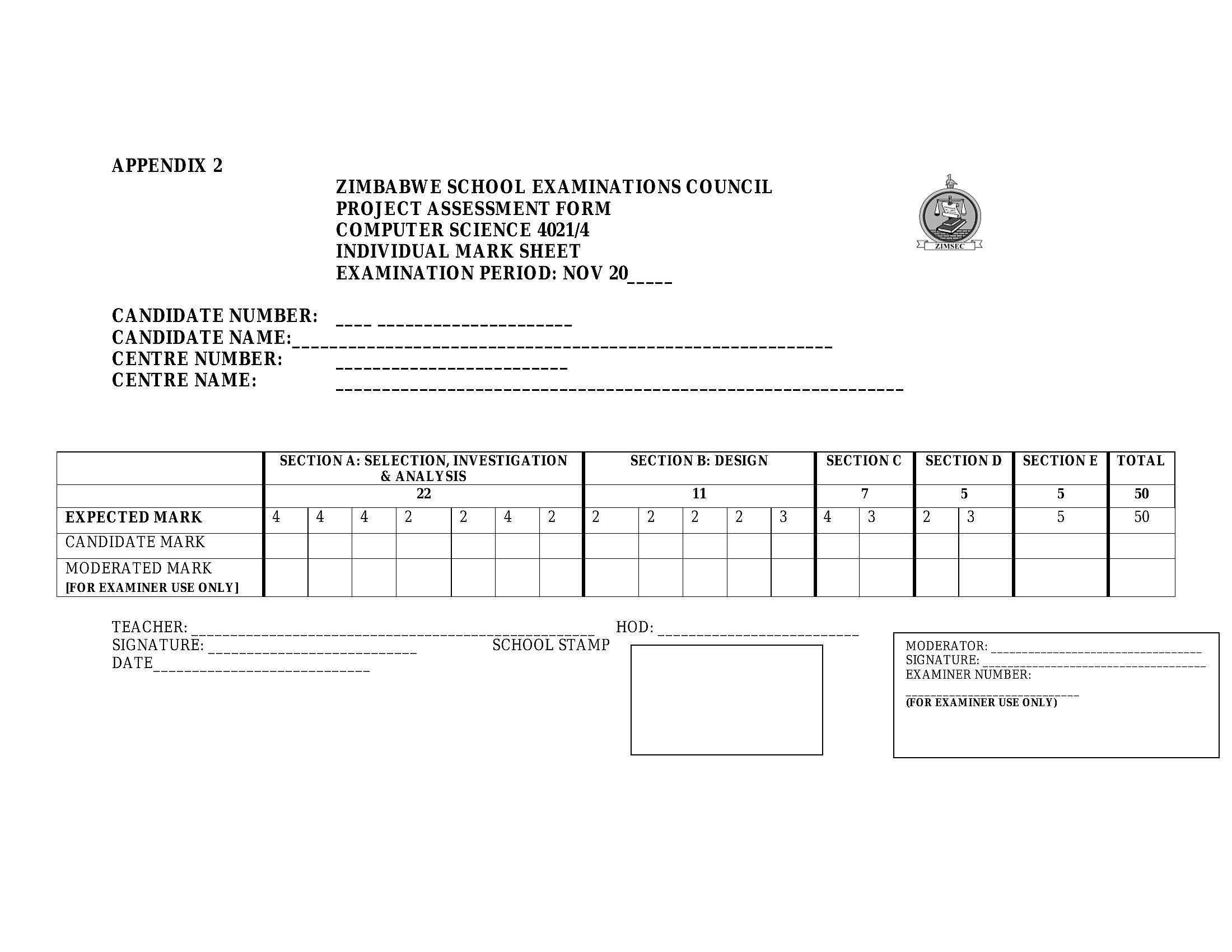
APPENDIX 2 ZIMBABWE SCHOOL EXAMINATIONS COUNCIL PROJECT ASSESSMENT FORM COMPUTER SCIENCE 4021/4 INDIVIDUAL MARK SHEET EXAMINATION PERIOD: NOV 20CANDIDATE NUMBER:
CANDIDATE NAME:
CENTRE NUMBER:
CENTRE NAME:
SECTION A: SELECTION, INVESTIGATION SECTION B: DESIGN SECTIONC | SECTIOND } SECTIONE | TOTAL
& ANALYSIS
22 11 7 5 5 50
EXPECTED MARK 4 4 4 2 2 4 2 2 2 2 2 3 4 3 2 3 5 50
CANDIDATE MARK
MODERATED MARK
[FOR EXAMINER USE ONLY]
TEACHER:
SIGNATURE: MODERATOR: _
~ SIGNATURE:
(FOR EXAMINER USE ONLY)
---