
📄 Exam Questions & Readable Text Transcript
Full OCR-extracted text of questions, syllabus codes, and exam instructions.
Extracted Content: 6036q01
Page 1
Extracted Text
ZIMBABWE SCHOOL EXAMINATIONS COUNCILGeneral Certificate of Education Advanced Level
FOOD TECHNOLOGY AND DESIGN 6036/1
PAPER 1 Theory
3 hours
SPECIMEN PAPER
Additional materials:
Answer paper
TIME: 3 hours
INSTRUCTIONS TO CANDIDATES
Write your name, centre number and candidate number in the spaces provided on the answer
paper/answer booklet.
Question one in Section A is compulsory. Answer any three from Section B.
Write your answers on the separate answer paper provided. If you use more than one sheet of
paper, fasten the sheets together.
INFORMATION FOR CANDIDATES
Each question carries 25 marks.
The number of marks is given in brackets [ ] at the end of each question or part question.
Y ou are reminded of the need for good English and clear presentation in your answers.
This question paper consists of 4 printed pages.
Copyright: Zimbabwe School Examinations Council, Specimen paper.
@ZIMSEC Specimen paper [Turn over
---
Page 2
Extracted Text
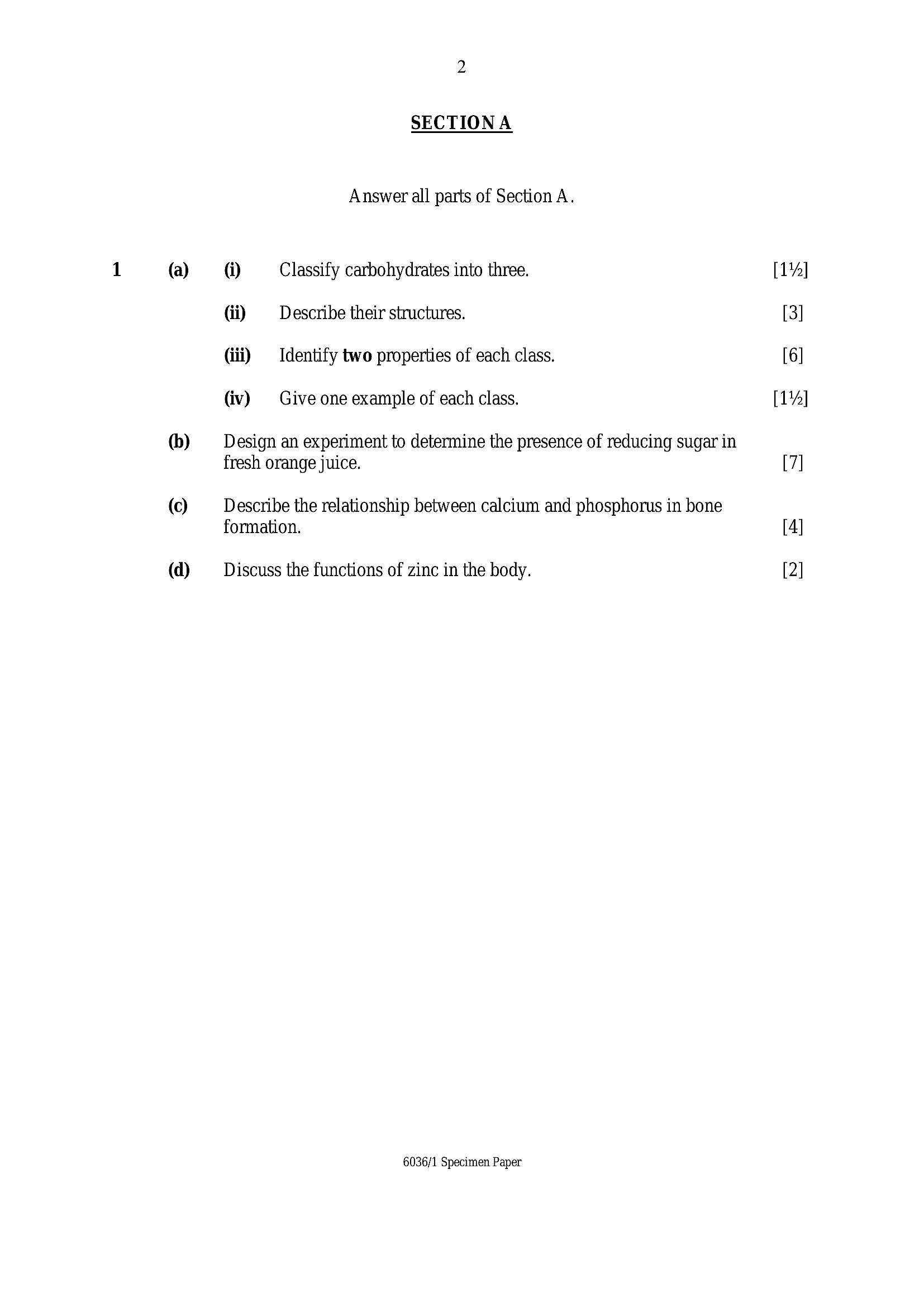
(a)(b)
©
(d)
SECTIONA
Answer all parts of Section A.
@ Classify carbohydrates into three.
di Describe their structures.
(iii) Identify two properties of each class.
(iv) | Give one example of each class.
Design an experiment to determine the presence of reducing sugar in
fresh orange juice.
Describe the relationship between calcium and phosphorus in bone
formation.
Discuss the functions of zinc in the body.
6036/1 Specimen Paper
---
Page 3
Extracted Text
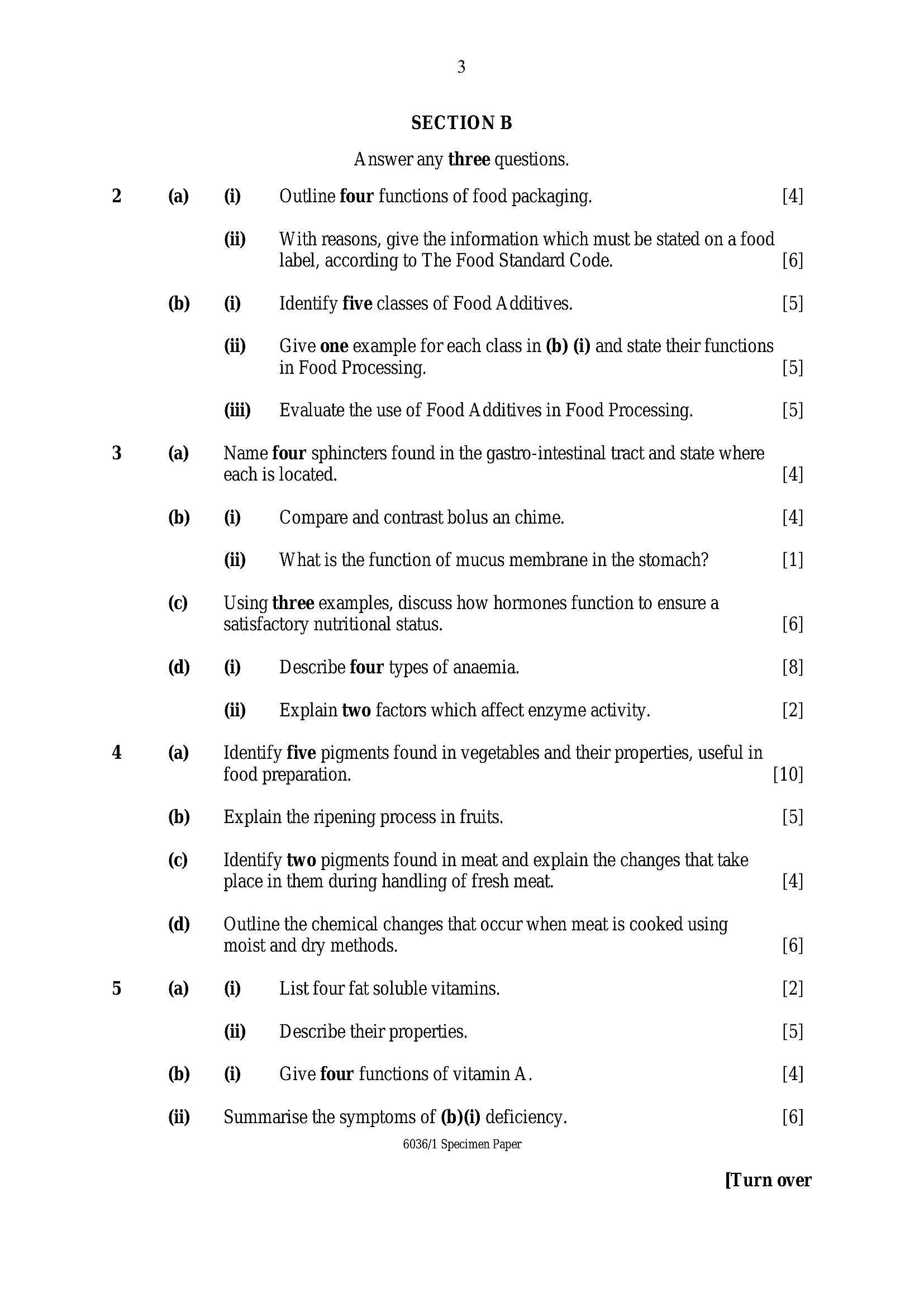
SECTION B Answer any three questions. (a) @ Outline four functions of food packaging. 4 di With reasons, give the information which must be stated on a food label, according to The Food Standard Code. 6 (b) @ Identify five classes of Food A dditives. 5 di Give one example for each class in (b) (i) and state their functions in Food Processing. 5 (iii) Evaluate the use of Food Additives in Food Processing. 5 (a) Name four sphincters found in the gastro-intestinal tract and state where each is located. 4 (b) @ Compare and contrast bolus an chime. 4 di What is the function of mucus membrane in the stomach? 1() Using three examples, discuss how hormones function to ensure a
satisfactory nutritional status. 6
@ @ Describe four types of anaemia. 8
(ii) Explain two factors which affect enzyme activity. 2
(a) _ Identify five pigments found in vegetables and their properties, useful in
food preparation. [10
(b) Explain the ripening process in fruits. 5
(©) Identify two pigments found in meat and explain the changes that take
place in them during handling of fresh meat. 4
@ Outline the chemical changes that occur when meat is cooked using
moist and dry methods. 6
(a) @ List four fat soluble vitamins. 2
di Describe their properties. 5
(b) @ Give four functions of vitamin A. 4]
di Summarise the symptoms of (b)(i) deficiency. 6]
6036/1 Specimen Paper
[Turn over
---
Page 4
Extracted Text
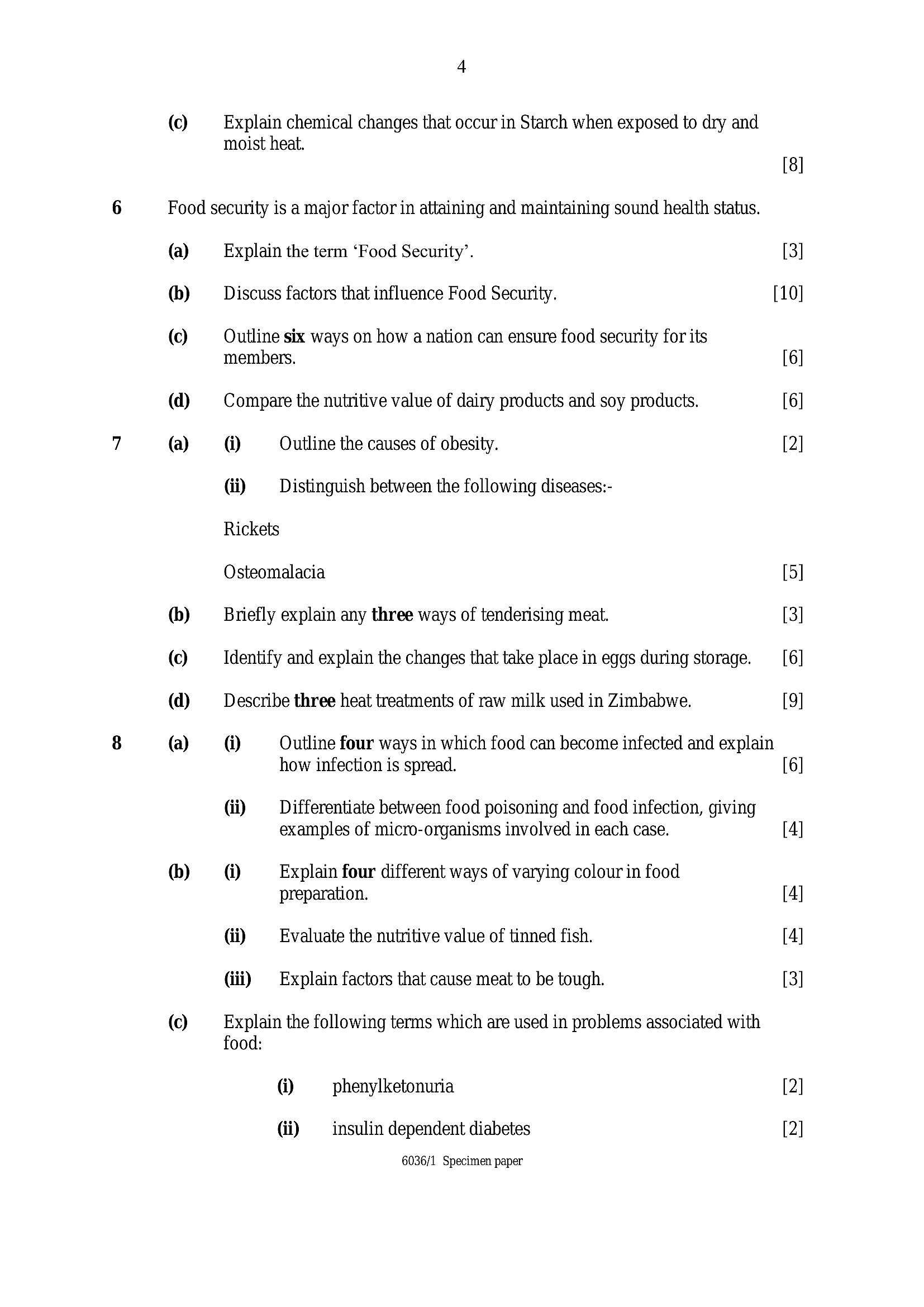
(©) Explain chemical changes that occur in Starch when exposed to dry and moist heat.Food security is a major factor in attaining and maintaining sound health status.
(a) Explain the term ‘Food Security’. [3
(b) Discuss factors that influence Food Security. [10
() Outline six ways on how a nation can ensure food security for its
members. [6
(d) Compare the nutritive value of dairy products and soy products. [6
(a) @ Outline the causes of obesity. [2
di Distinguish between the following diseases:-
Rickets
Osteomalacia 5]
(b) Briefly explain any three ways of tenderising meat. 3
(©) Identify and explain the changes that take place in eggs during storage. 6
@ Describe three heat treatments of raw milk used in Zimbabwe. 9
(a) @ Outline four ways in which food can become infected and explain
how infection is spread. 6
(ii) ‘Differentiate between food poisoning and food infection, giving
examples of micro-organisms involved in each case. 4
(b) @ Explain four different ways of varying colour in food
preparation. 4
di Evaluate the nutritive value of tinned fish. 4
(iii) | Explain factors that cause meat to be tough. 3
(©) Explain the following terms which are used in problems associated with
food:
@ phenylketonuria [2]
(ii) insulin dependent diabetes [2]
6036/1 Specimen paper
---
Page 5
Extracted Text
---