

📄 Exam Questions & Readable Text Transcript
Full OCR-extracted text of questions, syllabus codes, and exam instructions.
Extracted Content: reproductive_systems_in_humans
Page 1
Extracted Text
Reproduction is a process by which organisms produce new individuals of their kind. Just like plants, animals also have reproductive organs which produce sex cells. The reproductive organs become active at a certain stage in life called puberty, when the body undergoes changes in appearance and behaviour. It is important that you understand reproduction so as to avoid AIDS and unwanted pregnancies. Do not be shy to learn about this topic, understand what it is all about!Assessment objectives
By the end of the chapter students should be able
to:
* identify the reproductive organs of humans;
¢ identify sex cells in humans;
° describe the process of fertilization inh Humans;
| describe the course of pregnancy;
* describe the role of the placenta;
* describe the birth process.
Reproductive organs
Female reproductive organs
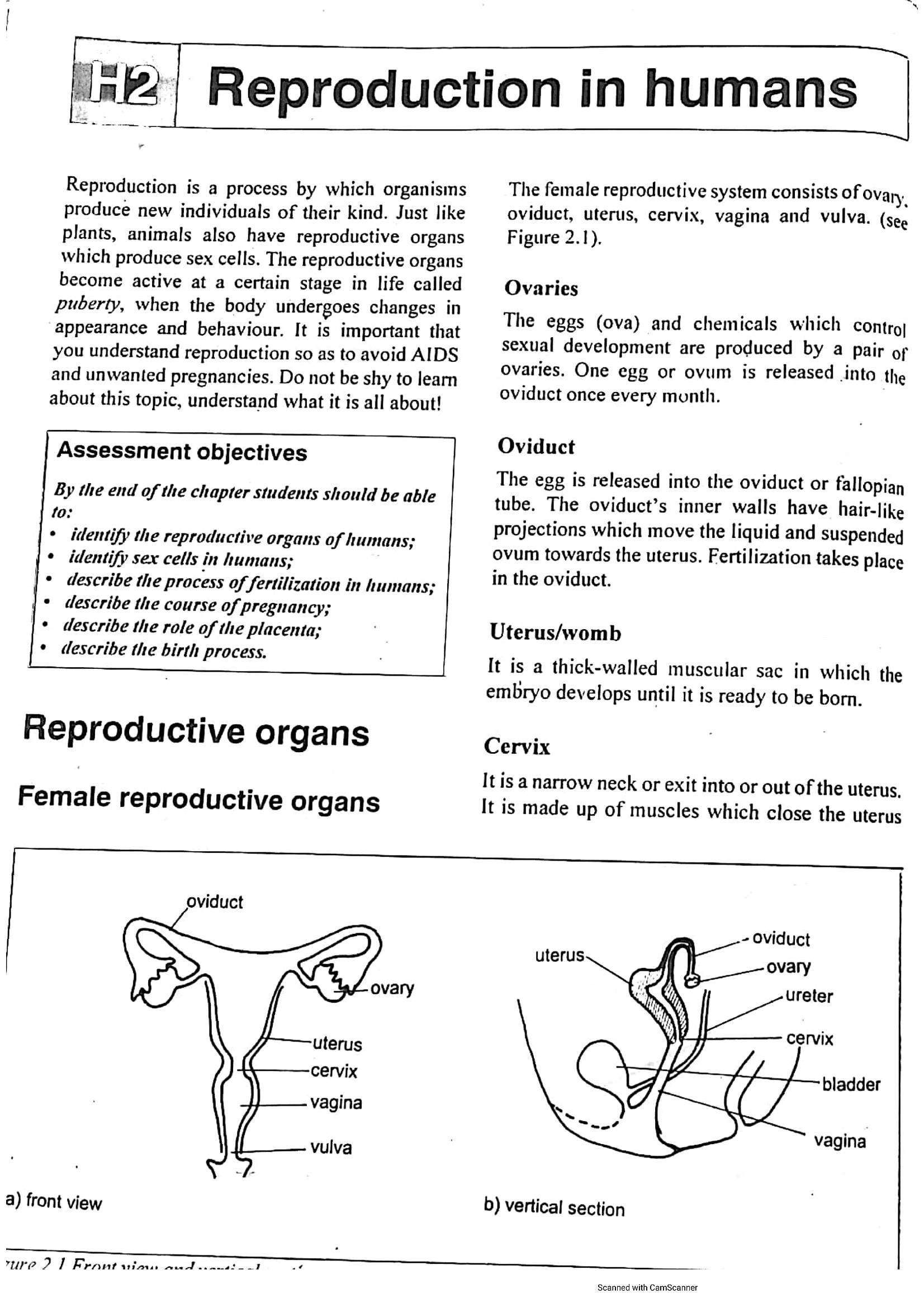
a) front view
ture 20 Fraut arias aed ecnnat_?
in®| Reproduction in humans
The female reproductive system consists of Ovary,
oviduct, uterus, cervix, vagina and vulva. (see
Figure 2.1).
Ovaries
The eggs (ova) and chemicals which Contro|
sexual development are produced by a pair of
ovaries. One egg or ovum is released into the
oviduct once every month.
Oviduct
The egg is released into the oviduct or fallopian
tube. The oviduct’s inner walls have hair-like
projections which move the liquid and suspended
ovum towards the uterus. Fertilization takes place
in the oviduct.
Uterus/womb
It is a thick-walled muscular sac in which the
embryo develops until it is ready to be born.
Cervix
It is a narrow neck or exit into or out of the uterus,
It is made up of muscles which close the uterus
vagina
b) vertical section
Scanned with CamScanner
---
Page 2
Extracted Text
gurin’ pregnancy but can open greatly during the pith of a baby:” er end is the cervix and its lower end
lig the vulva. The vagina receives the erected
[Ps during sexual intercourse. It also provides a
| msl for the birth of a baby.
“male reproductive organs
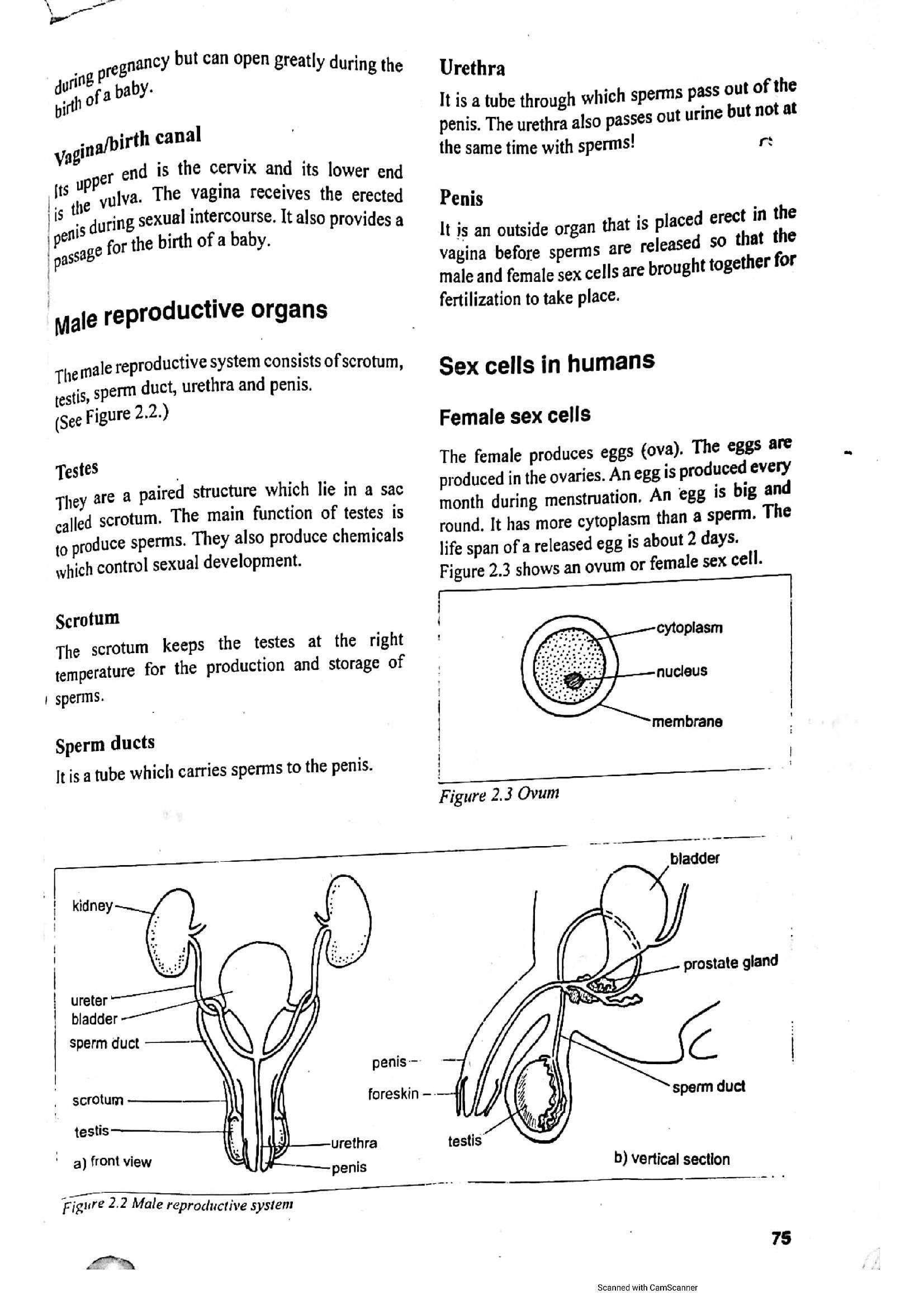
Themale reproductive system consists of scrotum,
testis, sperm™ duct, urethra and penis.
(see Figure 2.2.)
Testes
They are a paired structure which lie in a sac
called scrotum. The main function of testes is
to produce sperms. They also produce chemicals
which control sexual development.
Scrotum
The scrotum keeps the testes at the right
temperature for the production and storage of
sperms.
Sperm ducts
Itis a tube which carries sperms to the penis.
Urethra
It is a tube through which sp
penis. The urethra also passes oul
the same time with sperms! rs
erms pass out of the
t urine but not at
Penis
It is an outside organ that is placed erect in the
vagina before sperms are released so that the
male and female sex cells are brought together for
fertilization to take place.
Sex cells in humans
Female sex cells
The female produces eggs (ova). The eggs are
produced in the ovaries. An egg is produced every
month during menstruation. An egg is big and
round. It has more cytoplasm than a sperm. The
life span of a released egg is about 2 days.
Figure 2.3 shows an ovum OF female sex cell.
H
1
‘
Figure 2.3 Ovum
ureter
bladder
sperm duct
penis —
. scrotum foreskin —-
testis
: a) front view
b) Vertical section
75
Scanned with CamScanner
---
Page 3
Extracted Text
Scanned with CamScanner---
Page 4
Extracted Text
Male sex CellsFigure 2.4 shows a sperm. Sperms are the male
SEX cells, They are produced in the testes.
Figure 2.4 Sperm
The sperm has a head and a tail, The tail helps the
Sperm to swim and move. It is smaller than the
Ovum and contains less ‘cytoplasm. The life span
of a released Sperm is about 3 days,
Fertilization in humans
During mating the male produces sperms which
enter the female through the vagina and then
swim up through the cervix into the uterus, The
Sperms move into the fallopian tube/oviduct. In
the oviduct the Sperms meet the egg which has
been produced by the ovary. Males release many
sperms during mating but only one sperm will
fertilize the egg. Once the head of a sperm enters
an ovum, the ovum produces a protective coat
around itself to prevent further entry of sperms.
The other sperms die. The male sex nucleus and
the female sex nucleus join or fuse and this
process is called fertilization. The fertilized egg
(now called a zygote) moves along the oviduct
and divides several times.
Implantation and gestation
The zygote continues to divide and develops into
atball of dividing cells called an embryo. The
embryo attaches or implants itself to the wall of
the uterus, Jmplantation is the attachment of the
developing embryo to the lining’of the uterus.
76
Figure 2.5 Implantation
A placenta is formed by the thickenin
the lining of the uterus in preparation Of he
development of the fcetus. See F igure 2.5
The placenta connects the embryo to the wal
of the uterus and provides for the exchange of
materials between the blood of the embryo ang
the blood of the mother. (See Figure 2.6), Thetug
blood systems are separate but close together.
artery carries
waste substances
placenta_
vein carries food
and oxygen
a
Figure 2.6 Exchange of materials at the placema
The umbilical cord Connects the embryo to the
placenta. Food and Oxygen dissolved in blood ar
carried from the mother to the embryo through
the umbilical cord. Waste products dissolved i
blood are carried from the embryo to the mother
through the umbilical cord. The embryo grows
bigger and forms organs. It grows inside a bay of
ptotective liquid.
Scanned with CamScanner
---
Page 5
Extracted Text
placentafood substances and o:
from the mother's blogg"
baby's blood the
waste products move from
baby's blood to the Mother's b
0g
cervix and mucus Plug
umbilical cord
vagina
baby's blood moves waste
Products to the placenta tee]
Figure 8.10 Foetus developing in the uterus
As the embryo grows into a baby, the placenta also grows. After week eight the embryo is called a
foetus. Figure 8.10 shows the foetus and placenta.
The placenta develops many blood vessels and membranes to create a large surface area for the
exchange of substances between mother and baby.
Nutrients like glucose, amino acids, fatty acids and glycerol, vitamins and minerals can enter from tht
mother to the foetus. Antibodies and oxygen also enter the foetus through the placenta. The placenta
also removes waste products like carbon dioxide from the foetus.
Something interesting
About 20 percent of a pregnant woman's blood supply goes through the placenta every
minute. When a baby is born, the placenta will be about 20 cm in diameter and weigh
about 1.3 g.
Scanned with CamScanner
---
Page 6
Extracted Text
umbilical cordFigure 2. 7 40 weeks old embryo
At40 weeks the baby is now fully developed and
isready to be born. Most of the space in the uterus
js filled by the baby. The baby can only kick very
strongly but can no longer move around. When
the baby is ready-to be born it moves until its
head faces down. Under normal circumstances
a human embryo needs nine months to be well
developed. The length of time the embryo spends
in the uterus that is from fertilization to birth is
called gestation period.
The birth process/child birth/labour
At the beginning the vagina is closed and so
is the cervix. When labour starts the muscles
of the womb start contracting pushing the baby
down. The process is accompanied by pain. The
contractions force the baby to push against the
opening of the womb which is the cervix.
The bag containing the protective fluid bursts
and this is called breaking of the waters. The baby
is now pushed out through the vagina. The baby
easily passes through the narrow opening because
its bones are soft. The baby’s head moves out first
through the vagina. The rest of the body just slips
through.
When the baby finally comes out the umbilical
cord is cut and tied. When a baby is bom it cries.
If it does not cry the midwife beats the baby’s
bottom. lightly. This is done to open up the lungs
so that the baby starts breathing. Immediately the
baby may start suckling.
A few moments after the baby is born the
placenta is pushed out of the uterus and these
remains are called the afterbirth.
Remember...
1. Reproduction is a process whereby
ones are produced.
2. Male and female sex ce
gametes.
3. Sperms are male sex cells and eggs/ova are
the female sex cells.
4. Sperms are produced in the testes and eggs
in the ovaries.
5. a) The oviduct can be called the fallopian
tube/egg tube.
b) The egg is the ova (plural)/ovum
(singular).
c) The uterus is the womb.
6. Fertilization in mammals is internal.
7. Fertilization is the joining/fusion of a sperm
and an ovum to produce a zygote.
8. Implantation takes place in the uterus and
this happens after fertijization which takes
place in the oviduct.
9. Exchange of nutrients and wastes between
foetus and mother occurs through the
placenta.
10. When the baby in the uterus has fully
developed and is ready to be born the walls
of the uterus contract forcing the baby out.
This process is called labour. The cervix then
opens and the baby comes out through the
vagina.
11. Different animals have different gestation
periods.
young
Ils are referred to as
Study questions
Paper 1: Multiple choice questions
1. Inmammals eggs are produced in
A_ ovaries
B testes
C uterus
D scrotum . |
2. The period ‘from fertilization to birth is
called
reproduction
B_ gestation
C fertilization
D implantation
>
Scanned with CamScanner
---