

📄 Exam Questions & Readable Text Transcript
Full OCR-extracted text of questions, syllabus codes, and exam instructions.
Extracted Content: A_Level_Ecoz_N2016_Data_Response
Page 1
Extracted Text
The WE ~ MSHOWE HIGH sc220CT 201
UAL g)
TENGWE
ZIMBABWE SCHOOL EXAMINATIONS COUNG
General Certificate of Education Advanced Level
ECONOMICS 9158/2
PAPER 2 Data Response
NOVEMBER 2016 SESSION 1 hour 15 minutes
Additional materials:
Answer paper
TIME 1 hour 15 minutes
INSTRUCTIONS TO CANDIDATES
Write your name, Centre number and candidate number in the spaces provided on the answer
paper/answer booklet.
Answer both questions.
Write your answers on the separate answer paper provided.
If you use more than one sheet of paper, fasten the sheets together.
‘Brief answers only are required.
INFORMATION FOR CANDIDATES
ener ae
The questions in this paper carry equal marks. The number of marks is given in brackets [ ] at the
end of each part question.
rg
You should spend at least five minutes reading through the data for each question before you begin
writing your answers.
See PSI RES
ETT ST over |=aa
This question paper consists of 4 printed pages.
Copyright: Zimbabwe School Examinations Council, N2016.
‘OZIMSEC N2016 [Turn over
Scanned by CamScanner
---
Page 2
Extracted Text
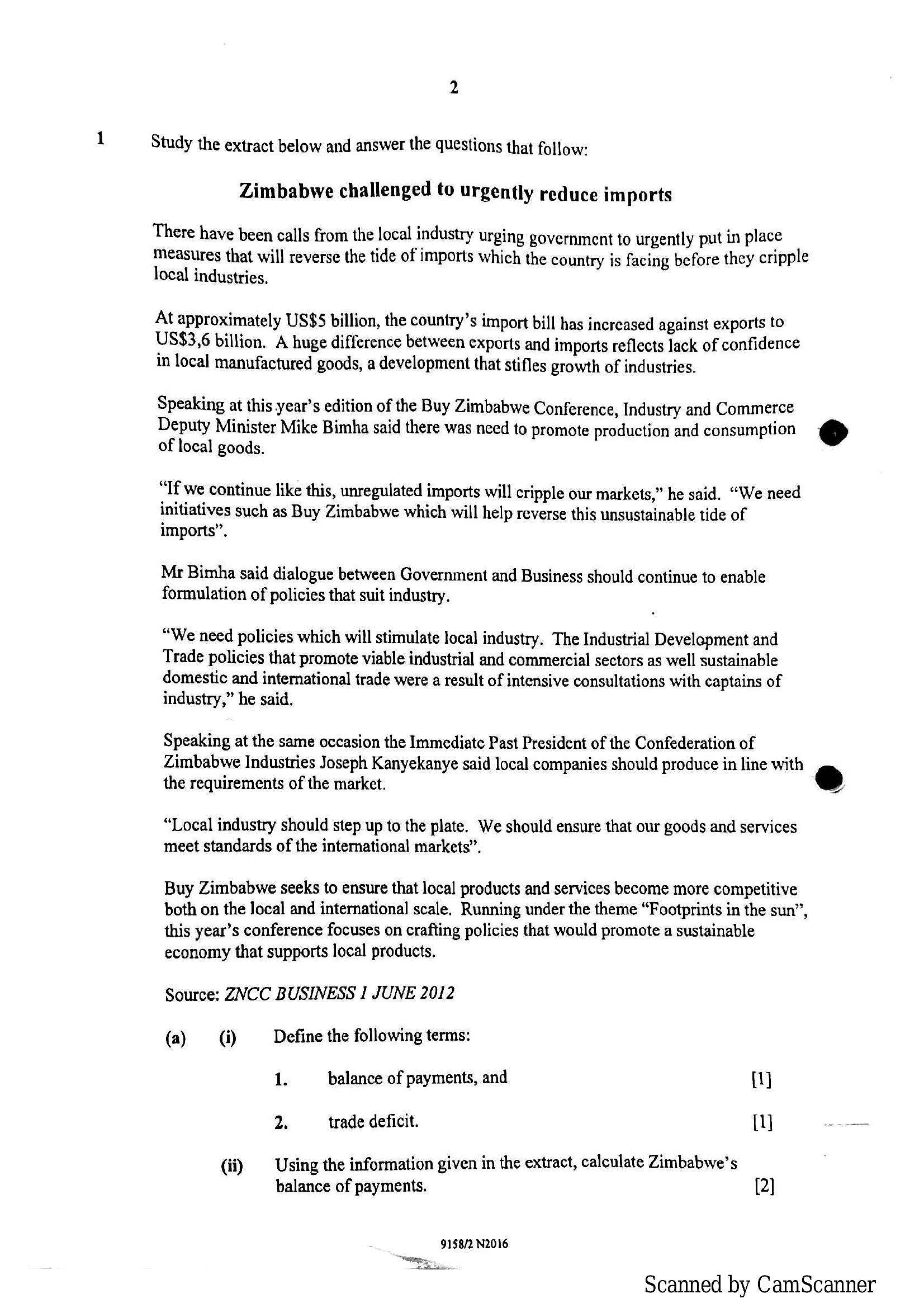
Study the extract below and answer the questions that follow: Zimbabwe challenged to urgently reduce importsThere have been calls from the local industry urging government to urgently put in place
measures that will reverse the tide of imports which the country is facing before they cripple
local industries.
At approximately US$5 billion, the country’s import bill has increased against exports to
USS3,6 billion. A huge difference between exports and imports reflects lack of confidence
in local manufactured goods, a development that stifles growth of industries.
Speaking at this year’s edition of the Buy Zimbabwe Conference, Industry and Commerce
Deputy Minister Mike Bimha said there was need to promote production and consumption oe
of local goods.
“If we continue like this, unregulated imports will cripple our markets,” he said. “We need
initiatives such as Buy Zimbabwe which will help reverse this unsustainable tide of
imports”,
Mr Bimha said dialogue between Government and Business should continue to enable
formulation of policies that suit industry.
“We need policies which will stimulate local industry. The Industrial Development and
Trade policies that promote viable industrial and commercial sectors as well sustainable
domestic and international trade were a result of intensive consultations with captains of
industry,” he said.
Speaking at the same occasion the Immediate Past President of the Confederation of
Zimbabwe Industries Joseph Kanyekanye said local companies should produce in line with
the requirements of the market. e
“Local industry should step up to the plate. We should ensure that our goods and services
meet standards of the international markets”.
Buy Zimbabwe seeks to ensure that local products and services become more competitive
both on the local and international scale, Running under the theme “Footprints in the sun”,
this year’s conference focuses on crafting policies that would promote a sustainable
economy that supports local products.
Source: ZNCC BUSINESS I JUNE 2012
(a) (i) Define the following terms:
1. balance of payments, and (1
2. trade deficit. by] a
(ii) Using the information given in the extract, calculate Zimbabwe’s
balance of payments. [2]
9158/2 N2016
eam
Scanned by CamScanner
---
Page 3
Extracted Text
3(b) (i) Explain two possible tools the government might use to regulate ,
imports. (2)
(ii) Suggest two reasons why consumers lacked confidence in 4i
locally produced goods,
(c) Assess the effectiveness of the industrial policy instruments that can be Hy
used in promoting domestic industries.
(d) Discuss the effects of restricting imports on the Zimbabwean economy. (6)
Read the following and answer the questions that follow:
Inflation
@
The annual rate of inflation declined from 46,6% in December 1998 to 44,2% in January
1999, against the background of declines in basic components of the food ealegory,
excluding meat. Food inflation decreased by 7,5 percentage points to 55,4%. Non-food
inflation registered a marginal 0,1 percentage points decline to 36,88%.
From an increase of 4,2% in December, month-on-month inflation rose by 3,8% in January.
This was on account of increases in both food and non-food aggregates. Food inflation
increased by 6.0%, down from 7,2% in December. This was underpinned by increases in
fish, 15,8%; meat, 9,8%; fruit and vegetables, 9,3%; coffee and tea, 6,7% and; dairy
products 5,6%.
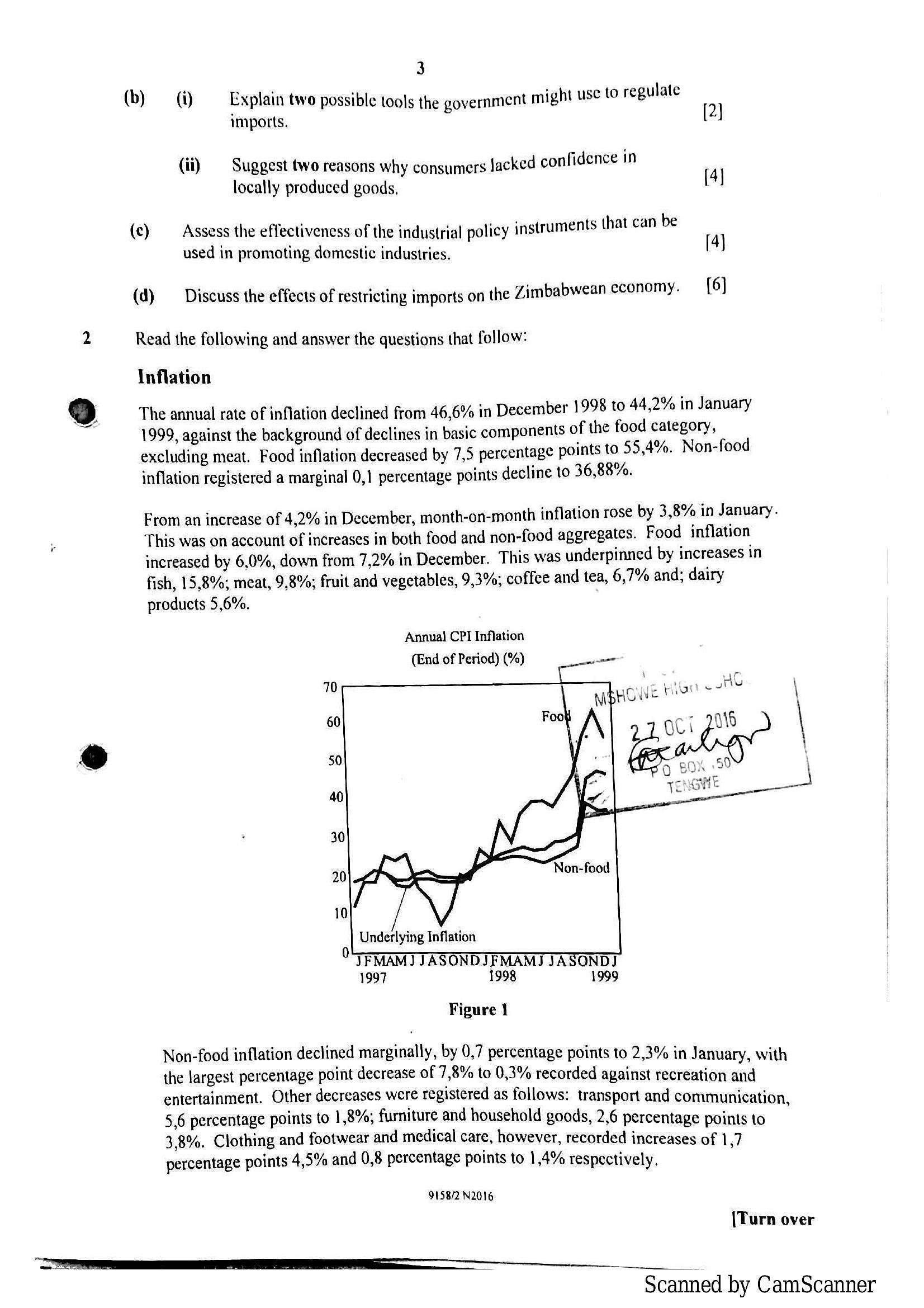
Annual CPI Inflation
(End of Period) (%)
70
60
40
Underlying Inflation
0 JFMAM) JASONDJFMAMJ JASONDJ
1997 1998 1999
Figure 1
Non-food inflation declined marginally, by 0,7 percentage points to 2,3% in January, with
the largest percentage point decrease of 7,8% to 0,3% recorded against recreation and
entertainment. Other decreases were registered as follows: transport and communication,
5,6 percentage points to 1,8%, furniture and household goods, 2,6 percentage points to
3,8%. Clothing and footwear and medical care, however, recorded increases of 1,7
percentage points 4,5% and 0,8 percentage points to 1,4% respectively,
9158/2 N2016
[Turn over
ee
Scanned by CamScanner
---
Page 4
Extracted Text
(a)(b)
(c)
(d)
Annual CPI Inflation Series
(End of Period) (%)
80 8182 8384 85 8687 88899091 9293 94959697 9899*
*January
Source: Reserve Bank of Zimbabwe Monthly
Review Vol 7 No. | January 1999
Figure 2
(i) Define the term Consumer Price Index. (2]
(ii) Apart from a decline in Costs of Components, what other
reason could have led to a fall in inflation between December
1998 and January 19997 [2]
(i) With reference to Figure 1, compare the trend in food inflation
with that of non-food inflation, over the period 1997 to 1999. (2]
(ii) Account for the rise in month-on-month inflation despite a decline
in annual inflation. [2]
(i) Using Figure 2, explain possible effects of the trend in inflation
between 1980 and 1999, [3]
(ii) | Comment on two possible policy instruments that might be used
to fight cost-push inflation. [3]
Discuss the relationship between inflation and consumption. [6]
9158/2 N2016
@
N
Scanned by CamScanner
---