6023 and 6044 EXAM CIRCULAR NO 17 OF 2018
Year: 2018 • Views: 1 • Downloads: 2

📄 Exam Questions & Readable Text Transcript
Full OCR-extracted text of questions, syllabus codes, and exam instructions.
Extracted Content: 6023 and 6044 EXAM CIRCULAR NO 17 OF 2018
Page 1
Extracted Text
03 April 2018EXAMINATIONS POLICY CIRCULAR
NUMBER 17 OF 2018
DISTRIBUTION:
Permanent Secretary-Ministry of Primary and Secondary Education
All ZIMSEC Regional Managers
All Provincial Education Directors-Ministry of Primary and Secondary Education
All District Education Officers-Ministry of Primary and Secondary Education
Heads of Advanced Level Examination Centres
ASSESSMENT OF CANDIDATES IN COMPUTER SCIENCE SYLLABUS (6023) AND
SOFTWARE ENGINEERING SYLLABUS (6044)
This circular brings to your attention procedures for the assessment of Advanced Level
Computer Science (6023) and Software Engineering (6044) candidates.
1
The Project (6023/3 and 6044/3)
Candidates will be expected to present a project. The expectations of the project were sent
out in 2017 (see Appendix 1) and copies will be kept at Regional Offices for centres to
photocopy if they find that to be more convenient.
A contents page should be prepared to indicate the location of sections of the project. The
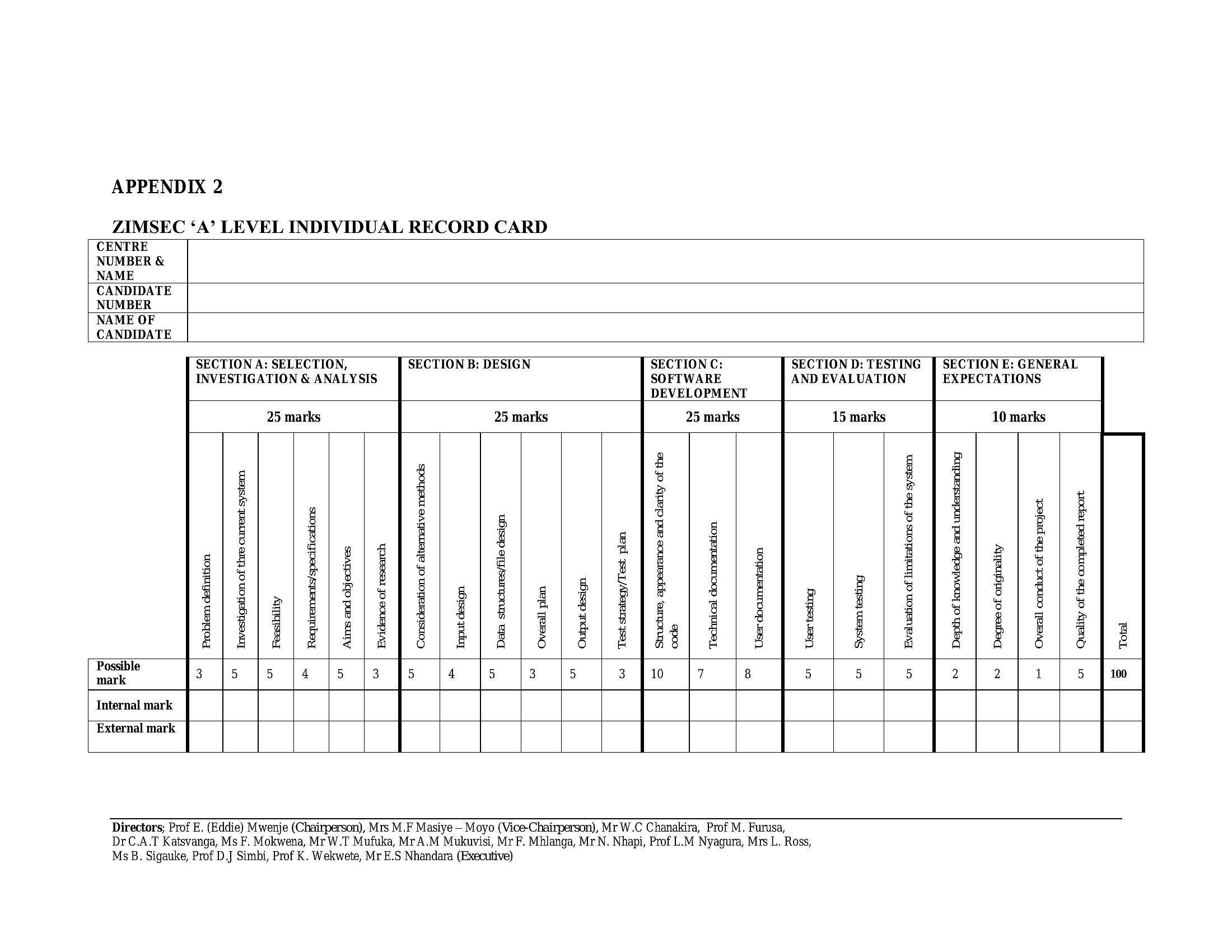
candidate’s project should contain the individual assessment mark sheet (See Appendix 2)
with all the teacher’s marks indicated.
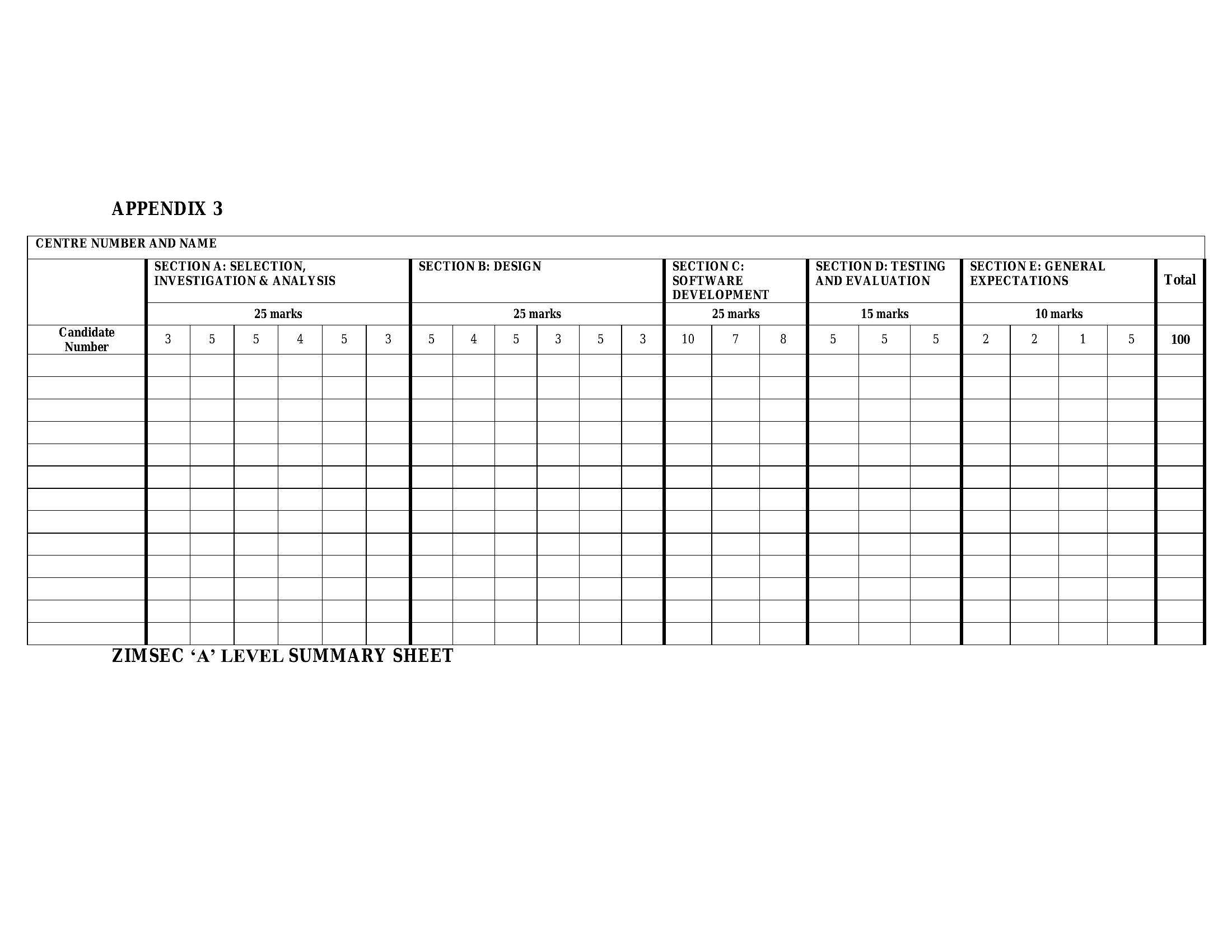
The project document should contain the project assessment form (See Appendix 3) with all
candidates’ marks recorded. In addition, the teacher should submit a soft copy of the
candidates’ work in the form of a CD. Each candidate should have a folder on the CD, where
his/her project has been saved. The folder should have the candidate’s name and number.
The project should be completed by 05 October 2018 and the projects should be
submitted to ZIMSEC Regional Offices or ZIMSEC Cluster Collection Centres by 26
October 2018.
The Practical Examination (6023/2 and 6044/2)
Each registered candidate will sit for a practical examination as indicated in the syllabus. The
duration of the Practical Examination is 3 hours. Please note that the 3 hours does not include
Directors; Prof E. (Eddie) Mwenje (Chairperson), Mrs M.F Masiye — Moyo (Vice-Chairperson), Mr W.C Chanakira, Prof M. Furusa,
DrC.A.T Katsvanga, Ms F. Mokwena, Mr W.T Mufuka, MrA.M Mukuvisi, Mr F. Mhlanga, Mr N. Nhapi, Prof L.M Nyagura, Mrs L. Ross,
Ms B. Sigauke, Prof D.J Simbi, Prof K. Wekwete, Mr E.S Nhandara (Executive)
---
Page 2
Extracted Text
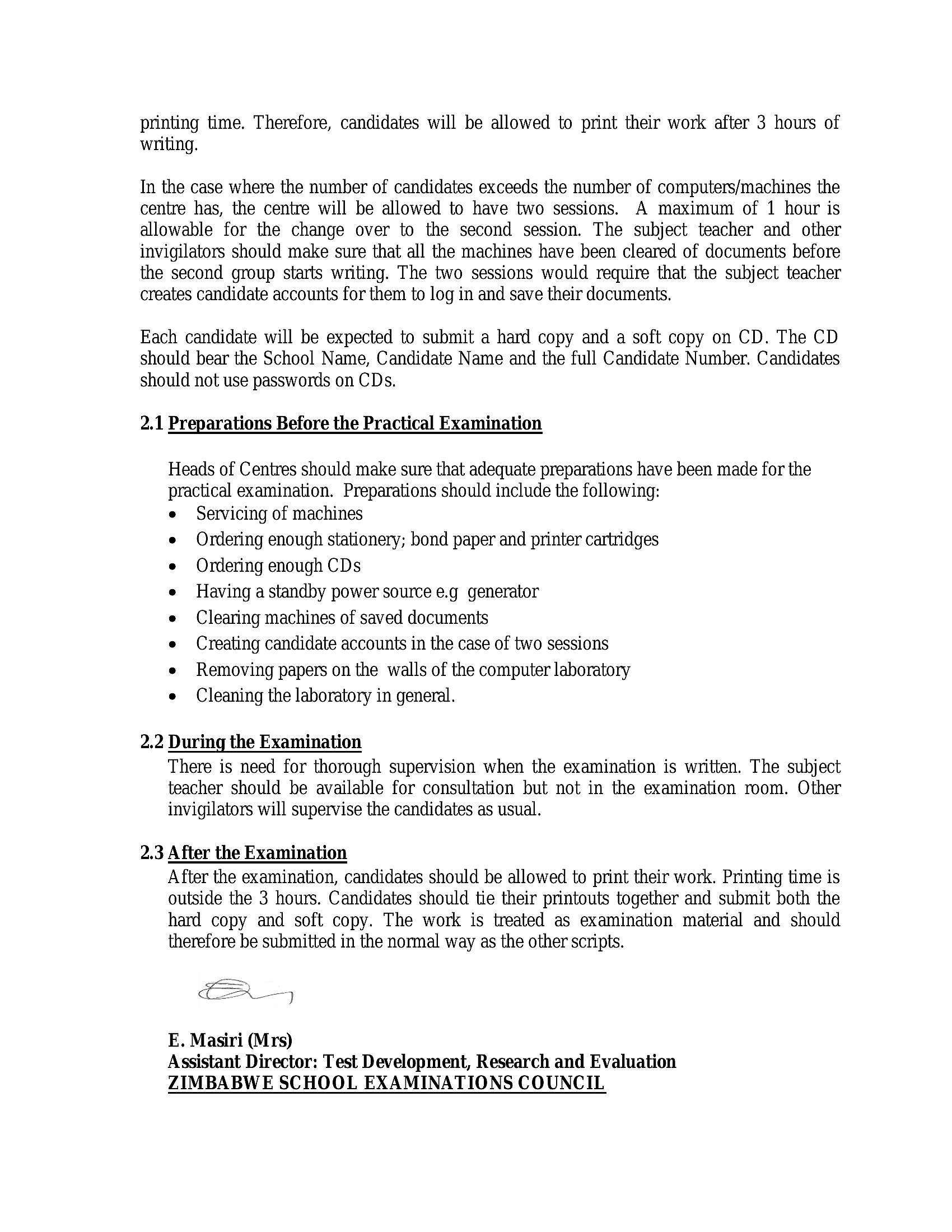
printing time. Therefore, candidates will be allowed to print their work after 3 hours of writing.In the case where the number of candidates exceeds the number of computers/machines the
centre has, the centre will be allowed to have two sessions. A maximum of 1 hour is
allowable for the change over to the second session. The subject teacher and other
invigilators should make sure that all the machines have been cleared of documents before
the second group starts writing. The two sessions would require that the subject teacher
creates candidate accounts for them to log in and save their documents.
Each candidate will be expected to submit a hard copy and a soft copy on CD. The CD
should bear the School Name, Candidate Name and the full Candidate Number. Candidates
should not use passwords on CDs.
2.1 Preparations Before the Practical Examination
Heads of Centres should make sure that adequate preparations have been made for the
practical examination. Preparations should include the following:
e Servicing of machines
e Ordering enough stationery; bond paper and printer cartridges
e Ordering enough CDs
e Having a standby power source e.g generator
e Clearing machines of saved documents
e Creating candidate accounts in the case of two sessions
e Removing papers on the walls of the computer laboratory
e Cleaning the laboratory in general.
2.2 During the Examination
There is need for thorough supervision when the examination is written. The subject
teacher should be available for consultation but not in the examination room. Other
invigilators will supervise the candidates as usual.
2.3 After the Examination
After the examination, candidates should be allowed to print their work. Printing time is
outside the 3 hours. Candidates should tie their printouts together and submit both the
hard copy and soft copy. The work is treated as examination material and should
therefore be submitted in the normal way as the other scripts.
ra —N —)
E. Masiri (Mrs)
Assistant Director: Test Development, Research and Evaluation
ZIMBABWE SCHOOL EXAMINATIONS COUNCIL
---
Page 3
Extracted Text
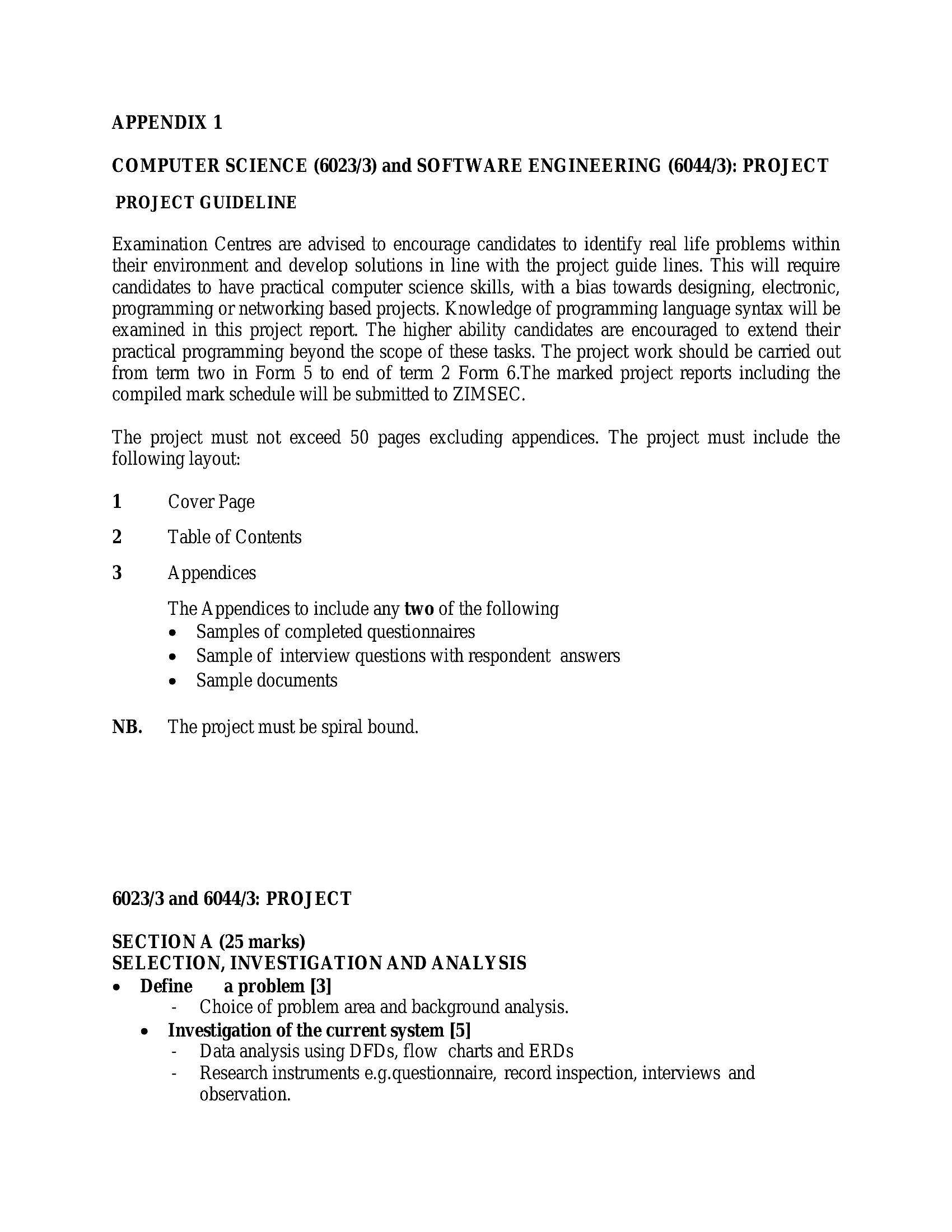
APPENDIX 1COMPUTER SCIENCE (6023/3) and SOFTWARE ENGINEERING (6044/3): PROJ ECT
PROJECT GUIDELINE
Examination Centres are advised to encourage candidates to identify real life problems within
their environment and develop solutions in line with the project guide lines. This will require
candidates to have practical computer science skills, with a bias towards designing, electronic,
programming or networking based projects. Knowledge of programming language syntax will be
examined in this project report. The higher ability candidates are encouraged to extend their
practical programming beyond the scope of these tasks. The project work should be carried out
from term two in Form 5 to end of term 2 Form 6.The marked project reports including the
compiled mark schedule will be submitted to ZIMSEC.
The project must not exceed 50 pages excluding appendices. The project must include the
following layout:
1 Cover Page
2 Table of Contents
3 Appendices
[he Appendices to include any two of the following
e Samples of completed questionnaires
e Sample of interview questions with respondent answers
e Sample documents
NB. The project must be spiral bound.
6023/3 and 6044/3: PROJ ECT
SECTION A (25 marks)
SELECTION, INVESTIGATION AND ANALYSIS
e Define a problem [3]
Choice of problem area and background analysis.
e Investigation of the current system [5]
Data analysis using DFDs, flow charts and ERDs
Research instruments e.g.questionnaire, record inspection, interviews and
observation.
---
Page 4
Extracted Text
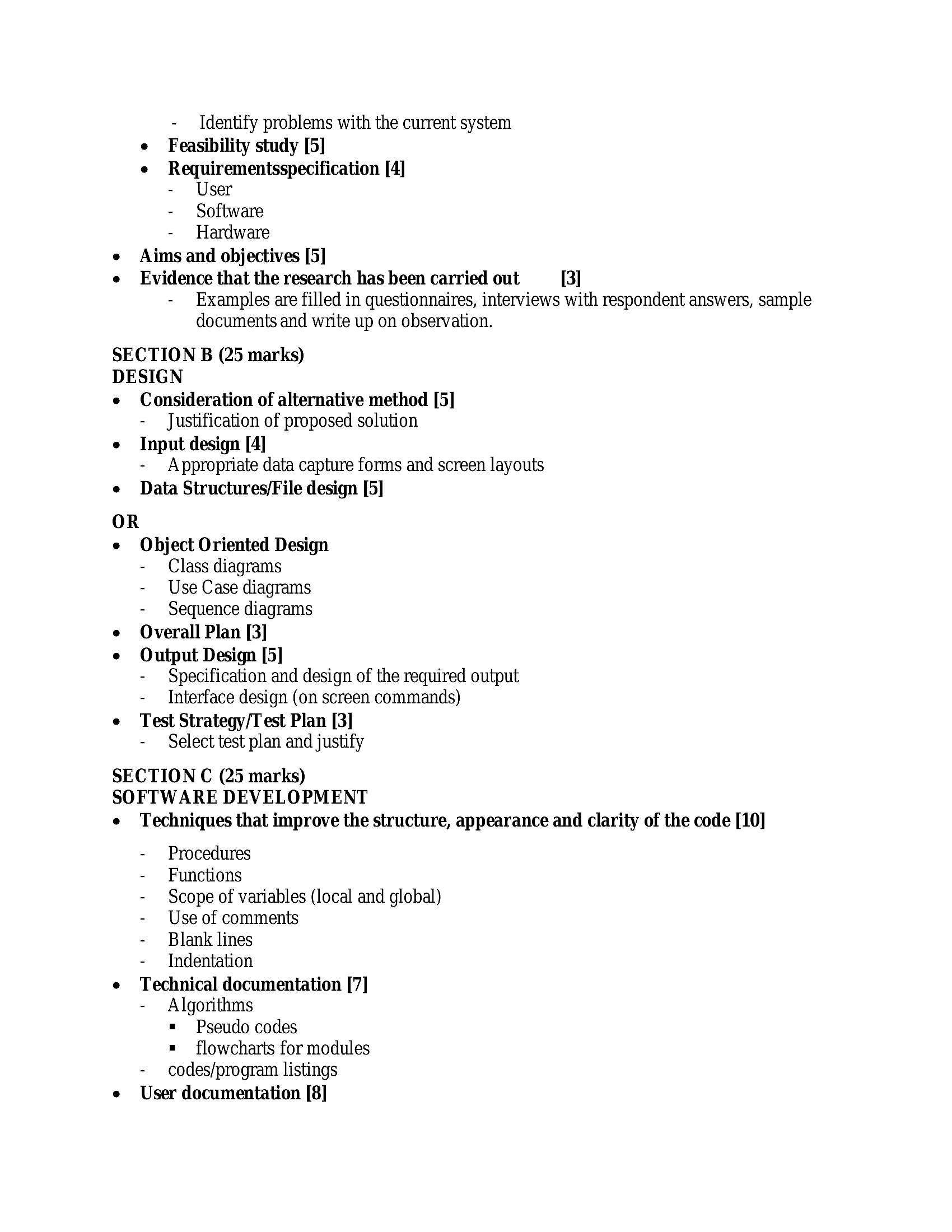
Identify problems with the current system e Feasibility study [5] e Requirementsspecification [4] User Software Hardware e Aims and objectives [5] e Evidence that the research has been carried out [3] Examples are filled in questionnaires, interviews with respondent answers, sample documents and write up on observation.SECTION B (25 marks)
DESIGN
e Consideration of alternative method [5]
Justification of proposed solution
e Input design [4]
Appropriate data capture forms and screen layouts
e Data Structures/File design [5]
OR
e Object Oriented Design
Class diagrams
Use Case diagrams
Sequence diagrams
e Overall Plan [3]
e Output Design [5]
Specification and design of the required output
Interface design (on screen commands)
e Test Strategy/T est Plan [3]
Select test plan and justify
SECTION C (25 marks)
SOFTWARE DEVELOPMENT
e Techniques that improve the structure, appearance and clarity of the code [10]
Procedures
Functions
Scope of variables (local and global)
Use of comments
Blank lines
- Indentation
e Technical documentation [7]
Algorithms
= Pseudo codes
= flowcharts for modules
codes/program listings
e User documentation [8]
---
Page 5
Extracted Text
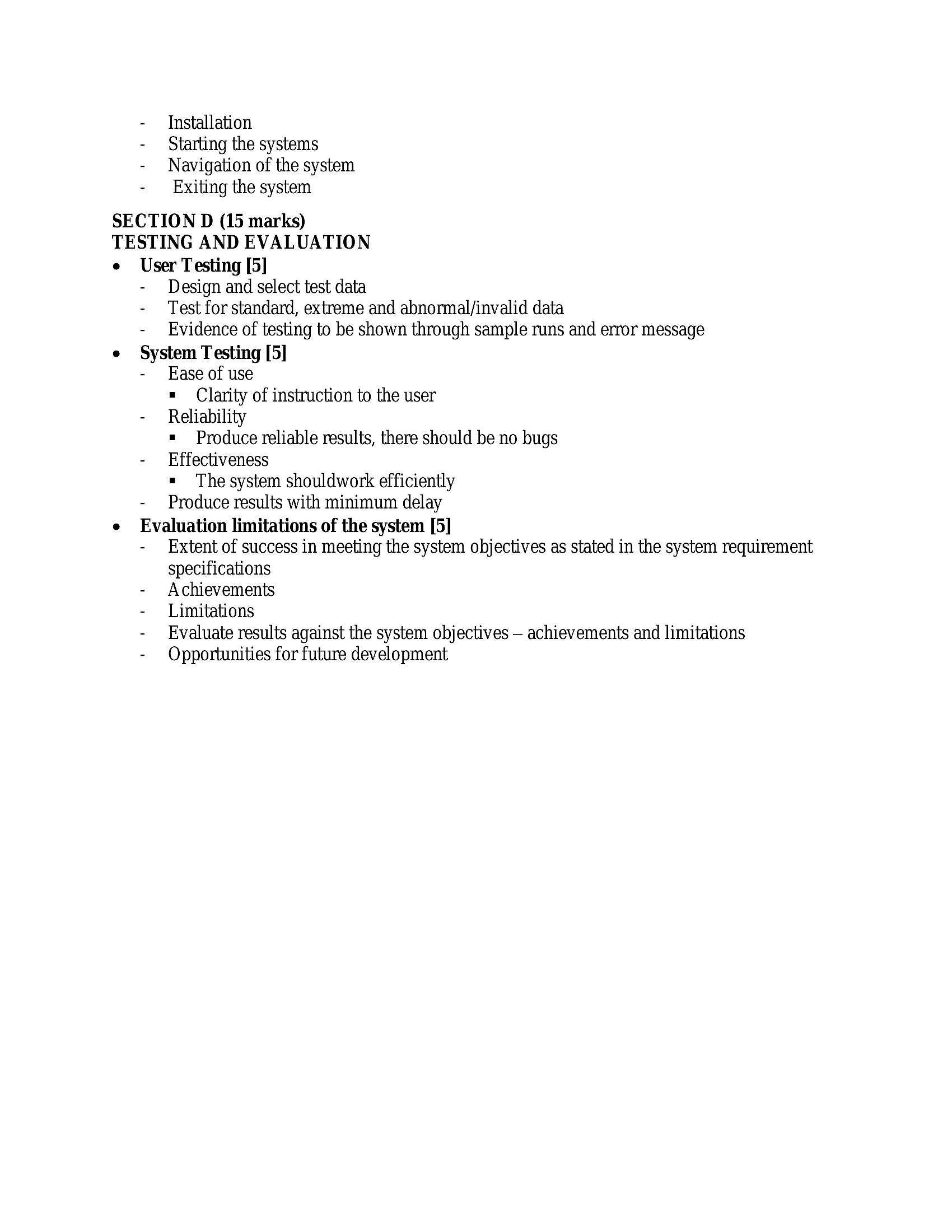
InstallationStarting the systems
Navigation of the system
Exiting the system
SECTION D (15 marks)
TESTING AND EVALUATION
e User Testing [5]
Design and select test data
Test for standard, extreme and abnormal/invalid data
Evidence of testing to be shown through sample runs and error message
° System Testing [5]
Ease of use
= Clarity of instruction to the user
Reliability
= Produce reliable results, there should be no bugs
Effectiveness
= The system shouldwork efficiently
Produce results with minimum delay
° Evaluation limitations of the system [5]
Extent of success in meeting the system objectives as stated in the system requirement
specifications
Achievements
Limitations
Evaluate results against the system objectives — achievements and limitations
Opportunities for future development
---
Page 6
Extracted Text
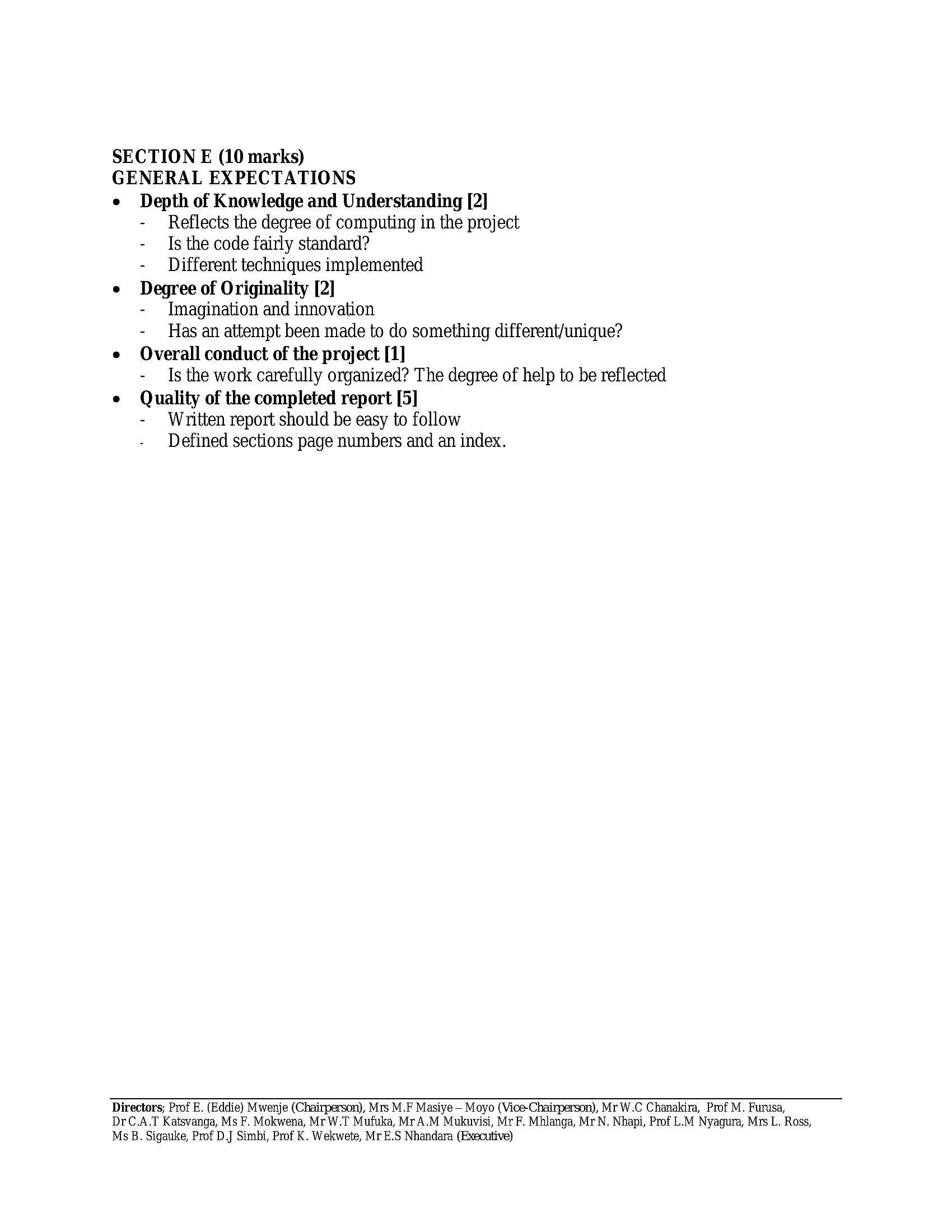
SECTION E (10 marks) GENERAL EXPECTATIONS e Depth of Knowledge and Understanding [2]Reflects the degree of computing in the project
Is the code fairly standard?
Different techniques implemented
e Degree of Originality [2]
Imagination and innovation
Has an attempt been made to do something different/unique?
e Overall conduct of the project [1]
Is the work carefully organized? The degree of help to be reflected
e Quality of the completed report [5]
Written report should be easy to follow
Defined sections page numbers and an index.
Directors; Prof E. (Eddie) Mwenje (Chairperson), Mrs M.F Masiye — Moyo (Vice-Chairperson), Mr W.C Chanakira, Prof M. Furusa,
DrC.A.T Katsvanga, Ms F. Mokwena, Mr W.T Mufuka, MrA.M Mukuvisi, Mr F. Mhlanga, Mr N. Nhapi, Prof L.M Nyagura, Mrs L. Ross,
Ms B. Sigauke, Prof D.J Simbi, Prof K. Wekwete, Mr E.S Nhandara (Executive)
---
Page 7
Extracted Text
APPENDIX 2ZIMSEC ‘A’ LEVEL INDIVIDUAL RECORD CARD
CENTRE
NUMBER &
NAME
CANDIDATE
NUMBER
NAME OF
CANDIDATE
SECTION A: SELECTION, SECTION B: DESIGN SECTION C: SECTION D: TESTING SECTION E: GENERAL
INVESTIGATION & ANALYSIS SOFTWARE AND EVALUATION EXPECTATIONS
DEVELOPMENT
25 marks 25 marks 25 marks 15 marks 10 marks
& :
: i
z E
E Z & : P F i i
a, | j 4 lel fei
sli] (bE aja) fs F j le) a]ele
; g ; g a]§& 5 : a
§ eile; g g |: ! q
§ 2 a E q 4 g 4 g % wel 3
TLE ELET a) bla] ili elelhlalals
2 |: Bel ela] s a | 33 p| g B18
£ a] 6 aA} 6 & & 5 5 a ala} 6 &
Possible
mark 3 5 5 4 5 3 5 4 5 3 5 3 7 10 7 8 5 5 5 2 2 1 5 100
Internal mark
External mark
Directors; Prof E. (Eddie) Mwenje (Chairperson), Mrs M.F Masiye — Moyo (Vice-Chairperson), Mr W.C Chanakira, Prof M. Furusa,
DrC.A.T Katsvanga, Ms F. Mokwena, Mr W.T Mufuka, MrA.M Mukuvisi, Mr F. Mhlanga, Mr N. Nhapi, Prof L.M Nyagura, Mrs L. Ross,
Ms B. Sigauke, Prof D.J Simbi, Prof K. Wekwete, Mr E.S Nhandara (Executive)
---
Page 8
Extracted Text
APPENDIX 3CENTRE NUMBER AND NAME
SECTION A: SELECTION, SECTION B: DESIGN SECTION C: SECTION D: TESTING SECTION E: GENERAL
INVESTIGATION & ANALYSIS SOFTWARE AND EVALUATION EXPECTATIONS
DEVELOPMENT
25 marks 25 marks 25 marks 15 marks 10 marks
Candidate
Number 3 5 5 4 5 3 5 4 5 3 5 3 10 7 8 5 5 5 2 2 1
ZIMSEC ‘A’ LEVEL SUMMARY SHEET
---