20_CHEMISTRY_PRACTICAL_SAMPLES-1
Year: Specimen • Views: 3 • Downloads: 3
📄 Exam Questions & Readable Text Transcript
Full OCR-extracted text of questions, syllabus codes, and exam instructions.
Extracted Content: 20_CHEMISTRY_PRACTICAL_SAMPLES-1
Page 1
Extracted Text
THE 20 MODEL CHEMISTRY PRACTICAL SAMPLES [MSCE]SUMMER LESSONS
By Sir James — MC 2019
BSc in Environmental Economics & Biochemistry
kudzalajamesmc@gmail.com or/ (+265) 881 298 174
qs)
)
---
Page 2
Extracted Text
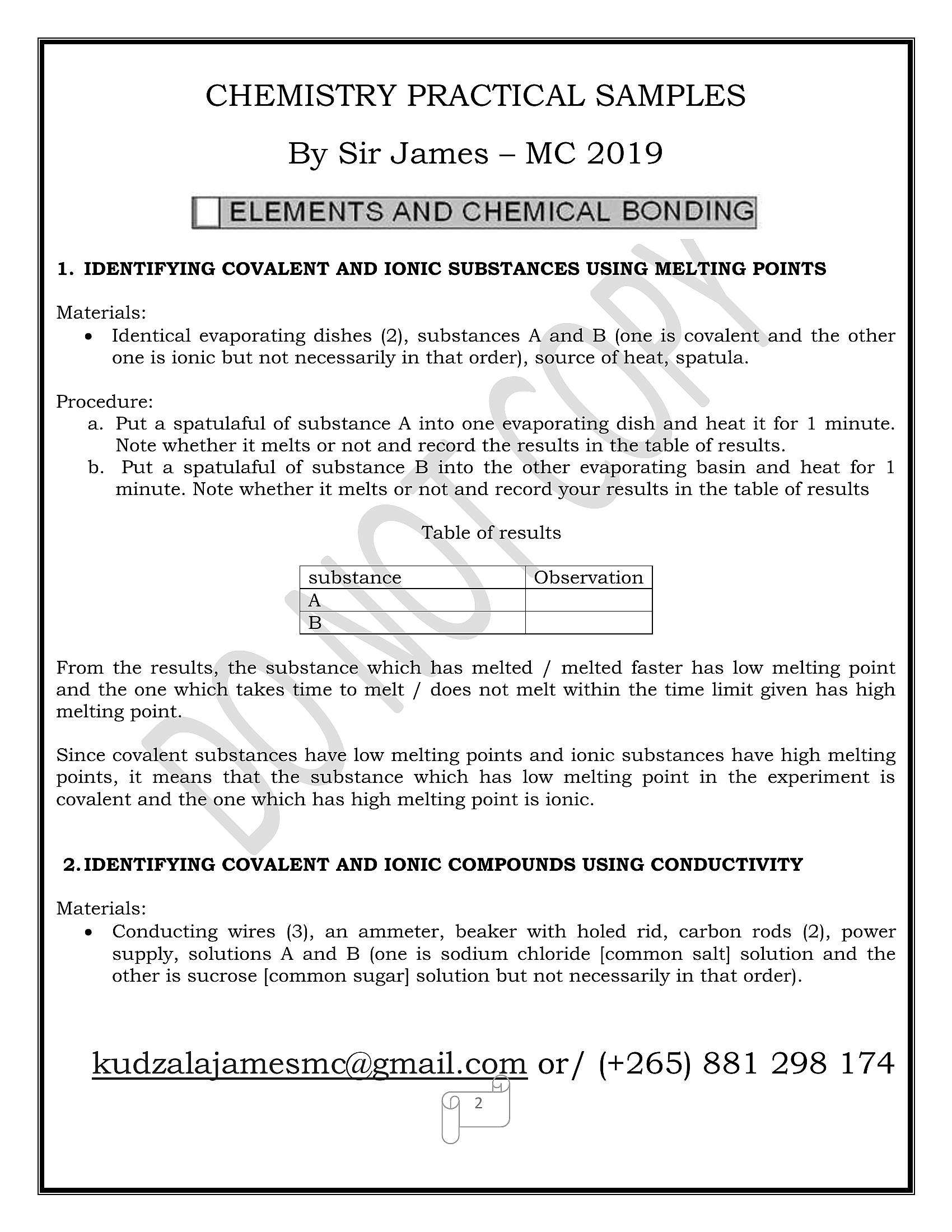
CHEMISTRY PRACTICAL SAMPLES By Sir James — MC 2019| [ELEMENTS AND CHEMICAL BONDING
1. IDENTIFYING COVALENT AND IONIC SUBSTANCES USING MELTING POINTS
Materials:
e Identical evaporating dishes (2), substances A and B (one is covalent and the other
one is ionic but not necessarily in that order), source of heat, spatula.
Procedure:
a. Put a spatulaful of substance A into one evaporating dish and heat it for 1 minute.
Note whether it melts or not and record the results in the table of results.
b. Put a spatulaful of substance B into the other evaporating basin and heat for 1
minute. Note whether it melts or not and record your results in the table of results
Table of results
substance Observation
A
B
From the results, the substance which has melted / melted faster has low melting point
and the one which takes time to melt / does not melt within the time limit given has high
melting point.
Since covalent substances have low melting points and ionic substances have high melting
points, it means that the substance which has low melting point in the experiment is
covalent and the one which has high melting point is ionic.
2. IDENTIFYING COVALENT AND IONIC COMPOUNDS USING CONDUCTIVITY
Materials:
e Conducting wires (3), an ammeter, beaker with holed rid, carbon rods (2), power
supply, solutions A and B (one is sodium chloride [common salt] solution and the
other is sucrose [common sugar] solution but not necessarily in that order).
kudzalajamesmc@gmail.com or/ (+265) 881 298 174
4 2
---
Page 3
Extracted Text
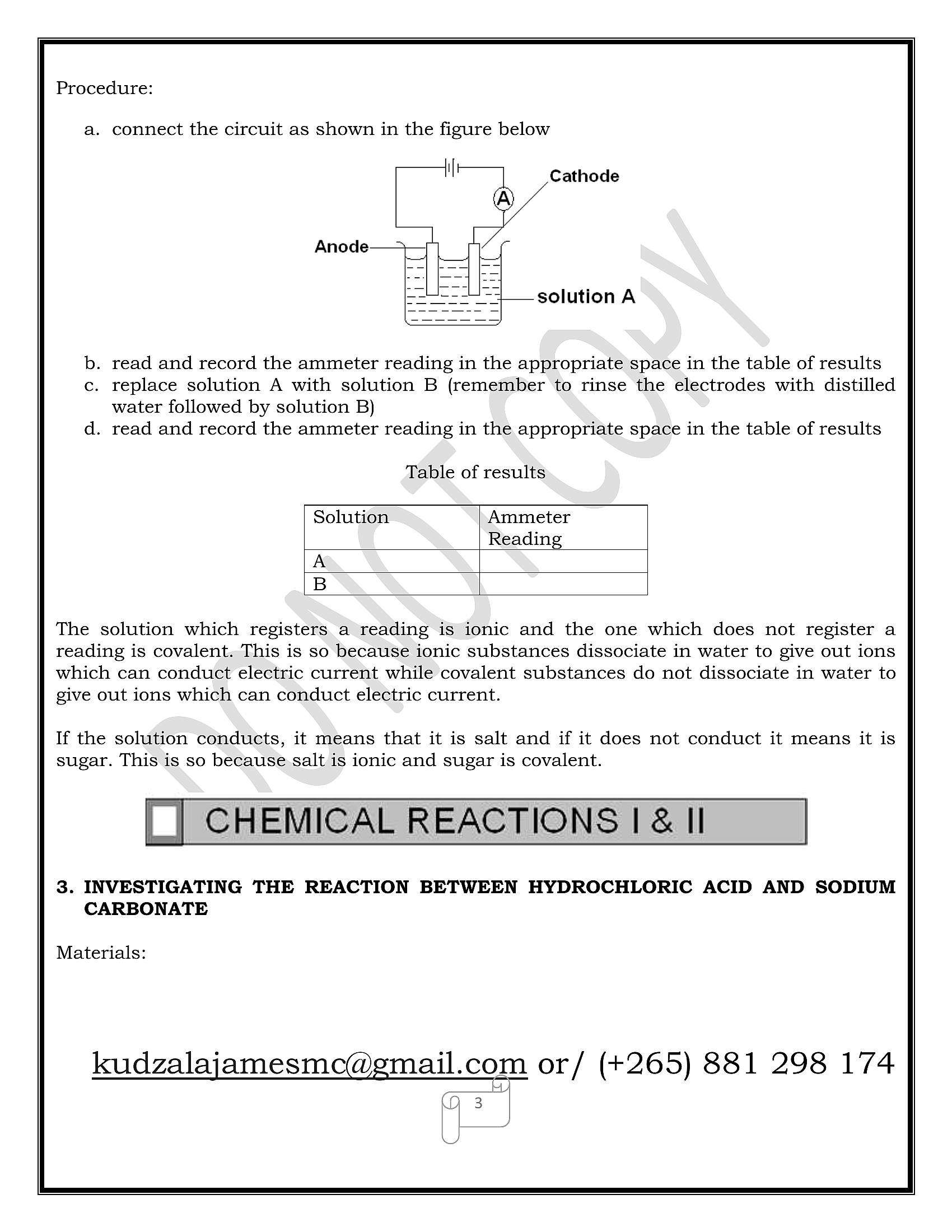
Procedure:a. connect the circuit as shown in the figure below
Cathode
+— solution A
. read and record the ammeter reading in the appropriate space in the table of results
. replace solution A with solution B (remember to rinse the electrodes with distilled
water followed by solution B)
. read and record the ammeter reading in the appropriate space in the table of results
Table of results
Solution Ammeter
Reading
A
B
The solution which registers a reading is ionic and the one which does not register a
reading is covalent. This is so because ionic substances dissociate in water to give out ions
which can conduct electric current while covalent substances do not dissociate in water to
give out ions which can conduct electric current.
If the solution conducts, it means that it is salt and if it does not conduct it means it is
sugar. This is so because salt is ionic and sugar is covalent.
| | CHEMICAL REACTIONS | & Il
3. INVESTIGATING THE REACTION BETWEEN HYDROCHLORIC ACID AND SODIUM
CARBONATE
Materials:
kudzalajamesmc@gmail.com or/ (+265) 881 298 174
| 3 |
---
Page 4
Extracted Text
e U-shaped glass tubing / rubber tubing, test tubes (2), thistle funnel, lime water, saturated sodium carbonate solution, hydrochloric acid, rubber bung, litmus solution,Procedure:
a. put sodium carbonate solution in one test tube and lime water in the other
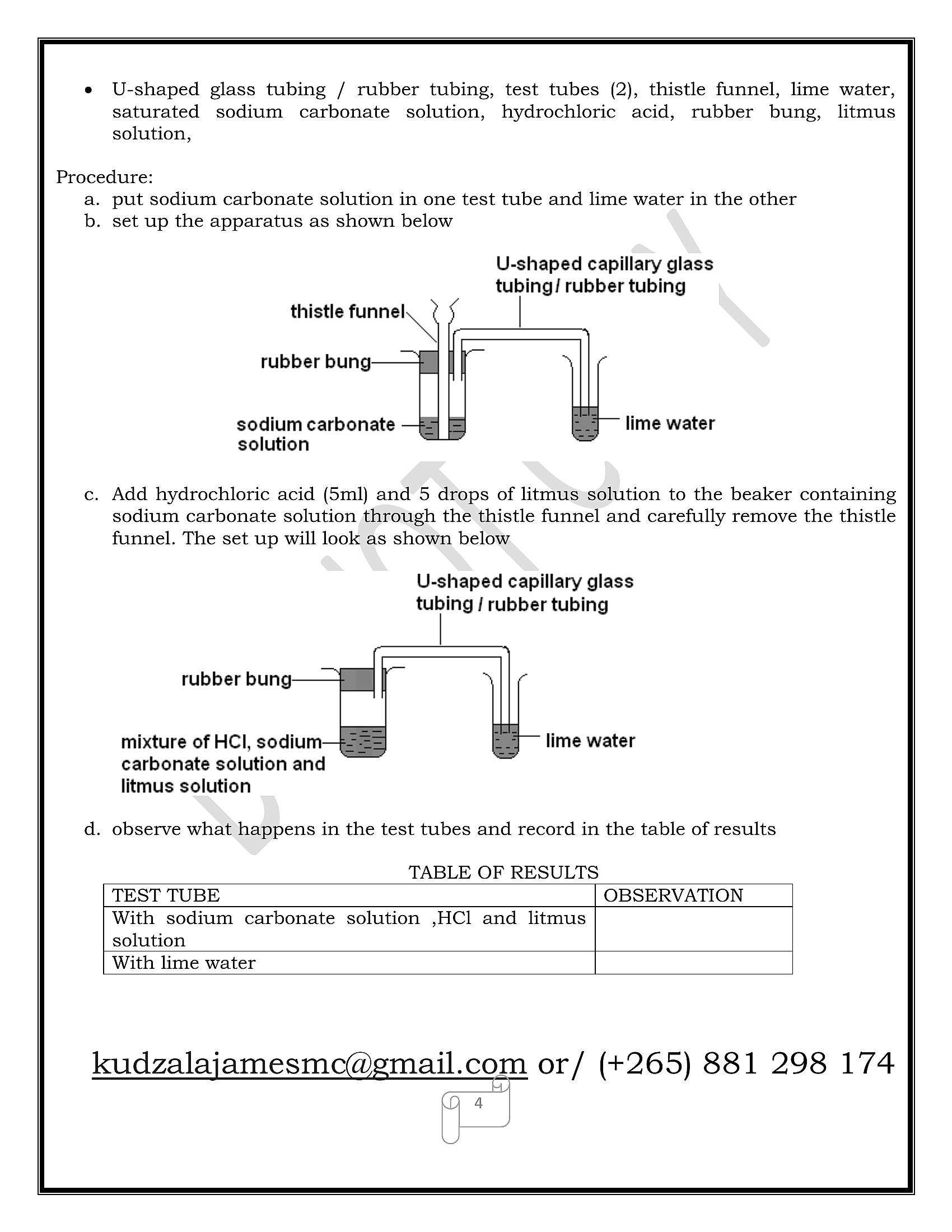
b. set up the apparatus as shown below
U-shaped capillary glass
tubing/ rubber tubing
sodium carbonate —&j lime water
solution
c. Add hydrochloric acid (5ml) and 5 drops of litmus solution to the beaker containing
sodium carbonate solution through the thistle funnel and carefully remove the thistle
funnel. The set up will look as shown below
U-shaped capillary glass
tubing / rubber tubing
mixture of HCI, sodium 7 — lime water
carbonate solution and
litmus solution
. observe what happens in the test tubes and record in the table of results
TABLE OF RESULTS
TEST TUBE OBSERVATION
With sodium carbonate solution ,HCl and litmus
solution
With lime water
kudzalajamesmc@gmail.com or/ (+265) 881 298 174
qa
---
Page 5
Extracted Text
It is expected that the mixture of sodium carbonate, hydrochloric acid and litmus solution will turn from red to colourless and the lime water will turn milky.If the mixture of sodium carbonate, hydrochloric acid and litmus solution turns from red to
colourless, it means that the acid has all reacted (there is no more acid in the reaction
vessel). On the other hand, if the lime water turns milky, it means one of the products of
the reaction is carbon dioxide. The whole process can be represented in an equation form
as follows:
2HCl(aq) + NazCOs(aq) — 2NaCl(aq) + H2O(l) + COa(g)
4. DETERMINING THE PERCENTAGE COMPOSITION OF CARBON IN SUCROSE
(COMMON SUGAR)
Materials:
e Sugar, a tin, tripod stand, wire gauze, a gas or ethanol burner, matches and balance.
Procedure:
. Weigh the empty tin and record the mass in the table below.
. With the tin still on the balance, add sugar until the mass increases by
approximately 10g.
. Record the mass of sugar in the table below.
. Heat the sugar in the tin until a dry, black solid (carbon) is formed.
. Weigh the tin + the black substance.
Heat and reweigh several times until the mass is constant.
. Record the mass of tin + carbon in the table of results.
. Calculate the mass of carbon [(mass of tin + carbon) — mass of empty tin].
Record mass of carbon in the table.
TABLE OF RESULTS
item Mass(g)
Empty tin
Tin + sugar
Sugar
Tin + carbon
Carbon
To calculate the percentage composition by mass of carbon in the sugar, the formula below
is used:
kudzalajamesmc@gmail.com or/ (+265) 881 298 174
---
Page 6
Extracted Text
wae mass of carbon from the table oy % composition of carbon = — < < x 100%mass of sugar (10g)
The number of moles of the carbon produced can be calculated using the formula below
nC = mC / MC
Where n means number of moles, m means mass and M means molar mass. The mass of
the carbon is taken from the table of results and molar of carbon is 12g/mol.
SAMPLE RESULTS
Item Mass(g)
Empty tin 30
Tin + sugar 40
Sugar 10
Tin + carbon 34.1
Carbon 4.1
mass of carbon from the table —_y 499%
% composition of carbon =
mass of sugar (10g)
= (4.1g /10g) x 100%
= 42.1%
5. PREPARING A SOLUTION FROM A STANDARD SOLUTION (250ml 2M NaOH
solution from a 3M NaOH solution)
Materials:
e Measuring cylinder (100ml), volumetric flask (250ml) with a stopper, distilled water,
standard solution (3M NaOH solution), balance.
Procedure:
a. Find the volume of the standard solution to be diluted to give the molarity required.
i.e. use the dilution formula,
Ci Vi = CaV2
Vi = CoV2/Ci
= (2M X 250ml) / 3M
167ml
b. Measure the volume of the standard solution found from the calculation (167ml)
using the measuring cylinder.
kudzalajamesmc@gmail.com or/ (+265) 881 298 174
---
Page 7
Extracted Text
d. add distilled water up to the mark i.e. ©’6. PREPARATION OF 500 CM? OF 0.2M SODIUM CHLORIDE SOLUTION FROM
SODIUM CHLORIDE CRYSTALS
Materials:
e Balance, sodium chloride crystals, beaker (20 cmS), volumetric flask (250 cm+),
distilled water.
Procedure:
a. calculate the mass of the sodium chloride which is going to be contained in 500 cm3
of 0.2M sodium chloride solution by following the steps below:
- Finding number of moles
n NaCl = c NaCl x v NaCl
= 0.2M X 0.5dm3
= 0.1mol
- Finding mass
m NaCl = n NaCl x M NaCl
= 0.1mol x 58.5gmol!
= 5.85g
b. Weigh 5.85 g of NaCl using the balance
c. Dissolve it using a little distilled water in a small beaker
d. Transfer the solution into a 500 cm$ volumetric flask i.e
e. add distilled water into the volumetric flask up to the mark i.e.
7. PREPARATION OF 250 CM? OF 1 M COPPER SULPHATE SOLUTION FROM
HYDRATED COPPER SULPHATE CRYSTALS
kudzalajamesmc@gmail.com or/ (+265) 881 298 174
---
Page 8
Extracted Text
Materials:Balance, hydrated copper sulphate crystals, beaker (20 cm), volumetric flask (250
cm), distilled water.
Procedure:
a. calculate the number of moles which is going to be contained in 250 cm’ of 1M
copper sulphate solution by following the steps below:
- find the percentage mass of CuSO, in the compound:
160/250 x 100% = 64%
- then find the mass of CuSO. needed to prepare 250 cm°, 1M solution:
n CuSO, = 1 mol/1x 0.251 = 0.25 mol
mCuSO, = Mn = 160g /mol x 0.25 mol = 40 g
- if 40g is 64% of the mass of the compound, the mass of the whole
compound will be found as follows
m CuSO4.5H20 = 100/64 x 40 g = 62.5g
. Weigh 62.5 g of CuSO4.5H20 using the balance
Dissolve it using a little distilled water in a small beaker
Transfer the solution into a 250 cm? volumetric flask i.e.
. add distilled water into the volumetric flask up to the mark i.e.
8. DETERMINING THE CONCENTRATION OF HYDROCHLORIC ACID (HCl(aq)) USING
TITRATION
Materials:
e aburette, clamp and clamp stand, measuring cylinder, conical flask, phenolphthalein
indicator, 0.1M sodium hydroxide solution (NaOH) and hydrochloric acid (HCl) of
unknown concentration.
Procedure:
a. Fill the burette to the mark with the hydrochloric acid (HCl)
b. Record the volume of HCl.
kudzalajamesmc@gmail.com or/ (+265) 881 298 174
---
Page 9
Extracted Text
c. Measure 10 ml of the 0.1 M NaOH using the measuring cylinder and transfer it into the conical flask.d. Add two drops of phenolphthalein indicator into the conical flask and set up the
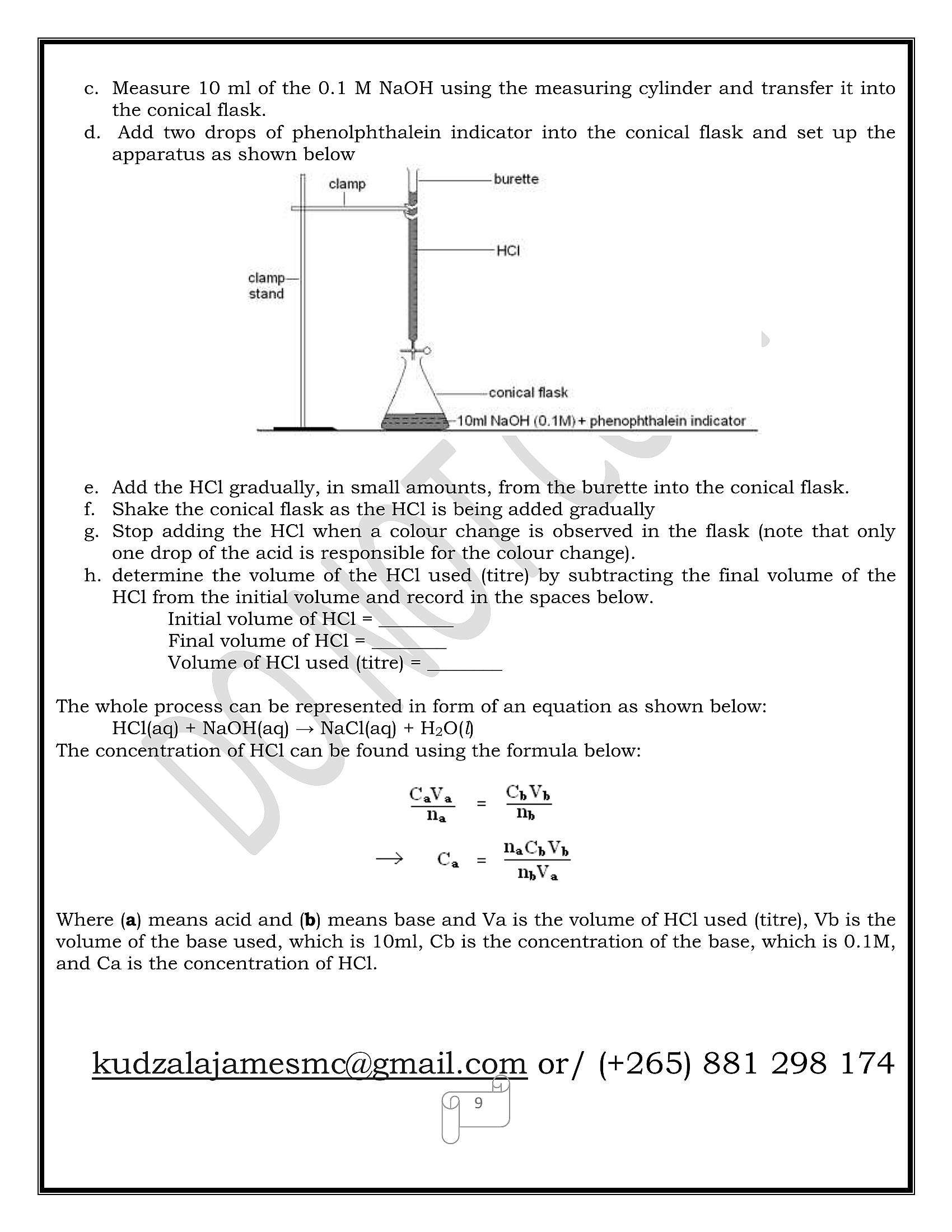
apparatus as shown below
clamp __—_—_—_—— burette
|
clamp—
stand
conical flask
10mI NaOH (0.1M)+ phenophthalein indicator
. Add the HCl gradually, in small amounts, from the burette into the conical flask.
. Shake the conical flask as the HCl is being added gradually
. Stop adding the HCl when a colour change is observed in the flask (note that only
one drop of the acid is responsible for the colour change).
. determine the volume of the HCl used (titre) by subtracting the final volume of the
HCl from the initial volume and record in the spaces below.
Initial volume of HCl =
Final volume of HCl =
Volume of HCl used (titre) =
The whole process can be represented in form of an equation as shown below:
HCl(aq) + NaOH(aq) — NaCl(aq) + H20())
The concentration of HCl can be found using the formula below:
CaVa _ ChoVn
Na Np
NaC, V b
> Ca -
nmpVa
Where (a) means acid and (b) means base and Va is the volume of HCl used (titre), Vb is the
volume of the base used, which is 10ml, Cb is the concentration of the base, which is 0.1M,
and Ca is the concentration of HCl.
kudzalajamesmc@gmail.com or/ (+265) 881 298 174
| 9
---
Page 10
Extracted Text
na = land nb =1(coeffients of HCl and NaOH in the balanced equation above respectively)9. DETERMINING THE CONCENTRATION OF SODIUM HYDROXIDE (NaOH(aq)) USING
TITRATION
Materials:
e aburette, clamp and clamp stand, measuring cylinder, conical flask, phenolphthalein
indicator, sodium hydroxide solution (NaOH) of unknown concentration and 0.2M
hydrochloric acid (HC).
Procedure:
. Fill the burette to the mark with the sodium hydroxide (NaOH)
. Record the volume of the NaOH in the table of results.
. Measure 10 ml of the 0.2 HCl using the measuring cylinder and transfer it into the
conical flask.
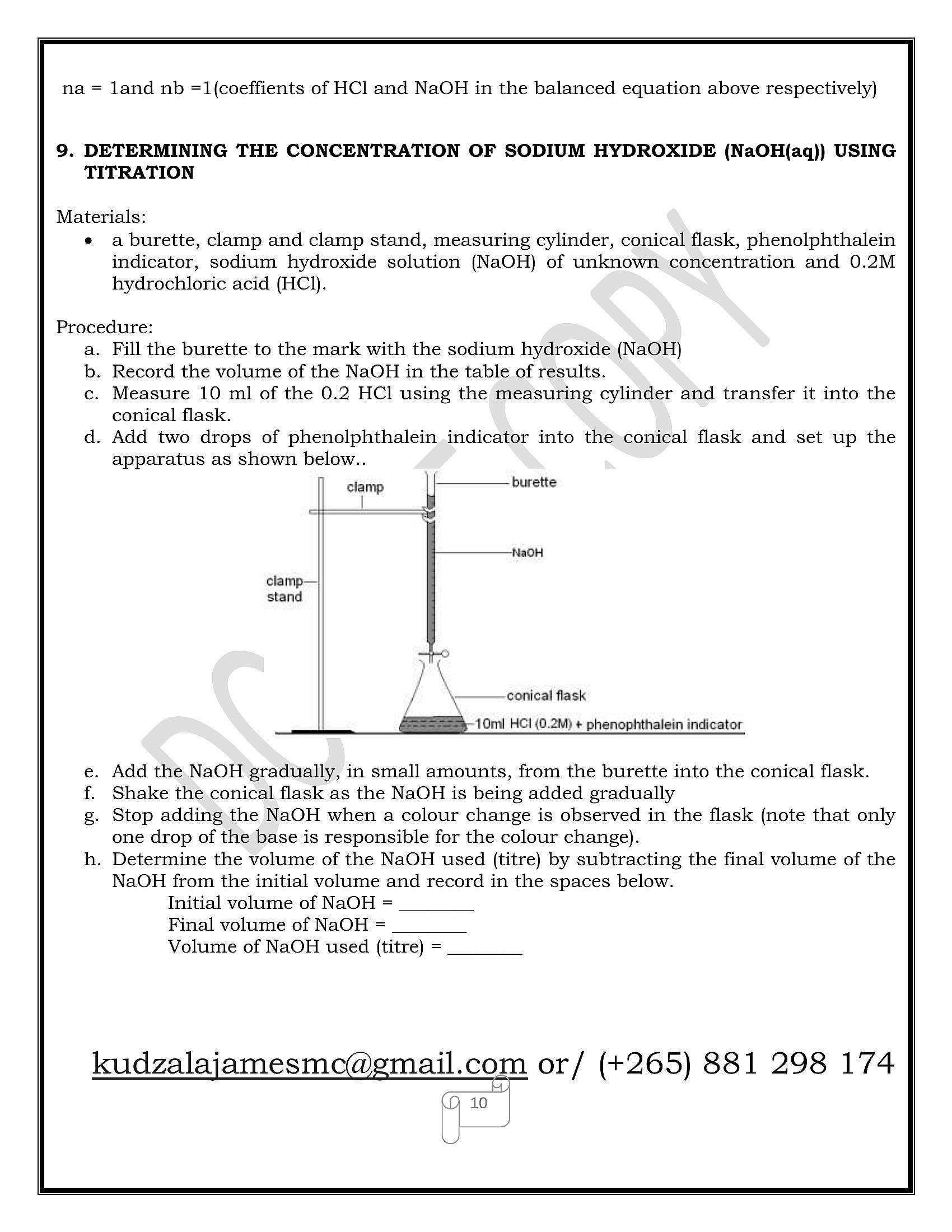
. Add two drops of phenolphthalein indicator into the conical flask and set up the
apparatus as shown below..
clamp burette
clamp—
stand
conical flask
10m! HCI (0.2M) + phenophthalein indicator
. Add the NaOH gradually, in small amounts, from the burette into the conical flask.
. Shake the conical flask as the NaOH is being added gradually
. Stop adding the NaOH when a colour change is observed in the flask (note that only
one drop of the base is responsible for the colour change).
. Determine the volume of the NaOH used (titre) by subtracting the final volume of the
NaOH from the initial volume and record in the spaces below.
Initial volume of NaOH =
Final volume of NaOH =
Volume of NaOH used (titre) =
kudzalajamesmc@gmail.com or/ (+265) 881 298 174
4 10 |
---
Page 11
Extracted Text
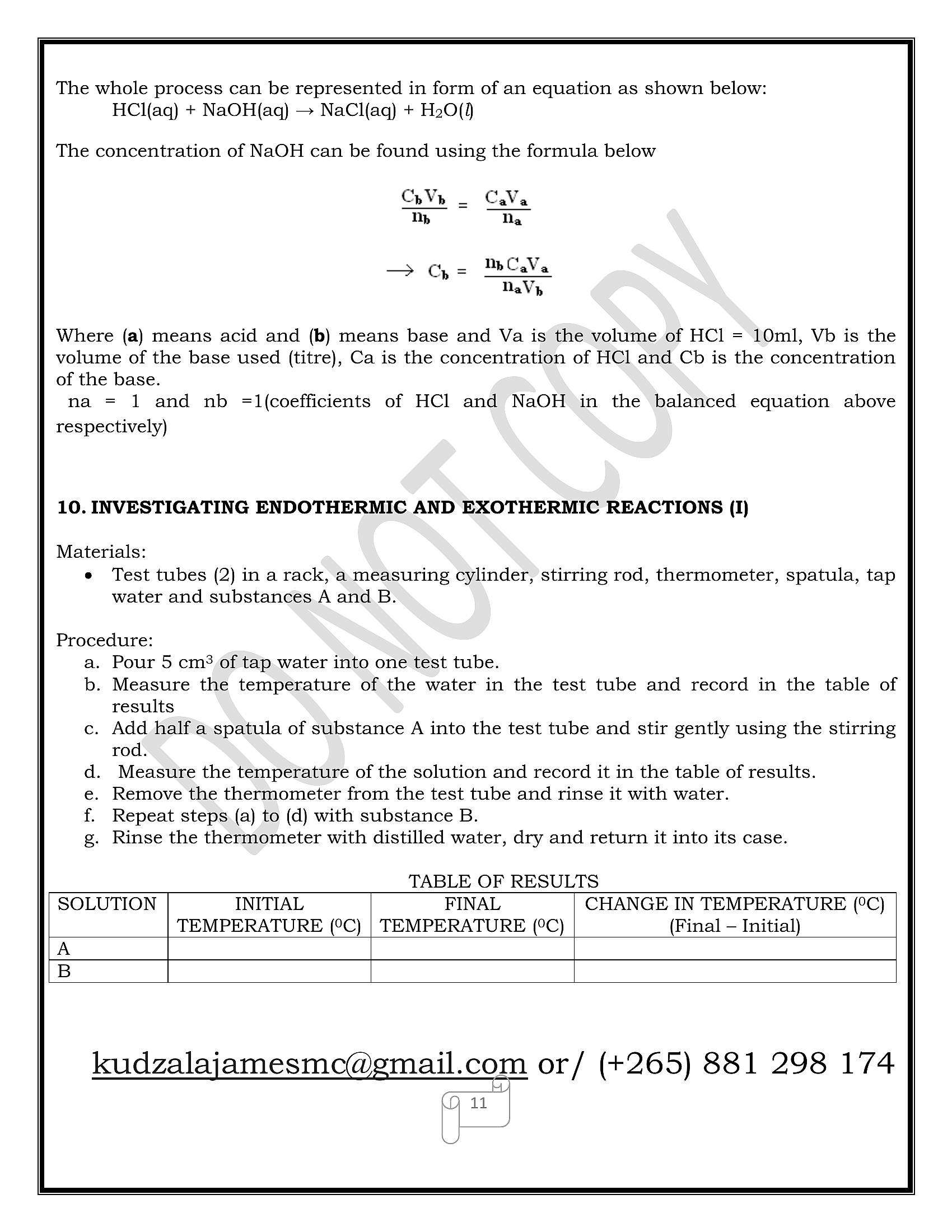
The whole process can be represented in form of an equation as shown below: HCl(aq) + NaOH(aq) > NaCl(aq) + H20(J)The concentration of NaOH can be found using the formula below
ChVn _ CaVa
Na
Np CaVa
NaVp,
Where (a) means acid and (b) means base and Va is the volume of HCl = 10ml, Vb is the
volume of the base used (titre), Ca is the concentration of HCl and Cb is the concentration
of the base.
= 1 and nb =l(coefficients of HCl and NaOH in the balanced equation above
respectively)
10. INVESTIGATING ENDOTHERMIC AND EXOTHERMIC REACTIONS (I)
Materials:
e Test tubes (2) in a rack, a measuring cylinder, stirring rod, thermometer, spatula, tap
water and substances A and B.
Procedure:
a. Pour 5 cm$ of tap water into one test tube.
b. Measure the temperature of the water in the test tube and record in the table of
results
. Add half a spatula of substance A into the test tube and stir gently using the stirring
rod.
Measure the temperature of the solution and record it in the table of results.
. Remove the thermometer from the test tube and rinse it with water.
Repeat steps (a) to (d) with substance B.
. Rinse the thermometer with distilled water, dry and return it into its case.
TABLE OF RESULTS
SOLUTION INITIAL FINAL CHANGE IN TEMPERATURE (°C)
TEMPERATURE (°C) | TEMPERATURE (°C) (Final — Initial)
A
B
kudzalajamesmc@gmail.com or/ (+265) 881 298 174
---
Page 12
Extracted Text
If the final temperature reached exceeds the initial temperature i.e. if the change in temperature is positive, then the reaction is exothermic (this means heat is released into the surroundings). On the other hand, if the final temperature reached is less than the initial temperature i.e. if the change in temperature is negative, then the reaction is endothermic (this means heat is absorbed from the surroundings).For the exothermic reaction, the change in heat energy is said to be negative because there
is loss of heat energy to the surroundings (-AH). For the endothermic reaction, the change
in heat energy is said to be positive because there is gain of heat energy from the
surroundings (+AH).
Note: Be careful when interpreting change in temperature and change in heat energy.
Positive change in temperature (+AT) means negative change in heat energy (-AH) and
negative change in temperature (-AT) means positive change in heat energy (+AH).
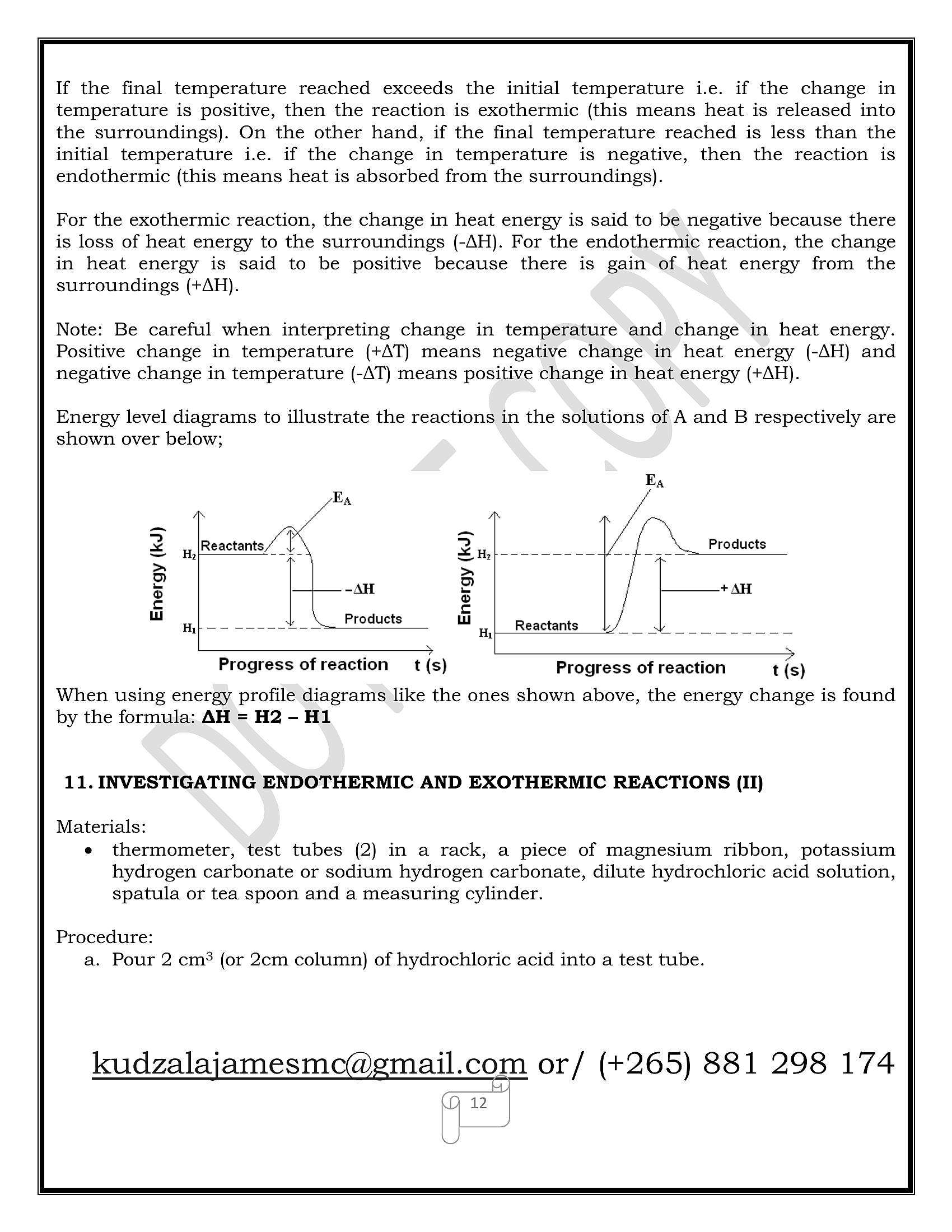
Energy level diagrams to illustrate the reactions in the solutions of A and B respectively are
shown over below;
Es
Products
=x
fy
+ AH
Energy (kJ)
Energy (kJ)
Products Reactants
m
o
Progress ofreaction — t (s) Progress of reaction t (s)
When using energy profile diagrams like the ones shown above, the energy change is found
by the formula: AH = H2 - H1
11. INVESTIGATING ENDOTHERMIC AND EXOTHERMIC REACTIONS (II)
Materials:
e thermometer, test tubes (2) in a rack, a piece of magnesium ribbon, potassium
hydrogen carbonate or sodium hydrogen carbonate, dilute hydrochloric acid solution,
spatula or tea spoon and a measuring cylinder.
Procedure:
a. Pour 2 cm$ (or 2cm column) of hydrochloric acid into a test tube.
kudzalajamesmc@gmail.com or/ (+265) 881 298 174
Mo |
---
Page 13
Extracted Text
. Measure the temperature of the acid and record it as initial temperature in the table of results.. Drop the magnesium ribbon in the acid and record the changes taking place as the
reaction occurs.
. Record the final temperature reached in the table of results.
. In the second test tube, pour 2 cm3 (or 2cm column) of hydrochloric acid and records
temperature as its initial temperature in the table of results.
Add '% spatulas full of potassium hydrogen carbonate or sodium hydrogen carbonate
to the acid and record the changes taking place as the reaction occurs.
. Record the final temperature reached in the table of results.
TABLE OF RESULTS
Liquid in the | Initial Substance Final temp. Temp. Other changes
tube temp. added reached during | change | observed during
reaction reaction
Hydrochloric Magnesium
acid ribbon
Hydrochloric Potassium
acid hydrogen
carbonate
or sodium
hydrogen
carbonate
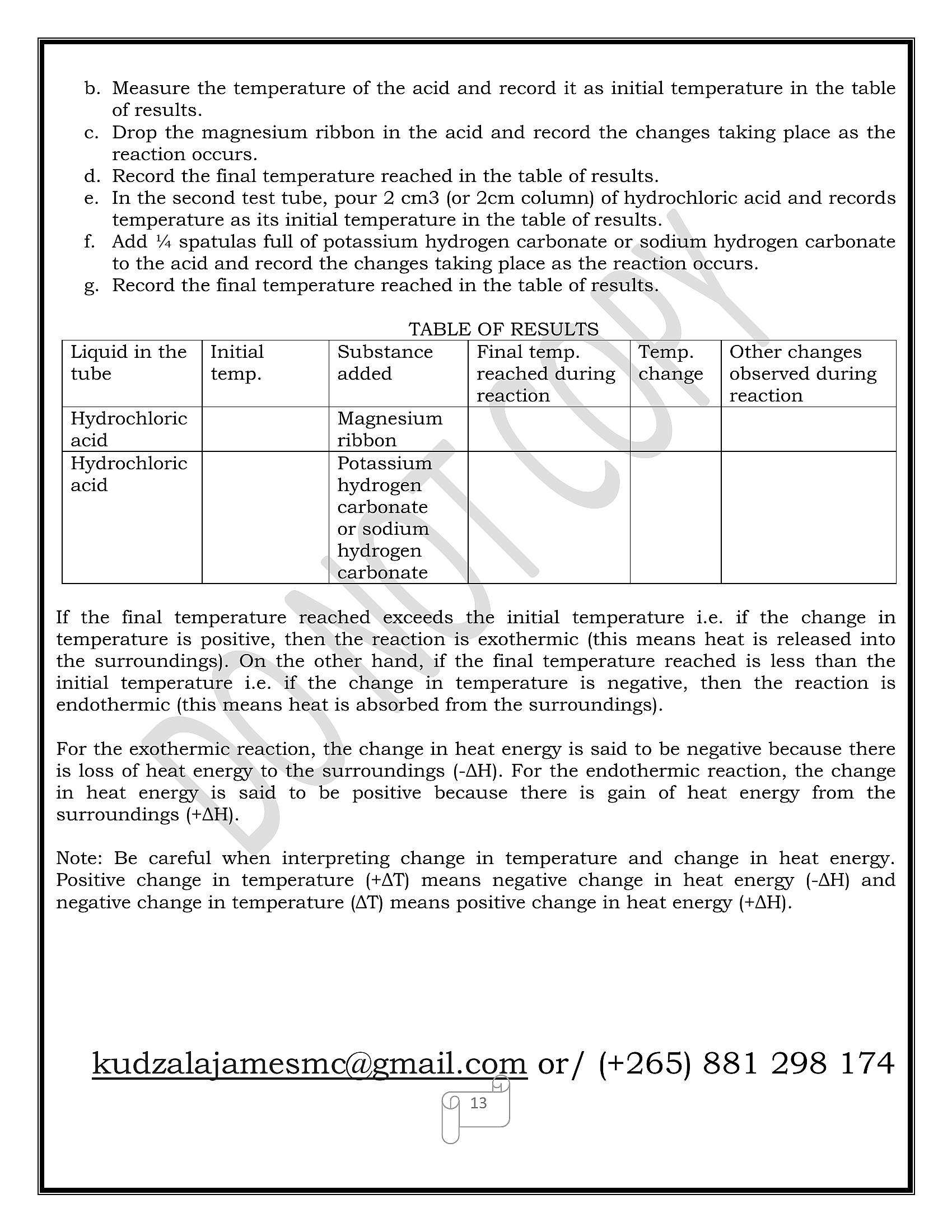
If the final temperature reached exceeds the initial temperature i.e. if the change in
temperature is positive, then the reaction is exothermic (this means heat is released into
the surroundings). On the other hand, if the final temperature reached is less than the
initial temperature i.e. if the change in temperature is negative, then the reaction is
endothermic (this means heat is absorbed from the surroundings).
For the exothermic reaction, the change in heat energy is said to be negative because there
is loss of heat energy to the surroundings (-AH). For the endothermic reaction, the change
in heat energy is said to be positive because there is gain of heat energy from the
surroundings (+AH).
Note: Be careful when interpreting change in temperature and change in heat energy.
Positive change in temperature (+AT) means negative change in heat energy (-AH) and
negative change in temperature (AT) means positive change in heat energy (+AH).
kudzalajamesmc@gmail.com or/ (+265) 881 298 174
---
Page 14
Extracted Text
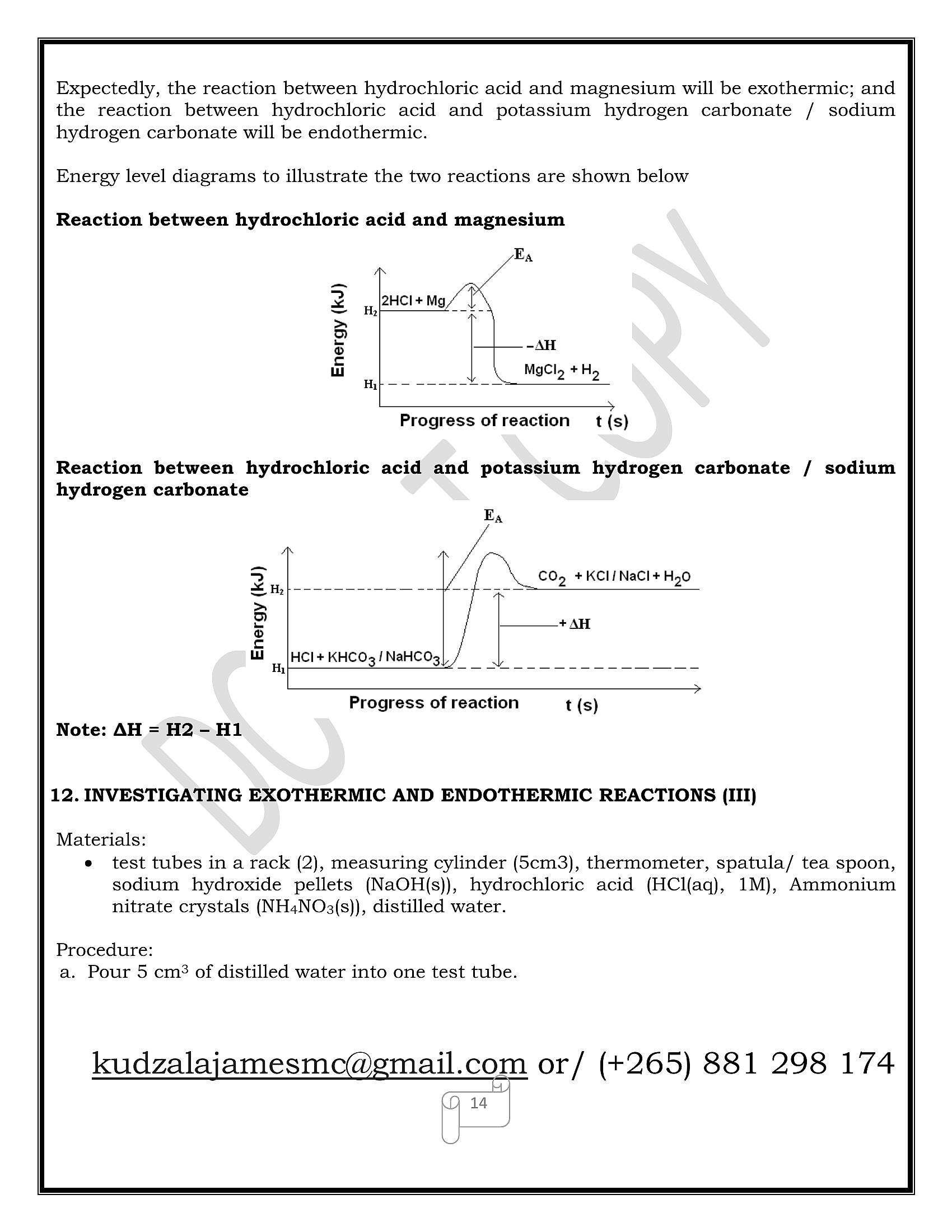
Expectedly, the reaction between hydrochloric acid and magnesium will be exothermic; and the reaction between hydrochloric acid and potassium hydrogen carbonate / sodium hydrogen carbonate will be endothermic.Energy level diagrams to illustrate the two reactions are shown below
Reaction between hydrochloric acid and magnesium
Energy (kJ)
MgCly +H,
Progress ofreaction _ t (s)
Reaction between hydrochloric acid and potassium hydrogen carbonate / sodium
hydrogen carbonate
COp +KCI/NaCl+H,0
B
Energy (kJ)
Progress of reaction t (s)
Note: AH = H2-H1
12. INVESTIGATING EXOTHERMIC AND ENDOTHERMIC REACTIONS (III)
Materials:
e test tubes in a rack (2), measuring cylinder (5cm3), thermometer, spatula/ tea spoon,
sodium hydroxide pellets (NaOH(s)), hydrochloric acid (HCl(aq), 1M), Ammonium
nitrate crystals (NH4NOsa(s)), distilled water.
Procedure:
a. Pour 5 cm of distilled water into one test tube.
kudzalajamesmc@gmail.com or/ (+265) 881 298 174
---
Page 15
Extracted Text
. Measure the temperature of the water in the test tube and record in the table of results. Add half spatula full/quarter teaspoon (about 1g) of ammonium nitrate, NH4NOs,
crystals and stir gently using the thermometer.
. Measure the temperature of the solution and record in the table of results
. Remove the thermometer from the test tube and rinse it with distilled water.
Pour 5cm$ of the hydrochloric acid into the second test tube.
. Measure the temperature of the hydrochloric acid in the test tube and record in the
table of results.
. Add one sodium hydroxide pellet into the test tube with HCl and stir gently with the
thermometer.
i. Measure and record the temperature of the solution and record it in the table of results.
TABLE OF RESULTS
SOLUTION INITIAL TEMP. | FINAL TEMP. CHANGE IN TEMP.
(Final — Initial)
Ammonium nitrate
+ water
Sodium Hydroxide
+ hydrochloric acid
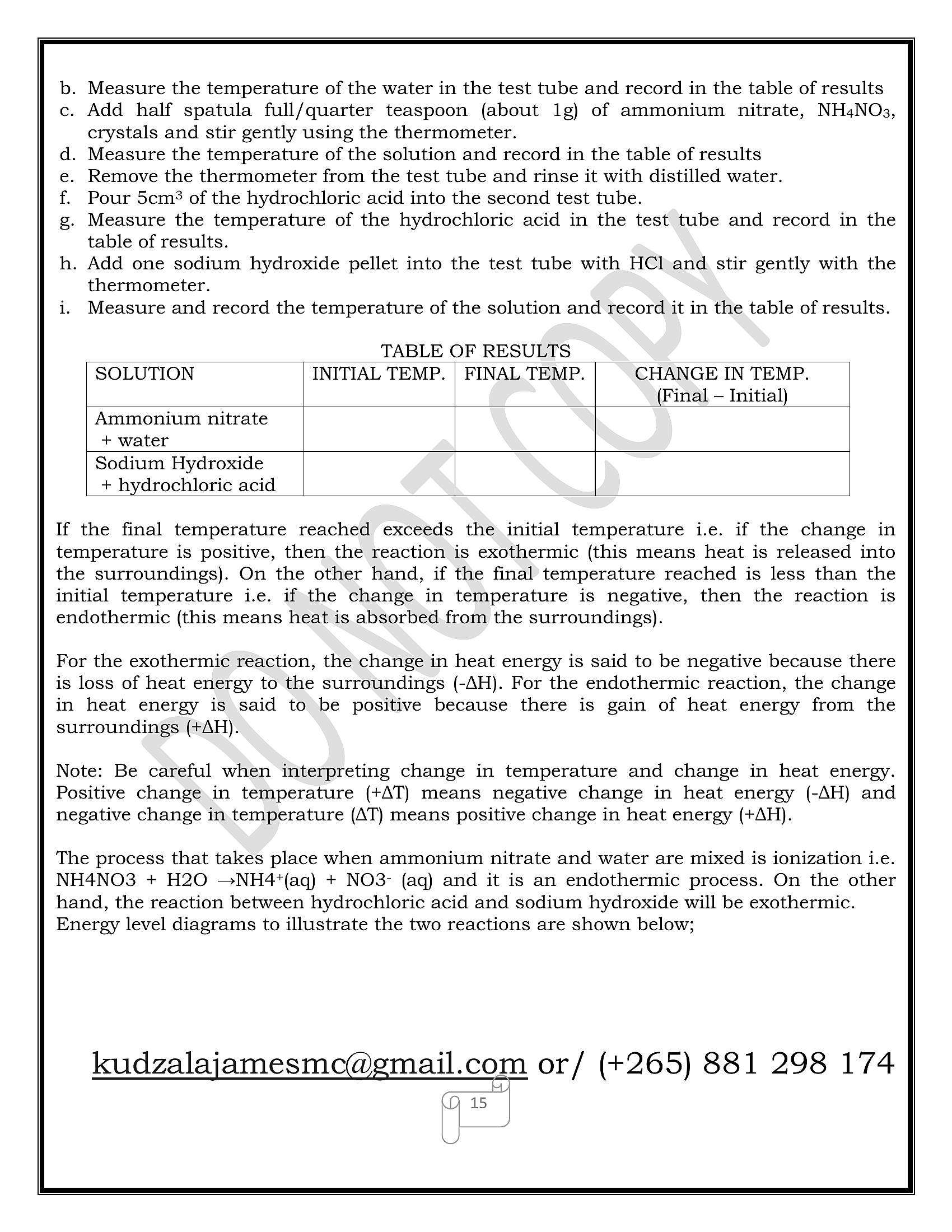
If the final temperature reached exceeds the initial temperature i.e. if the change in
temperature is positive, then the reaction is exothermic (this means heat is released into
the surroundings). On the other hand, if the final temperature reached is less than the
initial temperature i.e. if the change in temperature is negative, then the reaction is
endothermic (this means heat is absorbed from the surroundings).
For the exothermic reaction, the change in heat energy is said to be negative because there
is loss of heat energy to the surroundings (-AH). For the endothermic reaction, the change
in heat energy is said to be positive because there is gain of heat energy from the
surroundings (+AH).
Note: Be careful when interpreting change in temperature and change in heat energy.
Positive change in temperature (+AT) means negative change in heat energy (-AH) and
negative change in temperature (AT) means positive change in heat energy (+AH).
The process that takes place when ammonium nitrate and water are mixed is ionization i.e.
NH4NO3 + H20 —NH4*(aq) + NO3- (aq) and it is an endothermic process. On the other
hand, the reaction between hydrochloric acid and sodium hydroxide will be exothermic.
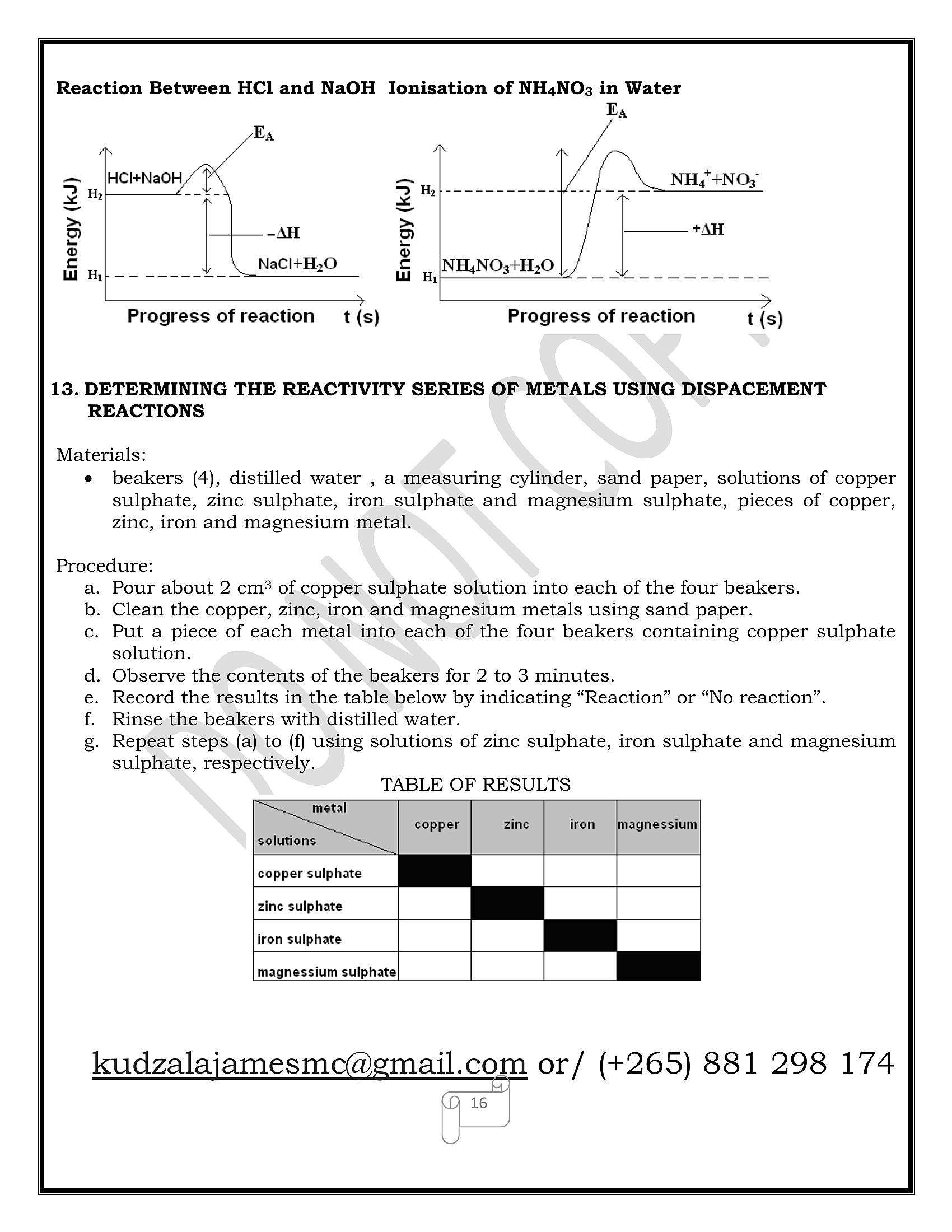
Energy level diagrams to illustrate the two reactions are shown below;
kudzalajamesmc@gmail.com or/ (+265) 881 298 174
---
Page 16
Extracted Text
Reaction Between HCl and NaOH Ionisation of NH.NO3 in Water Eg,Energy (kJ)
Energy (kJ)
=z
=z
NaCl+H,0 NH,NO,;+H,0
Progress ofreaction — t (s) Progress of reaction t (s)
13. DETERMINING THE REACTIVITY SERIES OF METALS USING DISPACEMENT
REACTIONS
Materials:
e beakers (4), distilled water , a measuring cylinder, sand paper, solutions of copper
sulphate, zinc sulphate, iron sulphate and magnesium sulphate, pieces of copper,
zinc, iron and magnesium metal.
Procedure:
. Pour about 2 cm’ of copper sulphate solution into each of the four beakers.
. Clean the copper, zinc, iron and magnesium metals using sand paper.
. Put a piece of each metal into each of the four beakers containing copper sulphate
solution.
. Observe the contents of the beakers for 2 to 3 minutes.
. Record the results in the table below by indicating “Reaction” or “No reaction”.
Rinse the beakers with distilled water.
. Repeat steps (a) to (f) using solutions of zinc sulphate, iron sulphate and magnesium
sulphate, respectively.
TABLE OF RESULTS
copper zine iron |magnessium
solutions
copper sulphate
zine sulphate
iron sulphate
magnessium sulphate
kudzalajamesmc@gmail.com or/ (+265) 881 298 174
---
Page 17
Extracted Text
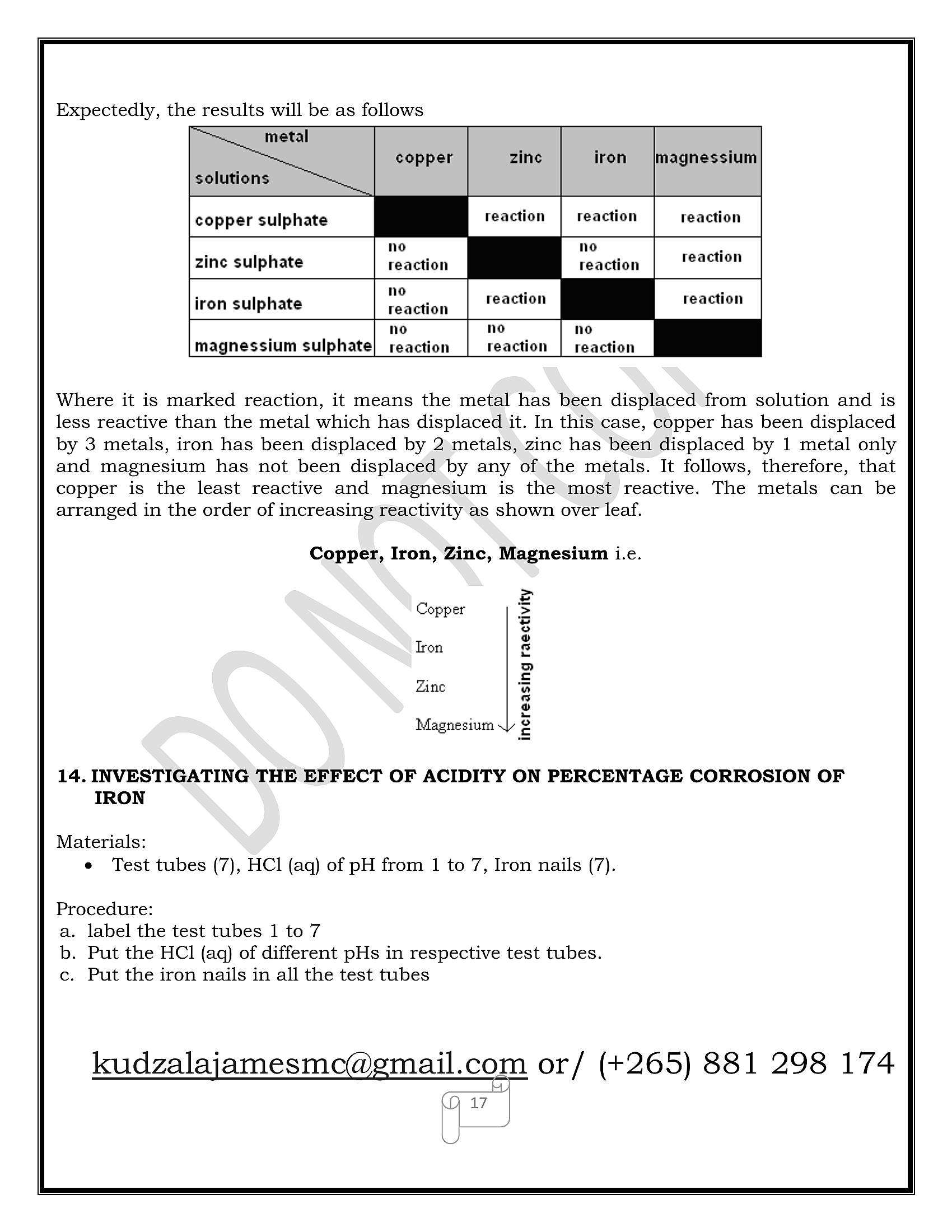
Expectedly, the results will be as followscopper zine iron |magnessium
solutions
copper sulphate reaction reaction reaction
ho no .
zine sulphate reaction reaction reaction
no . .
no no no
magnessium sulphate] reaction reaction | reaction
Where it is marked reaction, it means the metal has been displaced from solution and is
less reactive than the metal which has displaced it. In this case, copper has been displaced
by 3 metals, iron has been displaced by 2 metals, zinc has been displaced by 1 metal only
and magnesium has not been displaced by any of the metals. It follows, therefore, that
copper is the least reactive and magnesium is the most reactive. The metals can be
arranged in the order of increasing reactivity as shown over leaf.
Copper, Iron, Zinc, Magnesium i.e.
Copper
Tron
Zine
£
>
J
°
o
S
ph
D
£
a
o
ao
Pl
°
£
Magnesium
14. INVESTIGATING THE EFFECT OF ACIDITY ON PERCENTAGE CORROSION OF
IRON
Materials:
e Test tubes (7), HCl (aq) of pH from 1 to 7, Iron nails (7).
Procedure:
a. label the test tubes 1 to 7
b. Put the HCl (aq) of different pHs in respective test tubes.
c. Put the iron nails in all the test tubes
kudzalajamesmc@gmail.com or/ (+265) 881 298 174
| *7 |
---
Page 18
Extracted Text
d. Leave the test tubes at a safe place for a week.e. Observe the degree of corrosion / rusting of the iron nails and arrange the test tubes in
order of decreasing corrosion of the iron nail.
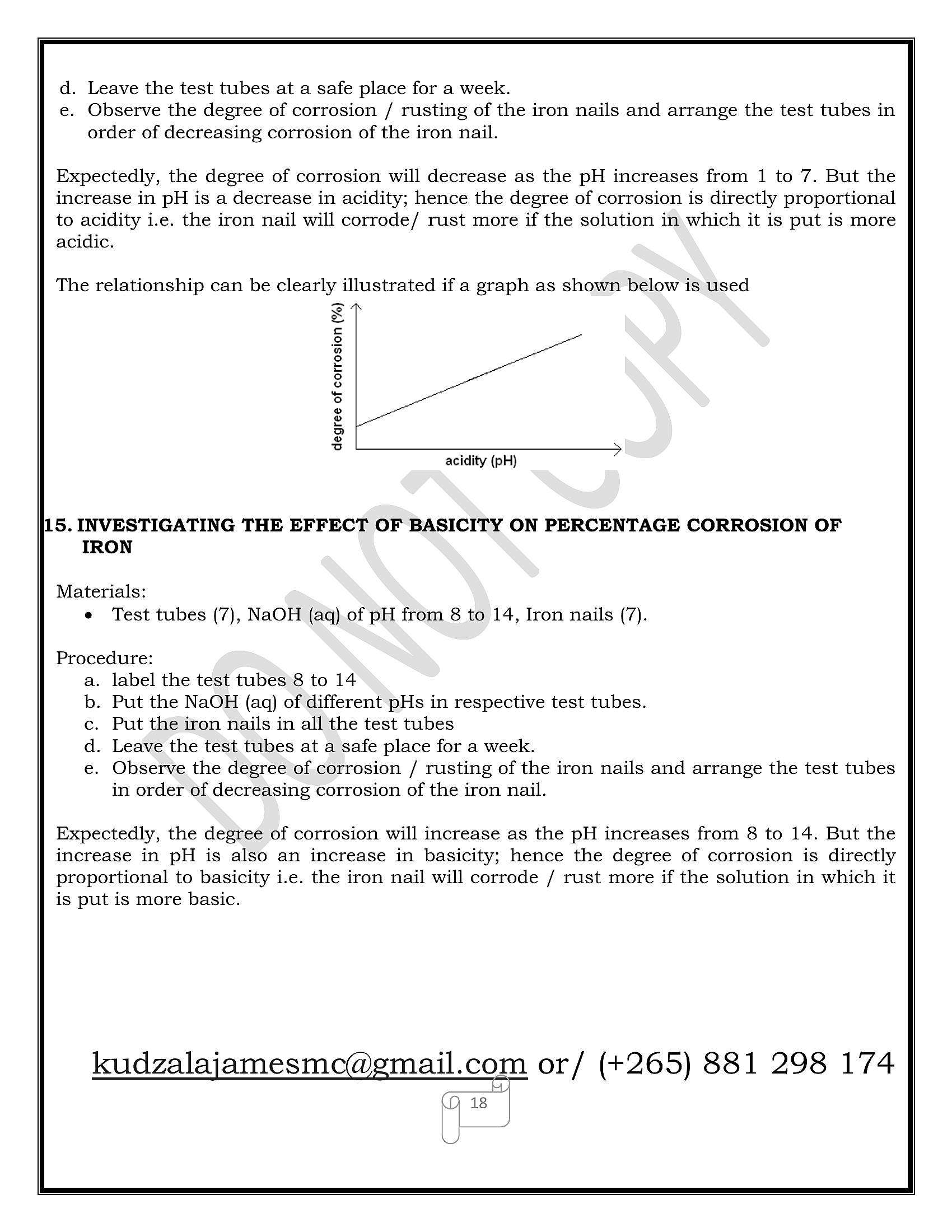
Expectedly, the degree of corrosion will decrease as the pH increases from 1 to 7. But the
increase in pH is a decrease in acidity; hence the degree of corrosion is directly proportional
to acidity i.e. the iron nail will corrode/ rust more if the solution in which it is put is more
acidic.
The relationship can be clearly illustrated if a graph as shown below is used
degree of corrosion (%)
acidity (pH)
15. INVESTIGATING THE EFFECT OF BASICITY ON PERCENTAGE CORROSION OF
IRON
Materials:
e Test tubes (7), NaOH (aq) of pH from 8 to 14, Iron nails (7).
Procedure:
. label the test tubes 8 to 14
. Put the NaOH (aq) of different pHs in respective test tubes.
. Put the iron nails in all the test tubes
. Leave the test tubes at a safe place for a week.
. Observe the degree of corrosion / rusting of the iron nails and arrange the test tubes
in order of decreasing corrosion of the iron nail.
Expectedly, the degree of corrosion will increase as the pH increases from 8 to 14. But the
increase in pH is also an increase in basicity; hence the degree of corrosion is directly
proportional to basicity i.e. the iron nail will corrode / rust more if the solution in which it
is put is more basic.
kudzalajamesmc@gmail.com or/ (+265) 881 298 174
---
Page 19
Extracted Text
The relationship can be clearly illustrated if a graph as shown below is useddegree of corrosion (%)
basicity (pH)
16. INVESTIGATING THE CONDITIONS OF RUSTING
Materials:
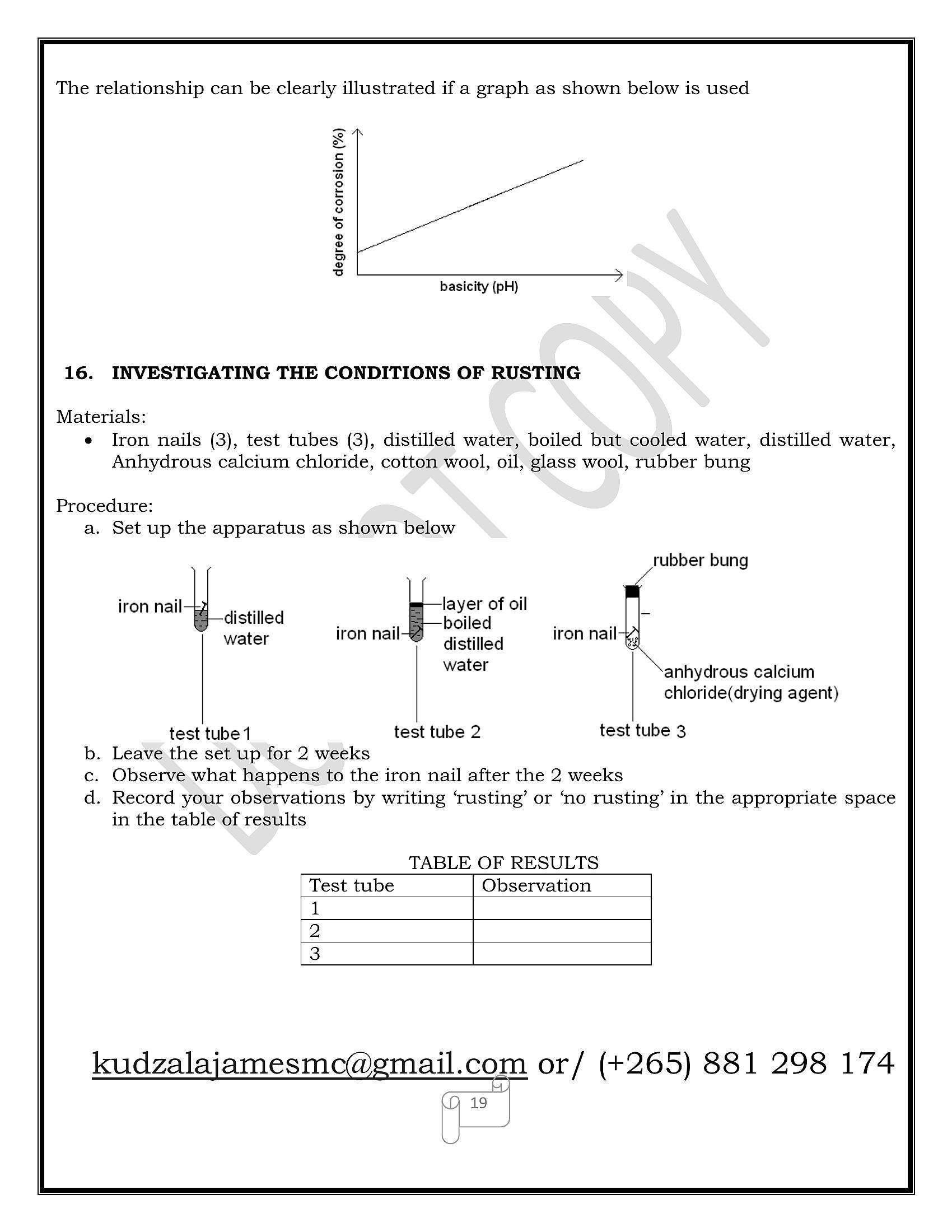
e Iron nails (3), test tubes (3), distilled water, boiled but cooled water, distilled water,
Anhydrous calcium chloride, cotton wool, oil, glass wool, rubber bung
Procedure:
a. Set up the apparatus as shown below
rubber bung
iron nail — layer of oil
distilled ; pe . ; iL
water iron nail distilled iron nail-y
water
anhydrous calcium
chloride(drying agent)
test tube 1 test tube 2 test tube 3
. Leave the set up for 2 weeks
. Observe what happens to the iron nail after the 2 weeks
. Record your observations by writing ‘rusting’ or ‘no rusting’ in the appropriate space
in the table of results
TABLE OF RESULTS
Test tube Observation
1
2
3
kudzalajamesmc@gmail.com or/ (+265) 881 298 174
Mo |
---
Page 20
Extracted Text
The test tube in which there is rusting consists of the necessary conditions of rusting.Expectedly, there will be rusting in test tube 1 and no rusting in test tubes 2 and 3. In test
tube 1, there is both oxygen (from the air) and water but in test tube 2, there is no oxygen
and in test tube 3, there is no water.
Hence the necessary conditions for rusting are oxygen and water.
17. INVESTIGATING THE FACTORS THAT AFFECT RUSTING
Materials:
e Test tubes (4), Iron nails (4), dilute sodium hydroxide, dilute hydrochloric acid, dilute
sodium chloride solution and water.
Procedure:
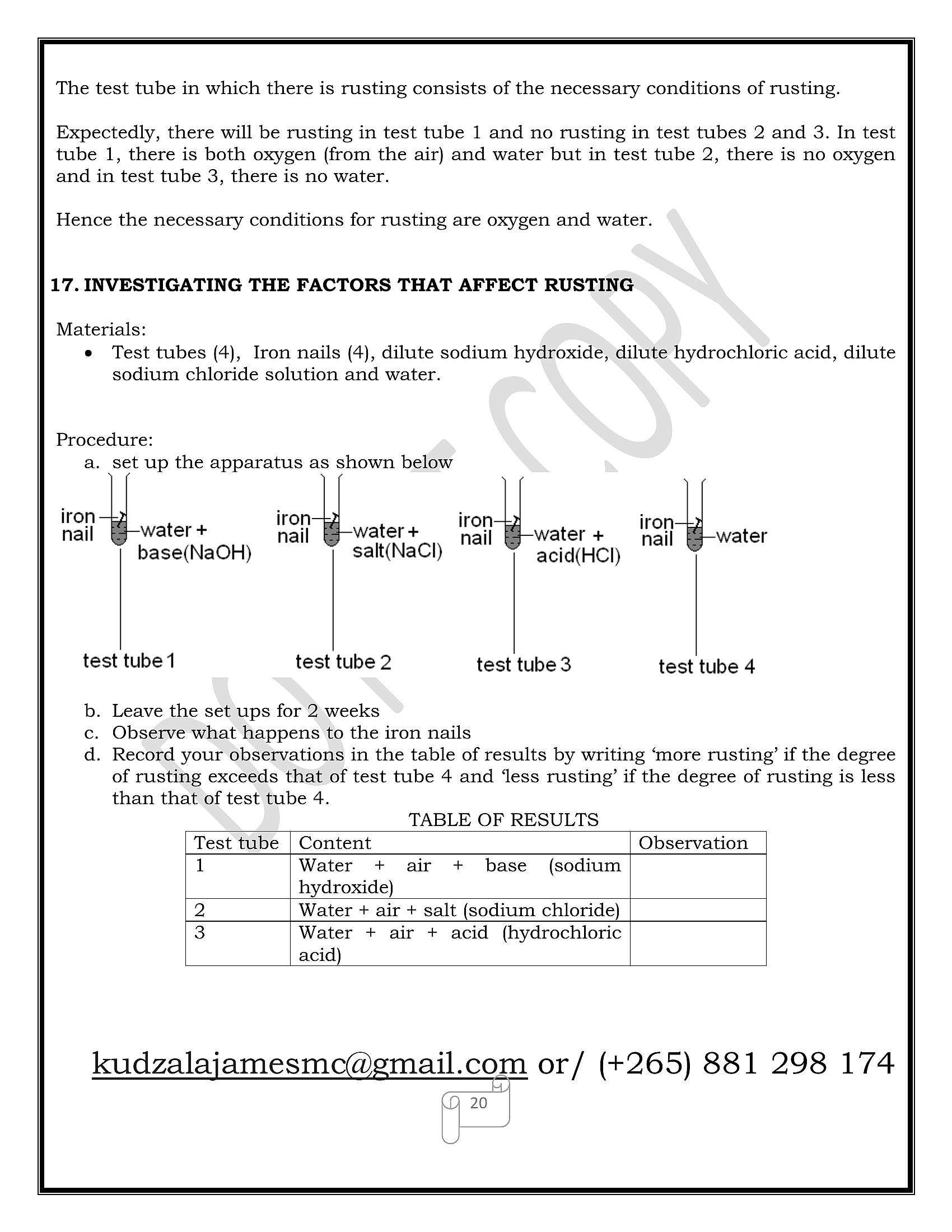
a. set up the apparatus as shown below
iron iron iron
nail water + nail water + nail water +
iron
base(NaOH) salt(NaCl) acid(HCl) nail
water
test tube 1 test tube 2 test tube 3 test tube 4
. Leave the set ups for 2 weeks
. Observe what happens to the iron nails
. Record your observations in the table of results by writing ‘more rusting’ if the degree
of rusting exceeds that of test tube 4 and ‘less rusting’ if the degree of rusting is less
than that of test tube 4.
TABLE OF RESULTS
Test tube | Content Observation
1 Water + air + base (sodium
hydroxide)
2 Water + air + salt (sodium chloride)
3 Water + air + acid (hydrochloric
acid)
kudzalajamesmc@gmail.com or/ (+265) 881 298 174
Mo |
---
Page 21
Extracted Text
In test tube 1, there will be normal rusting. If there is more or less rusting in the other test tubes, it means the additional substances in the test tubes i.e. acid, base and salt affect rusting.Expectedly, there will be more rusting in the other test tubes; hence acids, bases and salts
affect rusting
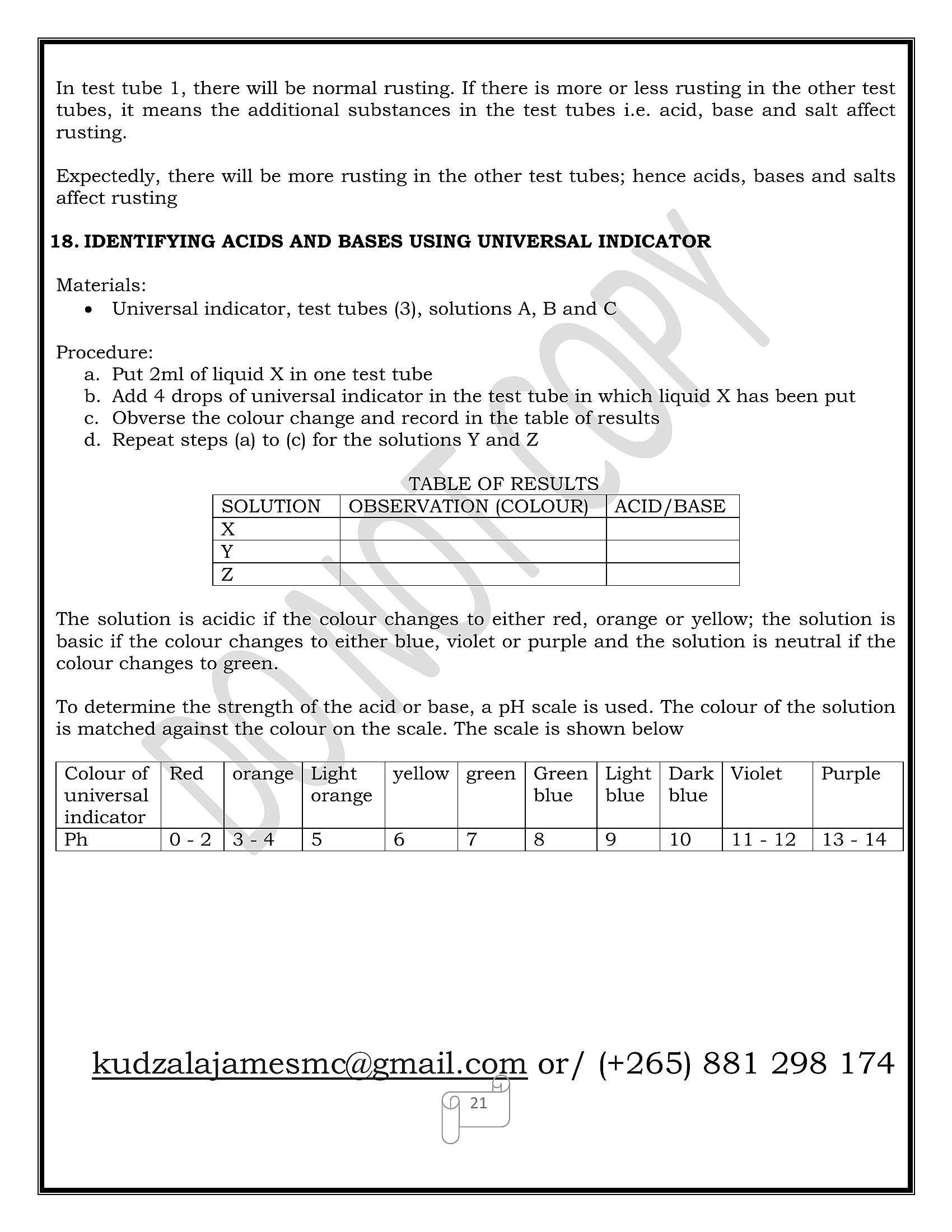
18. IDENTIFYING ACIDS AND BASES USING UNIVERSAL INDICATOR
Materials:
e Universal indicator, test tubes (3), solutions A, B and C
Procedure:
. Put 2ml of liquid X in one test tube
. Add 4 drops of universal indicator in the test tube in which liquid X has been put
. Obverse the colour change and record in the table of results
. Repeat steps (a) to (c) for the solutions Y and Z
TABLE OF RESULTS
SOLUTION | OBSERVATION (COLOUR) | ACID/BASE
x
Y
Z
The solution is acidic if the colour changes to either red, orange or yellow; the solution is
basic if the colour changes to either blue, violet or purple and the solution is neutral if the
colour changes to green.
To determine the strength of the acid or base, a pH scale is used. The colour of the solution
is matched against the colour on the scale. The scale is shown below
Colour of | Red | orange | Light yellow | green | Green | Light | Dark | Violet Purple
universal orange blue | blue | blue
indicator
Ph 0-2|3-4 5 8 9 10 11-12 | 13-14
kudzalajamesmc@gmail.com or/ (+265) 881 298 174
---
Page 22
Extracted Text
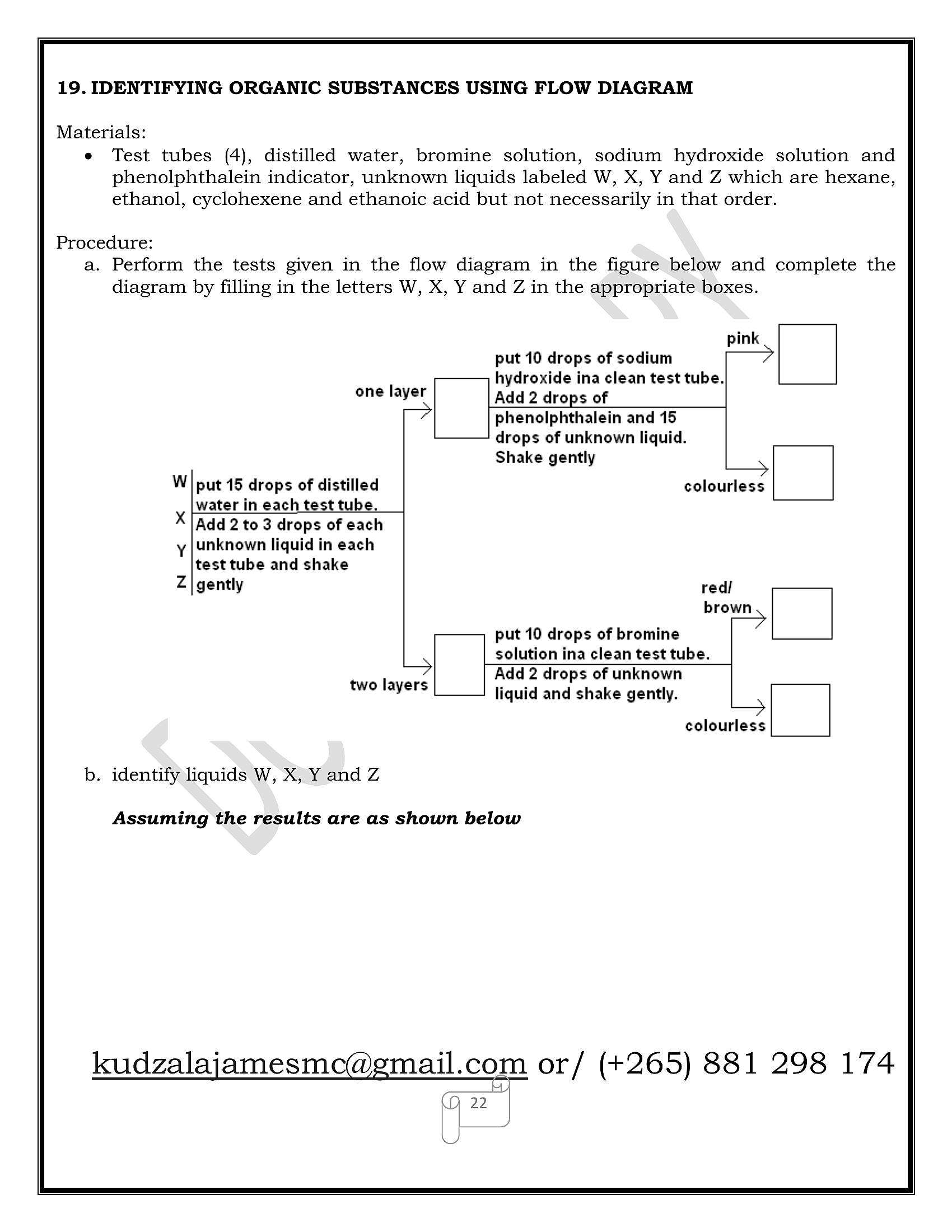
19. IDENTIFYING ORGANIC SUBSTANCES USING FLOW DIAGRAMMaterials:
e Test tubes (4), distilled water, bromine solution, sodium hydroxide solution and
phenolphthalein indicator, unknown liquids labeled W, X, Y and Z which are hexane,
ethanol, cyclohexene and ethanoic acid but not necessarily in that order.
Procedure:
a. Perform the tests given in the flow diagram in the figure below and complete the
diagram by filling in the letters W, X, Y and Z in the appropriate boxes.
pink.
put 10 drops of sodium
hydroxide ina clean test tube.
one layer Add 2 drops of
ea phenolphthalein and 15
drops of unknown liquid.
Shake gently :
put 15 drops of distilled colourless
water in each test tube.
Add 2 to 3 drops of each
unknown liquid in each
test tube and shake
gently red/
brown
put 10 drops of bromine r 7
solution ina clean test tube.
two layers Add 2 drops of unknown
liquid and shake gently.
Ls
colourless
b. identify liquids W, X, Y and Z
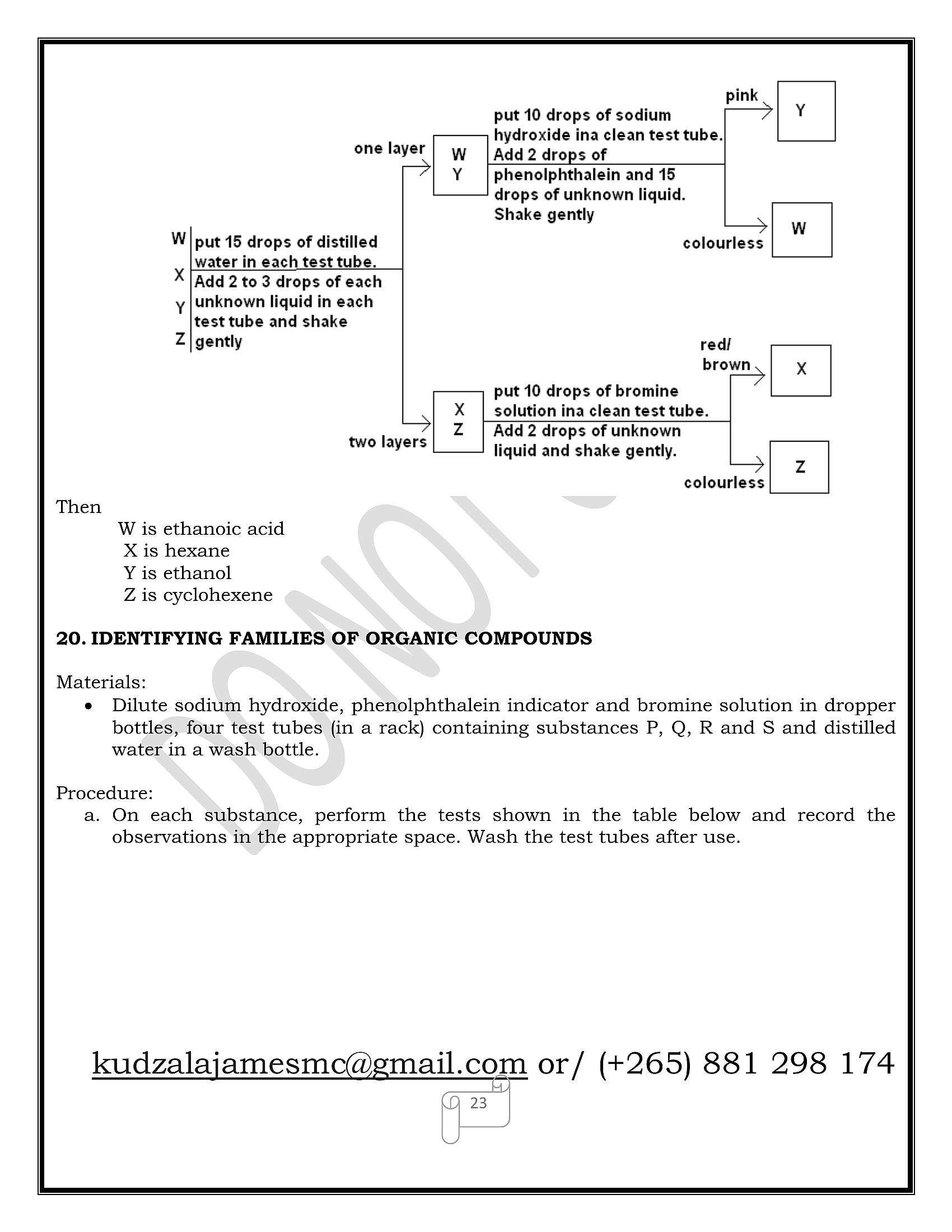
Assuming the results are as shown below
kudzalajamesmc@gmail.com or/ (+265) 881 298 174
---
Page 23
Extracted Text
pink put 10 drops of sodium r—?7| Y hydroxide ina clean test tube. onelayer| w | Add 2 drops of > Y phenolphthalein and 15drops of unknown liquid.
Shake gently
W|put 15 drops of distilled colourless
water in each test tube.
Add 2 to 3 drops of each
y [unknown liquid in each
test tube and shake
Z| gently red/
brown
put 10 drops of bromine r 7
solution ina clean test tube.
two layers Add 2 drops of unknown
liquid and shake gently.
Ls
colourless
Then
W is ethanoic acid
X is hexane
Y is ethanol
Z is cyclohexene
20. IDENTIFYING FAMILIES OF ORGANIC COMPOUNDS
Materials:
e Dilute sodium hydroxide, phenolphthalein indicator and bromine solution in dropper
bottles, four test tubes (in a rack) containing substances P, Q, R and S and distilled
water in a wash bottle.
Procedure:
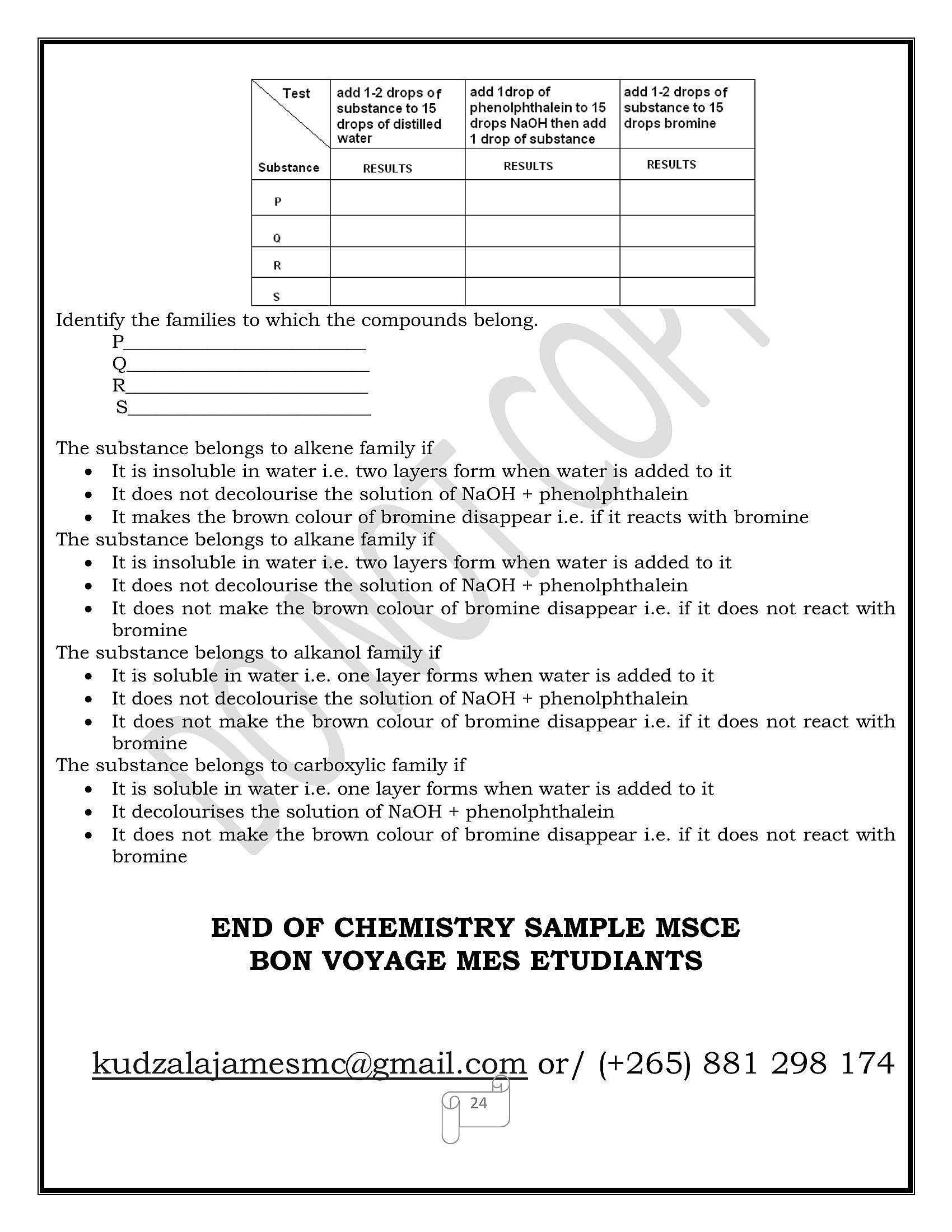
a. On each substance, perform the tests shown in the table below and record the
observations in the appropriate space. Wash the test tubes after use.
kudzalajamesmc@gmail.com or/ (+265) 881 298 174
| 4 23 |
---
Page 24
Extracted Text
add 1-2 drops of add 1drop of add 1-2 drops of substance to 15 phenolphthalein to 15 | substance to 15 drops of distilled drops NaOH then add _ | drops brominewater 1 drop of substance
Substance RESULTS RESULTS RESULTS
P
Q
R
s
Identify the families to which the compounds belong.
The substance belongs to alkene family if
e It is insoluble in water i.e. two layers form when water is added to it
e It does not decolourise the solution of NaOH + phenolphthalein
e It makes the brown colour of bromine disappear i.e. if it reacts with bromine
The substance belongs to alkane family if
e Itis insoluble in water i.e. two layers form when water is added to it
e It does not decolourise the solution of NaOH + phenolphthalein
e It does not make the brown colour of bromine disappear i.e. if it does not react with
bromine
The substance belongs to alkanol family if
e Itis soluble in water i.e. one layer forms when water is added to it
e It does not decolourise the solution of NaOH + phenolphthalein
e It does not make the brown colour of bromine disappear i.e. if it does not react with
bromine
The substance belongs to carboxylic family if
e It is soluble in water i.e. one layer forms when water is added to it
e It decolourises the solution of NaOH + phenolphthalein
e It does not make the brown colour of bromine disappear i.e. if it does not react with
bromine
END OF CHEMISTRY SAMPLE MSCE
BON VOYAGE MES ETUDIANTS
kudzalajamesmc@gmail.com or/ (+265) 881 298 174
---
Struggling with the concepts in this paper?
Revise syllabus notes, key exam points, and interactive practice questions for Chemistry: