2017_communication_skills_alevel_nov_paper1
Year: 2017 • Views: 1 • Downloads: 2
📄 Exam Questions & Readable Text Transcript
Full OCR-extracted text of questions, syllabus codes, and exam instructions.
Extracted Content: 2017_communication_skills_alevel_nov_paper1
Page 1
Extracted Text
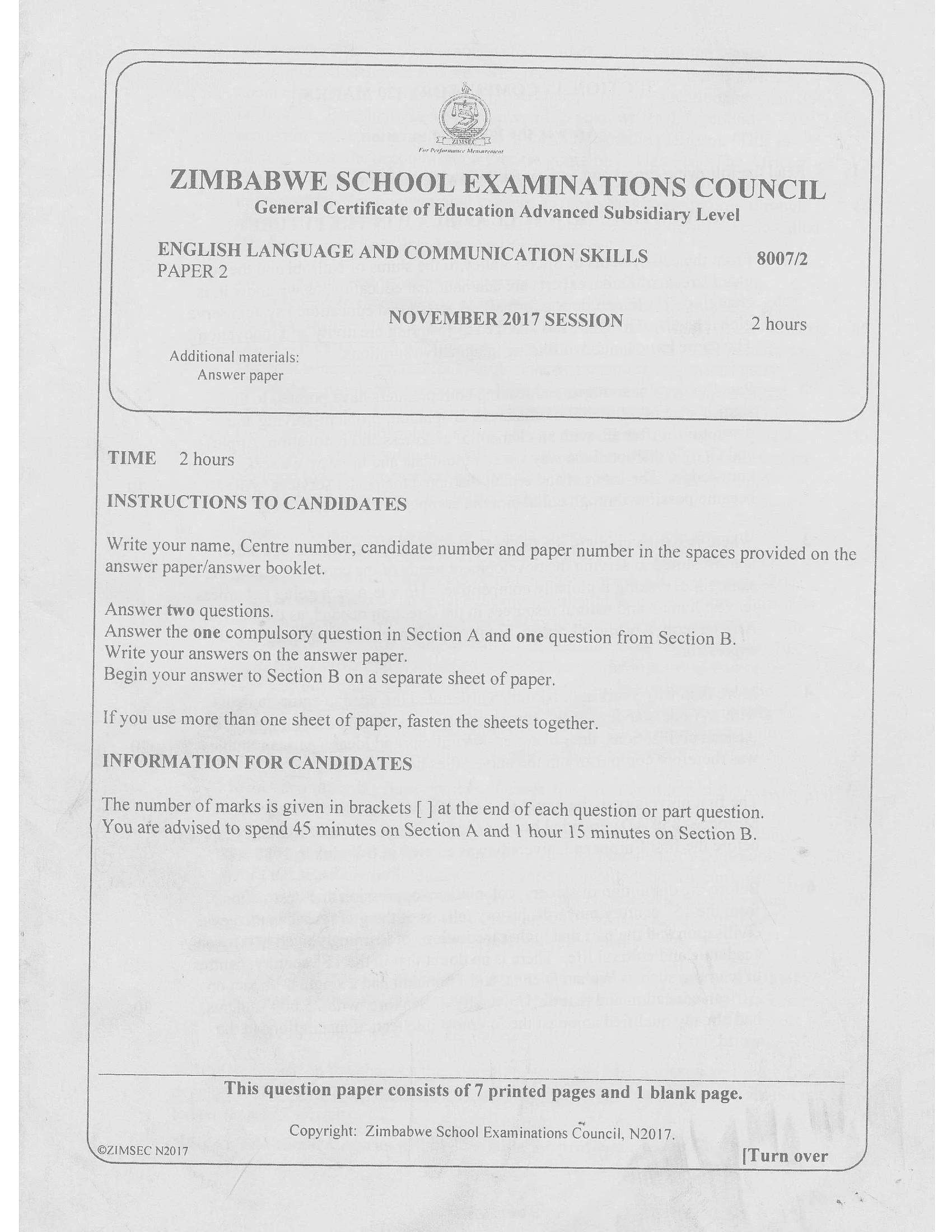
ZIMBABWE SCHOOL EXAMINATIONS COUNCILGeneral Certificate of Education Advanced Subsidiary Level
ENGLISH LANGUAGE AND COMMUNICATION SKILLS 8007/2
PAPER 2
NOVEMBER 2017 SESSION 2 hours
Additional materials:
Answer paper
TIME 2 hours
INSTRUCTIONS TO CANDIDATES
Write your name, Centre number, candidate number and paper number in the spaces provided on the
answer paper/answer booklet.
Answer two questions.
Answer the one compulsory question in Section A and one question from Section B.
Write your answers on the answer paper.
Begin your answer to Section B on a separate sheet of paper.
If you use more than one sheet of paper, fasten the sheets together.
INFORMATION FOR CANDIDATES
The number of marks is given in brackets [ ] at the end of each question or part question.
You ate advised to spend 45 minutes on Section A and 1 hour 15 minutes on Section B.
This question paper consists of 7 printed pages and 1 blank page.
Copyright: Zimbabwe School Examinations Council, N2017.
©ZIMSEC N2017 [Turn over
---
Page 2
Extracted Text
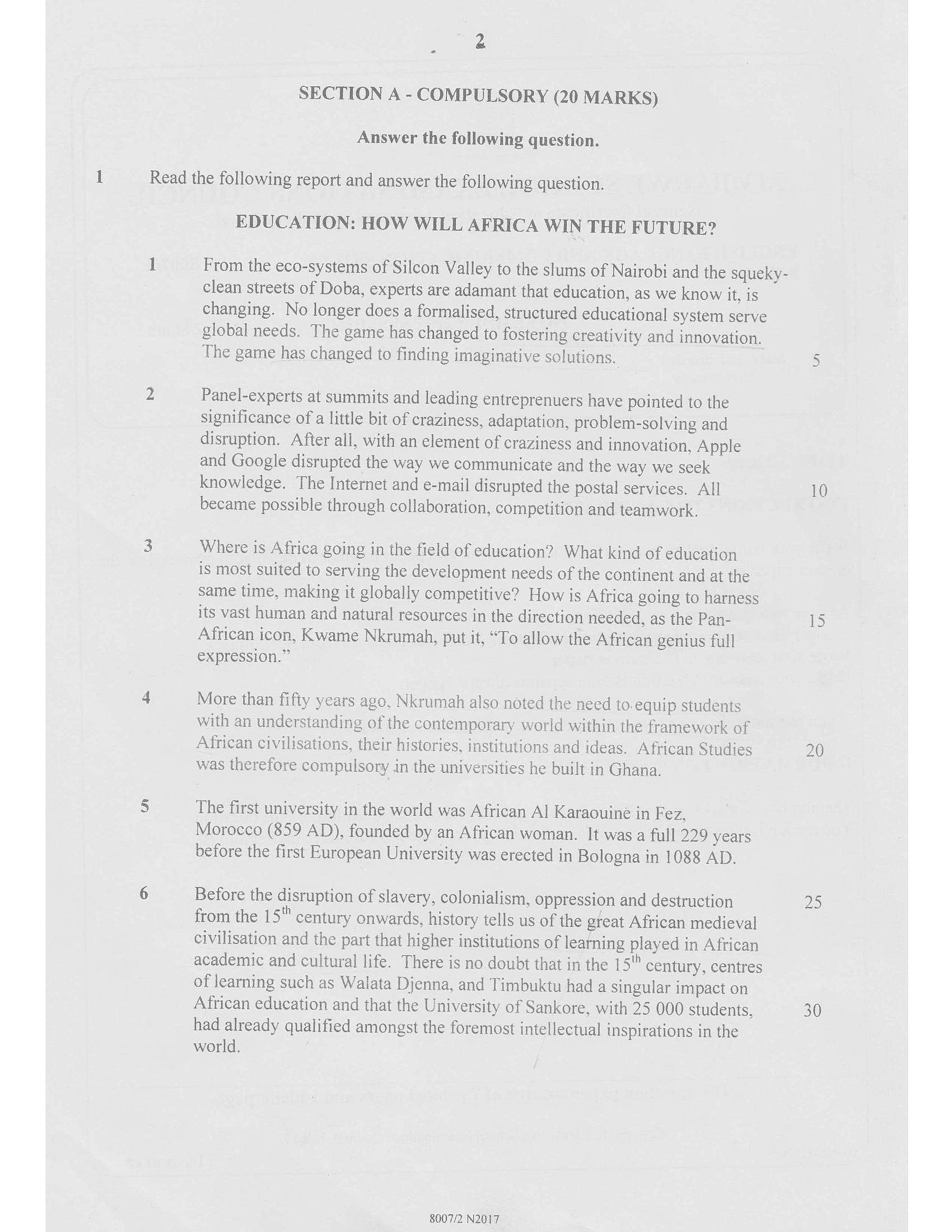
2SECTION A - COMPULSORY (20 MARKS)
Answer the following question.
Read the following report and answer the following question.
EDUCATION: HOW WILL AFRICA WIN THE FUTURE?
1 From the eco-systems of Silcon Valley to the slums of Nairobi and the squeky-
clean streets of Doba, experts are adamant that education, as we know it, is
changing. No longer does a formalised, structured educational system serve
global needs. The game has changed to fostering creativity and innovation.
The game has changed to finding imaginative solutions.
Nn
2 Panel-experts at summits and leading entreprenuers have pointed to the
significance of a little bit of craziness, adaptation, problem-solving and
disruption. After all, with an element of craziness and innovation, Apple
and Google disrupted the way we communicate and the way we seek
knowledge. The Internet and e-mail disrupted the postal services. All 10
became possible through collaboration, competition and teamwork.
8) Where is Africa going in the field of education? What kind of education
is most suited to serving the development needs of the continent and at the
same time, making it globally competitive? How is Africa going to harness
its vast human and natural resources in the direction needed, as the Pan- 15
Aftican icon, Kwame Nkrumah, put it, “To allow the African genius full
expression.”
4 More than fifty years ago, Nkrumah also noted the need to. equip students
with an understanding of the contemporary world within the framework of
African civilisations, their histories, institutions and ideas. African Studies 20
was therefore compulsory in the universities he built in Ghana.
5 The first university in the world was African Al Karaouiné in F eZ,
Morocco (859 AD), founded by an African woman. It was a full 229 years
before the first European University was erected in Bologna in 1088 AD.
6 Before the disruption of slavery, colonialism, oppression and destruction 25
from the 15" century onwards, history tells us of the great African medieval
civilisation and the part that higher institutions of learning played in African
academic and cultural life. There is no doubt that in the 15" century, centres
of learning such as Walata Djenna, and Timbuktu had a singular impact on
African education and that the University of Sankore, with 25 000 students, 30
had already qualified amongst the foremost intellectual inspirations in the
world.
8007/2 N2017
---
Page 3
Extracted Text
10Il
3
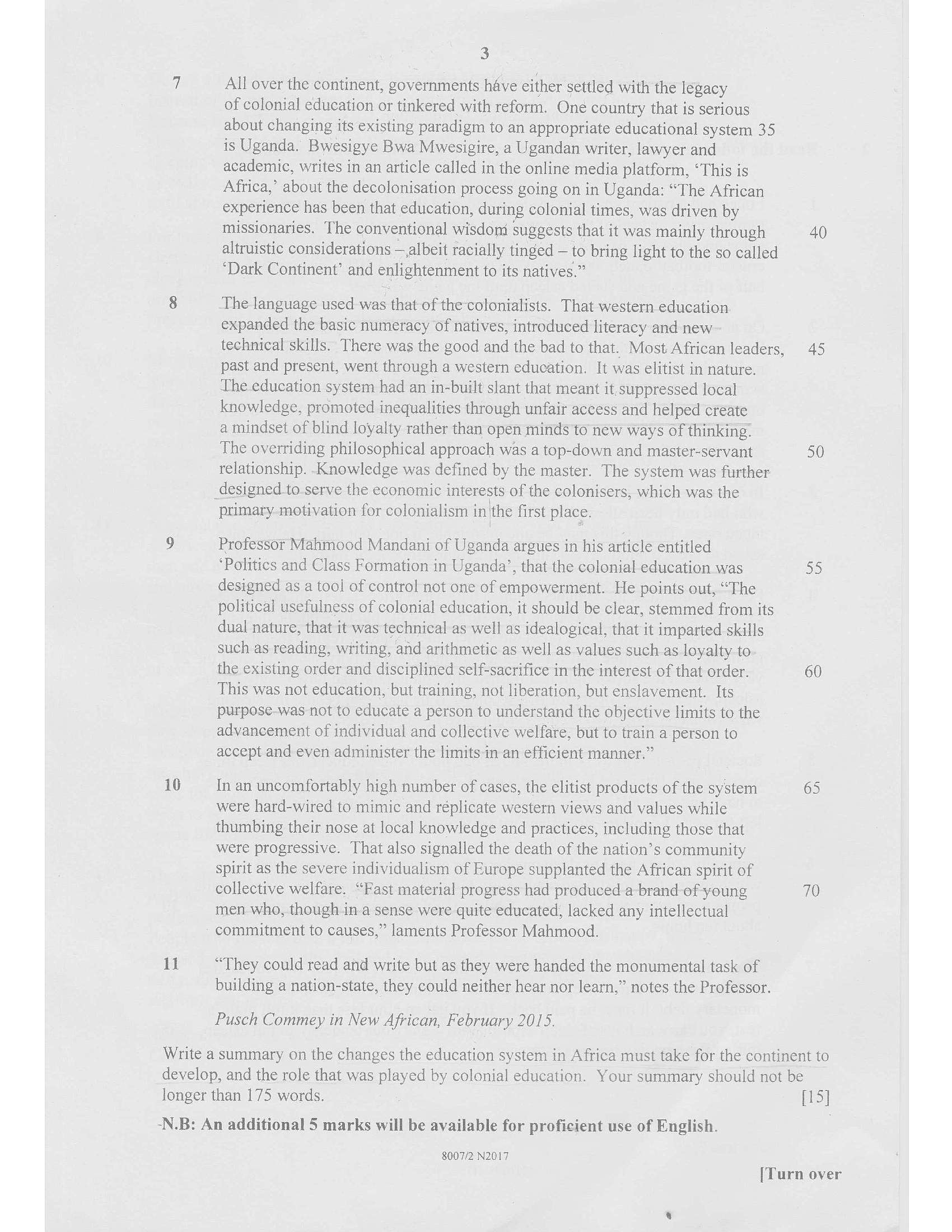
All over the continent, governments have either settled with the legacy
of colonial education or tinkered with reform. One country that is serious
about changing its existing paradigm to an appropriate educational system 35
is Uganda. Bwesigye Bwa Mwesigire, a Ugandan writer, lawyer and
academic, writes in an article called in the online media platform, ‘This is
Africa,’ about the decolonisation process going on in Uganda: “The African
experience has been that education, during colonial times, was driven by
missionaries. The conventional wisdoni suggests that it was mainly through
altruistic considerations — albeit racially tinged — to bring light to the so called
‘Dark Continent’ and enlightenment to its natives.”
The language used was that of the-colonialists. That western education
expanded the basic numeracy of natives, introduced literacy and new
technical skills. There was the good and the bad to that. Most African leaders,
past and present, went through a western education. It was elitist in nature.
The education system had an in-built slant that meant it suppressed local
knowledge, promoted inequalities through unfair aceess and helped create
a mindset of blind loyalty rather than open minds to new ways of thinking:
The overriding philosophical approach was a top-down and master-servant
relationship. Knowledge was defined by the master. The system was further
_designed to serve the economic interests of the colonisers, which was the
primary motivation for colonialism in the first place.
Professor Mahmood Mandani of Uganda argues in his article entitled
‘Politics and Class Formation in Uganda’, that the colonial education was
designed as a tool of control not one of empowerment. He points out, “The
political usefulness of colonial education, it should be clear, stemmed from its
dual nature, that it was technical as well as idealogical, that it imparted skills
such as reading, writing, and arithmetic as well as values suchas loyalty to
the existing order and disciplined self-sacrifice in the interest of that order.
This was not education, but training, not liberation, but enslavement. Its
purpose-was not to educate a person to understand the objective limits to the
advancement of individual and collective welfare, but to train a person to
accept and even administer the limits-in-an efficient manner.”
In an uncomfortably high number of cases, the elitist products of the system
were hard-wired to mimic and réplicate western views and values while
thumbing their nose at local knowledge and practices, including those that
were progressive. That also signalled the death of the nation’s community
spirit as the severe individualism of Europe supplanted the African spirit of
collective welfare. “Fast material progress had produced a-brand-of young
men who, though ina sense were quite educated, lacked any intellectual
commitment to causes,” laments Professor Mahmood.
“They could read and write but as they were handed the monumental task of
building a nation-state, they could neither hear nor learn,” notes the Professor.
Pusch Commey in New African, February 2015.
40
45
50
55
60
70
Write a summary on the changes the education system in Africa must take for the continent to
develop, and the role that was played by colonial education. Your summary should not be
longer than 175 words.
-N.B: An additional 5 marks will be available for proficient use of English.
8007/2 N2017
[15]
[Turn over
---
Page 4
Extracted Text
™~4
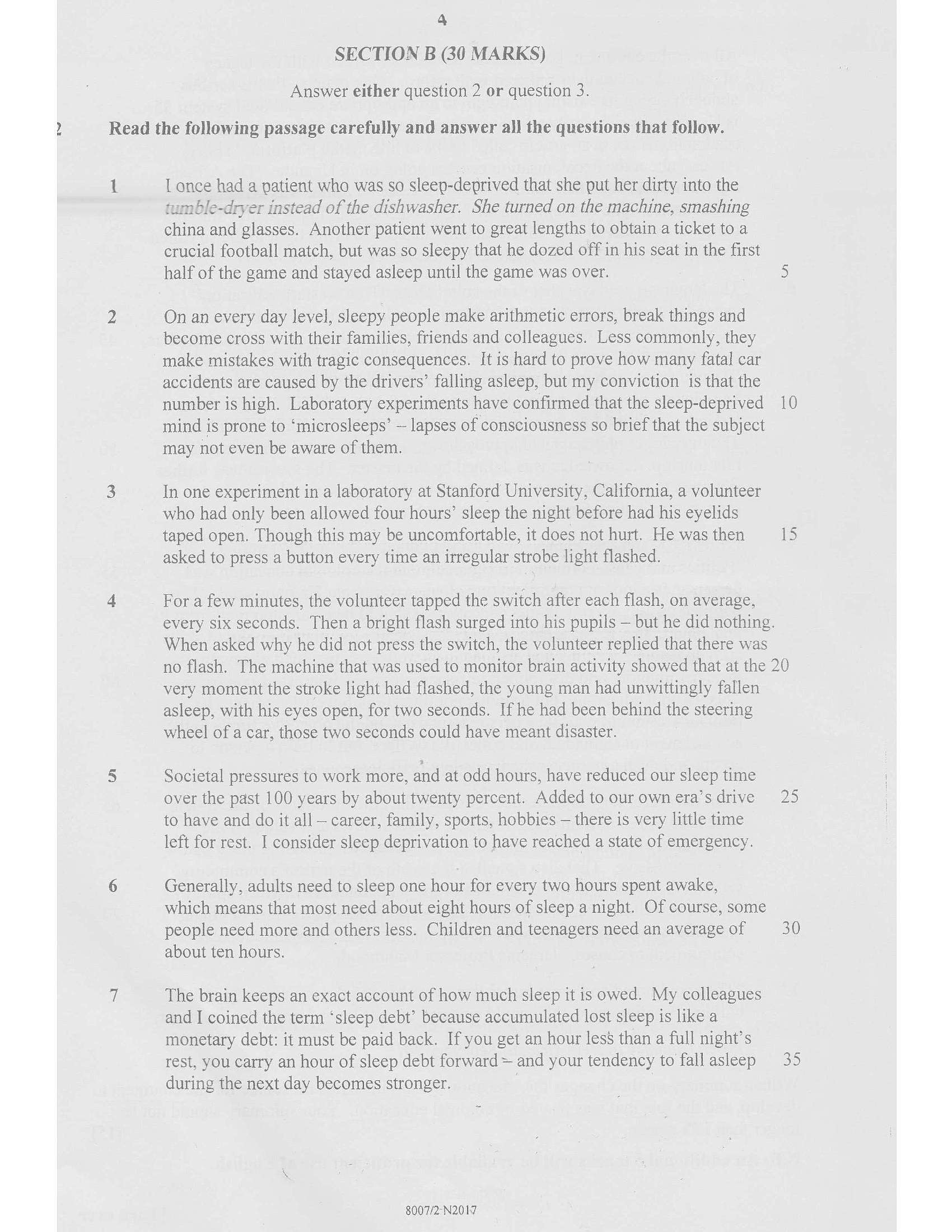
SECTION B 30 MARKS)
Answer either question 2 or question 3.
Read the following passage carefully and answer al) the questions that follow.
1 Lonce had a patient who was so sleep-deprived that she put her dirty into the
tumble-dryer instead of the dishwasher. She turned on the machine, smashing
china and glasses. Another patient went to great lengths to obtain a ticket to a
crucial football match, but was so sleepy that he dozed off in his seat in the first
half of the game and stayed asleep until the game was over. 5
2 On an every day level, sleepy people make arithmetic errors, break things and
become cross with their families, friends and colleagues. Less commonly, they
make mistakes with tragic consequences. It is hard to prove how many fatal car
accidents are caused by the drivers’ falling asleep, but my conviction is that the
number is high. Laboratory experiments have confirmed that the sleep-deprived 10
mind is prone to ‘microsleeps’ ~ lapses of consciousness so brief that the subject
may not even be aware of them.
3 In one experiment in a laboratory at Stanford University, California, a volunteer
who had only been allowed four hours’ sleep the night before had his eyelids
taped open. Though this may be uncomfortable, it does not hurt. He was then is
asked to press a button every time an irregular strobe light flashed.
4 For a few minutes, the volunteer tapped the switch after each flash, on average,
every six seconds. Then a bright flash surged into his pupils — but he did nothing.
When asked why he did not press the switch, the volunteer replied that there was
no flash. The machine that was used to monitor brain activity showed that at the 20
very moment the stroke light had flashed, the young man had unwittingly fallen
asleep, with his eyes open, for two seconds. If he had been behind the steering
wheel of a car, those two seconds could have meant disaster.
5 Societal pressures to work more, and at odd hours, have reduced our sleep time
over the past 100 years by about twenty percent. Added to our ownera’s drive 25
to have and do it all — career, family, sports, hobbies — there is very little time
left for rest. I consider sleep deprivation to have reached a state of emergency.
6 Generally, adults need to sleep one hour for every two hours spent awake,
which means that most need about eight hours of sleep a night. Of course, some
people need more and others less. Children and teenagers need an average of 30
about ten hours.
ql The brain keeps an exact account of how much sleep it is owed. My colleagues
and I coined the term ‘sleep debt’ because accumulated lost sleep is like a
monetary debt: it must be paid back. If you get an hour less than a full night’s
rest, you carry an hour of sleep debt forward= and your tendency to fallasleep 35
during the next day becomes stronger.
8007/2-N2017
---
Page 5
Extracted Text
1011
12
13
§
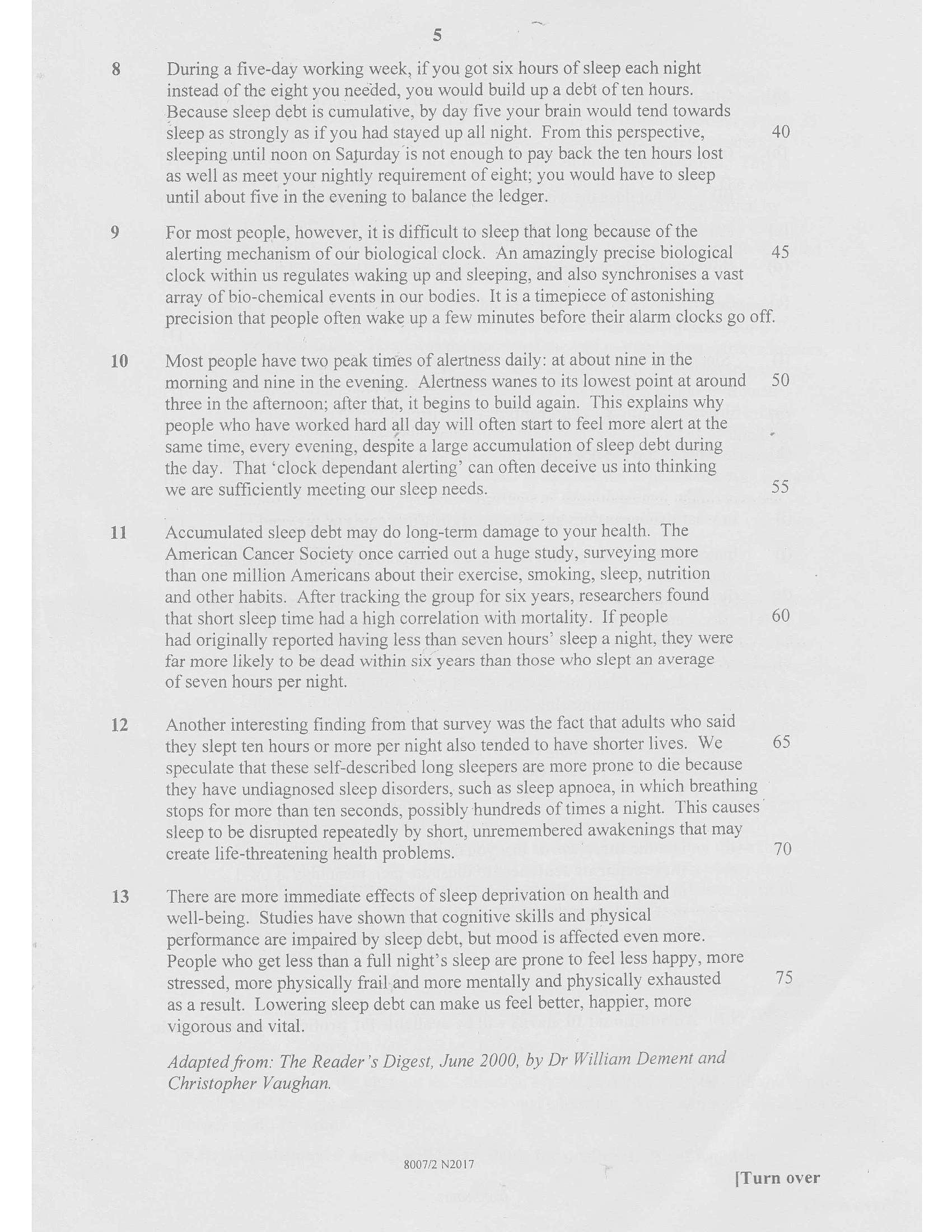
During a five-day working week, if you got six hours of sleep each night
instead of the eight you needed, you would build up a debt of ten hours.
Because sleep debt is cumulative, by day five your brain would tend towards
sleep as strongly as if you had stayed up all night. From this perspective, 40
sleeping until noon on Saturday is not enough to pay back the ten hours lost
as well as meet your nightly requirement of eight; you would have to sleep
until about five in the evening to balance the ledger.
For most people, however, it is difficult to sleep that long because of the
alerting mechanism of our biological clock. An amazingly precise biological 45
clock within us regulates waking up and sleeping, and also synchronises a vast
array of bio-chemical events in our bodies. It is a timepiece of astonishing
precision that people often wake up a few minutes before their alarm clocks go off.
Most people have two peak times of alertness daily: at about nine in the
morning and nine in the evening. Alertness wanes to its lowest point at around 50
three in the afternoon; after that, it begins to build again. This explains why
people who have worked hard all day will often start to feel more alert at the
same time, every evening, despite a large accumulation of sleep debt during
the day. That ‘clock dependant alerting’ can often deceive us into thinking
we are sufficiently meeting our sleep needs. 55
Accumulated sleep debt may do long-term damage to your health. The
American Cancer Society once carried out a huge study, surveying more
than one million Americans about their exercise, smoking, sleep, nutrition
and other habits. After tracking the group for six years, researchers found
that short sleep time had a high correlation with mortality. If people 60
had originally reported having less than seven hours’ sleep a night, they were
far more likely to be dead within six years than those who slept an average
of seven hours per night.
Another interesting finding from that survey was the fact that adults who said
they slept ten hours or more per night also tended to have shorter lives. We 65
speculate that these self-described long sleepers are more prone to die because
they have undiagnosed sleep disorders, such as sleep apnoea, in which breathing
stops for more than ten seconds, possibly hundreds of times a night. This causes
sleep to be disrupted repeatedly by short, unremembered awakenings that may
create life-threatening health problems. 70
There are more immediate effects of sleep deprivation on health and
well-being. Studies have shown that cognitive skills and physical
performance are impaired by sleep debt, but mood is affected even more.
People who get less than a full night’s sleep are prone to feel less happy, more
stressed, more physically frail.and more mentally and physically exhausted WS
as a result. Lowering sleep debt can make us feel better, happier, more
vigorous and vital.
Adapted from: The Reader's Digest, June 2000, by Dr William Dement and
Christopher Vaughan.
8007/2 N2017
[Turn over
---
Page 6
Extracted Text
(a)(b)
(©)
(d)
(e)
(
(g)
(bh)
(i)
@)
(k)
6
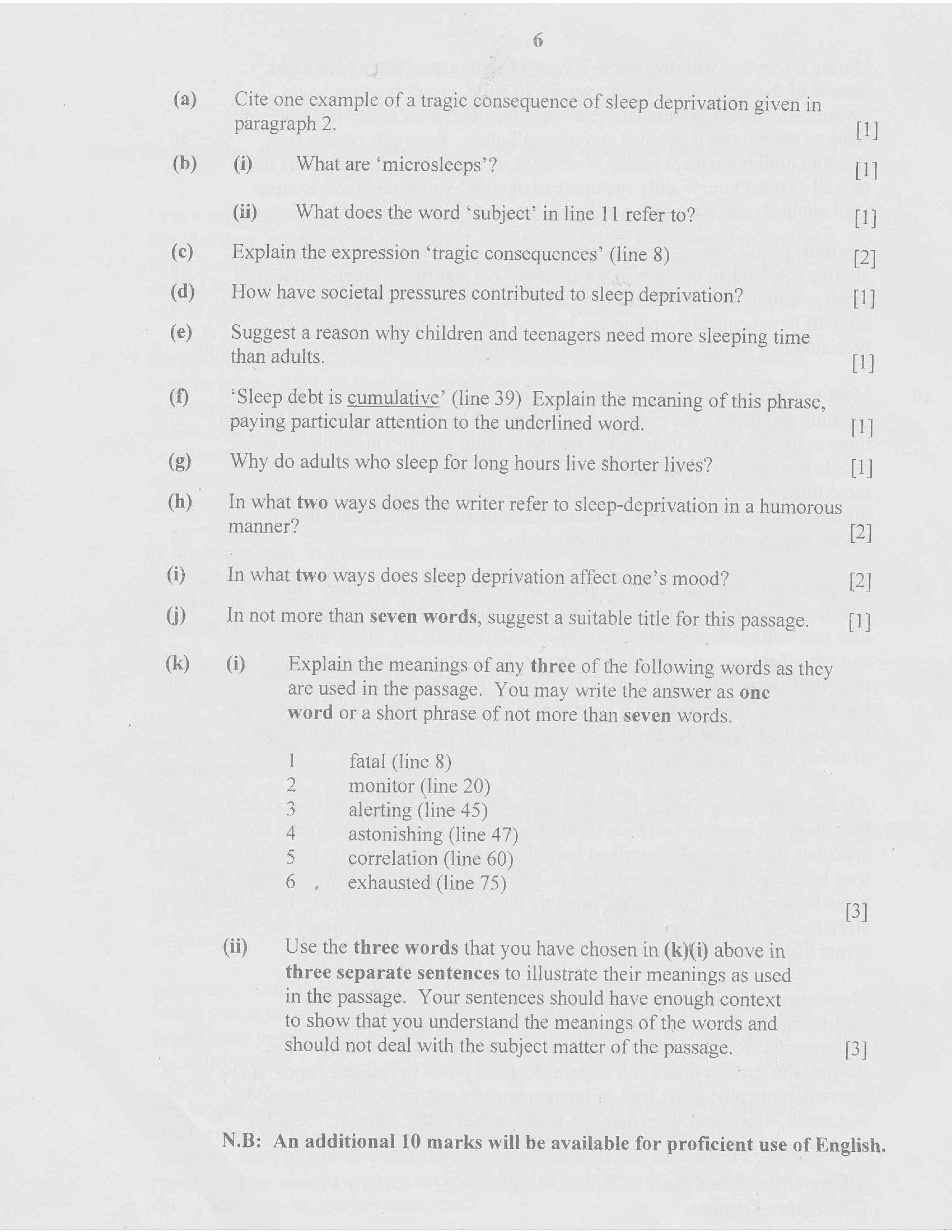
Cite one example of a tragic consequence of sleep deprivation given in
paragraph 2.
(i) What are ‘microsleeps’?
(ii) | What does the word ‘subject’ in line 11 refer to?
Explain the expression “tragic consequences’ (line 8)
How have societal pressures contributed to sleep deprivation?
Suggest a reason why children and teenagers need more sleeping time
than adults.
‘Sleep debt is cumulative’ (line 39) Explain the meaning of this phrase,
paying particular attention to the underlined word.
Why do adults who sleep for long hours live shorter lives?
In what two ways does the writer refer to sleep-deprivation in a humorous
manner?
In what two ways does sleep deprivation affect one’s mood?
In not more than seven words, suggest a suitable title for this passage.
(() Explain the meanings of any three of the following words as they
are used in the passage. You may write the answer as one
word or a short phrase of not more than seven words.
fatal (line 8)
monitor (line 20)
alerting (line 45)
astonishing (line 47)
correlation (line 60)
exhausted (line 75)
DnrAbB WN —
(ii) Use the three words that you have chosen in (k)(i) above in
three separate sentences to illustrate their meanings as used
in the passage. Your sentences should have enough context
to show that you understand the meanings of the words and
should not deal with the subject matter of the passage.
[1]
[2]
[2]
(]
[3]
[3]
N.B: An additional 10 marks will be available for proficient use of English.
---
Page 7
Extracted Text
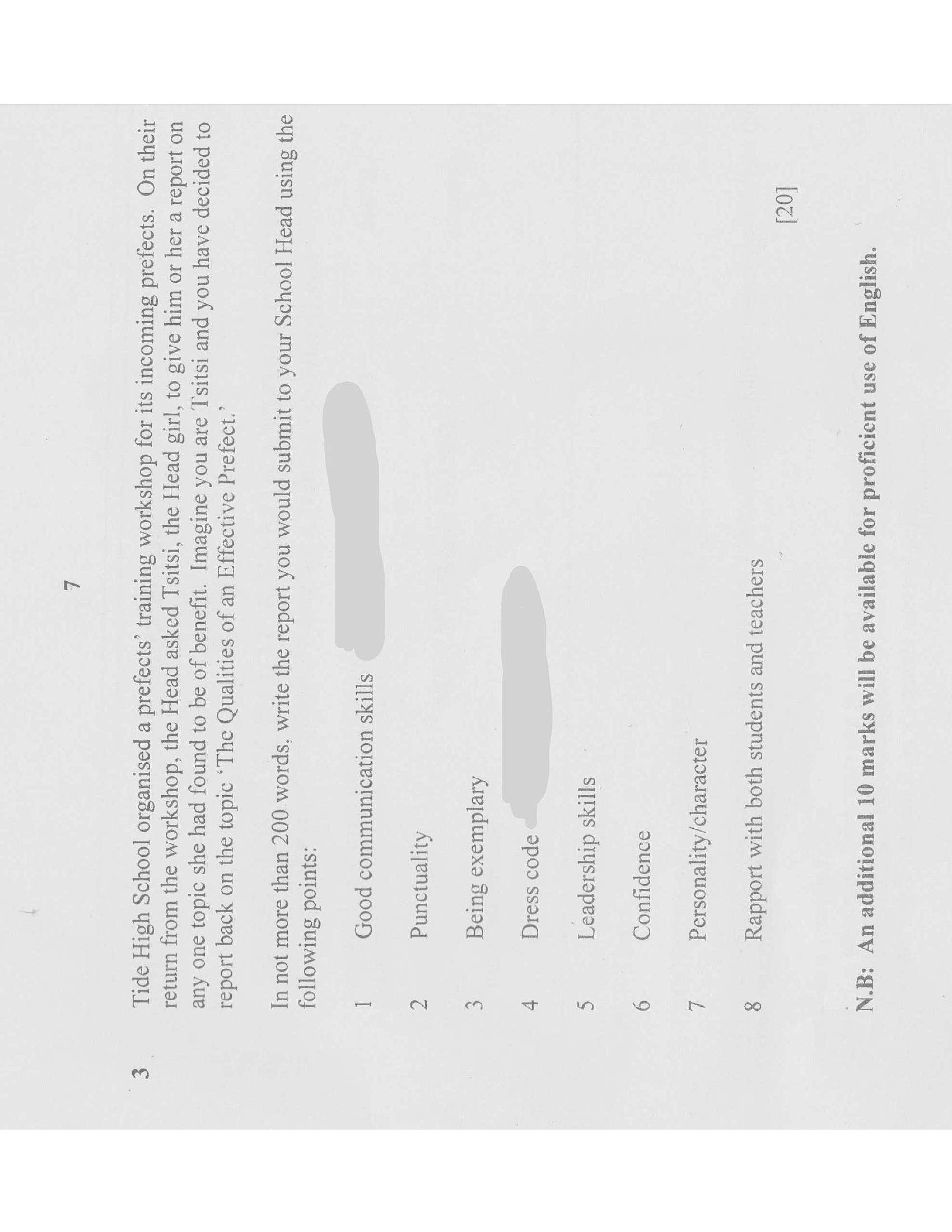
"Ysl[suy JO asn JUsIOOAd AO} ajquyleae aq [JIM SYAVUI QT [LUOWIPpe UW :q-NSi9ysea] pue sjUspNys YyJog YM oddey 8
Igjoeseyo/Aeuosiag L
aouaplyuodg 9
s[[pys diyssopeoy S
2pod ssaig 2
Arejduiaxe Sulag €
Ayyenjoung %
S[[DJs UONBOTUNUAUIOS pooy I
‘sjutod SUIMOTIO}
2y} Suisn peasy] Jooyss mo 0} WuwUQns pjnom noX yoda ay} a1M ‘splOM QZ UY} eOUr Jou UT
Deyold saNoajjq ue JO satyjend ay, sido} ay} uo yorq yoda1
0} poploap aaky Nod pur IsyIs | aie Nod auIseW] “1youaq Jo aq 0} punoy pey ays d1do} suo Aue
Uo Wodar v Joy JO WIY AIS 0} ‘[113 peaz] oy) ‘IsTS, poyse peop aup ‘doysyiom at Woy unas
Hay1 uC ‘sisefoud Suruoout si Joy doysyiom Sururen ,syoayaid v pastueB10 [ooyos YyBIH opty,
---
Struggling with the concepts in this paper?
Revise syllabus notes, key exam points, and interactive practice questions for Languages English: