📄 Exam Questions & Readable Text Transcript
Full OCR-extracted text of questions, syllabus codes, and exam instructions.
Extracted Content: 2019_Aenglish_olevel_mj_paper12
Page 1
Extracted Text
4.T.
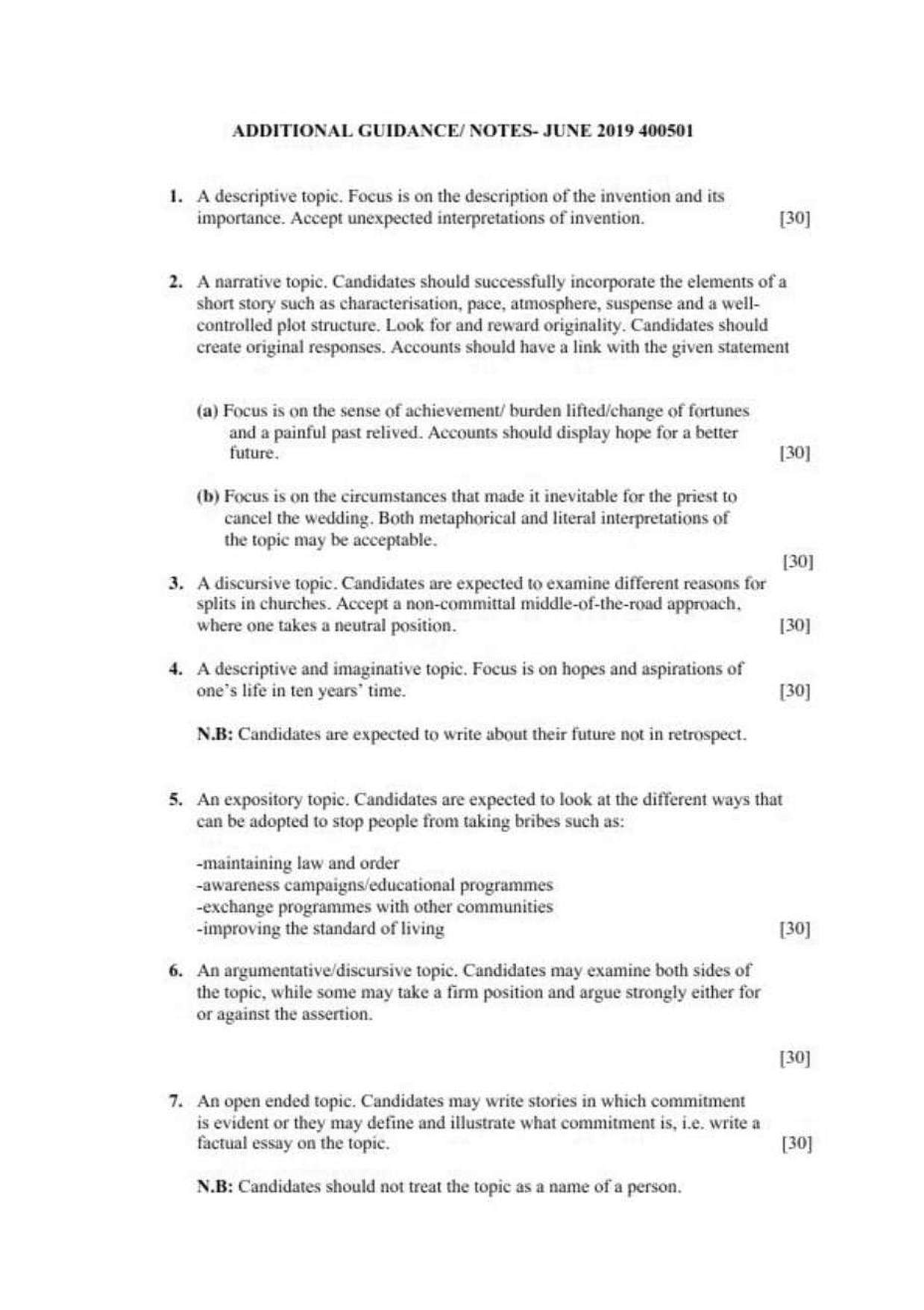
ADDITIONAL GUIDANCE/ NOTES- JUNE 2019 400501
A descriptive topic. Focus is on the description of the invention and its
importance. Accept unexpected interpretations of invention. [30]
A narrative topic, Candidates should successfully incorporate the elements of a
short story such as characterisation, pace, atmosphere, suspense and a weill-
controlled plot structure. Look for and reward originality. Candidates should
create original responses. Accounts should have a link with the given statement
(a) Focus is on the sense of achievement/ burden lifted/change of fortunes
and a painful past relived. Accounts should display hope for a better
future. [30]
(b) Focus is on the circumstances that made it inevitable for the priest to
cancel the wedding. Both metaphorical and literal interpretations of
the topic may be acceptable.
[30]
. A discursive topic. Candidates are expected to examine different reasons for
splits in churches. Accept a non-committal middle-of-the-road approach,
where one takes a neutral position. [30]
A descriptive and imaginative topic. Focus is on hopes and aspirations of
one’s life in ten years” time. [30]
N.B: Candidates are expected to write about their future not in retrospect.
An expository topic. Candidates are expected to look at the different ways that
can be adopted to stop people from taking bribes such as:
-maintaining law and order
-awareness campaigns/educational programmes
-exchange programmes with other communities
-improving the standard of living [30]
An argumentative/discursive topic. Candidates may examine both sides of
the topic, while some may take a firm position and argue strongly either for
or against the assertion.
130}
An open ended topic. Candidates may write stories in which commitment
is evident or they may define and illustrate what commitment is, ie. write a
factual essay on the topic. [30]
N.B: Candidates should not treat the topic as a name of a person.
---
Page 2
Extracted Text
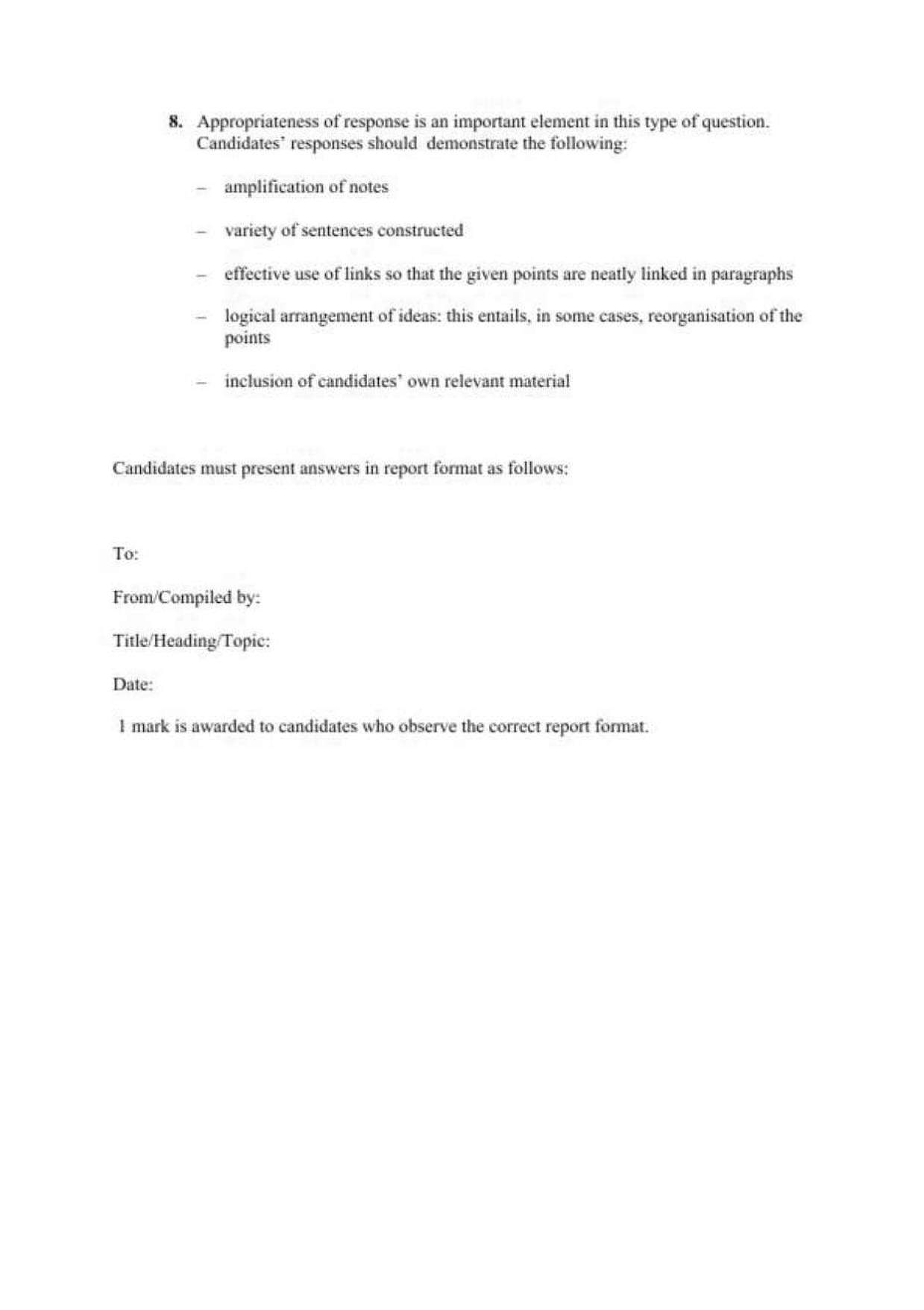
8. Appropriateness of response is an important element in this type of question. Candidates’ responses should demonstrate the following:— amplification of notes
— variety of sentences constructed
— effective use of links so that the given points are neatly linked in paragraphs
— logical arrangement of ideas: this entails, in some cases, reorganisation of the
points
— inclusion of candidates’ own relevant material
Candidates must present answers in report format as follows:
To:
From/Compiled by:
Title/Heading/Topic:
Date:
1 mark is awarded to candidates who observe the correct report format.
---
Page 3
Extracted Text
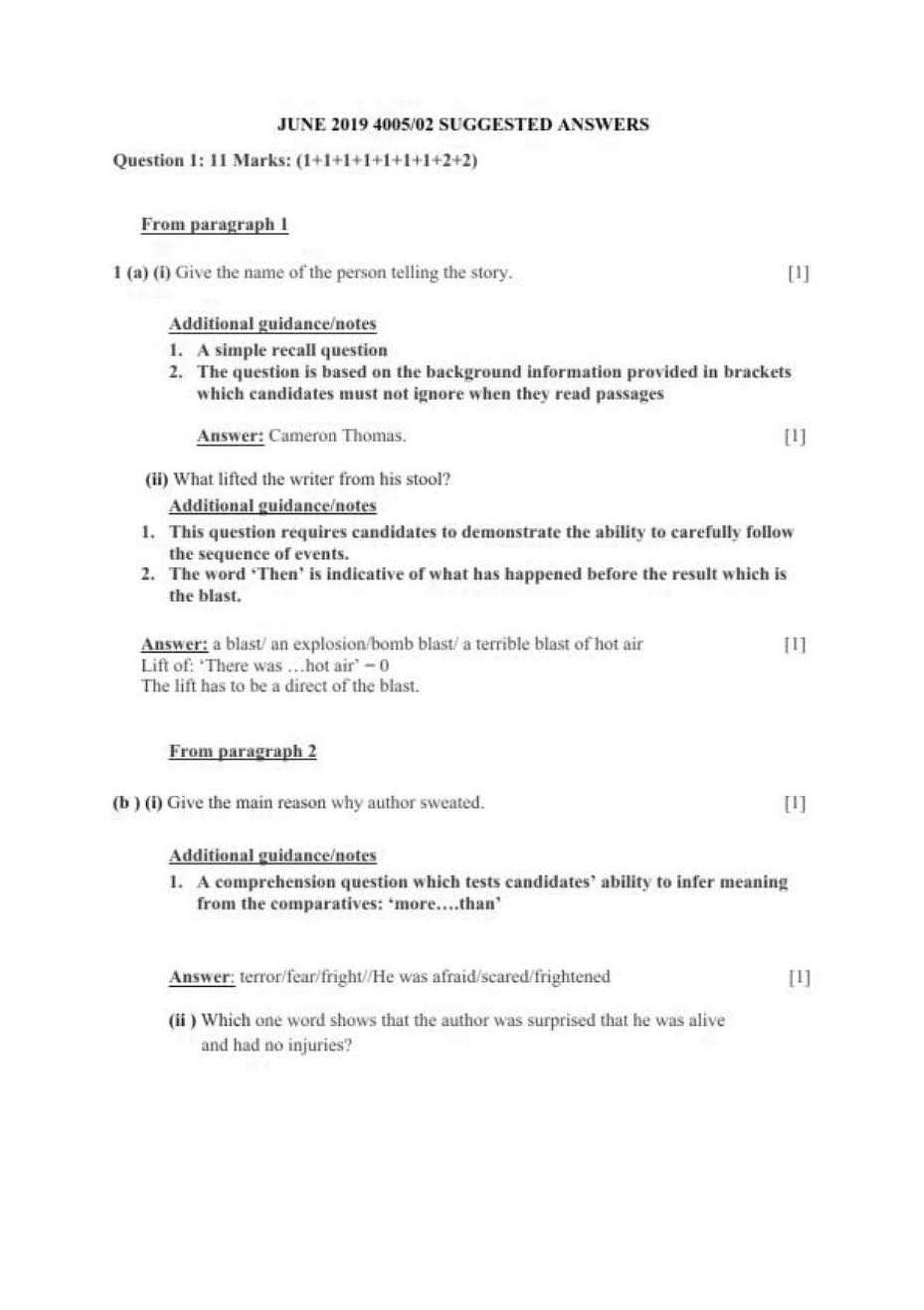
JUNE 2019 4005/02 SUGGESTED ANSWERS Question 1: 11 Marks: (1+1+1+14+1+1+142+2)From paragraph |
1 (a) (i) Give the name of the person telling the story. a]
Additional guidance/notes
1. Asimple recall question
2. The question is based on the background information provided in brackets
which candidates must not ignore when they read passages
Answer: Cameron Thomas. 1]
(ii) What lifted the writer from his stool?
Additional guidance/notes
1, This question requires candidates to demonstrate the ability to carefully follow
the sequence of events.
2. The word *Then’ is indicative of what has happened before the result which is
the blast.
Answer: a blast’ an explosion/bomb blast/ a terrible blast of hot air 1
Lift of: ‘There was ...hot air’ - 0
The lift has to be a direct of the blast.
From paragraph 2
(b ) (i) Give the main reason why author sweated. t]
Additional guidance/notes
1. A comprehension question which tests candidates’ ability to infer meaning
from the comparatives: *more....than’
Answer: terror/fear/fright//He was afraid/scared/frightened [)]
(ii) Which one word shows that the author was surprised that he was alive
and had no injuries?
---
Page 4
Extracted Text
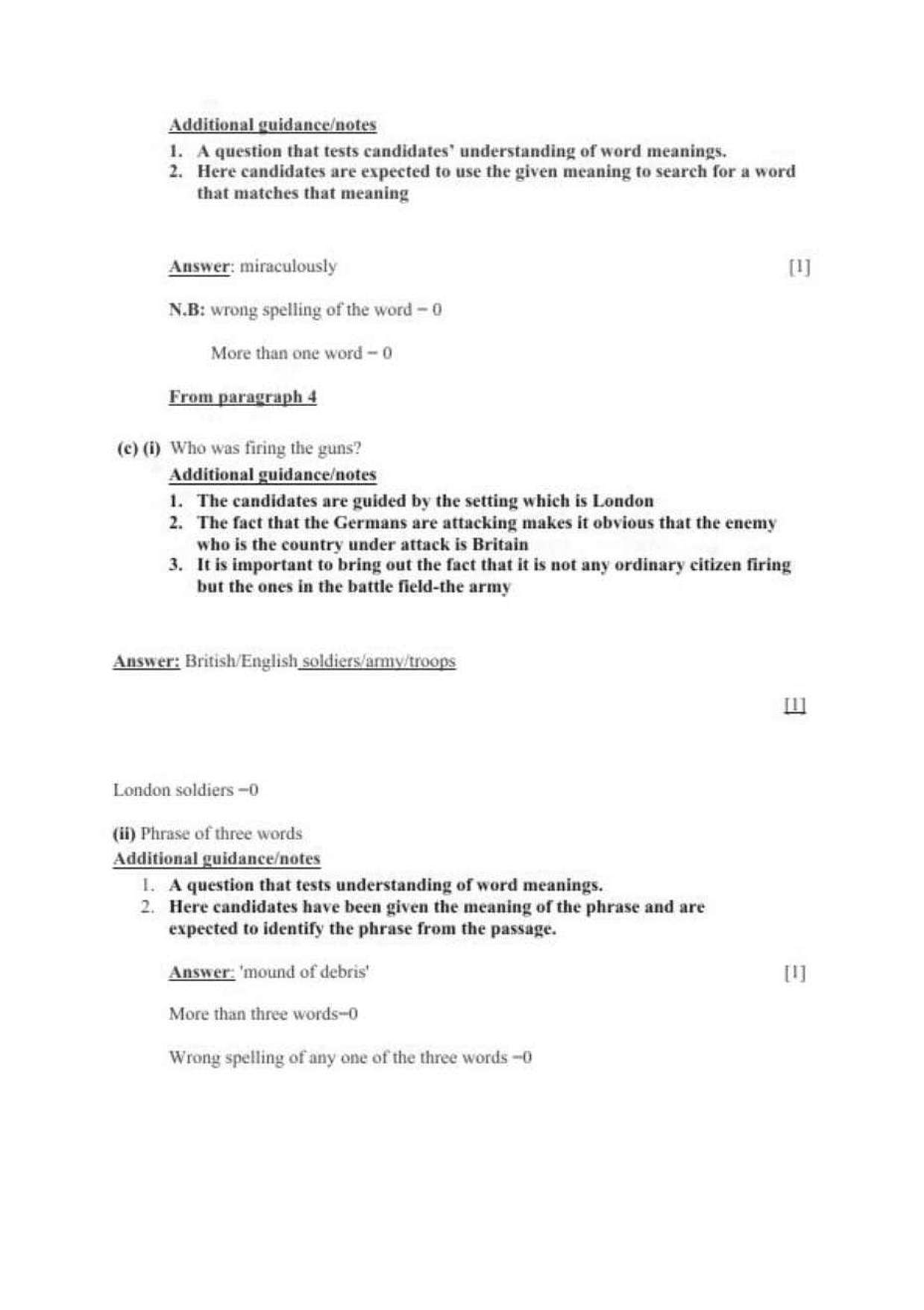
Additional guidance/notes1. A question that tests candidates’ understanding of word meanings,
2. Here candidates are expected to use the given meaning to search for a word
that matches that meaning
Answer: miraculously {}]
N.B: wrong spelling of the word — 0
More than one word ~ 0
From paragraph 4
(c) (i) Who was firing the guns?
Additional guidance/notes
1. The candidates are guided by the setting which is London
2. The fact that the Germans are attacking makes it obvious that the enemy
who is the country under attack is Britain
3. It is important to bring out the fact that it is not any ordinary citizen firing
but the ones in the battle field-the army
Answer: British/English soldiers/army/troops
London soldiers ~0
(ii) Phrase of three words
Additional guidance/notes
|. A question that tests understanding of word meanings.
2. Here candidates have been given the meaning of the phrase and are
expected to identify the phrase from the passage.
Answer: ‘mound of debris' 1
More than three words-0
Wrong spelling of any one of the three words -0
---
Page 5
Extracted Text
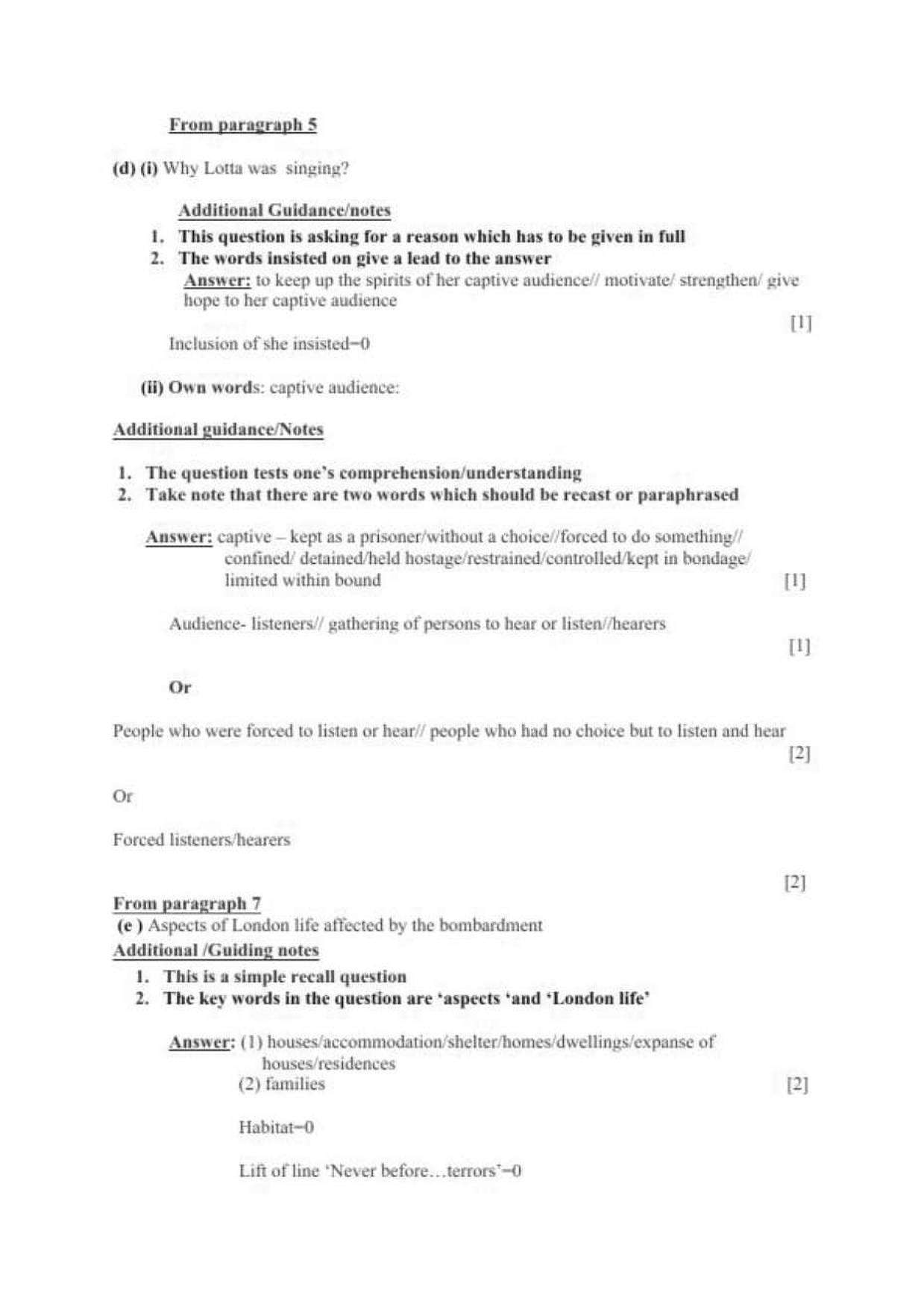
From raph 5 (d) (i) Why Lotta was singing?Additional Guidance/notes
1, This question is asking for a reason which has to be given in full
2. The words insisted on give a lead to the answer
Answer: to keep up the spirits of her captive audience// motivate/ strengthen/ give
hope to her captive audience
Inclusion of she insisted-(
(ti) Own words: captive audience:
Additional guidance/Notes
1. The question tests one’s comprehension/understanding
2. Take note that there are two words which should be recast or paraphrased
Answer: captive — kept as a prisoner/without a choice//forced to do something//
confined/ detained/held hostage/restrained/controlled/kept in bondage’
limited within bound
Audience- listeners// gathering of persons to hear or listen//hearers
Or
0
1
it)
People who were forced to listen or hear// people who had no choice but to listen and hear
Or
Forced listeners/hearers
From paragraph 7
(e ) Aspects of London life affected by the bombardment
Additional /Guiding notes
1. This is a simple recall question
2. The key words in the question are ‘aspects ‘and ‘London life’
Answer: (1) houses/accommodation/shelter/homes/dwellings/expanse of
houses/residences
(2) families
Habitat~0
Lift of line ‘Never before...terrors’-0
(2)
[2]
---
Page 6
Extracted Text
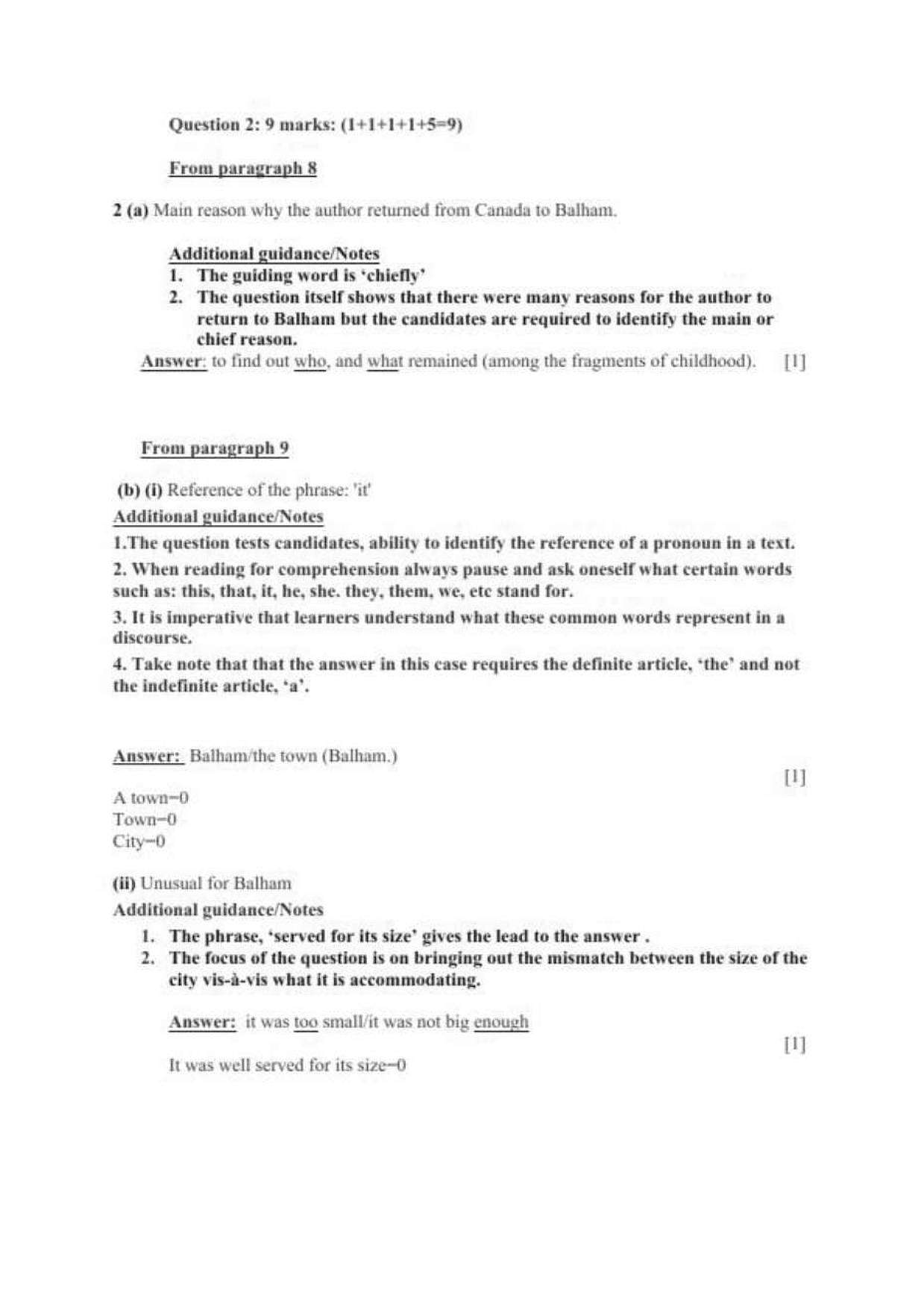
Question 2: 9 marks: (1+1+14+1+5=9)From paragraph 8
2 (a) Main reason why the author returned from Canada to Balham.
Additional guidance/Notes
1. The guiding word is ‘chiefly’
2. The question itself shows that there were many reasons for the author to
return to Balham but the candidates are required to identify the main or
chief reason.
Answer: to find out who, and what remained (among the fragments of childhood). [1]
From paragraph 9
(b) (i) Reference of the phrase: ‘it’
Additional guidance/Notes
1.The question tests candidates, ability to identify the reference of a pronoun in a text.
2. When reading for comprehension always pause and ask oneself what certain words
such as: this, that, it, he, she. they, them, we, ete stand for.
3. It is imperative that learners understand what these common words represent in a
discourse.
4. Take note that that the answer in this case requires the definite article, ‘the’ and not
the indefinite article, ‘a’.
Answer: Balham/the town (Balham.)
Atown~0
Town-0
City-0
(ii) Unusual for Balham
Additional guidance/Notes
1. The phrase, ‘served for its size’ gives the lead to the answer .
2. The focus of the question is on bringing out the mismatch between the size of the
city vis-a-vis what it is accommodating.
Answer: it was too small/it was not big enough
(]
Tt was well served for its size-0
---
Page 7
Extracted Text
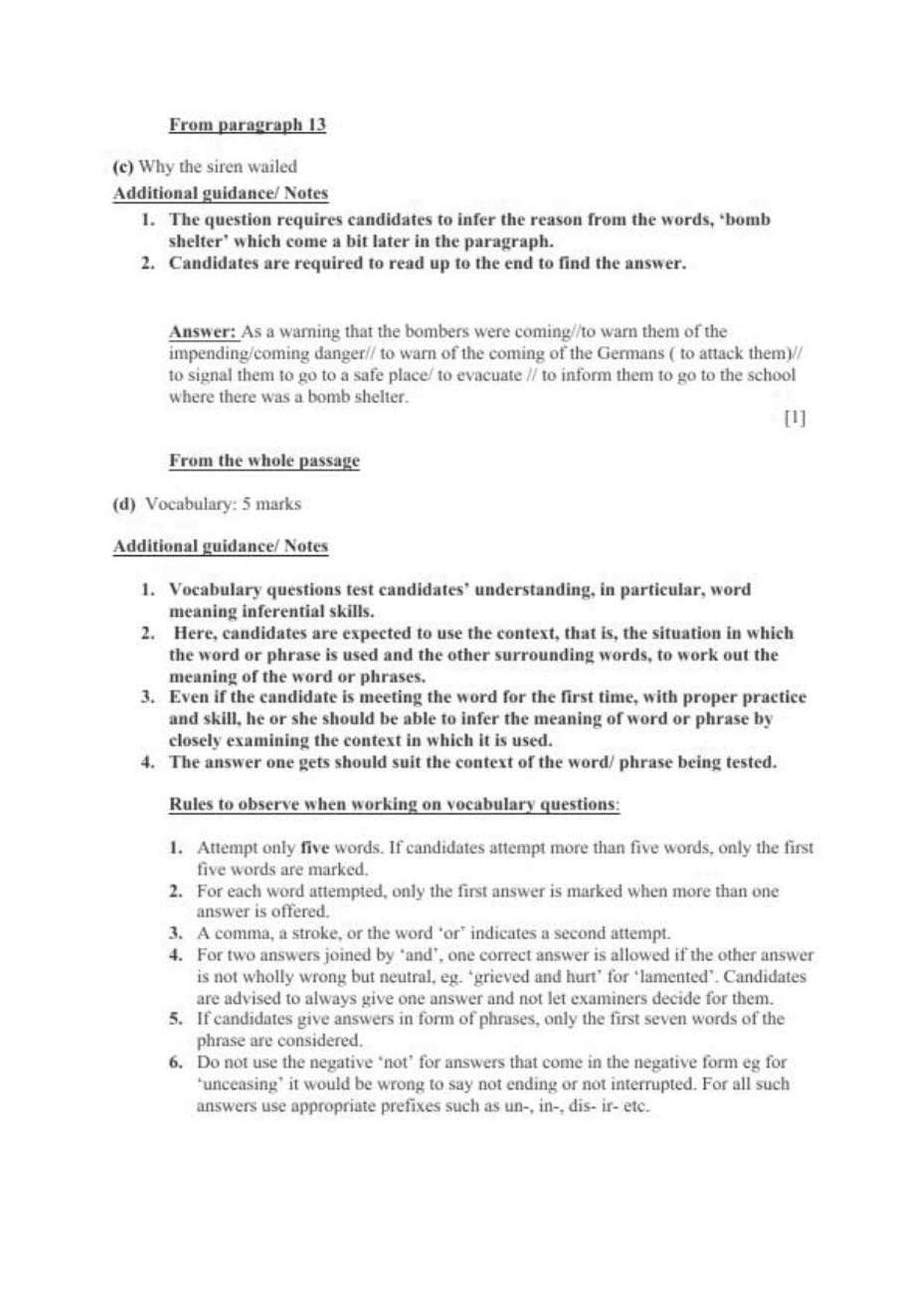
From paragraph 13(c) Why the siren wailed
Additional guidance/ Notes
2.
The question requires candidates to infer the reason from the words, ‘bomb
shelter’ which come a bit later in the paragraph.
Candidates are required to read up to the end to find the answer.
Answer: As a warning that the bombers were coming//to warn them of the
impending/coming danger// to warn of the coming of the Germans ( to attack them)//
10 signal them to go to a safe place/ to evacuate // to inform them to go to the school
where there was a bomb shelter.
ty)
From the whole passage
(d) Vocabulary: 5 marks
Additional guidance/ Notes
2,
Vocabulary questions test candidates’ understanding, in particular, word
meaning inferential skills.
Here, candidates are expected to use the context, that is, the situation in which
the word or phrase is used and the other surrounding words, to work out the
meaning of the word or phrases,
Even if the candidate is meeting the word for the first time, with proper practice
and skill, he or she should be able to infer the meaning of word or phrase by
closely examining the context in which it is used.
The answer one gets should sult the context of the word/ phrase being tested.
Rules to observe when working on yocabul uestions:
1, Attempt only five words. If candidates attempt more than five words, only the first
five words are marked.
2. For each word attempted, only the first answer is marked when more than one
answer is offered.
3. A comma, a stroke, or the word ‘or’ indicates a second attempt.
4. For two answers joined by ‘and’, one correct answer is allowed if the other answer
is not wholly wrong but neutral, eg. ‘grieved and hurt’ for ‘lamented’. Candidates
are advised to always give one answer and not let examiners decide for them.
5. If candidates give answers in form of phrases, only the first seven words of the
phrase are considered.
6. Do not use the negative ‘not’ for answers that come in the negative form eg for
‘unceasing’ it would be wrong to say not ending of not interrupted. For all such
answers use appropriate prefixes such as un-, in-, dis- ir- ete.
---
Page 8
Extracted Text
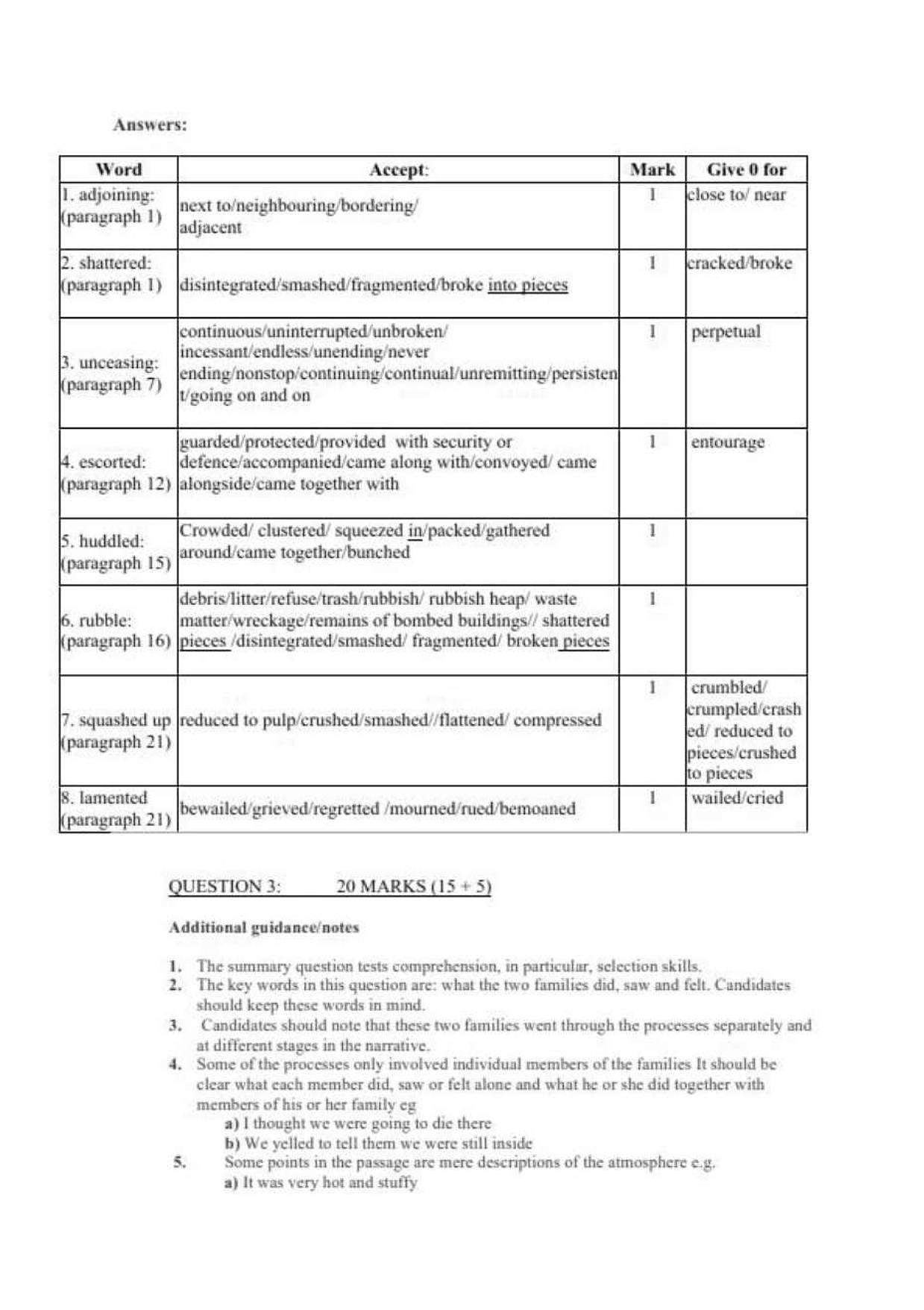
Answers:next to/neighbouring/bordering/
adjacent
disintegrated/smashed/fragmented/broke into pieces
continuous/uninterrupted/unbroken/
incessant/endless/unending/never
jlending/nonstop/continuing/continual/unremitting/ persiste:
t/going on and on
. unceasing:
paragraph 7)
guarded/protected/provided with security or
defence/accompanied/came along with/convoyed/ came
paragraph 12) Jalongside/came together with
ICrowded/ clustered/ squeezed in/packed/gathered
jaround/came together/bunched
debris/litter/refuse/trash/rubbish/ rubbish heap/ waste
matter/wreckage/remains of bombed buildings// shattered
ieces /disintegrated/smashed/ fragmented/ broken pieces
7. squashed up |reduced to pulp/crushed/smashed//flattened/ compressed
paragraph 21)
nies lbewailed/grieved/regretied /mourned/nued/bemoaned H | paibeteriod
paragraph 21)
QUESTION 3: 20 MARKS (15 * 5)
Additional guidance/notes
1, The summary question tests comprehension, in particulur, selection skills.
The key words in this question are: what the two families did, saw and felt. Candidates
should keep these words in mind.
3. Candidates should note that these two families went through the processes separutely and
at different stages in the narrative.
4. Some of the processes only involved individual members of the families It should be
clear what cach member did, saw or felt alone and what he or she did together with
members of his or her family eg
a) | thought we were going to dic there
b) We yelled to tell them we were still inside
5. Some points in the passage are mere descriptions of the atmosphere e.g.
a) It was very hot and stuffy
---
Page 9
Extracted Text
6. It is implied that the family members felt or saw since they were in that shelter.
Candidates should therefore present the members as active participants:
They felt hot and stuffy
They saw/felt the shelter heaving up and down
Pronouns such as he, she und/ or they should clearly refer to the correct agents
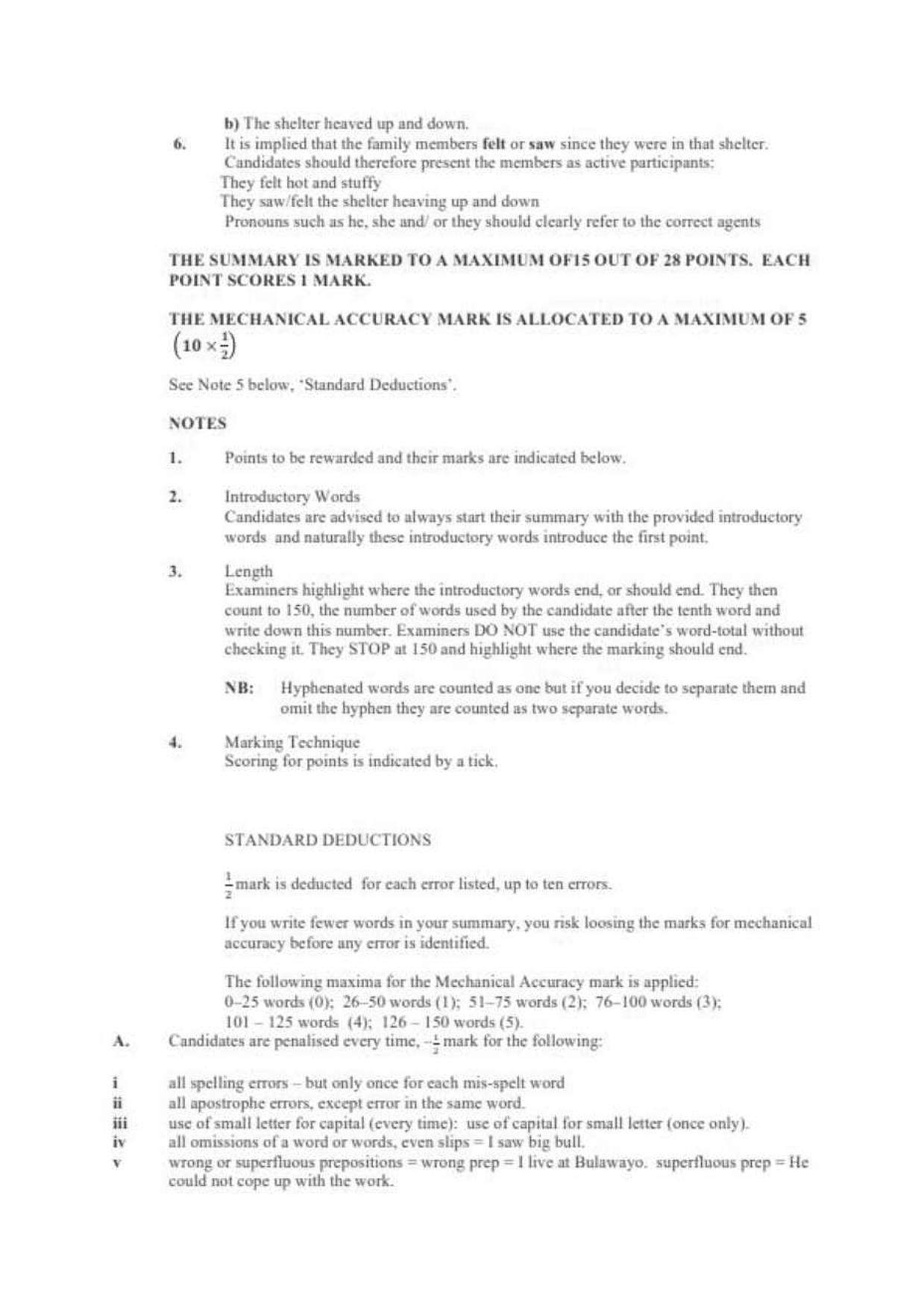
THE SUMMARY IS MARKED TO A MAXIMUM OF 15 OUT OF 28 POINTS. EACH
POINT SCORES | MARK.
THE MECHANICAL ACCURACY MARK IS ALLOCATED TO A MAXIMUM OF 5
ES
(103)
See Note 5 below, “Standard Deductions’.
NOTES
1. Points to be rewarded and their marks are indicated below.
2. Introductory Words
Candidates are advised to always start their summary with the provided introductory
words and naturally these introductory wards introduce the first point.
3. Len,
eee highlight where the introductory words end, or should end. They then
count to 150, the number of words used by the candidate after the tenth word and
write down this number. Examiners DO NOT use the candidate's word-total without
checking it. They STOP at 150 and highlight where the marking should end.
NB: Hyphenated words are counted as one but if you decide to separate them and
omit the hyphen they are counted 2s two separate words.
4 Marking Technique
Scoring for points is indicated by a tick,
STANDARD DEDUCTIONS
mark is deducted for cach error listed, up to ten errors.
If you write fewer words in your summary, you risk loosing the marks for mechanical
accuracy before any error is identified.
The following maxima for the Mechanical Accuracy mark is applied:
0-25 words (0); 26-50 words (1); 51-75 words (2); 76-100 words (3):
101 — 125 words (4); 126 — 150 words (5).
Candidates are penalised every time, -+ mark for the following:
all spelling errors — but only once for cach mis-spelt word
all apostrophe errors, except error in the same word.
use of small letter for capital (every time): use of capital for small letter (once only).
all omissions of a word or words, even slips = I saw big bull.
wrong or superfluous prepositions = wrong prep = | live at Bulawayo. superfluous prep = He
could not cope up with the work.
---
Page 10
Extracted Text
xvi xvii xviii xixBao
“3
we
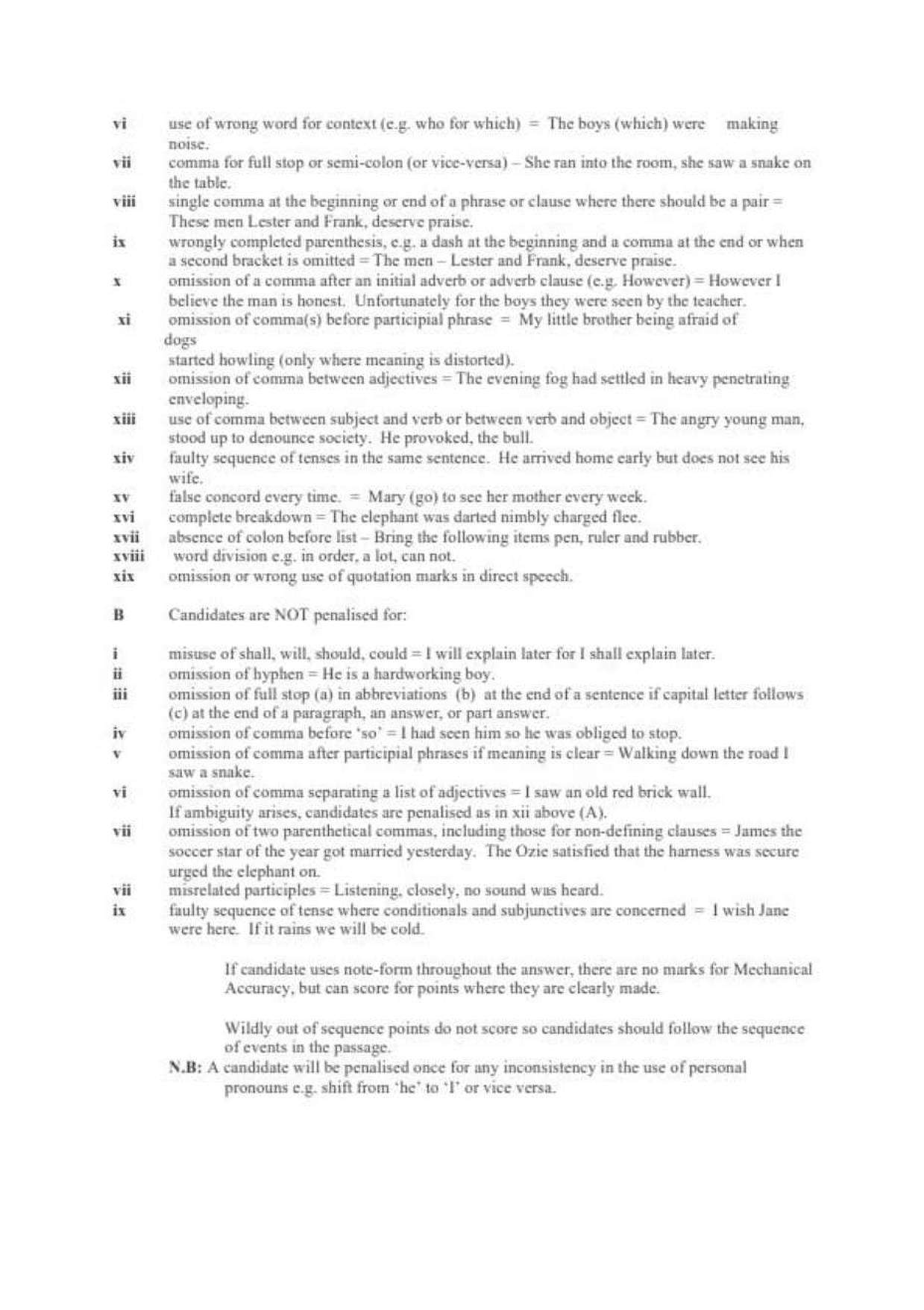
use of wrong word for context (e.¢. who for which) = The boys (which) were making
noise.
comma for full stop or semi-colon (or vice-versa) — She ran into the room, she saw a snake on
the table.
single comma at the beginning or end of a phrase or clause where there should be a pair =
These men Lester and Frank, deserve praise.
wrongly compicted parenthesis, ¢.g. a dash at the beginning and a comma at the end or when
a second bracket is omitted = The men — Lester and Frank, deserve praise.
omission of a comma after an initial adverb or adverb clause (c.g. However) = However |
believe the man is honest. Untortunately for the boys they were seen by the teacher.
omission of comma(s) before participial phrase = My little brother being afraid of
dogs
started howling (only where meaning is distorted).
omission of comma between adjectives = The evening fog had settled in heavy penctrating
enveloping.
use of comma between subject and verb or between verb and object = The angry young man,
stood up to denounce society. He provoked, the bull.
faulty sequence of tenses in the same sentence. He arrived home carly but does not see his
wife,
false concord every time. = Mary (go) to see her mother every week.
complete breakdown = The elephant was darted nimbly charged flee.
absence of colon before list - Bring the following items pen, ruler and rubber.
word division c.g. in order, a lot, can not.
omission of wrong use of quotation marks in direct speech.
Candidates are NOT penalised for:
misuse of shall, will, should, could = ! will explain later for | shall explain later-
omission of hyphen = He is a hardworking boy.
omission of full stop (a) in abbreviations (b) at the end of a sentence if capital letter follows
(c) at the end of a paragraph, an answer, or part answer.
omission of comma before ‘so’ = | had seen him so he was obliged to stop.
omission of comma after participial phrases if meaning is clear = Walking down the road |
saw a snake.
omission of comma separating a list of adjectives =| saw an old red brick wall.
If ambiguity arises, candidates are penalised as in xii above (A).
omission of two parenthetical commas, including those for non-defining clauses = James the
soccer star of the year got married yesterday. The Ozic satisfied that the harness was secure
urged the elephant on_
misrelated participles = Listening, closely, no sound wus heard.
faulty sequence of tense where conditionals and subjunctives are concerned = | wish Jane
were here. [fit rains we will be cold
If candidate uses note-form throughout the answer, there are no marks for Mechanical
Accuracy, but can score for points where they are clearly made.
Wildly out of sequence points do not score so candidates should follow the sequence
of events in the passage.
N.B: A candidate will be penalised once for any inconsistency in the use of personal
Pronouns ¢.g. shift from *he’ to I’ or yice versa
---
Page 11
Extracted Text
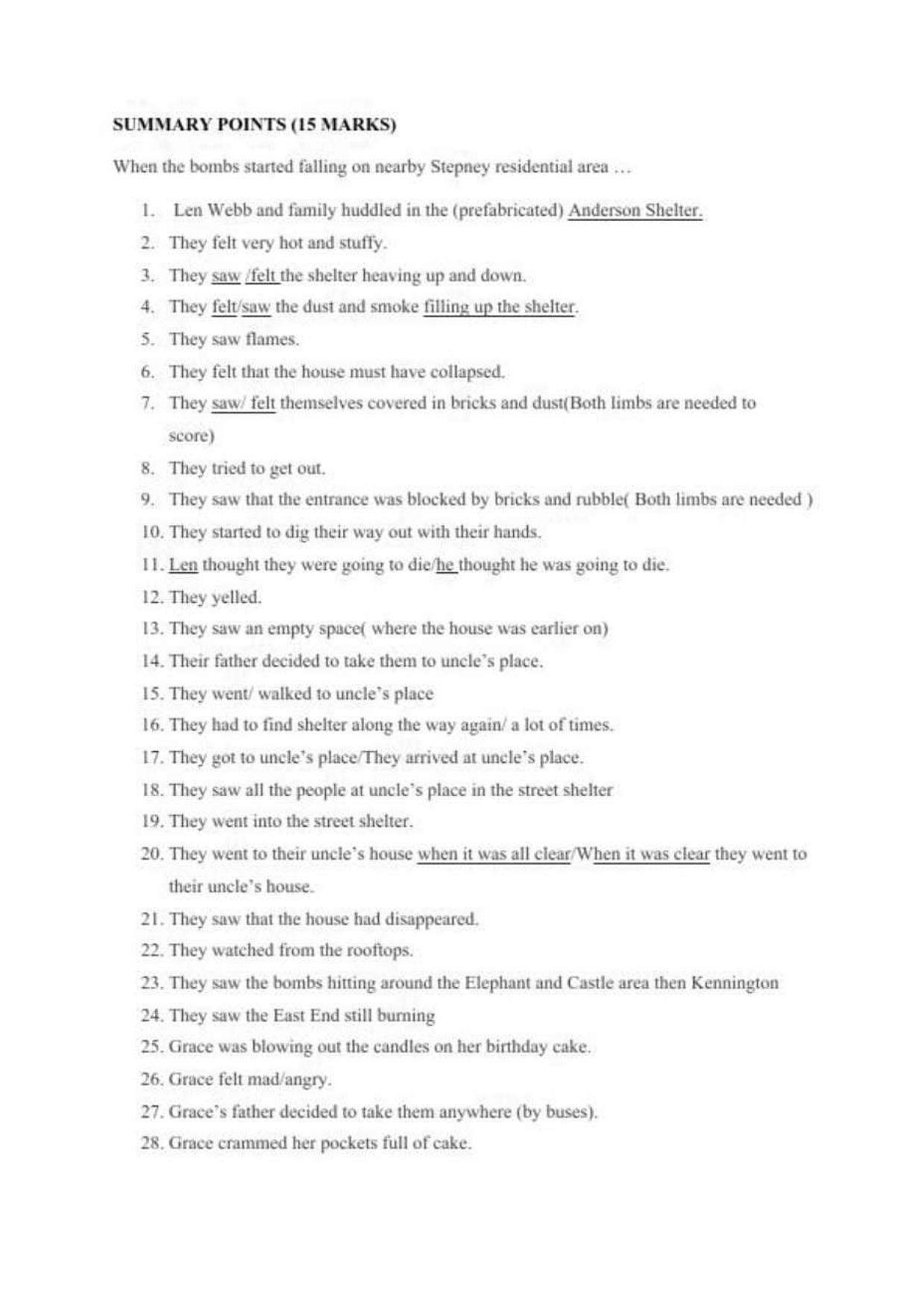
SUMMARY POINTS (15 MARKS) When the bombs started falling on nearby Stepney residential area ...1. Len Webb and family huddled in the (prefabricated) Anderson Shelter.
They felt very hot and stuffy.
They saw /felt the shelter heaving up and down,
They felt/saw the dust and smoke filling up the shelter.
te
They saw flames.
They felt that the house must have collapsed.
They saw/ felt themselves covered in bricks and dust(Both limbs are needed to
score)
8. They tried to get out.
9. They saw that the entrance was blocked by bricks and rubble( Both limbs are needed )
10. They started to dig their way out with their hands.
11. Len thought they were going to die/he thought he was going to die.
12. They yelled.
13. They saw an empty space( where the house was earlier on)
14. Their father decided to take them to uncle’s place.
15. They went/ walked to uncle's place
16. They had to find shelter along the way again/ a lot of times.
17. They got to uncle's place/They arrived at uncle's place.
22 ww
18. They saw all the people at uncle's place in the street shelter
19. They went into the street shelter.
20. They went to their uncle’s house when it was all clear/When it was clear they went to
their uncle's house.
21. They saw that the house had disappeared.
22. They watched from the rooftops.
23. They saw the bombs hitting around the Elephant and Castle area then Kennington
24. They saw the East End still burning
25. Grace was blowing out the candles on her birthday cake.
26. Grace felt mad/angry.
27. Grace’s father decided to take them anywhere (by buses).
28. Grace crammed her pockets full of cake.
---
Page 12
Extracted Text
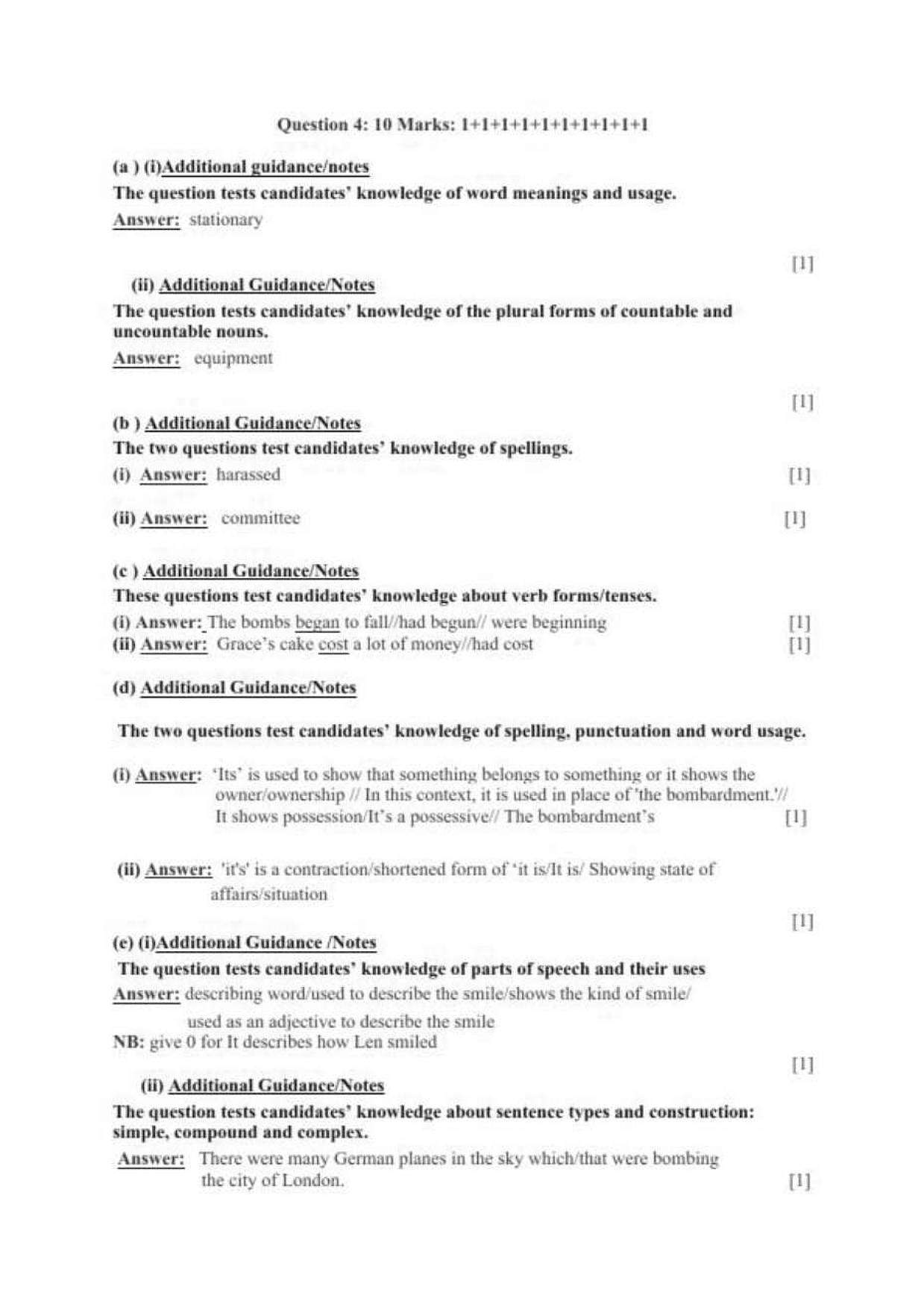
Question 4: 10 Marks: L¢141¢+1+14+14¢1+1+141(a ) (DAdditional guidance/notes
The question tests candidates’ knowledge of word meanings and usage.
Answer: stationary
(1
(ii) Additional Guidance/Notes
The question tests candidates’ knowledge of the plural forms of countable and
uncountable nouns.
Answer: equipment
1]
(b ) Additional Guidance/Notes
The two questions test candidates’ knowledge of spellings.
(i) Answer: harassed {1}
(ii) Answer: committee 1
(c ) Additional Guidance/Notes
These questions test candidates’ knowledge about verb forms/tenses.
(i) Answer: The bombs began to fall//had begun// were beginning [t]
(il) Answer: Grace’s cake cost a lot of money//had cost {!]
(d) Additional Guidance/Notes
The two questions test candidates’ knowledge of spelling, punctuation and word usage.
(}) Answer: ‘Its’ is used to show that something belongs to something or it shows the
owner/ownership // In this context, it is used in place of ‘the bombardment.'//
It shows possession/It’s a possessive// The bombardment’s a3)
(il) Answer: ‘it's’ is a contraction/shortened form of ‘it is‘It is/ Showing state of
affairs/situation
i)
(e) (DAdditional Guidance /Notes
The question tests candidates’ knowledge of parts of speech and their uses
Answer: describing word/used to describe the smile/shows the kind of smile/
used as an adjective to describe the smile
NB: give 0 for It describes how Len smiled
ta)
(il) Additional Guidance/Notes
The question tests candidates’ knowledge about sentence types and construction:
simple, compound and complex.
Answer: There were many German planes in the sky which/that were bombing
the city of London. [1]
---
Page 13
Extracted Text
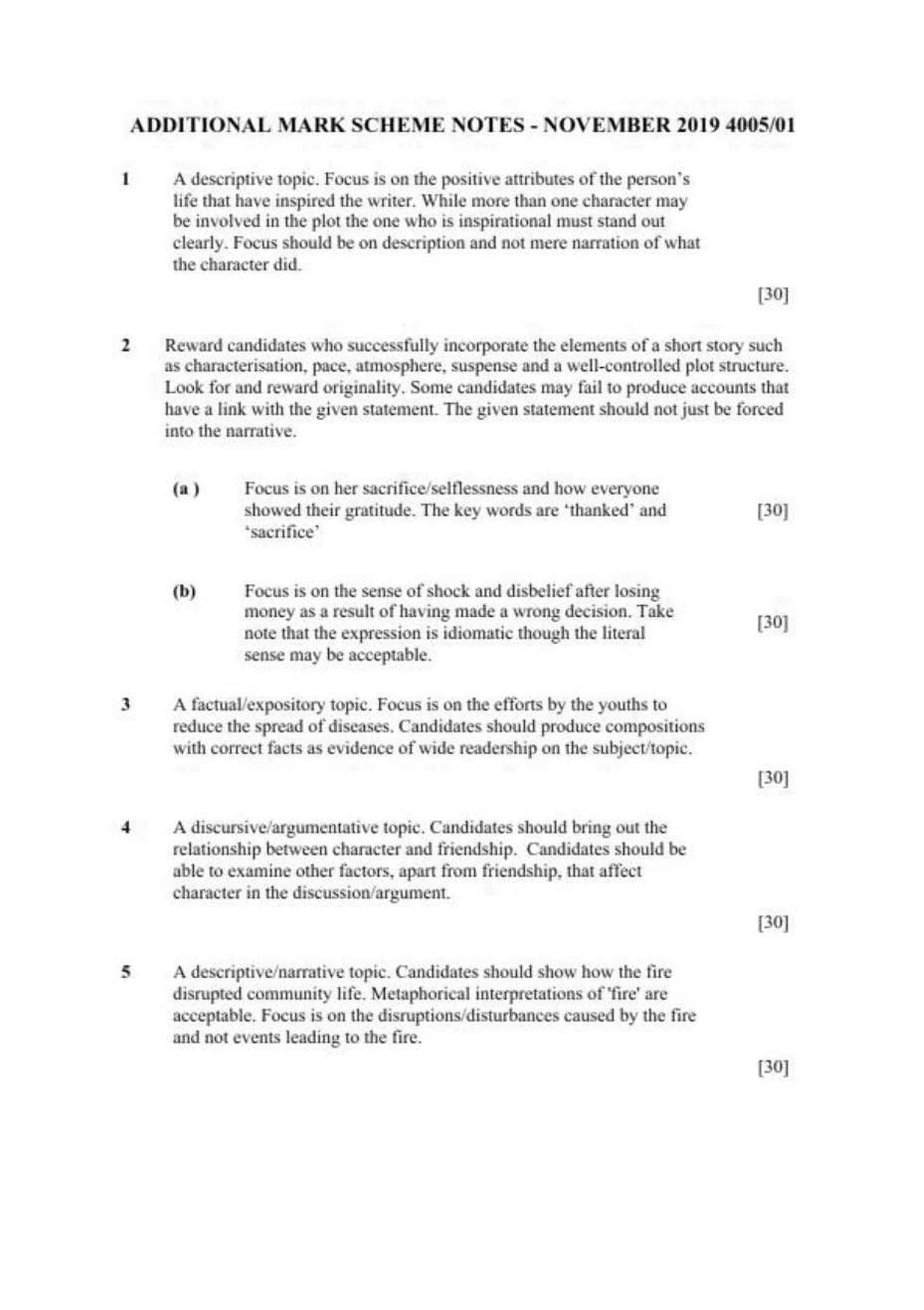
ADDITIONAL MARK SCHEME NOTES - NOVEMBER 2019 4005/01A descriptive topic. Focus is on the positive attributes of the person's
life that have inspired the writer. While more than one character may
be involved in the plot the one who is inspirational must stand out
clearly. Focus should be on description and not mere narration of what
the character did_
(30]
2 ~~ Reward candidates who successfully incorporate the elements of a short story such
as characterisation, pace, atmosphere, suspense and a well-controlled plot structure.
Look for and reward originality, Some candidates may fail to produce accounts that
have a link with the given statement. The given statement should not just be forced
into the narrative.
(a) Focus is on her sacrifice/selflessness and how everyone
showed their gratitude. The key words are ‘thanked* and [30]
“sacrifice”
(b) Focus is on the sense of shock and disbelief after losing
money as a result of having made a wrong decision. Take
note that the expression is idiomatic though the literal
sense may be acceptable.
[30]
3 A factual/expository topic. Focus is on the efforts by the youths to
reduce the spread of diseases. Candidates should produce compositions
with correct facts as evidence of wide readership on the subject/topic.
[30]
4 A discursive/argumentative topic. Candidates should bring out the
relationship between character and friendship. Candidates should be
able to examine other factors, apart from friendship, that affect
character in the discussion/argument_
[30]
5 A descriptive/narrative topic. Candidates should show how the fire
disrupted community life. Metaphorical interpretations of ‘fire’ are
acceptable. Focus is on the disruptions/disturbances caused by the fire
and not events leading to the fire.
[30]
---
Page 14
Extracted Text
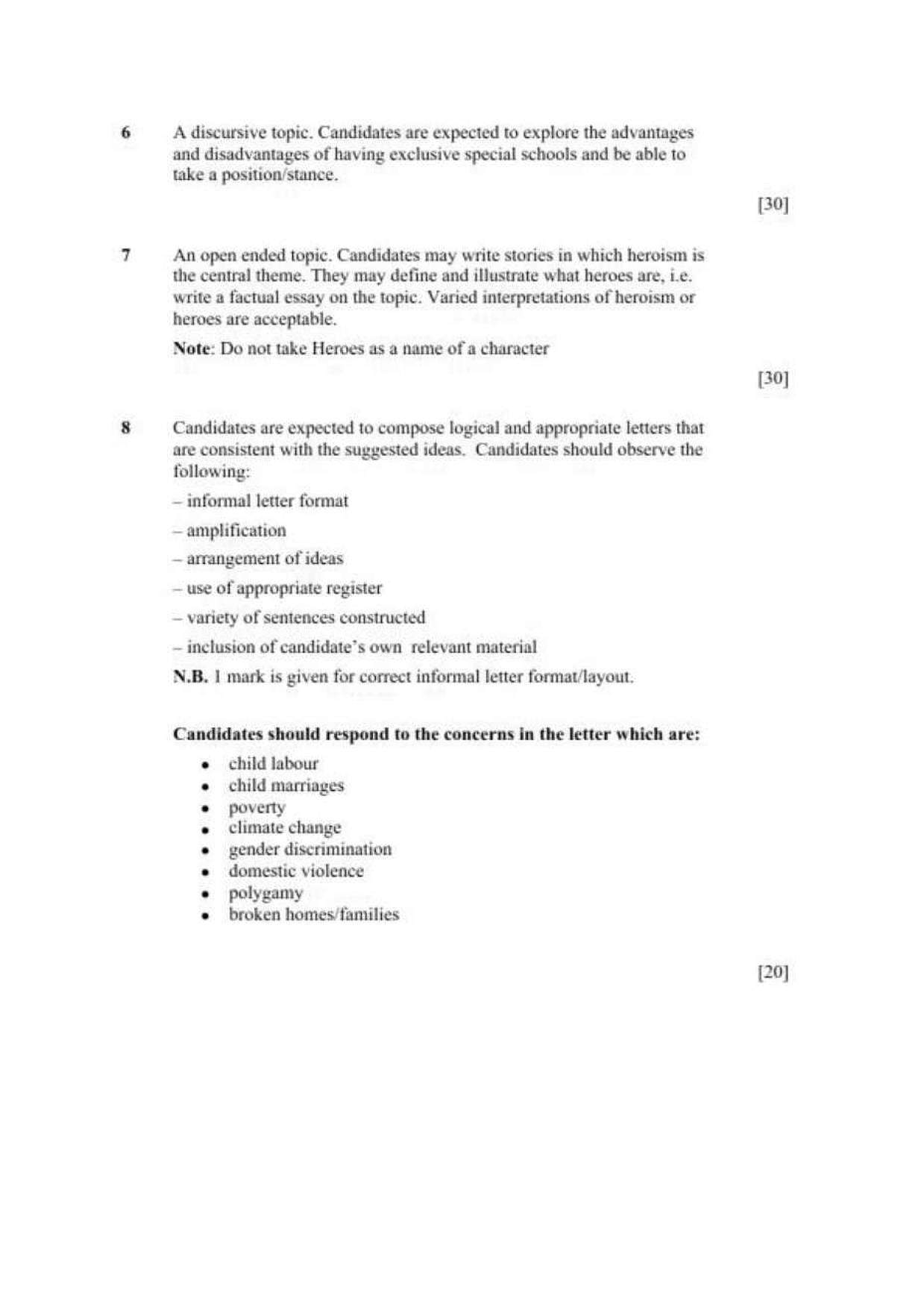
A discursive topic. Candidates are expected to explore the advantages and disadvantages of having exclusive special schools and be able to take a position/stance.[30]
An open ended topic. Candidates may write stories in which heroism is
the central theme. They may define and illustrate what heroes are, i.e.
write a factual essay on the topic. Varied interpretations of heroism or
heroes are acceptable.
Note: Do not take Heroes as a name of a character
[30]
Candidates are expected to compose logical and appropriate letters that
are consistent with the suggested ideas. Candidates should observe the
following:
— informal letter format
— amplification
— arrangement of ideas
~ use of appropriate register
— variety of sentences constructed
— inclusion of candidate’s own relevant material
N.B. | mark is given for correct informal letter format/layout.
Candidates should respond to the concerns in the letter which are:
child labour
child marriages
poverty
climate change
gender discrimination
domestic violence
polygamy
broken homes/families
[20]
---
Page 15
Extracted Text
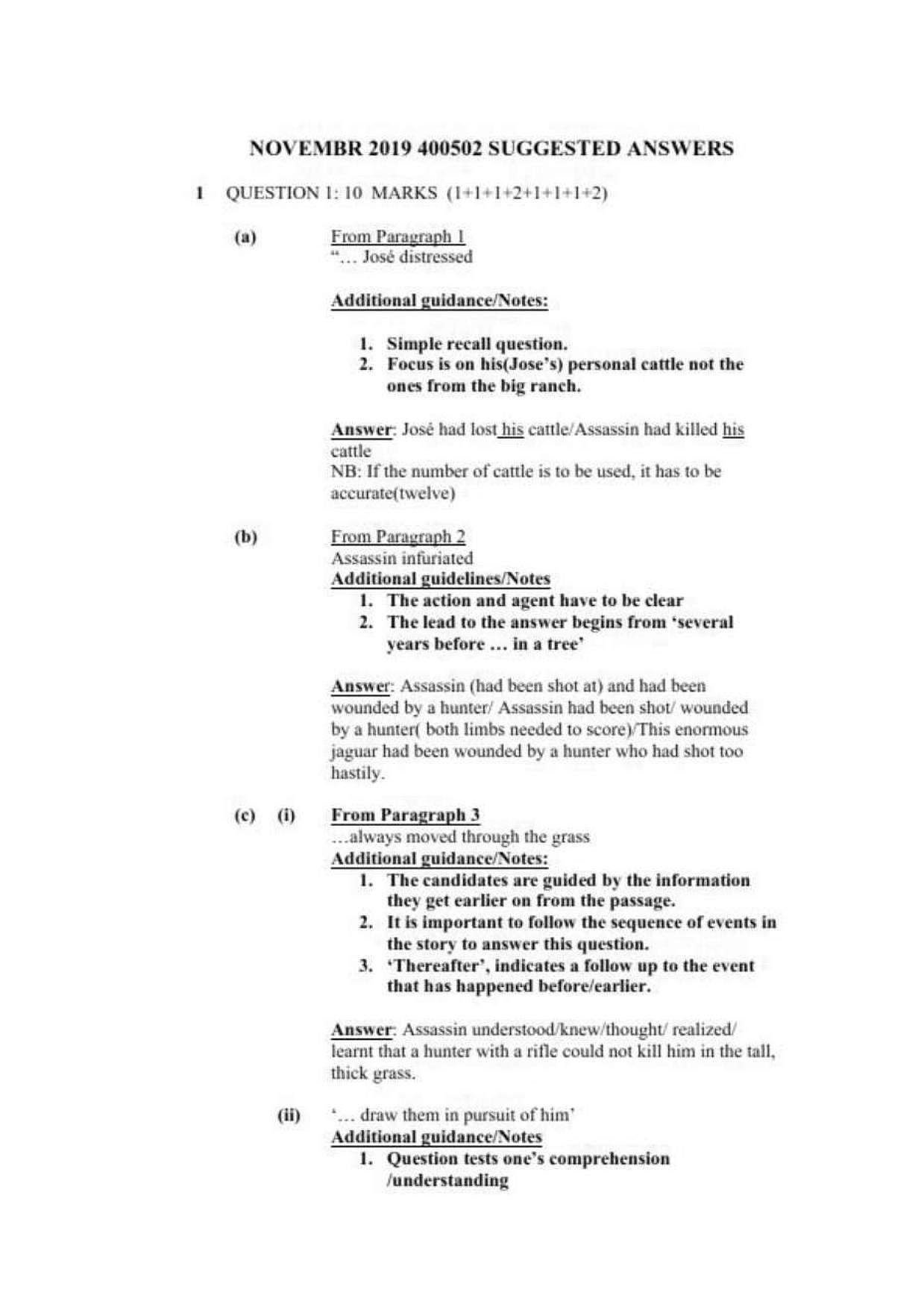
NOVEMBR 2019 400502 SUGGESTED ANSWERS1) QUESTION 1: 10 MARKS (1+1+1+2+1+1+1+#2)
(a)
(b)
(ec)
(i)
(ii)
From Paragraph |
“... José distressed
Additional guidance/Notes:
1. Simple recall question.
2. Focus is on his(Jose’s) personal cattle not the
ones from the big ranch.
Answer: José had lost_his cattle/ Assassin had killed his
cattle
NB: If the number of cattle is to be used, it has to be
accurate(twelve)
From Paragraph 2
Assassin infuriated
Additional guidelines/Notes
1. The action and agent have to be clear
2. The lead to the answer begins from ‘several
years before ... in a tree’
Answer: Assassin (had been shot at) and had been
wounded by a hunter’ Assassin had been shot/ wounded
by a hunter( both limbs needed to score)/This enormous
jaguar had been wounded by a hunter who had shot too
hastily.
From Paragraph 3
...always moved through the grass
Additional guidance/Notes:
1. The candidates are guided by the information
they get earlier on from the passage.
2. It is important to follow the sequence of events in
the story to answer this question.
3. ‘Thereafter’, indicates a follow up to the event
that has happened before/earlier.
Answer: Assassin understood/knew/thought realized/
learnt that a hunter with a rifle could not kill him in the tall,
thick grass.
*... draw them in pursuit of him’
Additional guidance/Notes
1. Question tests one’s comprehension
/understanding
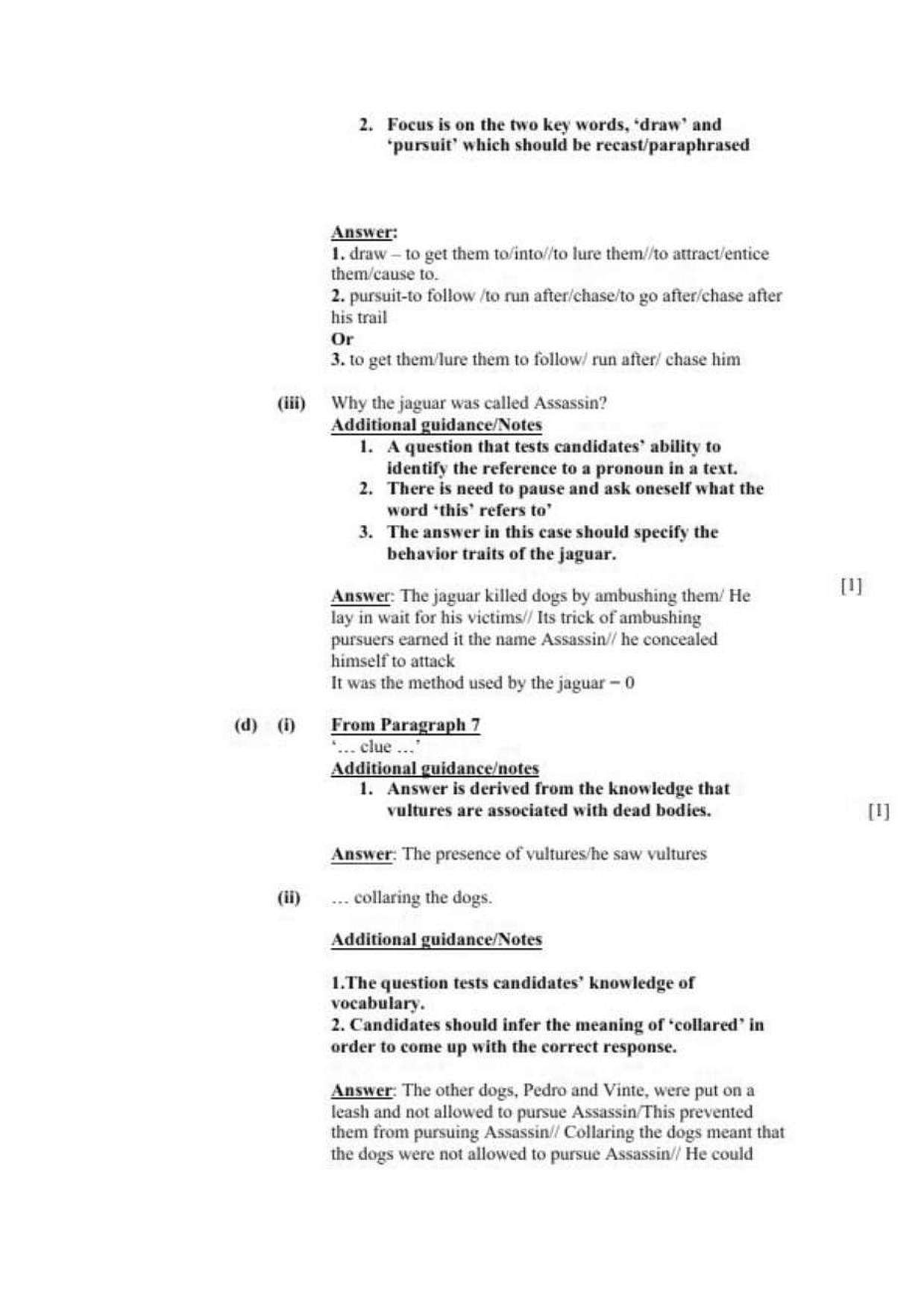
---
Page 16
Extracted Text
(iii)@) @
(ii)
2. Focus is on the two key words, ‘draw’ and
‘pursuit’ which should be recast/paraphrased
Answer:
1, draw — to get them to/into//to lure them//to attract/entice
them/cause to.
2. pursuit-to follow /to run after/chase/to go after/chase after
his trail
Or
3. to get them/lure them to follow/ run after/ chase him
Why the jaguar was called Assassin?
Additional guidance/Notes
1. A question that tests candidates’ ability to
identify the reference to a pronoun in a text.
2. There is need to pause and ask oneself what the
word ‘this’ refers to”
3, The answer in this case should specify the
behavior traits of the jaguar.
Answer: The jaguar killed dogs by ambushing them/ He 4]
lay in wait for his victims// Its trick of ambushing
pursuers earned it the name Assassin// he concealed
himself to attack
It was the method used by the jaguar - 0
From Paragraph 7
"535 CHB.
Additional guidance/notes
1. Answer is derived from the knowledge that
vultures are associated with dead bodies. {)]
Answer: The presence of yultures/he saw vultures
... collaring the dogs.
Additional guidance/Notes
L.The question tests candidates’ knowledge of
vocabulary.
2. Candidates should infer the meaning of ‘collared’ in
order to come up with the correct response.
Answer: The other dogs, Pedro and Vinte, were put on a
leash and not allowed to pursue Assassin/This prevented
them from pursuing Assassin// Collaring the dogs meant that
the dogs were not allowed to pursue Assassin// He could
---
Page 17
Extracted Text
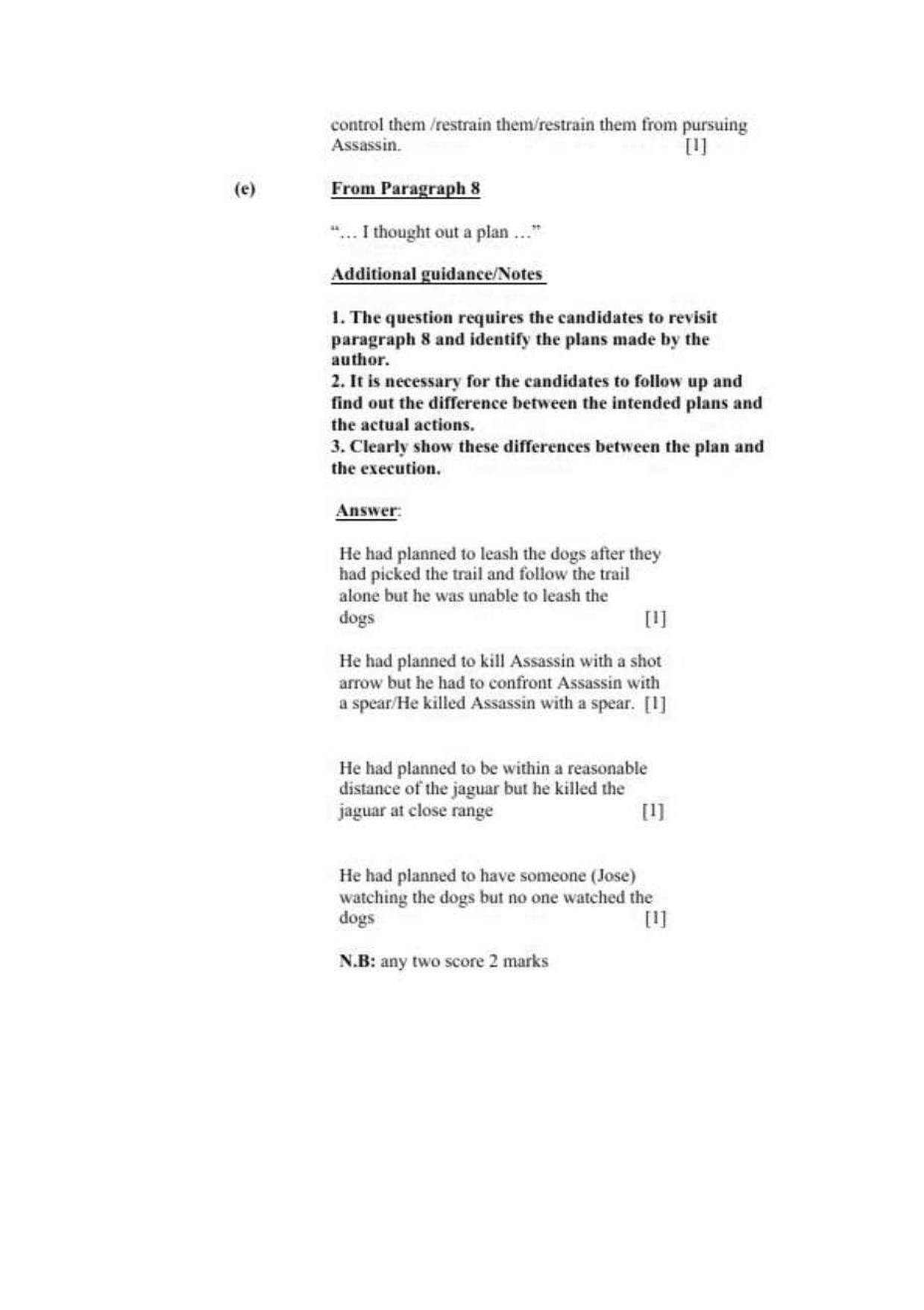
(e)control them /restrain them/restrain them from pursuing
Assassin. a3)
From Paragraph 8
“... [thought out a plan ...”
Additional guidance/Notes
1. The question requires the candidates to revisit
paragraph 8 and identify the plans made by the
author.
2. It is necessary for the candidates to follow up and
find out the difference between the intended plans and
the actual actions,
3. Clearly show these differences between the plan and
the execution,
Answer:
He had planned to leash the dogs after they
had picked the trail and follow the trail
alone but he was unable to leash the
dogs a3}
He had planned to kill Assassin with a shot
arrow but he had to confront Assassin with
a spear/He killed Assassin with a spear. [1]
He had planned to be within a reasonable
distance of the jaguar but he killed the
jaguar at close range 0)
He had planned to have someone (Jose)
watching the dogs but no one watched the
dogs eal
N.B: any two score 2 marks
---
Page 18
Extracted Text
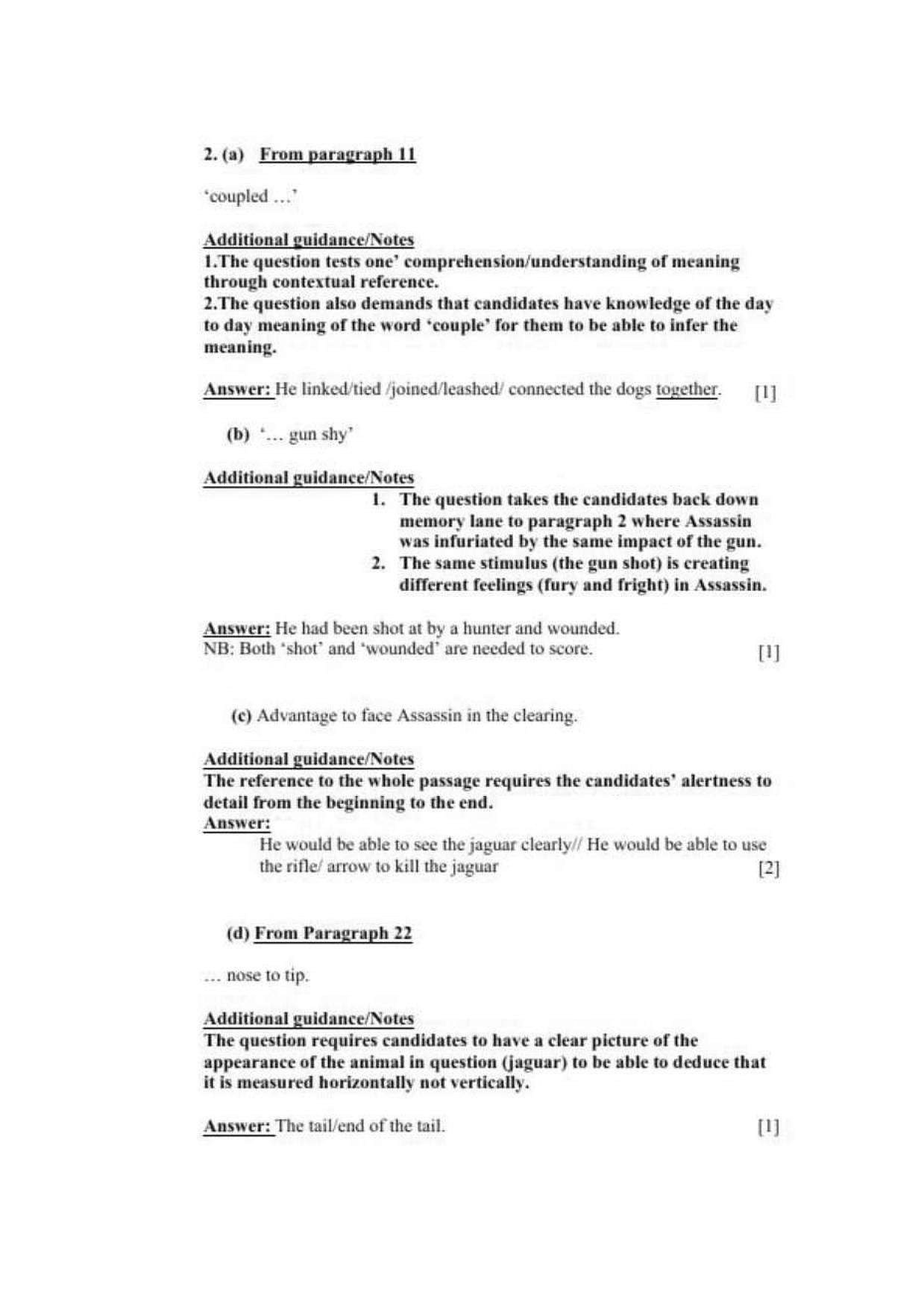
2.(a) From paragraph 11“coupled ...”
Additional guidance/Notes
1. The question tests one’ comprehension/understanding of meaning
through contextual reference.
2.The question also demands that candidates have knowledge of the day
to day meaning of the word ‘couple’ for them to be able to infer the
meaning.
Answer: He linked/tied /joined/leashed/ connected the dogs together. [1]
(b) *... gun shy”
Additional guidance/Notes
1. The question takes the candidates back down
memory lane to paragraph 2 where Assassin
was infuriated by the same impact of the gun.
2. The same stimulus (the gun shot) is creating
different feelings (fury and fright) in Assassin.
Answer: He had been shot at by a hunter and wounded.
NB; Both “shot” and “wounded” are needed to score. iy
(c) Advantage to face Assassin in the clearing.
Additional guidance/Notes
The reference to the whole passage requires the candidates’ alertness to
detail from the beginning to the end.
Answer:
He would be able to see the jaguar clearly// He would be able to use
the rifle/ arrow to kill the jaguar [2]
(d) From Paragraph 22
--- Nose to tip.
Additional guidance/Notes
The question requires candidates to have a clear picture of the
appearance of the animal in question (jaguar) to be able to deduce that
it is measured horizontally not vertically.
Answer: The tail/end of the tail. {1)
---
Page 19
Extracted Text
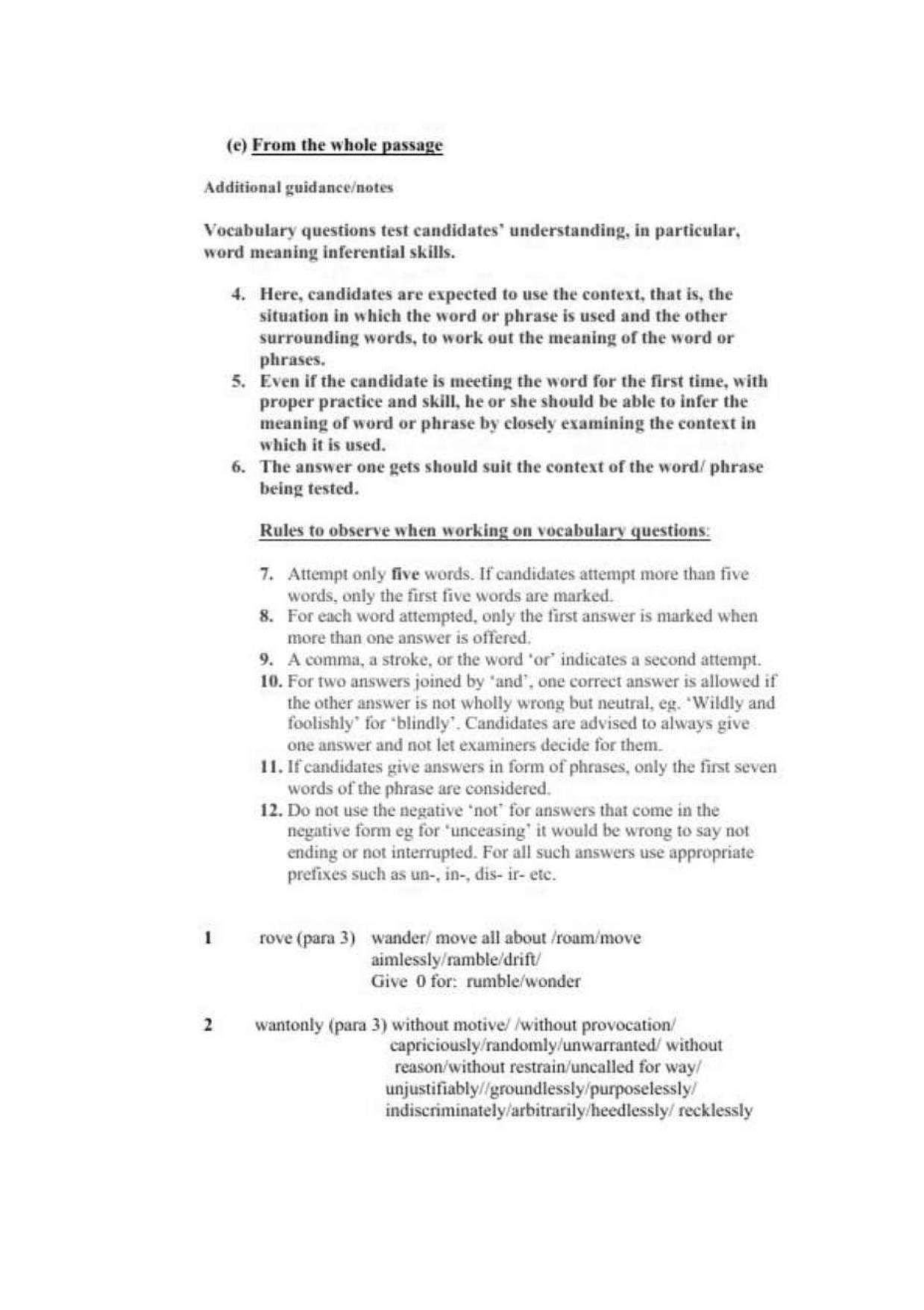
(c) From the whole passage Additional guidance/notesVocabulary questions test candidates’ understanding, in particular,
word meaning inferential skills.
4.
Here, candidates are expected to use the context, that is, the
situation in which the word or phrase is used and the other
surrounding words, to work out the meaning of the word or
phrases,
Even if the candidate is meeting the word for the first time, with
proper practice and skill, he or she should be able to infer the
meaning of word or phrase by closely examining the context in
which it is used.
The answer one gets should suit the context of the word/ phrase
being tested.
Rules to observe when working on vocabulary questions:
7. Attempt only five words. If candidates attempt more than five
words. only the first five words are marked.
8. For each word attempted, only the first answer is marked when
more than one answer is offered.
9. Acomma, a stroke, or the word ‘or’ indicates a second attempt.
10. For two answers joined by ‘and’, one correct answer is allowed if
the other answer is not wholly wrong but neutral, eg. “Wildly and
foolishly” for ‘blindly’. Candidates are advised to always give
one answer and not let examiners decide for them_
11, If candidates give answers in form of phrases, only the first seven
words of the phrase are considered.
12. Do not use the negative ‘not’ for answers that come in the
newative form eg for ‘unceasing’ it would be wrong to say not
ending of not interrupted. For all such answers use appropriate
prefixes such as un-, in-, dis- ir- ete.
rove (para 3) wander/ move all about /roam/move
aimlessly/ramble/drift/
Give 0 for: rumble/wonder
wantonly (para 3) without motive/ /without provocation/
capriciously/randomly/unwarranted/ without
reason/without restrain/uncalled for way/
unjustifiably//groundlessly/purposelessly/
indiscriminately/arbitrarily/heedlessly/ recklessly
---
Page 20
Extracted Text
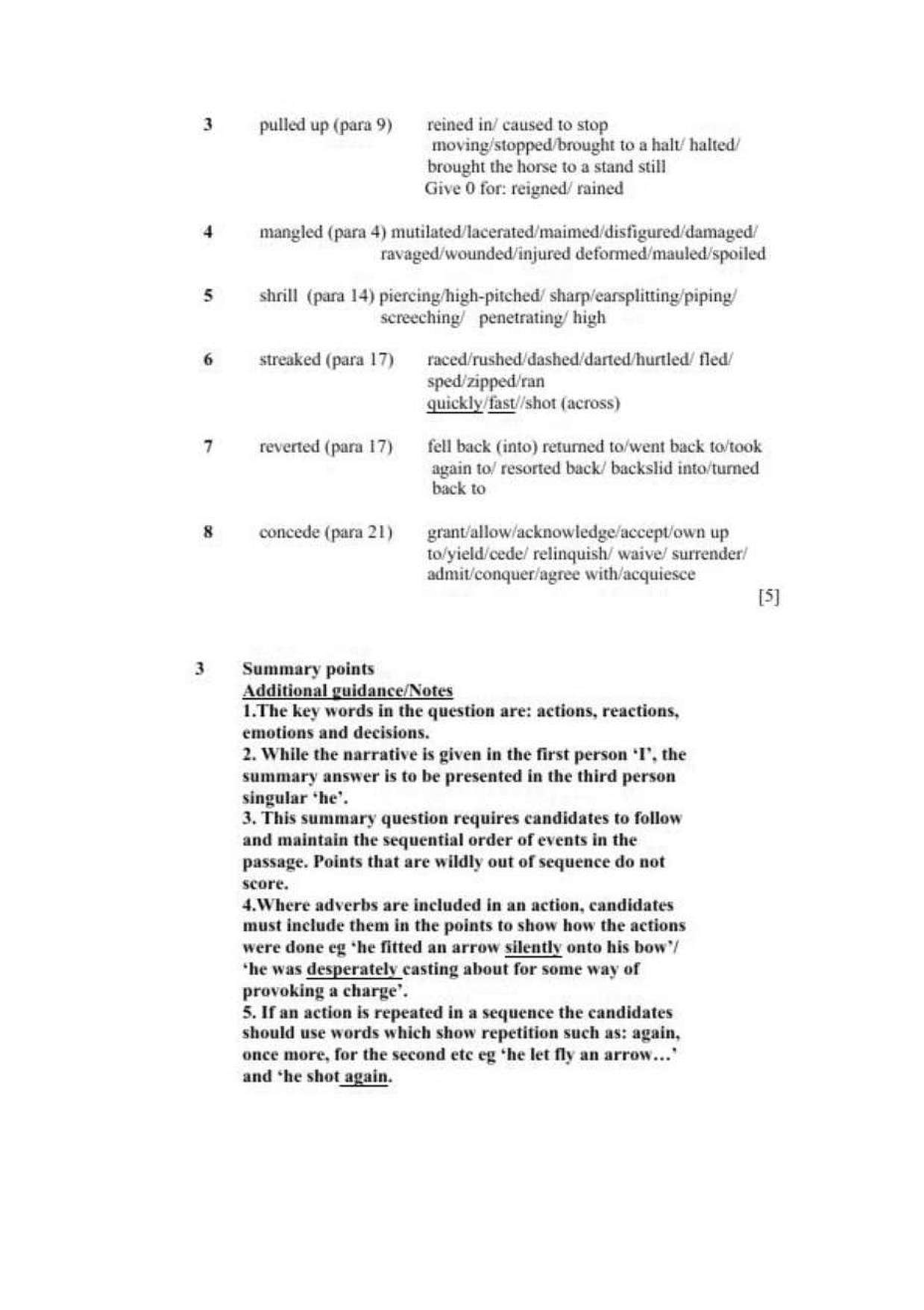
pulled up (para 9) reined in/ caused to stop moving/stopped/brought to a halt halted/ brought the horse to a stand still Give 0 for: reigned/ rainedmangled (para 4) mutilated/lacerated/maimed/disfigured/damaged/
ravaged/wounded/injured deformed/mauled/spoiled
shrill (para 14) piercing/high-pitched/ sharp/earsplitting/piping/
sereeching/ penetrating/ high
streaked (para 17) —_raced/rushed/dashed/darted/hurtled/ fled/
sped/zipped/ran
qguickly/fast//shot (across)
reverted (para 17) fell back (into) returned to/went back to/took
again to/ resorted back/ backslid into/tumed
back to
concede (para 21) grant/allow/acknowledge/accept/own up
to/yield/cede/ relinquish’ waive/ surrender!
admit/conquer/agree with/acquiesce
[5]
Summary points
Additional guidance/Notes
1.The key words in the question are: actions, reactions,
emotions and decisions.
2. While the narrative is given in the first person ‘I’, the
summary answer is to be presented in the third person
singular ‘he’.
3. This summary question requires candidates to follow
and maintain the sequential order of events in the
passage. Points that are wildly out of sequence do not
score.
4.Where adverbs are included in an action, candidates
must include them in the points to show how the actions
were done eg *he fitted an arrow silently onto his bow’/
“he was desperately casting about for some way of
provoking a charge’.
5. If an action is repeated in a sequence the candidates
should use words which show repetition such as: again,
once more, for the second ete eg *he let fly an arrow..."
and *he shot again.
---
Page 21
Extracted Text
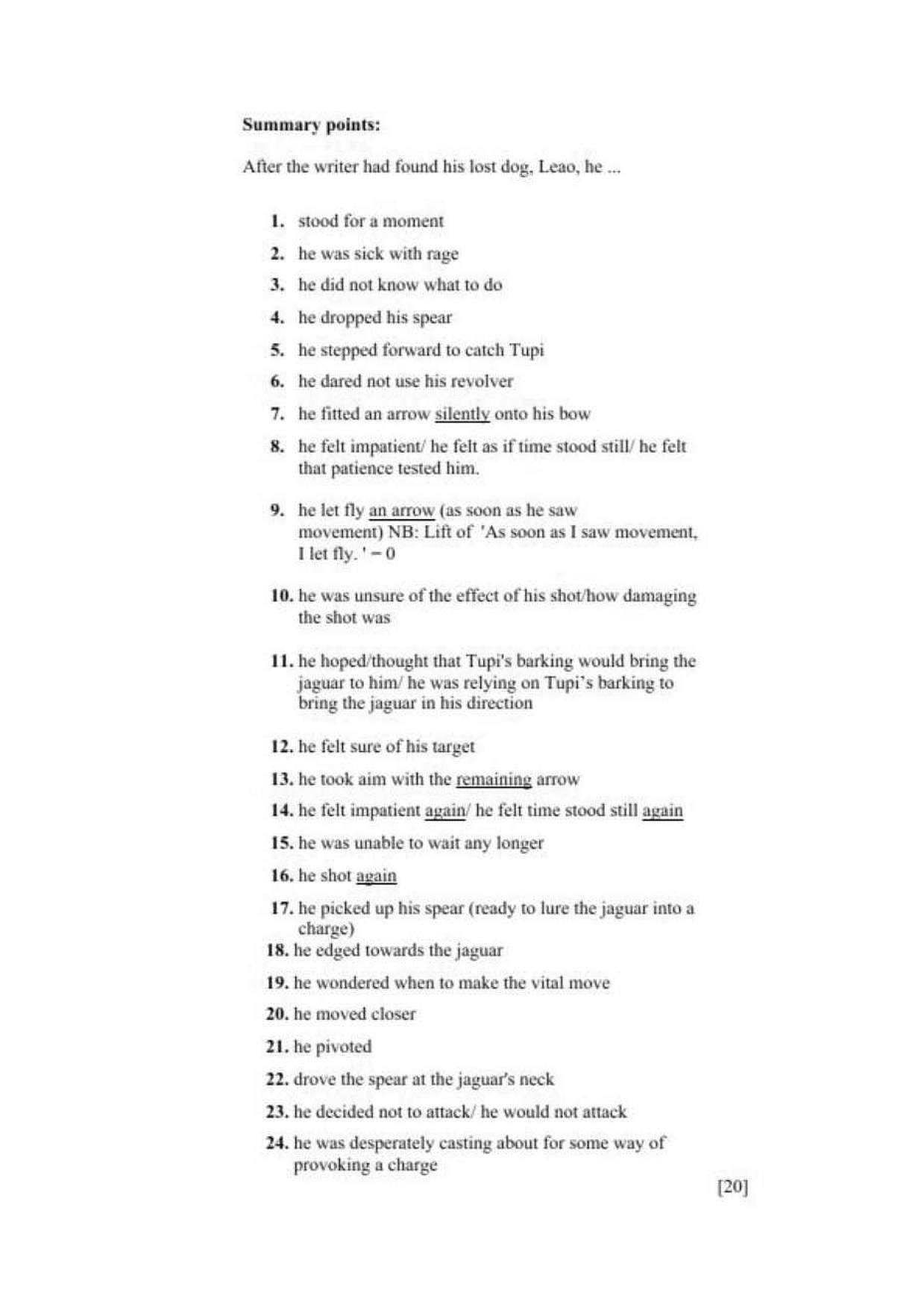
Summary points:After the writer had found his lost dog, Leao, he -..
1, stood for a moment
2. he was sick with rage
3. he did not know what to do
4. he dropped his spear
he stepped forward to catch Tupi
he dared not use his revolver
he fitted an arrow silently onto his bow
he felt impatient/ he felt as if time stood still/ he felt
that patience tested him.
9. he let fly an arrow (as soon as he saw
movement) NB: Lift of "As soon as I saw movement,
I let fly.'-0
10. he was unsure of the effect of his shot/how damaging
the shot was
11. he hoped/thought that Tupi's barking would bring the
jaguar to him/ he was relying on Tupi’s barking to
bring the jaguar in his direction
12. he felt sure of his target
13. he took aim with the remaining arrow
14. he felt impatient again/ he felt time stood still again
15. he was unable to wait any longer
16, he shot again
17. he picked up his spear (ready to lure the jaguar into a
charge)
18. he edged towards the jaguar
19. he wondered when to make the vital move
20. he moved closer
21. he pivoted
22. drove the spear at the jaguar’s neck
23. he decided not to attack/ he would not attack
24. he was desperately casting about for some way of
provoking a charge
[20]
---
Page 22
Extracted Text
(a)(b)
{e)
(d)
{e)
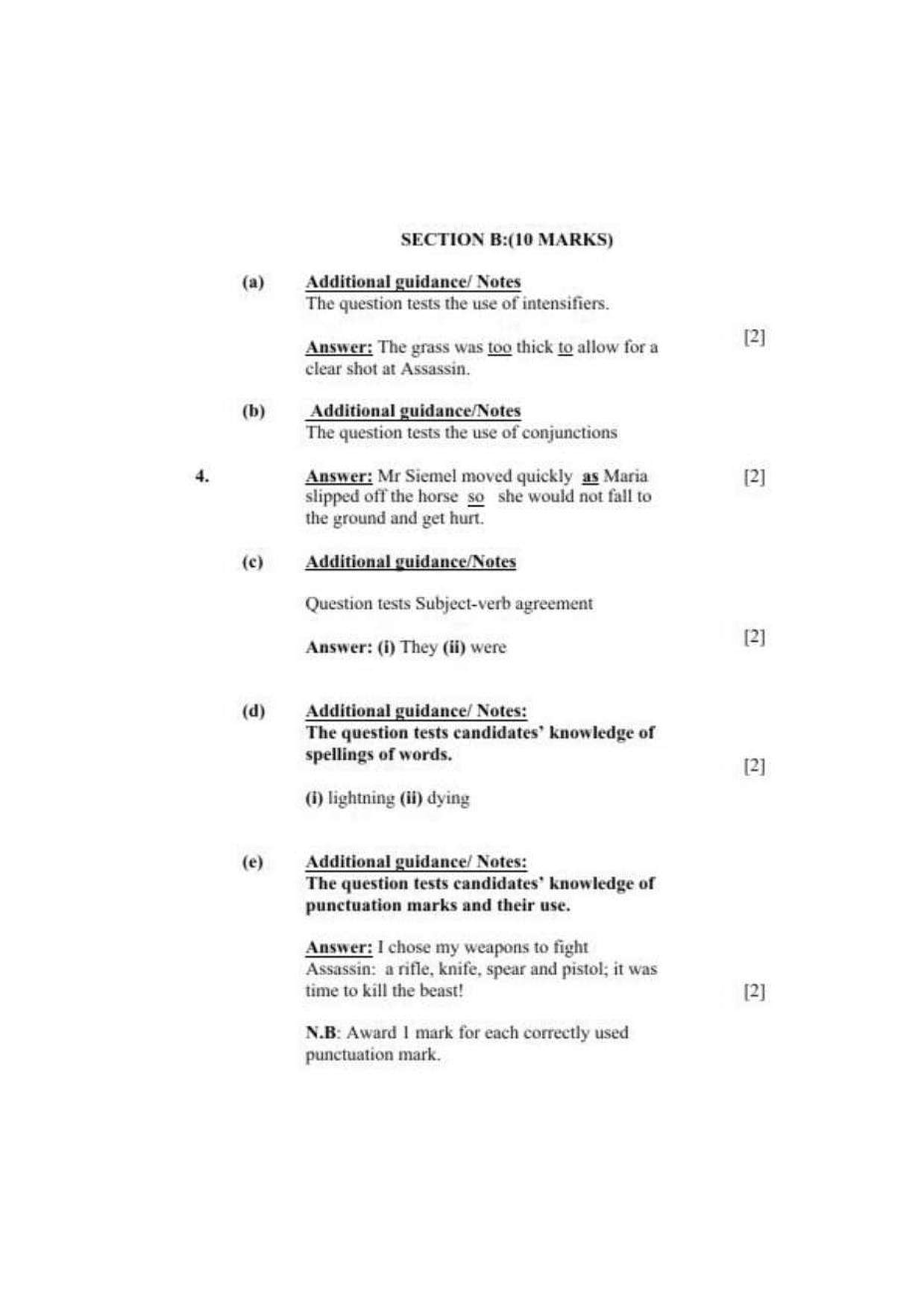
SECTION B:(10 MARKS)
Additional guidance/ Notes
The question tests the use of intensifiers.
Answer: The grass was too thick to allow fora
clear shot at Assassin.
Additional guidance/Notes
The question tests the use of conjunctions
Answer: Mr Siemel moved quickly as Maria
slipped off the horse so she would not fall to
the ground and get hurt.
dditio: ui Notes
Question tests Subject-verb agreement
Answer: (i) They (ii) were
Additional guidance/ Notes:
The question tests candidates’ knowledge of
spellings of words,
(i) lightning (ii) dying
Additional guidance/ Notes:
The question tests candidates’ knowledge of
punctuation marks and their use.
Answer: I chose my weapons to fight
Assassin: a rifle, knife, spear and pistol; it was
time to kill the beast!
N.B: Award | mark for each correctly used
punctuation mark,
[2]
[2]
P]
---
Struggling with the concepts in this paper?
Revise syllabus notes, key exam points, and interactive practice questions for Languages English: