📄 Exam Questions & Readable Text Transcript
Full OCR-extracted text of questions, syllabus codes, and exam instructions.
Extracted Content: grammar practice
Page 1
Extracted Text
By: Miss MaryamPRACTICE GRAMMAR
The Present Continuous \ ;
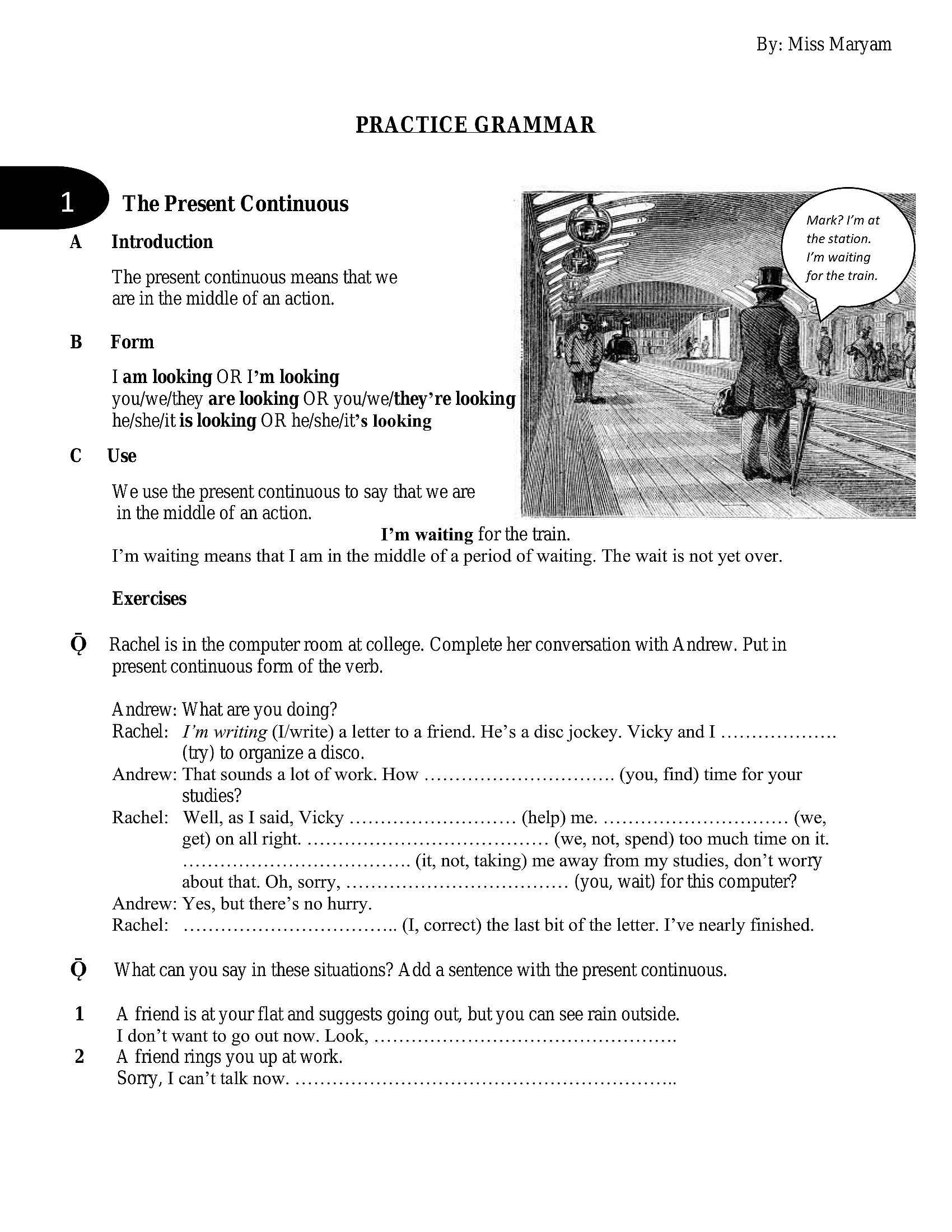
= Mark? I’m at
A Introduction the station.
: I’m waiting
The present continuous means that we g ‘ KX for the train.
are in the middle of an action.
B Form
Tam looking OR I’m looking
you/we/they are looking OR you/we/they’re looking
he/she/it is looking OR he/she/it’s looking
C Use A i
yy
We use the present continuous to say that we are \ Hi
in the middle of an action. SLi
I’m waiting for the train.
I’m waiting means that I am in the middle of a period of waiting. The wait is not yet over.
} i
| |
Exercises
O Rachel is in the computer room at college. Complete her conversation with Andrew. Put in
present continuous form of the verb.
Andrew: What are you doing?
Rachel: J’m writing (I/write) a letter to a friend. He’s a disc jockey. Vicky and1.................4.
(try) to organize a disco.
Andrew: That sounds a lot of work. How ................:e cece (you, find) time for your
studies?
Rachel: Well, as I said, Vicky ................ececeeee eee (help) me. ...... 0c ee eeeeeeeeeeeeeen eee (we,
get) on all right. 2.2.00... cece eeeeeeee eee teen ee (we, not, spend) too much time on it.
be bebee eee eens ee een ones ... (it, not, taking) me away from my studies, don’t worry
about that. Oh, Sorry, .............0ccccceeceeeeeeeeee eens (you, wait) for this computer?
Andrew: Yes, but there’s no hurry.
Rachel: ........ cece eee (L, correct) the last bit of the letter. I’ve nearly finished.
O What can you say in these situations? Add a sentence with the present continuous.
1__ A friend is at your flat and suggests going out, but you can see rain outside.
I don’t want to go out now. Look,
2 A friend rings you up at work.
Sorry, I can’t talk NOW. ...... 00.66. ceccec ec ee cece eee eeeeeceeeeeeeeeeeneeseeteeneees
---
Page 2
Extracted Text
©By: Miss Maryam
Y ou want to get off the bus, but the man next to you is sitting on your coat.
Excuse me, .........
A friend wants to talk to you, but you have just started to write an important letter.
Can I talk to you later? 0.0... ccc cence eee e eee n eee ee nee ee ease ene
You have been ill, but you’re better now than you were.
Tm okay now. 20.0.0... 0. cece cece cece cece cee e eee e nee ee eee et nea eene nea ee neg ea een eaeeee
Past C ontinuous or Simple?
Past Continuous Past simple
We use the past continuous for an action We use past simple for a complete
that we were in the middle of... action in the past.
We were driving home. We drove home.
(We were in the middle of our journey.) (We finished our journey.)
We often use the past continuous to describe We use the past simple for actions in a
the background. story.
The sun was shining. We arrived at the beach.
We often use the past continuous and simple together when one (shorter) action comes in the
middle of another (longer) one.
As we were driving down the hill, a strange object appeared in the sky.
While Laura was sitting in the garden, it suddenly began to rain.
Exercises
David is always hav
Y ou drove right past me when I was waiting for the bus.
ing accidents. His friend Melanie is talking about some of the accidents.
Write her sentences from these notes. Each sentence has one verb in the past continuous and one
in the past simple.
when / he/ carry /a
suitcase / he / drop / it / on his foot
when he was carrying a suitcase, he dropped it on his foot.
he / sit down / on a chair / while /1/ paint / it
---
Page 3
Extracted Text
By: Miss MaryamO Putin the correct form of the verb.
Rita: I hear the lights went (go) out in your flats last night.
Emma: Y es, I was watching (I / watch) a documentary on TV when suddenly
(1) oo eee eee ceeeteteteeeeteteeeeseeee (We / lose) all the power. But
....+ (it / come) on again after about ten minutes.
cede bees ee ee ee eens ee eeeaenenenes (come) down the stairs when the lights
Cn (go) out. She almost (5) .......... ee (fall)
over.
Daniel: Matthew and I (6) ............ cee eeeee eee cereeeees (play) table tennis at the time.
Andrew: (7) .........02:00eeeeeeeeseeeeeee (I/ work) on the computer.
((:) ee (I / lose) a whole hour's work. But this morning
(.) (I/get) up early and (10) .......... eee (do) it again.
The Present Perfect
A Introduction
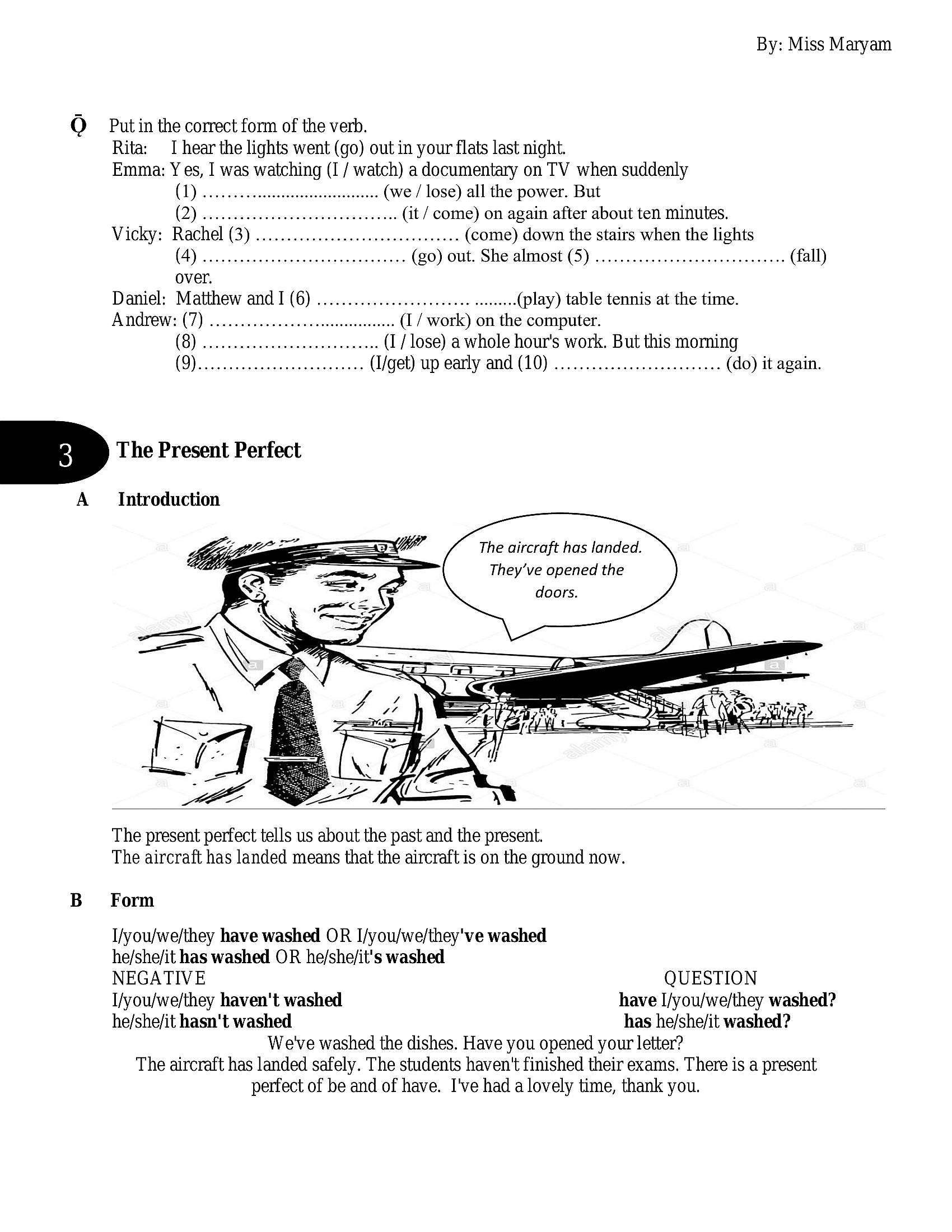
The aircraft has landed.
They’ve opened the
The present perfect tells us about the past and the present.
The aircraft has landed means that the aircraft is on the ground now.
B Form
I/you/we/they have washed OR I/you/we/they've washed
he/she/it has washed OR he/she/it's washed
NEGATIVE QUESTION
I/you/we/they haven't washed have I/you/we/they washed?
he/she/it hasn't washed has he/she/it washed?
We've washed the dishes. Have you opened your letter?
The aircraft has landed safely. The students haven't finished their exams. There is a present
perfect of be and of have. I've had a lovely time, thank you.
---
Page 4
Extracted Text
©By: Miss Maryam
Use
When we use the present perfect, we see things as happening in the past but having a result in the
present.
We've washed the dishes. (They're clean now.) The aircraft has landed. (It's on the ground now.)
We've eaten all the eggs. (There aren't any left.) They've learnt the words. (They know the words.)
Y ou've broken this watch. (It isn't working.)
Exercises
Add a sentence. Use the present perfect.
I'm tired. (I / walk / miles) I've walked miles.
Emma's computer is working now. (she / repair / it)
Trevor and Laura are decorating their house. Put in the verbs. Use the present perfect.
Laura: How is the painting going? Have you finished? (you / finish)
Trevor: No, I haven't. Painting the ceiling is really difficult, you know. (1) woe (I/ not /
do) very much. And it looks just the same as before. This new paint (2)
seseuesaeseseessesaeseusecscsscsesassassussssassaseese (not / make) any difference.
Laura: (3) vccccccccccsccscsscsssscssssscsesscssssssssessens (you / not / put) enough on.
TrOVOT: (4) viccccscsccscsscscsscsssseeserseseesees (1 / hurt) my back. It feels bad.
Laura: Oh, you and your back. Y ou mean (5).......... 00. 0c ccc eec cece eee eee eeeeeeeeneenes (you /
have) enough of decorating. Well, I'll do it. Where (6).......:eeccceeeceeeeeeeneeneeeeees
(you / put) the brush?
Trevor: I don't KNOW. (7)...cccccssccsccscsessessssscscsscssssssesssesseessseees (it / disappear). (8)
vec eeeceeeeseececeseseeeeeeeeeseueaeaeass (I / look) for it, but I can't find it.
Laura: You're hopeless, aren't you? How much (9).............ceeceeeeeseeeeeeeeeeeneees (you / do)
in here? Nothing! (10) occ ccsescseseeceeseseseeeseseeeseseeeeees (I / paint) two doors.
Trevor: (11)... eee eee eee cece eee eeeeeeeeeeeneeneenes (1/ clean) all this old paint around the
window. It looks much better now, doesn't it?
Laura: (12)...... cee eee ceeeeeeecneeeneeeeeeneeeneeees (we / make) some progress, I suppose. Now,
Where (13) vaccccccscsccscsscsessesesscsscsscsessssssessees (that brush /go)? Oh,
VA). eee cece eee ec eee eee een een cena (you / leave) it on the ladder, look.
---
Page 5
Extracted Text
By: Miss Maryam=> Just, Already, Y et; For and Since
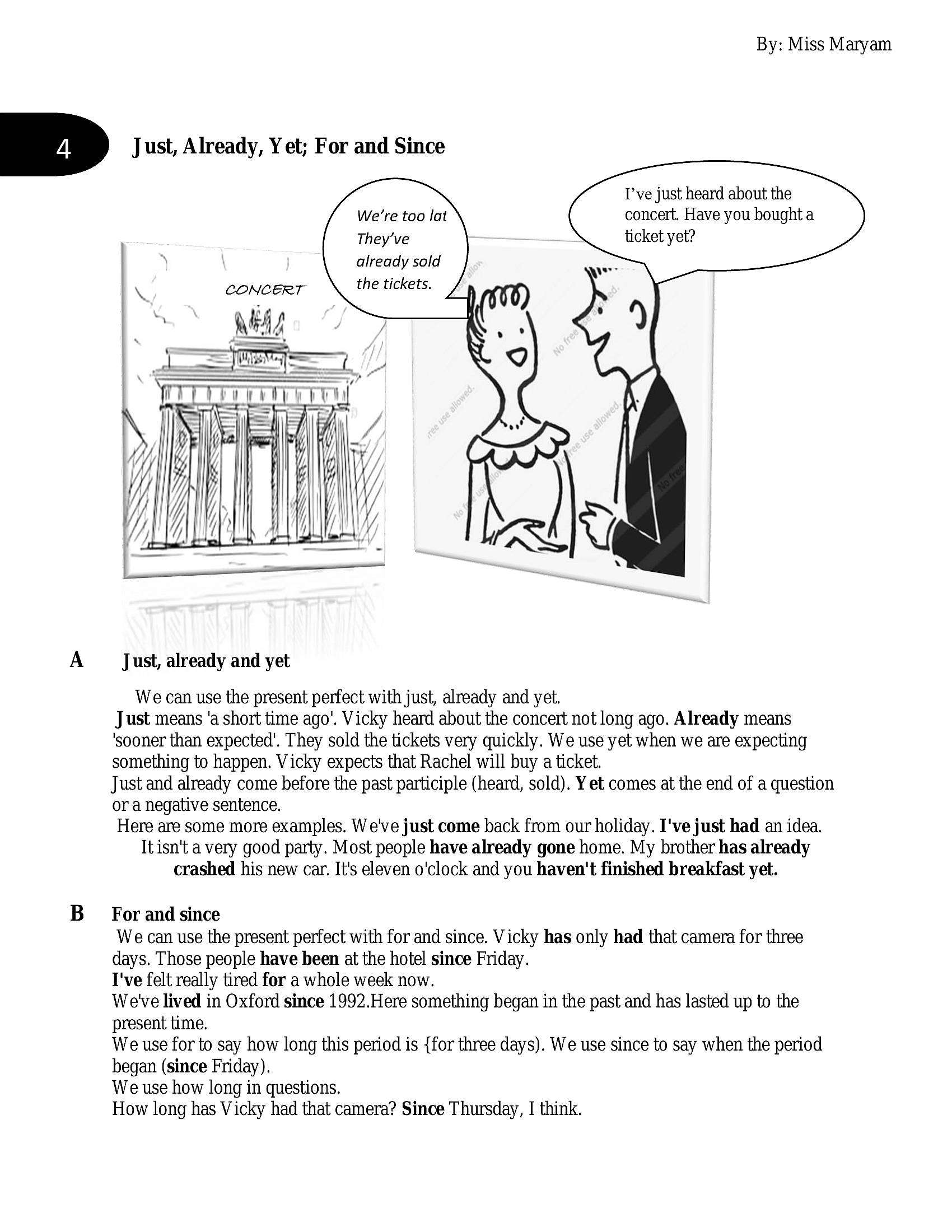
We’re too lat
I’ve just heard about the
concert. Have you bought a
ticket yet?
They’ve
already sold
the tickets.
\ CONCERT
Nod
A Just, already and yet
We can use the present perfect with just, already and yet.
Just means 'a short time ago’. Vicky heard about the concert not long ago. Already means
‘sooner than expected’. They sold the tickets very quickly. We use yet when we are expecting
something to happen. Vicky expects that Rachel will buy a ticket.
Just and already come before the past participle (heard, sold). Yet comes at the end of a question
or a negative sentence.
Here are some more examples. We've just come back from our holiday. I've just had an idea.
Itisn't a very good party. Most people have already gone home. My brother has already
crashed his new car. It's eleven o'clock and you haven't finished breakfast yet.
B For and since
We can use the present perfect with for and since. Vicky has only had that camera for three
days. Those people have been at the hotel since Friday.
I've felt really tired for a whole week now.
We've lived in Oxford since 1992.Here something began in the past and has lasted up to the
present time.
We use for to say how long this period is {for three days). We use since to say when the period
began (since Friday).
We use how long in questions.
How long has Vicky had that camera? Since Thursday, I think.
---
Page 6
Extracted Text
QO TeRwNr OrOF WN
By: Miss Maryam
How long have Trevor and Laura been married? Oh, for about three years.
We can also use the present perfect with for and since when something has stopped happening. /
haven't seen Rachel for ages. She hasn't visited us since July.
Exercises
Write replies using the present perfect and just.
Use these past participles: checked, eaten, made, remembered, rung, tidied
We must find out the address. It's all right, I've just remembered it.
The children's room looks neat. Y es, they've
Is Daniel making some coffee? It's ready.....
What happened to that chocolate? Sorry......
Has Rachel got all the answers right? Y es,.
Have you told your sister? Y eS, ['Ve oo .cseectecetetseeteeteteseeseeeeenes
Complete the sentences.
Y ou ought to wash the car. Y ou haven't washed it for ages.
I'd better have a shower. I haven't had one since Thursday.
T think I'll ring my girlfriend. I haven't 0... eeeetetetetetetetenes the weekend.
Werre going to see some old friends. We haven't 0.0... ceceeteeeteteeeeteteeteeenees five years.
Let's watch a video, shall we? We haven't... cccccesetesetetsteteeeeenees quite a while.
We could have a barbecue. We haven't 0... ceeseseeeeesenentereeenens last summer.
Shall we play tennis? We haven't... our holiday.
The Present Perfect C ontinuous
A
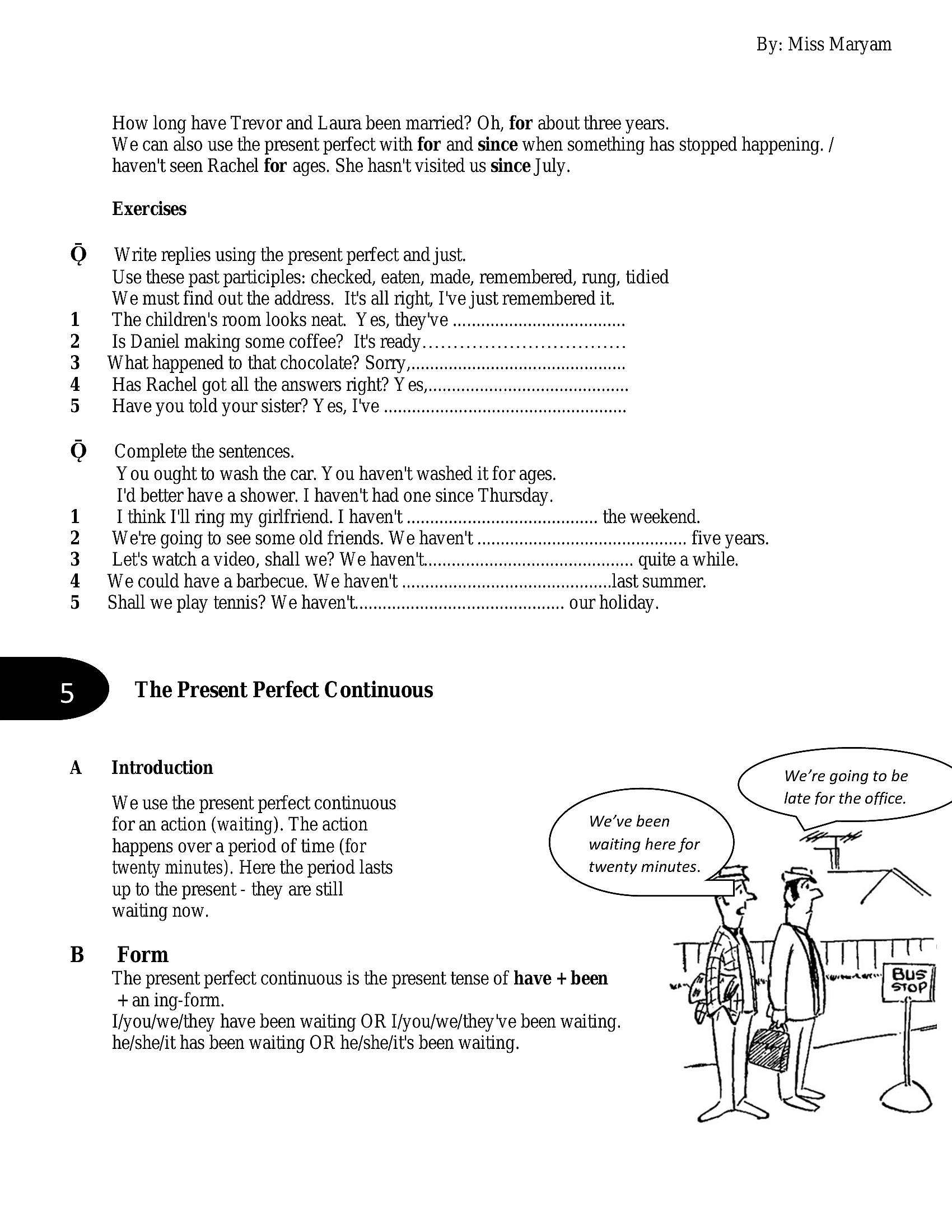
Introduction We’re going to be
late for the office.
We use the present perfect continuous
for an action (waiting). The action
happens over a period of time (for
twenty minutes). Here the period lasts
up to the present - they are still
waiting now.
We’ve been
waiting here for
twenty minutes. y
Form
The present perfect continuous is the present tense of have + been
+an ing-form.
I/you/we/they have been waiting OR I/you/we/they've been waiting.
he/she/it has been waiting OR he/she/it's been waiting.
---
Page 7
Extracted Text
©By: Miss Maryam
Use
We use the present perfect continuous for an action over a period of time leading up to the
present.
In these examples the action is still going on.
We've been waiting here for twenty minutes. (We're waiting now.)
Listen. That burglar alarm has been ringing since eight o'clock this morning.
We must use the perfect in these situations.
NOT We wait here for twenty minutes OR We're waiting-here for twenty- minutes.
We can use the present perfect continuous to talk about repeated actions up to now.
Natasha has been playing the piano since she was four. We can also use it to
talk about an action which ends just before the present.
I've been swimming. That's why my hair is wet.
Exercises
What could you say in these situations? Write sentences with the present perfect continuous
and a phrase with for. Use these verbs: play, read, swim, talk, travel, work
A video is on. It began two hours ago, and it hasn't finished yet.
The video has been playing for two hours.
Matthew went into the water an hour ago. He doesn't want to come out yet.
Y our friends started their journey around the world three months ago. They've gone about
halfway now.
Put in the verbs. Use the present perfect continuous.
Ilona: Sorry I'm late.
Emma: It's OK. I haven't been waiting (I / not / wait) long.
What(l)......... 0 eee eeeee ... (you/do)?
Tlona: I've been with Mrs. King. (2) woes (she / help) me with my
English.
Emma: Y our English is very good. Y ou don't need lessons, surely.
HOW LONG (3)...ccecccssseseteseteeseseeeseneseseneseneneeesenees (you / study) English?
Ilona: Er, eight years now. But my accent wasn't so good before I came to England.
(A) vicccccssssscsssscscsscsecsecsesscesssssseesees (I / try) to improve it. I think
(5) cccccsccsesssscsscsscsesscsscsecsscscssssessseessnsasees (it / get) better lately.
Emma: Y our accent is fine, Ilona. Honestly.
---
Page 8
Extracted Text
By: Miss Maryam6d The Past Perfect
A Introduction
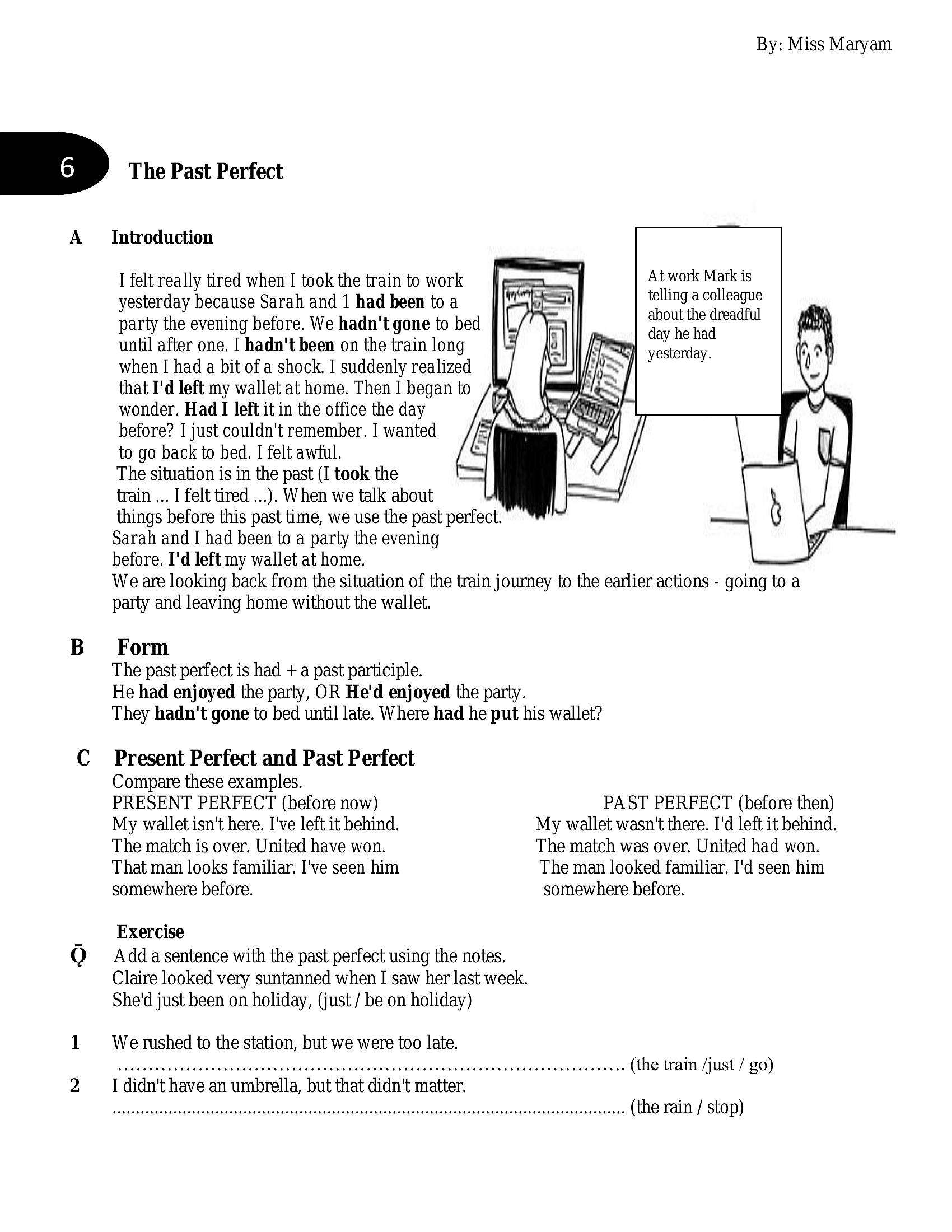
At work Mark is
telling a colleague
about the dreadful
day he had
}| yesterday.
I felt really tired when I took the train to work
yesterday because Sarah and 1 had been to a
party the evening before. We hadn't gone to bed
until after one. I hadn't been on the train long
when I had a bit of a shock. I suddenly realized
that I'd left my wallet at home. Then I began to
wonder. Had I left it in the office the day
before? I just couldn't remember. I wanted
to go back to bed. I felt awful.
The situation is in the past (I took the
train ... I felt tired ...), When we talk about
things before this past time, we use the past perfect.
Sarah and I had been to a party the evening
before. I'd left my wallet at home.
Weare looking back from the situation of the train journey to the earlier actions - going to a
party and leaving home without the wallet.
B- Form
The past perfect is had + a past participle.
He had enjoyed the party, OR He'd enjoyed the party.
They hadn't gone to bed until late. Where had he put his wallet?
C_ Present Perfect and Past Perfect
Compare these examples.
PRESENT PERFECT (before now) PAST PERFECT (before then)
My wallet isn't here. I've left it behind. My wallet wasn't there. I'd left it behind.
The match is over. United have won. The match was over. United had won.
That man looks familiar. I've seen him The man looked familiar. I'd seen him
somewhere before. somewhere before.
Exercise
Add a sentence with the past perfect using the notes.
Claire looked very suntanned when I saw her last week.
She'd just been on holiday, (just / be on holiday)
©
1 Werushed to the station, but we were too late.
(the train /just / go)
(the rain / stop)
---
Page 9
Extracted Text
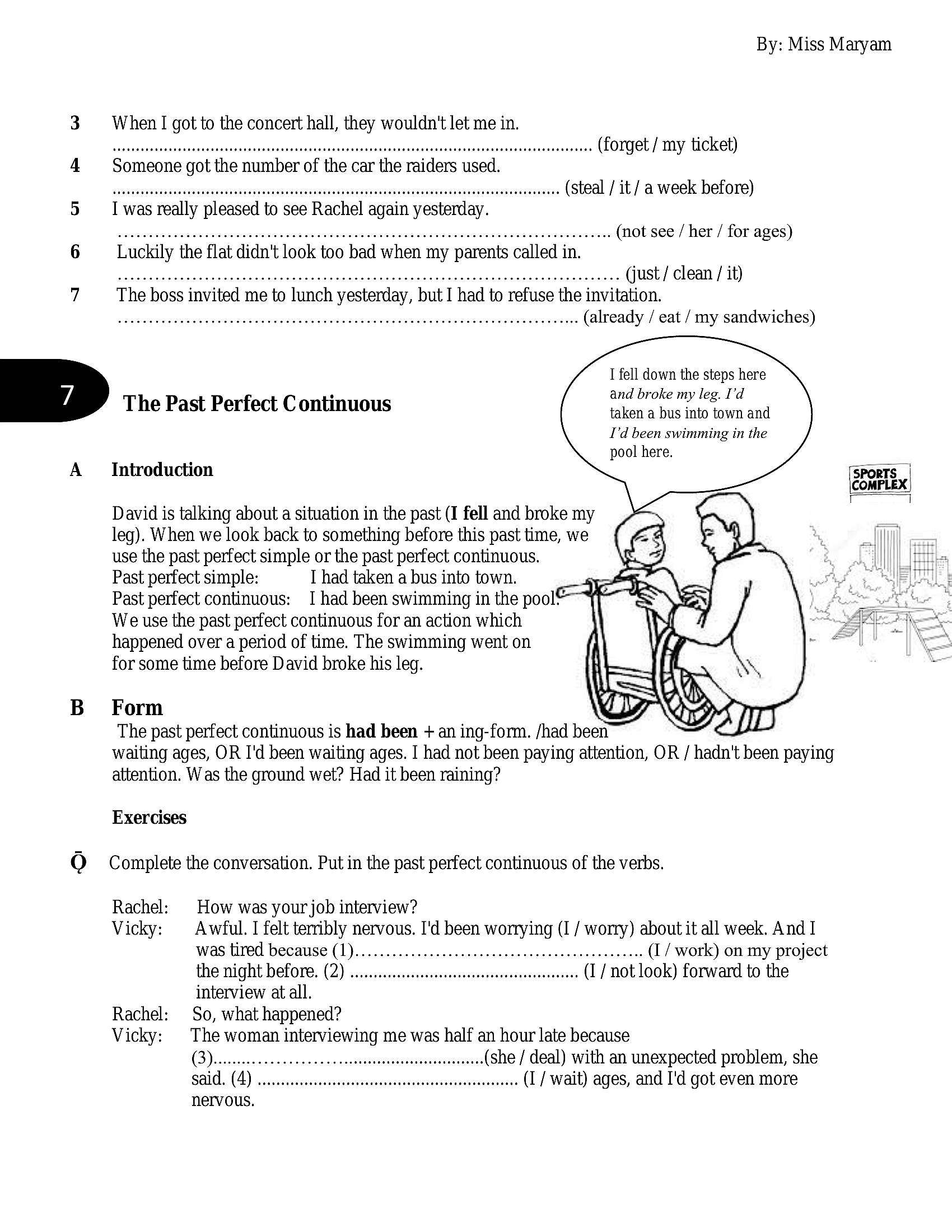
The Past Perfect ContinuousA
Q
By: Miss Maryam
When I got to the concert hall, they wouldn't let me in.
(forget / my ticket)
(steal / it / a week before)
(not see / her / for ages)
voce ee eeeeeaeueevececeueeenseeeseseeeseeeeseeeeeeaeaeaeaeaeneneseseutneneneeeees just / clean / it)
The boss invited me to lunch yesterday, but I had to refuse the invitation.
(already / eat / my sandwiches)
a
I fell down the steps here
and broke my leg. I'd
taken a bus into town and
I'd been swimming in the
Introduction (SFORTE
in|
David is talking about a situation in the past (I fell and broke my
leg). When we look back to something before this past time, we
use the past perfect simple or the past perfect continuous.
Past perfect simple: T had taken a bus into town.
Past perfect continuous: I had been swimming in the pool&—
We use the past perfect continuous for an action which
happened over a period of time. The swimming went on
for some time before David broke his leg.
Form
The past perfect continuous is had been + an ing-form. /had been
waiting ages, OR I'd been waiting ages. I had not been paying attention, OR / hadn't been paying
attention. Was the ground wet? Had it been raining?
Exercises
Complete the conversation. Put in the past perfect continuous of the verbs.
Rachel: How was your job interview?
Vicky: | Awful. I felt terribly nervous. I'd been worrying (I / worry) about it all week. And I
was tired because (1)............ceceseeeceeeeeeeeeeneeeeeeneeeaes (1/ work) on my project
the night before. (2) ..ccccccceseeeteteeteeeteeseeteeees (I / not look) forward to the
interview at all.
Rachel: So, what happened?
Vicky: | The woman interviewing me was half an hour late because
(B)eecceceseeeceeceeseeseseseseteseesseseeeeere (She / deal) with an unexpected problem, she
SAL. (4) viecccccsccsssscsessessssesscsscssssssesssssesseesee (I / wait) ages, and I'd got even more
nervous.
---
Page 10
Extracted Text
8d Will and Be Going ToA
©
By: Miss Maryam
Rachel: How did the interview go?
Vicky: | Well, I tried to sound confident. (5) ... .. ([/ read) a
book that said that's what you have to doi in n job interviews. “But I don' t know if I gave
the right answers.
Introduction
Andrew: It's my birthday soon. I'll be twenty
next Friday.
Aunt Joana: Oh, really? Are you going to have a party?
Andrew: I'm going to have a meal in a restaurant
with a few friends.
Aunt Joana: That'll be nice.
WILL BE GOING TO
Will has a neutral meaning. We use it to talk We use he going to for an intention, something
about facts in the future. we have already decided to do.
I'll be twenty next Friday. We're going to have a meal.
The spacecraft will come down in the Pacific Tom is going to sell his car.
Ocean tomorrow morning.
Predictions
WILL BE GOING TO
We can use will fora prediction about the | We use be going to for a prediction when we see
future. from the present situation what is going to
happen in the future.
I think United will win the game. One There isn't a cloud in the sky. It's going to bea
day people will travel to Mars. lovely day.
This bag isn't very strong. It's going to break.
Itis often possible to use either form in a prediction. For example, we can also say I think United
are going to win the game. Usually be going to is a little more informal and conversational than
will.
Exercises
Complete the conversations. Put in will or be going to with the verbs.
Vicky: Have you got a ticket for the play?
Daniel: Y es, I'm going to see (see) it on Thursday.
Harriet: The alarm's going. It's making an awful noise.
Mike: OK, I'll switch (switch) it off.
Daniel: Did you buy this book?
Matthew: No, Emma did. She.............c cece cece eee ee enero es (read) it on holiday.
---
Page 11
Extracted Text
©©
By: Miss Maryam
Laura: Would you like tea or coffee?
Sarah: Oh, 1.0.00... 0. cece ceseeeeseseeeeeeeeeeeeteeseeees (have) coffee, please.
Trevor: I'm going to miss a good film on TV because I'll be out tonight.
LaULA: Lececccccceccesccscsscsssscsssssssessesessessssseesseees (video) it for you, if you like.
Rachel: I'm just going out to get a paper.
Emma: What newspapel..........scsessssesecesseteeeeseseessseeeeeeeenes (you / buy)?
Complete the news report about the village of Brickfield.
Use will or be going to. Sometimes either is possible.
We have learned this week that the local council has plans for Westside Park in Brickfield.
The council is going to sell (sell) the land to a builder, Forbes and Son. The plans are all ready.
i 00 eererrrrerere rrr rerern setae etrrerteeeneare (we / build) fifty houses,’ said Mr. Forbes. ‘In two years'
time everything (2)...... 0... ..ccceecceeceeeeeeeeeeeeeeeeeeeeeeeaeeeseeeaes (be) finished. I'm sure people
(3). cece ee eee ee eee ee (like) the houses. Most of them
(A). cece we ...(be) for young families. And we intend to take care of the
environment. (5)...........ccceeeeeeeeeeeeen eee eeaeenees (we / not / cut) down all the trees, only a few
of them.' But people living near the park are angry. 'This is a terrible idea. We're all against it,'
said Mrs. Mary Brent. '(6)..............cceeeeeeecneeeeeeeeeeeeeeeees (we / have) a protest march on
Saturday. ] expect everyone in Brickfield a. beets ceeeeresseseaeaes .. (be) there. We've
reached our decision. (8).............5.+ beteeeeeeeee _ (we / stop) this plan.'
What would you say? Use will or be going to.
Y ou want to express your intention to look round the museum.
Y our friend: Do you have any plans for this afternoon?
Y ou: Yes, I'm going to look round the museum.
Y ou hate dogs. Dogs always attack you if they get the chance.
Y our friend: That dog doesn't look very friendly.
Y ou: It's coming towards US... ceeeseseeseseeeeeees
Y ou predict the landing of aliens on the earth in the next ten years.
Y our friend: All this talk about aliens is complete nonsense, isn't it?
Y our Is it? [think oo eseeeseeeeteneeneeenes
Y ou know that your friend's sister has decided to get married.
Y our friend: Have you heard about my sister?
You: Well, I heard that... sesesseeeeeneenees
Y ou suddenly decide you want to invite Ilona for a meal.
Y our friend: Did you know Ilona will be in town next weekend?
You: NO, I didn't. oe eceesesteeeeeeeeneeneeeneneeneeeee
---
Page 12
Extracted Text
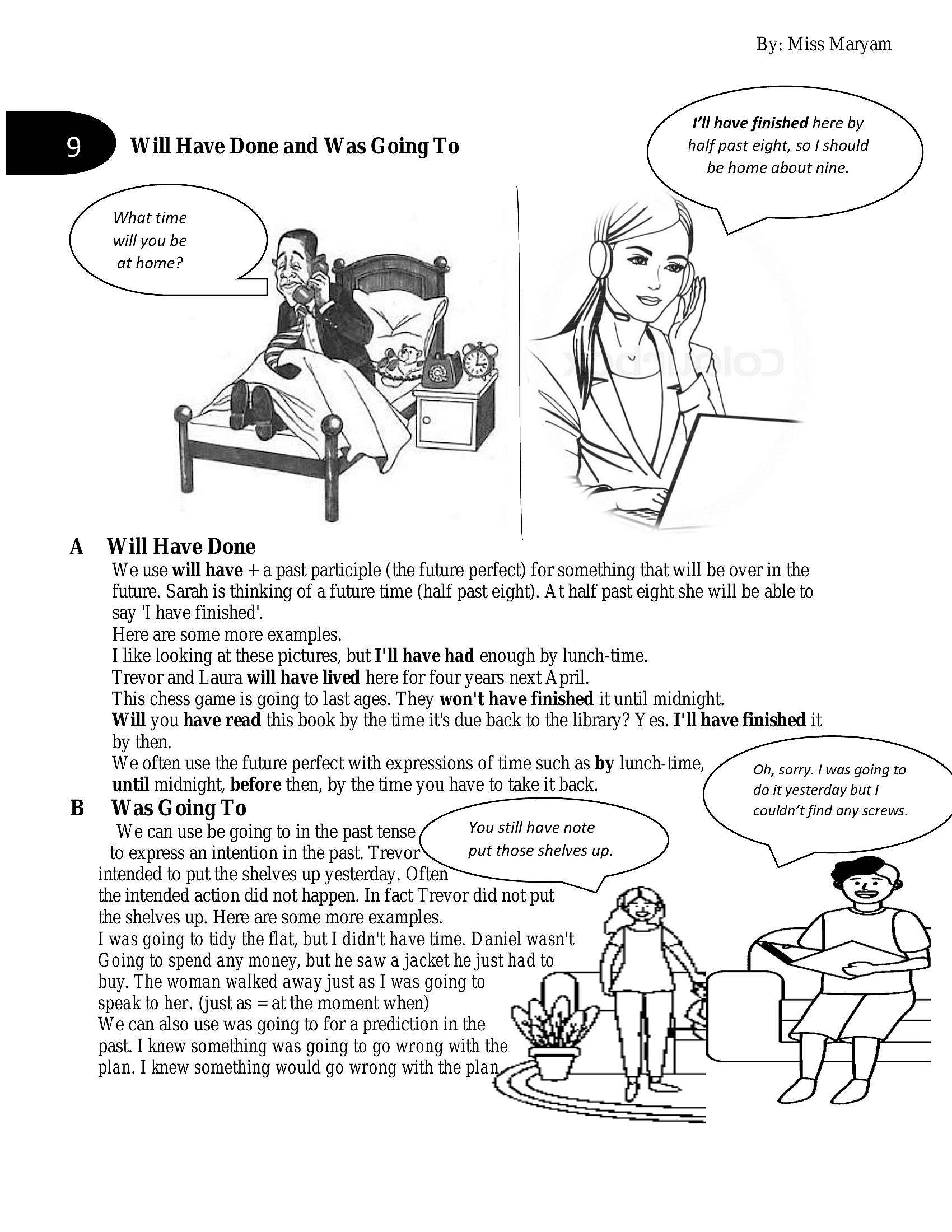
By: Miss Maryamlll have finished here by
Will Have Done and Was Going To half past eight, so | should
be home about nine.
What time
will you be
at home?
A Will Have Done
We use will have + a past participle (the future perfect) for something that will be over in the
future. Sarah is thinking of a future time (half past eight). At half past eight she will be able to
say 'I have finished’.
Here are some more examples.
1 like looking at these pictures, but I'll have had enough by lunch-time.
Trevor and Laura will have lived here for four years next A pril.
This chess game is going to last ages. They won't have finished it until midnight.
Will you have read this book by the time it's due back to the library? Y es. I'll have finished it
by then.
We often use the future perfect with expressions of time such as by lunch-time,
until midnight, before then, by the time you have to take it back.
B_ Was Going To
We can use be going to in the past tense
to express an intention in the past. Trevor
intended to put the shelves up yesterday. Often
the intended action did not happen. In fact Trevor did not put
the shelves up. Here are some more examples.
I was going to tidy the flat, but I didn't have time. Daniel wasn't
Going to spend any money, but he saw a jacket he just had to
buy. The woman walked away just as I was going to
speak to her. (just as = at the moment when)
We can also use was going to for a prediction in the
past. I knew something was going to go wrong with the
plan. I knew something would go wrong with the pla
Oh, sorry. | was going to
do it yesterday but |
couldn’t find any screws.
You still have note
put those shelves up.
---
Page 13
Extracted Text
Q©
Owe
By: Miss Maryam
Exercises
Will have done (A)
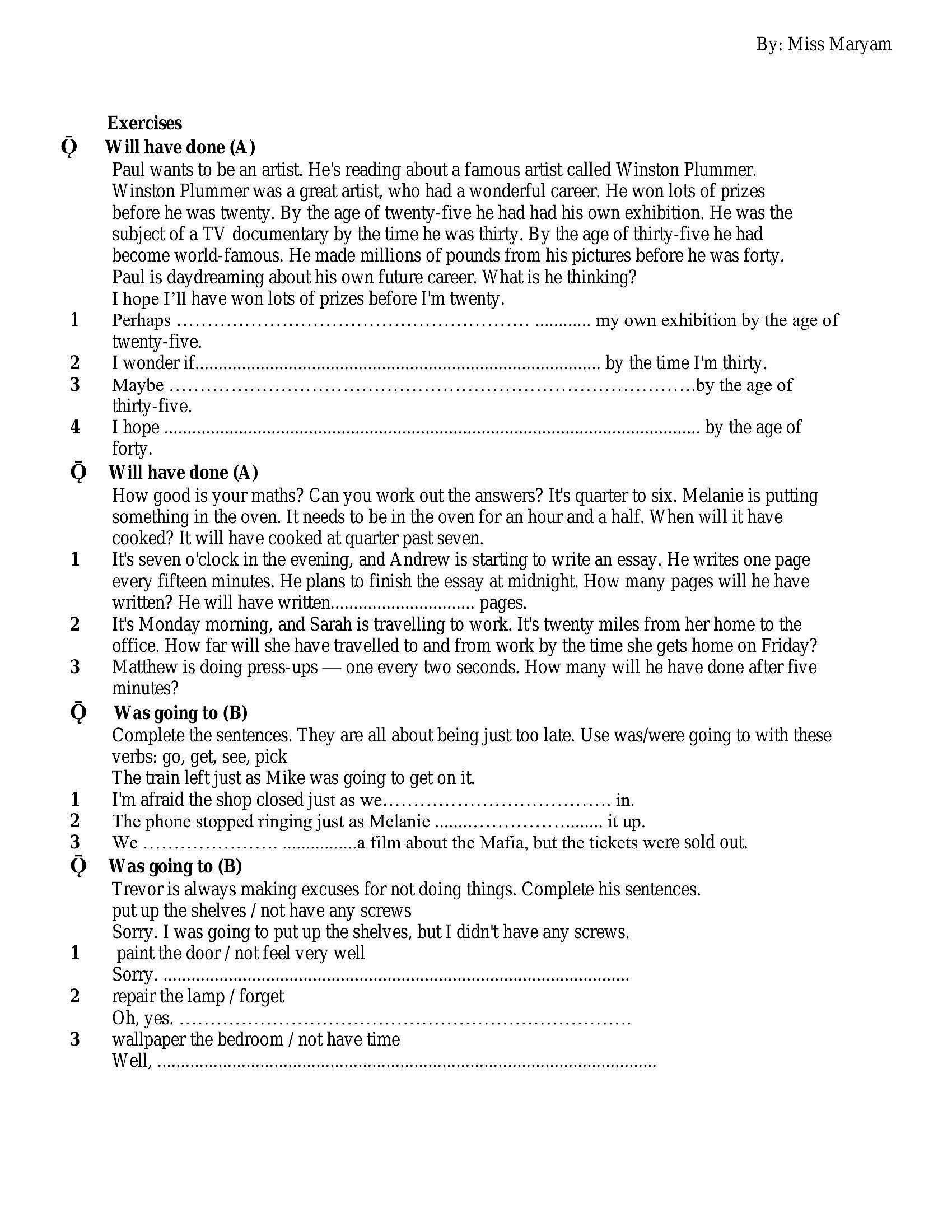
Paul wants to be an artist. He's reading about a famous artist called Winston Plummer.
Winston Plummer was a great artist, who had a wonderful career. He won lots of prizes
before he was twenty. By the age of twenty-five he had had his own exhibition. He was the
subject of a TV documentary by the time he was thirty. By the age of thirty-five he had
become world-famous. He made millions of pounds from his pictures before he was forty.
Paul is daydreaming about his own future career. What is he thinking?
I hope I’ll have won lots of prizes before I'm twenty.
Perhaps 2.0.00... cece cece eee c cence cece cence sense eats eneaee seeseaseeres my own exhibition by the age of
twenty-five.
T WONdET ifs. eeccteectetetetesecesenesesesesesenesesesesenesesesenesenenesenenesenenee by the time I'm thirty.
Maybe 2.0.0.0... eee cececec eee eee cee ee eee eee ence eneneneenenenenteeeeeeneeneeeaeaeaes by the age of
thirty-five.
TOC woeeeececccsscsetssesestctcnscenesesenesesenesesenesesenesesenssesenssesensesenseesenseesenseesenseeeneeenens by the age of
forty.
Will have done (A)
How good is your maths? Can you work out the answers? It's quarter to six. Melanie is putting
something in the oven. It needs to be in the oven for an hour and a half. When will it have
cooked? It will have cooked at quarter past seven.
It's seven o'clock in the evening, and Andrew is starting to write an essay. He writes one page
every fifteen minutes. He plans to finish the essay at midnight. How many pages will he have
written? He will have written... eee pages.
It's Monday morning, and Sarah is travelling to work. It's twenty miles from her home to the
office. How far will she have travelled to and from work by the time she gets home on Friday?
Matthew is doing press-ups — one every two seconds. How many will he have done after five
minutes?
Was going to (B)
Complete the sentences. They are all about being just too late. Use was/were going to with these
verbs: go, get, see, pick
The train left just as Mike was going to get on it.
I'm afraid the shop closed just as We..............0sceseeeeeeeneeeeeeeees in.
The phone stopped ringing just as Melanie .. . . it up.
We. . bee tise .a film about ‘the Mafia, ‘but the tickets were sold out.
Was going to (B)
Trevor is always making excuses for not doing things. Complete his sentences.
put up the shelves / not have any screws
Sorry. I was going to put up the shelves, but I didn't have any screws.
paint the door / not feel very well
SOTTY. ceecesccsesescseseceseseseseseeeseeeecseseecseseecsestecseetenseenenseseetseeeeneeeteeeeeneneeenes
repair the lamp / forget
OD, VES. ooo. cece cece ce cence eee ee eee e ec eeee eee eceeen eee eseeeeeeseeeneen snes
wallpaper the bedroom / not have time
WELL, oe eeccsecsssstcsecessseneensesseseensecseseensacseseencassesensatseseseeuensenseeacneensesacasenseeee
---
Page 14
Extracted Text
By: Miss MaryamAsking People to do Things
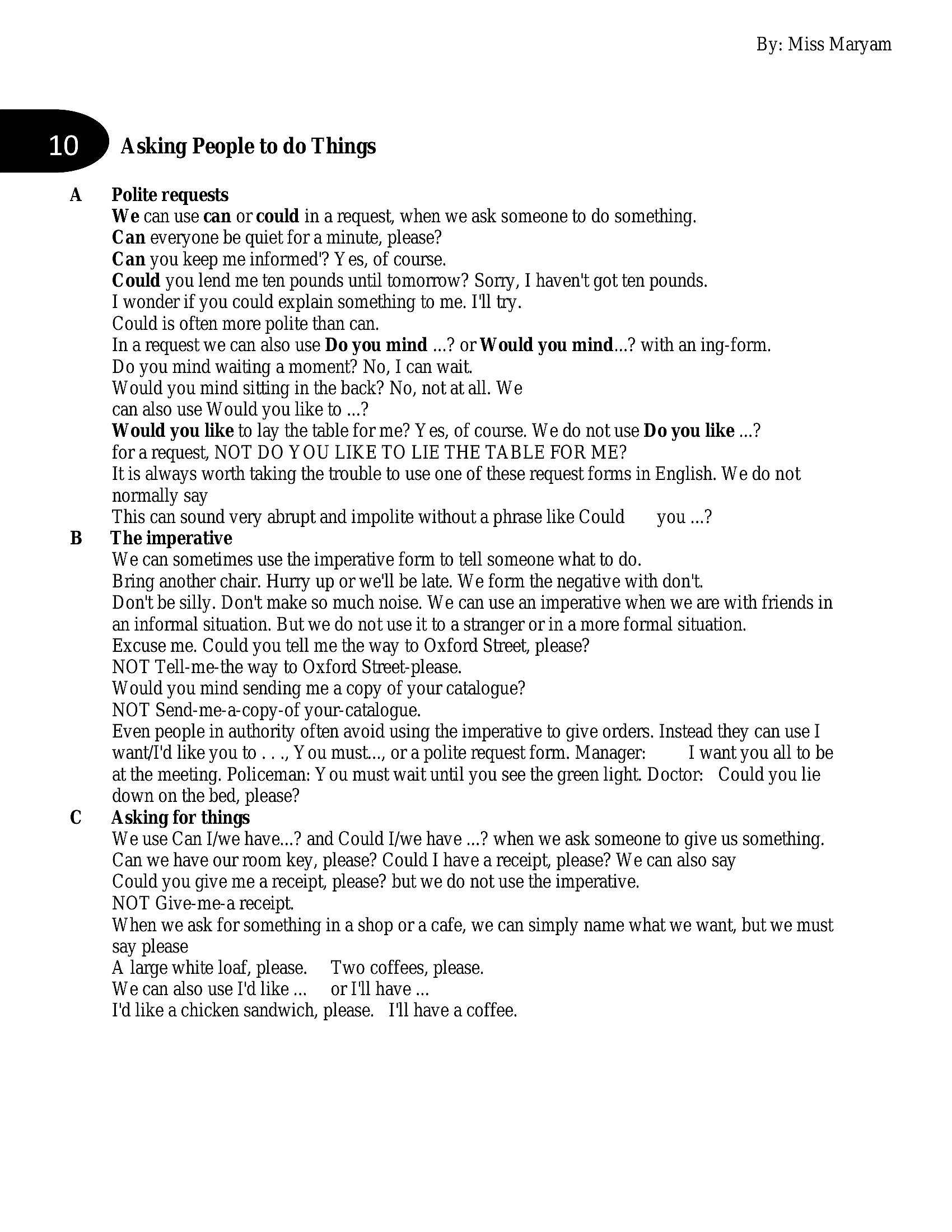
A Polite requests
We can use can or could in a request, when we ask someone to do something.
Can everyone be quiet for a minute, please?
Can you keep me informed’ Y es, of course.
Could you lend me ten pounds until tomorrow? Sorry, I haven't got ten pounds.
I wonder if you could explain something to me. I'll try.
Could is often more polite than can.
In a request we can also use Do you mind ...? or Would you mind...? with an ing-form.
Do you mind waiting a moment? No, I can wait.
Would you mind sitting in the back? No, not at all. We
can also use Would you like to ...?
Would you like to lay the table for me? Y es, of course. We do not use Do you like ...?
fora request, NOT DO YOU LIKE TO LIE THE TABLE FOR ME?
It is always worth taking the trouble to use one of these request forms in English. We do not
normally say
This can sound very abrupt and impolite without a phrase like Could =—you...?
B_ The imperative
We can sometimes use the imperative form to tell someone what to do.
Bring another chair. Hurry up or we'll be late. We form the negative with don't.
Don't be silly. Don't make so much noise. We can use an imperative when we are with friends in
an informal situation. But we do not use it to a stranger or in a more formal situation.
Excuse me. Could you tell me the way to Oxford Street, please?
NOT Tell-me-the way to Oxford Street-please.
Would you mind sending me a copy of your catalogue?
NOT Send-me-a-copy-of your- catalogue.
Even people in authority often avoid using the imperative to give orders. Instead they can use I
want/I'd like you to... ., You must..., or a polite request form. Manager: I want you all to be
at the meeting. Policeman: Y ou must wait until you see the green light. Doctor: Could you lie
down on the bed, please?
C Asking for things
We use Can I/we have...? and Could I/we have ...? when we ask someone to give us something.
Can we have our room key, please? Could I have a receipt, please? We can also say
Could you give me a receipt, please? but we do not use the imperative.
NOT Give-me-a receipt.
When we ask for something in a shop ora cafe, we can simply name what we want, but we must
say please
A large white loaf, please. Two coffees, please.
Wecan also use I'dlike... orI'll have...
I'd like a chicken sandwich, please. I'll have a coffee.
---
Page 15
Extracted Text
By: Miss MaryamExercises
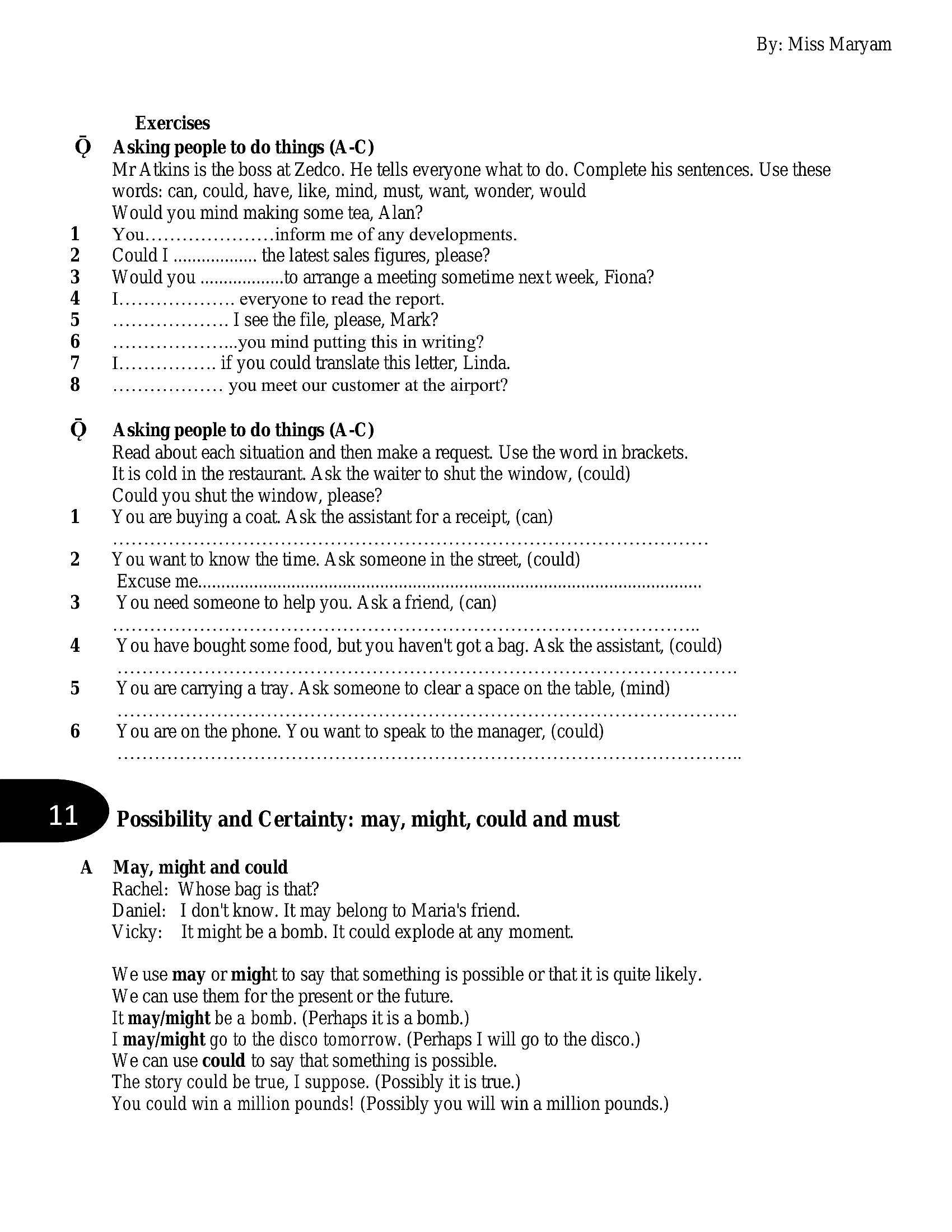
O Asking people to do things (A-C)
Mr Atkins is the boss at Zedco. He tells everyone what to do. Complete his sentences. Use these
words: can, could, have, like, mind, must, want, wonder, would
Would you mind making some tea, Alan?
YOU... eee eee eee eee inform me of any developments.
Could Toe the latest sales figures, please?
to arrange a meeting sometime next week, Fiona?
bee eceeeeeeenenens everyone to read the report.
.. | see the file, please, Mark?
......you mind putting this in writing?
... if you could translate this letter, Linda.
bebe eens ee eeeeeeee you meet our customer at the airport?
Srnnwlrwon-
rl
©
Asking people to do things (A-C)
Read about each situation and then make a request. Use the word in brackets.
Itis cold in the restaurant. Ask the waiter to shut the window, (could)
Could you shut the window, please?
1 Youare buying a coat. Ask the assistant for a receipt, (can)
2 Youwant to know the time. Ask someone in the street, (could)
EXCUSE MC... eceesecescseesesssceeeseseseeeeseseeeeecsensesescsecassaecseseeesecsenseesecsenseaeacsenseaeaeeensens
3 Y ou need someone to help you. Ask a friend, (can)
Possibility and Certainty: may, might, could and must
A May, might and could
Rachel: Whose bag is that?
Daniel: I don't know. It may belong to Maria's friend.
Vicky: Itmight be a bomb. It could explode at any moment.
We use may or might to say that something is possible or that it is quite likely.
We can use them for the present or the future.
It may/might be a bomb. (Perhaps it is a bomb.)
I may/might go to the disco tomorrow. (Perhaps I will go to the disco.)
We can use could to say that something is possible.
The story could be true, I suppose. (Possibly it is true.)
You could win a million pounds! (Possibly you will win a million pounds.)
---
Page 16
Extracted Text
©©
WN
By: Miss Maryam
Sometimes could means only a small possibility. Itis possible (but not likely) that you will win a
million pounds.
In some situations we can use may, might or could.
It may/might/could rain later.
After may, might or could we can use a continuous form (be + an ing-form). That man
may/might be watching us. (Perhaps he is watching us.)
May, Might and Could in the negative.
The negative forms are may not, might not/mightn't, and could not/couldn't.
MAY NOT AND MIGHT NOT COULDN'T
Something negative is possible. Daniel may Something is impossible.
not get the job. Tom might not be in. I Vicky is afraid of heights. She couldn't climb
mightn't finish the marathon tomorrow. onto the roof.
(Itis possible that I will not finish it.) I'm completely unfit. I couldn't run a marathon.
(It is impossible for me to run it.)
Must and Can't
MUST CAN’T
We use must when we realize that We use can't when we realize that something is
something is certainly true. impossible.
She isn't answering the phone. She must We haven't walked far. Y ou can't be tired yet.
be out. I had my keys amoment ago. They Life can't be easy when you have to spend it in a
must be here somewhere. wheelchair.
Andrew isn't here. He must be working inthe Nick can't be touring Scotland. I saw him hat
library. this morning.
Exercises
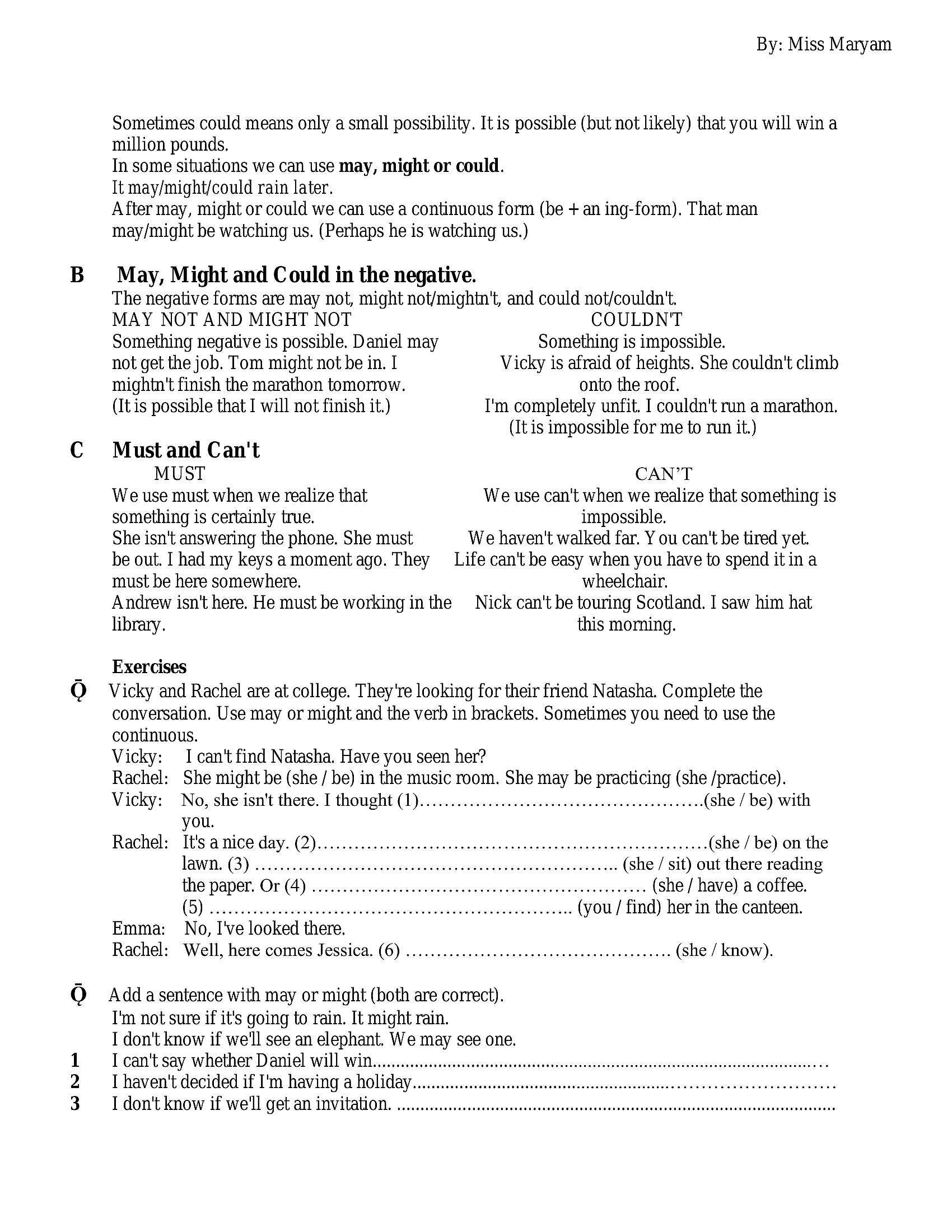
Vicky and Rachel are at college. They're looking for their friend Natasha. Complete the
conversation. Use may or might and the verb in brackets. Sometimes you need to use the
continuous.
Vicky: I can't find Natasha. Have you seen her?
Rachel: She might be (she / be) in the music room. She may be practicing (she /practice).
Vicky: No, she isn't there. I thought (1).............cccceeeceeeeeeeceeeeeeeeeterneees (she / be) with
you.
Rachel: It's a mice day. (2)...........cceeececeeeecceeeeeceeeeeeeeceeeeeeeaeeeeeeaeeeares (she / be) on the
IF \ 0 6) ee (she / sit) out there reading
the paper. Or (4) ........ccceeeceeceeeeceeeceeeeeeceeeceeeeeeeneeeeees (she / have) a coffee.
Co) (you / find) her in the canteen.
Emma: No, I've looked there.
Rachel: Well, here comes Jessica. (6) ..........:cceceeeeeeeeeeceeeeneeeeeeneees (she / know).
Add a sentence with may or might (both are correct).
I'm not sure if it's going to rain. It might rain.
I don't know if we'll see an elephant. We may see one.
I can't say whether Daniel will With... cecscseseseeetenesescsesescsesesesesescsessseseseseseaeseseseseseseseaeseees .
I haven't decided if I'm having a holiday. we
T don't know if we'll get an invitation. occ ccecesecesesesesesesesesesesesesesesesenssesensaesenssesensaesensaesenenee
---
Page 17
Extracted Text
=©
©
4
5
By: Miss Maryam
I've no idea whether Sarah will be late... ccc cseecesesesesescseseecseseecsesescsescecseseecsesseceeseeceeseeseeseesenees
I'm not sure if my friends are Visiting MC oe eceecesesecesesecesesesesesesesesescsesescseseeesescsesetsesteee ee ees
A reporter is interviewing Mrs Miles fora TV news programme.
Complete the conversation. Put in must, can't or might.
Mrs Miles: My name's Nora Miles, and I'm going to do a parachute jump.
Reporter: Mrs Miles, you're seventy-three, and you're going to jump out of an aeroplane.
Y ou must be mad. YOu (1) w.ccccccscsecsessssseseeees be serious.
Mrs Miles: It really (2)........ 0... ceeceeeeeeeeeeeeeeee tesa eens be wonderful to look down from the
sky. I've always wanted to try it.
Reporter: But anything could happen. Y 0U (3)... ccccseccseseeeseeeseseeeees be injured or even
killed. I wouldn't take the risk.
Mrs Miles: Well, young man, your life (4) .............ceeeeeeeeee neers be much fun if you never
take risks. Y ou ought to try it. Y ou never know — you
(5) eee eee eec eee eceeeeeeeeeeeeeeeees enjoy it.
Reporter: Enjoy it? YOu (6) ..ccccccceeseeeeeseneeees be joking!
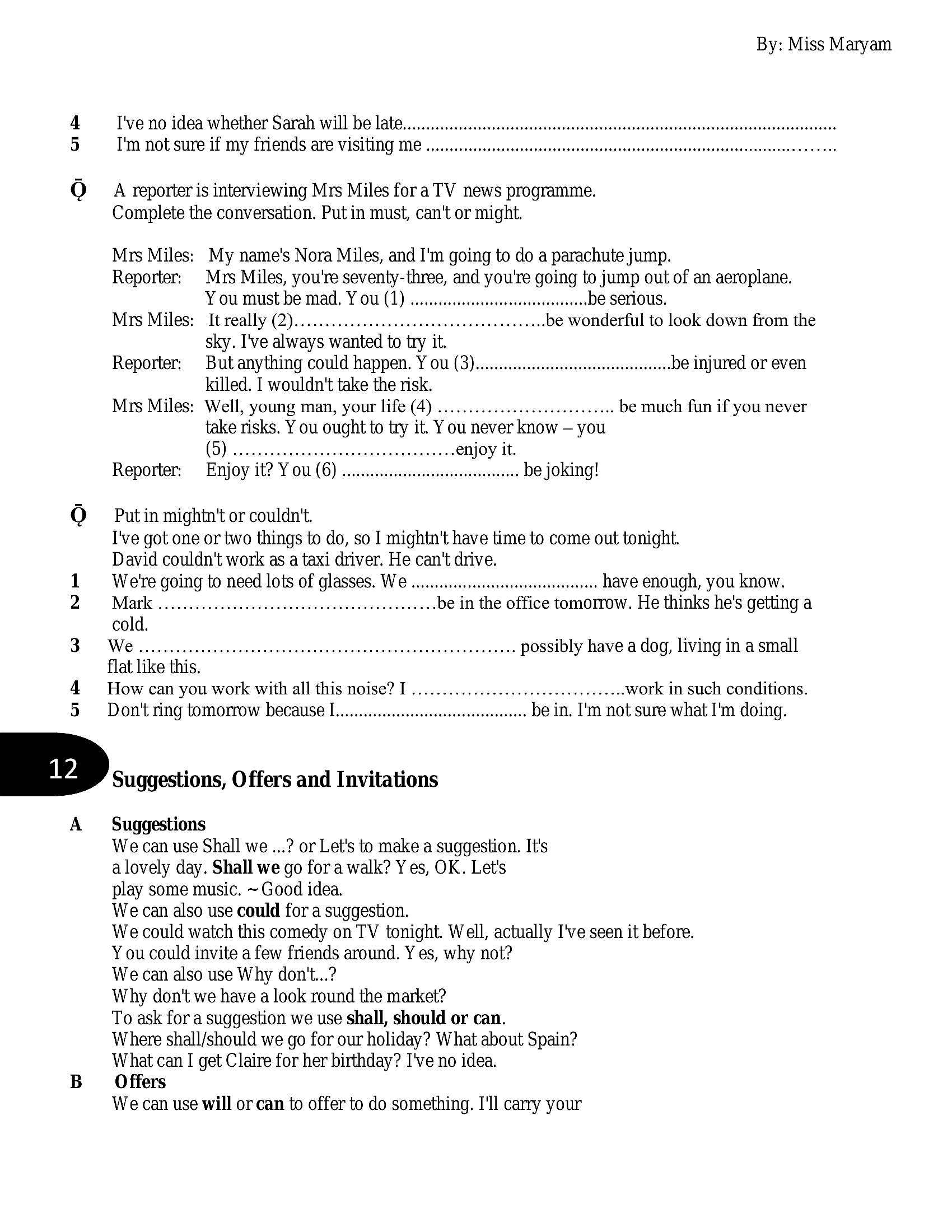
Put in mightn't or couldn't.
I've got one or two things to do, so I mightn't have time to come out tonight.
David couldn't work as a taxi driver. He can't drive.
We're going to need lots of glasses. We w...eecsceeteseeeeteneseeneees have enough, you know.
Mark 2.0.2.0... ccc cecc ccc cec eee ece een eeeeeeenees be in the office tomorrow. He thinks he's getting a
cold.
WE occ ceec ccc nee nee neee een eee eea een eeaeeaeen een eaeeaeeaees possibly have a dog, living in a small
flat like this.
How can you work with all this noise? I ........... eee work in such conditions.
Don't ring tomorrow because Lo... eseseeeseseteeetenenes be in. I'm not sure what I'm doing.
Suggestions, Offers and Invitations
A
Suggestions
We can use Shall we ...? or Let's to make a suggestion. It's
alovely day. Shall we go for a walk? Yes, OK. Let's
play some music. ~ Good idea.
We can also use could for a suggestion.
We could watch this comedy on TV tonight. Well, actually I've seen it before.
Y ou could invite a few friends around. Y es, why not?
We can also use Why don't...?
Why don't we have a look round the market?
To ask for a suggestion we use shall, should or can.
Where shall/should we go for our holiday? What about Spain?
What can I get Claire for her birthday? I've no idea.
Offers
We can use will or can to offer to do something. I'll carry your
---
Page 18
Extracted Text
©©
bag. Oh, thanks. We can give you a lift. Oh, that would be
great. Thank you.
We can also use question forms with shall or can.
Shall we pay you the money now? Oh, there's no hurry.
Can I get a taxi for you? Y es, please.
To offer food or drink, we use would like.
Would you like one of these chocolates? Y es, please. Thank you.
Would anyone like more coffee? No, thanks.
We can also use Will/Wont you have... ?
Will you have a biscuit? Thank you.
Won't you have something to drink? Not for me, thank you.
In informal speech we can use the imperative.
Have a biscuit. Thank you.
Invitations
To invite someone, we often use Would you like to ...?
Would you like to have lunch with us? Y es, I'd love to. Thank you.
Would like can have a verb with to after it, or an object with a noun. Would you
like to stay the night. Oh, that's very kind of you. Would you like a bed for the
night? Are you sure it's not too much trouble?
We can also use Will/W on't you ...?
Will you join us for coffee? Y es. Thanks. Won't you sit down?
In informal speech we can use the imperative. Come
and have coffee with us. Please sit down.
Exercises
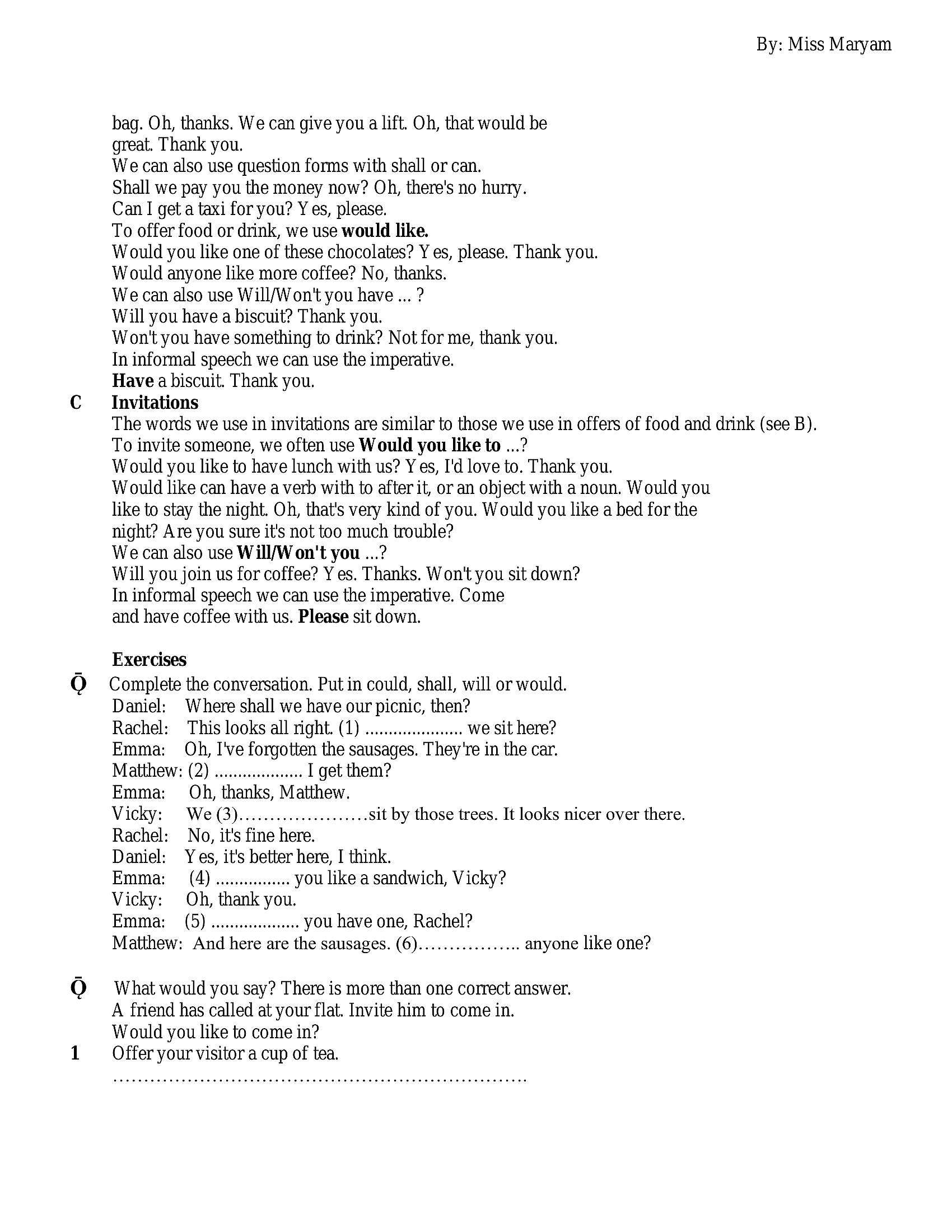
Complete the conversation. Put in could, shall, will or would.
Daniel: Where shall we have our picnic, then?
Rachel: This looks all right. (1) we we sit here?
Emma: Oh, I've forgotten the sausages. They're in the car.
Matthew: (2) voce I get them?
Emma: Oh, thanks, Matthew.
Vicky: We (3)........ceeeeeeee eee sit by those trees. It looks nicer over there.
Rachel: No, it’s fine here.
Daniel: Yes, it's better here, I think.
Emma: (4) wc you like a sandwich, Vicky?
Vicky: Oh, thank you.
Emma: (5) wesc you have one, Rachel?
Matthew: And here are the sausages. (6).............065 anyone like one?
What would you say? There is more than one correct answer.
A friend has called at your flat. Invite him to come in.
Would you like to come in?
Offer your visitor a cup of tea.
By: Miss Maryam
[he words we use in invitations are similar to those we use in offers of food and drink (see B).
---
Page 19
Extracted Text
2 You don't know what to say in your letter. Ask your friend for a suggestion.ED «.: Since, Ago and Before
A Introduction
By: Miss Maryam
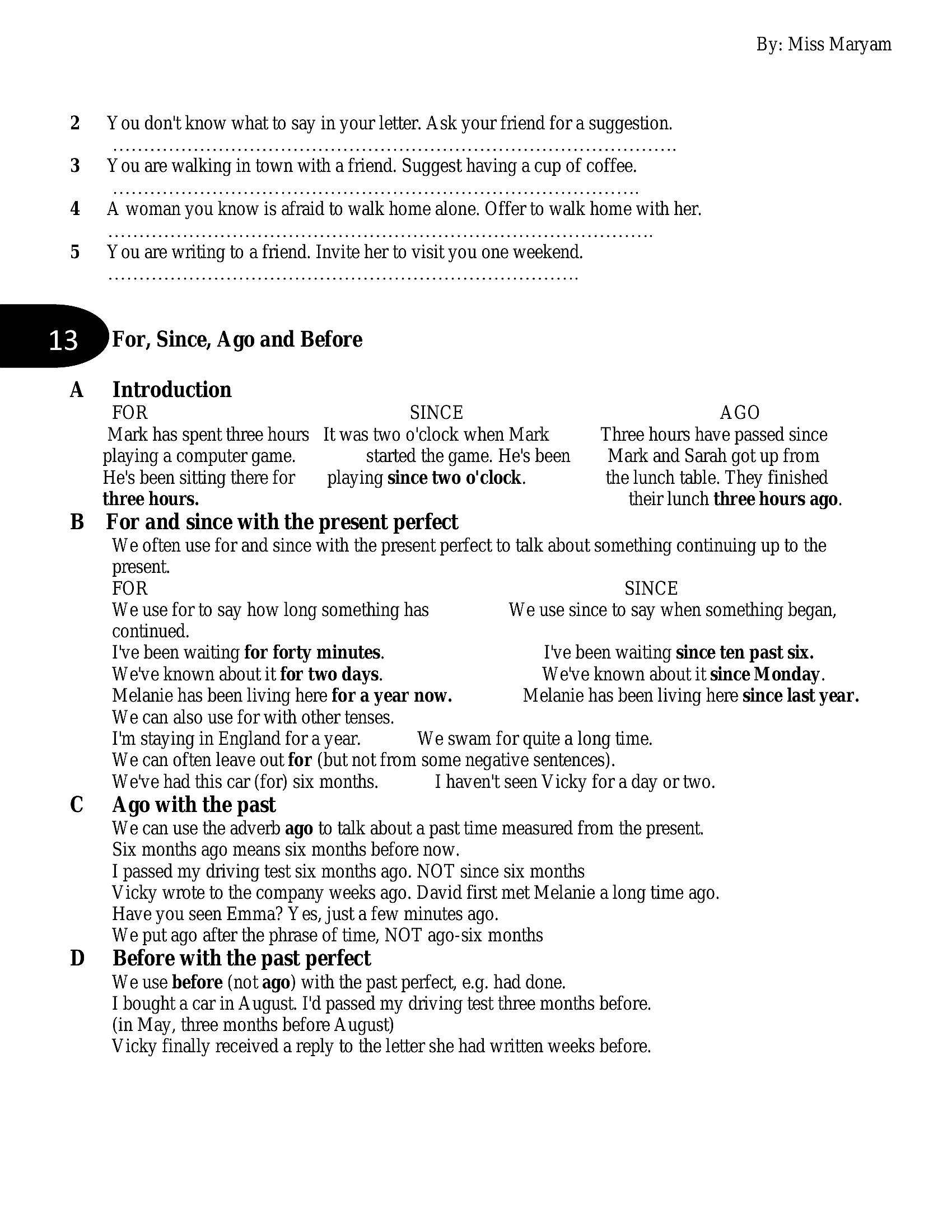
FOR SINCE AGO
Mark has spent three hours It was two o'clock when Mark Three hours have passed since
playing a computer game. started the game. He's been Mark and Sarah got up from
He's been sitting therefor _ playing since two o'clock. the lunch table. They finished
three hours. their lunch three hours ago.
B_ For and since with the present perfect
We often use for and since with the present perfect to talk about something continuing up to the
present.
FOR SINCE
Weuse for to say how long something has We use since to say when something began,
continued.
I've been waiting for forty minutes. I've been waiting since ten past six.
We've known about it for two days. We've known about it since Monday.
Melanie has been living here for a year now. Melanie has been living here since last year.
We can also use for with other tenses.
I'm staying in England for a year. We swam for quite a long time.
We can often leave out for (but not from some negative sentences).
We've had this car (for) six months. I haven't seen Vicky fora day or two.
C Ago with the past
We can use the adverb ago to talk about a past time measured from the present.
Six months ago means six months before now.
I passed my driving test six months ago. NOT since six months
Vicky wrote to the company weeks ago. David first met Melanie a long time ago.
Have you seen Emma? Y es, just a few minutes ago.
We put ago after the phrase of time, NOT ago-six months
D Before with the past perfect
We use before (not ago) with the past perfect, e.g. had done.
I bought a car in August. I'd passed my driving test three months before.
(in May, three months before A ugust)
Vicky finally received a reply to the letter she had written weeks before.
---
Page 20
Extracted Text
©SAR WN
©
By: Miss Maryam
Exercises
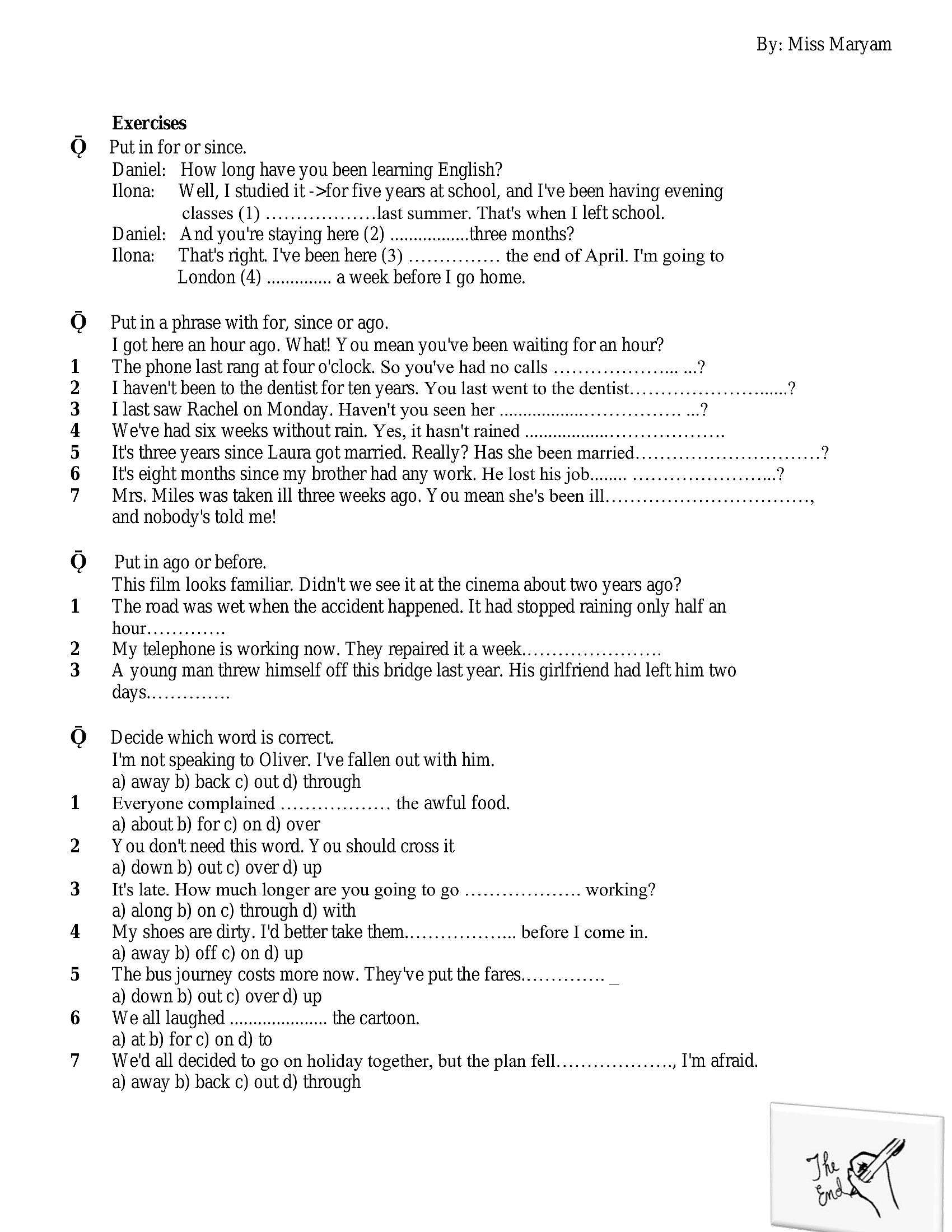
Put in for or since.
Daniel: How long have you been learning English?
Ilona: Well, I studied it ->for five years at school, and I've been having evening
classes (1) .........:eeeee ee last summer. That's when I left school.
Daniel: And you're staying here (2)... three months?
Ilona: That's right. I've been here (3) ............... the end of April. I'm going to
London (4) .........0 a week before I go home.
Put in a phrase with for, since or ago.
I got here an hour ago. What! Y ou mean you've been waiting for an hour?
The phone last rang at four o'clock. So you've had no calls ...............e:0e ee ?
I haven't been to the dentist for ten years. You last went to the dentist..................:0esee ?
I last saw Rachel on Monday. Haven't you seen her ..
We've had six weeks without rain. Yes, it hasn't rained . wees
It's three years since Laura got married. Really? Has she been married...
It's eight months since my brother had any work. He lost his job... .....s.cceeeeeeeeeeeeeee?
Mrs. Miles was taken ill three weeks ago. Y ou mean she's been ill. bee e cece cee eneneneeeeeeeneeees ;
and nobody's told me!
Put in ago or before.
This film looks familiar. Didn't we see it at the cinema about two years ago?
The road was wet when the accident happened. It had stopped raining only half an
My telephone is working now. They repaired it a week...................008
A young man threw himself off this bridge last year. His girlfriend had left him two
Decide which word is correct.
I'm not speaking to Oliver. I've fallen out with him.
a) away b) back c) out d) through
Everyone complained .................. the awful food.
a) about b) for c) on d) over
Y ou don't need this word. Y ou should cross it
a) down b) out c) over d) up
It's late. How much longer are you going to go .................. working?
a) along b) on c) through d) with
My shoes are dirty. I'd better take them................... before I come in.
a) away b) off c) on d) up
The bus journey costs more now. They've put the fares..............
a) down b) out c) over d) up
Weall laughed uu... eee the cartoon.
a) at b) forc) ond) to
We'd all decided to go on holiday together, but the plan fell................... , I'm afraid.
a) away b) back c) out d) through
---
Struggling with the concepts in this paper?
Revise syllabus notes, key exam points, and interactive practice questions for Languages English: