📄 Exam Questions & Readable Text Transcript
Full OCR-extracted text of questions, syllabus codes, and exam instructions.
Extracted Content: 2023_maths_alevel_nov_paper2
Page 1
Extracted Text
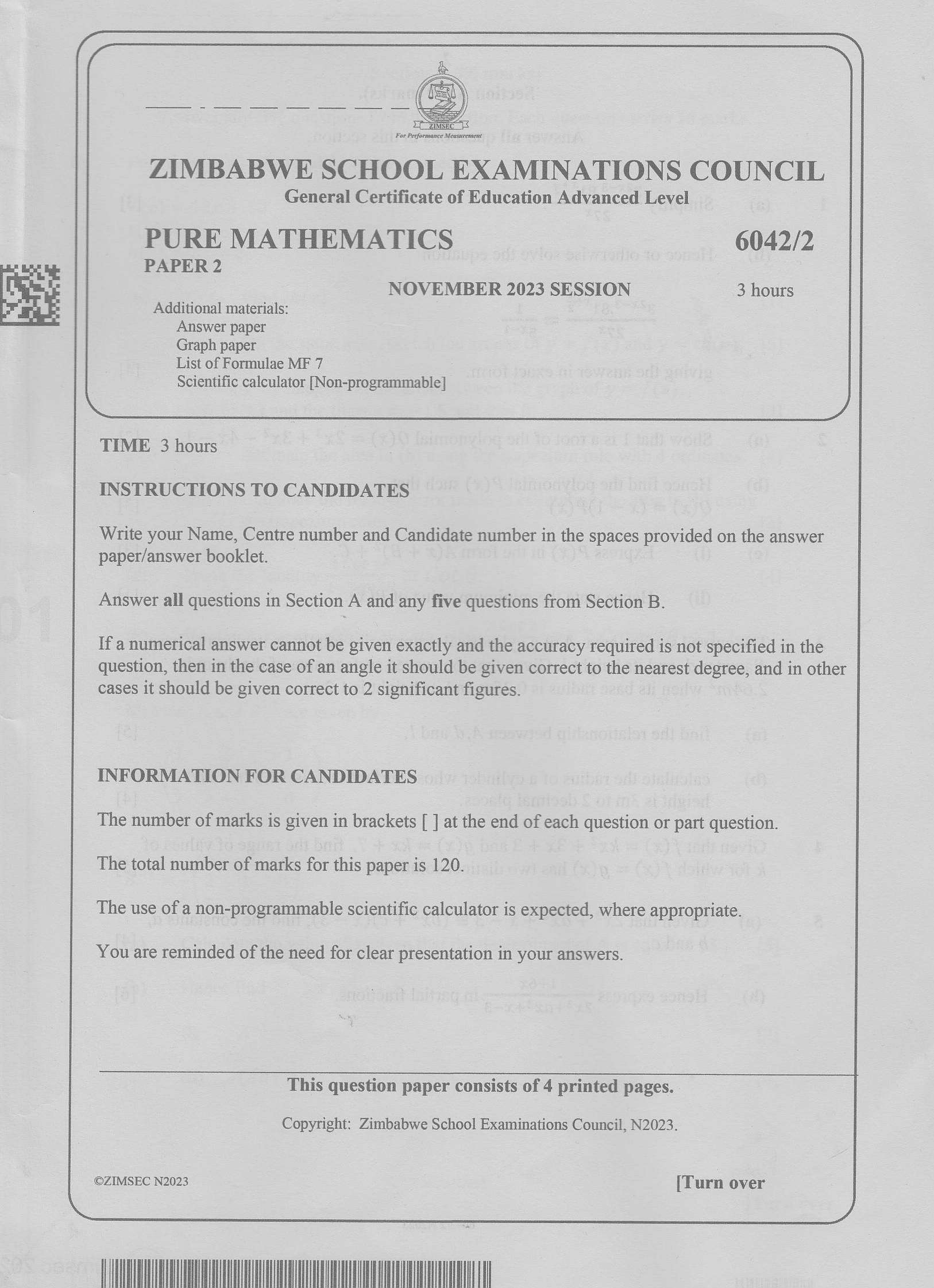
iNsec 1< For Peeformance MeasurementZIMBABWE SCHOOL EXAMINATIONS COUNCIL
General Certificate of Education Advanced Level
PURE MATHEMATICS 6042/2
PAPER 2
NOVEMBER 2023 SESSION 3 hours
Additional materials:
Answer paper
Graph paper
List of Formulae MF 7
Scientific calculator [Non-programmable]
TIME 3 hours
INSTRUCTIONS TO CANDIDATES
Write your Name, Centre number and Candidate number in the spaces provided on the answer
paper/answer booklet.
Answer all questions in Section A and any five questions from Section B.
If a numerical answer cannot be given exactly and the accuracy required is not specified in the
question, then in the case of an angle it should be given correct to the nearest degree, and in other
cases it should be given correct to 2 significant figures.
INFORMATION FOR CANDIDATES
The number of marks is given in brackets [ ] at the end of each question or part question.
The total number of marks for this paper is 120.
The use of a non-programmable scientific calculator is expected, where appropriate.
You are reminded of the need for clear presentation in your answers.
This question paper consists of 4 printed pages.
Copyright: Zimbabwe School Examinations Council, N2023.
©ZIMSEC N2023 [Turn over
UT
---
Page 2
Extracted Text
TV A2
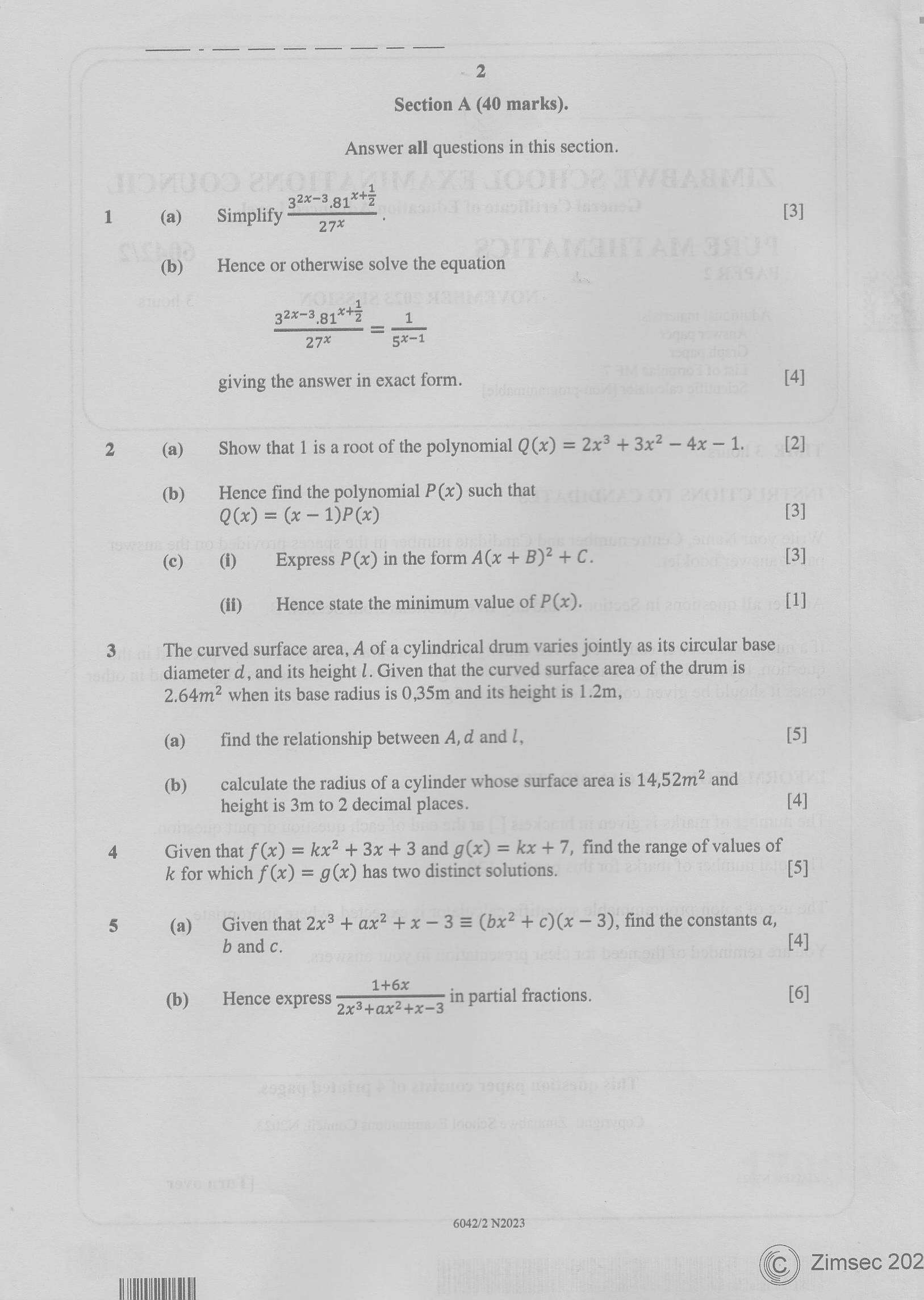
Section A (40 marks).
Answer all questions in this section.
a 32x-3,g1°42
@ Simphiy= [3]
(b) Hence or otherwise solve the equation
gai 4
27* = 5%-1
giving the answer in exact form. [4]
(a) Show that 1 is a root of the polynomial Q(x) = 2x* + 3x2 —4x-1. (2]
(b) Hence find the polynomial P(x) such that
Q(x) = (x - 1)P() {3]
c) @ Express P(x) in the form A(x + B)? + C. [3]
(ii) Hence state the minimum value of P(x). {1]
The curved surface area, A of a cylindrical drum varies jointly as its circular base
diameter d, and its height 1. Given that the curved surface area of the drum is
2.64m? when its base radius is 0,35m and its height is 1.2m,
(a) find the relationship between A, d and 1, [5]
(b) calculate the radius of a cylinder whose surface area is 14,52m? and
height is 3m to 2 decimal places. [4]
Given that f(x) = kx? + 3x + 3 and g(x) = kx +7, find the range of values of
k for which f (x) = g(x) has two distinct solutions. [5]
(a) Given that 2x3 + ax? + x — 3 = (bx? + c)(x — 3), find the constants a,
band c. [4]
(b) Hence express 5 in partial fractions. [6]
x3 +ax2+x-3
6042/2 N2023
---
Page 3
Extracted Text
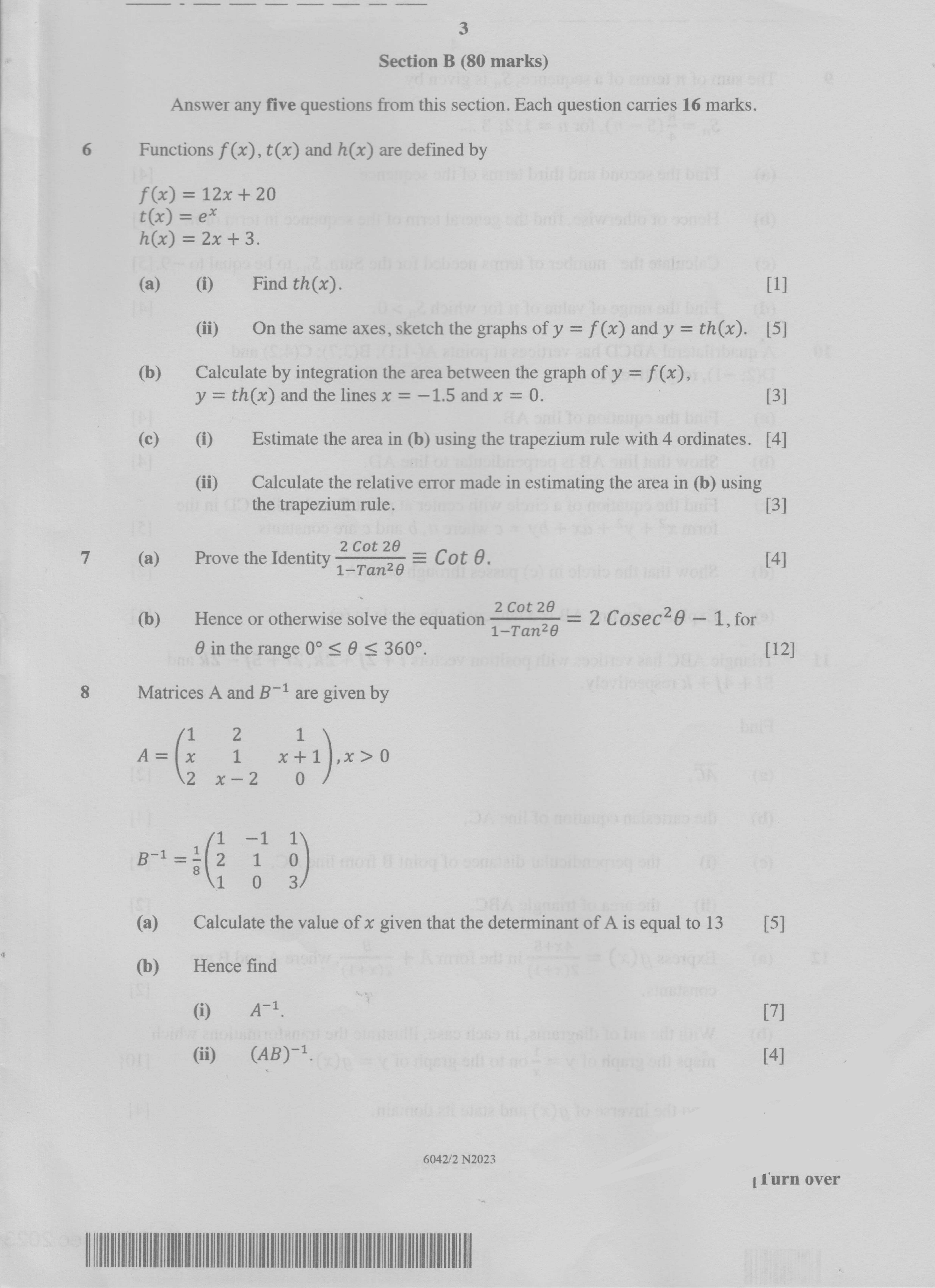
Section B (80 marks)Answer any five questions from this section. Each question carries 16 marks.
6 Functions f (x), t(x) and h(x) are defined by
f(x) = 12x + 20
tx) =<
h(x) = 2x +3.
(a) (i) Find th(x). [1]
(ii) | On the same axes, sketch the graphs of y = f(x) andy = th(x). [5]
(b) Calculate by integration the area between the graph of y = f(x),
y = th(x) and the lines x = —1.5 and x = 0. | [3]
(c) (i) Estimate the area in (b) using the trapezium rule with 4 ordinates. [4]
(ii) Calculate the relative error made in estimating the area in (b) using
the trapezium rule.
2 Cot 20
7 (a) Prove the Identity errs = Cot 0.
a 2 ot 20
(b) | Hence or otherwise solve the equation
8 in the range 0° < 6 < 360°.
8 Matrices A and B~? are given by
1 2 1
A=|x 1 x + 1). > 0
4 t=2 0
: 1 -1 1
2 ils = 4-2
a es: GS
(a) Calculate the value of x given that the determinant of A is equal to 13
(b) Hence find
(i) Ps
Gi)... AB).
6042/2 N2023
ANCA
1-—Tan76@
[3]
[4]
= 2 Cosec*6@ — 1, for
[12]
[5]
[7]
[4]
; {urn over
---
Page 4
Extracted Text
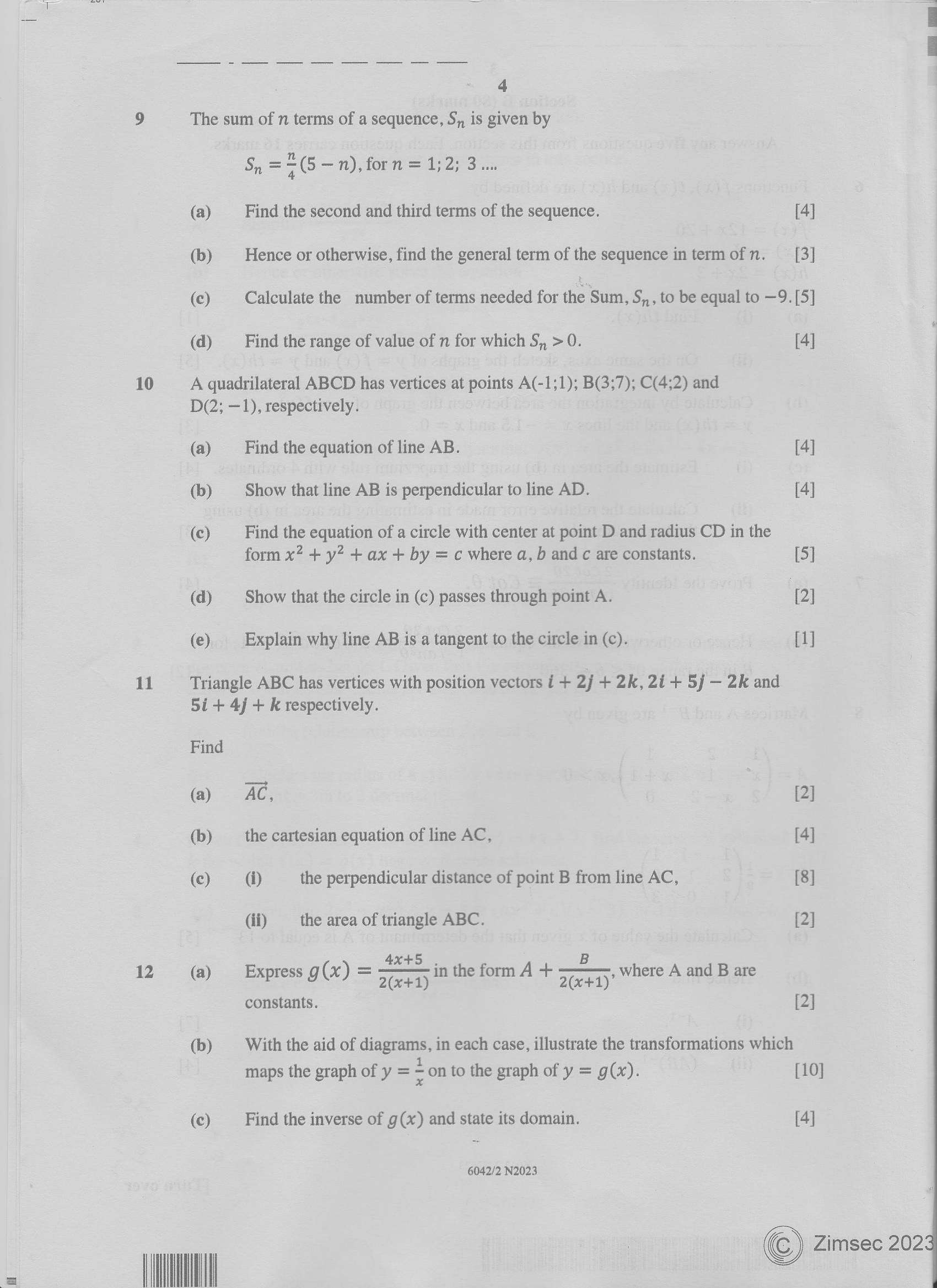
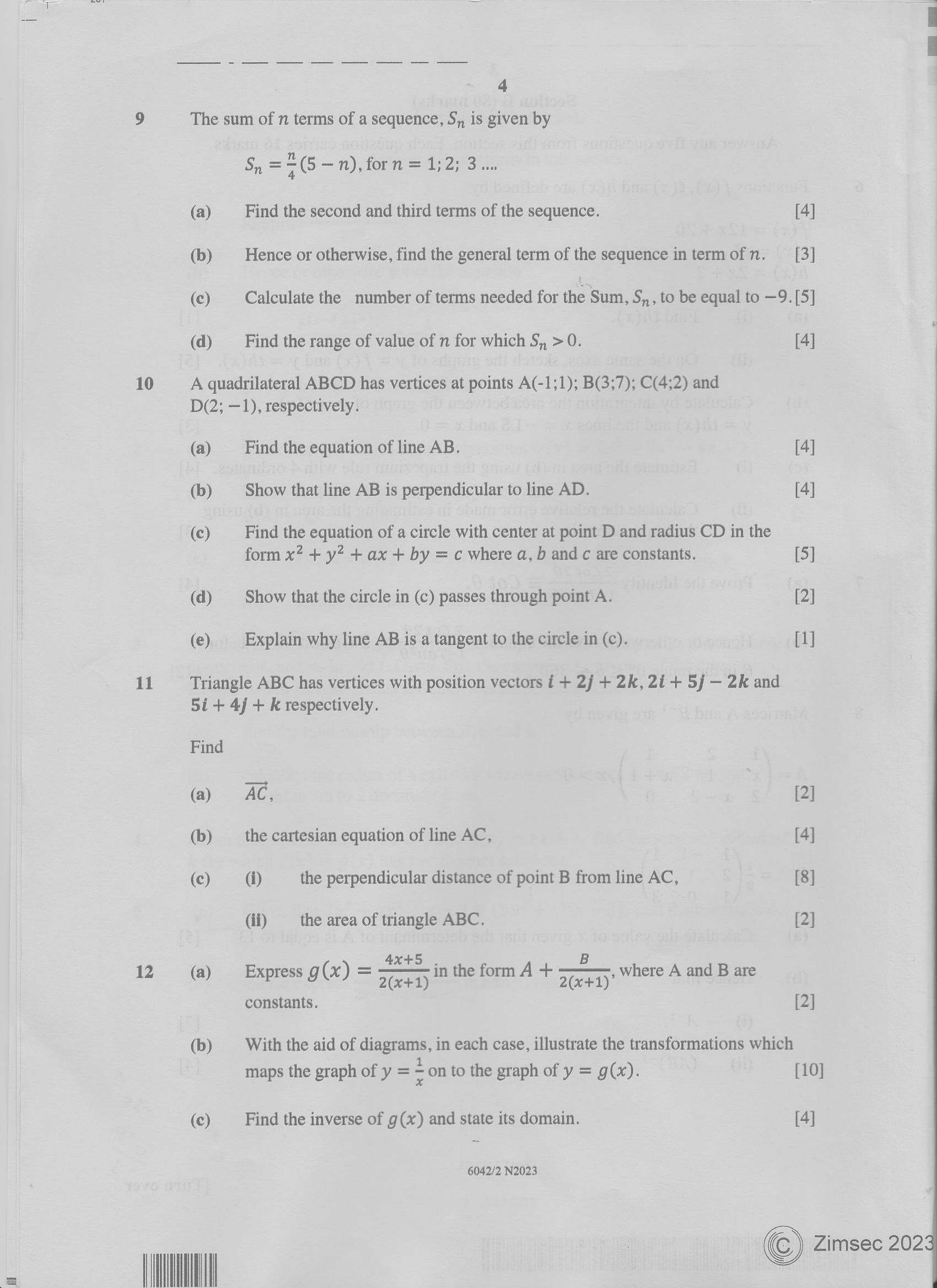
49 The sum of n terms of a sequence, S, is given by
(a)
(b)
(¢)
(d)
Si = —n),forn = 1;2; 3...
Find the second and third terms of the sequence. [4]
Hence or otherwise, find the general term of the sequence intermofn. [3]
Calculate the number of terms needed for the Sum, Sn, to be equal to —9.[5]
Find the range of value of n for which S, >0. [4]
10 A quadrilateral ABCD has vertices at points A(-1;1); B(3;7); C(4;2) and
D(2; —1), respectively.
(a) __ Find the equation of line AB. [4]
(b) Show that line AB is perpendicular to line AD. (4]
(c) Find the equation of a circle with center at point D and radius CD in the
form x? + y? + ax + by = c where a, b and c are constants. (5]
(d) Show that the circle in (c) passes through point A. I
(e) Explain why line AB is a tangent to the circle in (c). {1]
i Triangle ABC has vertices with position vectors i + 2j + 2k, 2i+ 5j — 2k and
5i + 4j + k respectively.
Find
(a) AC, [2]
(b) the cartesian equation of line AC, [4]
(c) @ the perpendicular distance of point B from line AC, [8]
(19) the area of triangle ABC. [2]
12 (a) Express g(x) = —— in the form A + = where A and B are
constants. [2]
(b) With the aid of diagrams, in each case, illustrate the transformations which
(c)
aA
maps the graph of y = =on to the graph of y = g(x). [10]
Find the inverse of g(x) and state its domain. [4]
6042/2 N2023
© Zimsec 202
---
Page 5
Extracted Text
9 The sum of n terms of a sequence, S,, is given by(a)
(b)
(c)
(d)
S, = Ae —n), forn = 1;2; 3...
Find the second and third terms of the sequence. [4]
Hence or otherwise, find the general term of the sequence intermofn. [3]
Calculate the number of terms needed for the Sum, S,,, to be equal to —9. [5]
Find the range of value of n for which S, > 0. [4]
10 A quadrilateral ABCD has vertices at points A(-1;1); B(3;7); C(4;2) and
D(2; —1), respectively.
(a) Find the equation of line AB. [4]
(b) Show that line AB is perpendicular to line AD. [4]
(c) Find the equation of a circle with center at point D and radius CD in the
form x? + y? + ax + by =c where a, b and c are constants. [5]
(d) Show that the circle in (c) passes through point A. (2]
(e) Explain why line AB is a tangent to the circle in (c). {1]
il Triangle ABC has vertices with position vectors i + 2j + 2k, 2i+ 5j — 2k and
5i + 4j + k respectively.
Find
(a) AC, [2]
(b) the cartesian equation of line AC, [4]
(c) @ the perpendicular distance of point B from line AC, (8]
(ii) the area of triangle ABC. [2]
12 (a) Express g(x) = a in the form A + = where A and B are
constants. [2]
(b) With the aid of diagrams, in each case, illustrate the transformations which
(c)
(ANNA
maps the graph of y = : on to the graph of y = g(x). [10]
Find the inverse of g(x) and state its domain. [4]
6042/2 N2023
© Zimsec 202
---
Struggling with the concepts in this paper?
Revise syllabus notes, key exam points, and interactive practice questions for Mathematics: