2019_Combined science_olevel_nov_paper3
Year: 2019 • Views: 1 • Downloads: 2
📄 Exam Questions & Readable Text Transcript
Full OCR-extracted text of questions, syllabus codes, and exam instructions.
Extracted Content: 2019_Combined science_olevel_nov_paper3
Page 1
Extracted Text
&Fie Perhormam y Ueasanvteest
ZIMBABWE SCHOOL EXAMINATIONS COUNCIL
General Certificate of Education Ordinary Level
COMBINED SCIENCE 4003/3
PAPER 3 Practical Test
NOVEMBER 2019 SESSION 1 hour 30 minutes
Candidates answer on the question paper.
Additional materials:
As listed in instructions to Supervisors
Calculator (optional)
INSTRUCTIONS TO CANDIDATES
Write your name, centre number and candidate number in the spaces at the top of this page.
Answer both questions.
Write your answers in the spaces provided on the question paper.
Use a sharp pencil for your drawings. Coloured pencils or crayons should not be used.
You should show the essential steps in any calculation and record all experimental results
in the spaces provided in the question paper.
FOR EXAMINER’S USE
INFORMATION FOR CANDIDATES
The number of marks is given in brackets [ |
at the end of each question or part question.
Copyright: Zimbabwe School Examinations Council, N2019.
® ZIMSEC
---
Page 2
Extracted Text
1.You are required to compare energy values of two food samples.
You are provided with 1.0 g mealie meal in a crucible, 1.0 g sugar ina crucible, a
thermometer, a boiling tube and a graduated syringe.
Method
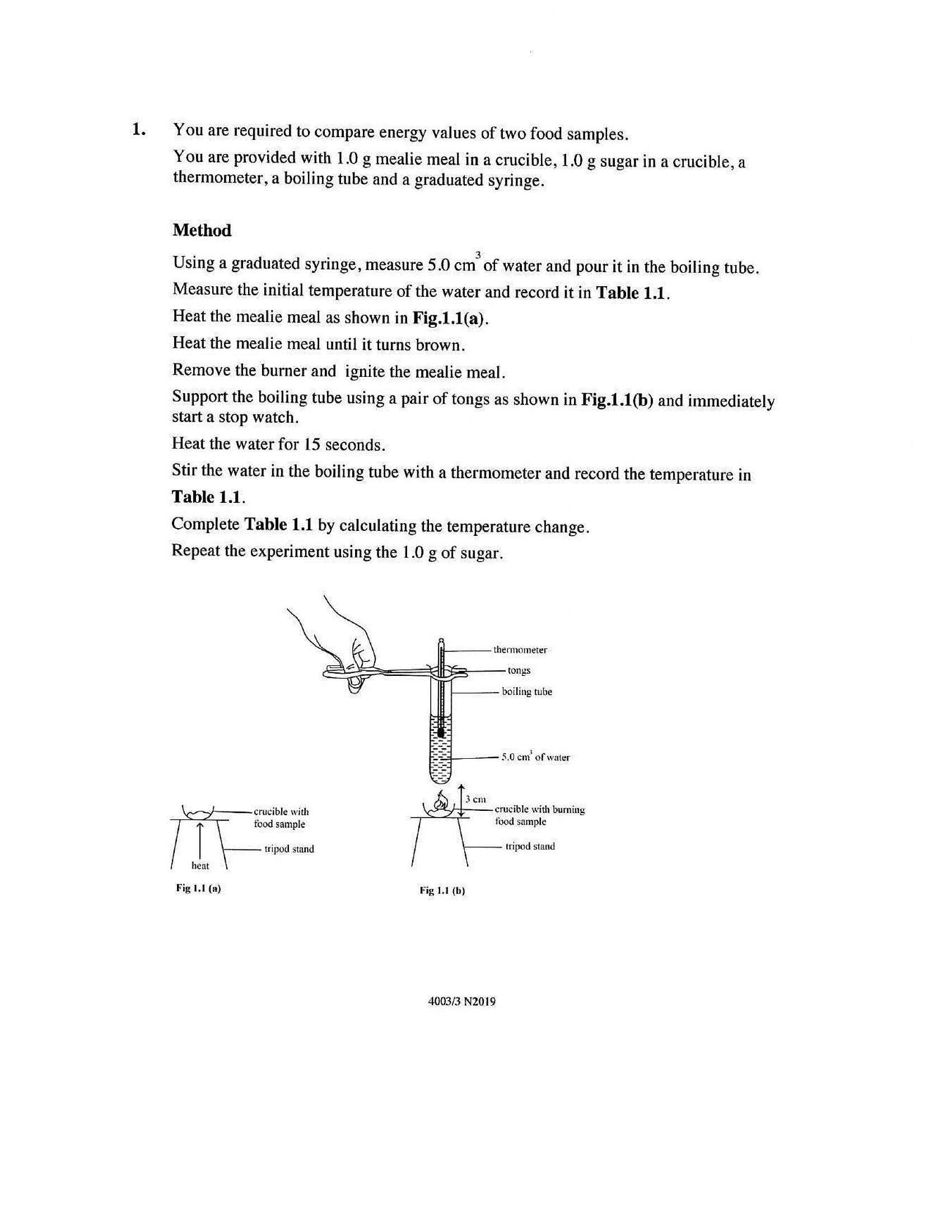
Using a graduated syringe, measure 5.0 cm of water and pour it in the boiling tube.
Measure the initial temperature of the water and record it in Table 1.1.
Heat the mealie meal as shown in Fig.1.1(a).
Heat the mealie meal until it turns brown.
Remove the burner and ignite the mealie meal.
Support the boiling tube using a pair of tongs as shown in Fig.1.1(b) and immediately
Start a stop watch.
Heat the water for 15 seconds.
Stir the water in the boiling tube with a thermometer and record the temperature in
Table 1.1.
Complete Table 1.1 by calculating the temperature change.
Repeat the experiment using the 1.0 g of sugar.
thermometer
tongs
boiling tube
:
5.0 cm of water
3cm
crucible with burning
food sample
crucible with
] food sample
tripod stand tripod stand
heat
Fig 1.1 (a) Fig 1.1 (b)
4003/3 N2019
---
Page 3
Extracted Text
(a)@
Gi)
(iii)
(iv)
(vy)
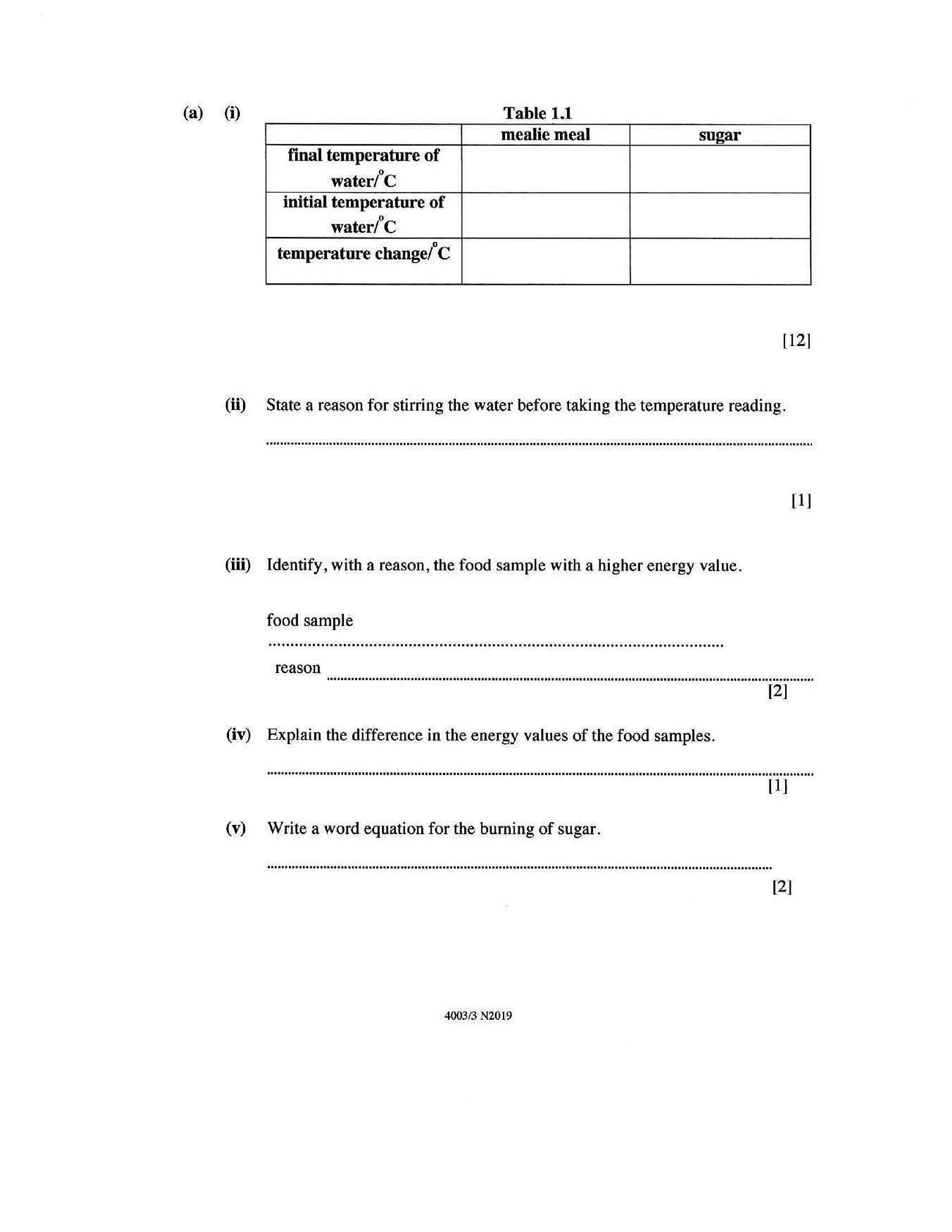
Table 1.1
mealie meal sugar
final temperature of
water/'C
initial temperature of |
water/"C
temperature change/"C |
[12]
State a reason for stirring the water before taking the temperature reading.
WW]
Identify, with a reason, the food sample with a higher energy value.
food sample
reason ted na Renae naneanenaneeseeaneanensetsnennenes nee ene SeSnEeeeeSeeHteONSONSHHSGHNGHSHSSCSSHNANNGHSAUPHSSHOSOHAMI SAU SRSeRESEOE EES AEEEESEREEEE
[2]
Explain the difference in the energy values of the food samples.
nace gaan eupnoeic cnn onan eae vbatonocnnneNaNnGTCESbN [ta
Write a word equation for the burning of sugar.
[2]
4003/3 N2019
---
Page 4
Extracted Text
(b) (i) Suggest any one source of error in the experiment.2. You are required to compare the reactivity of two metals based on their reaction with
dilute hydrochloric acid. A liquid soap has been added to the dilute hydrochloric acid.
You are provided with two metals labelled M1 and M2, a test tube, a graduated syringe,
dilute hydrochloric acid and a 30 cm ruler.
a) @ Measure 5.0 cm’ of the dilute hydrochloric acid using a graduated syringe
and place the acid into a test tube.
Place metal M1 into the test tube and immediately start the stop watch.
Measure the depth of the foam produced after 3 minutes and record it in
Table 2.1.
Rinse the test tube.
Repeat the experiment using dilute hydrochloric acid and metal M2.
Measure and record the depth of the foam produced for metal M2 in
Table 2.1.
Note: The metals used have the same number of moles.
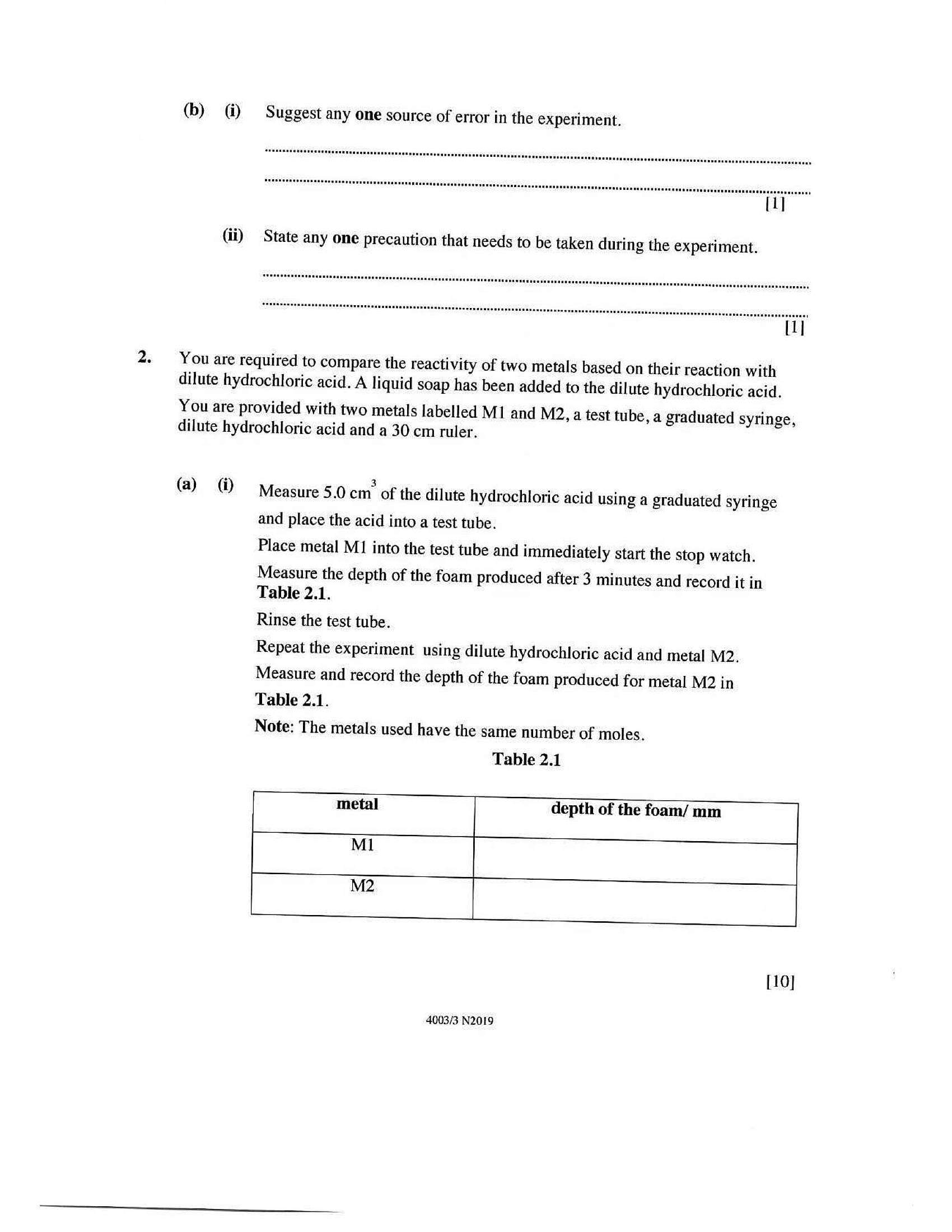
Table 2.1
metal depth of the foam/ mm
M1
M2
[10]
4003/3 N2019
---
Page 5
Extracted Text
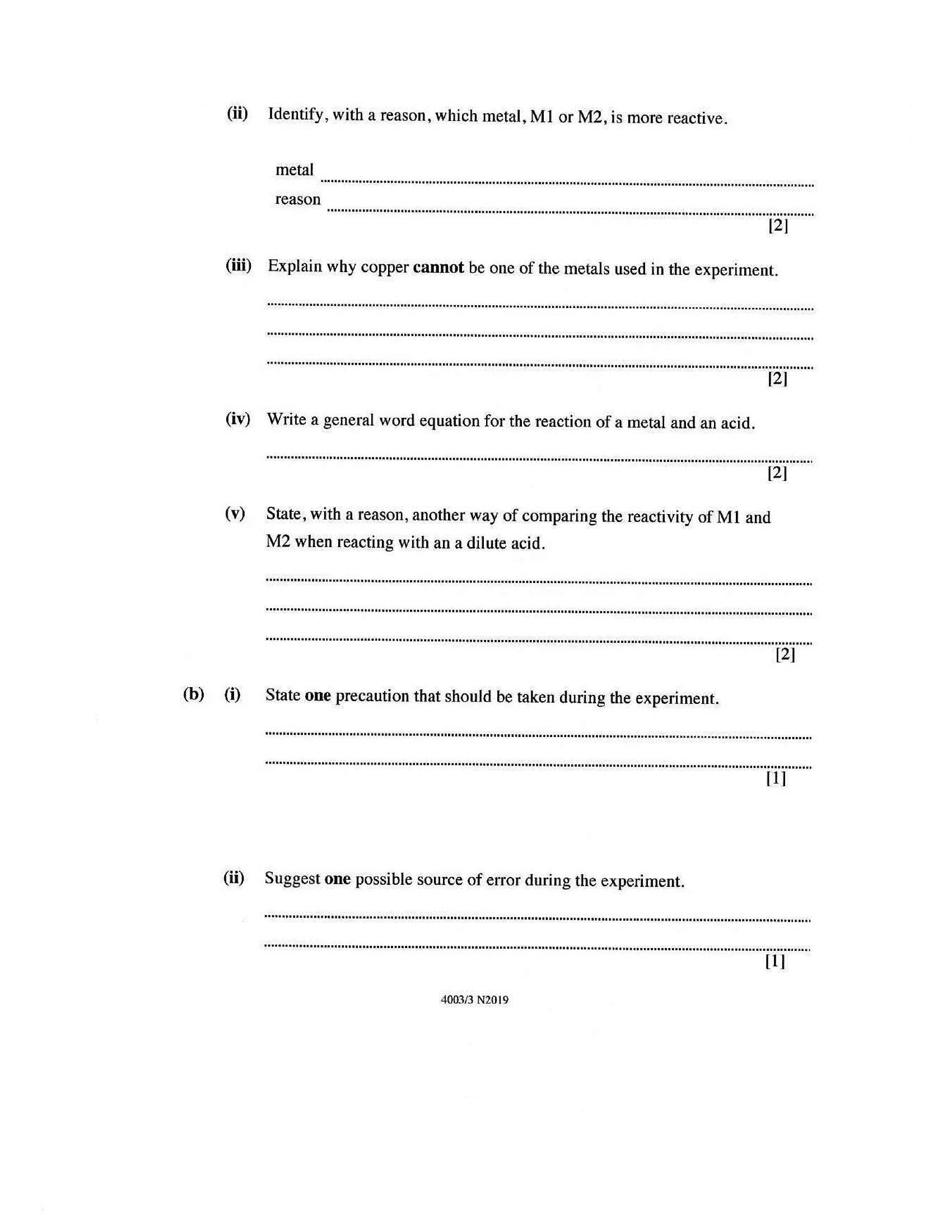
(b)(ii) Identify, with a reason, which metal, M1 or M2, is more reactive.
(iii) Explain why copper cannot be one of the metals used in the experiment.
(iv) Write a general word equation for the reaction of a metal and an acid.
(v) State, with a reason, another way of comparing the reactivity of M1 and
M2 when reacting with an a dilute acid.
(i) State one precaution that should be taken during the experiment.
(ii) Suggest one possible source of error during the experiment.
4003/3 N2019
---
Struggling with the concepts in this paper?
Revise syllabus notes, key exam points, and interactive practice questions for Science Combined: