6049Q1 CROP SCIENCE SPECIMEN
Year: Specimen • Views: 1 • Downloads: 2
📄 Exam Questions & Readable Text Transcript
Full OCR-extracted text of questions, syllabus codes, and exam instructions.
Extracted Content: 6049Q1 CROP SCIENCE SPECIMEN
Page 1
Extracted Text
Tf ak mentZIMBABWE SCHOOL EXAMINATIONS COUNCIL
General Certificate of Education Advanced Level
CROP SCIENCE 6049/1
PAPER 1 Multiple Choice
SPECIMEN PAPER 1 hour
Additional materials:
Multiple Choice answer sheet,
Soft clean eraser,
Soft pencil (type B or HB is recommended),
Scientific calculator.
TIME 1 hour
INSTRUCTIONS TO CANDIDATES
Do not open this booklet until you are told to do so.
Write your name, Centre number and candidate number on the answer sheet in the spaces provided
unless this has already been done for you.
There are forty questions in this paper. Answer all questions. For each question there are four
possible answers, A, B, C and D. Choose the one you consider correct and record your choice
in soft pencil on the separate answer sheet.
Read very carefully the instructions on the answer sheet.
INFORMATION FOR CANDIDATES
Each correct answer will score one mark.
Any rough working should be done in this booklet.
This specimen paper consists of 8 printed pages.
Copyright: Zimbabwe School Examinations Council, Specimen Paper.
©ZIMSEC SPECIMEN PAPER [Turn over
---
Page 2
Extracted Text
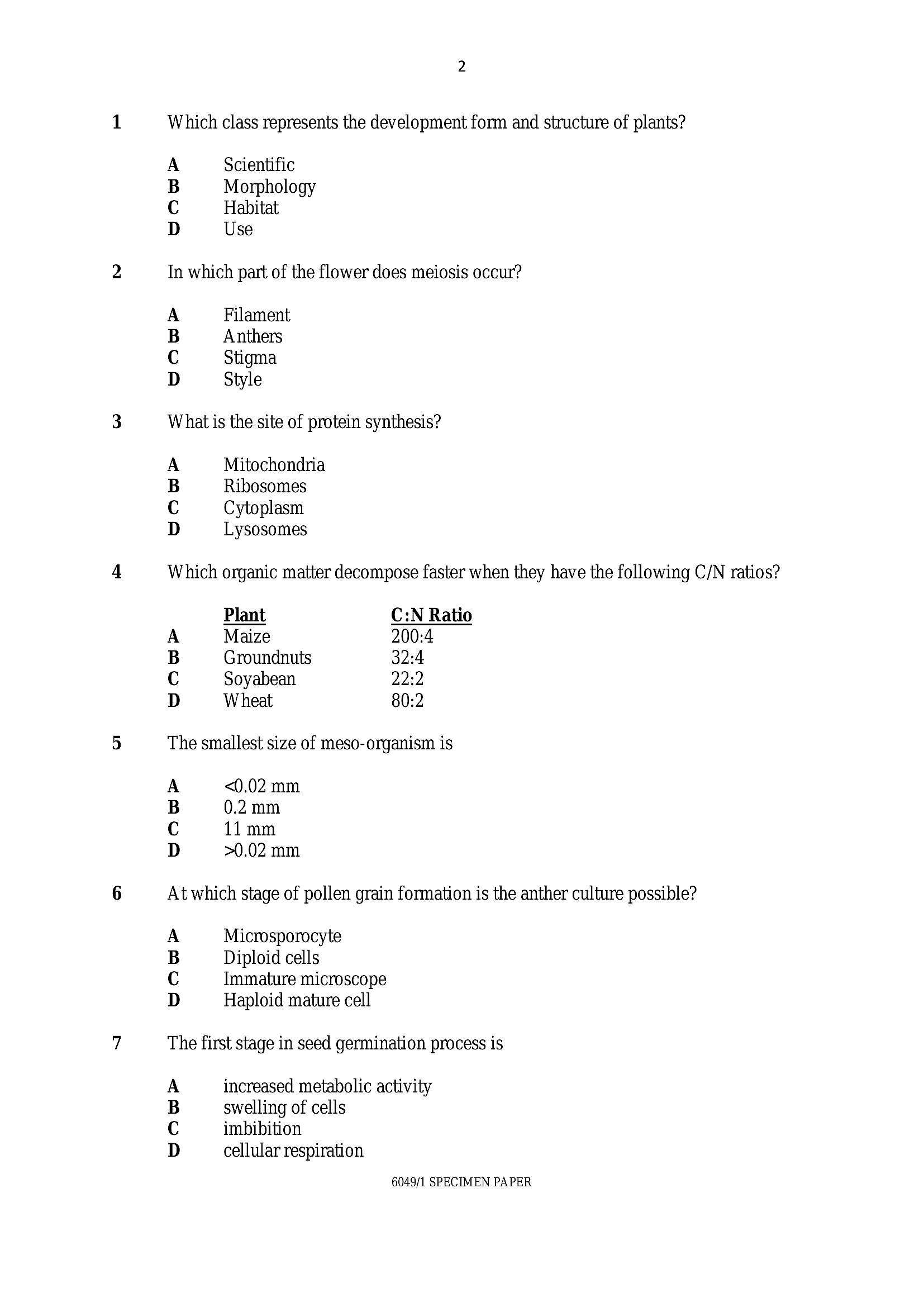
Which class represents the development form and structure of plants?A Scientific
B Morphology
C Habitat
D Use
In which part of the flower does meiosis occur?
A Filament
B Anthers
C Stigma
D Style
What is the site of protein synthesis?
A Mitochondria
B Ribosomes
C Cytoplasm
D Lysosomes
Which organic matter decompose faster when they have the following C/N ratios?
Plant C:N Ratio
A Maize 200:4
B Groundnuts 32:4
C Soyabean 22:2
D Wheat 80:2
The smallest size of meso-organism is
A <0.02 mm
B 0.2 mm
C 11mm
D >0.02 mm
At which stage of pollen grain formation is the anther culture possible?
A Microsporocyte
B Diploid cells
C Immature microscope
D Haploid mature cell
The first stage in seed germination process is
A increased metabolic activity
B swelling of cells
C imbibition
D cellular respiration
6049/1 SPECIMEN PAPER
---
Page 3
Extracted Text
1011
12
13
14
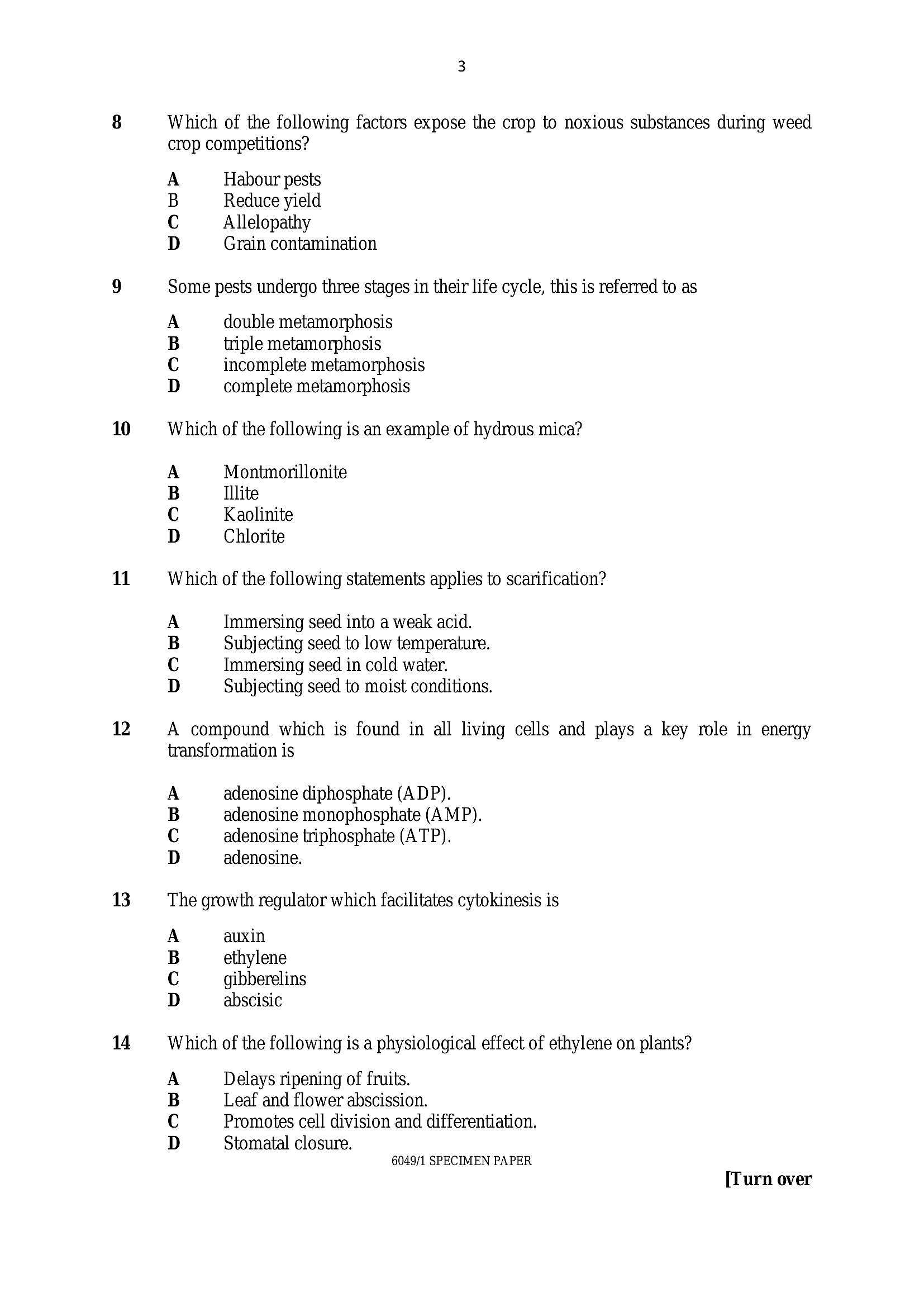
Which of the following factors expose the crop to noxious substances during weed
crop competitions?
A
B
Cc
D
Some pests undergo three stages in their life cycle, this is referred to as
A
B
Cc
D
Which of the following is an example of hydrous mica?
A
B
Cc
D
Which of the following statements applies to scarification?
A
B
Cc
D
Habour pests
Reduce yield
Allelopathy
Grain contamination
double metamorphosis
triple metamorphosis
incomplete metamorphosis
complete metamorphosis
Montmorillonite
Illite
Kaolinite
Chlorite
Immersing seed into a weak acid.
Subjecting seed to low temperature.
Immersing seed in cold water.
Subjecting seed to moist conditions.
A compound which is found in all living cells and plays a key role in energy
transformation is
A
B
Cc
D
The growth regulator which facilitates cytokinesis is
A
B
Cc
D
Which of the following is a physiological effect of ethylene on plants?
TOnmeF
adenosine diphosphate (A DP).
adenosine monophosphate (AMP).
adenosine triphosphate (ATP).
adenosine.
auxin
ethylene
gibberelins
abscisic
Delays ripening of fruits.
Leaf and flower abscission.
Promotes cell division and differentiation.
Stomatal closure.
6049/1 SPECIMEN PAPER
[Turn over
---
Page 4
Extracted Text
ib)16
17
18
19
20
21
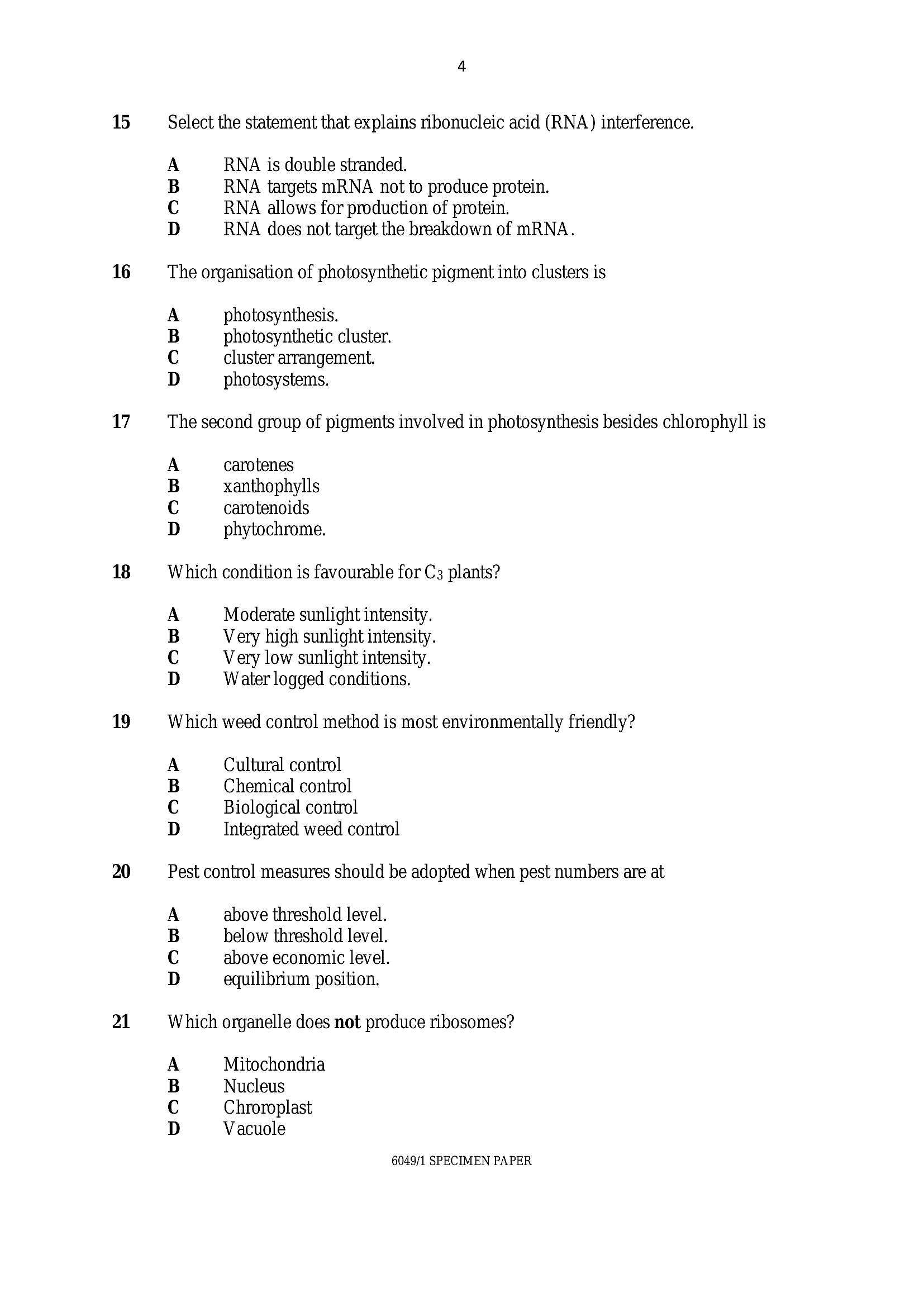
Select the statement that explains ribonucleic acid (RNA) interference.
A RNA is double stranded.
B RNA targets mRNA not to produce protein.
C RNA allows for production of protein.
D RNA does not target the breakdown of mRNA.
The organisation of photosynthetic pigment into clusters is
A photosynthesis.
B photosynthetic cluster.
C cluster arrangement.
D photosystems.
The second group of pigments involved in photosynthesis besides chlorophyll is
A carotenes
B xanthophylls
C carotenoids
D phytochrome.
Which condition is favourable for C3 plants?
A Moderate sunlight intensity.
B Very high sunlight intensity.
C Very low sunlight intensity.
D Water logged conditions.
Which weed control method is most environmentally friendly?
A Cultural control
B Chemical control
C Biological control
D Integrated weed control
Pest control measures should be adopted when pest numbers are at
A above threshold level.
B below threshold level.
C above economic level.
D equilibrium position.
Which organelle does not produce ribosomes?
A Mitochondria
B Nucleus
C Chroroplast
D Vacuole
6049/1 SPECIMEN PAPER
---
Page 5
Extracted Text
2223
24
25
26
Nitrogen depression is a period when there is
A lack of nitrogen for use by micro-organism in the soil.
B sufficient nitrogen in the soil.
C nitrogen locked up in micro-organisms.
D sufficient nitrogen for both micro-organisms and plants in the soil.
Select appropriate methods of quantifying fixed nitrogen by legume in the soil.
A Neutron probe, ureide method.
B Ureide method, nodule evaluation.
C Biological assay, nodule evaluation.
D Ureide method, biological assay.
Double fertilisation in plants leads to two structures found in the seed namely
A radicle and endosperm.
B embryo and radical.
C embryo and endosperm.
D plamule and endosperm.
What are the roles of phytates in germination of seeds?
A Contains oxidative enzymes.
B Storage of complex macromolecules.
C Storage of simple micromolecules.
D Microstorage form of inorganic phosphates in mature grain and leaves.
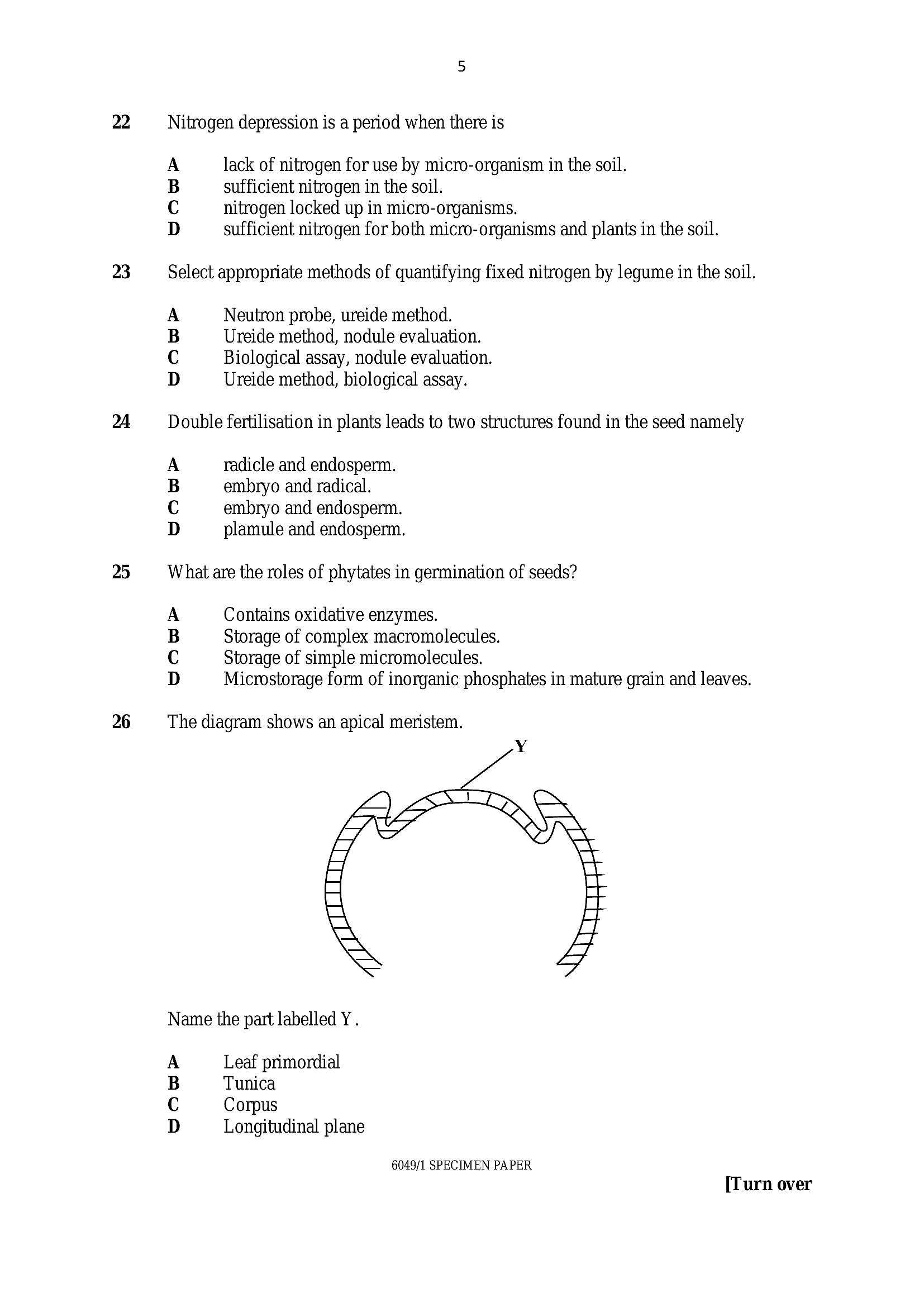
The diagram shows an apical meristem.
Name the part labelled Y .
A Leaf primordial
B Tunica
C Corpus
D Longitudinal plane
6049/1 SPECIMEN PAPER
[Turn over
---
Page 6
Extracted Text
2728
29
30
31
32
Which is the most destructive stage of stalk borer in crops?
A Adult
B Eggs
C Larvae
D Pupa
Herbicide residual effect is mostly caused by
A nature of weeds controlled.
B the high active ingredient of herbicides.
C the potential affinity for residual effect by colloid particles.
D leaching level of herbicides into soil and water bodies.
Select two major factors used to divide Zimbabwe into agroecological zones.
A Rainfall and humidity.
B Rainfall and wind.
C Humidity and wind.
D Rainfall and temperature.
When anthers mature before stigma it is referred to as,
A prophylaxy
B protandry
C protogyny
D protony
Conservation farming practised in water logged areas involve
A contour ploughing.
B terrace farming.
C application of organic matter.
D installing drainage pipes.
A.T.P is regarded as the universal energy carrier and this implies that it is found in
A all living cells.
B all reactions in plants.
C higher plants.
D the mitochondria.
6049/1 SPECIMEN PAPER
---
Page 7
Extracted Text
3334
35
36
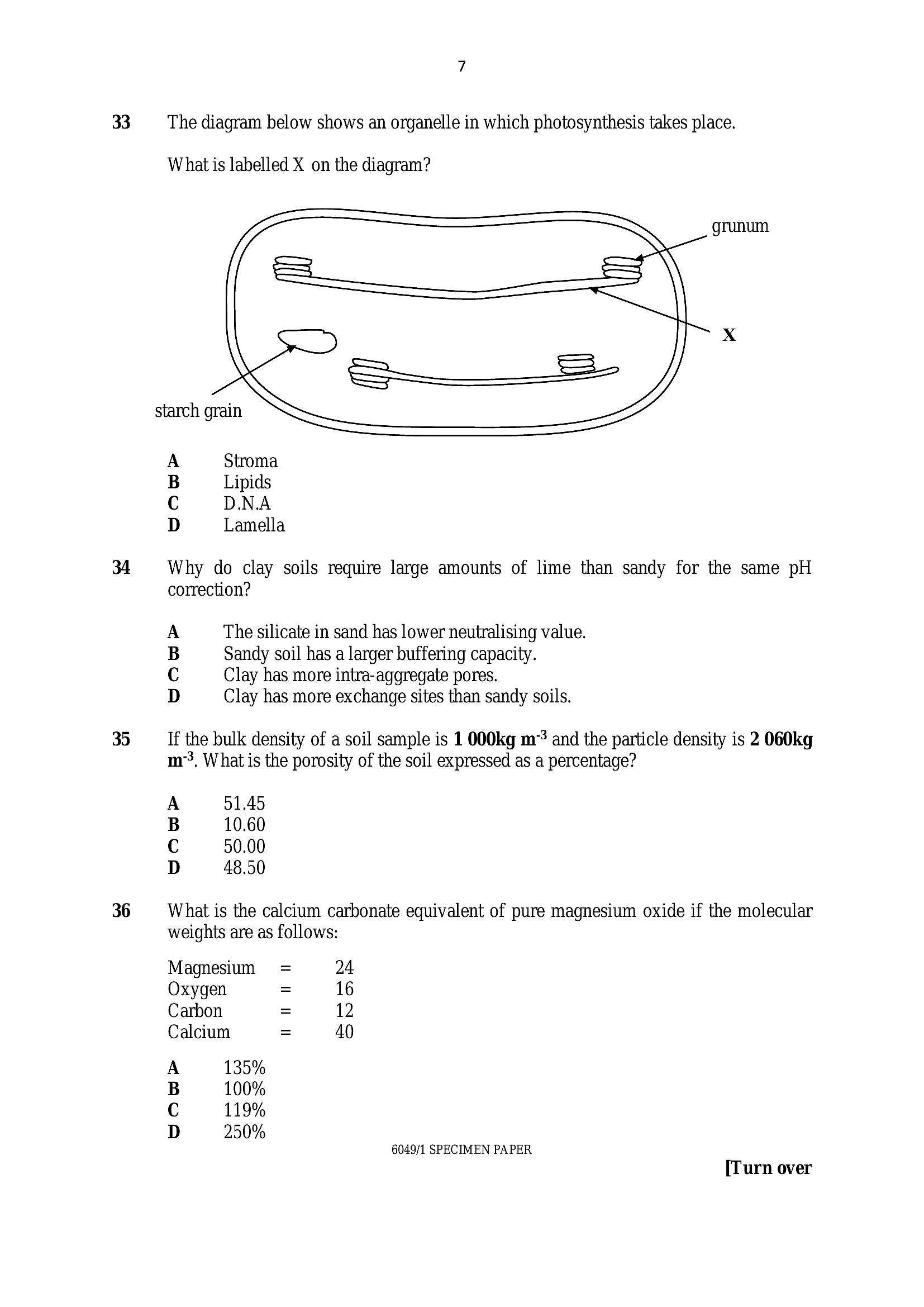
The diagram below shows an organelle in which photosynthesis takes place.
What is labelled X on the diagram?
grunum
Il
=
SK x
SE
starch grain
A Stroma
B Lipids
C DNA
D Lamella
Why do clay soils require large amounts of lime than sandy for the same pH
correction?
A The silicate in sand has lower neutralising value.
B Sandy soil has a larger buffering capacity.
C Clay has more intra-aggregate pores.
D Clay has more exchange sites than sandy soils.
If the bulk density of a soil sample is 1 000kg m° and the particle density is 2 060kg
m3, What is the porosity of the soil expressed as a percentage?
A 51.45
B 10.60
Cc 50.00
D 48.50
What is the calcium carbonate equivalent of pure magnesium oxide if the molecular
weights are as follows:
Magnesium = 24
Oxygen = 16
Carbon = 12
Calcium = 40
A 135%
B 100%
C 119%
D 250%
6049/1 SPECIMEN PAPER
[Turn over
---
Page 8
Extracted Text
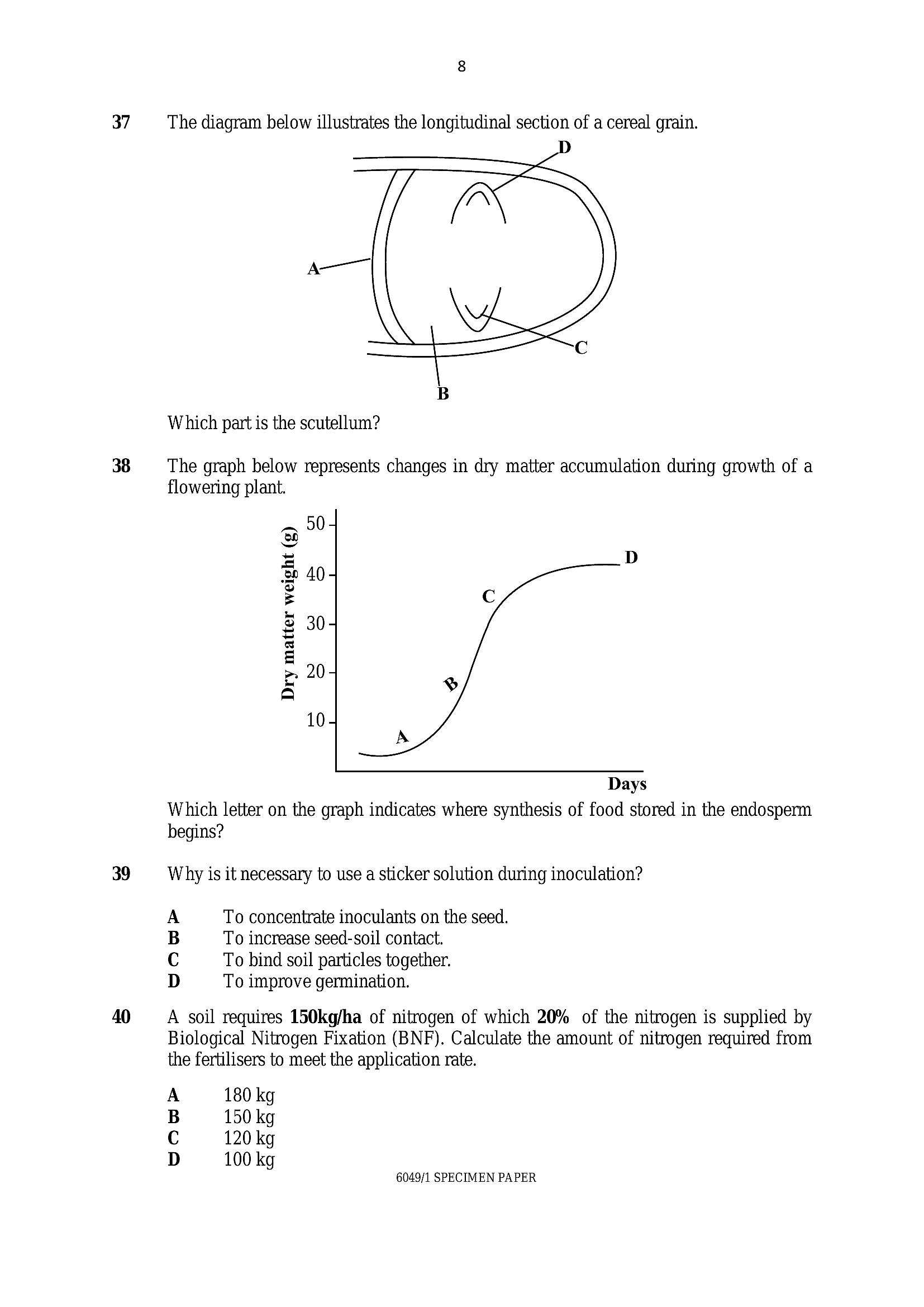
37 The diagram below illustrates the longitudinal section of a cereal grain.Aa
Which part is the scutellum?
38 The graph below represents changes in dry matter accumulation during growth of a
flowering plant.
—~ 50
oe
= 40
vo
S
5 30
E
> 20
=)
a
10
Days
Which letter on the graph indicates where synthesis of food stored in the endosperm
begins?
39 Why is it necessary to use a sticker solution during inoculation?
A To concentrate inoculants on the seed.
B To increase seed-soil contact.
C To bind soil particles together.
D To improve germination.
40 A soil requires 150kg/ha of nitrogen of which 20% of the nitrogen is supplied by
Biological Nitrogen Fixation (BNF). Calculate the amount of nitrogen required from
the fertilisers to meet the application rate.
A 180kg
B 150 kg
C 120k
D ~—-100kg
6049/1 SPECIMEN PAPER
---
Struggling with the concepts in this paper?
Revise syllabus notes, key exam points, and interactive practice questions for Science Combined: