

📄 Exam Questions & Readable Text Transcript
Full OCR-extracted text of questions, syllabus codes, and exam instructions.
Extracted Content: 4029q1 Specimen
Page 1
Extracted Text
For PeZIMBABWE SCHOOL EXAMINATIONS COUNCIL
General Certificate of Education Ordinary Level
LITERATURE IN ENGLISH 4029/1
PAPER 1: ZIMBABWEAN LITERATURE
SPECIMEN PAPER 1 hour 30 minutes
Additional materials:
Answer paper
TIME: 1 hours 30 minutes
INSTRUCTIONS TO CANDIDATES
Write your name, centre number and candidate number in the spaces provided on the answer
paper/answer booklet.
Answer two questions.
Each answer must be on a different text.
Write your answers on the separate answer paper provided.
If you use more than one sheet of paper, fasten the sheets together.
INFORMATION FOR CANDIDATES
All questions in this paper carry equal marks.
Y ou are reminded of the need for good English and clear presentation in your answers,
This Specimen paper consists of 7 printed pages and 1 blank page.
Copyright: Zimbabwe School Examinations Council, Specimen Paper.
@ZIMSEC SPECIMEN PAPER [Turn over
---
Page 2
Extracted Text
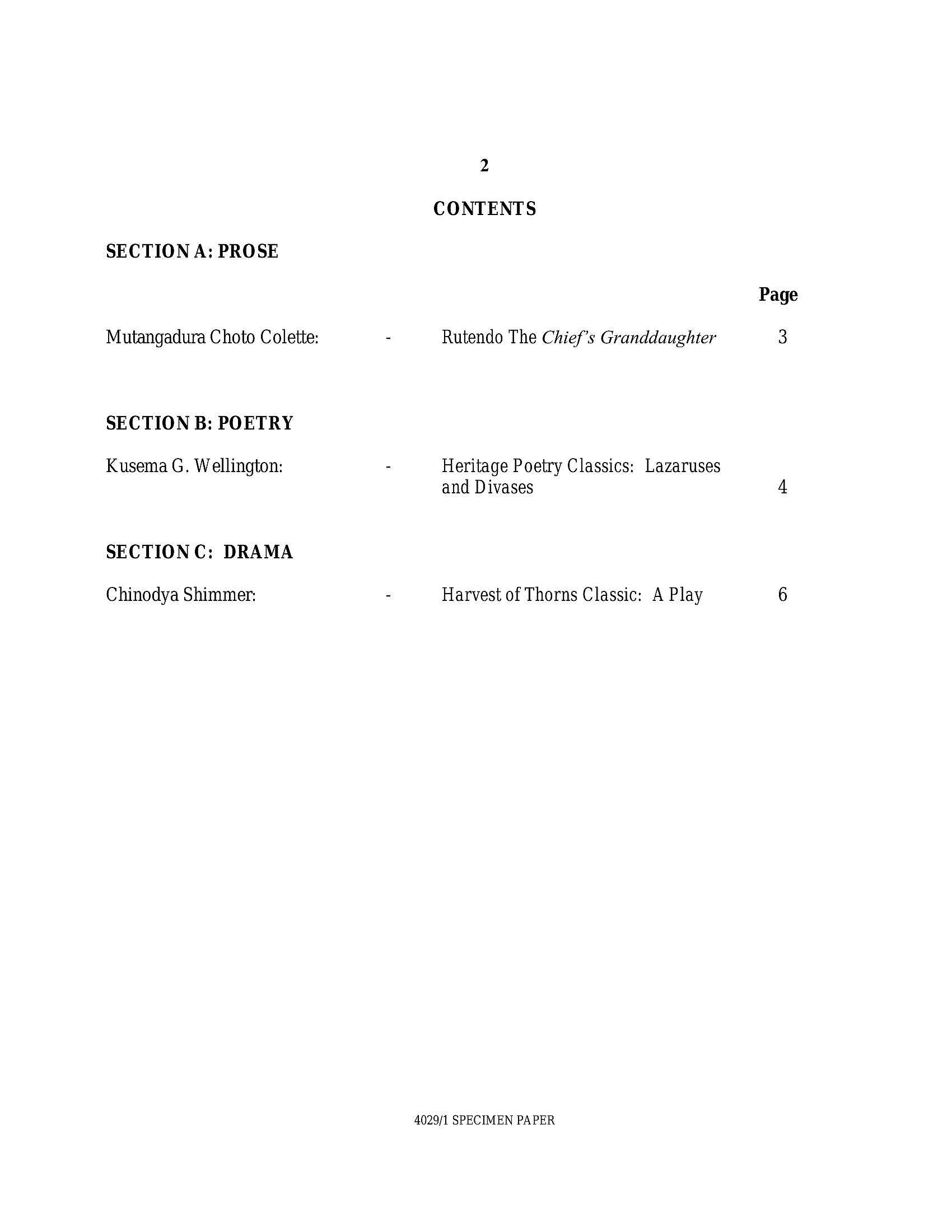
SECTION A: PROSEMutangadura Choto Colette:
SECTION B: POETRY
Kusema G. Wellington:
SECTION C: DRAMA
Chinodya Shimmer:
2
CONTENTS
Rutendo The Chief’s Granddaughter
Heritage Poetry Classics: Lazaruses
and Divases
Harvest of Thorns Classic: A Play
4029/1 SPECIMEN PAPER
Page
---
Page 3
Extracted Text
3SECTION A: (PROSE)
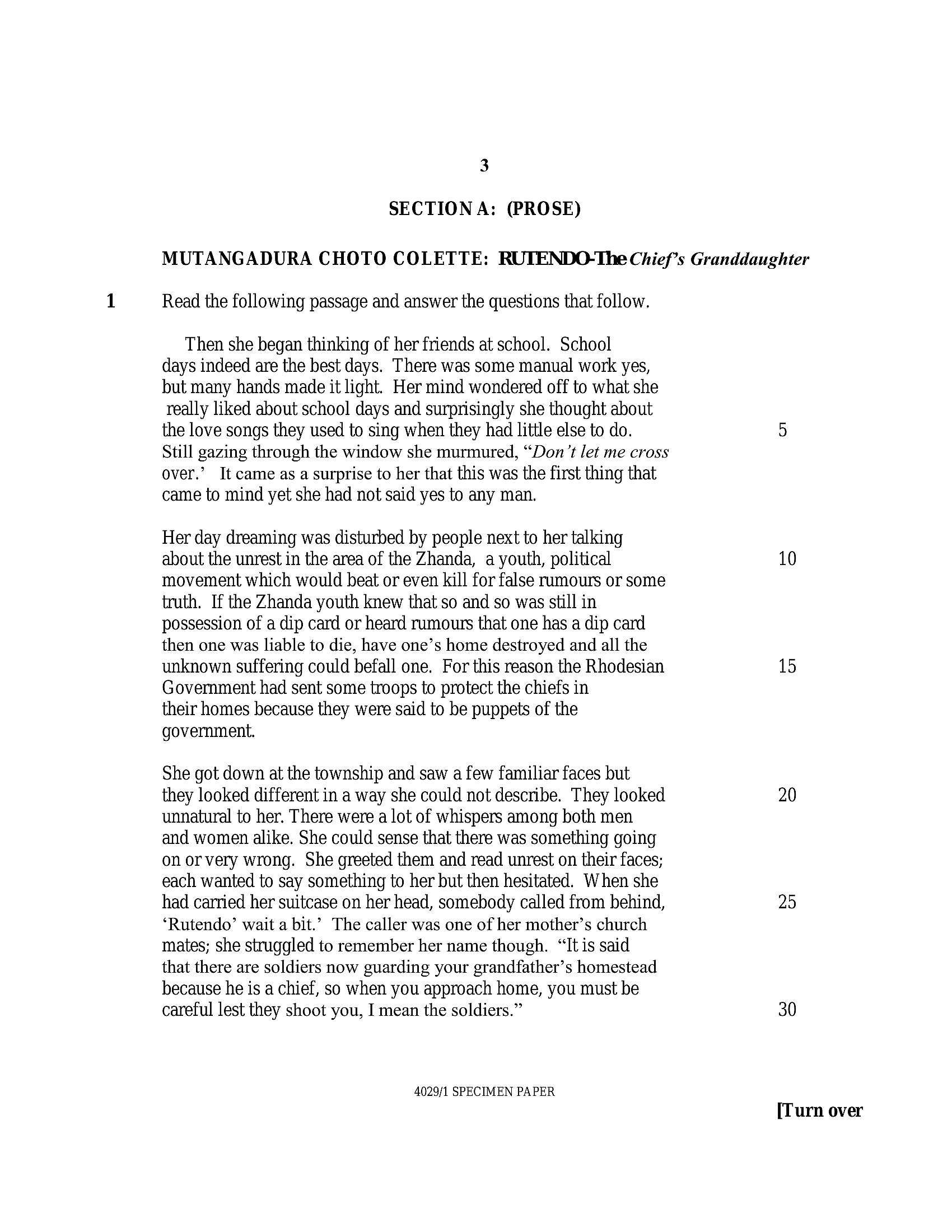
MUTANGADURA CHOTO COLETTE: RUTENDO-The Chief’s Granddaughter
Read the following passage and answer the questions that follow.
Then she began thinking of her friends at school. School
days indeed are the best days. There was some manual work yes,
but many hands made it light. Her mind wondered off to what she
really liked about school days and surprisingly she thought about
the love songs they used to sing when they had little else to do.
Still gazing through the window she murmured, “Don’t let me cross
over.’ It came as a surprise to her that this was the first thing that
came to mind yet she had not said yes to any man.
Her day dreaming was disturbed by people next to her talking
about the unrest in the area of the Zhanda, a youth, political
movement which would beat or even kill for false rumours or some
truth. If the Zhanda youth knew that so and so was still in
possession of a dip card or heard rumours that one has a dip card
then one was liable to die, have one’s home destroyed and all the
unknown suffering could befall one. For this reason the Rhodesian
Government had sent some troops to protect the chiefs in
their homes because they were said to be puppets of the
government.
She got down at the township and saw a few familiar faces but
they looked different in a way she could not describe. They looked
unnatural to her. There were a lot of whispers among both men
and women alike. She could sense that there was something going
on orvery wrong. She greeted them and read unrest on their faces;
each wanted to say something to her but then hesitated. When she
had carried her suitcase on her head, somebody called from behind,
‘Rutendo’ wait a bit.’ The caller was one of her mother’s church
mates; she struggled to remember her name though. “It is said
that there are soldiers now guarding your grandfather’s homestead
because he is a chief, so when you approach home, you must be
careful lest they shoot you, I mean the soldiers.”
4029/1 SPECIMEN PAPER
10
15
20
25
30
[Turn over
---
Page 4
Extracted Text
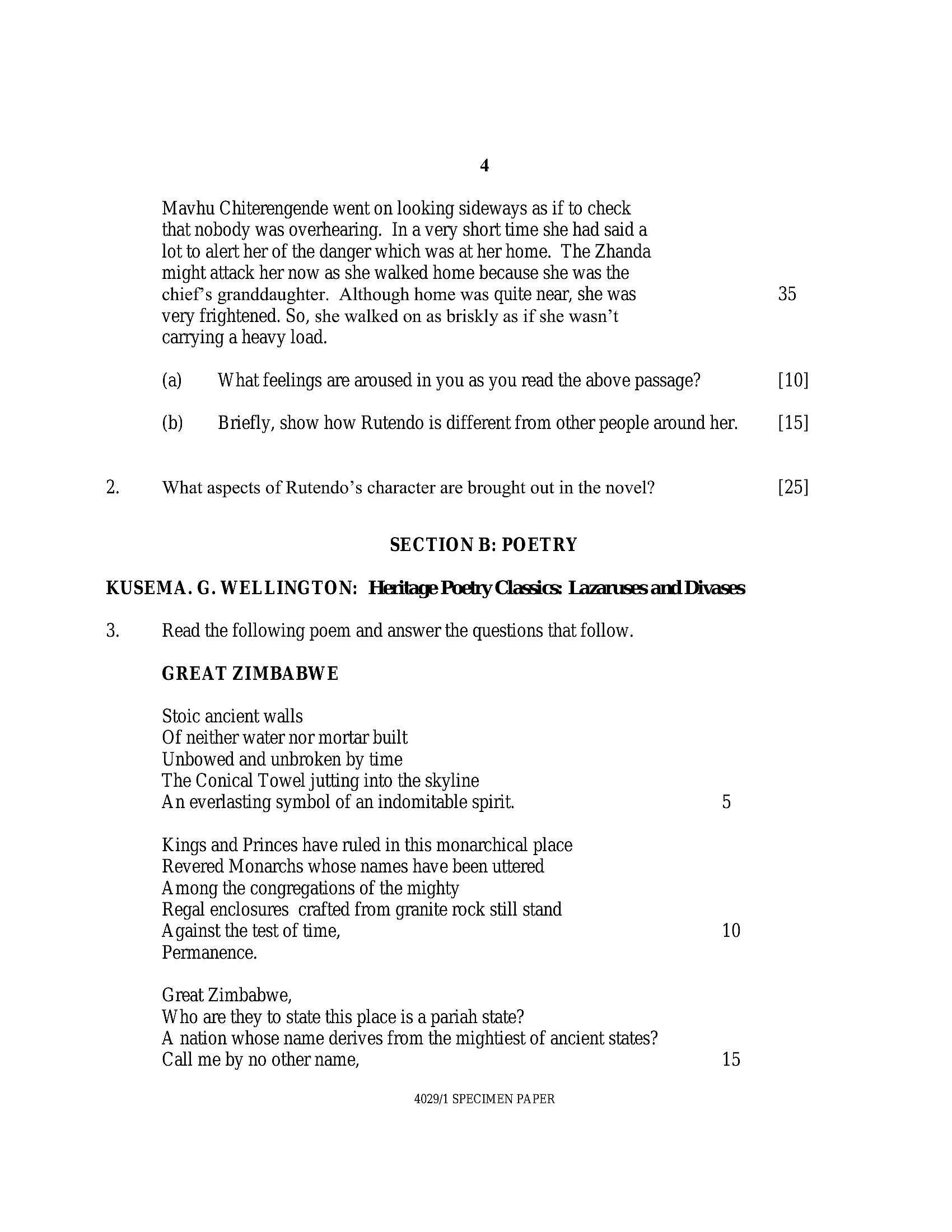
4Mavhu Chiterengende went on looking sideways as if to check
that nobody was overhearing. In a very short time she had said a
lot to alert her of the danger which was at her home. The Zhanda
might attack her now as she walked home because she was the
chief’s granddaughter. Although home was quite near, she was
very frightened. So, she walked on as briskly as if she wasn’t
carrying a heavy load.
(a) What feelings are aroused in you as you read the above passage?
(b) Briefly, show how Rutendo is different from other people around her.
What aspects of Rutendo’s character are brought out in the novel?
SECTION B: POETRY
KUSEMA.G.WELLINGTON: Heritage Poetry Classics: Lazaruses and Divases
3.
Read the following poem and answer the questions that follow.
GREAT ZIMBABWE
Stoic ancient walls
Of neither water nor mortar built
Unbowed and unbroken by time
The Conical Towel jutting into the skyline
An everlasting symbol of an indomitable spirit. 5
Kings and Princes have ruled in this monarchical place
Revered Monarchs whose names have been uttered
Among the congregations of the mighty
Regal enclosures crafted from granite rock still stand
Against the test of time, 10
Permanence.
Great Zimbabwe,
Who are they to state this place is a pariah state?
A nation whose name derives from the mightiest of ancient states?
Call me by no other name, 15
4029/1 SPECIMEN PAPER
35
---
Page 5
Extracted Text
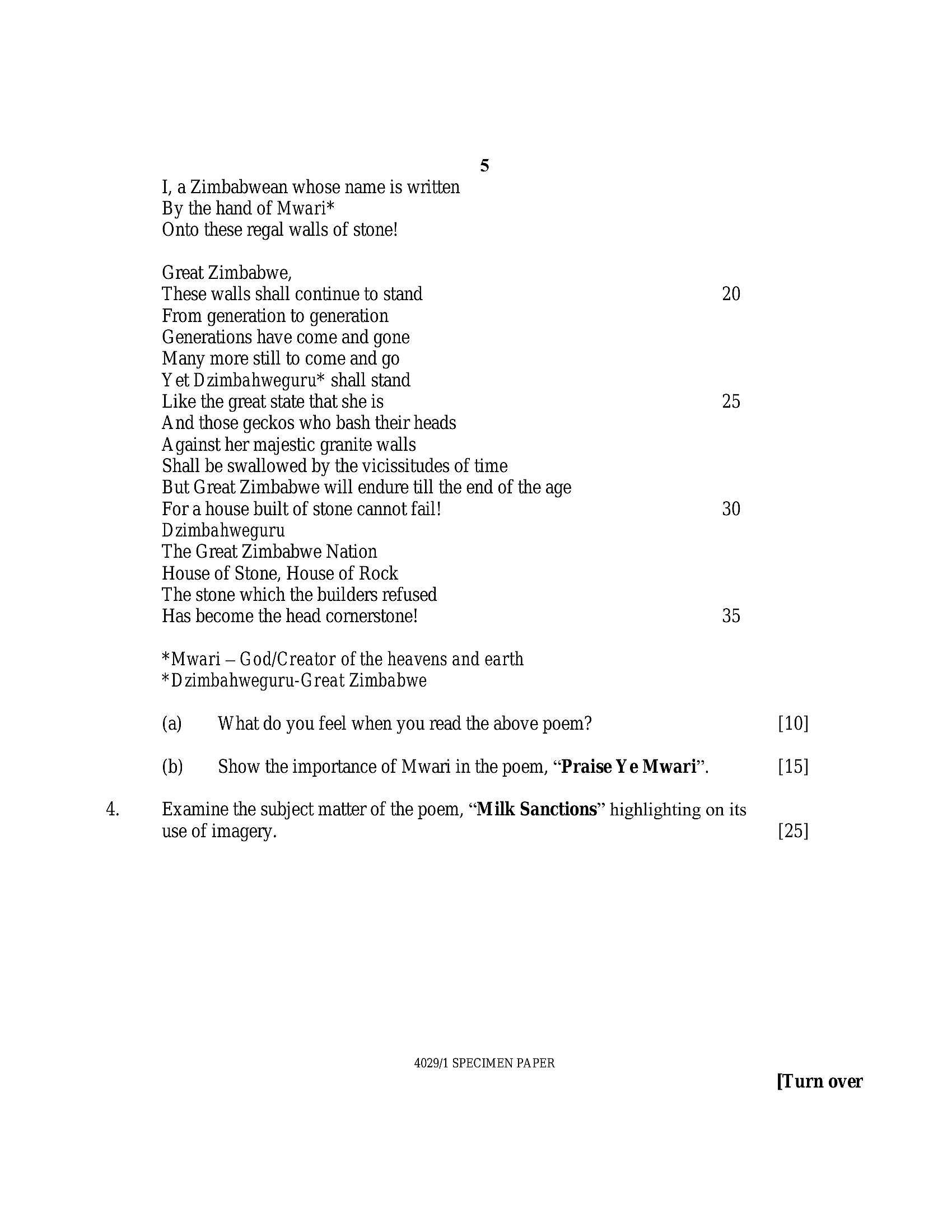
I, aZimbabwean whose name is written By the hand of Mwari* Onto these regal walls of stone!Great Zimbabwe,
These walls shall continue to stand 20
From generation to generation
Generations have come and gone
Many more still to come and go
Y et Dzimbahweguru* shall stand
Like the great state that she is 25
And those geckos who bash their heads
Against her majestic granite walls
Shall be swallowed by the vicissitudes of time
But Great Zimbabwe will endure till the end of the age
For a house built of stone cannot fail! 30
Dzimbahweguru
The Great Zimbabwe Nation
House of Stone, House of Rock
The stone which the builders refused
Has become the head cornerstone! 35
*Mwari — God/Creator of the heavens and earth
*D zimbahweguru-Great Zimbabwe
(a) What do you feel when you read the above poem? [10]
(b) Show the importance of Mwari in the poem, “Praise Ye Mwari”. [15]
Examine the subject matter of the poem, “Milk Sanctions” highlighting on its
use of imagery. [25]
4029/1 SPECIMEN PAPER
[Turn over
---
Page 6
Extracted Text
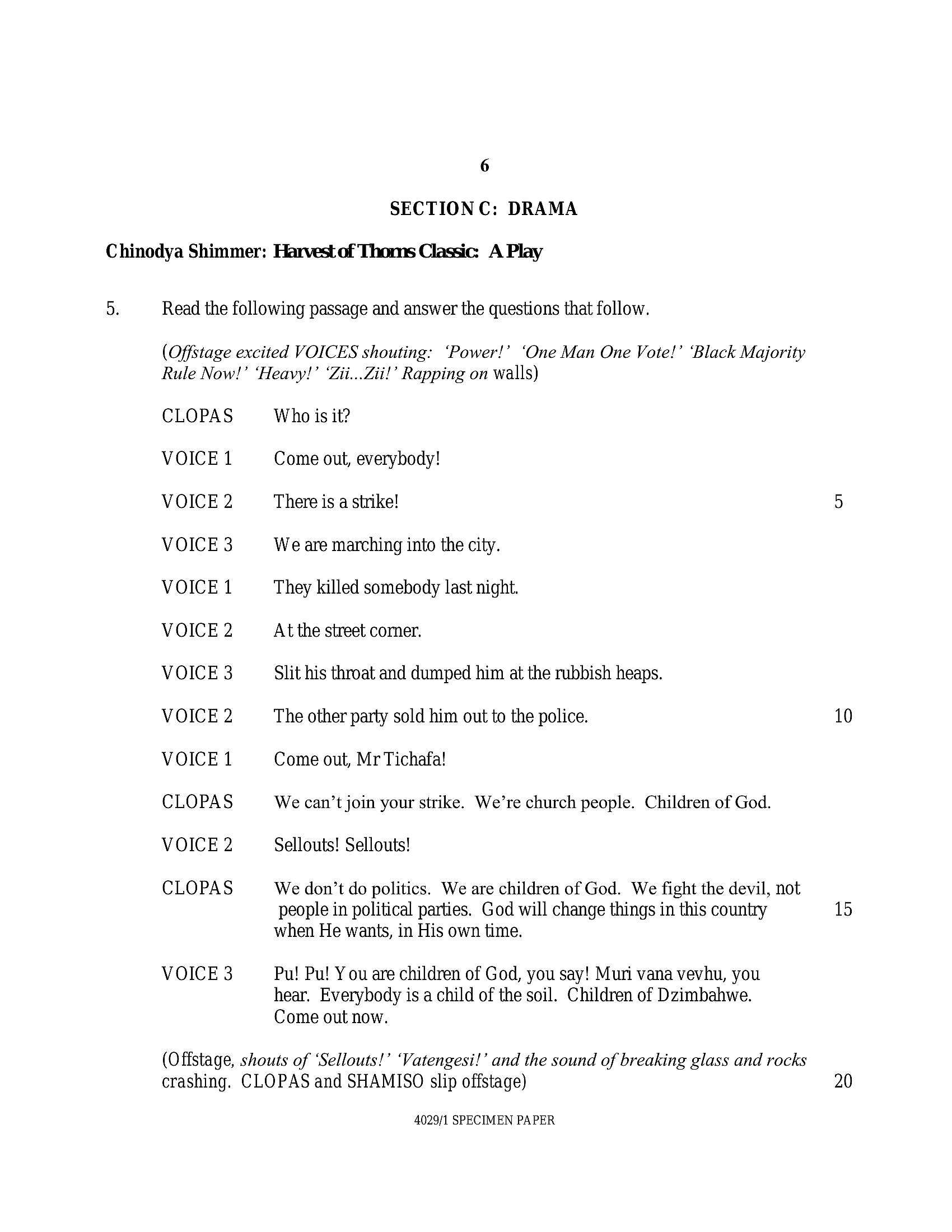
SECTION C: DRAMA6
Chinodya Shimmer: Harvest of Thoms Classic: A Play
5. Read the following passage and answer the questions that follow.
(Offstage excited VOICES shouting: ‘Power!’ ‘One Man One Vote!’ ‘Black Majority
Rule Now!’ ‘Heavy!’ ‘Zii...Zii!’ Rapping on walls)
CLOPAS
VOICE 1
VOICE 2
VOICE 3
VOICE 1
VOICE 2
VOICE 3
VOICE 2
VOICE 1
CLOPAS
VOICE 2
CLOPAS
VOICE 3
(Offstage, shouts of ‘Sellouts!’ ‘Vatengesi!’ and the sound of breaking glass and rocks
Who is it?
Come out, everybody!
q
here is a strike!
q
>
Nn
4
We are marching into the city.
hey killed somebody last night.
t the street corer.
it his throat and dumped him at the rubbish heaps.
he other party sold him out to the police.
Come out, Mr Tichafa!
We can’t join your strike. We’re church people. Children of God.
Sellouts! Sellouts!
We don’t do politics. We are children of God. We fight the devil, not
people in political parties. God will change things in this country
when He wants, in His own time.
Pu! Pu! Y ou are children of God, you say! Muri vana vevhu, you
hear. Everybody is a child of the soil. Children of Dzimbahwe.
Come out now.
crashing. CLOPAS and SHAMISO slip offstage)
4029/1 SPECIMEN PAPER
10
20
---
Page 7
Extracted Text
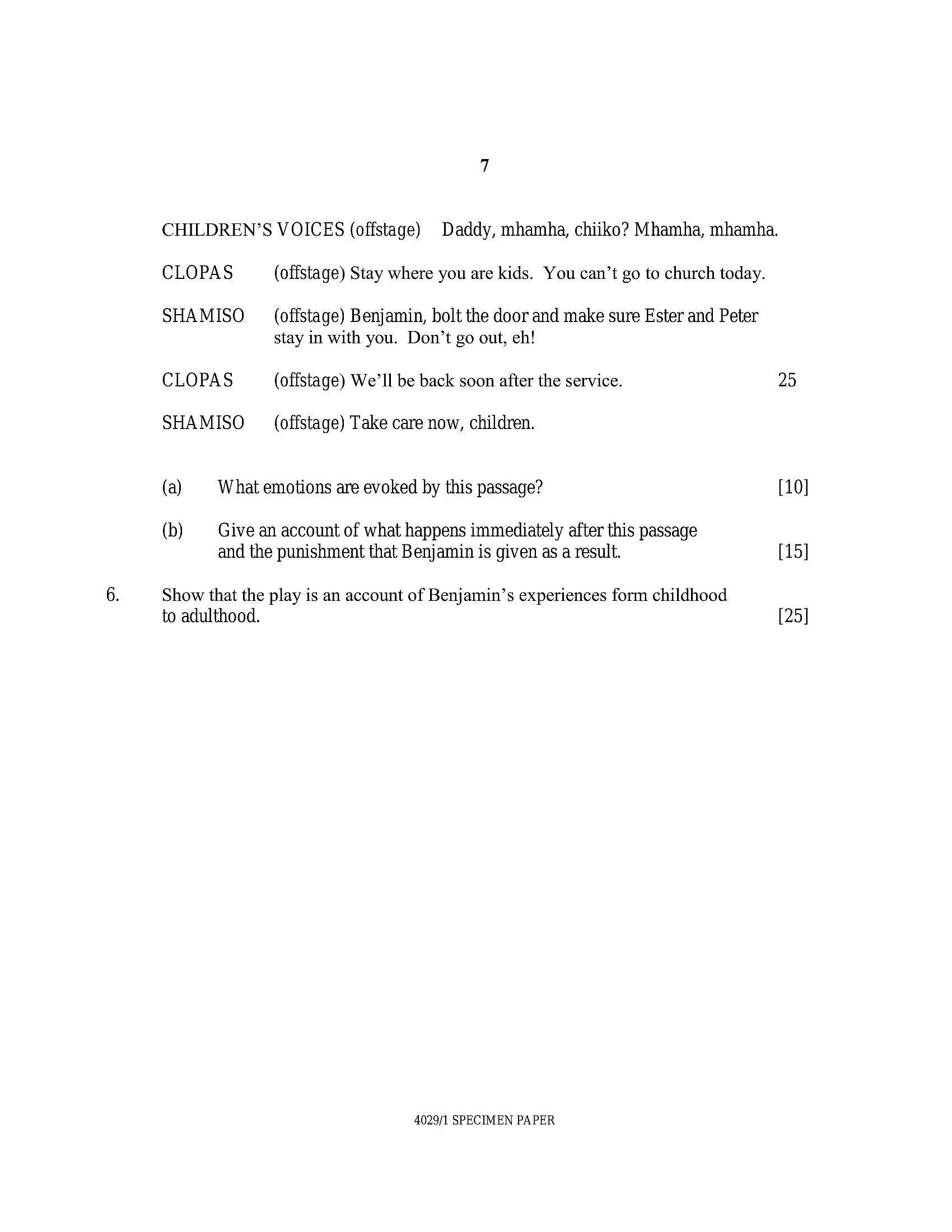
CHILDREN’S VOICES (offstage) Daddy, mhamha, chiiko? Mhamha, mhamha. CLOPAS (offstage) Stay where you are kids. You can’t go to church today.SHAMISO (offstage) Benjamin, bolt the door and make sure Ester and Peter
stay in with you. Don’t go out, ch!
CLOPAS (offstage) We’ll be back soon after the service. 25
SHAMISO (offstage) Take care now, children.
(a) What emotions are evoked by this passage? [10]
(b) Give an account of what happens immediately after this passage
and the punishment that Benjamin is given as a result. [15]
Show that the play is an account of Benjamin’s experiences form childhood
to adulthood. [25]
4029/1 SPECIMEN PAPER
---
Page 8
Extracted Text
8 BLANK PAGE4029/1 SPECIMEN PAPER
---