📄 Exam Questions & Readable Text Transcript
Full OCR-extracted text of questions, syllabus codes, and exam instructions.
Extracted Content: 2016_english_olevel_nov_paper2
Page 1
Extracted Text
Sumame Forename(s) Centre Number Candidate NumberFor Performance Measurement
ZIMBABWE SCHOOL EXAMINATIONS COUNCIL
General Certificate of Education Ordinary Level
ENGLISH LANGUAGE 1122/2
PAPER 2
NOVEMBER 2016 SESSION
Candidates should answer on the question paper.
The comprehension passage is provided as an insert and that should not be posted to ZIMSEC.
Allow candidates 5 minutes to count pages before the examination.
TIME 2 hours
INSTRUCTIONS TO CANDIDATES
Write your name, Centre Number and Candidate Number in the spaces at the top of this page
and your Centre Number and Candidate Number on the top right corner of every page of this
paper.
Check if the booklet has all the pages and ask the invigilator for a replacement if there are
duplicate or missing pages.
Do not remove pages from the booklet, punch holes on or staple the papers.
Read the provided passage very carefully before you attempt any question.
Answer all questions in the spaces provided using black or blue pens.
Shape all your letters very clearly.
INFORMATION FOR CANDIDATES
The number of marks is given in brackets [ ] at the end of each question or part question.
You are advised to spend 1 hour 30 minutes on Section A and 30 minutes on Section B.
Mistakes in spelling, punctuation and grammar may be penalised in any part of the paper.
This question paper consists of 10 printed pages.
Copyright: Zimbabwe School Examinations Council, N2016.
©ZIMSEC N2016 [Turn over]
---
Page 2
Extracted Text
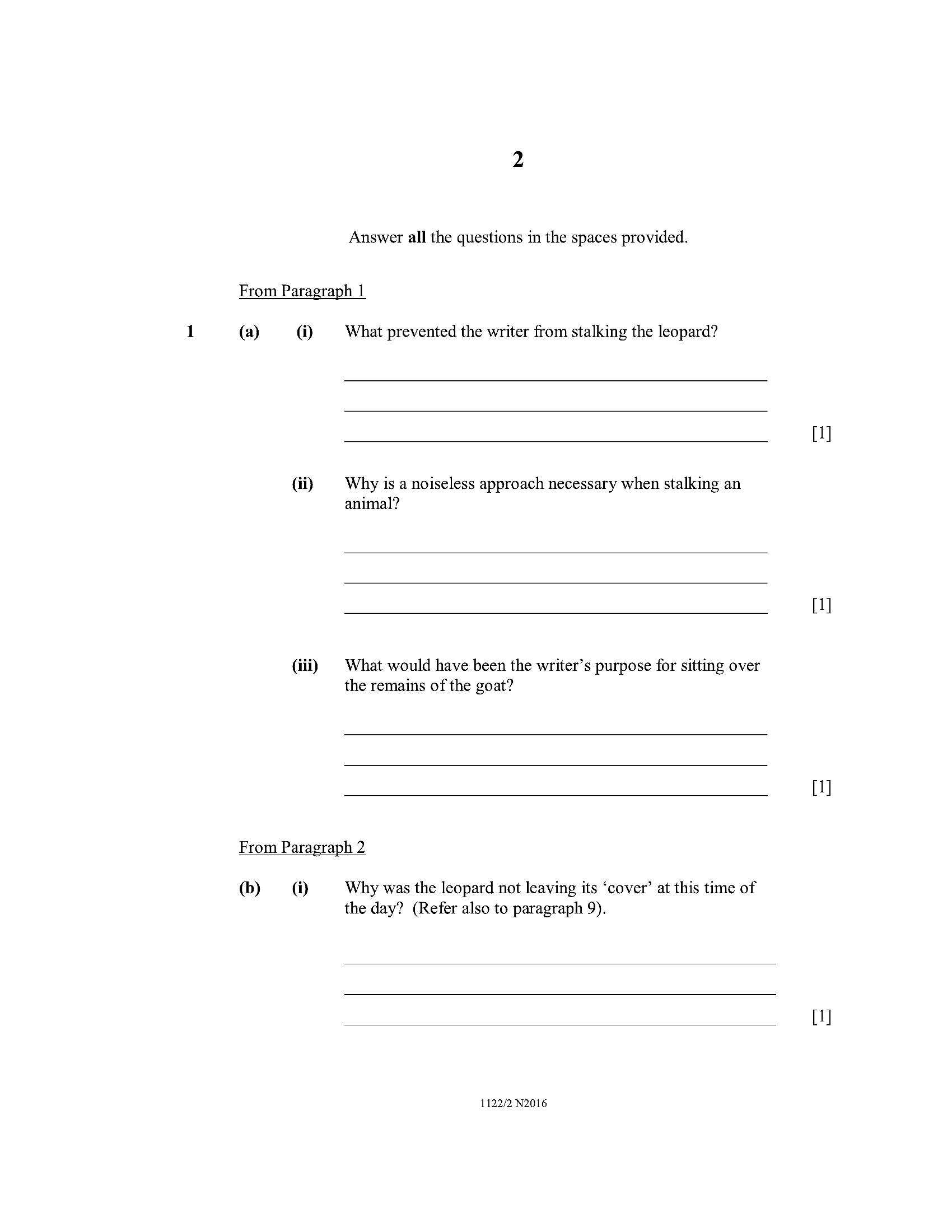
Answer all the questions in the spaces provided.From Paragraph 1
(a) @ What prevented the writer from stalking the leopard?
[1]
(ii) ~~ Why is a noiseless approach necessary when stalking an
animal?
[1]
(iii) += What would have been the writer’s purpose for sitting over
the remains of the goat?
[1]
From Paragraph 2
(b) @ Why was the leopard not leaving its ‘cover’ at this time of
the day? (Refer also to paragraph 9).
[1]
1122/2 N2016
---
Page 3
Extracted Text
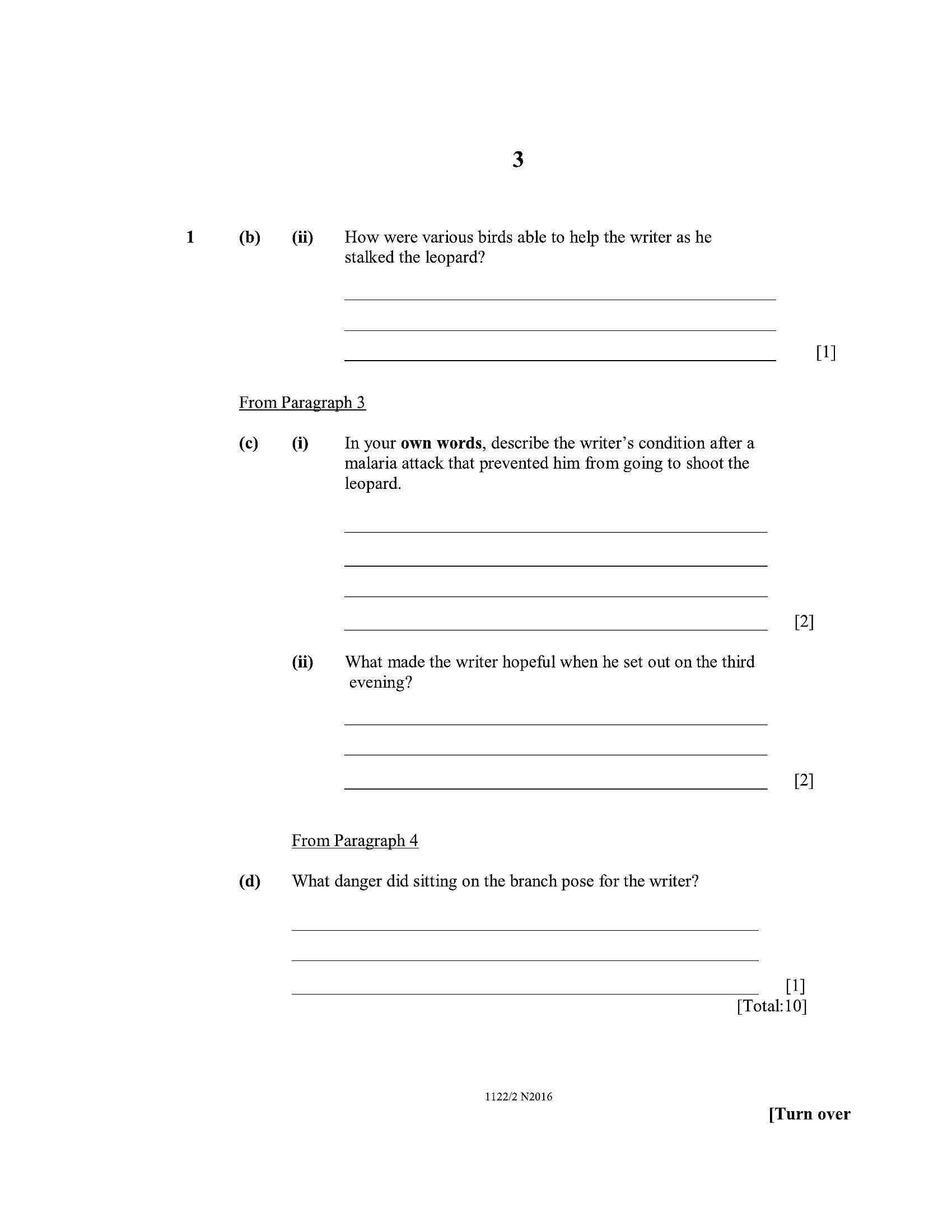
(b) (ii) How were various birds able to help the writer as he stalked the leopard?[1]
From Paragraph 3
(c) (0) In your own words, describe the writer’s condition after a
malaria attack that prevented him from going to shoot the
leopard.
[2]
(ii) What made the writer hopeful when he set out on the third
evening?
[2]
From Paragraph 4
(d) | What danger did sitting on the branch pose for the writer?
[1]
[Total:10]
1122/2 N2016
[Turn over
---
Page 4
Extracted Text
From Paragraph 5(a)
@
(ii)
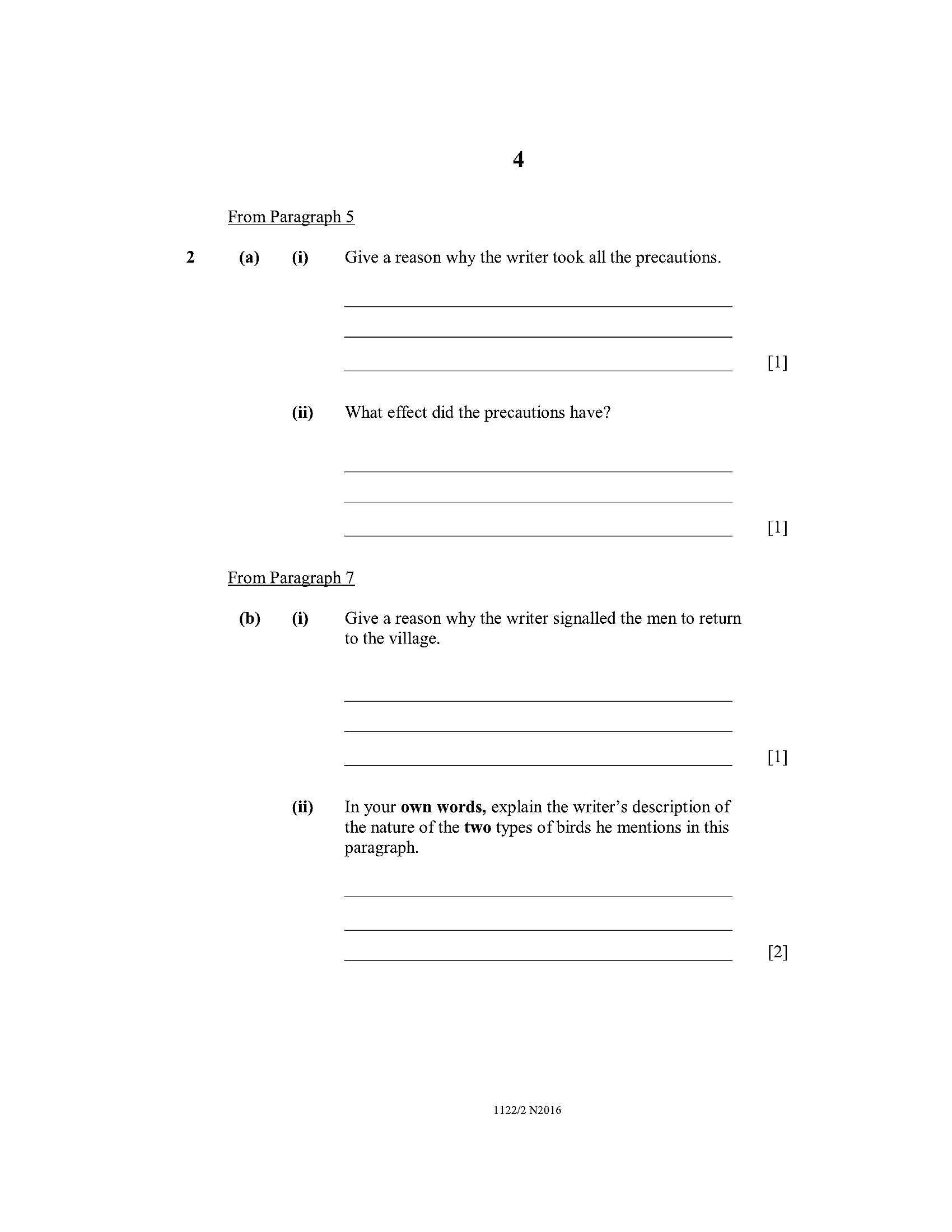
Give a reason why the writer took all the precautions.
From Paragraph 7
(b)
@
(ii)
[1]
What effect did the precautions have?
[1]
Give a reason why the writer signalled the men to return
to the village.
[1]
In your own words, explain the writer’s description of
the nature of the two types of birds he mentions in this
paragraph.
[2]
1122/2 N2016
---
Page 5
Extracted Text
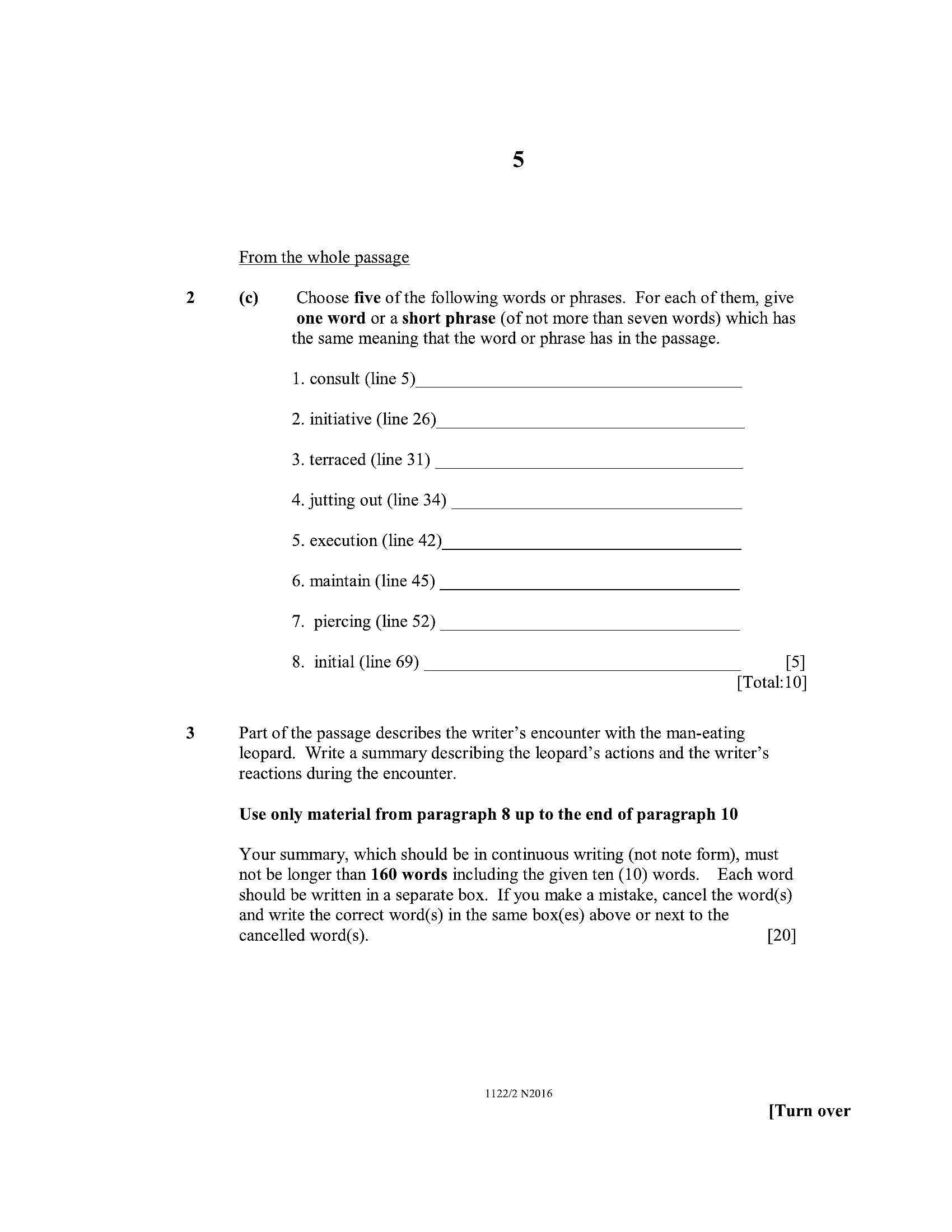
From the whole passage(c) Choose five of the following words or phrases. For each of them, give
one word or a short phrase (of not more than seven words) which has
the same meaning that the word or phrase has in the passage.
a
. consult (line 5)
2. initiative (line 26)
3. terraced (line 31)
4. jutting out (line 34)
wn
. execution (line 42)
n
. maintain (line 45)
~~
. piercing (line 52)
oO
. initial (line 69) [5]
[Total: 10]
Part of the passage describes the writer’s encounter with the man-eating
leopard. Write a summary describing the leopard’s actions and the writer’s
reactions during the encounter.
Use only material from paragraph 8 up to the end of paragraph 10
Your summary, which should be in continuous writing (not note form), must
not be longer than 160 words including the given ten (10) words. Each word
should be written in a separate box. If you make a mistake, cancel the word(s)
and write the correct word(s) in the same box(es) above or next to the
cancelled word(s). [20]
1122/2 N2016
[Turn over
---
Page 6
Extracted Text
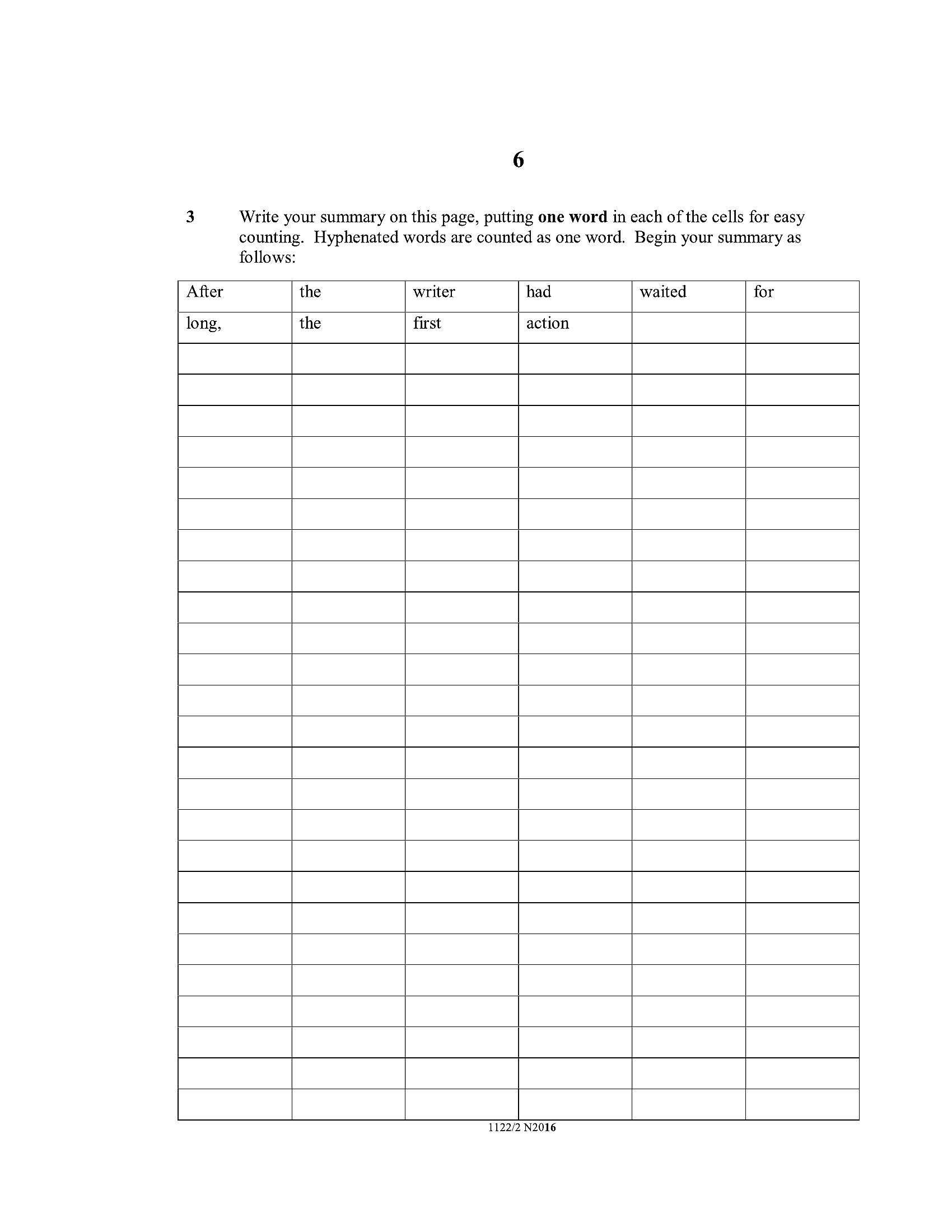
3 Write your summary on this page, putting one word in each of the cells for easy counting. Hyphenated words are counted as one word. Begin your summary as follows:After the writer had waited for
long, the first action
1122/2 N2016
---
Page 7
Extracted Text
1122/2 N2016 [Turn over---
Page 8
Extracted Text
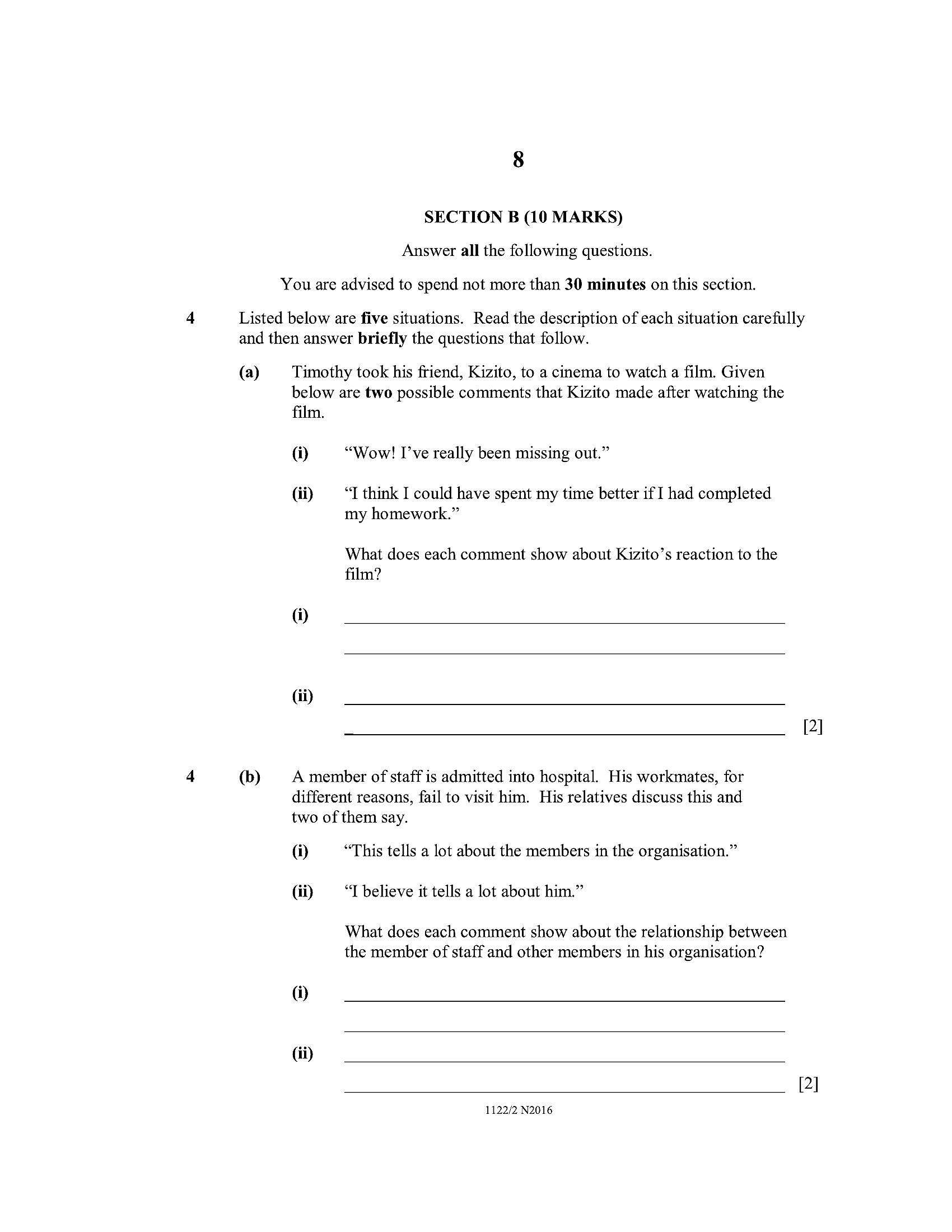
SECTION B (10 MARKS)Answer all the following questions.
You are advised to spend not more than 30 minutes on this section.
4 Listed below are five situations. Read the description of each situation carefully
and then answer briefly the questions that follow.
(a)
4 (b)
Timothy took his friend, Kizito, to a cinema to watch a film. Given
below are two possible comments that Kizito made after watching the
film.
@
(ii)
(ii)
“Wow! I’ve really been missing out.”
“T think I could have spent my time better if I had completed
my homework.”
What does each comment show about Kizito’s reaction to the
film?
[2]
A member of staff is admitted into hospital. His workmates, for
different reasons, fail to visit him. His relatives discuss this and
two of them say.
@
(ii)
(ii)
“This tells a lot about the members in the organisation.”
“T believe it tells a lot about him.”
What does each comment show about the relationship between
the member of staff and other members in his organisation?
[2]
1122/2 N2016
---
Page 9
Extracted Text
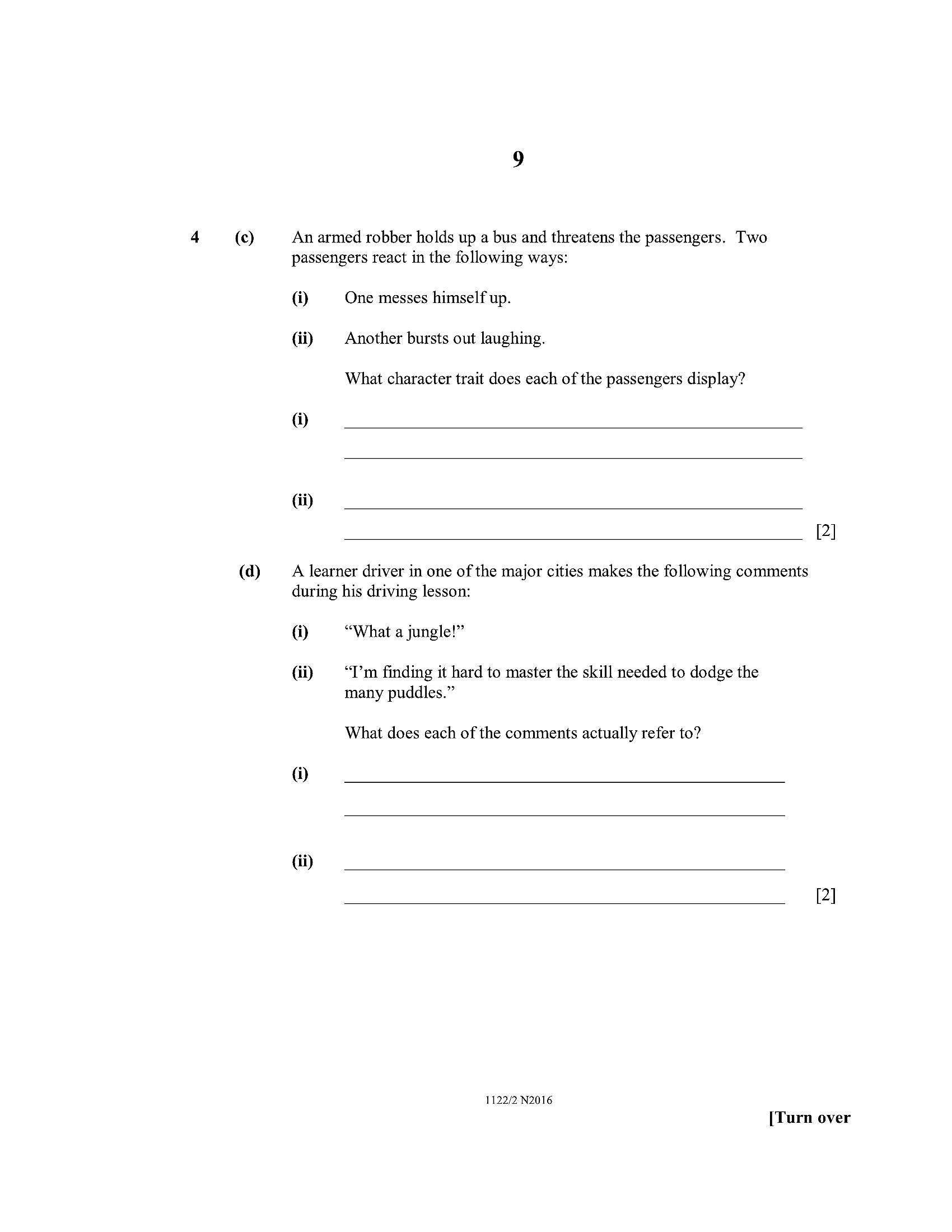
(c)(d)
An armed robber holds up a bus and threatens the passengers. Two
passengers react in the following ways:
(i) One messes himself up.
(ii) Another bursts out laughing.
What character trait does each of the passengers display?
@
Gi)
[2]
A learner driver in one of the major cities makes the following comments
during his driving lesson:
(i) “What a jungle!”
(ii) “I’m finding it hard to master the skill needed to dodge the
many puddles.”
What does each of the comments actually refer to?
@
(ii)
[2]
1122/2 N2016
[Turn over
---
Page 10
Extracted Text
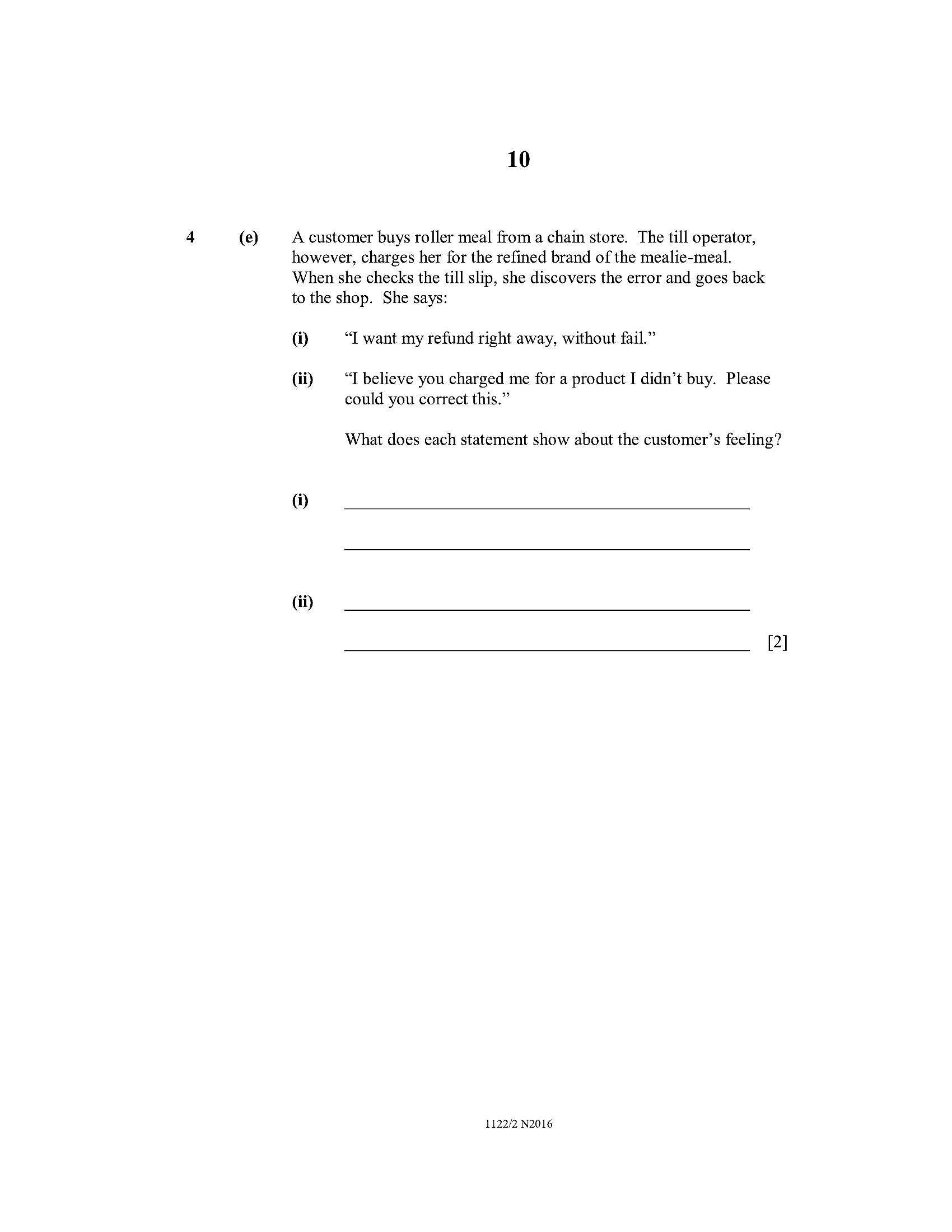
(e)10
A customer buys roller meal from a chain store. The till operator,
however, charges her for the refined brand of the mealie-meal.
When she checks the till slip, she discovers the error and goes back
to the shop. She says:
@ “T want my refund right away, without fail.”
(ii) “T believe you charged me for a product I didn’t buy. Please
could you correct this.”
What does each statement show about the customer’s feeling?
(ii)
[2]
1122/2 N2016
---
Struggling with the concepts in this paper?
Revise syllabus notes, key exam points, and interactive practice questions for Languages English: