📄 Exam Questions & Readable Text Transcript
Full OCR-extracted text of questions, syllabus codes, and exam instructions.
Extracted Content: 2023_geo_alevel_nov_paper1
Page 1
Extracted Text
For Performance M "ZIMBABWE SCHOOL EXAMINATIONS COUNCIL
General Certificate of Education Advanced Level
GEOGRAPHY 6037/1
PAPER 1: PHYSICAL COMPONENT
NOVEMBER 2023 SESSION 3 hours
Additional materials:
Answer paper
TIME 3 hours
INSTRUCTIONS TO CANDIDATES
Write your name, centre number and candidate number in the spaces provided on the answer
paper/answer booklet.
Answer any four questions in this paper.
Write your answers on the separate answer paper provided.
If you use more than one sheet of paper, fasten the sheets together.
INFORMATION FOR CANDIDATES
The number of marks is given in brackets [ ] at the end of each question or part question.
Sketch maps and diagrams should be drawn wherever they serve to illustrate an answer.
You are reminded of the need for good English and clear presentation in your answers.
This question paper consists of 6 printed pages and 2 blank pages.
Copyright: Zimbabwe School Examinations Council, N2023.
©ZIMSEC N2023 [Turn over
CAAT
---
Page 2
Extracted Text
Answer any four questions.(a) _ Explain why temperature in the troposphere decreases with increase
in altitude.
(b) Citing examples, discuss the causes and effects of global warming.
(c) _ Evaluate measures that are taken to improve the quality of air in large
cities. a
(a) What is meant by the following terms?
@ anabatic wind,
(ii) katabatic wind.
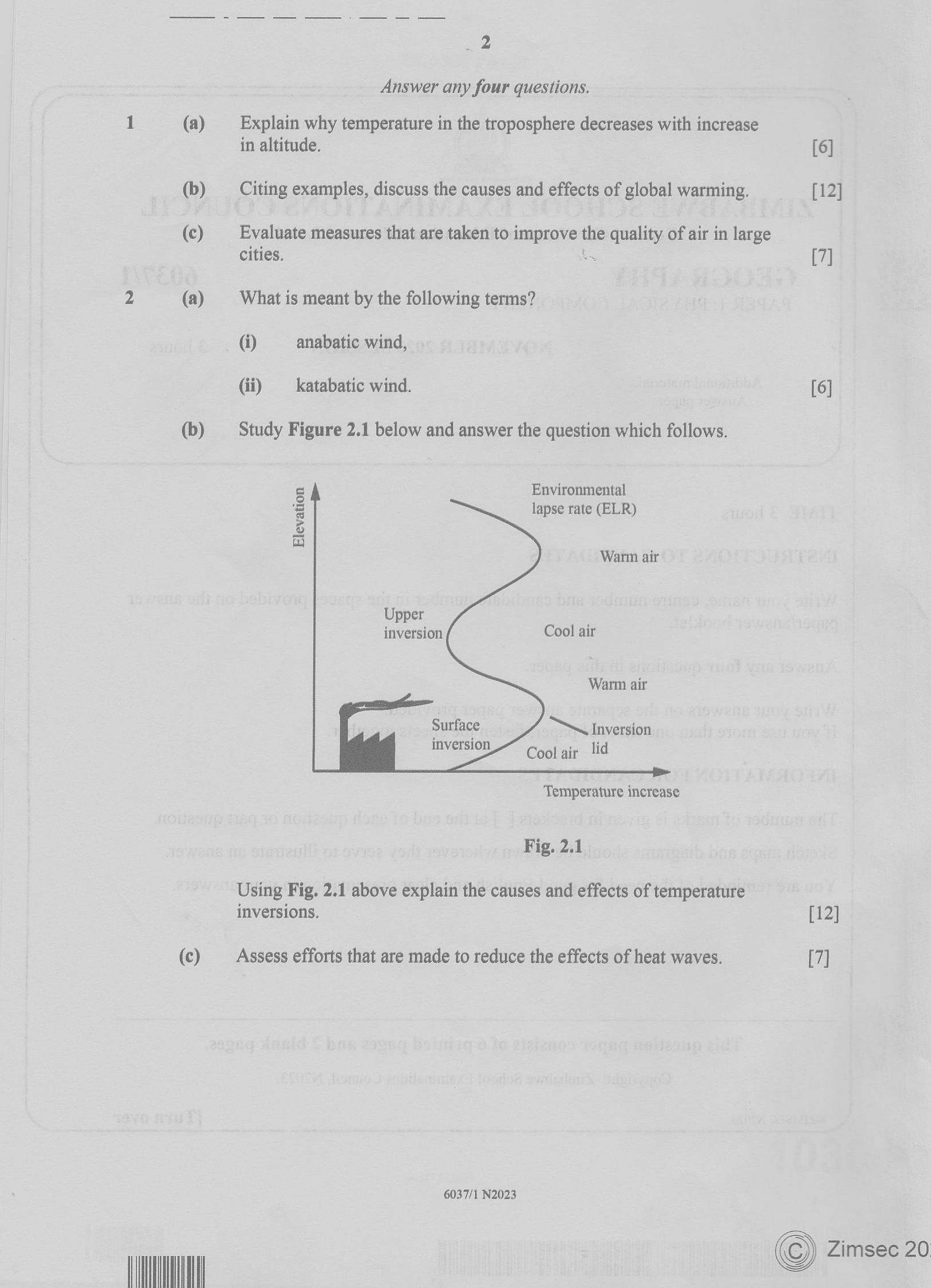
(b) — Study Figure 2.1 below and answer the question which follows.
Environmental
i~]
i=}
a lapse rate (ELR)
&
a
Warm air
Upper :
inversion Cool air
Warm air
Surface Inversion
inversion Cool air lid
Temperature increase
Fig. 2.1
Using Fig. 2.1 above explain the causes and effects of temperature
inversions.
(c) _ Assess efforts that are made to reduce the effects of heat waves.
6037/1 N2023
WATT
[6]
[12]
[6]
[12]
[7]
---
Page 3
Extracted Text
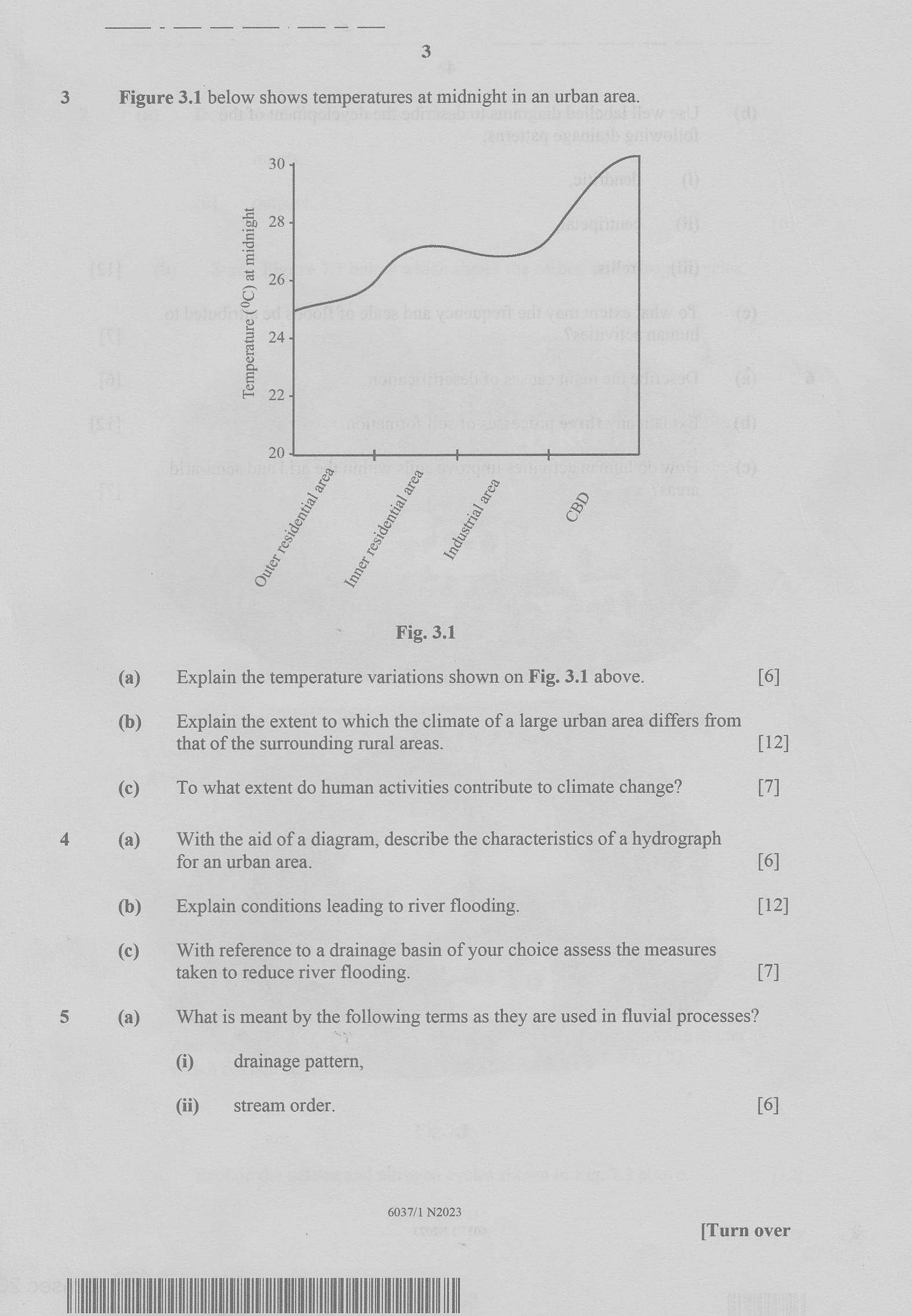
8)3 Figure 3.1 below shows temperatures at midnight in an urban area.
(a)
(b)
30
28
26
24
Temperature (°C) at midnight
22,
Fig. 3.1
Explain the temperature variations shown on Fig. 3.1 above.
[6]
Explain the extent to which the climate of a large urban area differs from
that of the surrounding rural areas.
To what extent do human activities contribute to climate change?
[12]
[7]
With the aid of a diagram, describe the characteristics of a hydrograph
for an urban area.
Explain conditions leading to river flooding.
[6]
[12]
With reference to a drainage basin of your choice assess the measures
taken to reduce river flooding.
[7]
What is meant by the following terms as they are used in fluvial processes?
@ drainage pattern,
(ii) stream order.
6037/1 N2023
ci
[6]
[Turn over
---
Page 4
Extracted Text
(b)(c)
6 (a)
(b)
AIH
4
Use well labelled diagrams to describe the development of the
following drainage patterns:
(i) dendritic,
(ii) _ centripetal,
(iii) _ trellis,
To what extent may the frequency and scale of floods be attributed to
human activities?
Describe the main causes of desertification.
Explain any three processes of soil formation.
How do human activities improve soils within the arid and semi-arid
areas?
6037/1 N2023
[12]
[7]
[6]
[12]
[7]
©) Zimsec 202:
---
Page 5
Extracted Text
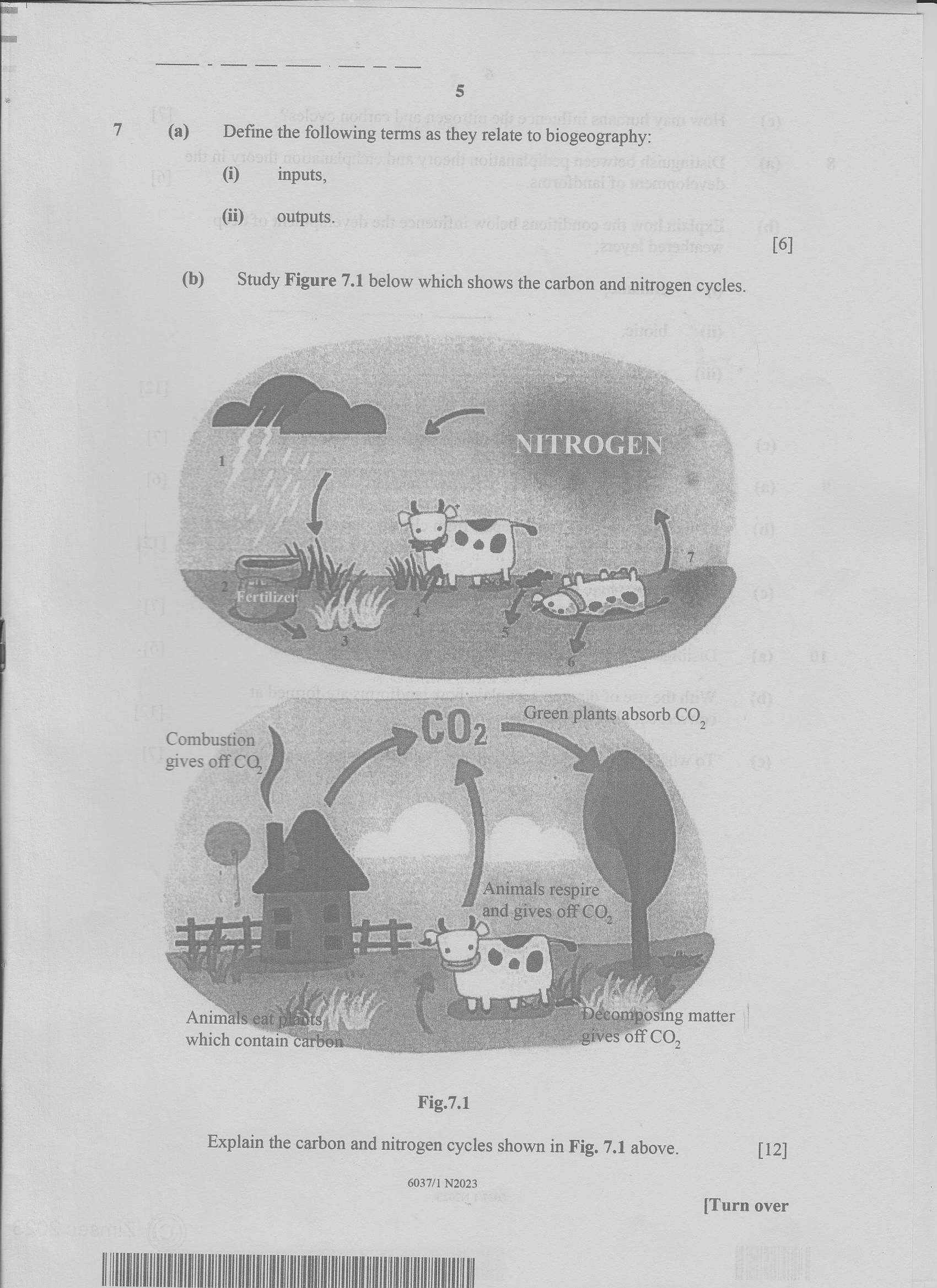
5 (a) _ Define the following terms as they relate to biogeography: @ inputs, (ii) outputs.[6]
(b)
Study Figure 7.1 below which shows the carbon and nitrogen cycles.
absorb co,
which contain
Fig.7.1
Explain the carbon and nitrogen cycles shown in Fig. 7.1 above.
[12]
6037/1 N2023
[Turn over
LAIMA ANAEMIA TULA AOL
---
Page 6
Extracted Text
©)8 {a)
(b)
©
9 {a)
(b)
©
10 (a)
(b)
©
WAMU
6
How may humans influence the nitrogen and carbon cycles?
[7]
Distinguish between pediplanation theory and etchplanation theory in the
development of landforms.
Explain how the conditions below influence the development of deep
weathered layers;
@ climatic,
(ii) biotic,
Gi) — geomorphic.
Assess the impact of humans on geomorphological processes.
Distinguish between rock disintegration and rock decomposition.
Explain the physical factors apart from climate that affect the rate and
type of weathering.
In what ways may humans benefit from landforms produced by
weathering?
Distinguish between continental plate and oceanic plate.
With the use of diagrams, explain how landforms are formed at
convergent plate boundaries.
To what extent are mass movements caused by human activities?
6037/1 N2023
[6]
[12]
[7]
[6]
[12]
[7]
[6]
[12]
[7]
---
Struggling with the concepts in this paper?
Revise syllabus notes, key exam points, and interactive practice questions for Geography: