
📄 Exam Questions & Readable Text Transcript
Full OCR-extracted text of questions, syllabus codes, and exam instructions.
Extracted Content: Circle_geometry_-1
Page 1
Extracted Text
ADCHAKARAREVISION
QUESTIONS
WITH
SOLUTIONS
Circle Geometry
---
Page 2
Extracted Text
CIRCLE GEOMETRY Revision E-book By Admire ChatsakariraAbout the Author
Admire is an experienced and practicing teacher who offers online
lessons through video lessons, daily exercises and weekly tests. Since
2014, Admire has offered the service to hundreds of both Zimsec and
Cambridge candidates.
The revision guides, video lessons and exercises enable students to cover
the syllabus and prepare for the final exam in just 6 months.
Y ou can check progress of the online class on Facebook page and group,
and on blog
To join the online class, receive video lessons and more revision guides,
get in touch on
WhatsA pp - +263 733 796 118
Email — mathstube18@ gmail.com
---
Page 3
Extracted Text
1. BASICS — angle sub tension2. Cyclic quadrilateral — opposite sides, exterior angles,
3. Tangents
A, Similarity and congruency
5. Revision questions
6. Answers to Revision Questions
---
Page 4
Extracted Text
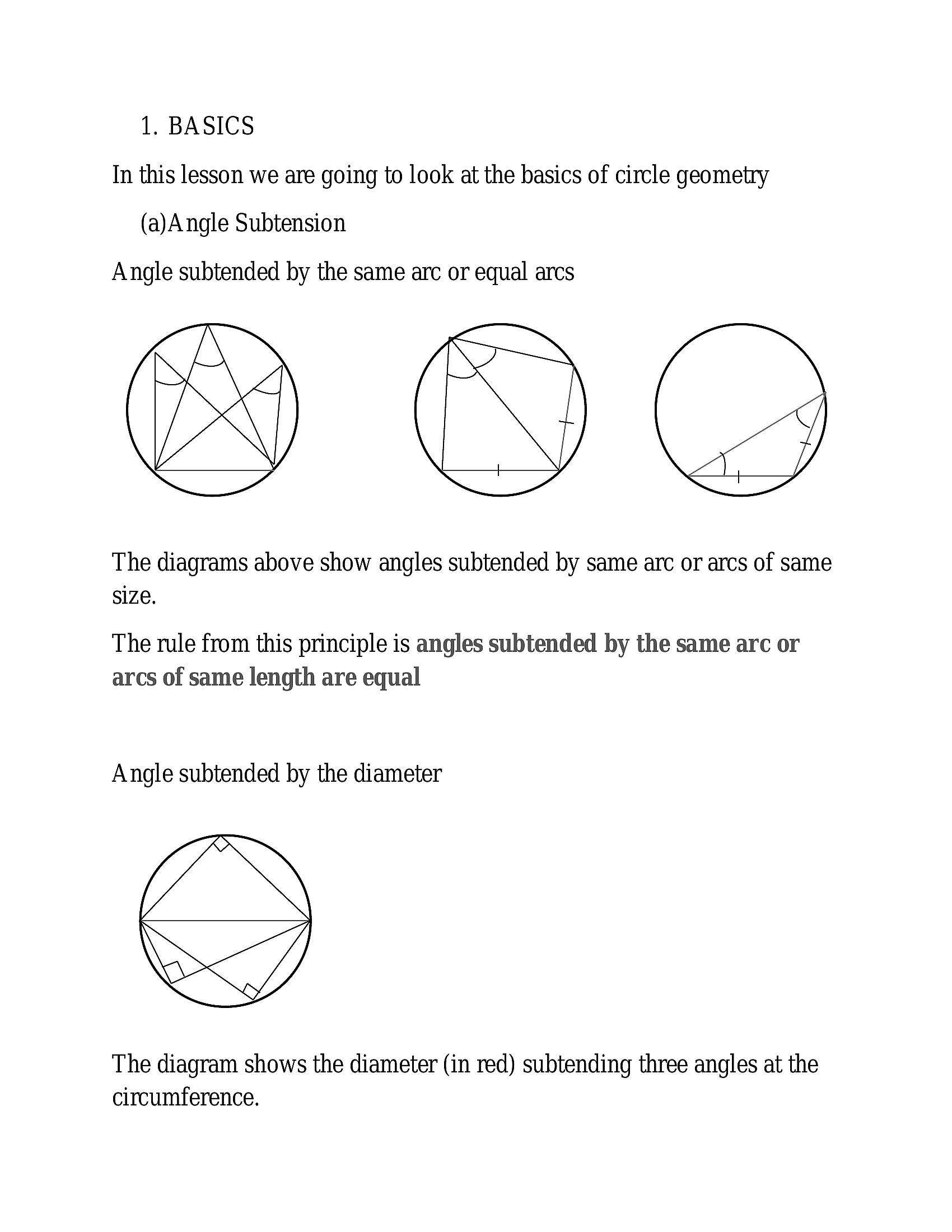
1. BASICS In this lesson we are going to look at the basics of circle geometry (a)Angle SubtensionAngle subtended by the same arc or equal arcs
OY OG
The diagrams above show angles subtended by same arc or arcs of same
size.
The rule from this principle is angles subtended by the same arc or
arcs of same length are equal
Angle subtended by the diameter
The diagram shows the diameter (in red) subtending three angles at the
circumference.
---
Page 5
Extracted Text
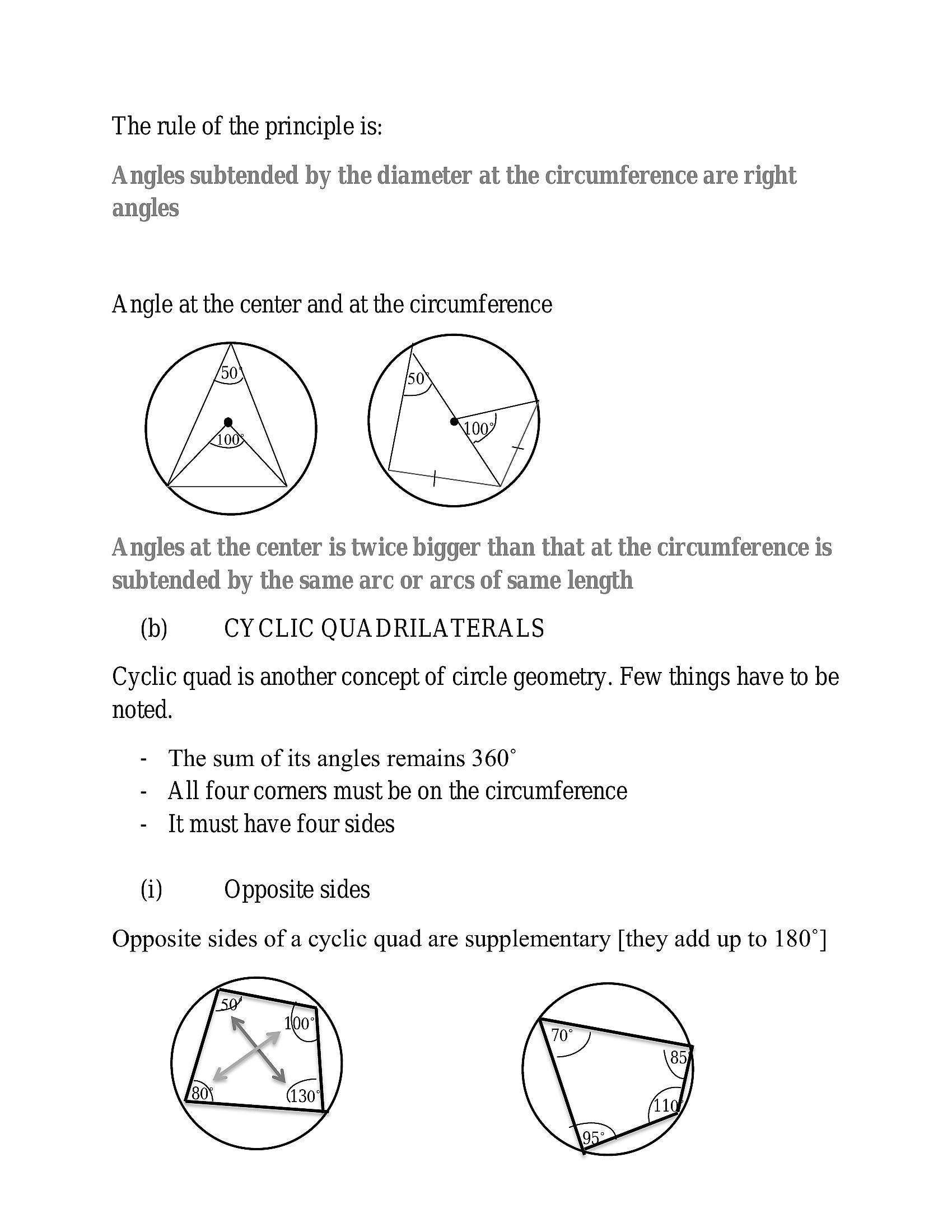
The rule of the principle is:Angles subtended by the diameter at the circumference are right
angles
Angle at the center and at the circumference
Angles at the center is twice bigger than that at the circumference is
subtended by the same arc or arcs of same length
(b) CY CLIC QUADRILATERALS
Cyclic quad is another concept of circle geometry. Few things have to be
noted.
- The sum of its angles remains 360°
- All fourcorners must be on the circumference
It must have four sides
(i) Opposite sides
Opposite sides of a cyclic quad are supplementary [they add up to 180°]
---
Page 6
Extracted Text
The angles a and c adds up to 180°, this means a + c = 180 andb+d= 180.On the other circle, you can see that the opposite angles add to 180°
(ii) Exterior angles
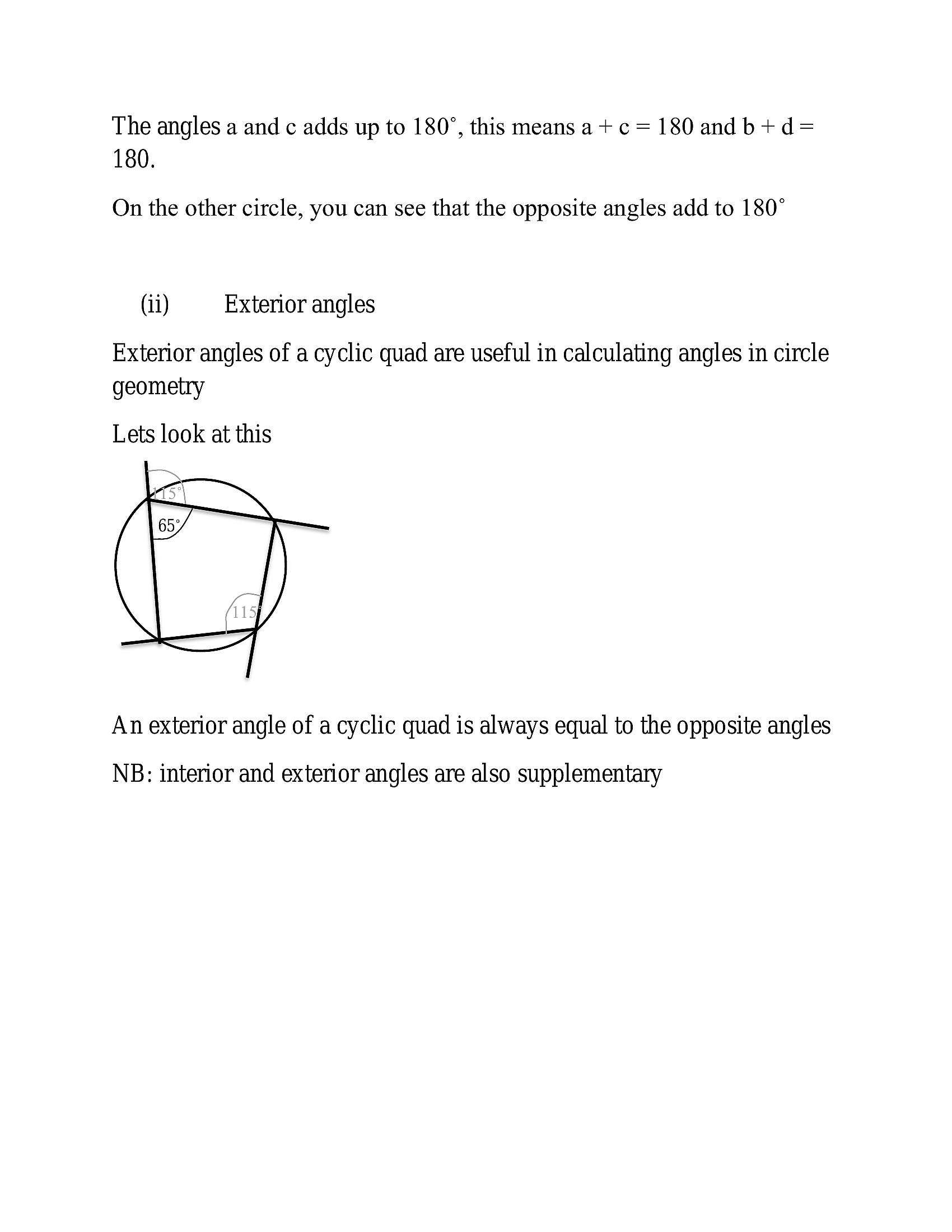
Exterior angles of a cyclic quad are useful in calculating angles in circle
geometry
Lets look at this
An exterior angle of a cyclic quad is always equal to the opposite angles
NB: interior and exterior angles are also supplementary
---
Page 7
Extracted Text
Important Facts in Circle Geometry1. Radii are equal and form isosceles triangle when they meet at the
center
Ss
The diagram shows that radii are equal and form isosceles triangle with
two equal base angles
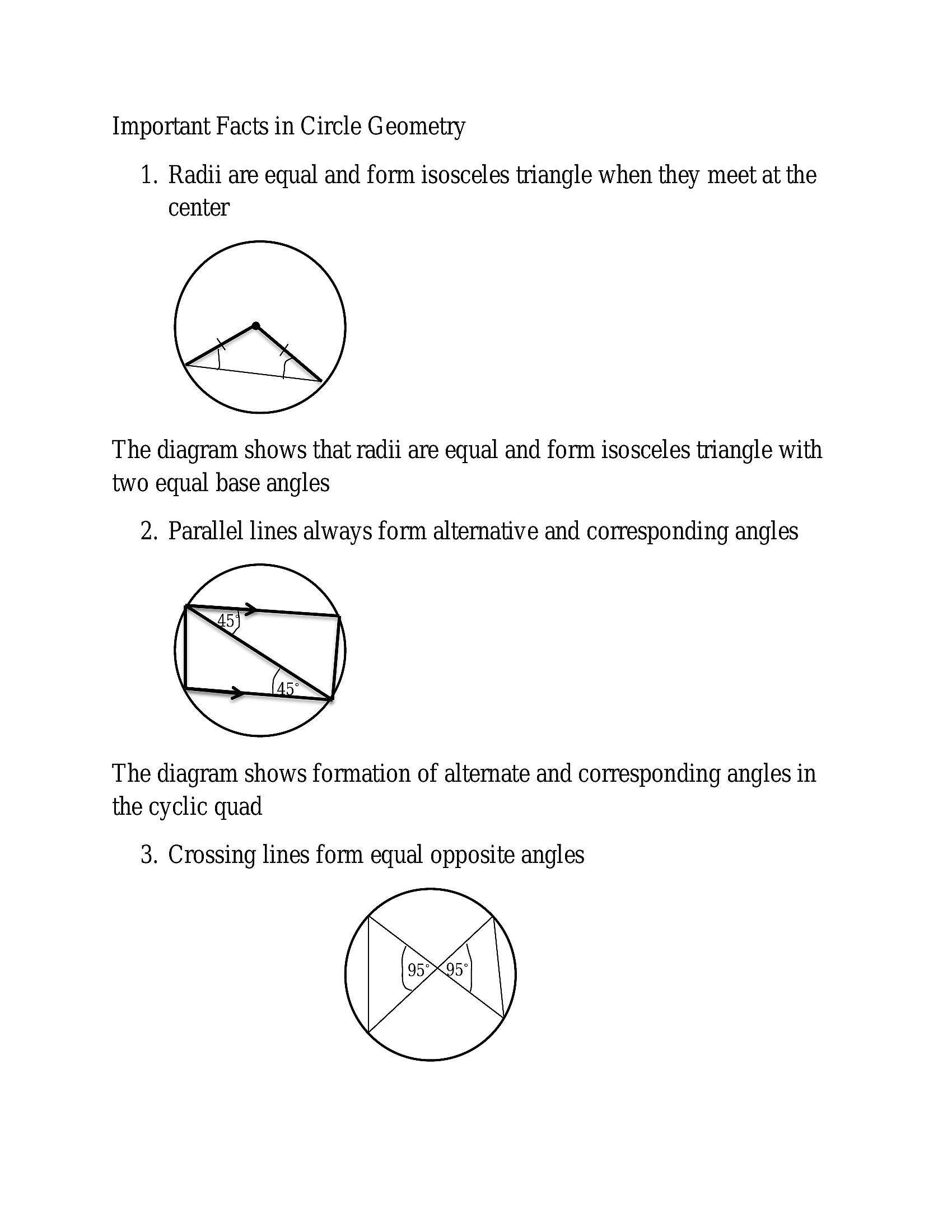
2. Parallel lines always form alternative and corresponding angles
The diagram shows formation of alternate and corresponding angles in
the cyclic quad
3. Crossing lines form equal opposite angles
---
Page 8
Extracted Text
The a diagram shows formation of equal opposite angles when two lines cross each other4. Angles on a straight line add up to 180
Las
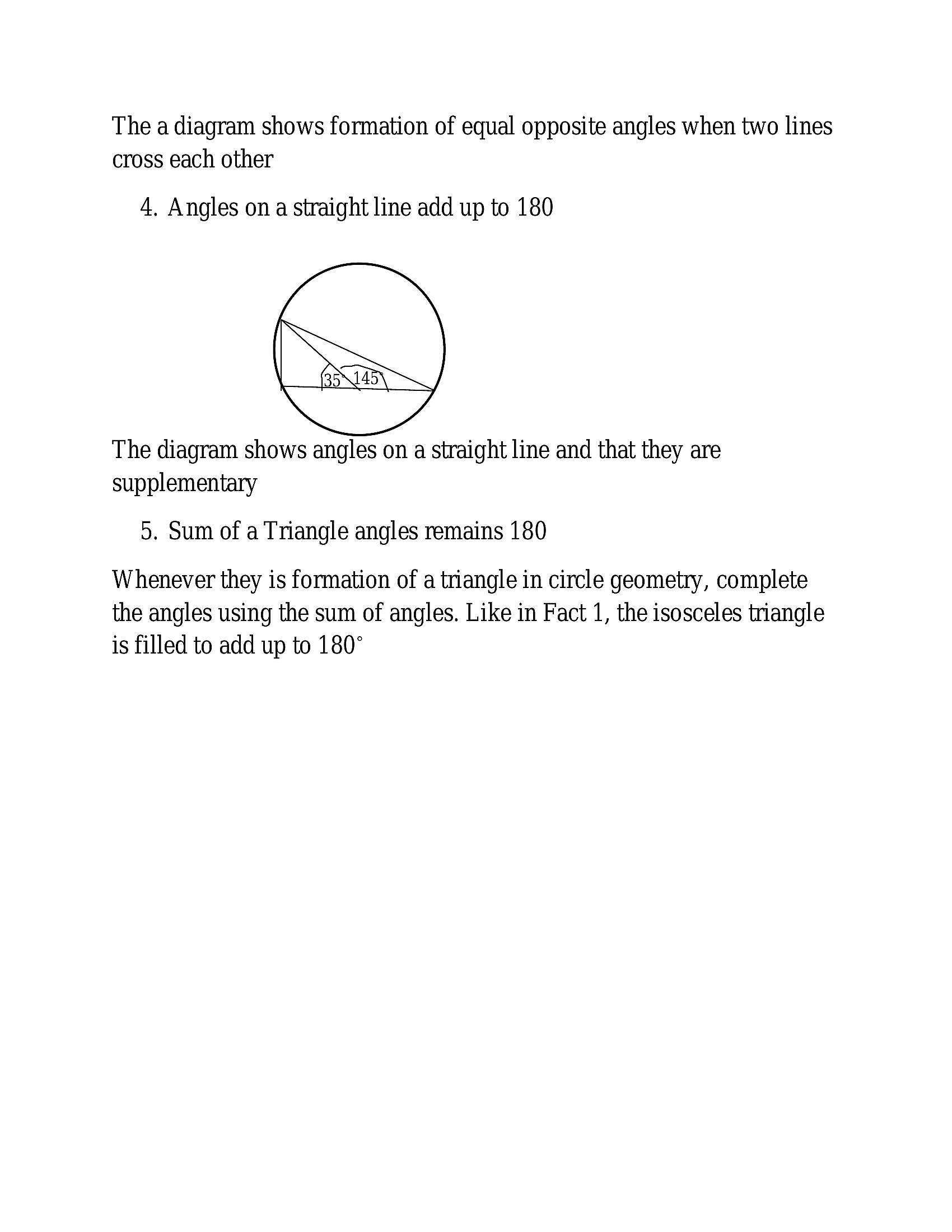
The diagram shows angles on a straight line and that they are
supplementary
5. Sum of a Triangle angles remains 180
Whenever they is formation of a triangle in circle geometry, complete
the angles using the sum of angles. Like in Fact 1, the isosceles triangle
is filled to add up to 180°
---
Page 9
Extracted Text
Examples 1.(-)
A
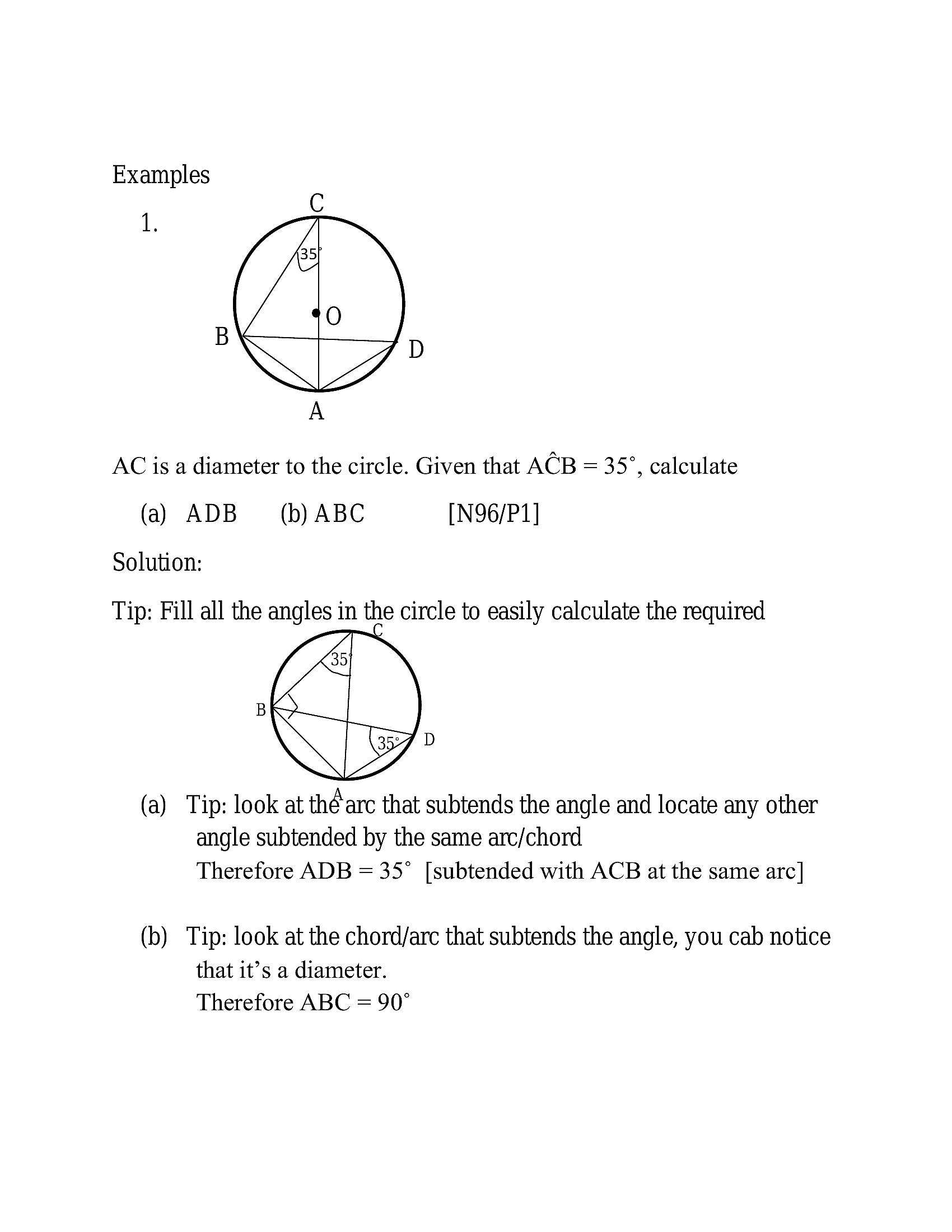
AC is a diameter to the circle. Given that ACB = 35’, calculate
(a) ADB (b) ABC [N96/P1]
Solution:
Tip: Fill all the angles in the circle to easily calculate the required
KG
NSE :
(a) Tip: look at thé arc that subtends the angle and locate any other
angle subtended by the same arc/chord
Therefore ADB = 35° [subtended with ACB at the same arc]
(b) Tip: look at the chord/arc that subtends the angle, you cab notice
that it’s a diameter.
Therefore ABC = 90°
---
Page 10
Extracted Text
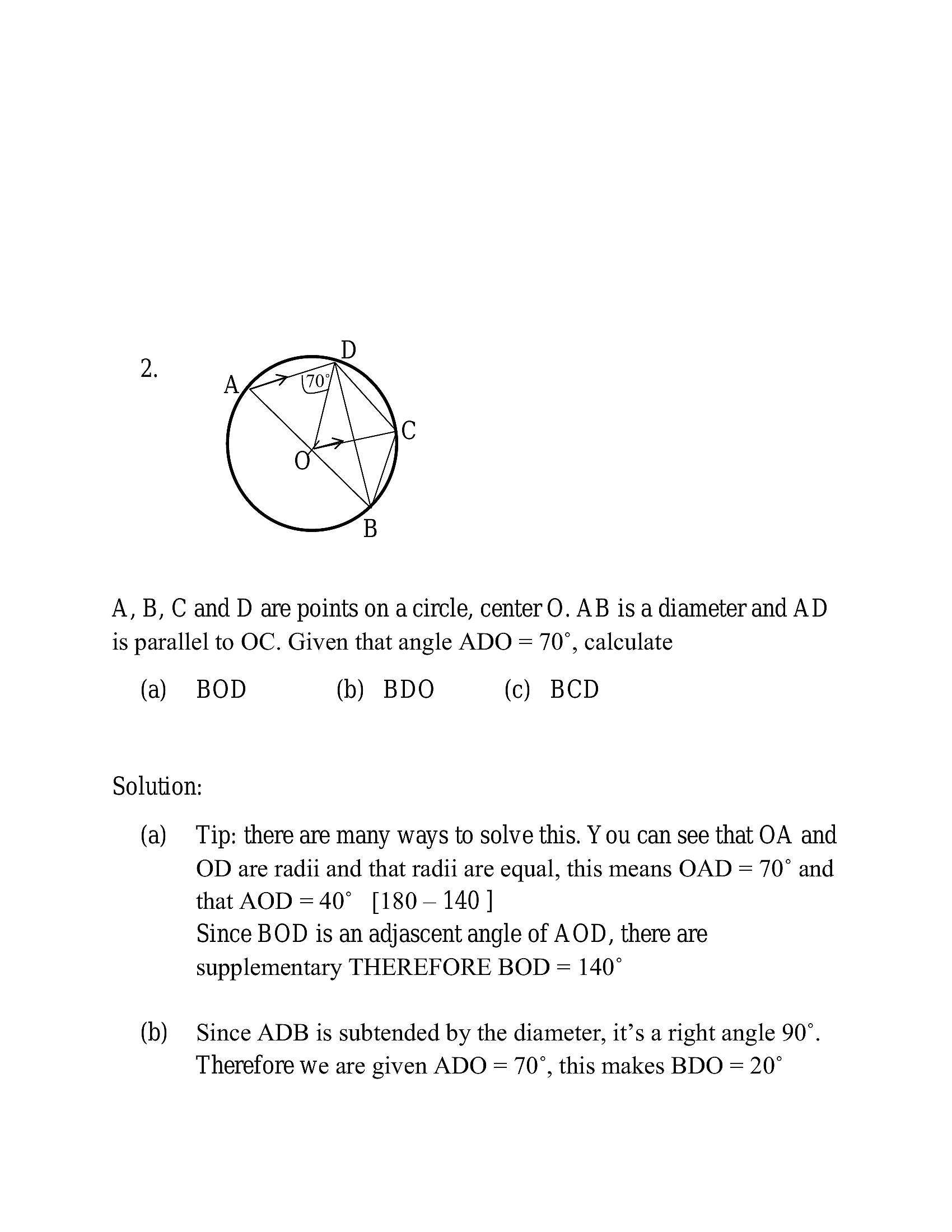
A,B, C and D are points on a circle, center O. AB is a diameter and AD is parallel to OC. Given that angle ADO = 70”, calculate(a) BOD (b) BDO (c) BCD
Solution:
(a) Tip: there are many ways to solve this. Y ou can see that OA and
OD are radii and that radii are equal, this means OAD = 70° and
that AOD = 40° [180-140 ]
Since BOD is an adjascent angle of AOD, there are
supplementary THEREFORE BOD = 140°
(b) Since ADB is subtended by the diameter, it’s a right angle 90°.
Therefore we are given ADO = 70°, this makes BDO = 20°
---
Page 11
Extracted Text
(c) ABCD is acyclic quad and BCD is opposite to BAD = 70’, this makes BCD = 110° [supplementary angles]---
Page 12
Extracted Text
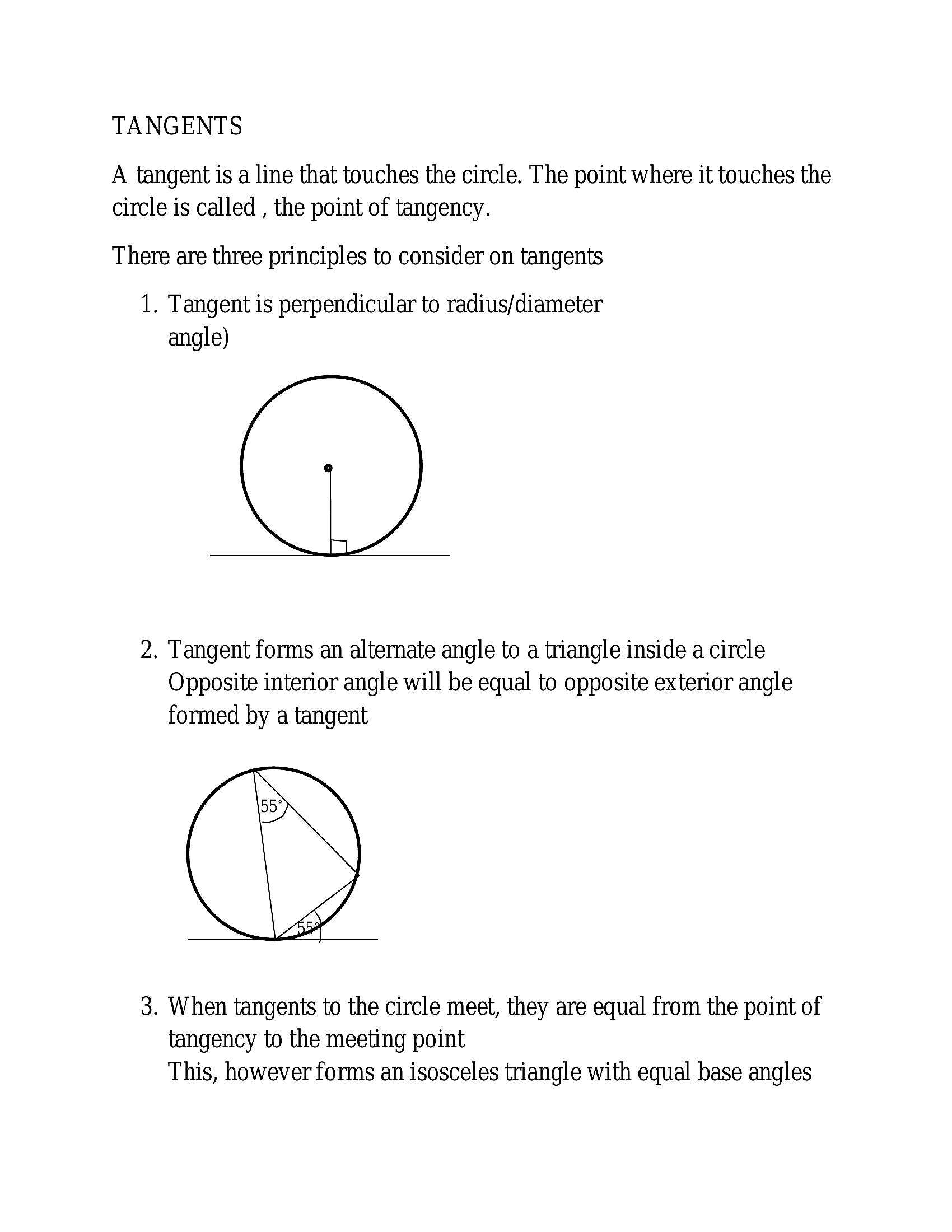
TANGENTSA tangent is a line that touches the circle. The point where it touches the
circle is called , the point of tangency.
There are three principles to consider on tangents
1. Tangent is perpendicular to radius/diameter
angle)
2. Tangent forms an alternate angle to a triangle inside a circle
Opposite interior angle will be equal to opposite exterior angle
formed by a tangent
3. When tangents to the circle meet, they are equal from the point of
tangency to the meeting point
This, however forms an isosceles triangle with equal base angles
---
Page 13
Extracted Text
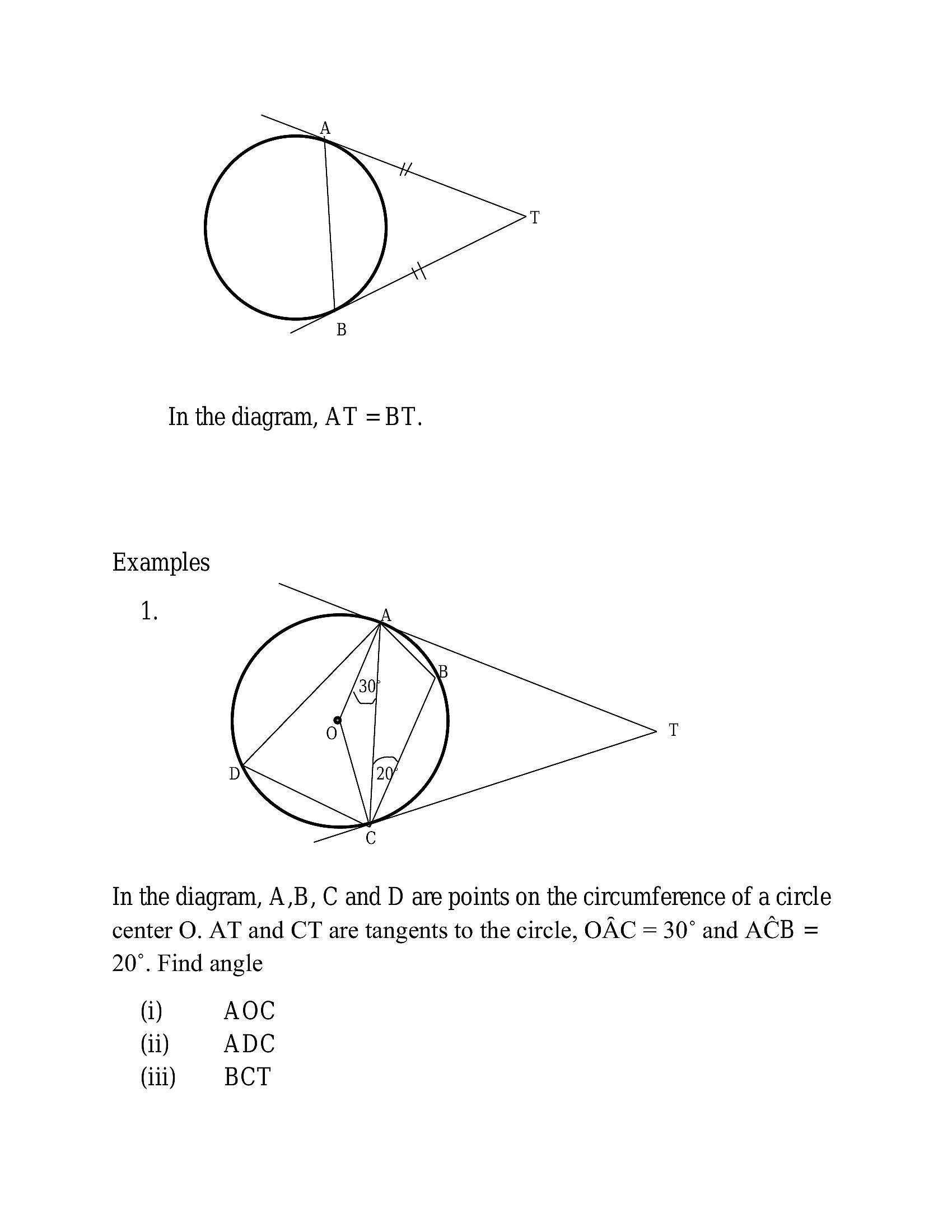
In the diagram, AT = BT.Examples
In the diagram, A,B, C and D are points on the circumference of a circle
center O. AT and CT are tangents to the circle, OAC = 30° and ACB =
20°. Find angle
(i) AOC
(ii) ADC
(iii) BCT
---
Page 14
Extracted Text
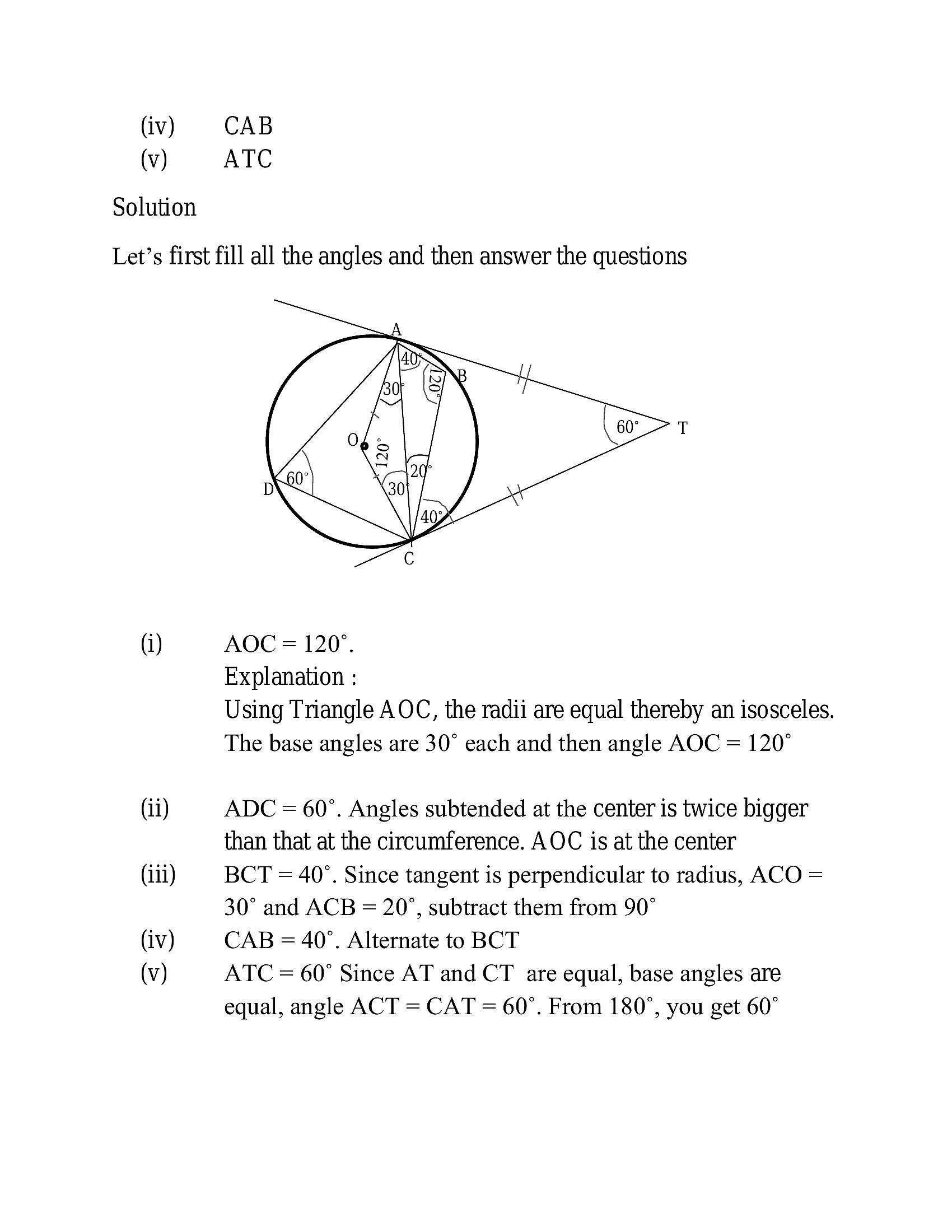
(iv) CAB (v) ATCSolution
Let’s first fill all the angles and then answer the questions
(i) AOC = 120°.
Explanation :
Using Triangle AOC, the radii are equal thereby an isosceles.
The base angles are 30° each and then angle AOC = 120°
(ii) ADC = 60’. Angles subtended at the center is twice bigger
than that at the circumference. AOC is at the center
(iii) BCT = 40°. Since tangent is perpendicular to radius, ACO =
30° and ACB = 20°, subtract them from 90°
(iv) CAB = 40°. Alternate to BCT
(v) ATC = 60° Since AT and CT are equal, base angles are
equal, angle ACT = CAT = 60°. From 180°, you get 60°
---
Page 15
Extracted Text
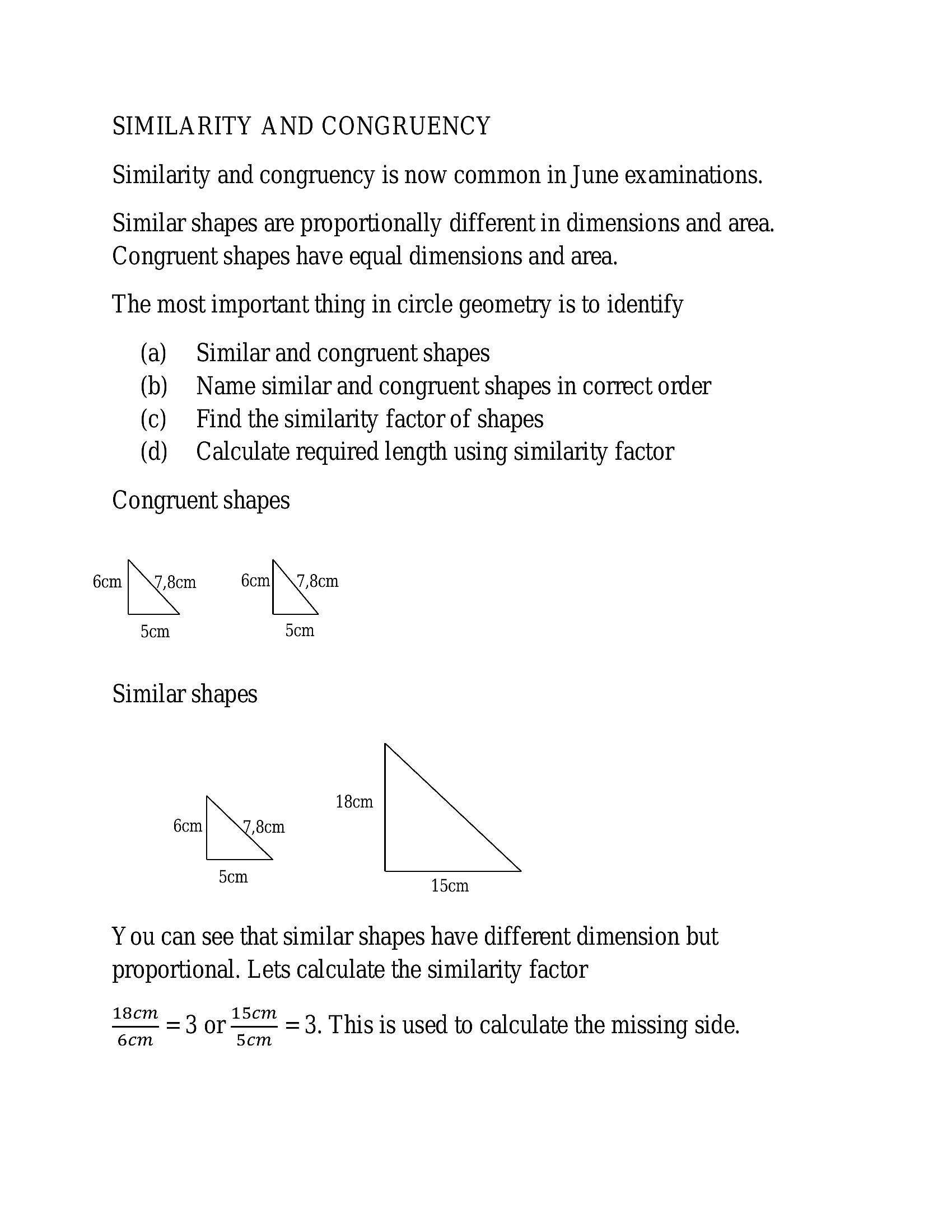
SIMILARITY AND CONGRUENCY Similarity and congruency is now common in June examinations.Similar shapes are proportionally different in dimensions and area.
Congruent shapes have equal dimensions and area.
The most important thing in circle geometry is to identify
a) Similar and congruent shapes
b) Name similar and congruent shapes in correct order
c) Find the similarity factor of shapes
d) Calculate required length using similarity factor
(
(
(
(
Congruent shapes
6cm Ke snl \ te
5cm 5cm
Similar shapes
18cm
6cm ,8cm
Som 15cm
Y ou can see that similar shapes have different dimension but
proportional. Lets calculate the similarity factor
em — 3 or —™ =3, This is used to calculate the missing side.
6cm ~ 5cm
---
Page 16
Extracted Text
Missing side =7,8cm x 3 = 23,4 cmExamples
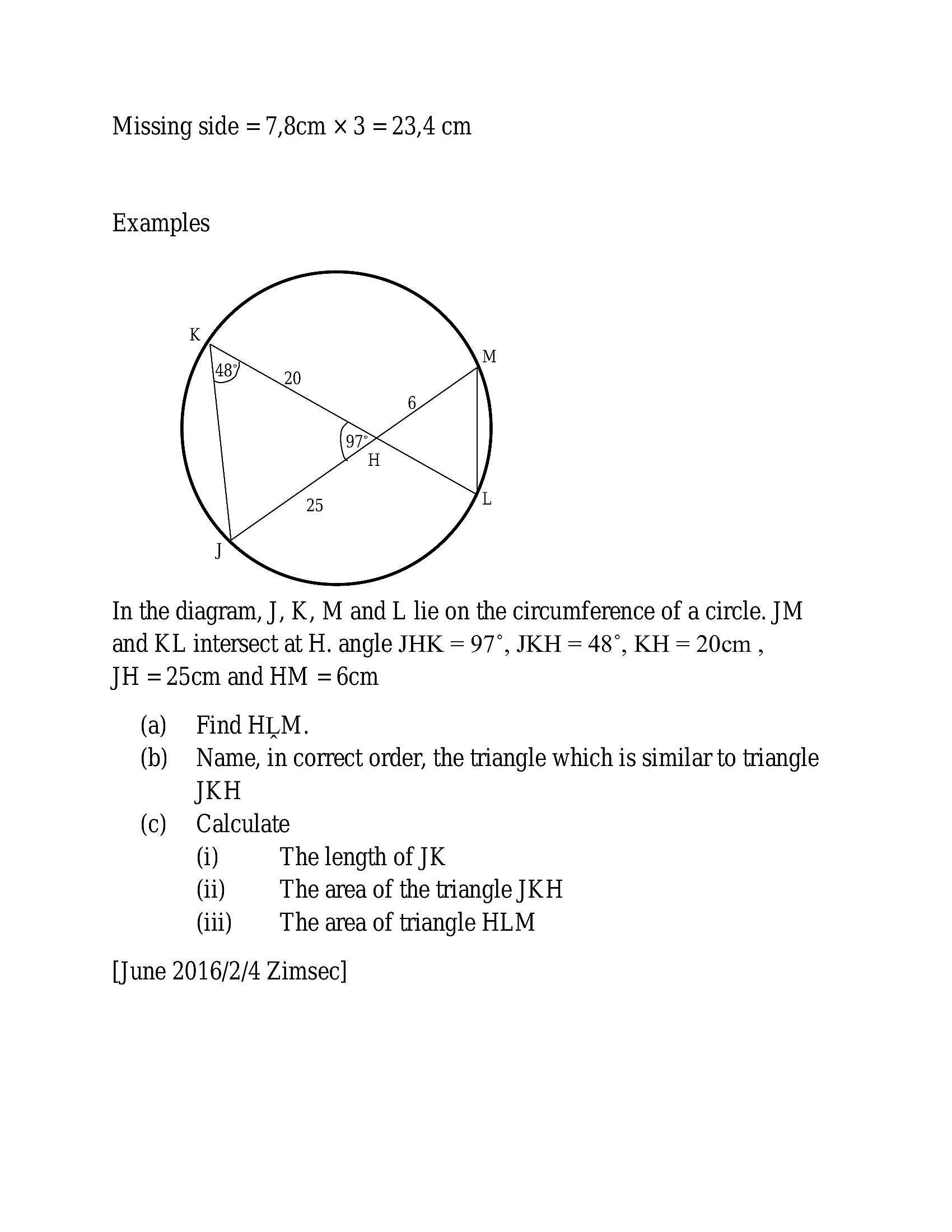
In the diagram, J, K, M and L lie on the circumference of a circle. JM
and KL intersect at H. angle JHK = 97°, JKH = 48°, KH = 20cm ,
JH =25cm and HM =6cm
(a) Find HLM.
(b) Name, in correct order, the triangle which is similar to triangle
JKH
(c) Calculate
(i) The length of JK
(ii) The area of the triangle JKH
(iii) The area of triangle HLM
[June 2016/2/4 Zimsec]
---
Page 17
Extracted Text
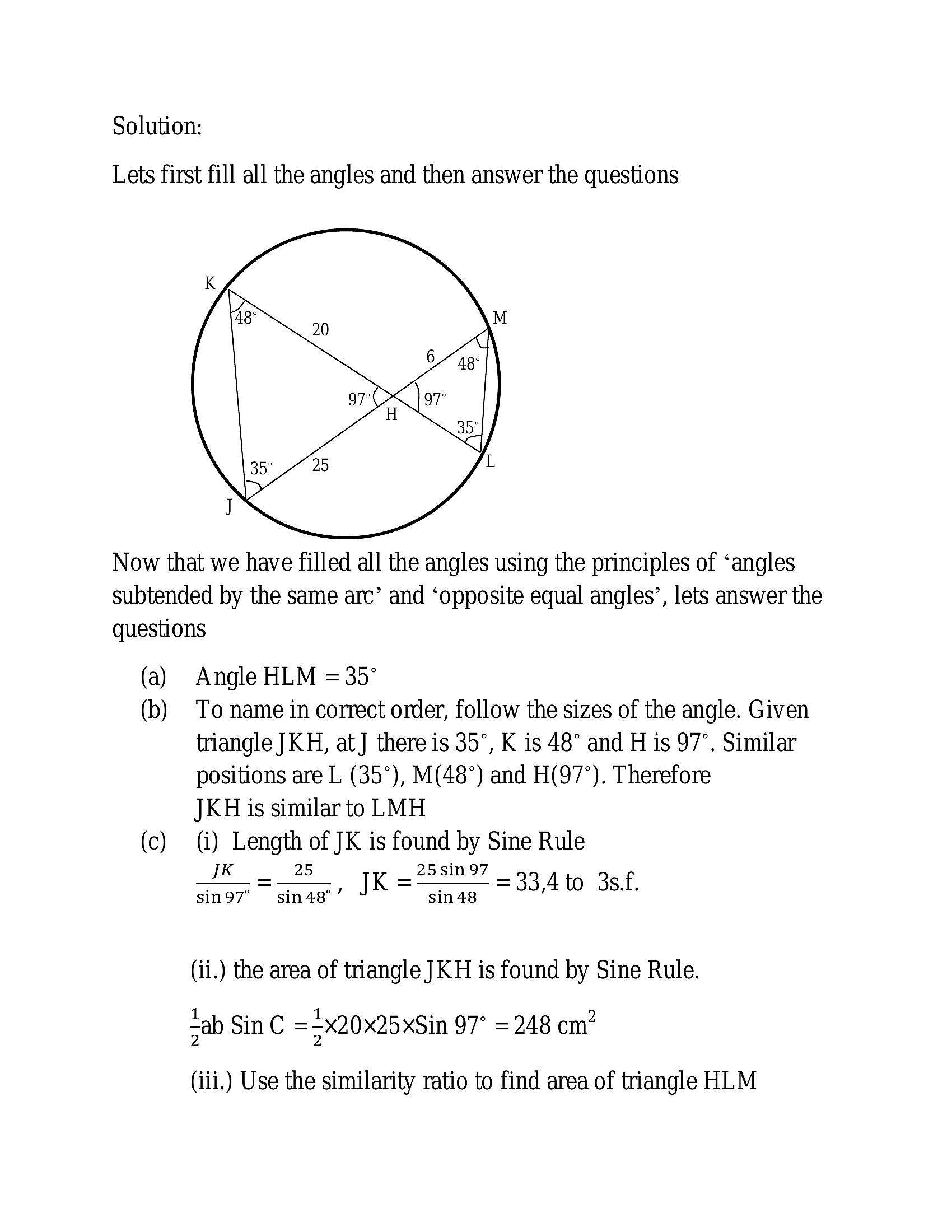
Solution:Lets first fill all the angles and then answer the questions
Now that we have filled all the angles using the principles of ‘angles
subtended by the same arc’ and ‘opposite equal angles’, lets answer the
questions
(b)
Angle HLM =35°
To name in correct order, follow the sizes of the angle. Given
triangle JKH, atJ there is 35°, K is 48° and H is 97°. Similar
positions are L (35°), M(48°) and H(97°). Therefore
JKH is similar to LMH
(i) Length of JK is found by Sine Rule
K 25 25sin 97
JR pK = P87 33.4 to Bs.f.
sin 97 sin 48 sin 48
(ii.) the area of triangle J KH is found by Sine Rule.
“ab Sin C ==x20x25xSin 97° = 248 cm’
(iii.) Use the similarity ratio to find area of triangle HLM
---
Page 18
Extracted Text
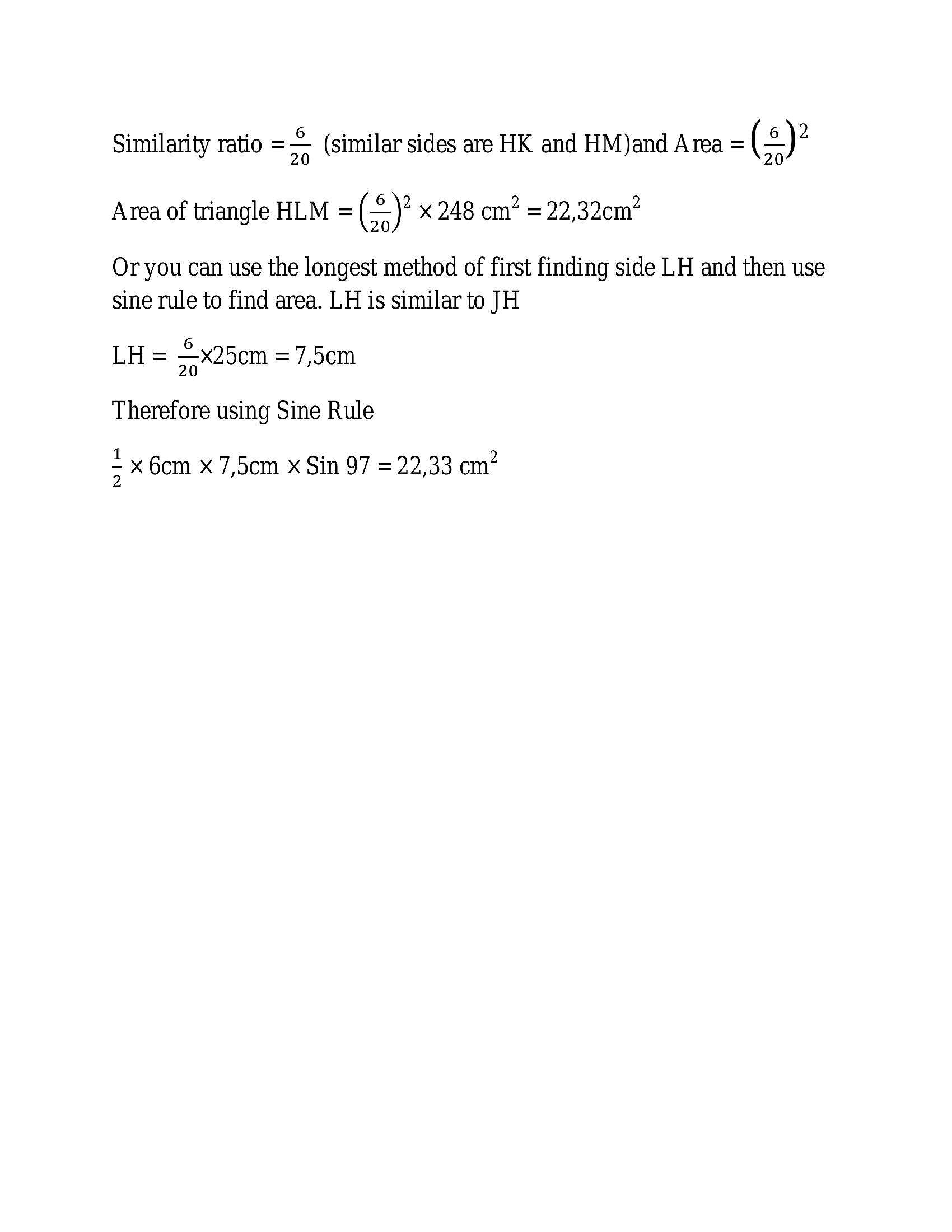
Similarity ratio = ~ (similar sides are HK and HM)and Area = (=)Area of triangle HLM = (=)? x 248 cm? = 22,32cm”
Or you can use the longest method of first finding side LH and then use
sine rule to find area. LH is similar to JH
LH = > x25om =7,5cm
Therefore using Sine Rule
: x 6cm x 7,5cm x Sin 97 = 22,33 cm?
---
Page 19
Extracted Text
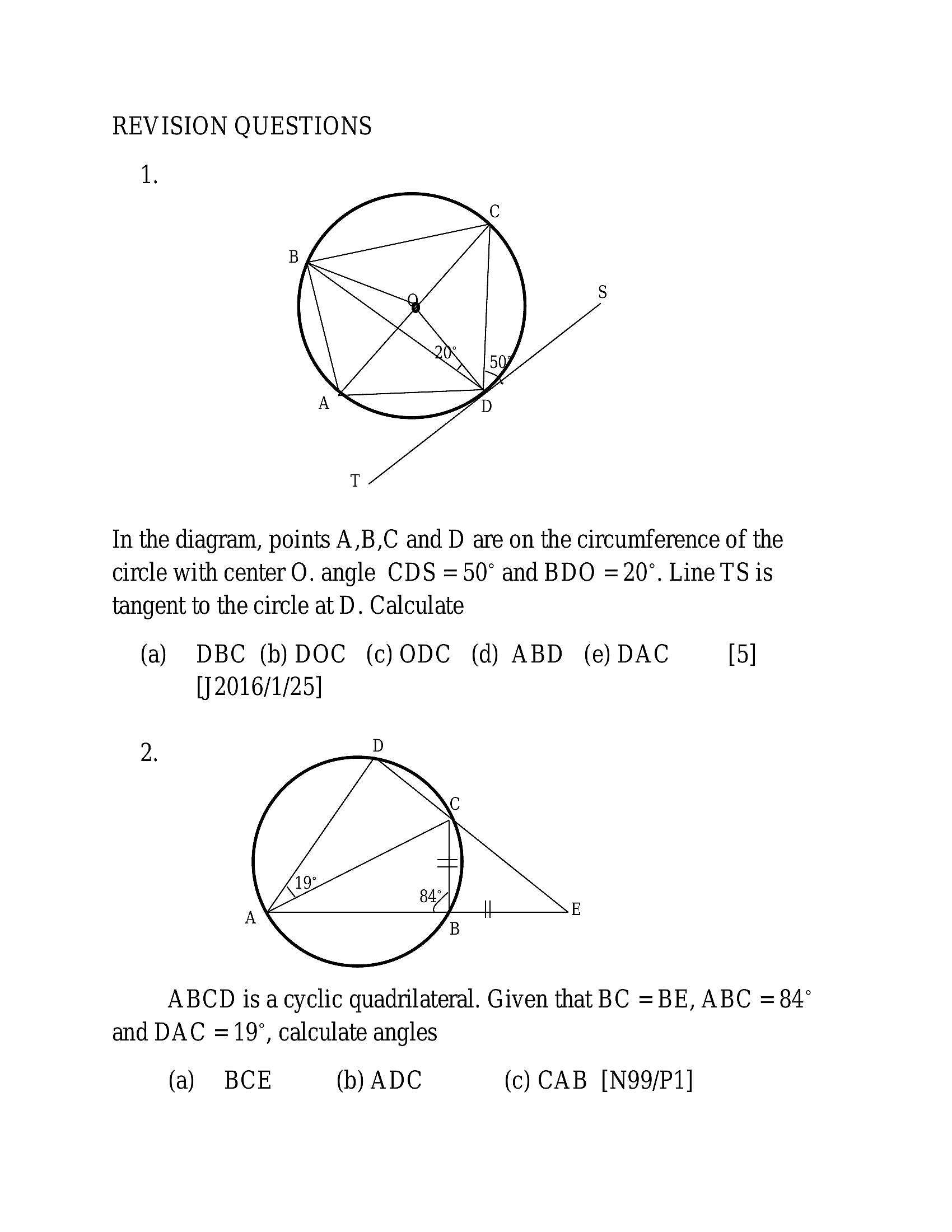
REVISION QUESTIONS 1.In the diagram, points A,B,C and D are on the circumference of the
circle with center O. angle CDS =50° and BDO = 20”. Line TS is
tangent to the circle at D. Calculate
(a) DBC (b)DOC (c)ODC (d) ABD (e) DAC [5]
[J2016/1/25]
ABCD is acyclic quadrilateral. Given that BC =BE, ABC = 84°
and DAC =19’, calculate angles
(a) BCE (b) ADC (c) CAB [N99/P1]
---
Page 20
Extracted Text
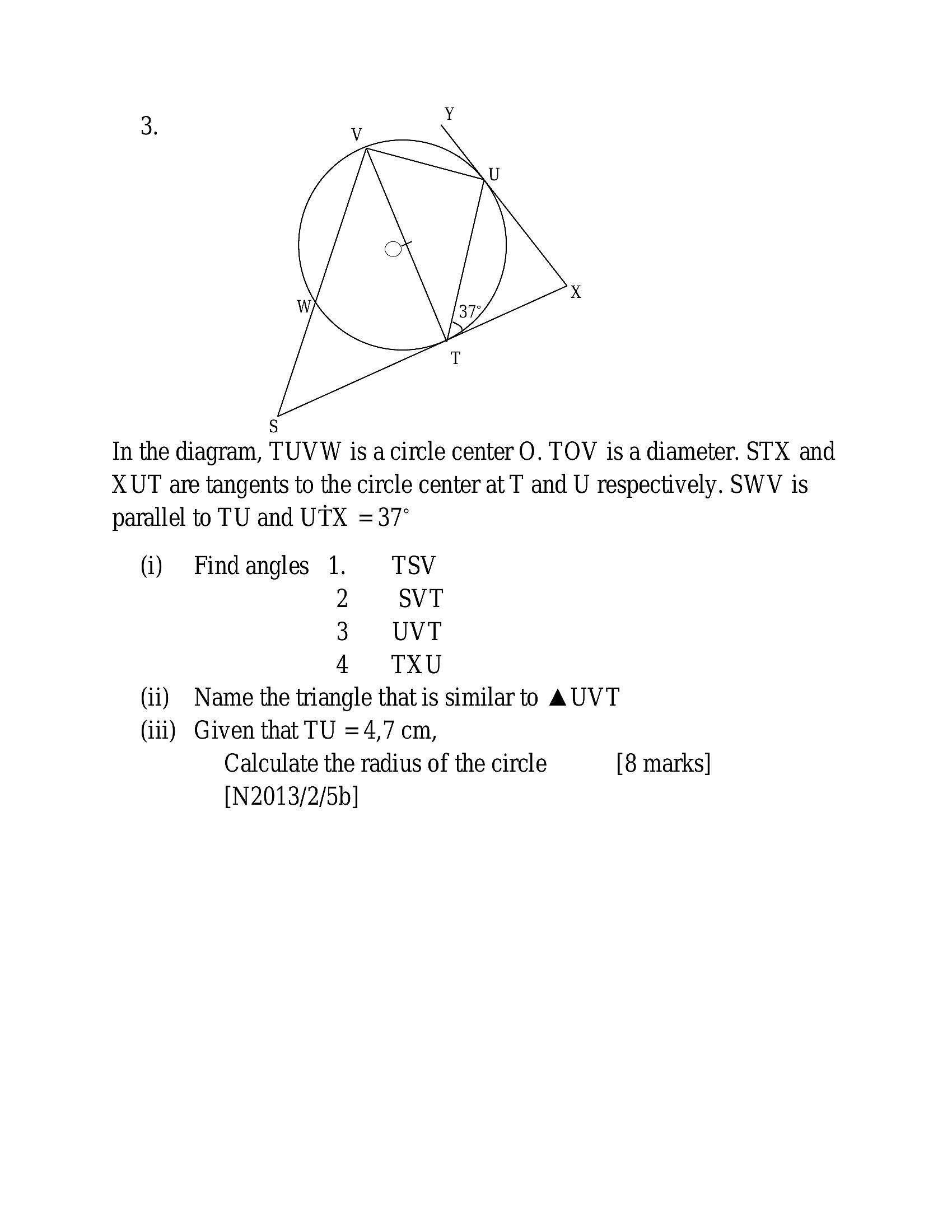
S In the diagram, TUVW is a circle center O. TOV is a diameter. STX and XUT are tangents to the circle center at T and U respectively. SWV is parallel to TU and UTX =37°(i) Findangles 1. TSV
2 SVT
3. UVT
4 TXU
(ii) Name the triangle that is similar to AUVT
(iii) Given that TU =4,7 cm,
Calculate the radius of the circle [8 marks]
[N2013/2/5b]
---
Page 21
Extracted Text
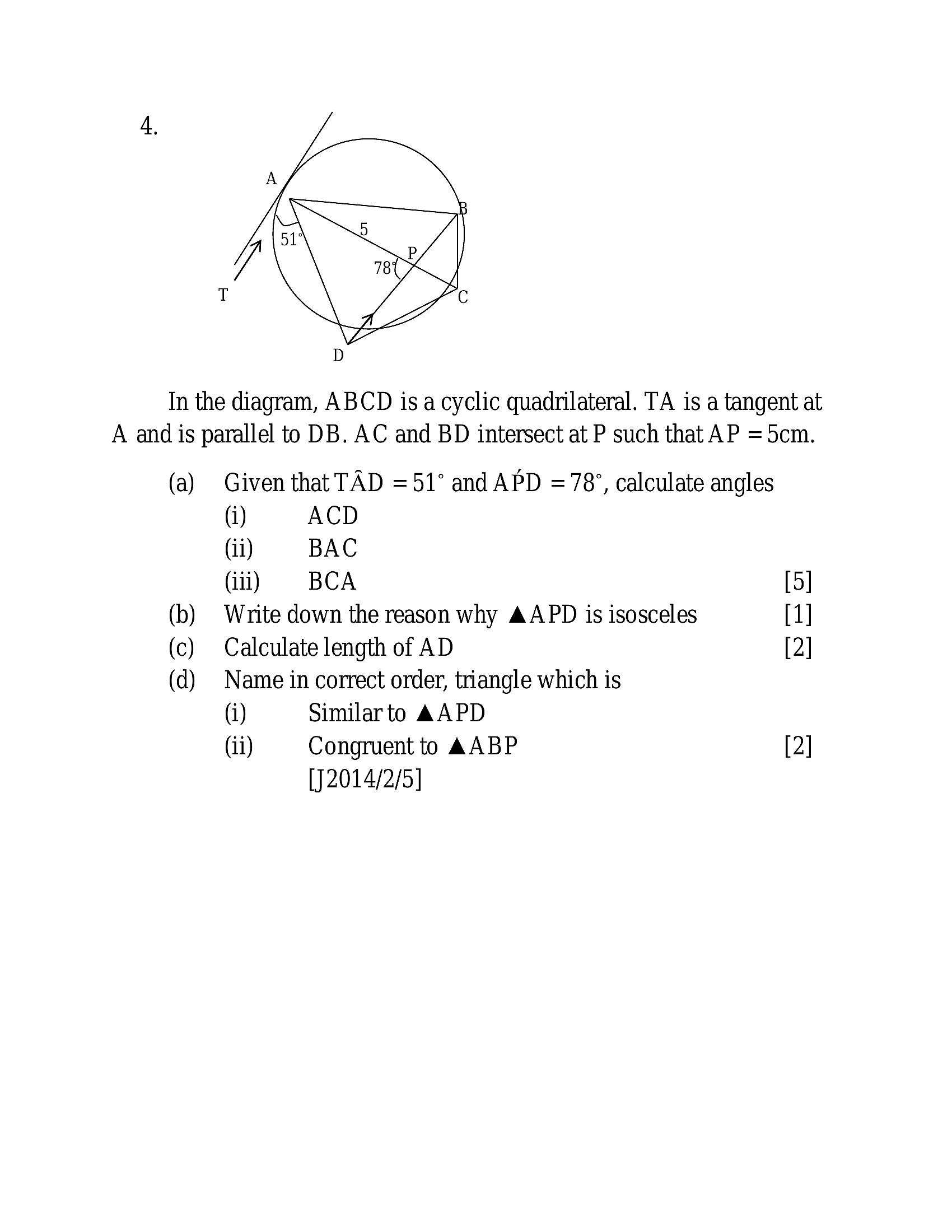
In the diagram, ABCD is acyclic quadrilateral. TA is a tangent at A and is parallel to DB. AC and BD intersect at P such that AP =5cm.(a) Given that TAD =51° and APD =78’, calculate angles
(i) ACD
(ii) BAC
(iii) BCA [5]
(b) Write down the reason why AAPD is isosceles [1]
(c) Calculate length of AD [2]
(d) Name in correct order, triangle which is
(i) Similar to AAPD
(ii) Congruent to AABP [2]
[J2014/2/5]
---
Page 22
Extracted Text
cNv,
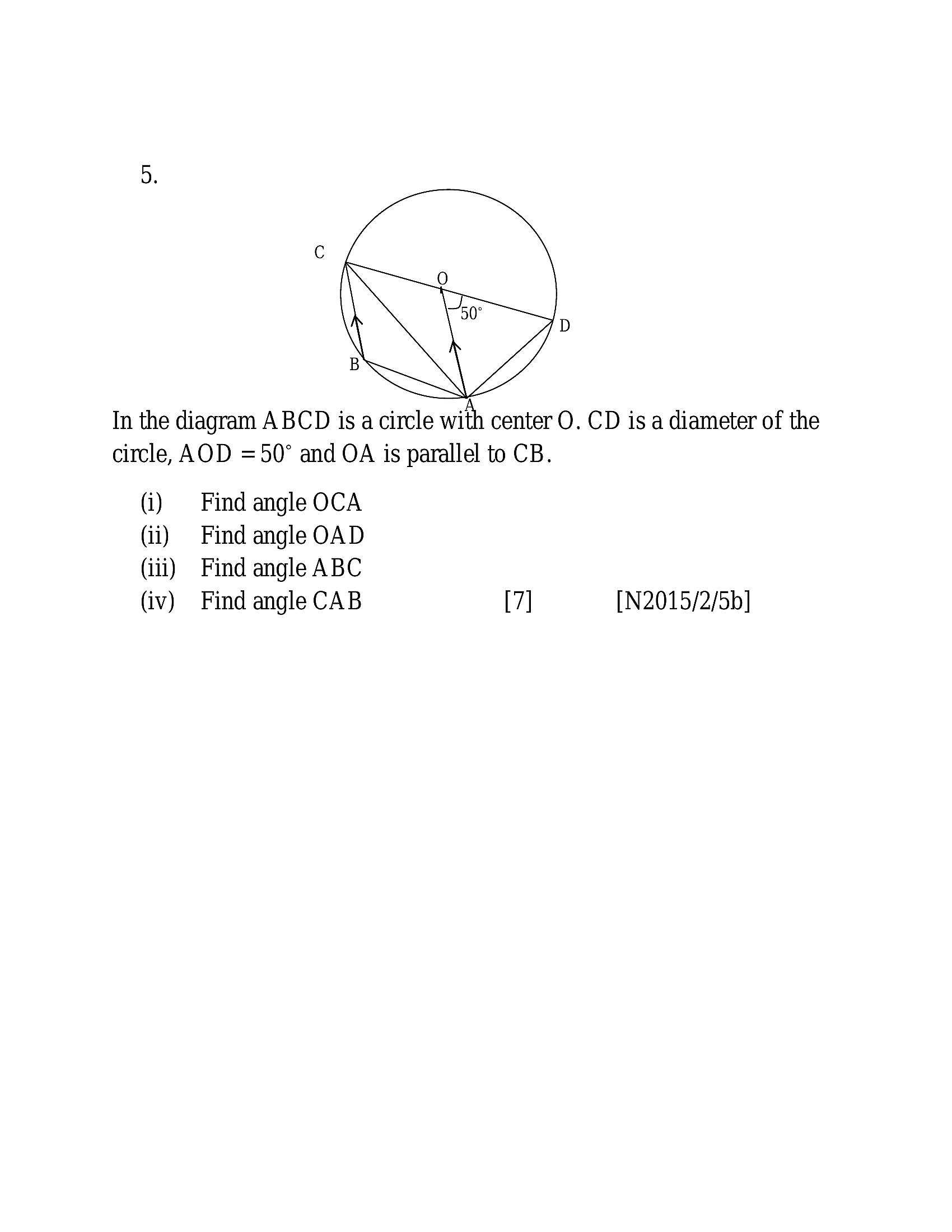
In the diagram ABCD is acircle with center O. CD is a diameter of the
circle, AOD =50° and OA is parallel to CB.
(i) Find angle OCA
(ii) Find angle OAD
(iii) Find angle ABC
(iv) Find angle CAB [7
—
[N2015/2/5b]
---
Page 23
Extracted Text
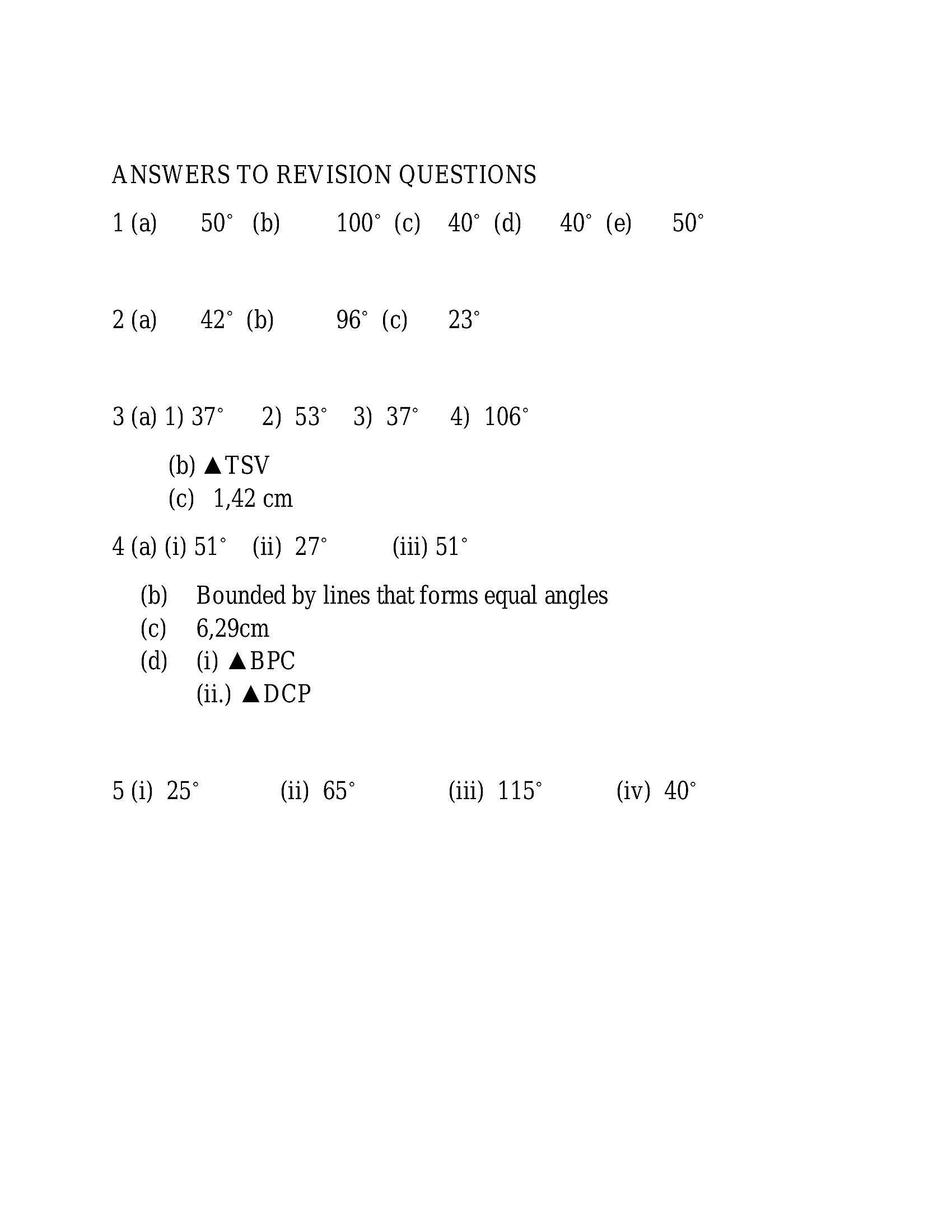
ANSWERS TO REVISION QUESTIONS 1(a) 50° (b) 100° (c) 40° (d) 40° (e)(b) ATSV
(c) 1,42 cm
A (a) (i) 51° ii) 27° (iii) 51°
(b) Bounded by lines that forms equal angles
(c) 6,29cm
C
(d) (i) ABPC
(ii.) ADCP
50°
5 (i) 25° (ii) 65° (iii) 115° (iv) 40°
---
Struggling with the concepts in this paper?
Revise syllabus notes, key exam points, and interactive practice questions for Geography: