
📄 Exam Questions & Readable Text Transcript
Full OCR-extracted text of questions, syllabus codes, and exam instructions.
Extracted Content: 2019_economics_alevel_nov_paper3
Page 1
Extracted Text
For Performance MeasurementZIMBABWE SCHOOL EXAMINATIONS COUNCIL
General Certificate of Education Advanced Level
ECONOMICS 6073/3
PAPER 3 Essays
JUNE 2019 SESSION 3 hours
Additional materials:
Answer paper
TIME 3 hours
INSTRUCTIONS TO CANDIDATES
Write your name, Centre number and candidate number in the spaces provided on the answer
paper/answer booklet.
Answer any four questions.
Write your answers on the separate answer paper provided.
If you use more than one sheet of paper, fasten the sheets together.
INFORMATION FOR CANDIDATES
The number of marks is given in brackets [ ] at the end of each question or part question.
You are reminded of the need for good English and clear presentation in your answers.
This question paper consists of 3 printed pages and 1 blank page.
Copyright: Zimbabwe School Examinations Council, J2019.
©ZIMSEC 32019 [Turn over
---
Page 2
Extracted Text
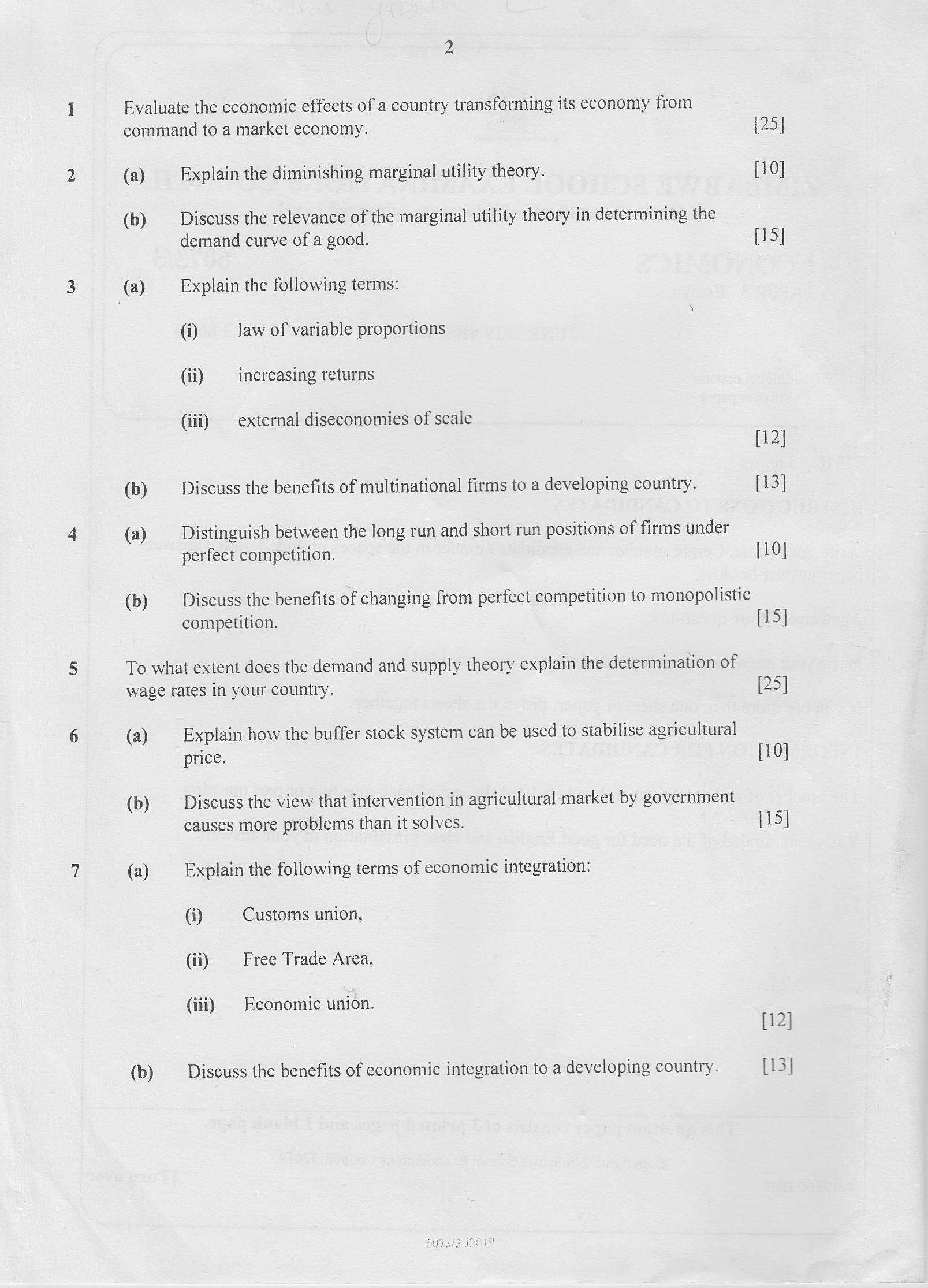
nNEvaluate the economic effects of a country transforming its economy from
command to a market economy.
(a) Explain the diminishing marginal utility theory.
(b) Discuss the relevance of the marginal utility theory in determining the
demand curve of a good.
(a) Explain the following terms:
(i) Jaw of variable proportions
(ii) increasing returns
(iii) external diseconomies of scale
(b) Discuss the benefits of multinational firms to a developing country.
(a) Distinguish between the long run and short run positions of firms under
perfect competition.
(b) Discuss the benefits of changing from perfect competition to monopolistic
competition.
To what extent does the demand and supply theory explain the determination of
wage rates in your country.
(a) Explain how the buffer stock system can be used to stabilise agricultural
price.
(b) Discuss the view that intervention in agricultural market by government
causes more problems than it solves.
(a) Explain the following terms of economic integration:
(i) Customs union,
(ii) Free Trade Area,
(iii) | Economic union.
(b) Discuss the benefits of economic integration to a developing country.
[25]
[10]
[15]
[12]
(13]
{10}
U5]
[25]
[10]
(15]
---
Page 3
Extracted Text
1011
12
{a)
(b)
(a)
(b)
(a)
(b)
(a)
(b)
(b)
3
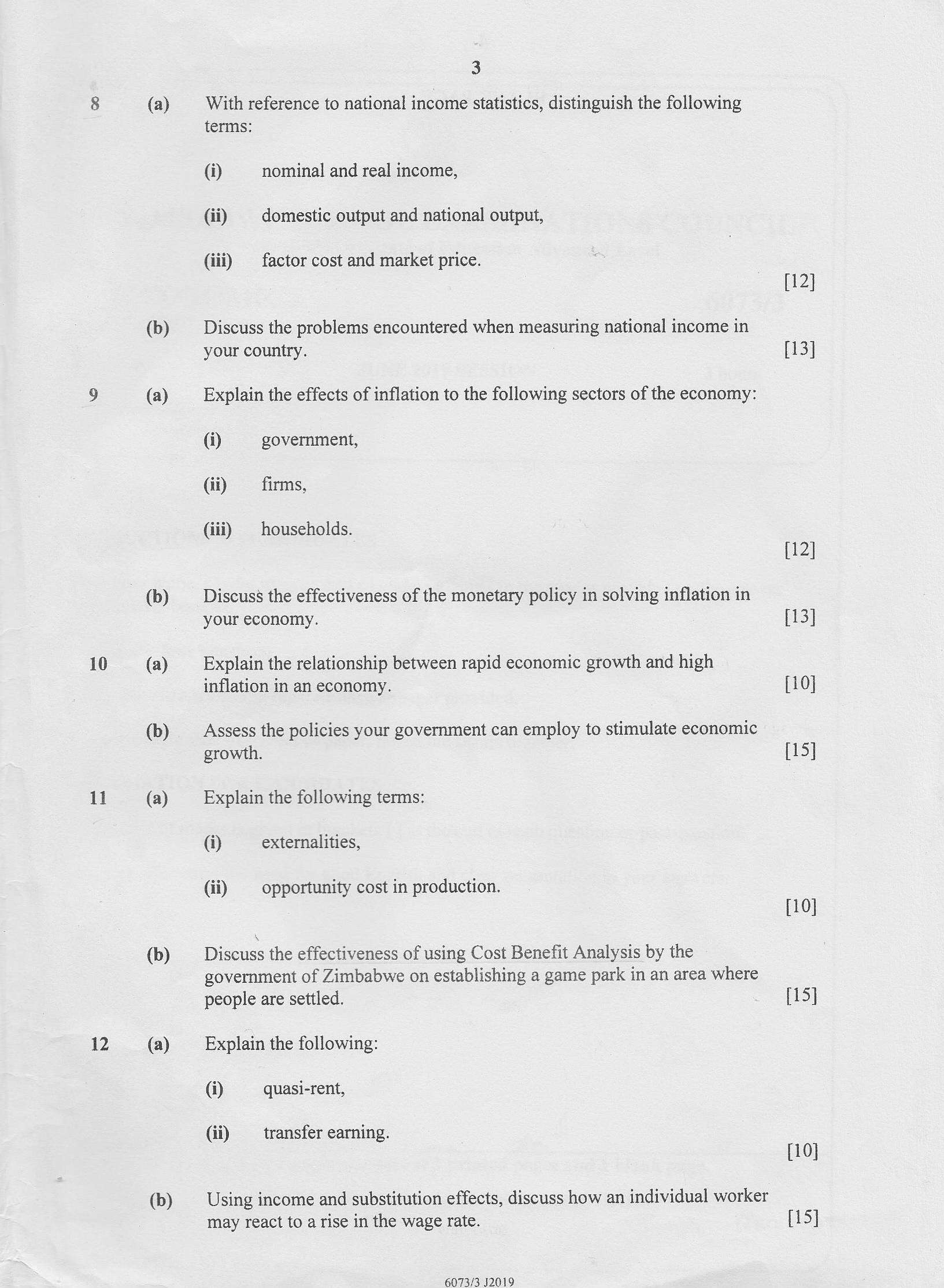
With reference to national income statistics, distinguish the following
terms:
(i) nominal and real income,
(ii) domestic output and national output,
(iii) factor cost and market price.
Discuss the problems encountered when measuring national income in
your country.
Explain the effects of inflation to the following sectors of the economy:
(i) government,
Gi) —_— firms,
(iii) households.
Discuss the effectiveness of the monetary policy in solving inflation in
your economy.
Explain the relationship between rapid economic growth and high
inflation in an economy.
Assess the policies your government can employ to stimulate economic
growth.
Explain the following terms:
@ externalities,
(ii) opportunity cost in production.
Discuss the effectiveness of using Cost Benefit Analysis by the
government of Zimbabwe on establishing a game park in an area where
people are settled.
Explain the following:
(i) quasi-rent,
(ii) _ transfer earning.
Using income and substitution effects, discuss how an individual worker
may react to a rise in the wage rate.
6073/3 J2019
[12]
[13]
[12]
[13]
[10]
[15]
[10]
{15]
{10]
{15]
---
Struggling with the concepts in this paper?
Revise syllabus notes, key exam points, and interactive practice questions for Business Accounts: